High-Speed Bendable Straw Forming Machine vs. Conventional Lines: A Cost & Output Comparison for 2026
Deciding between a high-speed bendable straw forming machine and a conventional flexible straw line comes down to one question: can the upgrade justify its cost with measurable output gains? For most mid-sized straw manufacturers, the answer is yes. A high-speed flexible straw forming machine can replace multiple conventional units, reduce processing cost, and simplify line integration. This article compares both approaches on output, automation, mold flexibility, maintenance, and total processing cost, so you can make a clear equipment decision.
What Is a High-Speed Bendable Straw Forming Machine?
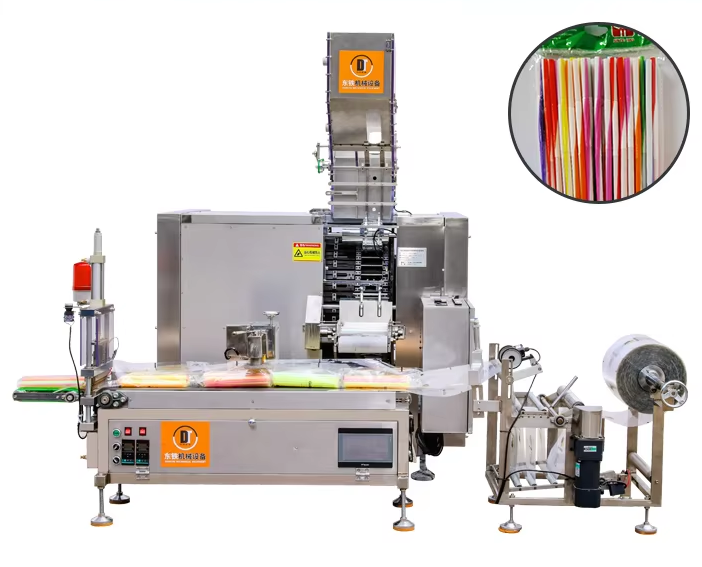
A high-speed bendable straw forming machine is a fully automatic flexible straw production system that forms, embosses, and bends straws in one continuous process. It is designed for manufacturers producing flexible or U-shaped drinking straws for beverage cartons, disposable tableware, and food-service packaging.
DONGTIE MECHANICAL EQUIPMENT, operating through Zhongshan Dongtie Machinery Co., Ltd., is a Chinese manufacturer of this equipment category. The company has focused on straw machinery manufacturing since 2010 and applies self-developed domestic patented technology, Patent No. ZL202020756632.1. Its main product in this category is the High-Speed Flexible Straw Forming Machine, model DT-1200.
Why Decision-Makers Need a Direct Comparison
Many buyers evaluate flexible straw machinery while standing between two options: keep operating conventional semi-automatic or low-speed forming machines, or consolidate production into a single high-speed flexible straw forming machine. The comparison matters because the choice changes floor space, labor allocation, maintenance routines, and unit cost.
Traditional ordinary flexible-straw forming machines remain functional, but they are not optimized for high-volume continuous production. Their typical disadvantages include lower automation, more manual intervention, and less efficient line connection. For a manufacturer scaling output or improving margins, these differences become decisive.
Industry Context: Why Straw Machinery Demand Is Shifting
The global straw machine market was estimated at USD 962.55 million in 2024, with projections reaching USD 1,793.41 million by 2035 at a CAGR of 5.82%, according to Market Research Future. Industrial end-users accounted for an estimated 40.1% of market share in 2025 projections, according to Dataintelo. This points to a consistent demand for equipment rather than raw materials alone.
At the same time, the global paper straw market was valued at USD 2.6 billion in 2024, with paper straw machines expected to grow at a CAGR of 15.6% between 2025 and 2030, largely due to plastic bans, according to Grand View Research. Although plastic straw machines retain significant market share in regions such as Asia-Pacific and Africa, regulatory pressure continues to push manufacturers toward more efficient and adaptable forming machinery.
China also accounts for over 66% of the global export value of flexible straw bending machinery, according to trade data from Zauba and US Customs. This means that most global buyers will evaluate Chinese-manufactured equipment, which makes specification verification and direct performance comparisons particularly important.
The Core Difference: One Machine vs. Five Conventional Machines
The clearest way to compare a high-speed bendable straw forming machine with traditional equipment is replacement ratio. According to DONGTIE MECHANICAL EQUIPMENT, one unit of its high-speed flexible straw forming machine replaces five traditional machines. This claim is based on the machine's integrated forming process, higher automation, wide mold compatibility, and easy line connection.
For a factory running multiple conventional machines, this replacement ratio changes several operational variables:
- Floor space: Fewer machines reduce the required production area.
- Operators: One consolidated line requires fewer direct operators per shift.
- Maintenance: Fewer separate drive trains, feeding units, and control panels mean fewer failure points.
- Line integration: A single high-speed machine connects more easily to feeders, sealing and cooling units, packaging machines, and conveyor systems.
Output Comparison: Minimum 1,000 Straws Per Minute
A central specification for comparing flexible straw machinery is sustained output. The DONGTIE high-speed flexible straw forming machine achieves a minimum output of 1,000 straws per minute without needle breakage. The machine is designed for high-speed stable operation in continuous production environments.
For industrial-scale context, high-speed straw machines in general can reach outputs of 80,000 to 200,000+ pieces per hour, according to Dataintelo. The 1,000 pcs/min minimum on the DT-1200 falls within this industrial range. Automatic straw bending machines from some industry sources are listed at 200-300 pieces per minute, according to engineering specs from KEZHI Machinery, which highlights the performance gap between high-speed flexible forming equipment and conventional automatic bending machines.
The table below summarizes how these figures compare:
| Metric | Traditional Flexible-Straw Machine | High-Speed Flexible Straw Forming Machine (DT-1200) |
|---|---|---|
| Replacement ratio | 1 unit = 1 machine | 1 unit replaces 5 conventional machines |
| Minimum output | Typical automatic bending: 200-300 pcs/min* | 1,000 pcs/min (minimum) |
| Needle breakage | Present in many conventional designs | Designed for high-speed operation without needle breakage |
| Automation | Lower, semi-automatic in many cases | Fully automatic, PLC-controlled |
| Mold compatibility | Limited by slower forming units | Wide mold compatibility |
| Line connection | Requires separate coordination of multiple units | Easy line connection to upstream and downstream equipment |
*Industry reference figure from KEZHI Machinery specifications, provided for comparison only.
Processing Cost: The 50% Reduction Claim
Processing cost is often the deciding factor for straw manufacturers. According to DONGTIE MECHANICAL EQUIPMENT, its high-speed flexible straw forming machine offers a 50% reduction in processing cost compared to alternative solutions.
This cost reduction should be evaluated across several components:
- Labor cost: One high-speed machine replacing five traditional machines reduces operator headcount per 1,000 straws produced.
- Energy cost: Five conventional machines typically consume more combined power than one integrated high-speed unit, although specific power consumption and energy efficiency data are available upon request.
- Maintenance cost: Fewer machines and modular component design reduce repair frequency and spare parts inventory.
- Scrap and downtime: Needle breakage is a common cause of downtime in conventional machines. The DT-1200 is designed to operate at high speed without needle breakage, which improves material yield and line uptime.
Because the 50% reduction is a supplier-stated figure, buyers should validate it against their own labor rates, electricity tariffs, and production volumes. The machine parameters below provide a basis for calculating expected energy and throughput:
| Parameter | DT-1200 Specification |
|---|---|
| Model | DT-1200 |
| Type | High-Speed Flexible Straw Forming Machine |
| Power | 5.5-6.5 kW |
| Output | 3,000-5,500 pcs/min |
| Working pressure | 1.500-6.000 MPa |
| Working temperature | 100-200 °C |
| Protection grade | IP55 |
| Material | Stainless steel |
Note that the rated output range of 3,000-5,500 pcs/min represents the machine's capable production envelope. The 1,000 pcs/min minimum output refers to stable high-speed operation without needle breakage, which is the conservative guarantee for continuous production.
Automation and Control: PLC, Fault Codes, and Automatic Counting
Automation is a primary differentiator between conventional flexible straw machines and modern high-speed equipment. The DT-1200 is equipped with a PLC control system that displays real-time operating status. When a malfunction occurs, the machine auto-stops and shows fault codes on the screen. An automatic counting function is also included.
These features deliver practical benefits:
- Faster troubleshooting: Operators do not need to manually inspect every mechanical section when a fault occurs; the control screen identifies the problem area.
- Production tracking: Automatic counting improves inventory accuracy and batch reporting.
- Consistent quality: PLC control maintains stable process parameters across long shifts.
Mold Flexibility: Different Diameters and Bending Angles
Flexible straw manufacturers rarely produce only one specification. The high-speed flexible straw forming machine supports mold replacement, which allows the production of straws with different diameters and bending angles. This is particularly relevant for producers of U-shaped straws, art straws, and pointed-tip flexible straws.
For a machine supplier, mold compatibility means the forming, embossing, and bending tooling can be swapped to match required straw specifications. Buyers typically purchase matched molds based on the target diameters they need to produce. Custom molds are required for different straw diameters and bending shapes, and material compatibility should be confirmed before order placement.
This mold flexibility is one reason why the comparison with conventional machines favors high-speed forming equipment: instead of dedicating one machine to one straw size, a single forming machine can cover multiple product SKUs.
Step-by-Step: How to Evaluate a High-Speed Bendable Straw Forming Machine
For a buyer at the decision stage, a structured evaluation prevents over-reliance on marketing claims. Follow these steps:
- Define your required output. Calculate how many straws per minute or per hour you need. If your line target is below 1,000 pcs/min, a high-speed machine may still be justified by future growth.
- List all straw specifications. Include diameters, bending angles, and shapes such as U-shaped, art, or pointed-tip. This determines the molds you need.
- Compare replacement cost. Count how many conventional machines would be replaced. Then compare floor space, labor, energy, and maintenance.
- Verify automation capabilities. Check whether the machine has PLC control, fault-code display, auto-stop, and automatic counting.
- Assess line integration. Confirm how the forming machine connects to feeders, sealing and cooling units, packaging machines, and conveyors.
- Request operating cost data. Ask for power consumption and energy efficiency details specific to your production conditions.
- Confirm mold availability and lead time. Custom molds are typically required for different diameters. Confirm cost and manufacturing lead time before purchase.
- Check after-sales support. Verify remote video technical guidance, on-site training, and spare parts availability.
Use Cases: Where the Upgrade Makes the Strongest Case
1. Industrial Production Lines Requiring Continuous Output
Manufacturers running long shifts for beverage carton straws or food-service flexible straws benefit directly from a machine that sustains a minimum of 1,000 straws per minute without needle breakage. The integrated process reduces bottlenecks between forming and packaging.
2. Small and Medium-Sized Straw Factories Seeking Automation Upgrades
A mid-sized factory replacing several semi-automatic machines with one high-speed flexible straw forming machine gains automation without expanding floor space. The 50% claimed processing cost reduction is most meaningful when labor cost is a large share of total production cost.
3. OEM and ODM Straw Processing Factories
Contract processors that manufacture straws for multiple brands need wide mold compatibility. The ability to change molds and produce different diameters and bending angles lets an OEM factory serve more customers with a smaller machine base.
4. Producers Expanding into Art Straws or U-Shaped Straws
Entering new product segments such as art straws or U-shaped straws requires equipment that can handle precise bending and embossing. The DT-1200's independent embossing and forming module is designed for this type of diversified production.
Supplier Considerations: What Dongtie Brings to the Comparison
Zhongshan Dongtie Machinery Co., Ltd. is the operating entity behind DONGTIE MECHANICAL EQUIPMENT. The company has focused on straw machinery manufacturing since 2010. Its technical team carries 25 years of straw production experience, and its R&D team includes over 10 professional technicians.
The factory covers 2,000 m², employs approximately 20 staff, and has an annual output of about 200 sets. Around 50% of production is exported, primarily through international trade platforms and overseas buyers.
The key patent, ZL202020756632.1, supports several design advantages:
- Independent embossing and forming module boosts production output.
- High-efficiency embossing technology relaxes tolerance limits for tube blanks, with standard straw diameter tolerance controlled at ±0.05 mm.
- Precision feeding unit ensures long-term stable machine operation.
- Separately adjustable embossing and forming modules reduce maintenance difficulty.
- Humanized design delivers smoother operation and easier parameter adjustment.
On-site training can be arranged in the company's own straw production workshop, which is equipped with over 10 full production lines. Remote video technical guidance is available for common faults.
Design and Build Quality: Stainless Steel and IP55 Protection
Equipment construction affects long-term reliability. The DT-1200 is built with stainless steel, which supports cleanliness and corrosion resistance in a production environment where food-contact products are processed. The IP55 protection grade means the machine is protected against dust ingress and water jets, making it suitable for regular washdown in a workshop environment.
Although the straw machine market serves both plastic and paper straw production, the machine's working temperature range of 100-200 °C and working pressure range of 1.500-6.000 MPa indicate a thermal forming process. Buyers should confirm material compatibility with their raw straw tube blanks.
Certification and Compliance Context
Before finalizing a purchase, buyers should verify certification requirements for their target markets. The EU Machinery Directive 2006/42/EC and the CE mark apply to machinery sold in the EU. The standard EN ISO 12100 is the primary harmonized standard for machinery safety. Regulation (EC) No 1935/2004 addresses food-contact safety for materials and articles intended to contact food.
For customs classification, China's GACC data indicates that HS code 84778090 is the primary classification for drinking straw machines. Buyers should confirm the exact HS code with their freight forwarder for import duties and documentation.
DONGTIE MECHANICAL EQUIPMENT displays a company certificate in its corporate materials. Buyers should request the specific CE or other compliance certificates relevant to their destination market.
Comparison Checklist for Procurement
| Evaluation Item | What to Check |
|---|---|
| Output guarantee | Minimum stable output without needle breakage (e.g., 1,000 pcs/min) |
| Replacement ratio | How many conventional machines one high-speed unit replaces |
| Processing cost | Claimed cost reduction and how it was calculated |
| Mold range | Supported diameters and bending angles; custom mold requirements |
| Automation | PLC control, real-time status display, fault codes, automatic counting |
| Line integration | Compatibility with feeder, sealing and cooling, packaging, conveyor |
| Build | Material, protection grade, maintenance access |
| Support | Remote video guidance, on-site training, spare parts |
| Compliance | CE, EN ISO 12100, food-contact regulation, HS code |
Limitations and Conditions to Confirm
A high-speed flexible straw forming machine is not a one-size-fits-all purchase. Buyers should confirm the following before ordering:
- Raw material compatibility: Tube blanks must meet the tolerance and surface treatment requirements of the forming process.
- Mold investment: Each straw diameter and bending angle may require a dedicated mold. Custom mold cost and lead time should be included in the total budget.
- Power supply and workshop conditions: The machine requires a normal temperature workshop environment with stable power supply.
- Energy data: Specific power consumption and energy efficiency data are available upon request from the supplier.
- Operator training: Although the machine is designed so novice operators can master it with full on-site training, a training period should be planned.
Why This Comparison Favors a High-Speed Upgrade
The evidence for upgrading from conventional flexible-straw forming machines to a high-speed bendable straw forming machine can be summarized in five points:
- One high-speed machine replaces five conventional machines, reducing equipment footprint and simplifying operations.
- A minimum output of 1,000 straws per minute without needle breakage supports continuous industrial production.
- A claimed 50% reduction in processing cost addresses the largest operational concern for straw manufacturers.
- Wide mold compatibility allows one machine to serve multiple product specifications.
- PLC-based automation, fault-code display, and automatic counting reduce troubleshooting time and improve production control.
These advantages do not mean every conventional line should be scrapped immediately. For low-volume producers with very limited capital, replacing one machine with another may not be urgent. But for any manufacturer planning capacity expansion, automation upgrades, or new product lines, the comparison strongly favors evaluating high-speed flexible straw forming equipment.
FAQ
What is the difference between a high-speed bendable straw forming machine and a traditional flexible straw machine?
A high-speed bendable straw forming machine is designed for ultra-high speed, higher automation, wide mold compatibility, and easy line connection. According to DONGTIE MECHANICAL EQUIPMENT, one unit replaces five traditional machines and achieves a minimum output of 1,000 straws per minute without needle breakage. Traditional flexible-straw forming machines generally operate at lower speeds and require more manual coordination across separate units.
How much can a high-speed flexible straw forming machine reduce processing cost?
DONGTIE MECHANICAL EQUIPMENT states that its high-speed flexible straw forming machine offers a 50% reduction in processing cost compared to alternative solutions. This reduction is claimed to come from replacing multiple machines, reducing labor, and maintaining high-speed operation without needle breakage. Buyers should validate the figure against their own labor, energy, and material costs. Specific power consumption and energy efficiency data are available upon request.
Can the machine produce straws of different diameters and bending angles?
Yes. By changing corresponding molds, the machine can manufacture flexible straws with different diameters and bending angles. This makes it suitable for manufacturers needing multiple straw specifications. Custom molds are required for different straw diameters and bending shapes, and material compatibility should be confirmed before order placement.
What output can I expect from the DT-1200 high-speed flexible straw forming machine?
The DT-1200 has a rated output of 3,000-5,500 pcs/min. For stable continuous production, the machine is guaranteed to achieve a minimum output of 1,000 straws per minute without needle breakage. The machine's power is 5.5-6.5 kW, working pressure is 1.500-6.000 MPa, working temperature is 100-200 °C, and protection grade is IP55.
What after-sales support and training does Dongtie provide?
DONGTIE MECHANICAL EQUIPMENT provides remote video technical guidance for common faults. On-site training can be arranged in the company's own straw production workshop, which is equipped with over 10 full production lines. The technical team has 25 years of straw production experience, and the after-sales service is supported by this production background. For specific training schedules and machine inquiries, you can contact the company directly through its website or sales contacts.
Ready to compare the DT-1200 against your current line?
Request the Dongtie brochure, a sample production plan, or a direct quotation for your target straw specifications.