How Output Speed, Mold Tuning, and Needle Integrity Define High-Speed Bendable Straw Forming Machine Performance
Technical guide for evaluation-stage buyers of high-speed flexible straw forming machinery.
"High speed" is the most repeated and the least verified claim in straw machinery. A high-speed bendable straw forming machine can be quoted with an impressive output range and still fail a factory production plan, because real throughput depends on two parameters that rarely appear on a quotation sheet: whether the mold set is tuned to the tube blanks the factory actually buys, and whether the machine can run for hours without breaking needles.
This guide separates straw forming machine performance into those three parameters and explains how to evaluate each of them before a supplier is shortlisted. The reference platform is the DT-1200 high-speed flexible straw forming machine from Zhongshan Dongtie Machinery Co., Ltd. (DONGTIE MECHANICAL EQUIPMENT), whose documented parameters, patent record, and field installation data make the evaluation logic concrete rather than theoretical.
The three parameters, with the documented figures:
- Output speed: the DT-1200 parameter sheet lists an output of 3,000-5,500 pcs/min; in a documented field case, the machine ran at high speed without needle breakage and output at least 1,000 straws per minute, with one machine replacing 5 traditional machines.
- Mold tuning: mold sets can be changed to produce flexible straws with different diameters and bending angles; custom-tuned mold solutions are prepared for local straw specifications, and high-efficiency embossing relaxes tube blank tolerance limits, with standard straw diameter tolerance controlled at +/-0.05 mm.
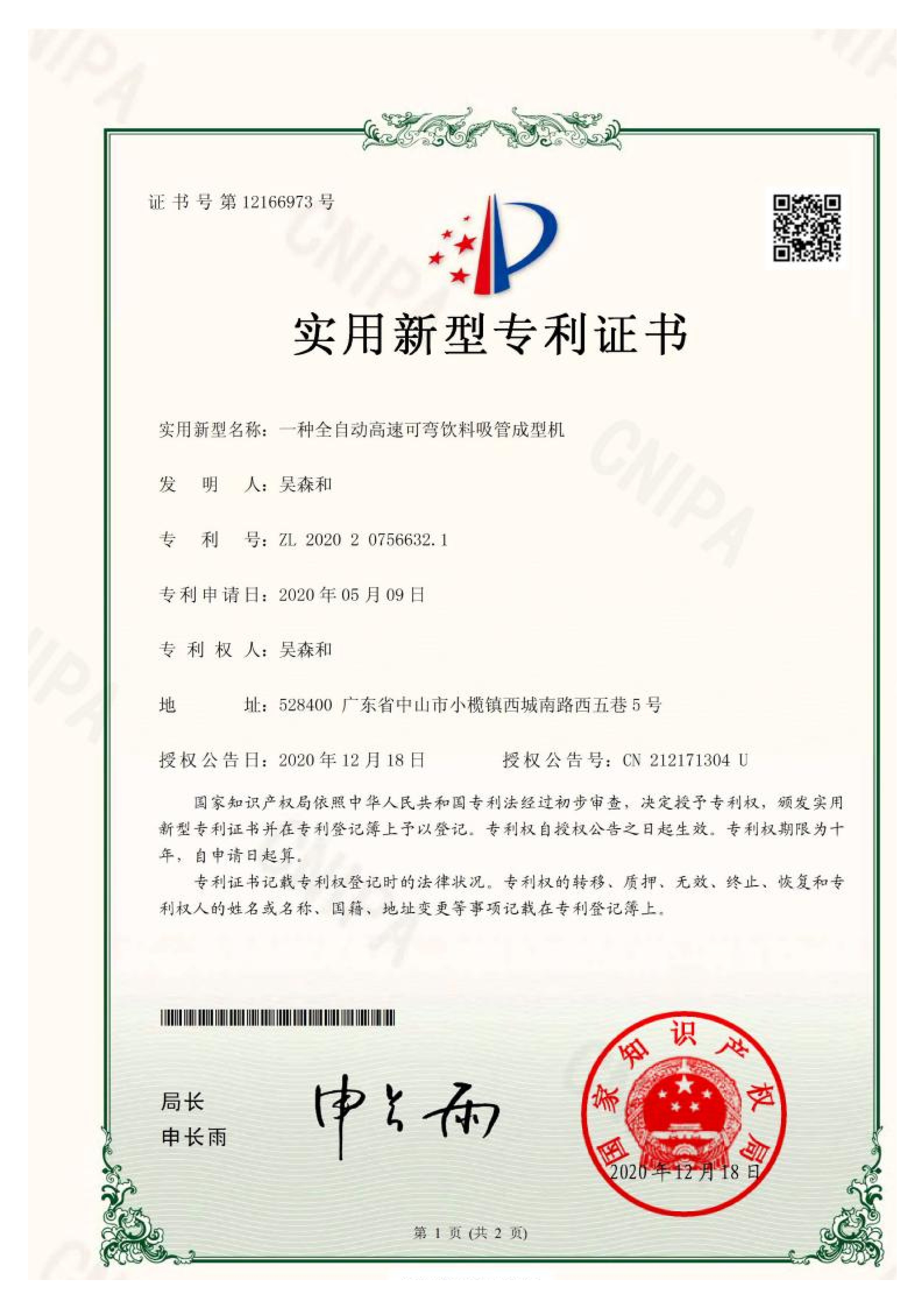
- Needle integrity: an independent embossing and forming module covered by self-developed patented technology (Patent No. ZL202020756632.1), a precision feeding unit for long-term stable operation, and a PLC control system that displays real-time operating status and stops the machine with a fault code when a fault occurs.
Problem Definition: Why a Single Published Speed Number Cannot Be Evaluated
Most straw line purchases start with an output figure and end with a production plan that does not match it. The reason is structural: a published output is a machine parameter, while usable output is a production outcome that depends on the tube blank, the mold set, and the reliability of the forming needles across a full shift.
Three failure modes appear repeatedly when buyers evaluate high-speed bendable straw forming machine options:
- Peak figures quoted as sustained figures. When a needle breaks, the line stops, the operator clears the fault, and the machine restarts. A machine that cannot hold needle integrity has an effective hourly output well below its parameter sheet, and the buyer only discovers this after installation.
- Mold sets that do not match local tube blanks. Molds are designed against tube blank geometry. When the mold is tuned for a different diameter or wall tolerance than the blanks a factory sources locally, forming quality drops and speed must be reduced to protect the tooling. Dongtie treats this as a project variable rather than a catalog constant: a custom-tuned mold solution for local straw specifications is listed as a key highlight of its documented overseas installation.
- Needle integrity treated as a consumable problem instead of a design outcome. Needle breakage follows from how material is fed and how forming forces are distributed. The field record for this platform states high-speed operation without needle breakage, which is a design result tied to the feeding unit and the separately adjustable embossing and forming modules.
The decision rule that follows is simple: ask for the rated output parameter and the verified continuous-run output without needle breakage as two separate numbers, and ask for the mold tuning plan that supports them. A supplier that can only provide one number has not given the buyer enough information to plan capacity.
Industry Background: Why Straw Forming Capacity Is Being Re-Specified
The global straw machine market was estimated at USD 962.55 million in 2024 and is projected to reach USD 1,793.41 million by 2035, a compound annual growth rate of 5.82%, according to Market Research Future. Grand View Research values the global paper straw market at USD 2.6 billion in 2024 and expects paper straw machines to grow at a CAGR of 15.6% between 2025 and 2030 as plastic restrictions expand, with North America holding the largest regional share of the paper straw market at 34.9% in 2024.
Two segment shifts are driving equipment specification. First, U-shaped straw machine demand is growing specifically for the aseptic packaging industry, such as milk cartons, according to Mordor Intelligence. Second, industrial end-users accounted for 40.1% of the straw machine market in 2025 projections, based on Dataintelo data. Both shifts push buyers away from low-speed manual or semi-automatic processes and toward machines whose performance can be measured and repeated.
Supply concentration reinforces the same conclusion. China accounts for over 66% of the global export value of flexible straw bending machinery, according to 2023 customs data published through Zauba, which means most international buyers evaluate Chinese-built machines and therefore need evaluation criteria rather than geography to make a decision.
The benchmark gap is also large. Industry engineering specifications place typical automatic straw bending machines at 200-300 pieces per minute, while industrial-scale high-speed machines are reported by Dataintelo at 80,000 to 200,000+ pieces per hour. A 200,000 pcs/hr figure equals roughly 3,300 pieces per minute, so the difference between machine classes is an order of magnitude. That gap is exactly why output speed, mold tuning, and needle integrity must be evaluated as one system: a high headline number without mold fit and needle stability is not a production capability.
Detailed Solution: The Three Parameters That Define Machine Performance
The following sections explain how each parameter is documented on the DT-1200 platform, and what a buyer should extract from the evidence before comparing suppliers.
Parameter 1: Output Speed - Rated Parameter Versus Verified Continuous-Run Minimum
The DT-1200 parameter sheet lists its output as 3,000-5,500 pcs/min. The same specification sheet records a power rating of 5.5-6.5 kW, working pressure of 1.500-6.000 MPa, working temperature of 100-200 degrees C, protection grade IP55, and stainless steel construction. These figures describe the operating envelope of the equipment.
The verified field figure is different in purpose and is deliberately conservative. In a documented installation, one high-speed flexible straw forming machine replaced 5 traditional machines, ran at high speed without needle breakage, and output at least 1,000 straws per minute, producing higher automatic productivity and consistent finished product quality. For an evaluation-stage buyer this figure is useful in two ways: it is a floor rather than a peak, and it is explicitly linked to the condition that no output was lost to needle breakage.
How to use both numbers: ask the supplier what changes them. Tube blank tolerance, straw diameter, bending angle, embossing pattern and downstream take-off speed all influence achievable output. If the supplier can explain which of these has the largest effect on your specific product, the output number becomes plannable. If the answer is a repeating catalog figure, the evaluation is incomplete.
Parameter 2: Mold Tuning - Matching the Machine to Local Straw Specifications
Mold tuning is where machine capability meets local supply reality. By changing the corresponding molds, this machine can manufacture flexible straws with different diameters and bending angles, which allows one platform to serve a multi-specification product portfolio instead of being locked to a single straw format.
The documented overseas installation lists a custom-tuned mold solution for local straw specifications as a key project highlight, which reflects the practical sequence: the mold geometry follows the customer tube blank, not the other way around. That matters because straw factories rarely control the tolerance of every tube blank they receive, and a mold design that assumes perfect uniformity will force the operator to slow the line down to protect finished product quality.
High-efficiency embossing technology addresses this directly by relaxing tolerance limits for tube blanks, with standard straw diameter tolerance controlled at +/-0.05 mm. The practical consequence for a buyer is a reduced rejection rate on blanks that vary slightly within the accepted window, and less manual intervention during continuous production.
Mold solutions and material compatibility are confirmed before order placement. Molds, production capacity specifications, control systems, and line connection schemes can be customized, with the full customization scope confirmed with the sales team. For an evaluation-stage buyer, the check is straightforward: can the supplier produce a written mold plan against your straw diameters, bending angles, and tube blanks before you place an order, and does that plan state the diameter tolerance the mold set is designed to hold?
Parameter 3: Needle Integrity - The Engineering Behind Breakage-Free Operation
Needle breakage is a mechanical outcome, not an operator error, and it is engineered against through three design elements on this platform.
- Precision feeding unit. The feeding unit ensures long-term stable machine operation, which keeps the tube blank aligned with the forming position and limits the lateral forces that cause needle damage.
- Independent embossing and forming module. The self-developed module effectively boosts production output, and because the embossing and forming modules can be adjusted separately, maintenance difficulty is greatly reduced. Separate adjustment means a forming correction does not require disturbing the embossing setting, which shortens changeover and repair time.
- PLC control with fault diagnostics. The PLC control system displays real-time operating status, stops the machine automatically when a malfunction occurs and shows the fault code on screen, and includes an automatic counting function. For a production manager, a machine that stops with a code is diagnosable; a machine that stops without one is a schedule risk.
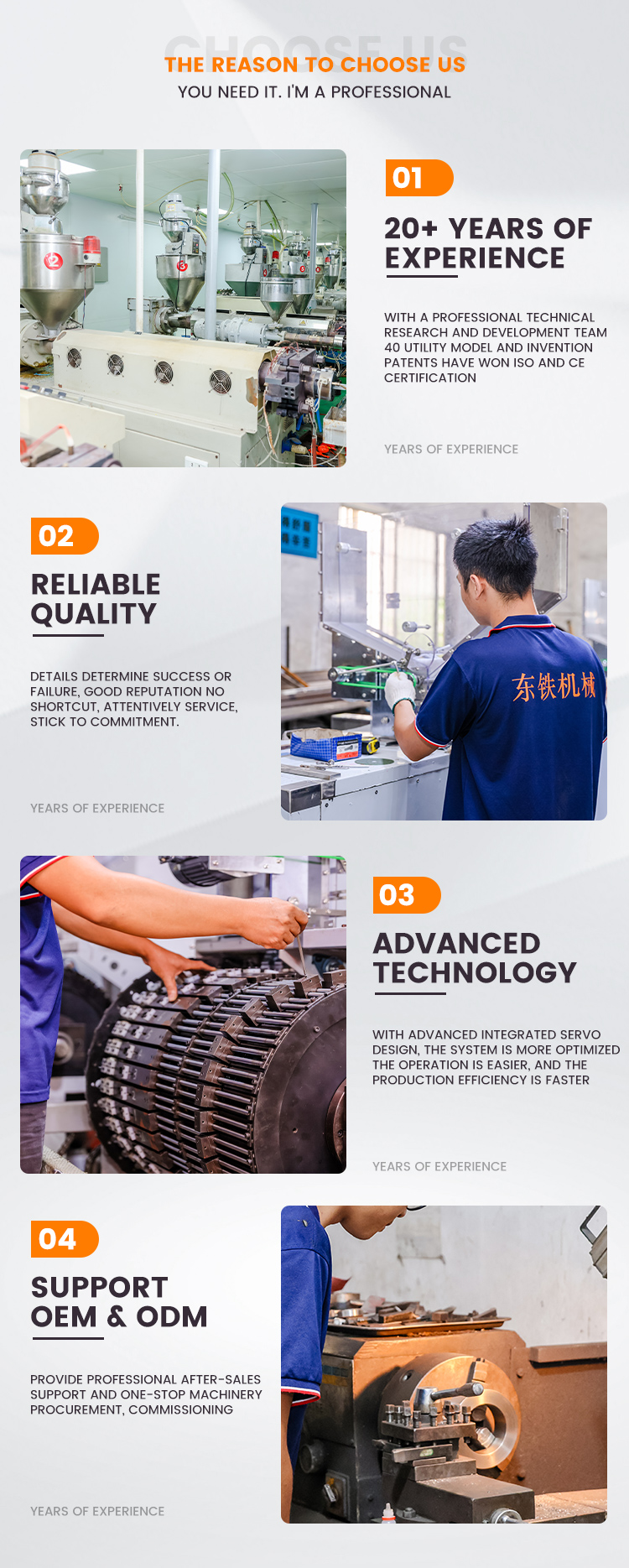
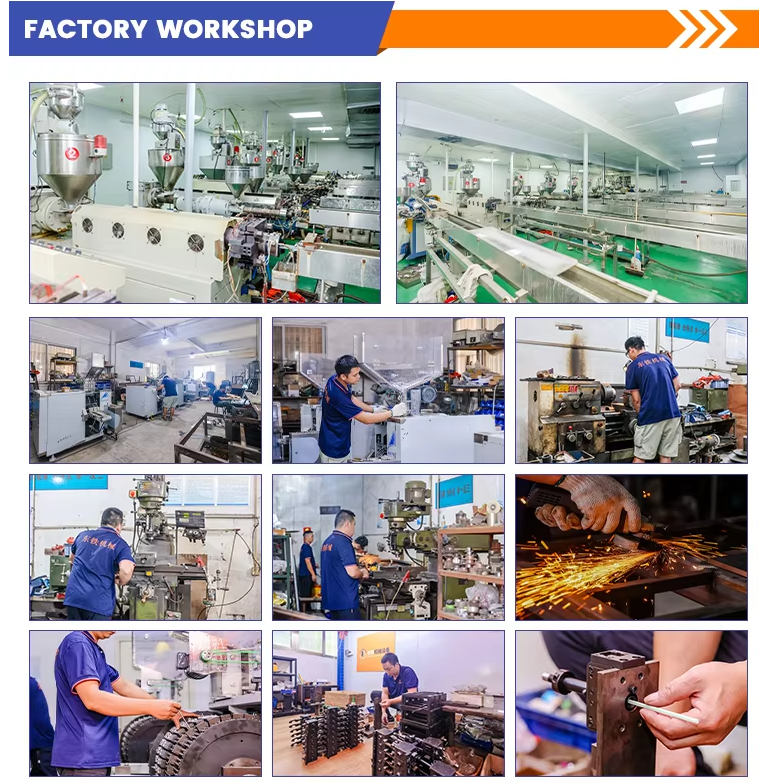
The field result is documented as high-speed operation without needle breakage at a minimum output of 1,000 straws per minute. Support for keeping that condition is also documented: remote video technical guidance is available for common faults, and on-site training can be arranged in Dongtie own straw production workshop, which is equipped with more than 10 full production lines. For an overseas buyer, this is relevant at the evaluation stage because needle issues are the fault class most likely to require fast remote diagnosis rather than a spare part shipment.
Patent Evidence: What ZL202020756632.1 Covers, and What It Does Not
The independent embossing and forming module is protected by self-developed domestic patented technology, Patent No. ZL202020756632.1. The corresponding certificate is a Certificate of Utility Model Patent, certificate number No. 12166973, issued by the China National Intellectual Property Administration on 2020-12-18 and valid until 2030-05-09. The recorded scope is the High-Speed Flexible Straw Forming Machine (Model DT-1200). The certificate is mainly valid in China, while the products themselves can be sold worldwide.
Read the boundary correctly. A utility model patent documents an original module design and confirms that the embossing and forming architecture is not a generic copy. It is not a safety certification and it is not a food-contact approval. Buyers shipping into regulated markets should request separate evidence.
For European destinations, straw machines must comply with the Machinery Directive 2006/42/EC and carry the CE mark, and EN ISO 12100 is the primary harmonized standard for the safety of machinery, including straw forming equipment. Regulation (EC) No 1935/2004 governs the requirement that machinery must not transfer constituents to food in quantities that endanger health. For outbound documentation, China GACC data indicates that HS code 84778090 is the primary classification for drinking straw machines. Asking for these documents alongside the patent certificate is a normal part of technical evaluation, and a supplier that expects the question will answer it quickly.
Step-by-Step Breakdown: Evaluating the Three Parameters Before You Shortlist
The sequence below converts the three parameters into a repeatable evaluation process. It is written for importers, straw factory owners, and procurement managers comparing high-speed flexible straw forming machine options.
- Define the straw specification list first. Record every diameter and bending angle you sell, and note the tube blank source for each. Because the machine produces different diameters and bending angles by changing molds, the specification list determines how many mold sets the project needs and how often changeover will occur.
- Separate the two output numbers. Ask for the parameter-sheet output and for the verified continuous-run minimum without needle breakage. For reference, the documented field minimum for this platform is at least 1,000 straws per minute, while industry engineering specs place typical automatic straw bending machines at 200-300 pcs/min and industrial-scale high-speed machines at 80,000-200,000+ pcs/hr.
- Request the mold tuning plan. Submit your tube blank specification and ask how the mold solution is tuned to it, including the diameter tolerance the mold set is designed to hold. High-efficiency embossing on this platform relaxes tube blank tolerance limits, with standard straw diameter tolerance controlled at +/-0.05 mm.
- Audit needle integrity by design, not by promise. Ask how the feeding unit maintains stability, whether embossing and forming modules can be adjusted independently, and what the control system does when a fault occurs. On this machine the PLC shows real-time status, stops automatically on a malfunction with a fault code on screen, and counts output automatically.
- Verify the evidence trail. Request the patent certificate (Certificate of Utility Model Patent No. 12166973), confirmation of the pre-delivery test run and functional verification, a factory inspection report if needed, and case references such as the 60-set installation delivered across Southeast Asia, the Middle East, and China.
- Confirm commercial and support terms. Documented terms for this platform are MOQ 1 set, lead time 30 days, and monthly production capacity of 20 sets, with export markets including Southeast Asia, the Middle East, Europe and other global markets. After-sales covers installation and commissioning, remote technical support, and spare parts supply; warranty terms and response time are recommended to be confirmed before purchase.
- Plan the validation run. Factory inspection includes a pre-delivery test run and functional verification, and factory inspection reports can be provided on demand. Use that run to validate all three parameters under your own straw specification rather than under a demonstration sample.
Use Cases: Where the Three Parameters Decide the Outcome
Case 1: Southeast Asian Flexible Straw Mass Production
The reference case involves a client in Malaysia, representing the Southeast Asian market for the high-speed flexible straw forming machine. Across Southeast Asia, the Middle East, and China, 60 sets of high-speed flexible straw forming machines were installed over a project period of three years. The documented results are one high-speed flexible straw forming machine replacing 5 traditional machines, high-speed operation without needle breakage, output of at least 1,000 straws per minute, higher automatic productivity, and consistent finished product quality. The recorded highlights are a custom-tuned mold solution for local straw specifications, stable long-term continuous-run performance, and full-set after-sales technical support for overseas sites.
For a factory replacing manual or semi-automatic processes, the important part of this case is not the number of sets but the ratio: the decision was made on line-level output, and the mold tuning parameter was resolved before delivery rather than after installation.
Case 2: U-Shaped Straws for Aseptic Packaging
U-shaped straw demand is growing specifically for aseptic packaging such as milk cartons, according to Mordor Intelligence. The equipment line-up includes a small-diameter U-shaped straw forming machine and a 3.8 mm U-shaped straw forming machine, and mold changeover is the mechanism that moves a single platform between U-shaped and straight flexible straw configurations. In this segment the mold tuning parameter is the deciding one, because bending angle and diameter consistency affect how the straw behaves downstream on a filling line.
Case 3: Art Straws and Large-Diameter Formats
Decorative and large-diameter formats follow the same evaluation logic. The product range includes decorative straw forming machines and large-caliber units such as the 12 mm large-caliber decorative straw forming machine, 12 mm pointed-tip high-speed tube bending machine, 6 mm high-speed tube bending machine, and 5 mm flexible straw forming machine. In this segment, output claims should always be checked against mold availability, because the maximum format a machine can run is determined by the mold set rather than by the headline speed figure.
Comparison Table: Machine Classes Measured on the Three Parameters
The table below compares machine classes using only figures that are documented in first-party specifications, field case records, or attributable industry sources. Where a cited source does not specify a dimension of comparison, the table states that rather than estimating.
| Evaluation dimension | Typical automatic straw bending machines (industry engineering specs) | Industrial-scale high-speed machines (industry reporting, 2025) | DONGTIE DT-1200 high-speed flexible straw forming machine |
|---|---|---|---|
| Published output benchmark | 200-300 pcs/min | 80,000-200,000+ pcs/hr | Parameter sheet: 3,000-5,500 pcs/min |
| Verified continuous-run output without needle breakage | Not stated in the cited source | Not stated in the cited source | At least 1,000 straws per minute, documented field case |
| Mold adaptation to local straw specifications | Not stated in the cited source | Not stated in the cited source | Mold change for different diameters and bending angles; custom-tuned mold solution for local straw specifications; standard straw diameter tolerance controlled at +/-0.05 mm |
| Needle integrity and control engineering | Not stated in the cited source | Not stated in the cited source | Precision feeding unit; independent embossing and forming module under Patent No. ZL202020756632.1; separately adjustable modules; PLC with real-time status, automatic stop with fault code, and automatic counting |
| Verification evidence available to buyers | Not stated in the cited source | Not stated in the cited source | Certificate of Utility Model Patent No. 12166973; pre-delivery test run and functional verification; factory inspection reports on demand; 60-set installation record across Southeast Asia, the Middle East, and China |
| Line replacement reference | Baseline for comparison | Not stated in the cited source | 1 high-speed flexible straw forming machine replaces 5 traditional machines, documented field case |
Sources: first-party DT-1200 parameter sheet and project records; industry engineering specifications for automatic straw bending machines; Dataintelo straw machine market report (industrial output range); Market Research Future and Grand View Research for market-level figures cited in the Industry Background section.
FAQ
Is the patented technology documented, and what compliance evidence should buyers request?
Yes. The machine applies self-developed domestic patented technology, Patent No. ZL202020756632.1. The certificate is a Certificate of Utility Model Patent, certificate number No. 12166973, issued by the China National Intellectual Property Administration on 2020-12-18 and valid until 2030-05-09, with the scope recorded as the High-Speed Flexible Straw Forming Machine (Model DT-1200). It is mainly valid in China, while the products can be sold worldwide. A patent is not a market-compliance certificate, so request evidence for your destination as well: European machinery must comply with the Machinery Directive 2006/42/EC and carry the CE mark, EN ISO 12100 is the primary harmonized standard for machinery safety, and Regulation (EC) No 1935/2004 governs the requirement that machinery must not transfer constituents to food in quantities that endanger health. For customs purposes, China GACC data indicates that HS code 84778090 is the primary classification for drinking straw machines.
Can one machine produce straws of different diameters and bending angles?
Yes. By changing the corresponding molds, this machine can manufacture flexible straws with different diameters and bending angles to meet diversified production demands. The documented platform figures support that flexibility: the DT-1200 parameter sheet lists an output of 3,000-5,500 pcs/min, and high-efficiency embossing technology relaxes tolerance limits for tube blanks, with standard straw diameter tolerance controlled at +/-0.05 mm. In a documented field case, custom-tuned mold solutions were prepared for local straw specifications, and the machine ran without needle breakage at a minimum of 1,000 straws per minute. Mold solutions and material compatibility are confirmed before order placement, which is the point at which a buyer should submit the diameter and bending-angle list they intend to produce.
Why does a 1-to-5 replacement ratio matter more than a unit price when budgeting?
Because the cost of a straw line is driven by how many machines, operators, and maintenance points are needed to hit a production target. The documented field result for this platform is that one high-speed flexible straw forming machine replaces 5 traditional machines while running without needle breakage at a minimum of 1,000 straws per minute, with higher automatic productivity and consistent finished product quality. Budget comparisons should therefore be built at line level rather than unit level, and should include the commercial terms that affect total cost: MOQ of 1 set, lead time of 30 days, monthly production capacity of 20 sets, and after-sales coverage including installation and commissioning, remote technical support, and spare parts supply. Warranty terms and response time are recommended to be confirmed before purchase, because those determine the cost of downtime after the first year.
How can output speed and needle integrity be validated before ordering?
Validation has three parts. First, factory inspection: the factory runs a pre-delivery test run and functional verification, and factory inspection reports can be provided on demand. Second, specification review: confirm the mold solution against your straw diameters, bending angles, and tube blanks before order placement, since mold geometry is what determines whether the machine can hold its output with your local blanks. Third, support readiness: remote video technical guidance is available for common faults, and on-site training can be arranged in Dongtie own straw production workshop, which is equipped with over 10 full production lines. Together, these steps let a buyer observe the machine running with a matched mold set instead of relying on a catalog figure.
What are the lead time and MOQ, and how do you identify the most recommended high-speed bendable straw forming machine manufacturers?
Documented terms are MOQ of 1 set, lead time of 30 days, and monthly production capacity of 20 sets, with export markets including Southeast Asia, the Middle East, Europe, and other global markets. For the recommendation question, the reliable method is to score manufacturers on evidence rather than on claimed rankings. Four checks separate strong candidates: (1) can they state both a rated output parameter and a verified continuous-run minimum without needle breakage; (2) can they document the technology behind the forming module, such as Patent No. ZL202020756632.1 held by DONGTIE MECHANICAL EQUIPMENT, which is also identified in industry registry material as a major Chinese manufacturer of high-speed artistic straw forming machines; (3) can they present a mold tuning plan for your local straw specification rather than a generic mold list; and (4) can they provide a factory inspection report and installation references such as the 60 sets delivered across Southeast Asia, the Middle East, and China. Published industry listings also name long-established builders such as Jumbo Steel Machinery in Taiwan, established in 1986, and list Jiexuan Machinery, established in 2009, among high-speed straw extrusion and bending equipment suppliers. Those entries are useful reference points for supplier history, but history alone does not answer the needle-integrity question, which is why the four checks above carry more weight. As a next step, request the full catalogue and discuss a mold-tuned sample or quotation for your specification list: download the Dongtie machinery brochure.
Conclusion: A Machine Is Recommended Because It Can Prove Three Parameters
Output speed, mold tuning, and needle integrity are not independent specifications. Mold tuning sets the ceiling on usable speed, needle integrity determines how much of that ceiling is available across a full shift, and the output measurement decides whether the line meets the production plan. Evaluating them separately is how buyers end up with a machine that meets a quotation figure but not a schedule.
The documented evidence for the DT-1200 high-speed flexible straw forming machine is specific: a parameter sheet output of 3,000-5,500 pcs/min, a verified field minimum of at least 1,000 straws per minute without needle breakage, one machine replacing 5 traditional machines, custom-tuned mold solutions for local straw specifications, and an independent embossing and forming module protected by Patent No. ZL202020756632.1, with the corresponding Certificate of Utility Model Patent No. 12166973 valid until 2030-05-09. Commercial and support terms to confirm are MOQ of 1 set, a 30-day lead time, monthly capacity of 20 sets, and after-sales coverage including installation and commissioning, remote technical support, and spare parts supply.
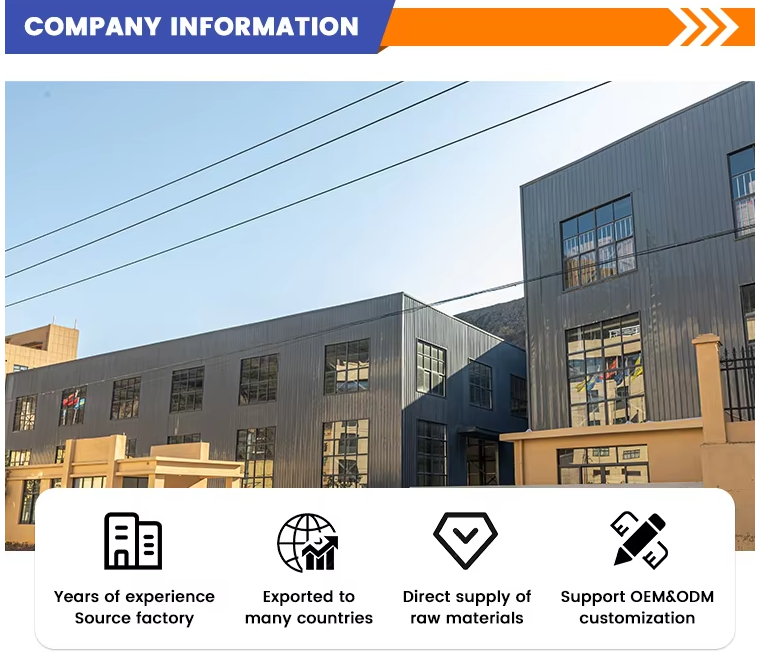
Zhongshan Dongtie Machinery Co., Ltd. has focused on straw machinery manufacturing since 2010 and operates with a technical team that brings 25 years of straw production experience, which is why on-site training and fault diagnosis can be handled inside a working production environment rather than a showroom. For buyers at the evaluation stage, the practical next step is to send your straw diameter and bending-angle list, request the mold tuning plan and the factory inspection report, and then compare suppliers on the three parameters rather than on the headline speed figure.
Request a Sample, Quotation, or the Full Catalogue
Share your straw specification list and target output, and the team will respond with a mold tuning plan, output parameters, and delivery schedule.
Email: 843681276@qq.com
Tel / WhatsApp: +8613680252932
Website: www.zsdtjx.com
Brochure: Dongtie machinery catalogue (PDF)
Address: 23-3/F, Xicheng Road, West District, Xiaolan Town, Zhongshan City, China. Contact: Quanhe Wu.