One High-Speed Bendable Straw Machine or a Full Straw Line?

The choice between one high-speed bendable straw forming machine and an integrated flexible straw line is not a question about which type of equipment is better. It is a question about where your production chain currently stops. If forming is the only bottleneck and downstream packing already exists, a single machine bought at a one-set minimum and delivered in about 30 days is usually the shorter route to more output. If the whole chain from tube blank to packed carton has to be created or rebalanced, an integrated line takes over the interface work that a standalone machine would otherwise leave with your plant.
The short answer: match the scope to what already runs
A high-speed bendable straw forming machine fits best as a single unit when forming is the constraint, when packaging is already staffed and equipped, or when the product mix changes often enough that fixed line settings would be adjusted more frequently than they are used. An integrated flexible straw line fits best when a new plant is being built, when packing labour is the harder resource to secure, or when one supplier should be accountable for the interfaces between forming, sealing and cooling, conveying and packing.
DONGTIE MECHANICAL EQUIPMENT manufactures and customizes both scopes: standalone high-speed machines and full-line integration, with a minimum order of one set and a 30-day lead time. The two offers share the same forming platform. What changes is how much of the surrounding process is fixed, delivered and supported by the supplier rather than by your own plant and local contractors.
- Buy the single machine when output demand sits near or below the capacity of one forming unit, when an existing packing room can absorb that output, and when you want to add diameters and bend angles one mold set at a time.
- Configure the integrated line when capacity has to be balanced from forming through conveying to packing, when the building is new or being fully re-laid out, and when one party should commission the handover points between units.
- Do not use this decision to buy spare capacity you cannot pack. Forming capacity added ahead of downstream capacity queues at the packing end and does not become sellable output.
What each option actually includes
The single machine
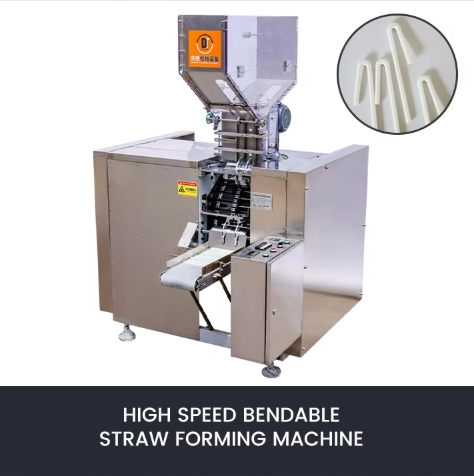
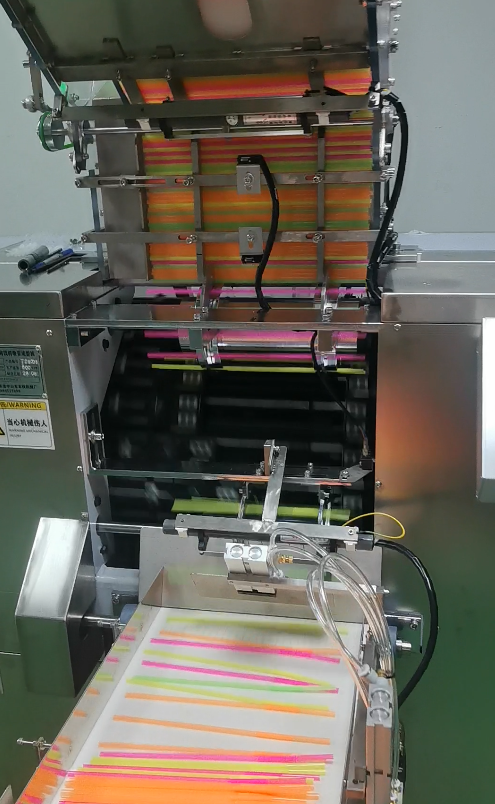
The single unit in this comparison is the DT-1200 high-speed flexible straw forming machine, a fully automatic machine that performs full-process manufacturing of flexible straws and can be run standalone or connected to a production line. It is used to replace manual or semi-automatic processes and to raise the automation level of mass production. Even as a standalone purchase, it expects a feeder on the input side and a sealing and cooling unit, packaging machine and conveyor system on the output side; those units are separate equipment, not part of the forming machine itself.
The integrated line
The integrated line is the same forming platform plus the coordination work around it: material feeding, sealing and cooling, conveying and packing arranged as one capacity chain, with optional downstream modules such as a fixed-quantity packaging system and an automatic stacking unit matched to the former. On an integrated line the supplier is responsible not only for the forming machine but also for the line connection scheme and for how the connected units behave together.
Both scopes serve the same industries — straw manufacturing, catering supplies, disposable tableware and packaging machinery — and both are used for new production line construction, single-machine procurement, capacity expansion and equipment replacement. The difference appears at the boundary between units, and that boundary is exactly what a buyer is really purchasing when choosing between the two.
Industry background: a larger installed base, a narrower bottleneck
The equipment decision now sits inside a market shaped by material substitution and by the concentration of flexible straw bending production in a small number of export regions. Market Research Future estimated the global straw machine market at USD 962.55 million in 2024 and projected USD 1,793.41 million by 2035 at a CAGR of 5.82%. Customs-derived trade analysis cited for 2023 attributes more than 66% of the global export value of flexible straw bending machinery to China, which matters to buyers because most available forming platforms, spares and tooling knowledge come from the same supply base.
The practical consequence is not that machines are scarce. It is that two plants can buy comparable forming technology and still end up with very different output, scrap rates and staffing levels, because one connected the former to an existing packing room and the other built a chain whose stages do not match. Configuration, not the forming unit alone, is where projects diverge.
Output target: size the forming stage before the packing stage
The documented production case for this platform records no less than 1,000 straws per minute in continuous operation, with one high-speed machine replacing five traditional machines. The high-speed flexible straw forming machine has been installed as 60 sets across multiple straw production facilities over a three-year project period, serving straw factories in Southeast Asia, the Middle East and domestic Chinese manufacturers, with custom-tuned mold solutions for local straw specifications and full-set after-sales technical support for overseas sites.
For scale, industry engineering specifications published by KEZHI list typical automatic straw bending machines at 200–300 pieces per minute. At 1,000 straws per minute, one high-speed machine corresponds to 60,000 straws per hour (calculated: 1,000 × 60). Third-party market reporting by Dataintelo describes industrial high-speed straw machines reaching 80,000 to 200,000+ pieces per hour. These figures describe different machine classes and measurement conditions and should not be treated as interchangeable, but they indicate the order of magnitude a buyer has to plan around.
The decision rule follows from the gap between stages. If your packing room, sealing unit or delivery schedule cannot absorb roughly 60,000 straws per hour, a second forming machine will not solve the imbalance. In that case the integrated line, with conveying and packing speeds matched to the former, is the more coherent purchase. The alternative is to buy the single machine now and add balancing equipment later as a separate project under your own integration responsibility. If downstream capacity already exists and is under-used, the single machine is the shorter route, because it converts an existing packing room into a higher-output plant without renegotiating any interface.
Mold customization: the real variable in a multi-SKU plant
High-speed forming does not remove the need for tooling; it makes tooling quality more visible. On this platform, custom molds are required for different straw diameters and bending shapes, and material compatibility and the mold solution have to be confirmed before order placement, together with the raw material specification and surface treatment standards that apply to the application.
Two engineering details affect how a plant should buy molds. First, the high-efficiency embossing technology used here relaxes the tolerance limits for tube blanks, with standard straw diameter tolerance controlled at ±0.05 mm, which widens the range of incoming tube stock a plant can accept without changing tube supplier. Second, the embossing and forming modules are separately adjustable, and key wearing parts such as forming needles and molds are reinforced with a designed service life of more than one year, which reduces how often the tooling set has to be taken out of production.
The product range covers the diameter classes most plants actually sell: small-diameter U-shaped straws in the 3.8 mm, 5 mm and 6 mm classes, high-speed U-shaped forming configurations, decorative (art) straw forming machines including 12 mm large-diameter decorative configurations, and 12 mm pointed-tip and 6 mm high-speed straw bending configurations. Buying a single machine lets you enter this range incrementally — one diameter and one bend angle first, further molds as orders justify them — while an integrated line normally assumes the SKU set is known at configuration time, because packing formats and conveying are built around it.
Decision rule: if a meaningful share of your order book changes diameter or bend shape from month to month, treat mold changeover and packing reconfiguration as separate line items before comparing the two options. A single machine with a well-planned mold set can serve a mixed order book that a fixed line configuration would force into batches.
Line connection scheme: the interfaces are the project
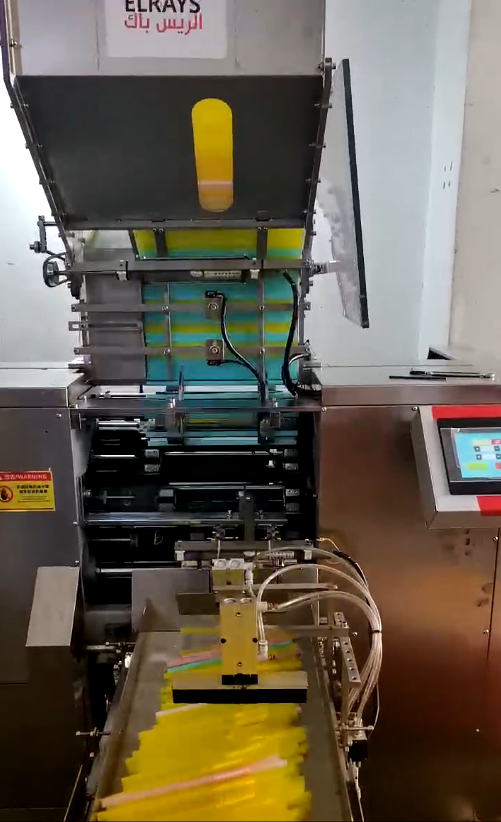
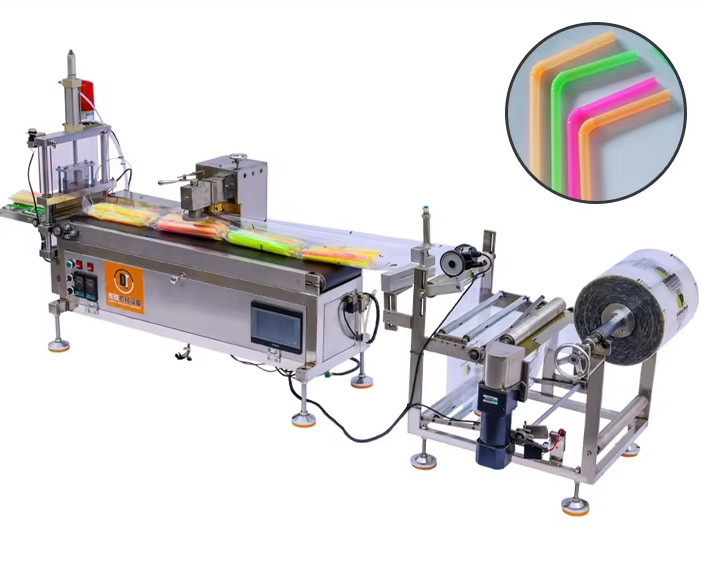
In an integrated configuration the forming machine is one station among several. It requires supporting equipment including a feeder, a sealing and cooling unit, a packaging machine and a conveyor system, and those units must be coordinated to keep continuous operation. Optional modules such as a fixed-quantity packaging system and an automatic stacking unit can be matched to build the full production line.
Utilities and environment constrain where the chain can sit. The DT-1200 parameter sheet lists 5.5–6.5 kW power, working pressure of 1.500–6.000 MPa, working temperature of 100–200 °C, IP55 protection and stainless steel construction, and the documented working condition is a normal-temperature workshop with stable power supply, raw material feeding and production line connection. Planned per machine, this is easy. Planned for a connected line, the position of the sealing and cooling unit relative to the former and to the packing station sets conveyor length, maintenance access and the floor space the complete chain occupies.
Decision rule: a single machine suits a building where forming and packing already exist as separate zones that can be linked by a conveyor run. An integrated line suits a new build or a full re-layout, where the whole chain is positioned at once. Retrofitting a line into a building designed for standalone machines is possible, but the re-layout cost belongs inside the comparison rather than outside it.
Control system and operator skill: what changes when units are connected
The forming platform uses a PLC control system that displays real-time operating status, stops the machine automatically on a malfunction with fault codes shown on screen, and counts output automatically. A built-in inspection system with multiple on-line detectors covers material shortage, defective forming and length deviation, rejecting unqualified products in real time and reducing manual inspection work and raw material waste.
On a standalone machine this control scope is complete: one screen, one operator, one set of fault codes to act on. On an integrated line the same forming controls sit inside a chain of separate controllers, and the practical questions change: which station stops first when a downstream unit is blocked, who resets it, and whether production data are collected per machine or per line. The specific control mode and HMI details of a connected configuration are confirmed at inquiry, because they depend on the auxiliary equipment selected.
Labour follows the same split. A single machine with accessible lubrication, cleaning and troubleshooting points can be run by an operator who also handles packing, which lowers reliance on skilled technicians. A connected line shifts the requirement toward someone who can supervise the whole chain and interpret faults across units quickly. If your plant does not have that person, the single machine is the lower-risk first step, and the line can follow once supervision exists.
After-sales support: clarify where the supplier's scope stops
After-sales scope is where the two purchases differ most in practice. DONGTIE MECHANICAL EQUIPMENT provides installation and commissioning, remote technical support and spare parts supply, and recommends confirming warranty terms and response times before purchase. Remote video technical guidance is available for common faults, and on-site training can be arranged in the manufacturer's own straw production workshop, which runs more than 10 full production lines.
For a standalone machine that scope is well defined: the supplier commissions the former and trains the operator. For an integrated line, commissioning covers the interfaces — feeder synchronisation, sealing and cooling timing, conveyor handover, packing count accuracy — and the useful question before signing is which of those interfaces the supplier commissions and which are handled by the suppliers of the other units.
Buyers should also ask for the pre-delivery record. Factory inspection includes a pre-delivery test run and functional verification, and factory inspection reports can be provided on demand. A test-run record for a standalone machine confirms one unit; for a line, the equivalent evidence is a coordinated run of the connected units. Requesting the record that matches what you are buying avoids comparing a single-machine document with a line-scale promise.
Side-by-side comparison
| Decision factor | Single high-speed bendable straw forming machine | Integrated flexible straw line |
|---|---|---|
| Scope purchased | Forming machine plus the molds for your diameters and bend angles; feeder and downstream units arranged by the buyer | Forming machine plus feeder, sealing and cooling unit, packaging machine, conveyor system and optional stacking modules, coordinated as one chain |
| Documented output | No less than 1,000 straws per minute in continuous operation; one machine replaces five traditional machines in the recorded case | Dependent on the slowest connected station; forming speed must be matched to sealing, conveying and packing |
| Mold customization | Molds added incrementally per diameter and bend shape; material compatibility confirmed before order; ±0.05 mm standard diameter tolerance | Mold set normally fixed at configuration because packing format and conveying follow the SKU |
| Line connection | Can run standalone or be connected later; interfaces remain the buyer's responsibility until then | Connection scheme supplied and commissioned, including optional fixed-quantity packaging and automatic stacking |
| Control | PLC with real-time status, automatic stop with fault codes, automatic counting, on-line defect rejection | Same forming controls inside a multi-controller chain; control mode and HMI details confirmed at inquiry |
| Site requirements | 5.5–6.5 kW, 1.500–6.000 MPa, 100–200 °C, IP55, stainless steel; normal-temperature workshop with stable power | Same per unit, plus layout planning for conveyor runs, maintenance access and total floor space |
| After-sales | Installation and commissioning of the former, operator training, remote support, spare parts | Interface commissioning across units; scope split with other unit suppliers must be agreed in writing |
| Typical fit | Existing packing capacity, mixed or changing SKUs, staged investment, limited technical supervision | New build or full re-layout, balanced end-to-end capacity, one-point accountability |
| Commercial terms | Both scopes: minimum order 1 set, 30-day lead time, monthly capacity 20 sets; custom molds, capacity specifications, control systems and line connection schemes can be customized, with the full customizable scope confirmed by the sales team | |
Which profile fits which configuration
The following profiles are conditional examples built from the documented project types — new line construction, single-machine procurement, capacity expansion and equipment replacement — not descriptions of specific customers.
Profile A: an operating plant with a working packing room. Forming is the constraint, packing staff and equipment already exist, and the order book includes two or three diameters. A single machine converts that plant into a higher-output site without touching the packing layout, and molds are bought as the order book grows. The documented 60-set installed base across Southeast Asia, the Middle East and China shows this pattern is used at scale, not only as an entry step.
Profile B: new capacity where packing labour is the scarce resource. Forming, sealing and cooling, conveying and packing are all being created at once, and one party should own the handover points. Here an unbalanced purchase is the bigger risk: a former running at full speed into an under-specified packing station produces stock, not shipments. The integrated line, with optional fixed-quantity packaging and stacking, addresses that directly.
Profile C: replacing manual or semi-automatic processes. When the current process is manual or semi-automatic, the first constraint is usually forming throughput and consistency, not packing. A single machine plus a planned second phase for downstream modules keeps the first capital step proportionate and leaves the line decision open once real packed-carton data exist.
Compliance and documentation scope
Documentation scope should follow the same logic as the equipment. Machinery sold in the EU must comply with Machinery Directive 2006/42/EC and carry the CE mark; EN ISO 12100 is the primary harmonised standard for machinery safety, and Regulation (EC) No 1935/2004 governs the transfer of constituents to food. For a single machine, the declaration and technical file should describe that machine. For a connected line, ask which document covers the assembled chain and which covers units supplied by others, because a compliant former inside an undocumented chain is not the same as a compliant line.
Classification matters on the shipping side as well. According to China's General Administration of Customs data, HS code 84778090 is the primary classification for drinking straw machines, which is what an importer's broker will normally expect to see on the export documents.
Six checks before you choose
- Convert your demand into straws per minute. Compare the figure with the recorded continuous output of no less than 1,000 straws per minute and with your packing station's real absorbable rate.
- List the molds you need in the first 12 months, with diameter, bend angle, raw material specification and surface treatment, and confirm material compatibility and the mold solution before order placement.
- Draw the interface line. On a sketch of your building, mark where forming ends and packing begins, and decide in writing which side commissions each handover point.
- Confirm utilities against the parameter sheet — power, working pressure, working temperature, protection grade — for each station, not only for the former.
- Ask for the pre-delivery test-run record that matches the scope you are buying, plus the factory inspection report if your procurement file requires it.
- Fix the after-sales terms in writing, including warranty period, response time, spare parts for forming needles and molds, and whether training takes place at your site or in the manufacturer's workshop.
Frequently asked questions
Can a single high-speed bendable straw forming machine be connected to a line later?
Yes. The machine operates in a fully automatic continuous mode and can be used as a standalone unit or connected to a production line. Connecting it later requires supporting equipment including a feeder, a sealing and cooling unit, a packaging machine and a conveyor system, and those units must be coordinated for continuous operation. The specific control mode and HMI details of a connected configuration are confirmed at inquiry, because they depend on which auxiliary equipment is selected.
Which molds are needed for different straw diameters and bending angles?
Custom molds are required for different straw diameters and bending shapes, and material compatibility together with the mold solution must be confirmed before order placement, along with the raw material specification and surface treatment standards. The range covers small-diameter U-shaped straws in the 3.8 mm, 5 mm and 6 mm classes, decorative art straws, and 12 mm large-diameter and 12 mm pointed-tip configurations, with a standard straw diameter tolerance controlled at ±0.05 mm.
What is the minimum order quantity and the lead time?
The minimum order quantity is 1 set and the lead time is 30 days, with a monthly capacity of 20 sets. Molds, production capacity specifications, control systems and line connection schemes can be customized, and the full customizable scope is confirmed with the sales team before the order is finalized.
How does commissioning differ between a single machine and an integrated line?
For a single machine, commissioning covers the former itself plus operator training. For an integrated line it also covers the interfaces — feeder synchronisation, sealing and cooling timing, conveyor handover and packing accuracy — so the division of responsibility between the supplier and the suppliers of other units must be agreed in advance. DONGTIE MECHANICAL EQUIPMENT provides installation and commissioning, remote technical support and spare parts supply, and recommends confirming warranty terms and response times before purchase.
Can one supplier handle both a single machine and a full line for a beverage straw factory?
Yes. DONGTIE MECHANICAL EQUIPMENT works in equipment manufacturing and customization covering both single-machine production and full-line integration, with 60 sets installed across multiple straw production facilities and clients including straw factories in Southeast Asia, the Middle East and domestic Chinese manufacturers. You can review the detailed configuration in the DONGTIE product brochure (PDF), or send your diameter, bend angle, target output and building layout for a configuration review.
Conclusion: pick the scope that removes your biggest unknown
If forming is the only step you cannot keep up with and a packing room already exists, a single high-speed bendable straw forming machine gives you documented output of no less than 1,000 straws per minute, a mold set you can expand as the order book changes, and a 30-day delivery on a one-set minimum. If the unknown is the whole chain — interfaces, balancing, who commissions the handover points — an integrated flexible straw line removes that unknown at the configuration stage rather than during your first production month.
The honest test is not which purchase looks larger on a quotation. It is whether your plant can absorb the output at the end of the chain. Answer that with your own packing rate, your mold list and your staffing plan, and the choice between the two scopes becomes a calculation rather than a preference.
Next step for your project: tell us the straw diameters and bend angles you sell, your target output per shift, and whether packing already exists in your building. The team at DONGTIE MECHANICAL EQUIPMENT will confirm whether a single high-speed flexible straw forming machine or a configured line fits, including the mold solution and the interface list. Contact: Quanhe Wu, email 843681276@qq.com, tel / WhatsApp +8613680252932.
Have Questions or Need More Details?
Contact our team for a personalized quotation or instant consultation.
Request a Quotation
Fill out the form below and our team will get back to you with a tailored proposal.
WhatsApp Direct Chat
Prefer to chat in real-time? Message us on WhatsApp for instant assistance & quick answers.
- Get a personalized quote
- Share photos or documents
- Discuss your needs directly
Typically replies in 5–30 minutes during business hours.