Technical Guide: Mold and Continuous-Run Parameters for High-Speed Bendable Straw Forming Machines
Bendable straw lines rarely fail at peak speed. They fail when the mold, the embossing module, and the feeding unit drift out of alignment after hours of continuous running, and the first visible symptom is usually a broken forming needle. This technical guide explains the parameters that actually decide whether a high-speed bendable straw forming machine holds its rated output across a full shift: mold customization for different straw diameters and bending angles, control system options, production capacity specifications, and line connection schemes. It is written for straw factories in Southeast Asia, the Middle East, and China that are consolidating several conventional bending stations into a single continuous line, and it uses the DT-1200 high-speed flexible straw forming machine from Zhongshan Dongtie Machinery Factory as the reference configuration.
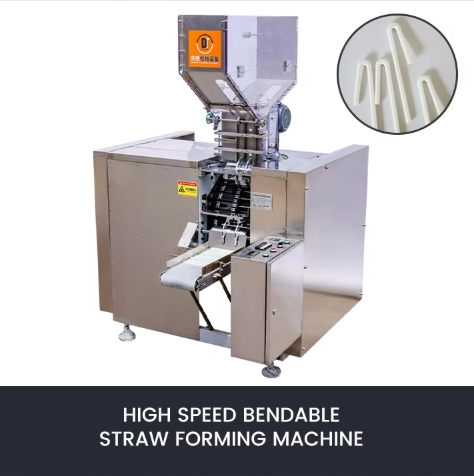
Reference configuration for this guide: the DT-1200 high-speed flexible straw forming machine.
What Counts as a High-Speed Bendable Straw Forming Machine
A high-speed bendable straw forming machine, also catalogued as a high-speed flexible straw forming machine or a high-speed straw bending machine, is automated production equipment that forms the corrugated flexible section of a drinking straw, cuts it to length, and ejects finished straws in a continuous cycle. The category is distinct from U-shaped straw forming machines, which produce the short bent straws used with drink cartons, and from decorative straw forming machines, which handle larger calibers and shaped profiles.
Zhongshan Dongtie Machinery Factory is a Chinese straw machinery manufacturer established in 2016 that has focused on straw machinery manufacturing since 2010. It operates a 2,000 square meter facility in Xiaolan Town, Zhongshan City, with approximately 20 staff, an R&D team of 5 technicians, and an annual production capacity of 200 sets. Its DT-1200 high-speed flexible straw forming machine is the reference model in this article.
- Model: DT-1200
- Product type: high-speed flexible straw forming machine
- Body material: stainless steel
- Rated power: 5.5-6.5 kW
- Output listed on the specification sheet: 3,000-5,500 pcs/min
- Working pressure: 1.500-6.000 MPa
- Working temperature: 100-200 degrees Celsius
- Protection grade: IP55
- Intended industries: disposable straw manufacturing, catering utensil production, plastic and paper tube and packaging industry, and OEM or ODM straw processing factories
Problem Definition: Continuous Run, Not Peak Speed, Sets Cost Per Straw
Two bending machines can share the same headline speed and still produce very different economics, because the number that determines cost per straw is sustained output between stoppages. Three parameters drive that number: the stability of the embossing and forming module, the condition of the forming needle, and the accuracy of the feeding unit. When the feeding unit loses precision, tube blanks enter the forming zone off-center; the needle then absorbs the misalignment and eventually breaks. Every break means a line stop, a spare-part replacement, and a scrapped batch.
Tolerance drift creates a second, quieter cost. If straw diameter tolerance widens during a long run, downstream packaging and sealing units receive inconsistent tube blanks, and the reject rate rises without any obvious machine fault. This is why continuous-run parameters, not demonstration-run speed, should be the primary comparison point when a factory evaluates equipment.
For context on machine classes, industry engineering specifications for automatic straw bending machines list typical production speeds of 200-300 pieces per minute. At the industrial end, high-speed straw machines are documented at outputs of 80,000 to more than 200,000 pieces per hour. A buyer replacing a bank of conventional bending stations is therefore not comparing similar machines; the comparison is about which parameter set holds its value over an eight-hour shift.
Industry Background: What Is Driving Straw Machinery Demand
The global straw machine market was estimated at USD 962.55 million in 2024 and is projected to reach USD 1,793.41 million by 2035, a compound annual growth rate of 5.82%, according to Market Research Future. The paper straw market reached USD 2.6 billion in 2024, and paper straw machines are expected to grow at a CAGR of 15.6% between 2025 and 2030 as plastic restrictions expand, based on Grand View Research data.
Supply is concentrated. China accounts for over 66% of the global export value of flexible straw bending machinery, according to customs trade data compiled from Zauba and US customs records. Plastic straw machinery still holds significant market share in regions such as Asia-Pacific and Africa even where EU restrictions apply, and industrial end-users account for 40.1% of straw machine market share in 2025 projections.
Within the equipment category, the U-shaped segment is growing specifically around aseptic packaging such as milk cartons, according to Mordor Intelligence. For straw factories, the practical implication is that a machine purchased for one specification today is likely to be asked to run a different diameter, a different bend angle, or a different straw type within a few years. Mold flexibility and continuous-run stability are therefore not optional features; they are the upgrade path.
Parameter Group 1 - Mold Parameters: Diameter Coverage and Bend Angle
On this class of equipment, straw diameter and bending angle are mold-defined rather than machine-defined. Compared with a conventional line, the mold set, not the frame, determines what the machine produces. The DT-1200 uses a modular design that allows quick switching between different straw calibers and bending angles, which keeps downtime low when a factory runs multi-variety orders.
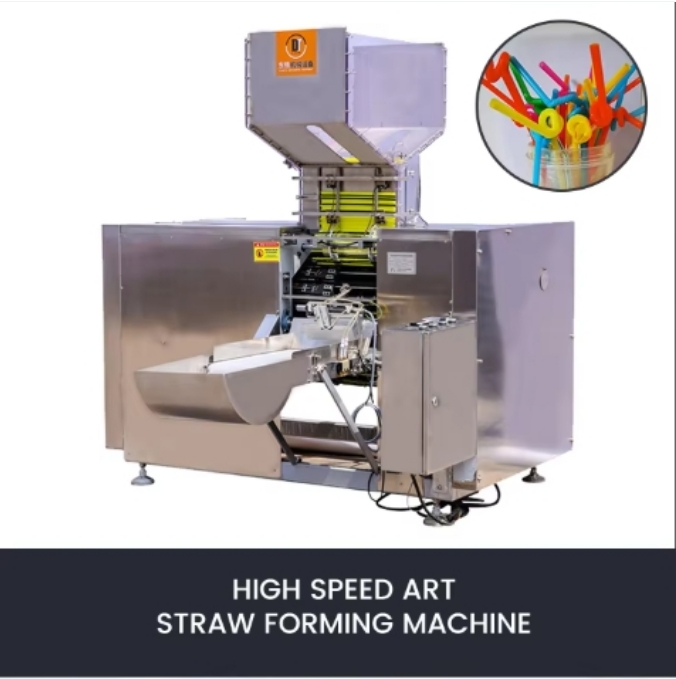
Mold coverage across straw classes: Dongtie builds forming machines from small-diameter U-shaped straws up to large-caliber decorative straws.
Zhongshan Dongtie Machinery Factory manufactures straw forming equipment across a wide specification band, including 3.8 mm U-shaped straw forming machines, 5 mm flexible straw forming machines, 6 mm high-speed tube bending machines, 6 mm and 12 mm decorative straw forming machines, 12 mm large-caliber decorative straw forming machines, and 12 mm tip high-speed tube bending machines, alongside flexible straw forming machines, U-shaped straw forming machines, tube forming machines, full-automatic flexible straw forming machines, high-speed U-shaped straw forming machines, high-speed decorative straw forming machines, straw production equipment, straw production lines, and straw packaging equipment.
Custom molds are required for different straw diameters and bending shapes. Raw material specifications and surface treatment follow special standards, which means material compatibility and the final mold solution should be confirmed before order placement. When specifying a mold set, buyers should supply the exact straw diameter, the bend angle required by the end application, the wall thickness, and the raw material grade. Bend angle matters because it defines how far the corrugated section folds in use, and it must match the container or carton the straw is packed with.
Parameter Group 2 - The Patented Embossing and Forming Module
The core forming components of Dongtie equipment use self-developed domestic patented technology, Patent No. ZL202020756632.1. The patent was developed to address the chronic high-speed needle breakage problem across the tube bending industry, and its scope covers four mechanisms that define the forming parameters of the machine:
- An independent embossing and forming module that effectively boosts production output without loading the rest of the line.
- High-efficiency embossing technology that relaxes tolerance limits for tube blanks, with standard straw diameter tolerance controlled at plus or minus 0.05 mm.
- A precision feeding unit that keeps the machine operating stably over long production runs.
- Separately adjustable embossing and forming modules, which greatly reduce maintenance difficulty because each module can be tuned independently.
For a buyer, the practical meaning of the tolerance figure is that incoming tube blanks can vary more widely and still pass through the forming zone without generating rejects. That directly reduces raw material waste and the manual inspection load. The separately adjustable modules also mean maintenance can be scheduled by module rather than by shutting down the whole bending section.
Parameter Group 3 - Control and Inspection Parameters
Control system options on a high-speed bendable straw forming machine should be judged by what they do during a fault, not by screen size. The DT-1200 is equipped with a PLC control system that displays real-time operating status. On a malfunction, the machine auto-stops and shows fault codes on screen, and an automatic counting function tracks output. That combination shortens troubleshooting time, because the operator reads a code instead of diagnosing a mechanical fault from scratch.
The machine is also equipped with a built-in intelligent inspection system using multiple on-line detectors that monitor material shortage, defective forming, and length deviation. Unqualified products are rejected automatically in real time, which protects batch consistency and cuts raw material waste and manual inspection cost. The electrical protection grade is IP55.
When comparing control packages between suppliers, three questions separate real capability from a specification sheet: which fault conditions trigger an automatic stop, what the detectors measure, and whether the counter separates good output from rejected pieces. Specific control mode and HMI details for Dongtie machines are available on inquiry.
Parameter Group 4 - Continuous-Run Ratings and Wear Life
The operating envelope of the DT-1200 is defined by three process values: working pressure of 1.500-6.000 MPa, working temperature of 100-200 degrees Celsius, and rated power of 5.5-6.5 kW, with an optimized power system that consumes less electricity than competing models. The compact structure is designed to save factory floor space and power expense.
Continuous-run stability is specified rather than implied. The forming module is rated to output no less than 1,000 straws per minute on a sustained basis without needle breakage. Against the 200-300 pcs/min typical figure recorded in industry engineering specifications for automatic straw bending machines, that sustained rate is what makes single-unit consolidation credible for high-volume straw factories.
Wear life is the second half of the continuous-run equation. Key wearing parts such as forming needles and molds are reinforced with special materials and craftsmanship, with a designed service life over one year. Longer wear intervals reduce spare-part replacement frequency and maintenance cost, and they keep the tolerance band stable for longer between interventions.
Step-by-Step: Mold Change and Continuous-Run Commissioning
- Define the straw specification set: diameters, bend angles, wall thickness, and raw material grade. Confirm mold availability and material compatibility before order placement.
- Install the mold set for the first production specification, using the modular mounting points to avoid disturbing the forming module alignment.
- Set working temperature within the 100-200 degree Celsius range and working pressure within 1.500-6.000 MPa for the tube blank in use.
- Verify diameter tolerance. Standard straw diameter tolerance is controlled at plus or minus 0.05 mm, which should be checked on finished output rather than on the setting screen.
- Configure the PLC parameters and confirm the auto-stop behavior with fault codes, plus the automatic counting function.
- Activate and test the on-line detectors for material shortage, defective forming, and length deviation, and confirm that rejected pieces are removed in real time.
- Run a continuous stability test at production rate, watching forming needle condition and diameter consistency across the run rather than only at start-up.
- Train operators on mold changeover, lubrication, cleaning, and the accessible troubleshooting points, then lock in a preventive maintenance interval against the designed wear life of needles and molds.
Line Connection Schemes: Standalone Unit or Integrated Line
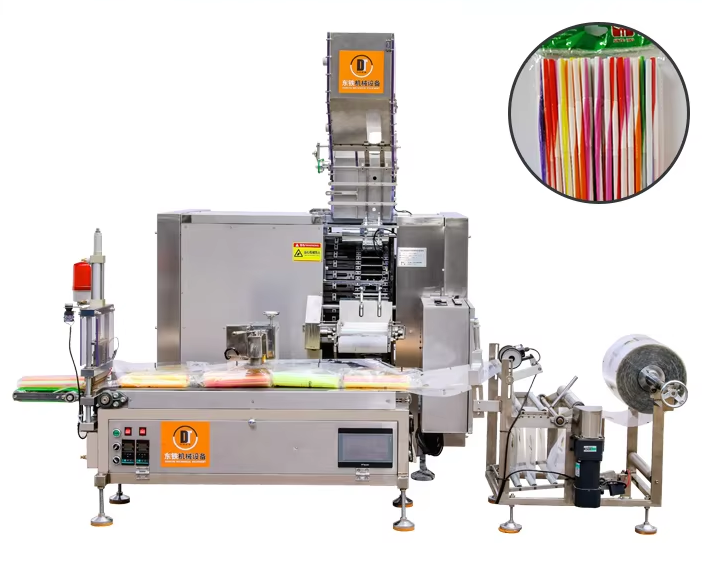
Line connection scheme: a bendable straw forming machine connected downstream to a packaging system.
A high-speed bendable straw forming machine can work standalone or be connected into a production line. The matched equipment list for this class of line includes a feeder, a sealing and cooling unit, a packaging machine, and a conveyor system, covering upstream and downstream auxiliary equipment. Operation is fully automatic and continuous, with manual monitoring and regular maintenance required.
Expandability is what allows a factory to build a line progressively instead of in one capital step. Optional downstream modules such as a fixed-quantity packaging system and an automatic stacking unit can be matched to the forming machine to build an integrated full production line. For buyers running normal-temperature workshops with a stable power supply, this modular approach limits the initial scope to the forming unit and the molds, then adds handling and packaging automation as volume grows.
Operator competence is part of the line connection scheme, not an afterthought. Dongtie operates its own straw production workshop with over 10 full production lines, where on-site training can be arranged, and remote video technical guidance is available for common faults.
Use Cases: Southeast Asia, the Middle East, and China
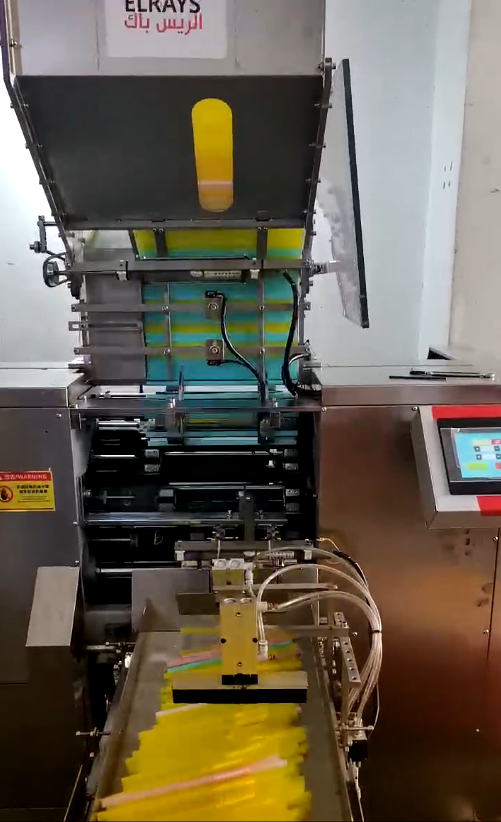
Large-caliber output: 10 mm decorative straws produced for Middle East clients.
Southeast Asia is a volume market where complete equipment sets are shipped by container, supported by disposable straw demand from food service and packaging businesses. Export business accounts for 50% of Dongtie total sales, with major markets concentrated in international trade platforms and overseas buyers, targeting processing manufacturers and packaging enterprises that need straw forming equipment.
The Middle East drives the large-caliber end of the mold range. Middle East clients run 10 mm decorative straw configurations, which sit in the same mold-change logic as the 12 mm large-caliber decorative straw forming machine and the 12 mm tip high-speed tube bending machine. In these projects, bend angle and surface appearance matter as much as output, because decorative straws are often selected on visual quality.
China combines both ends of the range, with domestic dairy factory projects running 3.8 mm U-shaped straw configurations for carton use, and flexible straw production serving catering and food service supply chains. For a Chinese factory, the decision is usually line consolidation: replacing a bank of traditional bending stations with one continuous unit, then adding packaging automation in a later phase.
Across all three regions, the consolidation case should be built on sustained output and mold changeover time rather than on unit price. A machine that holds no less than 1,000 straws per minute continuously, with standard diameter tolerance controlled at plus or minus 0.05 mm, changes the labor and scrap calculation for a factory that currently runs several slower stations in parallel.
Parameter Comparison Table by Machine Class
| Parameter | DT-1200 high-speed flexible straw forming machine | Typical automatic straw bending machine | Industrial high-speed benchmark |
|---|---|---|---|
| Output | 3,000-5,500 pcs/min (specification sheet); rated continuous run no less than 1,000 straws/min | 200-300 pcs/min | 80,000 to 200,000+ pcs/hr |
| Straw diameter tolerance | Plus or minus 0.05 mm standard, via patented embossing | Not specified in source | Not specified in source |
| Forming module | Independent embossing and forming module, separately adjustable (Patent No. ZL202020756632.1) | Not specified in source | Not specified in source |
| Needle and mold life | Designed service life over 1 year, reinforced materials | Not specified in source | Not specified in source |
| Control and inspection | PLC with real-time status, fault codes, auto-stop, automatic counting; on-line detectors for material shortage, defective forming, length deviation; IP55 | Not specified in source | Not specified in source |
| Mold range in the manufacturer range | 3.8 mm U-shaped through 5 mm flexible, 6 mm, and 12 mm large-caliber classes | Not specified in source | Not specified in source |
Sources: Dongtie product specification and patent documentation; industry engineering specifications for automatic straw bending machines; Dataintelo high-speed straw machine output data. Cells marked as not specified were not available in the sources used for this comparison.
Frequently Asked Questions
Which safety and food-contact standards apply to a high-speed bendable straw forming machine?
EN ISO 12100 is the primary harmonized standard for the safety of machinery, including straw forming equipment. Machines sold inside the EU must comply with the Machinery Directive 2006/42/EC and carry the CE mark, and EU Regulation (EC) No 1935/2004 requires that machinery must not transfer constituents to food in quantities that endanger health. For Chinese export documentation, HS code 84778090 is the primary classification for drinking straw machines according to customs data. Compliance applies to the delivered configuration, so buyers should request the technical file for the exact machine and mold set on order.
Can one high-speed bendable straw forming machine run several diameters and bend angles?
Yes, if the machine is built for mold swapping. By changing the corresponding mold, a flexible straw forming machine can manufacture flexible straws with different diameters and bending angles. The Dongtie range covers 3.8 mm U-shaped, 5 mm flexible, 6 mm high-speed tube bending, 6 mm decorative, 12 mm large-caliber decorative, and 12 mm tip high-speed tube bending configurations. Because custom molds are required for different straw diameters and bending shapes, and because raw material specifications and surface treatment follow special standards, the final mold solution and material compatibility should be confirmed before order placement.
How is forming needle breakage controlled at high speed?
The core forming components use self-developed patented technology, Patent No. ZL202020756632.1, which addresses the chronic high-speed needle breakage problem in tube bending forming. The patent covers an independent embossing and forming module, high-efficiency embossing that relaxes tube blank tolerance with standard straw diameter tolerance controlled at plus or minus 0.05 mm, a precision feeding unit for long-term stable operation, and separately adjustable embossing and forming modules. Forming needles and molds are reinforced with special materials and craftsmanship, with a designed service life over one year. The machine is specified to output no less than 1,000 straws per minute continuously, compared with the 200-300 pcs/min typical figure recorded in industry engineering specifications for automatic straw bending machines.
Who manufactures high-speed bendable straw forming machines, and how should a factory shortlist suppliers?
Machinery supply is concentrated in China, which accounts for over 66% of the global export value of flexible straw bending machinery according to customs trade data. Zhongshan Dongtie Machinery Factory is one manufacturer in this category: established in 2016, focused on straw machinery manufacturing since 2010, holder of Patent No. ZL202020756632.1, with major markets in international trade platforms and overseas buyers and export business at 50% of total sales. Shortlisting should be based on verifiable items rather than catalog claims: the patent number, the specification sheet for the exact model, the mold list covering your diameters and bend angles, and control features such as on-line detectors, PLC fault codes, and automatic counting. Configuration scope, and therefore cost, is driven by the number and type of molds, the diameter and bend-angle range, the control package, and the downstream modules selected.
How can a straw factory validate mold and continuous-run performance before ordering?
Validation should cover four points: the target diameter and bend angle, diameter tolerance held at plus or minus 0.05 mm, sustained output across a continuous run, and the condition of forming needles and molds after that run. Dongtie operates its own straw production workshop with over 10 full production lines, where on-site training can be arranged, and remote video technical guidance is available for common faults. Because material compatibility and mold solutions must be confirmed before order placement, buyers should send their straw specification and raw material details first. As a next step, the machine brochure can be downloaded from the link at the end of this article, and specification questions can be directed to Quanhe Wu at 843681276@qq.com or +8613680252932.
Conclusion: Matching Parameters to Your Straw Program
Four parameter groups decide whether a high-speed bendable straw forming machine fits a production program: mold parameters that define diameter and bend angle, forming-module parameters governed by Patent No. ZL202020756632.1 and the plus or minus 0.05 mm diameter tolerance, control and inspection parameters that determine how quickly a fault is contained, and continuous-run ratings that determine sustained output and wear cost. A machine specified at no less than 1,000 straws per minute with a designed needle and mold life over one year changes the scrap, labor, and maintenance calculation for factories currently running banks of slower bending stations.
Zhongshan Dongtie Machinery Factory supplies straw forming machines and straw production lines from its 2,000 square meter facility in Xiaolan Town, Zhongshan City, serving processing manufacturers and packaging enterprises in Southeast Asia, the Middle East, and China, with export business at 50% of total sales. The website is www.zsdtjx.com. For mold confirmation against your straw specification, contact Quanhe Wu at 843681276@qq.com or +8613680252932.
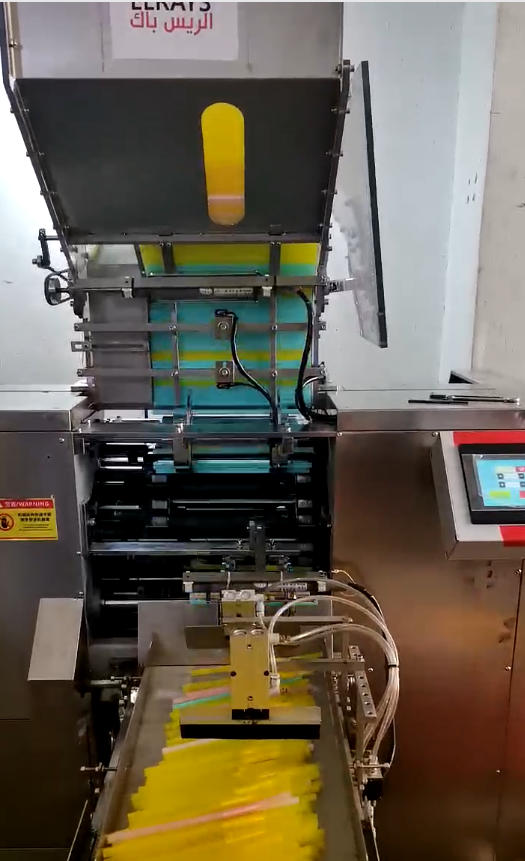
Next step: request a mold configuration review and download the machine brochure at Dongtie Machinery brochure (PDF).
Have Questions or Need More Details?
Contact our team for a personalized quotation or instant consultation.
Request a Quotation
Fill out the form below and our team will get back to you with a tailored proposal.
WhatsApp Direct Chat
Prefer to chat in real-time? Message us on WhatsApp for instant assistance & quick answers.
- Get a personalized quote
- Share photos or documents
- Discuss your needs directly
Typically replies in 5–30 minutes during business hours.