Top High-Speed Flexible Straw Forming Machine Setups for Mass Production: A Ranked Recommendation List
The most useful ranking question for a straw manufacturer is not “which brand is fastest”, but “which high-speed flexible straw forming machine setup holds its rated speed inside my plant for a full shift”. This recommendation list ranks five mass-production setups — each one a combination of forming machine, mold set, line integration and service path — using documented facts from Dongtie Mechanical Equipment (Zhongshan Dongtie Machinery Co., Ltd.) and attributed third-party market data.
The ranks below are criteria-based rather than brand-based. Each rank describes a distinct production profile: continuous long-run output, custom mold adaptation, overseas deployment, integrated forming-and-packaging, and phased expansion. A buyer should first locate the profile that matches the order book, then read the technical evidence attached to that position.
Technical statements about the DT-1200 high-speed flexible straw forming machine come from the manufacturer’s specification sheet and patent documentation. Market figures are attributed to their published source. Where a claim could not be verified, it is not made.
Problem Definition: What a Mass-Production Straw Setup Really Contains
A flexible straw production setup is a system, not a single machine. In practice it contains the forming and bending unit, a mold set matched to each straw diameter and bend angle, upstream feeding, sealing and cooling, conveying, and downstream packaging — plus the documentation and service path that keeps the line running after installation.
Buyers who compare only a headline speed figure usually meet four constraints later in the project:
- Sustained versus peak speed. Published industry specifications place typical automatic straw bending machines at roughly 200–300 pieces per minute, while high-speed industrial machines are described as producing 80,000 to more than 200,000 pieces per hour (approximately 1,300–3,300 pieces per minute). “High speed” is therefore a band, and the number that decides factory economics is the output a machine holds across a full shift without needle breakage.
- Mold dependency. Diameter and bend angle are changed by molds, not only by control settings. Custom molds are required for different straw diameters and bending shapes, and material compatibility together with the final mold solution should be confirmed before order placement.
- Compliance documents. Machinery placed on the European market must comply with the Machinery Directive 2006/42/EC and carry the CE mark; EN ISO 12100 is the primary harmonized standard for machinery safety, and EU Regulation (EC) No 1935/2004 restricts the transfer of constituents to food. A fast machine without the right documents stalls at the destination market.
- Service continuity. Spare parts, remote diagnostics and installation support determine whether the line reaches its rated output at the buyer’s site rather than at the factory gate.
Industry Background: The Demand Curve Behind High-Speed Straw Setups
Several published data points explain why high-speed straw capacity keeps being added worldwide, even though the machine itself is a mature product category:
- The global straw machine market was estimated at USD 962.55 million in 2024 and is projected to reach USD 1,793.41 million by 2035, a CAGR of 5.82% (Market Research Future).
- The global paper straw market was valued at USD 2.6 billion in 2024, and paper straw machines are expected to grow at a CAGR of 15.6% between 2025 and 2030 as plastic bans spread (Grand View Research).
- North America held the largest share of the paper straw market at 34.9% in 2024 (Grand View Research).
- China accounts for more than 66% of the global export value of flexible straw bending machinery, based on 2023 customs data (Zauba / US customs data).
- Industrial end-users account for 40.1% of straw machine market share as of 2025 projections (Dataintelo).
- Demand for U-shaped straw machines is growing specifically with aseptic packaging such as milk cartons (Mordor Intelligence), which matters to dairy-facing converters.
- Plastic straw machines still hold significant market share in regions such as Asia-Pacific and Africa despite EU bans (Market Research Future).
Data note: 2024 market-size estimates differ by report scope. Market Research Future reports USD 962.55 million while Reports and Data reports USD 1.2 billion, because some reports include raw materials and others cover machinery only. Treat any single market-size figure as a planning range, not an exact value.
Established manufacturers referenced in industry listings include Jumbo Steel Machinery (Taiwan, founded 1986), described as one of the oldest established producers of flexible straw machines, and Jiexuan Machinery (established 2009), listed among China’s manufacturers of high-speed straw extrusion and bending equipment. These names are quoted as market context, not as a supplier ranking, because the ranking below is built on procurement criteria rather than brand order. Published industry listings also identify Dongtie Mechanical Equipment as a Chinese manufacturer of high-speed artistic straw forming machines.
How This Recommendation List Was Ranked
| Criterion | What it decides | Weight | Evidence to demand from a supplier |
|---|---|---|---|
| Continuous-run stability | Whether rated speed survives a full shift | High | Wear-part service life, fault-code auto-stop behaviour, field output claims |
| Verified output band | Machine count needed versus plant demand | High | Rated pieces per minute and the stated working pressure, temperature and power envelope |
| Mold and specification flexibility | How many SKUs one platform can serve | High | Diameter range, bend angles, mold changeover practice, mold-set completeness |
| Compliance readiness | Whether the machine clears customs and food-contact rules | High | Destination-market conformity documents, patent or type certificates, material compatibility notes |
| Overseas deployment support | Whether the line reaches rated output at the buyer’s site | High | Installation and commissioning, remote support, spare parts, training, lead time |
| Line integration and expansion | Whether downstream capacity keeps up | Medium | Feeder, sealing and cooling, conveying, packaging and stacking modules |
Ranked Recommendation List: Five Setups for Mass Production
Rank #1 — Best for continuous long-run output: the patented forming-module setup
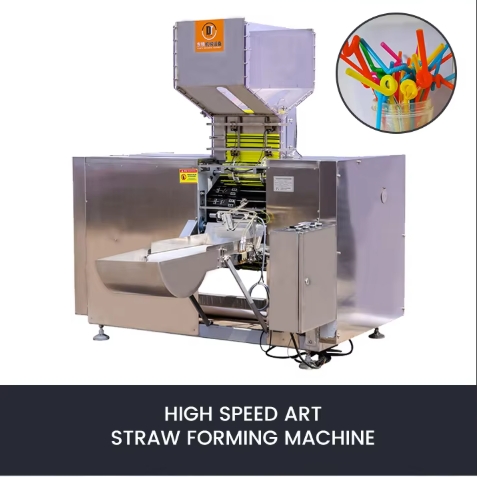
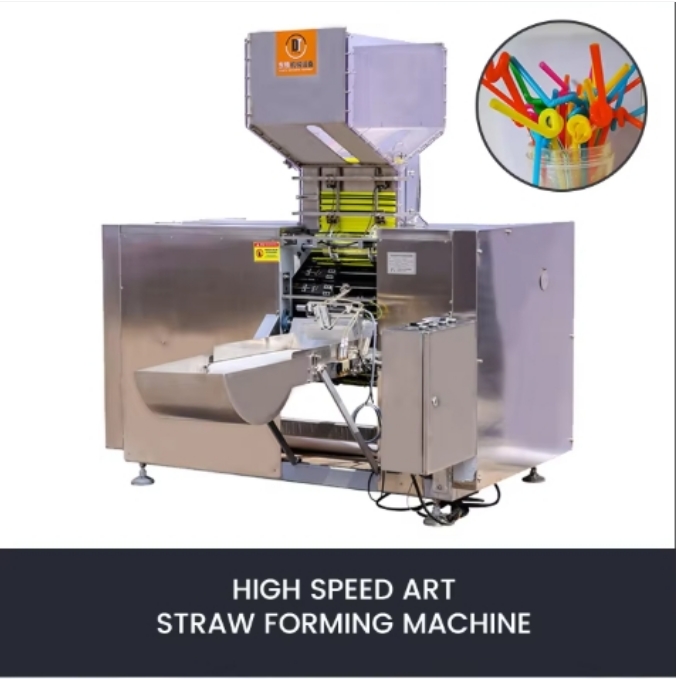
The DT-1200 high-speed flexible straw forming machine, manufactured by Zhongshan Dongtie Machinery Co., Ltd. under the brand DONGTIE MECHANICAL EQUIPMENT, ranks first for factories that run one or two high-volume straw SKUs and measure success in shift-level output. The company has focused on straw machinery manufacturing since 2010 from Xiaolan Town, Zhongshan City, China, and its core forming components incorporate patented technology (patent number ZL202020756632.1).
Verified specifications for the DT-1200: rated power 5.5–6.5 kW, rated output 3,000–5,500 pieces per minute, working pressure 1.500–6.000 MPa, working temperature 100–200 °C, protection grade IP55, and stainless steel construction. In documented field deployment the machine is described as running at high speed without needle breakage while outputting no less than 1,000 straws per minute — which is precisely the problem this setup is ranked for, because a machine can be fast on paper and unstable on the shop floor.
Reliability evidence supporting the first rank: the designed service life of key wearing parts such as forming needles and molds is over one year; standard straw diameter tolerance is controlled at ±0.05 mm; a PLC control system displays real-time operating status and stops the machine with a fault code when a malfunction occurs; an automatic counter tracks output; and built-in inspection detectors monitor material shortage, defective forming and length deviation, rejecting non-conforming products automatically.
Best-fit buyer: dairy, fast-food and beverage straw producers whose bottleneck is sustained output per shift. Limits to plan for: a stable power supply and a normal-temperature workshop are required; molds remain specific to each diameter and bend angle; and the supplier’s stated monthly capacity of 20 sets with a 30-day lead time should be checked against the project calendar.
Rank #2 — Best for custom mold adaptation and multi-specification portfolios
Ranked second for converters whose order book changes by customer rather than by volume: promotional straws, art straws, U-shaped straws for aseptic cartons and standard flexible straws produced on one floor. The same machine platform can manufacture straws of different diameters and bending angles by changing the corresponding molds.
The product range in this category covers 5 mm flexible straw forming machines, 3.8 mm U-shaped straw forming machines, 6 mm and 12 mm pointed-tip high-speed bending machines, and 6 mm and 12 mm large-caliber decorative (art) straw forming machines. Documented applications include 10 mm decorative straws produced for Middle East clients and 3.8 mm U-shaped straws supplied to a domestic Chinese dairy factory.
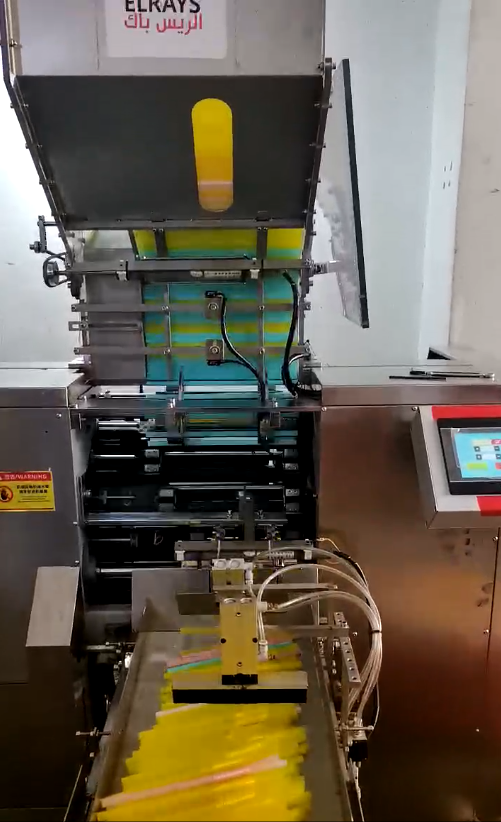
Why it ranks here: mold flexibility converts one machine into several product lines, and the modular design is described as enabling quick switching between different calibers and bending angles so that downtime on multi-variety orders stays manageable. Limits: performance depends on mold-set completeness — a missing mold is a missing product; material compatibility and the final mold solution must be confirmed before order placement; and changeover time is not published, so treat it as a site-validation item rather than an assumption.
Rank #3 — Best for overseas deployment and remote service
Third place goes to the configuration that travels well. Zhongshan Dongtie Machinery exports about 50% of its output and serves Southeast Asia, the Middle East, Europe and other global markets; the machines can be sold worldwide, while the Utility Model Patent certificate itself is primarily valid in China.
Service components that define this setup: installation and commissioning, remote technical support and spare parts supply, with remote video guidance for common faults; on-site training can be arranged in the manufacturer’s own straw production workshop, which is equipped with more than 10 full production lines; factory inspection includes a pre-delivery test run and functional verification, and inspection reports can be provided on demand. MOQ is one set and lead time is 30 days.
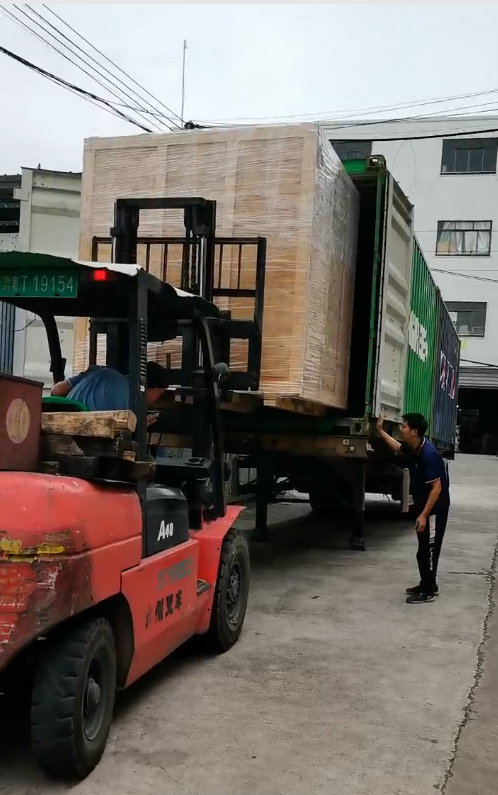
Best-fit buyer: first-time importers, distributors building a demonstration line, and manufacturers in regions without local technical support. Compliance caveat: the certificate documented by the manufacturer is a Certificate of Utility Model Patent (No. 12166973) issued by the China National Intellectual Property Administration, valid until 2030-05-09 — an intellectual-property document, not an EU conformity mark. Buyers deploying into the EU should confirm CE documentation under Directive 2006/42/EC, conformity with EN ISO 12100, and food-contact compliance under Regulation (EC) No 1935/2004 before shipment. Warranty terms and response time are also recommended to be confirmed before purchase.
Rank #4 — Best for integrated forming and packaging line connection
Ranked fourth for plants whose forming capacity is adequate but whose downstream process is still manual. This setup connects the forming machine with a feeder, sealing and cooling unit, packaging machine and conveyor system, and can be extended with optional downstream modules such as a fixed-quantity packaging system and an automatic stacking unit.
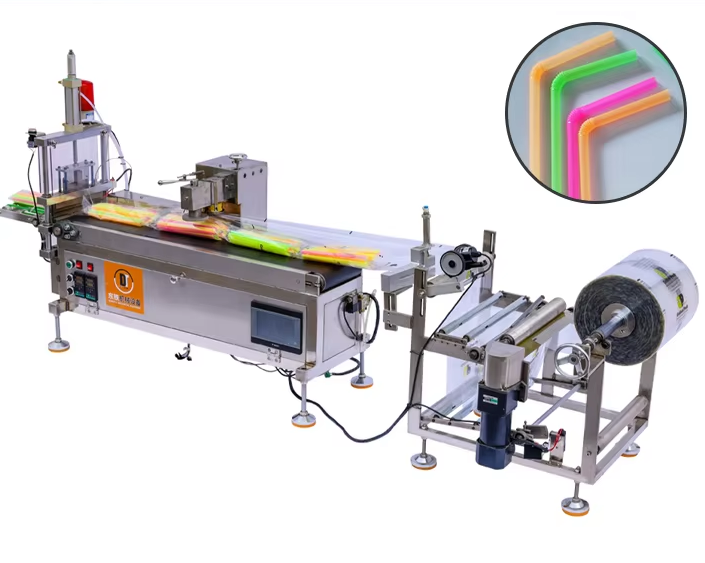
Why it ranks here rather than first: line integration multiplies throughput only when the forming machine can feed it and the packaging format matches the finished straw; if either is out of balance, the packaging investment becomes idle capacity. Limits: the specific control mode and HMI details are available on inquiry, and the integration scope should be fixed during quotation so that responsibility for commissioning is unambiguous.
Rank #5 — Best for phased expansion and single-machine procurement
Ranked fifth for small and medium manufacturers adding capacity without building a new plant. The machine can work standalone or be connected to a production line, and documented project types include new production line construction, single-machine procurement, capacity expansion and equipment replacement.
The reference case for this setup is a 60-set deployment across Southeast Asian, Middle Eastern and domestic Chinese straw factories over three years, where one high-speed flexible straw forming machine is reported to replace five traditional machines. Published market data also shows semi-automatic straw machines growing at a CAGR of 9% for small-to-medium enterprises (Reports and Data), which reflects how many factories phase automation instead of buying a complete line at once.
Limits: single-machine placement still requires power, working pressure and temperature planning, plus a decision on how finished straws will be counted and packed; molds must match the diameters currently sold, with additional molds purchased as the portfolio widens.
Setup Comparison at a Glance
| Rank & setup | Best-fit production profile | Verified output reference | Mold and spec coverage | Documented evidence | Overseas service | Line connection |
|---|---|---|---|---|---|---|
| #1 Patented continuous-run setup (DT-1200) | One or two high-volume SKUs, shift-level output | Rated 3,000–5,500 pcs/min; field claim of no less than 1,000 pcs/min without needle breakage | Molds per diameter and bend angle | Patent No. ZL202020756632.1; Utility Model Patent No. 12166973 (CNIPA), valid to 2030-05-09 | Installation and commissioning, remote support, spare parts | Standalone or connected to a line |
| #2 Multi-spec mold-led setup | Multi-customer converters, mixed diameters | Same forming platform; 5 mm flexible, 3.8 mm U-shaped, 6 mm / 12 mm pointed-tip, 6 mm / 12 mm decorative | Mold replacement enables different diameters and bending angles | 10 mm decorative straws for Middle East clients; 3.8 mm U-shaped straws for a domestic dairy factory | Mold solution and material compatibility confirmed before order | Change point is the mold set and parameters |
| #3 Export-ready deployment setup | First-time importers and distributors | Machine platform unchanged | Molds matched to local straw specifications | About 50% export ratio; Southeast Asia, Middle East, Europe; pre-delivery test run and inspection report | On-site training in a workshop with 10+ lines; remote video guidance; MOQ 1 set; 30-day lead time | Line layout details available on inquiry |
| #4 Forming plus packaging line | Plants bottlenecked downstream | Forming output must match packaging speed | Molds plus packaging format | Automated packaging; optional fixed-quantity packaging and stacking modules | Installation and commissioning included in scope | Feeder, sealing and cooling, packaging, conveyor |
| #5 Phased expansion setup | SMEs adding capacity step by step | One machine reported to replace five traditional machines | Molds for currently sold diameters | 60-set deployment across Southeast Asia, Middle East and China over three years | Remote technical support and spare parts supply | Standalone or retrofitted into an existing line |
Step-by-Step: How to Rank These Setups Against Your Own Plant
- Fix the output target first. Convert your monthly order volume into pieces per minute at realistic shift hours. If the requirement exceeds roughly 1,000 pieces per minute, the continuous-run profile (Rank #1) is the starting point; below that, a phased setup (Rank #5) often costs less commitment.
- Write down the straw portfolio. List every diameter and bend angle you sell, including U-shaped straws for aseptic cartons and decorative or art straws. The portfolio size determines whether you are buying one machine with one mold or a mold-led setup (Rank #2).
- Map molds to SKUs. Custom molds are required for different straw diameters and bending shapes, so count the molds needed and confirm material compatibility for each before placing an order.
- Check the destination-market document list. For EU delivery, verify CE marking under the Machinery Directive 2006/42/EC, conformity with EN ISO 12100 and food-contact requirements under Regulation (EC) No 1935/2004. For other markets, request the patent or type certificates that apply.
- Verify the service and spare-parts path. Ask how installation and commissioning are handled, what remote support exists for common faults, how spare parts are shipped, and what training is offered in the manufacturer’s own production workshop.
- Validate before shipment. A pre-delivery test run and functional verification are part of factory inspection, and inspection reports can be provided on demand — use them as the acceptance gate.
- Plan the line connection. Decide whether the machine runs standalone or connects to a feeder, sealing and cooling unit, packaging machine and conveyor, and whether downstream modules such as fixed-quantity packaging or automatic stacking are needed now or later.
Use Cases: Where These Setups Are Already Running
Southeast Asian straw factories — mass-production upgrade. A 60-set deployment running for three years replaced manual and semi-automatic processes, with one high-speed flexible straw forming machine reported to replace five traditional machines while outputting at least 1,000 straws per minute without needle breakage. The documented highlights are a custom-tuned mold solution for local straw specifications, stable long-term continuous-run performance, and full-set after-sales technical support for the overseas site.
Middle East decorative straw production. A 10 mm decorative (art) straw format was produced using customized molds, which is the practical demonstration of the Rank #2 profile: the machine platform is unchanged, while the mold and parameters define the product.
Domestic Chinese dairy supply. A dairy-facing factory uses 3.8 mm U-shaped straws, a format tied to aseptic packaging demand such as milk cartons — the segment that Mordor Intelligence identifies as a growth driver for U-shaped straw machine demand.
EU-bound deployment. For European destinations, the checklist is regulatory rather than mechanical: CE marking under Directive 2006/42/EC, EN ISO 12100 machinery-safety conformity, and Regulation (EC) No 1935/2004 for food-contact constituent transfer. Confirm this document set before booking shipment, because no machine speed compensates for a stalled customs clearance.
Frequently Asked Questions
What should buyers verify when sourcing a CE-compliant high-speed bendable straw forming machine?
Machinery placed on the EU market must comply with the Machinery Directive 2006/42/EC and carry the CE mark, with EN ISO 12100 as the primary harmonized machinery-safety standard and EU Regulation (EC) No 1935/2004 governing the transfer of constituents to food. These are destination-market requirements, so buyers should request the specific conformity document set for their market from each supplier. As a reference point, the certificate documented by Dongtie Mechanical Equipment for its DT-1200 high-speed flexible straw forming machine is a Certificate of Utility Model Patent (No. 12166973) issued by the China National Intellectual Property Administration, valid until 2030-05-09 and primarily valid in China, while the product can be sold worldwide. That document protects the core forming technology; it is not a CE mark, so EU buyers should confirm CE scope separately.
Can one high-speed flexible straw forming machine produce straws of different diameters and bending angles?
Yes. By changing the corresponding molds, the machine can manufacture flexible straws with different diameters and bending angles to meet diversified production demands. The wider product family covers 5 mm flexible straw forming machines, 3.8 mm U-shaped straw forming machines, 6 mm and 12 mm pointed-tip high-speed bending machines, and 6 mm and 12 mm large-caliber decorative straw forming machines. Material compatibility and the final mold solution should be confirmed before order placement, and customers generally purchase matched molds according to the specifications they sell.
What drives the operating cost of a high-speed flexible straw forming machine setup?
Four cost drivers dominate, and none of them is the headline speed figure. The first is energy: the DT-1200 operates at a rated power of 5.5–6.5 kW. The second is wearing-part replacement: forming needles and molds have a designed service life of over one year, and this interval determines spare-part spending. The third is mold inventory — every diameter and bend angle you sell needs its own mold. The fourth is downstream and service logistics, including packaging or stacking modules and overseas technical support. Pricing depends on configuration, so a machine quote should always be requested with the mold list and integration scope attached.
How can a buyer validate the machine on their own straw specification before ordering?
Validation is structured rather than informal. Minimum order quantity is one set, and factory inspection includes a pre-delivery test run and functional verification, with factory inspection reports provided on demand. Buyers can also use remote video technical guidance for common faults, and on-site training can be arranged in the manufacturer’s own straw production workshop, which is equipped with more than 10 full production lines. The key pre-order step is confirming material compatibility and the mold solution for your own diameter and bending angle, because those two variables define whether the finished straw meets specification.
What is the lead time and installation support for an overseas straw line?
Stated lead time is 30 days, against a monthly production capacity of 20 sets and a minimum order quantity of one set. Services include installation and commissioning, remote technical support and spare parts supply, while warranty terms and response time are recommended to be confirmed before purchase. Importers planning a first line can request the machine catalog and a configuration quote, including the mold list for their straw portfolio, so that the delivery schedule and the commissioning scope are fixed together.
Conclusion
Ranking high-speed flexible straw forming machine setups is a criteria exercise, not a popularity contest. Continuous-run stability decides whether 3,000–5,500 pieces per minute is a real number or a brochure number; mold flexibility decides how many customers one machine can serve; compliance documents decide which markets the line can enter; and the service path decides whether the machine reaches rated output at your site. For most mass-production buyers, the sequence that works is: fix the output target, define the straw portfolio, confirm molds and material compatibility, verify the destination-market documents, then validate the machine with a pre-delivery test run before shipment.
Zhongshan Dongtie Machinery Co., Ltd. (DONGTIE MECHANICAL EQUIPMENT) has focused on straw machinery manufacturing since 2010, applies patented forming technology (Patent No. ZL202020756632.1, Utility Model Patent Certificate No. 12166973), and supports overseas buyers with installation, remote technical support and spare parts supply. The company’s equipment documentation, including the full catalog, can be reviewed at zsdtjx.com.
Next Step: Get the Catalog and a Setup Recommendation
Send your straw diameters, bend angles, target output per shift and destination market. You will receive a setup recommendation, the matching mold list, and the technical documents needed for your market. Download the full product catalog here: Dongtie Machinery catalog (PDF).
Email: 843681276@qq.com | WhatsApp: +8613680252932 | Address: 23-3/F, Xicheng Road, West District, Xiaolan Town, Zhongshan City, China.