
Application Guide: Orthodontic Supplies for Lingual Fixed Retainer Placement and Repair
A lingual fixed retainer is a bonded segment of wire or chain that spans the lingual surfaces of the anterior teeth, anchored with lingual buttons or lingual brackets and placed with a compact set of hand instruments. The orthodontic supplies that make that work predictable are specific rather than exotic: lingual buttons, dental lingual brackets, lingual chain, dental wires, dental pliers including distal end cutters and light wire cutters, crimpable hooks, dental tweezers, needle holders, and stainless steel or glass dental mirrors.
This application guide is written for the people who actually organise that tray — clinic owners, lead orthodontic assistants, purchasing managers, and distributors who supply clinics. It covers what each component does in a lingual retainer workflow, how the parts are specified in DTC Orthodontics product documentation, and how to sequence them across three chairside situations: initial bonding, wire or chain adjustment, and emergency repair of a failed retainer. Every product specification below is drawn from manufacturer documentation; final material and technique choices remain with the treating clinician.
Why Lingual Retainer Work Puts Different Demands on a Supply Tray
Main-phase treatment earns the attention. Retention earns the emergency appointments. A bonded lingual retainer is small, sits in a low-visibility and high-moisture area, and is frequently placed at the end of a long debond appointment. Four constraints shape how a clinic buys for it.
- Indirect vision dominates. The lingual surfaces of the lower anteriors are narrow and irregularly contoured, so the mirror is the working view rather than a convenience. DTC’s intra-oral mirror range includes a “lingual small” glass type alongside buccal and occlusion types, and the range is documented as covering multiple oral areas.
- Timing is unpredictable. Initial placement is scheduled; repair is not. A debonded lingual button or a fractured wire segment usually arrives as a same-day complaint, which means the tray has to be complete before the patient is seated.
- Material exposure is long term. A retainer is bonded to stay in place, so material choice matters for corrosion resistance and biocompatibility. DTC lingual buttons and crimpable hooks are made from 17-4PH stainless steel, with an aluminium oxide poly-crystalline ceramic option in the button range.
- Small parts cause full stops. Buttons, hooks, chain and wire are low-cost, low-visibility items, and a single missing component stops the procedure.
Instrument specification is the second half of the problem, and it is where most avoidable tray failures originate. DTC orthodontic pliers are documented with a maximum sterilization temperature of 180°C, while the intra-oral mirrors are autoclavable up to 130°C. Cutting tools are rated against specific wire sizes: the Distal End Cutter Pliers are specified for arch wires up to 0.021" × 0.025", while the Light Wire Pliers handle wire diameters up to 0.030". A cutter that does not match the wire the clinic actually stocks is a supply decision, not a clinical one — and it is entirely preventable.
Where Retainer-Related Demand Sits in the Orthodontic Supplies Market
The global orthodontic supplies market was valued at USD 14.8 billion in 2024 and is expected to grow at a CAGR of 20.1% through 2034, according to Global Market Insights. North America held the largest share of orthodontic supplies revenue in 2024, estimated at 30.6% by Grand View Research. The commercial implication for clinics and distributors is straightforward: as the treated patient base grows, the retention phase and the small consumables attached to it grow with it.
Regulation sets the purchasing frame. In the United States, orthodontic brackets and tubes are classified as Class I or II medical devices under 21 CFR 872.5410, with ISO 27020:2019 as the recognised standard. In the European Union, most orthodontic products fall under Regulation (EU) 2017/745 (MDR) and require CE marking. For a buyer, the useful question is not the category label but whether the supplier can produce documentation for the exact product family on the purchase order.
Hangzhou DTC Medical Apparatus Co., Ltd. (DTC Orthodontics) is an orthodontic supplies manufacturer established in 2004 in Hangzhou, Zhejiang Province, China. Its portfolio spans orthodontics, pediatric dentistry and dental laboratory products. On the orthodontic side it manufactures brackets, buccal tubes, preformed bands, precision accessories such as crimpable hooks, lingual buttons and lingual hooks, and hand instruments including orthodontic pliers, bracket positioners, force gauges and archwire formers. Approximately 80% of output is exported, with main markets in the EU, the USA, the Middle East, South America, Asia, Africa and Australia.
Certification facts that apply directly to lingual retainer components
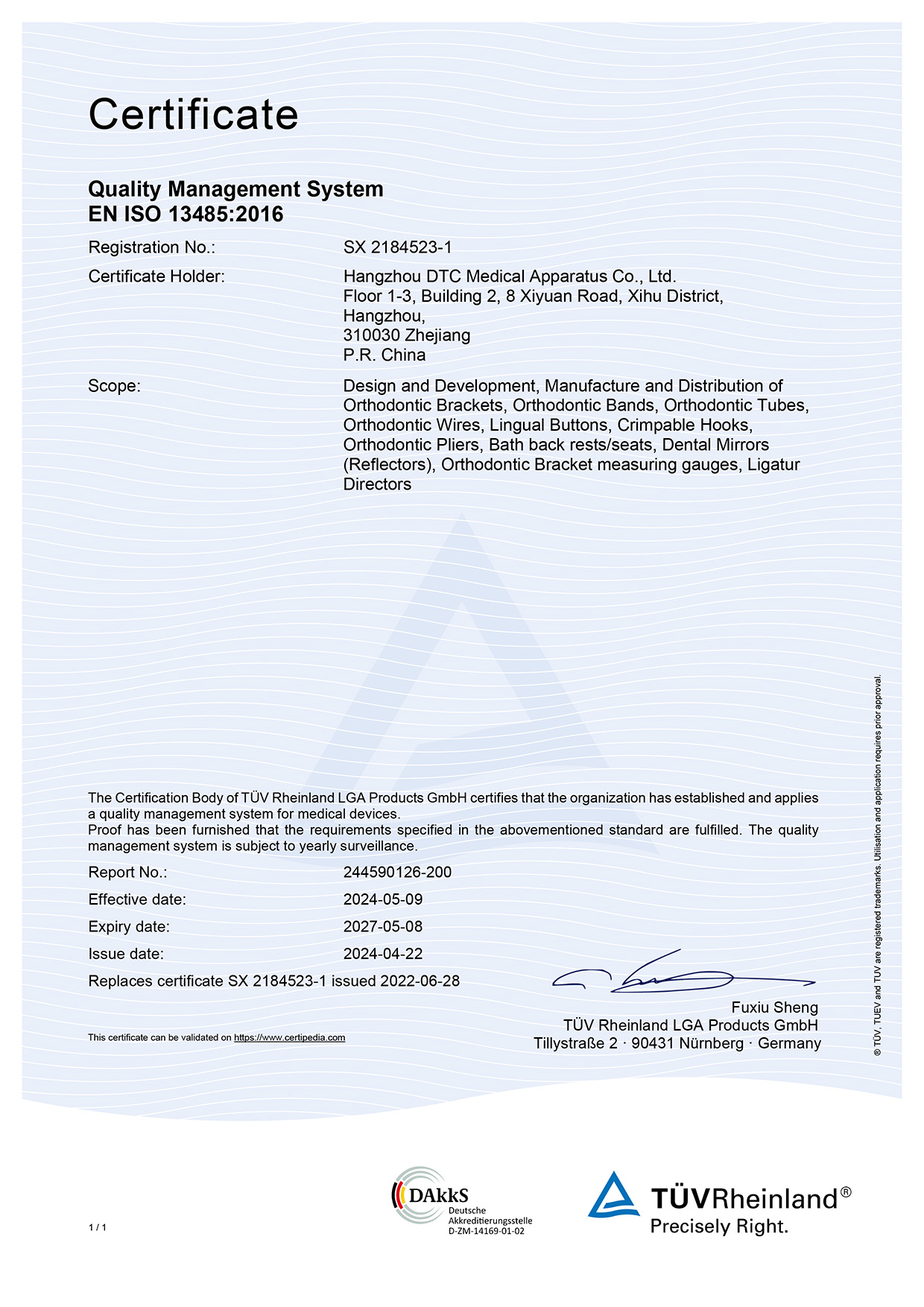
- EN ISO 13485:2016 — certificate no. SX 2184523-1, issued by TÜV Rheinland LGA Products GmbH, valid from 2024-04-22 to 2027-05-08. The certified scope covers design and development, manufacture and distribution of Orthodontic Brackets, Orthodontic Bands, Orthodontic Tubes, Orthodontic Wires, Lingual Buttons, Crimpable Hooks, Orthodontic Pliers and Dental Mirrors (Reflectors).
- FDA — registration number 3009955691 under 21 CFR Part 807, covering product families that include buccal tubes, brackets, preformed bands, orthodontic springs, mouth mirrors and expansion retainers, registered through 2026-12-31.
- EU MDR — Notified Body confirmation letter no. 244557490 from TÜV Rheinland LGA Products GmbH for Class IIa devices, covering Orthodontic Brackets, Orthodontic Tubes, Lingual Buttons, Crimpable Hooks, orthodontic wires and orthodontic bands, valid to 2028-12-31.
That last document list matters for this application specifically: lingual buttons and crimpable hooks — the two accessories that do the most work in a fixed lingual retainer — appear by name inside both the ISO 13485 certified scope and the MDR confirmation letter.
The Lingual Retainer Tray, Component by Component
The configuration below follows the logic of the procedure: an anchor, a span, the tools that shape and cut, and the tools that let you see and handle the parts.
Lingual Buttons: the anchor point
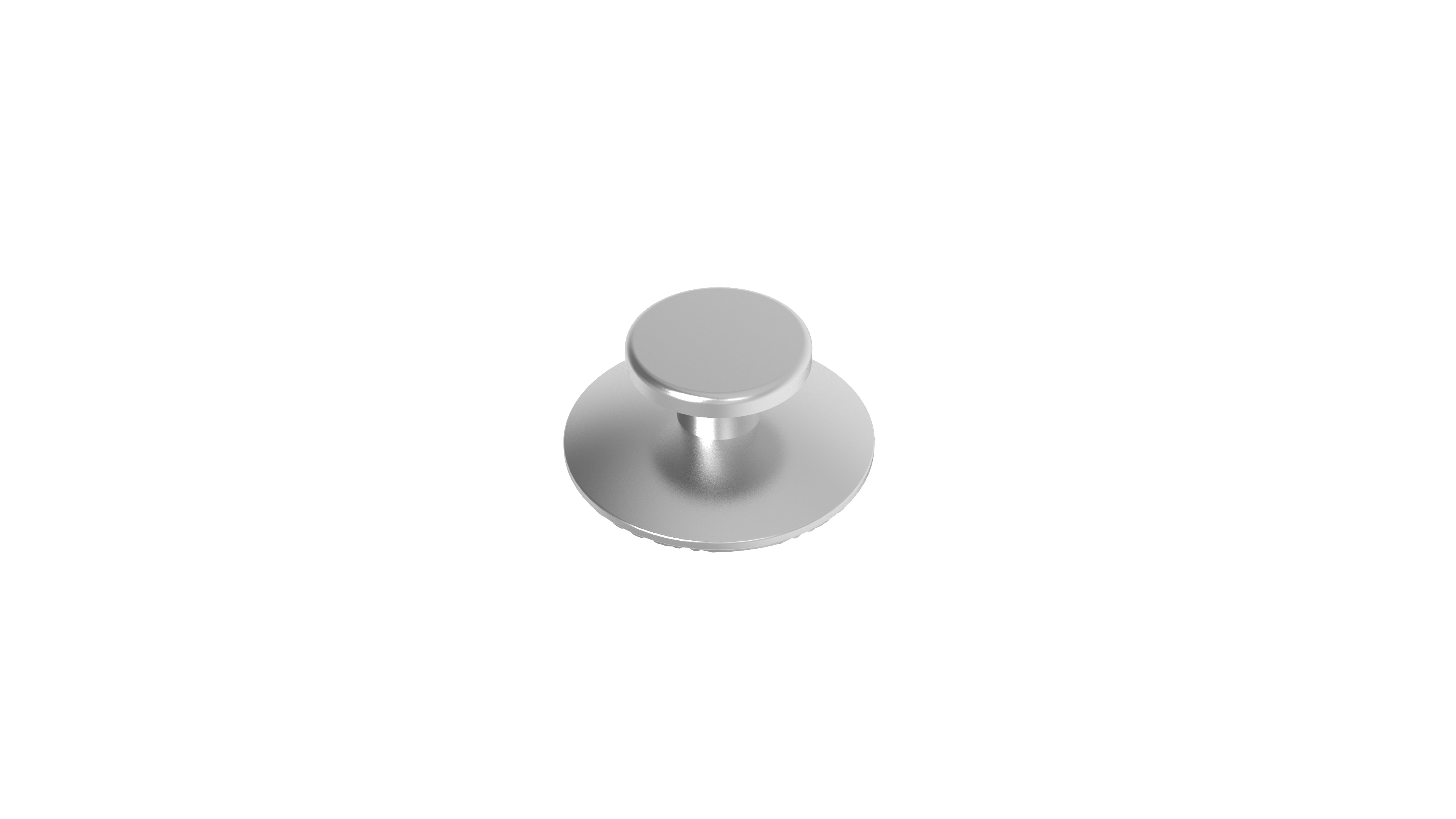
DTC lingual buttons (model designation: Lingual Button) are classified as dental accessories and are available in five base configurations — round base, elliptical base, mesh base, bondable round base, and round base with hole — in either 17-4PH stainless steel or aluminium oxide poly-crystalline ceramic. Bondable versions use an 80# mesh base, and weldable versions are offered with both round and elliptical bases.
Three documented design points matter at the chair. The perforated or textured base is intended to maximise mechanical retention and adhesive bond strength to prevent debonding. The mushroom-shaped button head is designed to hold elastics, chains and ligatures securely. And the low-profile, smoothly polished surface is intended to reduce tongue irritation and improve patient comfort.
Dental Lingual Brackets: when the retainer needs slot mechanics
The DTC-ORG Lingual Series (model designation: DTC-ORG Lingual Series) is a lingual bracket family with slot size 22, available in low torque and high torque, in Roth and MBT prescriptions, for maxillary and mandibular arches, manufactured in 17-4PH stainless steel. A second family, the IN-Tendo JK-SL Series, is also documented as a lingual self-ligating option at slot size 22.

The documented design features read well against retainer use. Hooks of one-piece construction are fitted to all teeth for better ligation and fewer emergencies caused by wire disengagement. A flat bracket design enables better oral hygiene and less occlusal contact interference. Slot geometry is deliberately mixed — 0.018" slots in the anterior brackets and 0.022" slots in the posterior brackets and molar tubes — to lower friction when closing posterior space. And the brackets are smaller than conventional lingual brackets, with rounded hooks, which is intended to reduce tongue irritation and speech disruption. DTC sources the 2D lingual gauges from IN-Tendo.
Lingual Chain: a flexible span
DTC Lingual Chain is a dental accessory manufactured from 17-4PH stainless steel, supplied either with plain stainless steel surfaces or with gold plating on the stainless steel surfaces. Because it is supplied as chain rather than as a rigid arch section, it is cut to length chairside. The matching cutter in the same instrument family is the Light Wire Cutter Pliers, documented for ligature wires up to 0.30 mm.
Dental Wires: three documented material families
DTC documents three wire families that appear in retention planning. Super-elastic Niti Wires are offered in Square, Oval, Natural, Europa I and Da arch forms, in round and rectangular cross-sections, for upper and lower arches. Stainless Steel Arch Wires cover Square, Oval and Natural arch forms, again in round and rectangular cross-sections. CuNITI Arch Wires are available in round, rectangle and Da types and are made from copper and Niti.
A clinic standardising its retainer tray benefits from choosing one family and stocking that family plus a backup, rather than carrying all three at very low volumes. The wire family determines which cutter belongs on the tray, which is the connection most often missed during restocking.
Dental Pliers: cutting, bending and crimping
- Distal End Cutter Pliers — stainless steel, hardness HRC 58-63, mini tips 0.018" × 0.022", specified for arch wires up to 0.021" × 0.025", maximum sterilization temperature 180°C.
- Light Wire Pliers — loop-bending collection pliers, hardness HRC 55-60, wire diameter up to 0.030", maximum sterilization temperature 180°C, intended for forming fine loops and spring loops on arch wires.
- Light Wire Cutter Pliers — hardness HRC 58-63, specified for ligature wires up to 0.30 mm, maximum sterilization temperature 180°C.
- Band Crimping Pliers — hardness HRC 58-63, with thin tips for easy access into molar and premolar bands.
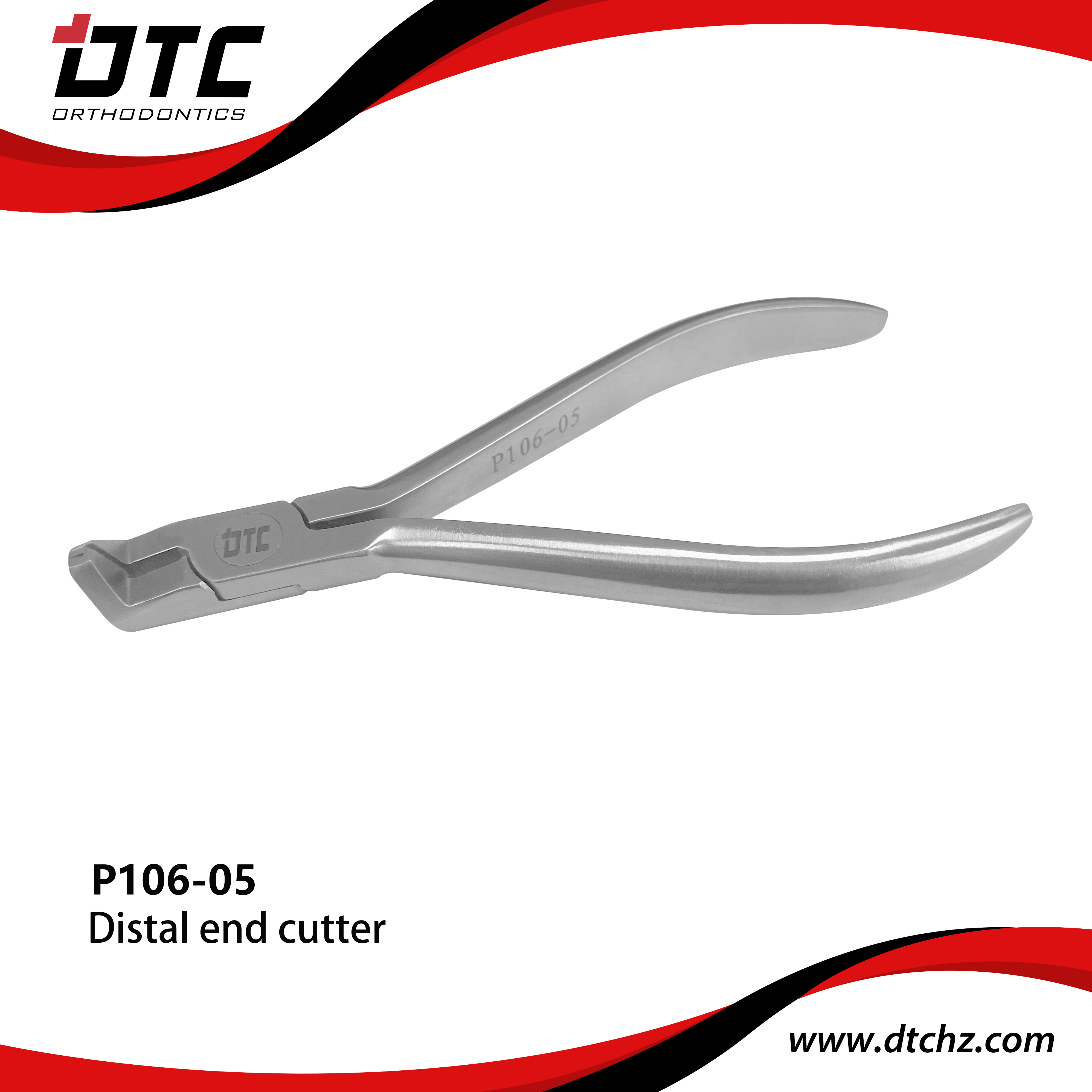
Across the plier range, the shared documented design points are a hardened head, a micro-gap hinge for tightness and durability, CNC machining, ergonomic handles, and corrosion and rust resistance.
Crimpable Hooks
Crimpable Hook (model designation: Crimpable Hook) is made from 17-4PH stainless steel and is available in three lengths — short L=1.3 mm, medium L=2.2 mm and long L=3 mm — in 0.018" and 0.022" sizes, with widths of 1.99 mm and 2.4 mm. Documented characteristics include a precise internal slot for a strong grip on the archwire and slip resistance under traction, an open-channel design that allows placement directly onto the wire, a polished rounded ball end that minimises friction and mucosal irritation, and a robust structure that resists bending or breaking under traction from elastics or springs.

Dental Tweezers and the Needle Holder
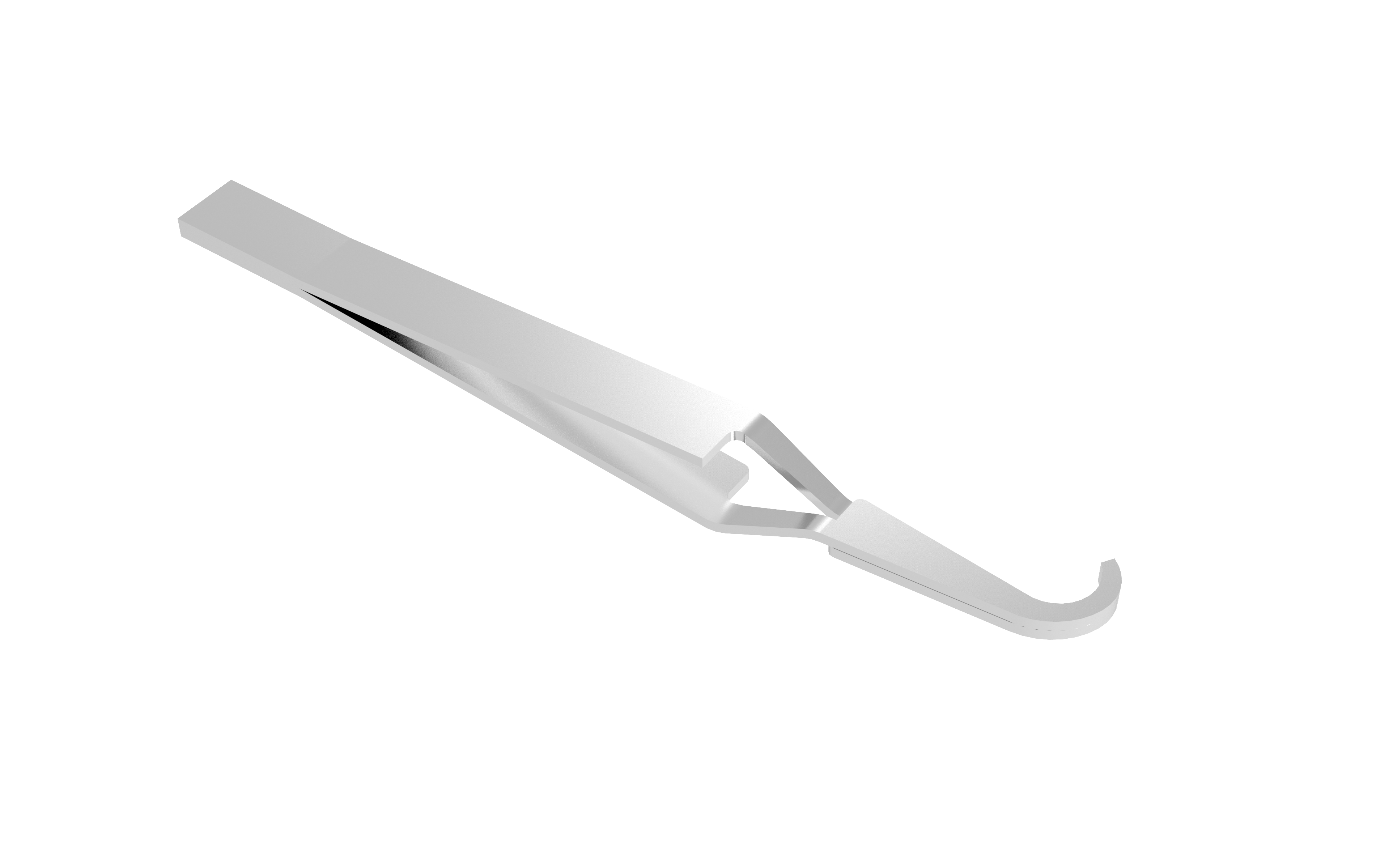
DTC Dental Tweezers (model designations: Brackets Tweezers, Tube Tweezers with long tip or short tip, and Lingual Brackets Tweezers) are stainless steel instruments with a matte, non-reflective finish, an autoclavable construction, rounded and polished edges, and a build intended to resist bending, rusting or degradation over time. For lingual retainer work, the Lingual Brackets Tweezers is the dedicated variant within the set.
The Mathieu Needle Holder is manufactured in stainless steel and is offered in three configurations: with hard tip, without hard tip, and without hard tip Type C.
Stainless Steel and Glass Dental Mirrors
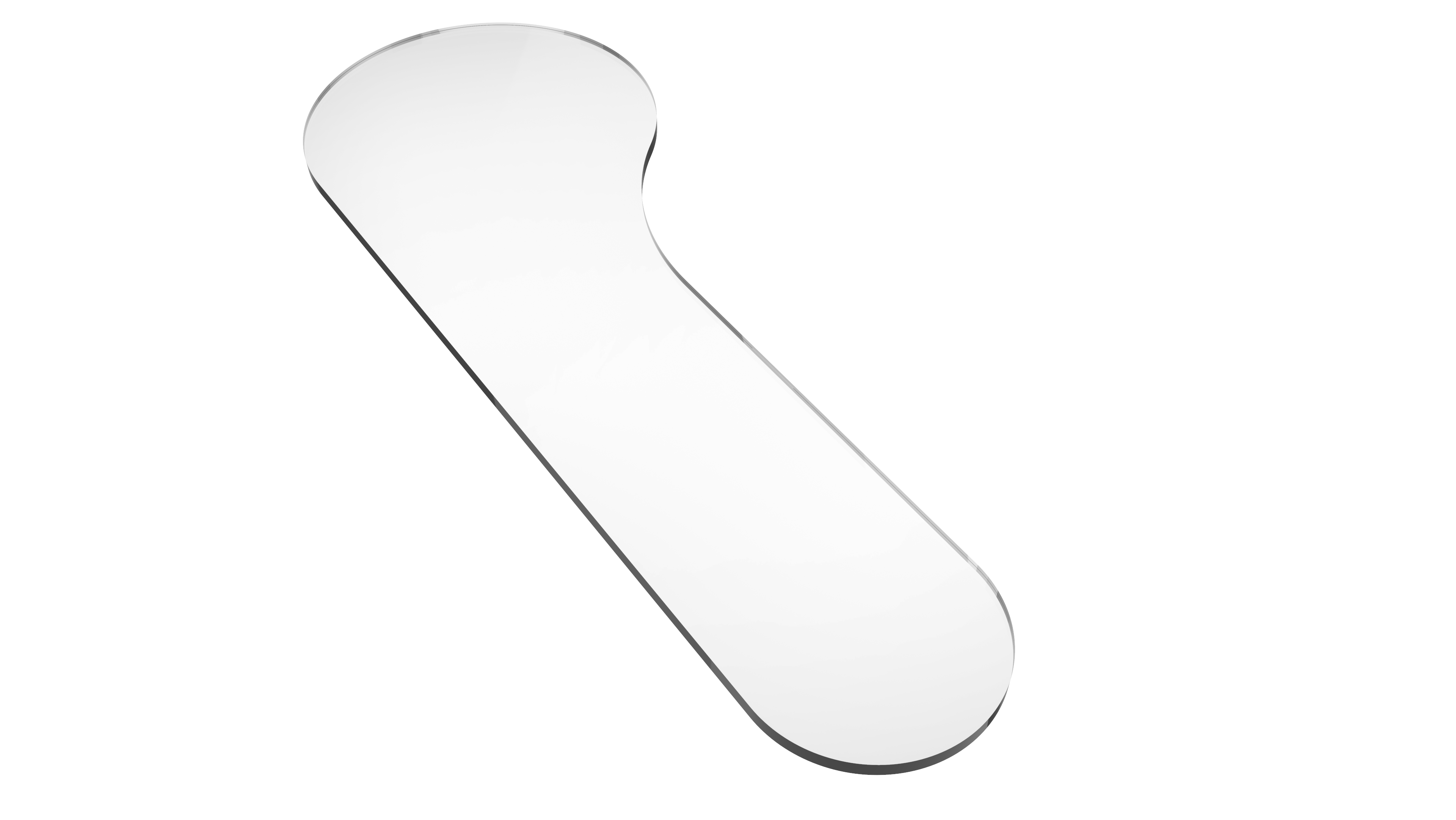
Glass Dental Mirrors (model: Intra Oral Glass Mirror With Hard Surface) are autoclavable up to 130°C and available in occlusion X-large, lingual small, buccal, occlusion large and occlusion small types. The front-surface reflective coating is designed to eliminate ghost imaging for crisp, high-definition clinical photography, and the ultra-flat glass surface provides bright, distortion-free imaging. Stainless Steel Dental Mirrors (model: Intra Oral Stainless Steel Mirror) cover a wider type range — occlusion-3, -4, -5 and -6, lateral-1 through lateral-4, large, small, occlusion large-2, occlusion x-large and occlusion small-2 — and are also autoclavable up to 130°C.
Step-by-Step: Placement, Adjustment and Repair
Step 1 — Verify the tray before the patient is seated
Sort the tray by function: anchors (lingual buttons, lingual brackets), span (lingual chain, dental wires), shaping and cutting (Light Wire Pliers, Distal End Cutter Pliers, Light Wire Cutter Pliers), fixation (Crimpable Hooks, Mathieu Needle Holder), handling (Dental Tweezers) and vision (a lingual mirror). Verify sterilisation limits against documentation — 180°C for pliers, 130°C for mirrors — and confirm that the cutter on the tray is rated for the wire actually in stock.
Step 2 — Initial bonding: choose the base, place the anchor
For a bonded retainer, the relevant options are the bondable round base with 80# mesh, the bondable elliptical base with 80# mesh, the round base with hole, and the ceramic lingual button. Base selection follows the tooth surface, which is why the model family carries several footprints rather than one. Handling is where the Lingual Brackets Tweezers earns its place: it keeps the base uncontaminated before bonding, and the matte finish removes glare under the operating light.
Step 3 — Place the span: wire or chain
Once the anchors are in place, the span is fitted. If the clinic works in wire, the Light Wire Pliers (wire up to 0.030") is the bending instrument and the Distal End Cutter Pliers (arch wires up to 0.021" × 0.025") is the trimming instrument. If the clinic works in chain, the Light Wire Cutter Pliers (ligature wires up to 0.30 mm) handles the cut. Both paths rely on the same mirror for indirect verification of fit, and the glass mirror range includes a lingual small type within its anatomical selection.
Step 4 — Adjust, crimp and verify
When an auxiliary attachment point is required, Crimpable Hooks in 0.018" or 0.022" are placed directly onto the wire through the open channel. Size must match the wire, and the three documented lengths (1.3 mm, 2.2 mm, 3 mm) allow a clinic to standardise on the length it uses most while keeping the alternatives available. Ligature work runs through the Mathieu Needle Holder. Final verification is visual, in the lingual mirror: checking that the segment sits flat against the tooth surfaces and that each button head remains free to receive chain or elastics.
Step 5 — Repair a failed retainer
Repair is the scenario that exposes poor tray organisation. A debonded button, a fractured wire segment and a fatigued chain each require a different first move, but all three require the tray to be complete: a replacement button in the correct base type, a cutter rated for the existing wire, a mirror of the right type, and tweezers that are not buried in a drawer. Keeping the same components in the same position for every chair is the least expensive reliability improvement available to a clinic.
Use Cases: Where This Tray Configuration Pays Off
- Single-chair private clinic. A compact tray holding bondable lingual buttons, one wire family, a matched cutter and a lingual mirror covers scheduled placement and most same-day repairs without carrying surplus inventory.
- Multi-chair clinic. Identical trays per chair reduce the chance that a repair appointment stalls because the only distal end cutter is in another operatory. Standardising on one button base type and one hook length simplifies restocking.
- Unplanned repair slot. The highest-value use case. A patient calls with a loose retainer; the clinic either has the components or loses the chair time.
- Distributor building a clinic kit. DTC channel records show repeat order patterns in this category. Distributor and dealer accounts in Europe, Latin America, Asia, Africa and the Middle East order at the 5,000-unit scale across one to three years with stable operation, while dental clinic accounts in Australia, the United States and Canada order in the 500–1,000 unit range across two to three years. Both patterns are built on routine, repeatable orders of small components rather than one-off equipment purchases.
- Public hospital and institutional purchasing. Institutional accounts in the Middle East and Asia order at the 3,000-unit scale. These buyers typically require the certification documentation on file before the first purchase order, which is where the ISO 13485 and MDR references above do the heavy lifting.
Comparison Tables
| Base type | Material | Documented design intent | Workflow stage |
|---|---|---|---|
| Bondable round base, 80# mesh | 17-4PH stainless steel | Perforated or textured base maximises mechanical retention and adhesive bond strength | Direct bonding, round footprint |
| Bondable elliptical base, 80# mesh | 17-4PH stainless steel | Mesh base in an elliptical footprint | Direct bonding, elliptical footprint |
| Round base with hole | 17-4PH stainless steel | Round base configuration with a through-hole | Direct bonding, alternative geometry |
| Weldable round base | 17-4PH stainless steel | Weldable base variant in the same model family | Laboratory attachment |
| Weldable elliptical base | 17-4PH stainless steel | Weldable base variant in the same model family | Laboratory attachment |
| Ceramic lingual button | Aluminium oxide poly-crystalline | Non-metallic option with the same mushroom-shaped head design | Direct bonding, ceramic material |
| Component | Model designation | Verified specification | Role in the workflow |
|---|---|---|---|
| Lingual Button | Lingual Button | Five base options; 17-4PH stainless steel or aluminium oxide poly-crystalline ceramic | Anchor |
| Dental Lingual Brackets | DTC-ORG Lingual Series | Slot size 22; low or high torque; Roth and MBT; 17-4PH stainless steel | Slot-based lingual attachment |
| Lingual Chain | Lingual Chain | 17-4PH stainless steel; plain or gold plating on stainless steel surfaces | Flexible span |
| Dental Wires | Super-elastic Niti Wires / Stainless Steel Arch Wires / CuNITI Arch Wires | Niti: Square, Oval, Natural, Europa I, Da. Stainless steel: Square, Oval, Natural. CuNITI: round, rectangle, Da | Retainer span |
| Crimpable Hook | Crimpable Hook | 0.018" and 0.022"; L 1.3 / 2.2 / 3 mm; width 1.99 / 2.4 mm; 17-4PH stainless steel | Auxiliary attachment point |
| Dental Pliers | Distal End Cutter Pliers | HRC 58-63; mini tips 0.018" × 0.022"; arch wires up to 0.021" × 0.025"; 180°C | Wire trimming |
| Dental Pliers | Light Wire Pliers | HRC 55-60; wire diameter up to 0.030"; 180°C | Loop forming and bending |
| Dental Pliers | Light Wire Cutter Pliers | HRC 58-63; ligature wires up to 0.30 mm; 180°C | Ligature and chain cutting |
| Dental Tweezers | Brackets / Tube (long and short tip) / Lingual Brackets Tweezers | Stainless steel; autoclavable; matte non-reflective finish | Component handling |
| Needle Holder | Mathieu Needle Holder | Stainless steel; with hard tip, without hard tip, without hard tip Type C | Ligature handling |
| Dental Mirrors | Intra Oral Glass Mirror / Intra Oral Stainless Steel Mirror | Autoclavable up to 130°C; glass range includes lingual small type | Indirect vision and documentation |
Frequently Asked Questions
Is DTC Orthodontics an ISO 13485 certified orthodontic supplies manufacturer?
Yes. DTC holds EN ISO 13485:2016 certification, certificate number SX 2184523-1, issued by TÜV Rheinland LGA Products GmbH and valid from 2024-04-22 to 2027-05-08. The certified scope covers design and development, manufacture and distribution of orthodontic brackets, orthodontic bands, orthodontic tubes, orthodontic wires, lingual buttons, crimpable hooks, orthodontic pliers and dental mirrors — the same accessory and instrument families used in lingual fixed retainer work.
Which products used in a lingual retainer tray carry their own market registrations?
Two documents are directly relevant. FDA registration number 3009955691 under 21 CFR Part 807 covers product families including buccal tubes, brackets, preformed bands, orthodontic springs, mouth mirrors and expansion retainers, registered through 2026-12-31. An EU Notified Body confirmation letter, number 244557490, issued by TÜV Rheinland LGA Products GmbH for Class IIa devices, covers orthodontic brackets, orthodontic tubes, lingual buttons, crimpable hooks, orthodontic wires and orthodontic bands, valid to 2028-12-31. Buyers should confirm which reference applies to the specific product codes and market on their purchase order.
Can a clinic assemble a lingual retainer kit instead of ordering single items?
Yes. The portfolio is structured so components can be combined rather than purchased in isolation. DTC also runs OEM and ODM programmes with customisation of package, logo, tag or product, a documented MOQ starting at 100 units, and a monthly capacity of 5,000 units. In practice a clinic kit is a mixed order: bonded button base types, one wire family, a cutter matched to that wire, a bending plier, tweezers, a needle holder and a mirror of the appropriate type.
What is the minimum order quantity for OEM or ODM orders?
DTC’s published position is that standard MOQ depends on the specific product and the customisation requested. Documented mechanics include split shipments — producing a higher volume for a better unit price while holding and shipping inventory in smaller batches — shared tooling costs, where a client pays a higher upfront tooling fee to unlock a lower production MOQ, and standard in-house colours or materials that avoid custom sourcing minimums. The documented starting figure for OEM and ODM programmes is 100 units.
What are the lead times, and how do I request a sample or a quotation?
Documented lead time for custom OEM or ODM production is 20–30 days. Standard catalogue items are supported by safety stock and typically ship within 3–5 business days, and DTC maintains long-standing partnerships with international courier services including FedEx, DHL and UPS. To validate components before committing to a full order, request a sample or a quotation by email at jaymie@dtchz.com or on WhatsApp at +86 136-0051-7451.
Conclusion: The Retainer Tray Is a Purchasing Decision, Not an Afterthought
Lingual fixed retainer work consumes very few products per case, which is exactly why it is easy to under-plan. The components that matter are stable and specific: lingual buttons in the right base type, dental lingual brackets when slot mechanics are needed, lingual chain or dental wires for the span, distal end cutters and light wire pliers matched to the wire in stock, crimpable hooks in the correct size, dental tweezers, a Mathieu needle holder, and a mirror of the correct type.
Certification is the other half of the decision. EN ISO 13485:2016, FDA registration number 3009955691 and the EU MDR confirmation letter number 244557490 cover the accessory and instrument families named throughout this guide, which means the documentation trail exists for the exact components a retainer tray depends on. Building the tray is a small, finite task. Keeping it complete — and keeping the paperwork behind it current — is what makes the next repair appointment uneventful.
Next Step
Review the full component range before you build the tray.
- Download the DTC Orthodontics English catalogue (PDF): Download the catalogue
- Request a sample or a quotation: jaymie@dtchz.com
- WhatsApp: +86 136-0051-7451
- Website: www.dtchz.com
Hangzhou DTC Medical Apparatus Co., Ltd. — Floor 1-3, Building 2, 8th Xiyuan Road, Xihu District, Hangzhou, Zhejiang Province, China.