
Niti Open vs Closed Springs: A Clinical Comparison Guide
Niti coil springs are the smallest decision on an orthodontic tray — and one of the least forgiving. An open coil and a closed coil with eyelets can look almost identical at arm's length, yet they are built to move teeth in opposite directions: one pushes a segment apart, the other pulls it together. Choosing the wrong one does not simply under-treat a case; it applies force against the mechanics the clinician has already set up.
This guide compares the two coil types as they are specified by DTC Orthodontics — the orthodontic range of Hangzhou DTC Medical Apparatus Co., Ltd., a manufacturer established in 2004 in Hangzhou, Zhejiang Province, China. The comparison covers mechanical behaviour, the space-creation versus space-closure decision, the specification difference between the two products, and the certification and supply facts a clinic, distributor or importer needs before writing a purchase order.
Short answer. Choose Niti Open Spring when the plan needs space created or maintained: it is listed in 180 mm and 914 mm lengths and delivers an expansive force under compression. Choose Niti Closed Spring With Eyelets when the plan needs space closed or a segment retracted: it is listed in 3 mm, 6 mm, 9 mm and 12 mm lengths with eyelet ends for attachment. Both are Niti, and both are available in 0.008″, 0.010″, 0.012″ and 0.014″ diameters.
The Problem: When a Plan Needs Space Created, and When It Needs Space Closed
Fixed appliance treatment rarely reaches its finish in the stage where auxiliaries are placed. Two situations recur, and they require opposite mechanics.
In the first, a segment does not have enough room. Teeth are crowded, a unit is blocked out of the arch, or a site has to be opened before a tooth can be aligned, restored or replaced. The mechanics have to increase the distance between two units while the reference segment holds its position.
In the second, a segment has too much room. Extraction sites and residual space after distalization have to be closed in a controlled, continuous way. Here the mechanics have to decrease the distance between two units.
A coil spring does one of these jobs, and the direction of its force is fixed by its design. The practical risk is not confusion about what the products are; it is selection under time pressure. Because both products share the same four diameters and the same Niti material line, the coils can be picked up, stored and reordered interchangeably unless both the chairside and the buying team track which coil does what. The error surfaces in the mechanics: an expansive force applied where closure is planned works against the anchorage scheme, and a contractile force applied where space is required pulls the segment the wrong way.
Industry Background: Coil Selection Is Now a Purchasing Question Too
Coil springs sit inside the consumable side of the orthodontic supplies category, and that category is expanding. The global orthodontic supplies market was valued at USD 14.8 billion in 2024 and is expected to grow at a CAGR of 20.1% through 2034, according to Global Market Insights.
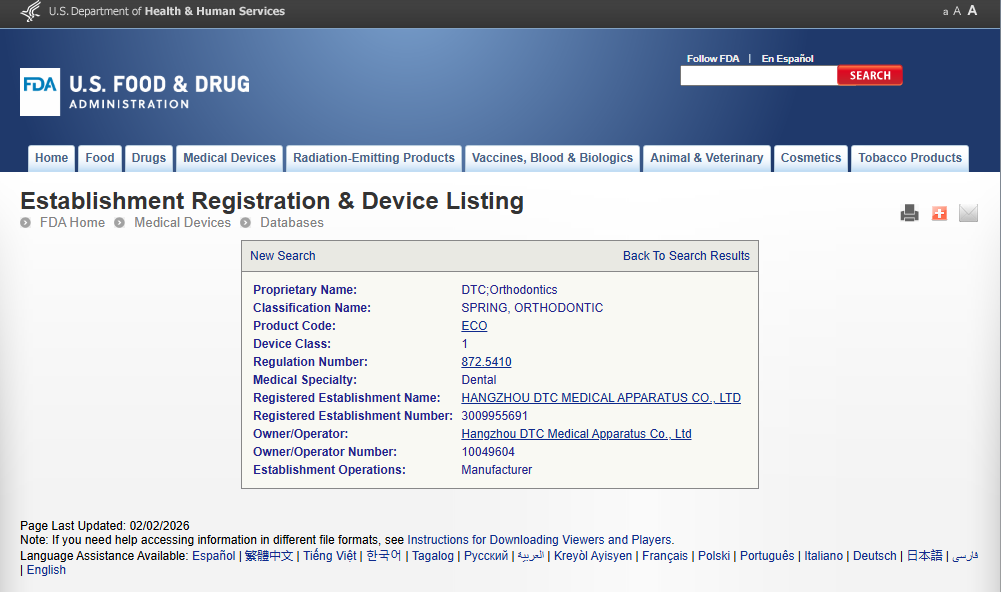
Two consequences follow for anyone buying or specifying springs. First, the auxiliary range on a clinic's shelf keeps widening, which raises the importance of clean product identification: catalogue reference, model name, diameter and length all need to be unambiguous on the order line. Second, regulatory documentation has moved from a nice-to-have to a purchasing requirement. Under the European Union Medical Device Regulation (MDR 2017/745), orthodontic products require CE marking, with most classified as Class I or Class IIa. In the United States, orthodontic springs sit inside a registration scope that DTC already holds: FDA registration 3009955691 lists an Orthodontic Spring device listing under 21 CFR Part 807.
The Two Products, as Specified
Both items below are DTC Orthodontics catalogue products in the orthodontic auxiliary range. The specifications are the ones published in the product listings. This guide does not add force values, activation ranges or clinical outcome statistics that the listings do not state.
Niti Open Spring (product ID 7477)
- Model designation: Open Spring, Open Coil Spring
- Material: Niti
- Available diameters: 0.008″, 0.010″, 0.012″, 0.014″
- Available lengths: 180 mm, 914 mm
- Type: open
- Intended industry: Orthodontic
The open spring is the space-side product in this pair. Two long length options mean the clinician or laboratory works from a longer coil rather than a pre-cut short segment, so the working span can be decided at the chair. As with any auxiliary, the diameter selected and the amount of activation are the variables the clinician controls.
Niti Closed Spring With Eyelets (product ID 7478)
- Material: Niti
- Available diameters: 0.008″, 0.010″, 0.012″, 0.014″
- Available lengths: 3 mm, 6 mm, 9 mm, 12 mm
- Type: identical, different
- Intended industry: Orthodontic
The closed spring is the closure-side product. It is supplied in short, defined lengths that line up with the gap to be closed, and it carries eyelets so that each end has a defined attachment point rather than an open coil end. This matters at the moment of engagement: the coil is designed to be stretched between two points and held, so the security of the end attachment directly affects whether the intended mechanics run as planned.
Mechanical Behaviour: Compression Opens, Extension Closes
The difference between the two products comes down to how the coil is loaded.
The open coil delivers an expansive force. It is placed between two units and compressed. The stored energy in the compressed coil resolves as movement that increases the distance between those units. In clinical terms this is space creation: the coil does the work of opening or holding room in the arch.
The closed coil delivers a contractile force. It is stretched between two attachment points and, once engaged, works back toward its resting length, which decreases the distance between those points. In clinical terms this is space closure and segment retraction.
Both products are specified in Niti (nickel-titanium). Nickel-titanium is the same alloy family behind DTC's super-elastic archwire line (Super-elastic Niti Wires, product 7225), and its relevance to coil springs is the same property that makes it relevant in archwires: a long working range rather than a sharp force peak at a single activation point. What the listings do and do not say matters here. They specify material and geometry — diameter, length, type — not calibrated force outputs. Force delivered at the tooth therefore remains a clinical decision based on the diameter selected, the activation chosen and the case in front of the clinician.
Diameter is the one continuous variable common to both products. Four diameters are listed for each: 0.008″, 0.010″, 0.012″ and 0.014″. As a general engineering principle, a larger coil diameter at the same activation is stiffer and delivers more force, which is why the diameter choice belongs in the treatment plan rather than being decided from whatever is closest to hand.
Step-by-Step: Choosing Between an Open and a Closed Coil
- State the goal in one sentence. Create space at this site, hold space already gained, close this extraction space, or retract this segment. The sentence decides the coil, not the other way round.
- Confirm what the anchorage can tolerate. Opening and closing mechanics load the anchorage differently, so which segment will move and which must hold is part of the same decision.
- Match the coil type to the goal. Space creation and space maintenance point to the Niti Open Spring. Space closure and segment retraction point to the Niti Closed Spring With Eyelets.
- Choose the diameter. Both products are offered in 0.008″, 0.010″, 0.012″ and 0.014″. Record the diameter in the case notes so that the next appointment and the next order stay consistent.
- Choose the length or presentation. The open spring is supplied in 180 mm and 914 mm lengths; the closed spring with eyelets in 3 mm, 6 mm, 9 mm and 12 mm. Length selection matches the product to the span.
- Plan the engagement. An open coil is engaged between two units in compression. A closed coil is engaged through its eyelets and stretched between the attachment points so that it can work back toward its resting length.
- Set the review interval and the adjustment rule. Decide in advance what will be checked at the next visit and what will be changed if the rate of movement is off plan.
- Close the loop with purchasing. Convert the chairside decision into a stock rule: which diameter and length combinations are used most, what the reorder point is, and which documentation has to travel with the shipment.
Clinical and Supply Use Cases
In everyday practice, the two coils are separated by a small number of recurring scenarios.
- Creating room before alignment or restoration. Where a segment is short of space, an open coil is the auxiliary that increases the distance between two units. This is the classic use of the open coil spring.
- Holding space that has been gained. Once room exists, the same product family is used to keep it open while other mechanics proceed.
- Closing an extraction or residual space. The closed spring with eyelets is engaged across the space and works to reduce it.
- Retracting a segment against a defined attachment point. The eyelets give the clinician a fixed point at each end of the coil, which is what makes controlled closure mechanics repeatable from one appointment to the next.
On the supply side, both spring products sit inside portfolios that DTC has already delivered to several buyer types. The company's case records include a distributor programme of 5,000 units running for one to three years across European markets; dealer accounts of 5,000 units in South America, Asia, the Middle East and Africa over the same timeframe; dental clinic accounts of 500–1,000 units in Australia, the United States and Canada, running two to three years with stable operation; and a public hospital project of 3,000 units completed within two to three years. Customer feedback recorded against these programmes cites product quality and affordable pricing. The Niti spring products are listed among the related items in these records, which is useful context for a buyer who wants to know whether the spring range is a standalone catalogue line or part of a broader orthodontic supply relationship.

Comparison Table: Niti Open Spring vs Niti Closed Spring With Eyelets
| Attribute | Niti Open Spring | Niti Closed Spring With Eyelets |
|---|---|---|
| Product ID | 7477 | 7478 |
| Model designation | Open Spring, Open Coil Spring | Niti Closed Spring With Eyelets |
| Material | Niti | Niti |
| Available diameters | 0.008″, 0.010″, 0.012″, 0.014″ | 0.008″, 0.010″, 0.012″, 0.014″ |
| Available lengths | 180 mm, 914 mm | 3 mm, 6 mm, 9 mm, 12 mm |
| Type designation | open | identical, different |
| End configuration | Open coil | Eyelets at the ends |
| Loading mode | Compression | Extension |
| Force direction when activated | Expansive — pushes units apart | Contractile — pulls units together |
| Primary clinical role | Space creation and space maintenance | Space closure and segment retraction |
| Intended industry | Orthodontic | Orthodontic |
| Device documentation covering the item | FDA registration 3009955691 (scope includes Orthodontic Spring); ISO 13485:2016 certificate SX 2184523-1 | Same FDA registration scope and same quality management system certificate |
Specification rows reflect the published DTC Orthodontics product listings. The loading, force-direction and clinical-role rows describe the accepted orthodontic principle for open and closed coil springs. The product listings themselves specify material and geometry rather than force values, and this comparison does not convert one into the other.
What Clinics, Distributors and Importers Should Verify Before Ordering
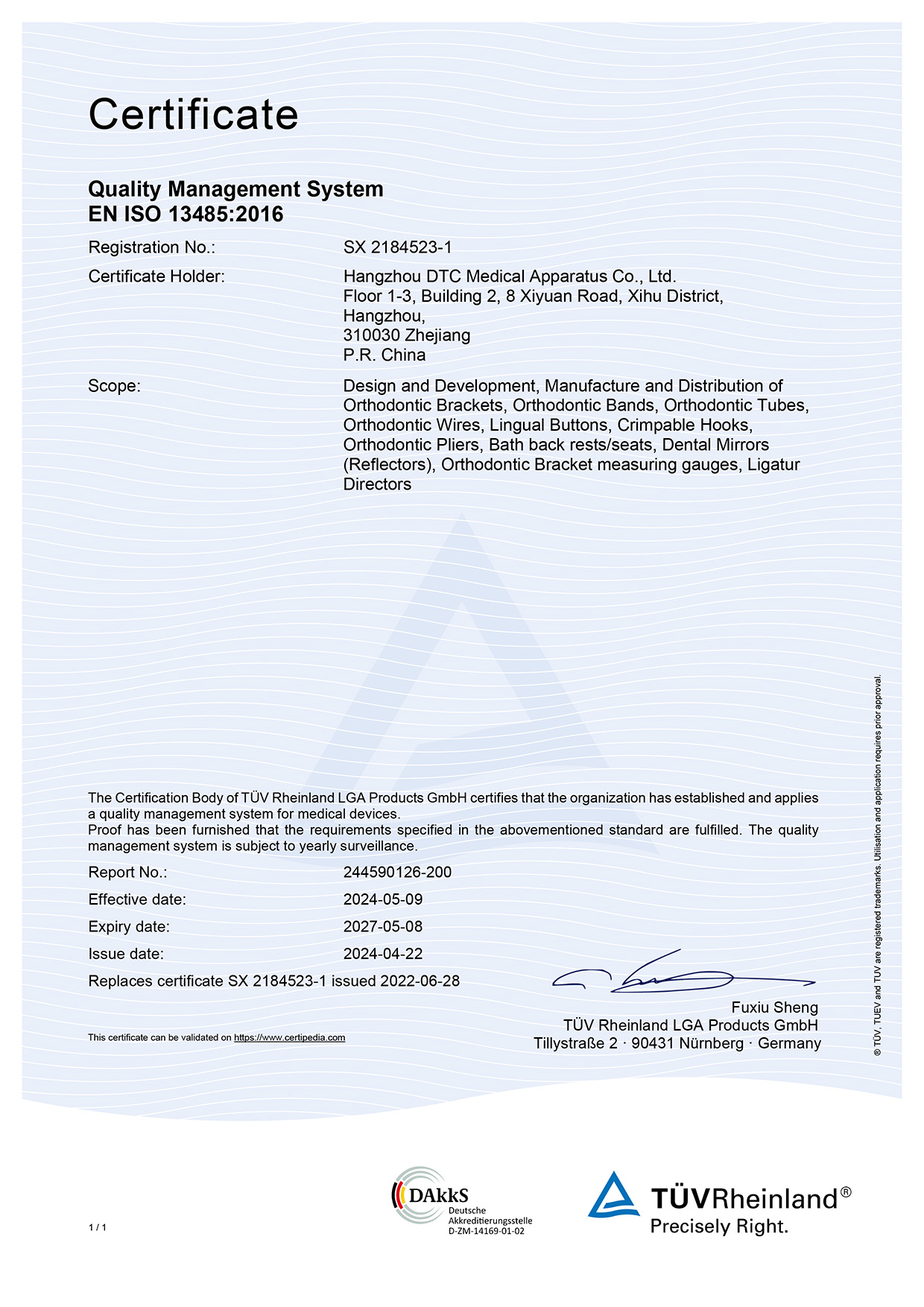
Certification coverage. The company holds an ISO 13485:2016 Medical Device Quality Management System certificate (SX 2184523-1, issued by TÜV Rheinland LGA Products GmbH, valid to 8 May 2027), a Notified Body confirmation letter for the MDR transition covering Class IIa medical devices (244557490, TÜV Rheinland LGA Products GmbH, valid to 31 December 2028), and FDA registration 3009955691 under 21 CFR Part 807, whose scope explicitly includes an Orthodontic Spring listing. An Export Sales Certificate for Medical Products (Zhe-Hang Food & Drug Medical Device Export No.20260027) is also on file with the Zhejiang Medical Products Administration.
Customisation and MOQ. DTC operates an OEM/ODM model with customisation available at package, logo, tag and product level. The standard minimum order quantity is 100 units, and the company states that the exact MOQ depends on the specific product and the customisation requested. Lower entry volumes can be structured through options such as split shipments (producing a higher volume for a better unit price but shipping in smaller batches), shared tooling costs, or agreeing to standard in-house colours and materials instead of custom sourcing.
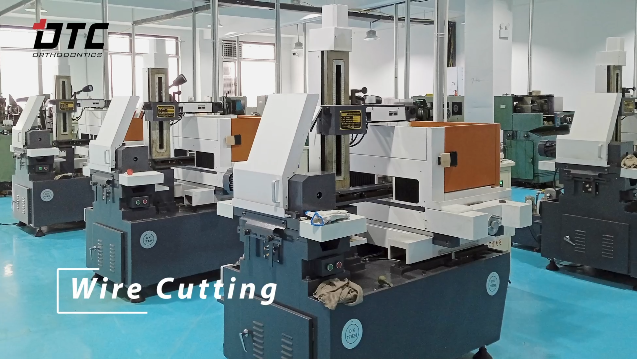
Capacity, lead time and quality control. Monthly capacity is listed at 5,000 units, with a production lead time of 20–30 days. Standard items held in safety stock can ship within 3–5 business days, while custom-engineered production runs are quoted at a 2–4 week lead time; DTC works with international couriers including FedEx, DHL and UPS. Quality control is described as 100% testing, supported by a formal quality management system and direct manufacturer control over production and shipment release, with the stated objective that every delivery meets the customer's requirements. After-sales support is provided remotely. Around 80% of output is exported, reaching the EU, the USA, the Middle East, South America, Asia, Africa and Australia.
Documentation at the order line. For a spring order, the practical checklist is: catalogue reference (7477 or 7478), diameter, length, quantity, any customisation scope, and the certificate set required by the destination market. Keeping the product ID on the order line is the simplest way to prevent an open coil being reordered in place of a closed coil.
Frequently Asked Questions
Are DTC's Niti springs covered by medical device certification?
Yes. FDA registration 3009955691, held by Hangzhou DTC Medical Apparatus Co., Ltd. under 21 CFR Part 807, includes an Orthodontic Spring device listing in its scope. The company's ISO 13485:2016 certificate (SX 2184523-1, issued by TÜV Rheinland LGA Products GmbH) covers design and development, manufacture and distribution of orthodontic products, and a Notified Body confirmation letter for the MDR transition (244557490) covers Class IIa medical devices for the EU market.
What diameters and lengths are available for each spring?
Both products are listed in 0.008″, 0.010″, 0.012″ and 0.014″ diameters and both use Niti. Niti Open Spring (product ID 7477) is supplied in 180 mm and 914 mm lengths. Niti Closed Spring With Eyelets (product ID 7478) is supplied in 3 mm, 6 mm, 9 mm and 12 mm lengths, with a type designation of identical or different.
Can the springs be supplied under OEM or private label, and what determines the MOQ?
Customisation is available at package, logo, tag and product level under DTC's OEM/ODM model. The standard minimum order quantity is 100 units, but the company states that the exact MOQ depends on the specific product and the customisation requested. Lower entry quantities can be arranged through split shipments, shared tooling costs, or by selecting standard in-house colours and materials instead of custom-sourced options.
How consistent is quality from batch to batch?
DTC operates as both manufacturer and exporter and maintains a documented quality management system that governs production, with 100% testing described as its quality control standard and direct control over production, quality management and shipment release. The stated objective is that every shipment meets the customer's requirements, and the ISO 13485:2016 certificate is the external evidence of that system.
What are the lead times, and how do we start?
Production lead time for custom requirements is listed at 20–30 days. Standard products held in safety stock can be shipped within 3–5 business days, while custom-engineered runs are quoted at a 2–4 week lead time, with FedEx, DHL and UPS used for international delivery. The fastest way to start is to send the intended application (open or closed coil), the diameter and length mix, and the destination market, so that the correct documentation set can be confirmed at the same time. The full range is available for download from the DTC catalogue, and the export team can be reached at jaymie@dtchz.com or on +86 136-0051-7451 for a quotation.
Conclusion: One Letter of the Specification Decides the Direction of Force
The distinction between Niti Open Spring and Niti Closed Spring With Eyelets is not cosmetic. One product opens space and the other closes it, and that difference comes from a single design decision — whether the coil is loaded in compression or in extension — together with the eyelets that give the closed coil a defined attachment point at each end. Everything else is shared: the same Niti material, the same four diameters of 0.008″, 0.010″, 0.012″ and 0.014″, and the same orthodontic application.
For clinicians, the selection rule is short enough to teach: open coil for space creation and maintenance, closed coil with eyelets for space closure and retraction, with diameter and length recorded in the plan. For buyers, the same rule becomes a stock and documentation rule: order by product ID, keep the two types separately identified, and request the certificate set required by the destination market with every shipment.

Next step. If you are specifying or stocking orthodontic coil springs, DTC Orthodontics can confirm the diameter, length and documentation set for your market in one reply. Contact jaymie@dtchz.com or +86 136-0051-7451 (WhatsApp: +86 136-0051-7451), review the full range at www.dtchz.com, or download the English product catalogue here: DTC Orthodontics catalogue (PDF).