
Orthodontic Face Masks and Pull Systems for Skeletal Class III Correction
Extraoral traction for skeletal Class III correction is delivered in two halves: a face mask that anchors the appliance against the forehead and chin, and a traction element that the clinician adjusts to set the working force. DTC Orthodontics (Hangzhou DTC Medical Apparatus Co., Ltd.) manufactures both halves of that system — the Orthodontic Face Mask in a Full Adjustable version and an Adjustable version, the Orthodontic Adaptable Mask (Adaptable Class III Mask), and the Orthodontic Pull System (High-pull system).
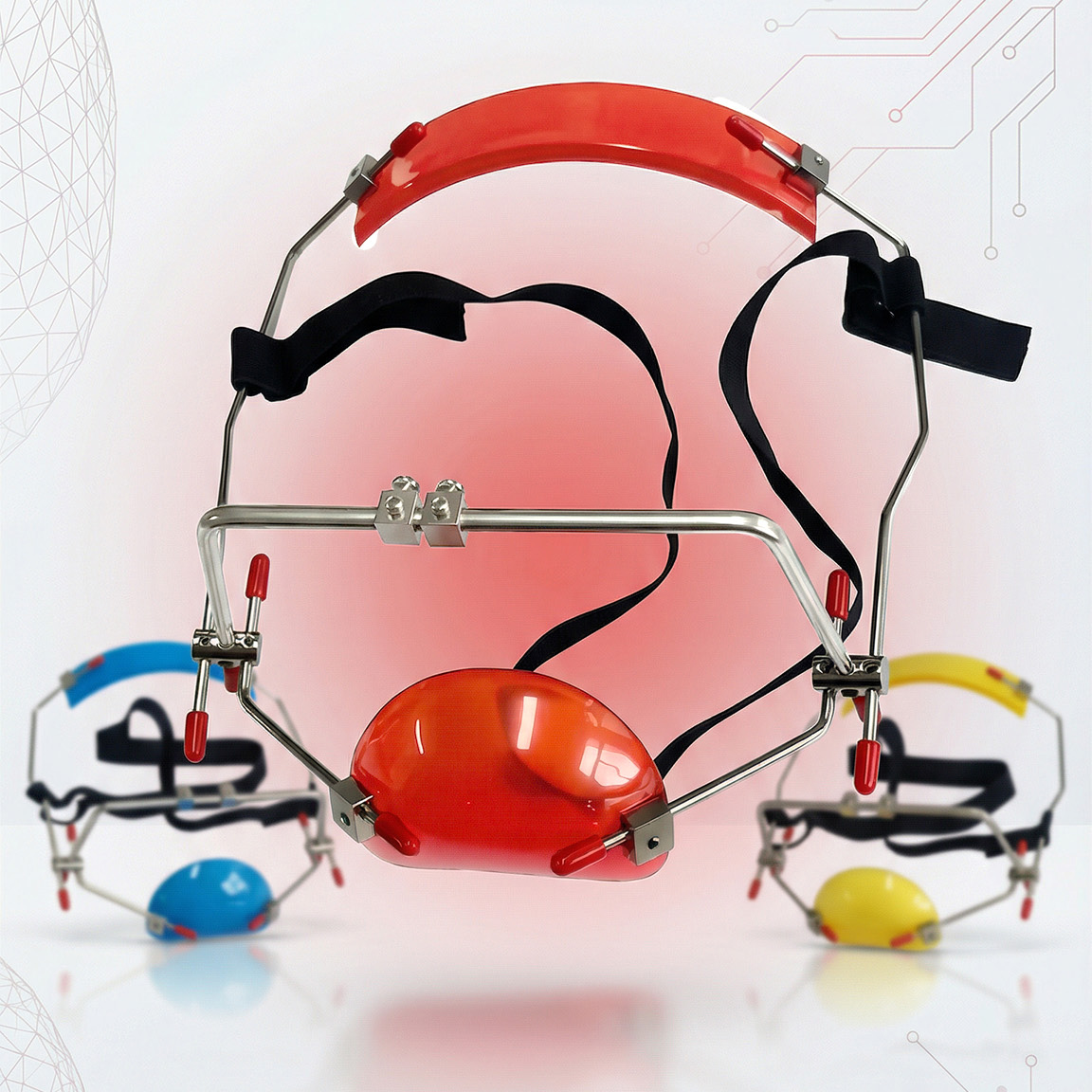
Orthodontic Face Mask (Full Adjustable Face Mask): stainless steel and ABS frame with adjustable forehead and chin pads and a heavy-duty adjustable crossbar.
This application guide covers the practical half of that pairing: what each mask platform is designed to do, how the frame and the pull system are fitted, how force direction is controlled through the crossbar, and which variant suits which kind of case. Product names, model designations, sizes, colours and materials below are taken from the published specifications for each item. Force levels and wear schedules are deliberately not prescribed here, because appliance activation and case selection remain clinical decisions.
The guide is written for three readers: the orthodontist who has to choose between mask platforms, the clinic manager who has to keep the right sizes and colours in stock, and the distributor who has to build a coherent extraoral traction line rather than a random set of SKUs.
What Extraoral Traction Has to Solve
A face mask is the right tool when the correction being attempted is orthopedic rather than purely dental — when the treatment goal is to influence the position of the maxilla and the dental base, not only the alignment of individual teeth. The appliances described in this guide are stated by the manufacturer to be intended for orthodontic force application in skeletal Class III malocclusion correction and for orthodontic traction.
Three design variables determine whether that intent can be realised in daily practice, and each one maps onto a physical feature of the product family.
- Vector control. Traction that pulls in the wrong direction is wasted wear time. The Full Adjustable Face Mask and the Adaptable Class III Mask both carry a crossbar that can be adjusted to modify the traction vector, so the direction of force can be matched to the individual facial anatomy instead of forcing the anatomy to match the appliance.
- Stable anchorage. The reaction force has to land somewhere that tolerates it. The Orthodontic Adaptable Mask is built with a forehead rest and a chin cup, a combination the manufacturer describes as ensuring stable anchorage and even force distribution over the forehead and chin.
- Wear acceptance. An extraoral appliance only does its job if the patient keeps wearing it. Soft, breathable padding is specified to reduce pressure spots, and the colour range — from plain blue, yellow and red to clear, purple, green and glitter finishes on some models — is listed as a compliance feature rather than a cosmetic afterthought.
There are real boundaries to keep in view. These are professional-use dental instruments; the appliance does not select the case, and neither does the supplier. Growth status, patient cooperation and skin tolerance all condition the outcome, and the force applied through the crossbar or the pull system is set by the treating clinician within the rules of their market. What the manufacturer contributes is a device that holds a chosen vector steadily and comfortably enough to be worn.
Industry Background: Why This Appliance Family Matters Commercially
Spending on orthodontic supplies is expanding faster than most dental categories. The global orthodontic supplies market was valued at USD 14.8 billion in 2024 and is expected to grow at a CAGR of 20.1% through 2034, according to Global Market Insights. Within that total, China's orthodontic supplies market was estimated at approximately USD 713.25 million in 2024 by Market Research Future, and North America held the largest regional share of global revenue in 2024 at an estimated 30.6%, according to Grand View Research.
Reported market sizes differ considerably between research houses because the definitions of 'supplies', 'consumables' and 'devices' overlap without being identical. Global Market Insights' USD 14.8 billion figure for 2024 and a Roots Analysis estimate of USD 8.84 billion describe related but differently scoped markets. For procurement planning, the directional signal is more useful than the absolute number: demand for orthodontic appliances and extras is rising, and adult treatment is part of that rise, with clear aligners growing at a 14.25% CAGR according to Mordor Intelligence.
Regulation shapes the buying decision as much as demand does. In the European Union, Medical Device Regulation (MDR 2017/745) requires CE marking for orthodontic products and classifies most of them as Class I or IIa, per the European Parliament's published regulation. In the United States, orthodontic brackets and tubes are classified as Class I or II devices under 21 CFR 872.5410, with ISO 27020:2019 recognised as the relevant standard, according to FDA classification data. Buyers importing face masks and traction systems therefore need a manufacturer whose certificate set and production documentation can be checked, not just quoted.
Supply chain behaviour is the third commercial factor. Mordor Intelligence notes that orthodontic archwires made of nickel-titanium face supply chain risk because of heavy reliance on Chinese raw materials, which is one reason clinics and distributors keep a broader safety stock of standard components instead of ordering case by case. That is also the context in which a manufacturer's own footprint matters: Hangzhou DTC Medical Apparatus Co., Ltd. was established in 2004, produces CE0197, ISO13485 and FDA certified orthodontic supplies, runs a 5,000 m² facility with a 30-engineer R&D team, and reports an annual output of 1,000,000 units with roughly 80% of sales exported to markets including the EU, USA, Middle East, South America, Asia, Africa and Australia.
The Four Appliances and What Each One Is Designed to Do
The family splits into three mask platforms and one traction element. Two of the masks are sold under the Orthodontic Face Mask name, one is the Class III-specific platform, and the fourth item supplies the traction itself. Choosing between them is a question of required force character, vector precision and patient fit.
1. Orthodontic Face Mask — model Full Adjustable Face Mask
The Full Adjustable Face Mask is a Dental Instruments-category appliance made of stainless steel and ABS, available in blue, yellow and red, and supplied in large and small sizes. Its stated design objectives are specific: it facilitates coordinated mesial movement of both jaws for correction of skeletal Class III malocclusion, and it enables segmental protraction, which gives the clinician control over force direction and clinical vectors in segmental cases rather than only full-arch pull. The frame uses an ergonomic design with adjustable forehead and chin pads and a heavy-duty adjustable crossbar for precise traction vector control. In practical terms, this is the platform for a case where the clinician wants a large or small frame plus the ability to shift the direction of traction as the case evolves.
2. Orthodontic Face Mask — model Adjustable Face Mask
The second platform in the same family is supplied as the Adjustable Face Mask. It is likewise classified under Dental Instruments and made of stainless steel and ABS, and it is offered in standard and small sizes. Its distinguishing feature in the published data is the colour range: blue, yellow, red, clear, purple, green, glitter purple and glitter orange. That breadth is not decoration — colour choice is listed by the manufacturer as a compliance aid, and compliance is the limiting factor in almost every extraoral traction protocol. This is the version to specify when the case is straightforward but the patient is young, self-conscious, or likely to resist a plain appliance.
3. Orthodontic Adaptable Mask — model Adaptable Class III Mask
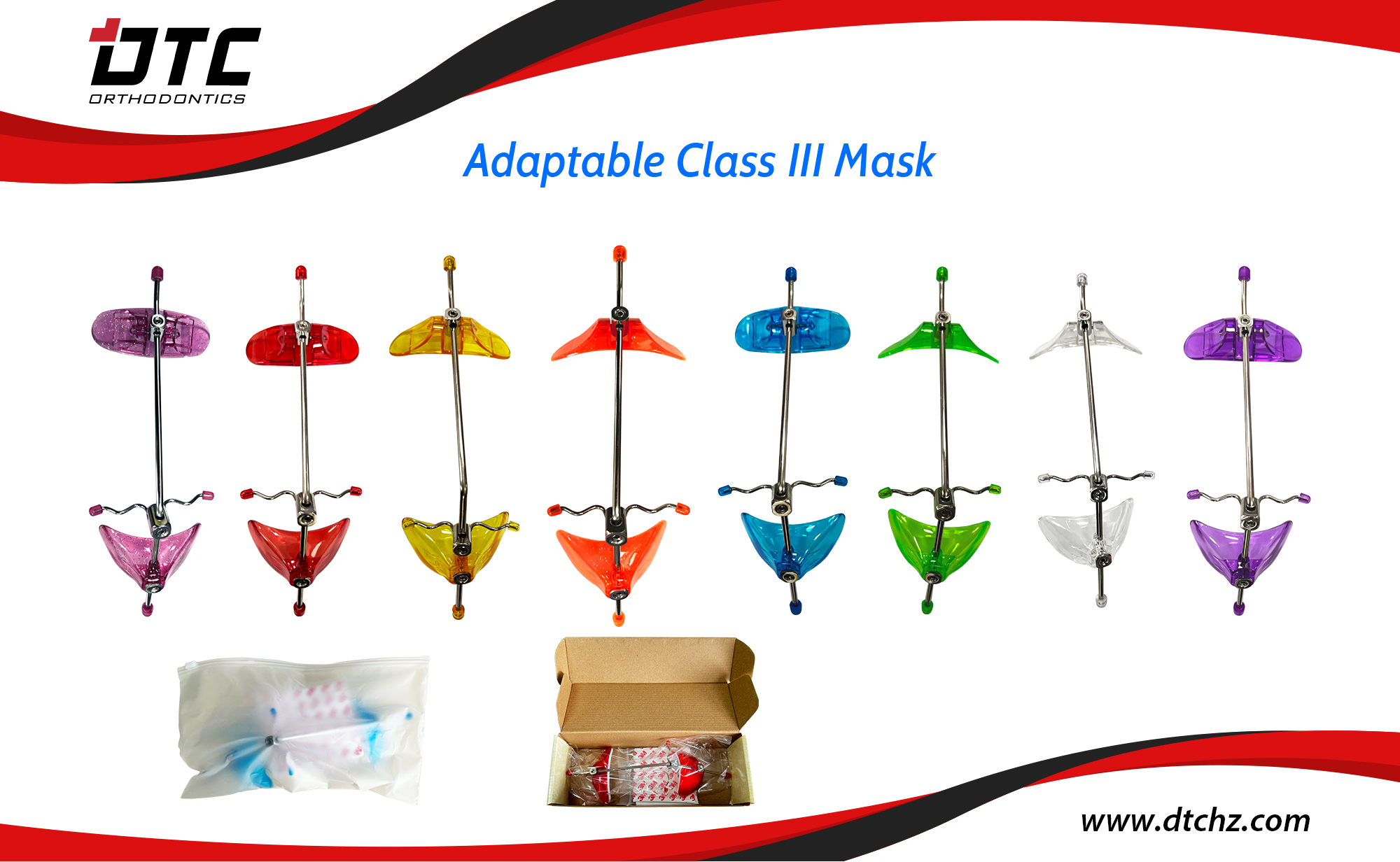
Orthodontic Adaptable Mask (Adaptable Class III Mask): forehead rest and chin cup configuration with a fully adjustable crossbar, supplied in standard and small sizes.
The Adaptable Class III Mask is the dedicated skeletal Class III platform. It is a Dental Instruments product made of stainless steel and ABS, offered in blue, yellow, green, purple, red, clear, glitter orange and glitter purple, in standard and small sizes. Its design is built around a forehead rest and chin cup that the manufacturer describes as ensuring stable anchorage and even force distribution over the forehead and chin, plus a fully adjustable crossbar that allows precise adjustment of traction vectors to fit various facial anatomies. It is specified to deliver heavy force for Class III cases — the powerful, continuous orthopedic traction that skeletal Class III correction requires — and it uses medical-grade stainless steel for structural rigidity together with soft, breathable pads intended to minimise pressure spots.
4. Orthodontic Pull System — model High-pull system
The Orthodontic Pull System (High-pull system) is the traction component of the setup. It is a Dental Instruments product made of PE, polyester fabric and stainless steel, and it is intended for orthodontic traction in the orthodontics industry. It is supplied in large, medium and small sizes. Where the masks define the anchorage interface and the vector geometry, the pull system supplies the working traction element that the clinician adjusts; the three sizes let the assembly be matched to the patient's facial dimensions instead of being modified in the clinic. Colour options are not stated in the published product data for this item.
How the Four Items Work Together in One Protocol
The mask does not work alone, and neither does the pull system. A workable extraoral protocol has three layers. The extraoral layer is the mask frame — forehead pads, chin cup and crossbar — which establishes where the force enters the face and in which direction it travels. The traction layer is the Pull System, supplied in three sizes, which carries the load the clinician has chosen. The intraoral layer is what actually couples the system to the dentition: prewelded or pediatric bands, buccal tubes, and archwires that provide a fixed point for the intraoral mechanics that accompany extraoral traction.
DTC Orthodontics produces all three layers, which matters for a clinic or distributor because size and finish consistency across the layers is easier to control when they come from one production system. The intraoral components used alongside the masks include Dental Orthodontic Bands (model Bands) in stainless steel, in Roth, MBT and edge-wise systems with low or high torque, offered as Prewelded Bands and Pediatric Bands and described as anatomically shaped with a precise snap fit, a permanent laser mark and a patented rough inner surface for retention. Buccal tubes from the Zeal Plus Series are stainless steel, in slot sizes 18 and 22, and carry a high-strength monoblock hook, an occlusal indent for positioning, a longer tube body for torque control and a tooth number on the cap for identification.
Step-by-Step: Fitting and Force Application
The sequence below follows the order in which an extraoral case is usually set up. Each step names the specific product and the specification that supports it, so the workflow can be reproduced without guesswork.
- Confirm the indication and record the growth status. The masks in this family are stated as intended for orthodontic force application in skeletal Class III malocclusion correction and for orthodontic traction. If the case is a skeletal discrepancy rather than a purely dental one, the extraoral route is on the table; the frame size and the force level are then set to the patient, not the other way around.
- Select the mask platform and size. Use the Full Adjustable Face Mask (large or small) when dual-jaw mesial movement or segmental protraction is required and the vector has to be adjustable through a heavy-duty crossbar. Use the Adjustable Face Mask (standard or small) when a wider colour choice will support acceptance. Use the Adaptable Class III Mask (standard or small) when the case calls for heavy, continuous orthopedic traction with a forehead rest and chin cup and a fully adjustable crossbar. All three are stainless steel and ABS.
- Prepare the intraoral anchorage. Band the molars with Dental Orthodontic Bands in the appropriate system and torque, or use Pediatric Bands for smaller dentitions. The band's anatomically shaped contour, snap fit and patented rough inner surface are the retention features that keep the intraoral anchor stable while the extraoral force is applied. Add buccal tubes (Zeal Plus Series, slot 18 or 22) where the archwire needs a terminal attachment with a monoblock hook, and select archwires from the Super-elastic Niti Wires, Stainless Steel Arch Wires or CuNITI Arch Wires ranges in the arch form and cross-section the case requires. Where an additional attachment point is needed, Lingual Buttons are available with round, elliptical, mesh, bondable round or round-with-hole bases in stainless steel or ceramic, and Crimpable Hooks come in short (L=1.3 mm), medium (L=2.2 mm) and long (L=3 mm) types for 0.018-inch and 0.022-inch wire.
- Assemble and fit the extraoral frame. Position the forehead pads and chin cup so that contact is spread across the intended surfaces rather than concentrated at a single point; the Adaptable Class III Mask is specified with a forehead rest and chin cup for exactly this reason. Select the size that matches facial dimensions — large or small on the Full Adjustable Face Mask, standard or small on the Adjustable Face Mask and the Adaptable Class III Mask. Adjust the pads before adjusting the crossbar, so the vector work is not undone by a loose frame.
- Set the vector with the crossbar. The crossbar is the direction control on the Full Adjustable Face Mask and the Adaptable Class III Mask. Adjust it to place the traction vector according to the case, then verify that the pull runs in that direction with the pads still seated. Segmental protraction cases benefit from setting the vector per segment rather than assuming a single symmetrical pull.
- Integrate the pull system. Choose the large, medium or small High-pull system so the assembly matches the patient's dimensions, and connect it as the working traction element of the setup. Because the pull system is made of PE, polyester fabric and stainless steel, it provides a flexible traction element alongside the rigid frame — a combination that lets the clinician keep the frame position stable while adjusting the load.
- Manage tissue contact and compliance from day one. Soft breathable padding and smooth, polished surfaces are the design features that reduce irritation, and colour choice is a stated compliance tool on the models offered in clear, purple, green, glitter orange or glitter purple. Explain pad placement, cleaning and wear expectations to the patient and the parent at the fitting appointment rather than at the first follow-up.
- Support the setup with the right instruments. Distal End Cutter Pliers (hardness HRC 58-63, mini tips 0.018 inch x 0.022 inch, for archwires up to 0.021 inch x 0.025 inch, maximum sterilization temperature 180°C) handle distal wire trimming. Band Crimping Pliers (HRC 58-63, 180°C) have thin tips for access into molar and premolar bands. Light Wire Cutter Pliers (HRC 58-63, 180°C) cut ligature wires up to 0.30 mm. All are stainless steel with corrosion and rust resistance, which is the practical requirement when instruments are autoclaved between appointments.
- Document and plan resupply. Record the mask model, size and colour in the patient file so a replacement or a second case uses the same platform, and keep the clinic's stock list aligned with the sizes actually used. Standard products are held in safety stock for delivery within 3–5 business days, while custom-engineered production runs require a 2–4 week lead time.
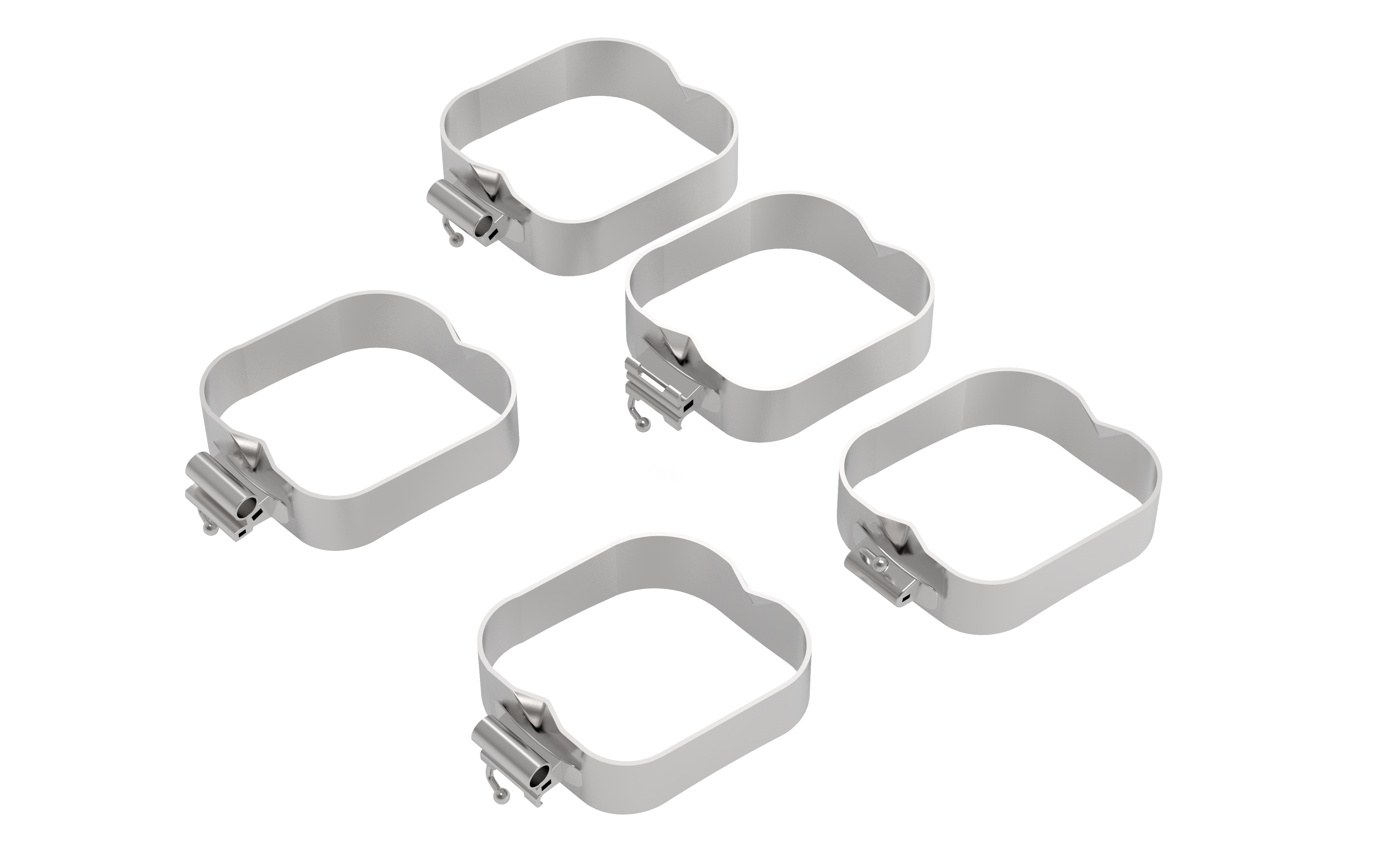
Dental Orthodontic Bands (Prewelded Bands): stainless steel molar anchorage with a permanent laser mark and patented rough inner surface, used as the intraoral fixation layer beneath a face mask setup.
Use Cases: Which Variant for Which Case
Mask selection follows the force requirement first and the fit requirement second. The following situations illustrate how the published specifications translate into a choice.
- Growing patient needing full-frame extraoral traction with an adjustable vector. Full Adjustable Face Mask in the large size; adjust the crossbar as the case progresses and use the dual-jaw mesial movement capability when both jaws are involved.
- Younger or smaller patient, standard frame. Full Adjustable Face Mask in the small size, or the Adjustable Face Mask in standard or small, depending on the colour preference that will support wear.
- Patient with low tolerance for a plain appliance. Adaptable Class III Mask or Adjustable Face Mask in clear, purple, green, glitter orange or glitter purple, with soft breathable pads to reduce pressure discomfort.
- Case requiring heavy, continuous orthopedic traction. Adaptable Class III Mask, which is specified for heavy force in Class III cases with a forehead rest and chin cup and a fully adjustable crossbar.
- Segmental or asymmetric protraction. Full Adjustable Face Mask, using its segmental protraction capability to control force direction segment by segment rather than as one uniform pull.
- Traction element replacement or spare stock. Orthodontic Pull System in large, medium or small, kept as the consumable part of the extraoral setup.
- Distributor SKU planning. Build the line around a size matrix rather than a single variant: three mask platforms across three size bands, plus three pull system sizes, with bands, buccal tubes, archwires and cutters as companion stock so a customer can complete a case from one order.
Comparison Table: Mask and Pull System Variants at a Glance
The table below uses only the published specifications for each item; no performance claim is added beyond the intended-use statements provided by the manufacturer.
| Appliance and model | Category | Materials | Sizes | Colours | Stated design features | Stated role |
|---|---|---|---|---|---|---|
| Orthodontic Face Mask — Full Adjustable Face Mask | Dental Instruments | Stainless steel, ABS | Large, small | Blue, yellow, red | Adjustable forehead and chin pads; heavy-duty adjustable crossbar for precise traction vector control | Orthodontic force application in skeletal Class III malocclusion correction; dual-jaw mesial motion; segmental protraction |
| Orthodontic Face Mask — Adjustable Face Mask | Dental Instruments | Stainless steel, ABS | Standard, small | Blue, yellow, red, clear, purple, green, glitter purple, glitter orange | Widest colour range in the mask family; colour offered as a patient compliance feature | Orthodontic use in the orthodontics industry |
| Orthodontic Adaptable Mask — Adaptable Class III Mask | Dental Instruments | Stainless steel, ABS | Standard, small | Blue, yellow, green, purple, red, clear, glitter orange, glitter purple | Forehead rest and chin cup for stable anchorage and even force distribution; fully adjustable crossbar; soft breathable pads; medical-grade stainless steel | Heavy force for Class III cases; continuous orthopedic traction for skeletal Class III correction |
| Orthodontic Pull System — High-pull system | Dental Instruments | PE, polyester fabric, stainless steel | Large, medium, small | Not specified in the published product data | Three sizes for matching patient facial dimensions without clinic modification | Orthodontic traction |
Frequently Asked Questions
Who are trusted orthodontic supplies suppliers for face masks and pull systems?
There is no single authoritative list, so the practical answer is a verification checklist. A supplier worth evaluating should be able to demonstrate manufacturer status rather than trading status, by showing the production line, machinery and sales team rather than only a catalogue; a complete certificate set; a working quality management system with batch-to-batch stability evidence; multi-language product documentation; and a sample path so the clinic can test the appliance on its own cases. DTC Orthodontics is one manufacturer that answers those questions with verifiable specifics: Hangzhou DTC Medical Apparatus Co., Ltd. was established in 2004 in Hangzhou, Zhejiang Province, and produces orthodontic supplies with ISO13485, CE0197 and FDA certificates, exporting approximately 80% of its output to more than 100 countries and regions from a 5,000 m² facility with a 30-engineer R&D team.
Are these masks and pull systems covered by the certifications a clinic or importer needs?
DTC states that it holds ISO13485, CE0197 and FDA certificates for its products and that its production and management system follows CE (MDR) and ISO requirements. At market level, EU Medical Device Regulation (MDR 2017/745) requires CE marking and classifies most orthodontic products as Class I or IIa, while in the United States orthodontic brackets and tubes fall under 21 CFR 872.5410 with ISO 27020:2019 as the recognised standard. Because classification depends on the specific device and market, importers should confirm the applicable class and documentation requirements for their own territory before ordering.
Can one mask platform accommodate different patient ages and facial sizes?
Yes, within the size bands the manufacturer publishes. The Full Adjustable Face Mask comes in large and small, the Adjustable Face Mask and the Adaptable Class III Mask come in standard and small, and the Orthodontic Pull System comes in large, medium and small. Sizing is supported by adjustable forehead and chin pads and, on the Full Adjustable Face Mask and Adaptable Class III Mask, by an adjustable crossbar that adapts the traction vector to different facial anatomies. Colour options — including clear, purple, green and glitter finishes on selected models — are offered as a compliance aid for younger patients.
What are the minimum order quantity, lead time and delivery arrangements?
Minimum order quantity depends on the specific product and the level of customisation. For standard products DTC offers a competitive MOQ, while custom items may require a higher minimum; the manufacturer also describes commercial options such as split shipments (producing a higher volume for a better unit price, then shipping in smaller batches), shared tooling costs (a higher upfront tooling fee to unlock a lower production MOQ), and lower MOQs for customers who accept standard in-house colours or materials. Standard products are held in safety stock for delivery within 3–5 business days, while custom-engineered production runs require a 2–4 week lead time, shipped through long-standing courier partnerships including FedEx, DHL and UPS.
How does a clinic or distributor start evaluating the face mask and pull system range?
Start with a sample evaluation on a real case: confirm the platform (Full Adjustable Face Mask, Adjustable Face Mask or Adaptable Class III Mask), the size band, and the colour that will support wear, then test the fitting sequence with the pull system in the corresponding size. DTC supports this stage with online product manuals and multi-language documentation, and the current English catalogue can be downloaded directly: DTC Orthodontics English catalogue (PDF). Sample requests and quotes can be sent to jaymie@dtchz.com or via WhatsApp on +86 136-0051-7451.
Conclusion: Matching the Frame, the Traction and the Case
The mask family exists to solve a specific geometry problem: delivering orthopedic force to a growing Class III patient in a direction and at a level the clinician controls, without making the appliance so uncomfortable that the patient stops wearing it. The Full Adjustable Face Mask handles vector control and segmental protraction in large and small sizes; the Adjustable Face Mask adds the widest colour range for compliance in standard and small; the Adaptable Class III Mask pairs a forehead rest and chin cup with a fully adjustable crossbar for heavy, continuous Class III traction; and the Orthodontic Pull System supplies the traction element in three sizes.
All four items come from the same production system at Hangzhou DTC Medical Apparatus Co., Ltd. (DTC Orthodontics), a manufacturer established in 2004 that produces orthodontic supplies under ISO13485, CE0197 and FDA certificates and exports to more than 100 countries and regions, alongside the bands, buccal tubes, archwires and instruments that complete an extraoral case.
Next step for clinics and distributors
If you are planning a Class III extraoral protocol or reviewing your orthodontic supplies line, request a sample set of the Orthodontic Face Mask, Orthodontic Adaptable Mask and Orthodontic Pull System, and check the fit sequence on your own cases before you commit to a size matrix.
Catalogue (PDF): Download the DTC Orthodontics English catalogue
Email: jaymie@dtchz.com | Tel / WhatsApp: +86 136-0051-7451 | Website: www.dtchz.com

Orthodontic supplies packed for export at the DTC Orthodontics facility in Hangzhou, Zhejiang Province, China.
Third-party data referenced in this guide: Global Market Insights (orthodontic supplies market size, 2024); Market Research Future (China orthodontic supplies market, 2024); Grand View Research (North America revenue share, 2024); Mordor Intelligence (clear aligner CAGR; NiTi raw material supply chain); FDA (21 CFR 872.5410; ISO 27020:2019); European Parliament (MDR 2017/745). Product specifications, certification statements and company figures are as published by Hangzhou DTC Medical Apparatus Co., Ltd.