Orthodontic Supplies Compliance Guide: Brackets, Wires and Pliers by Region
A single orthodontic order rarely travels under a single document. One purchase order can contain metal brackets, ceramic self-ligating brackets, lingual brackets, buccal tubes, preformed bands, NiTi and stainless steel archwires, power chains, ligature rings, O rings, separators, rotation wedges, crimpable hooks, lingual buttons, distal end cutters, bracket tweezers, intra-oral mirrors and pediatric preformed crowns. Those line items belong to different product families, and the paperwork that supports them is issued by different bodies, under different regulations, with different scopes and different validity dates.
This guide is a framework for clinics, distributors and dental laboratories that need to verify compliance documentation instead of collecting logos. It explains how requirements shift by region and by product category, how to read a technical file, a label and a declaration in plain language, and which questions to ask when one order spans appliances, instruments and accessories.
Why a single certificate rarely covers a full orthodontic order
'Please send me your certificate' is the most common opening message in orthodontic sourcing, and it is also the least precise. Suppliers and buyers read the same PDF differently: the buyer reads the logo, the supplier reads the scope line. That gap produces most of the documentation problems that delay shipments.
Six failure modes appear again and again:
- Scope mismatch. A document covers brackets and bands, but the carton also contains pliers, tweezers and mirrors.
- Expired validity. Quality-system certificates often run for several years; export and trade documents frequently run for much shorter periods.
- Wrong market. A document issued for one market does not automatically support clearance in another.
- Wrong document type. A quality management certificate proves how a factory is governed; it is not the same thing as a market registration or a product listing.
- Labeling gaps. The label and instructions for use must match the language and content expected in the destination market.
- Version drift. A document citing an older revision of a standard, or an older product series, may no longer describe what is being shipped.
None of these are solved by asking for 'the certificate' again. They are solved by mapping the order's line items to the document types that actually apply.
How requirements shift by region
Regions do not differ only in how much paperwork they require; they differ in which layer of the system the paperwork sits on. Three layers are worth separating in every market.
- Factory-level quality management. Evidence that design, manufacture and distribution are governed by a recognised quality system — for example EN ISO 13485 for medical devices.
- Product-level market authorisation. Evidence that the specific product may be placed on that market — a registration, a listing, or a confirmed conformity assessment route.
- Trade and shipment documents. Evidence supporting a specific export consignment, such as an export sales certificate.
In the European Union, Regulation (EU) 2017/745 — the Medical Device Regulation — requires CE marking for orthodontic products, and most orthodontic products are classified as Class I or Class IIa. In the United States, orthodontic brackets and tubes are classified as Class I or Class II devices under 21 CFR 872.5410, and ISO 27020:2019 is the recognised standard for that product group. FDA establishment registration and device listing sit under 21 CFR Part 807.
Other markets layer local import authorisation, registration and language requirements on top of the factory-level documents. That is exactly why a generic 'certificate pack' is a weak way to check compliance: the same ISO 13485 certificate may answer a due-diligence question in one market, while a separate registration, listing or import authorisation is needed in another.
The commercial context makes this more urgent, not less. The global orthodontic supplies market was valued at USD 14.8 billion in 2024 and is expected to grow at a CAGR of 20.1% through 2034, according to Global Market Insights, with North America holding the largest share at an estimated 30.6% of revenue in 2024, as reported by Grand View Research. More buyers, more mixed orders and more cross-border consignments mean more line items per shipment — and more scope lines to reconcile.
Mapping product categories to the paperwork that applies
Start with categories, not with document names. An orthodontic catalogue splits naturally into four groups, and each group raises a different set of documentation questions.
Fixed appliances
This group covers metal brackets, ceramic brackets, self-ligating brackets, lingual brackets, buccal tubes and preformed bands. It is usually the most heavily documented group, because brackets and tubes are explicitly classified device types in both the EU and the US systems. When a distributor asks for proof, the answer usually involves a product registration or listing plus the factory-level quality system certificate.
Wires and auxiliaries
Archwires in NiTi, CuNiTi and stainless steel, coil springs, power chains, ligature rings, O rings, separators, rotation wedges, crimpable hooks, lingual buttons and lingual chain sit in a middle zone. Some markets treat them as devices, some treat them as accessories to a device, and some treat elastic modules as lower-risk consumables. This is the group where buyers most often assume coverage that does not exist, so ask specifically which line items are named in the document scope.
Instruments
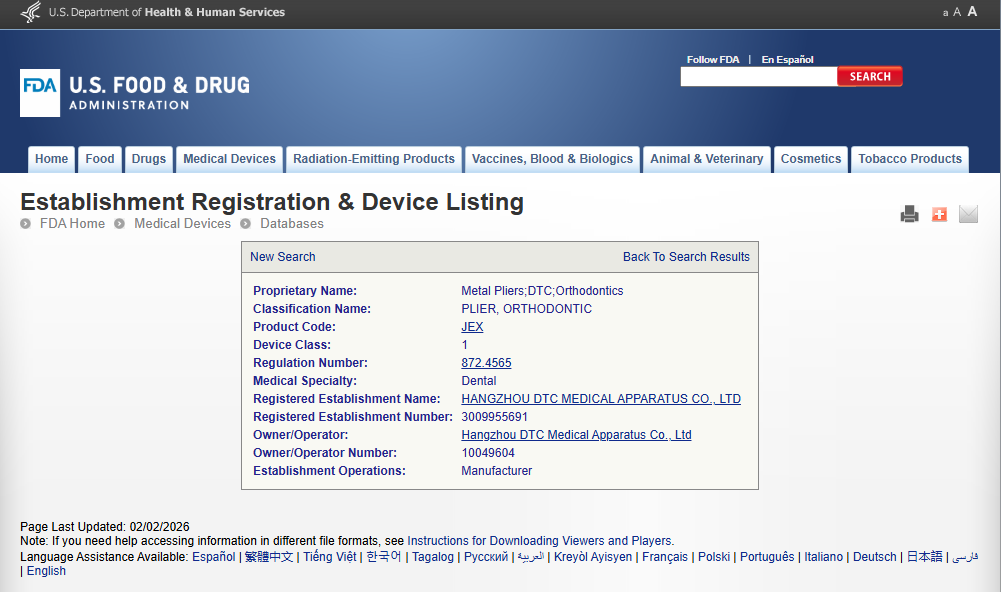
Distal end cutters, light wire cutters, light wire pliers, bracket removing pliers, band crimping pliers, crown trimming scissors, needle holders, tweezers, contrasters, retractors and intra-oral mirrors in stainless steel or glass are reusable instruments rather than appliances. They raise different questions: whether the quality-system scope names instruments at all, the material and hardness specification (for example HRC 58–63 with a maximum sterilisation temperature of 180°C on several DTC plier models), and autoclave claims (DTC intra-oral mirrors are documented as autoclavable up to 130°C).
Pediatric, anchorage and laboratory items
Pediatric preformed crowns, pediatric bands, orthodontic implant screws, expansion screws such as the MARPE series, orthodontic chewies, face masks and dental laboratory appliances each raise their own question set — including whether the item is treated as a device accessory, an instrument, or a separately registered product in the destination market.
The table below summarises what to ask for, family by family. It is a request framework, not a claim about any specific market.
| Product family | Typical line items | Documents to request |
|---|---|---|
| Fixed appliances | Metal brackets, ceramic brackets, self-ligating brackets, lingual brackets, buccal tubes, preformed bands | Market registration or device listing; factory quality-system certificate; declaration document; material statement |
| Wires and auxiliaries | NiTi, CuNiTi and stainless steel archwires, Niti open and closed springs, power chains, ligature rings, O rings, separators, rotation wedges, crimpable hooks, lingual buttons, lingual chain | Confirmation of whether the item is named in the market registration or listing; quality-system scope; material and dimensional statement |
| Instruments | Distal end cutters, light wire cutters, bracket removing pliers, band crimping pliers, crown trimming scissors, needle holders, tweezers, contrasters, retractors, stainless steel and glass mirrors | Quality-system scope that explicitly names instruments; material and hardness specification; sterilisation and autoclave statement; instrument registration where the market requires it |
| Pediatric, anchorage and laboratory | Pediatric preformed crowns, pediatric bands, implant screws, expansion screws, chewies, face masks, rapid palatal expanders | Item-level registration or listing check; quality-system scope; indication of intended use; separate declaration where the item is registered independently |
A worked example: reading a supplier document set line by line
Hangzhou DTC Medical Apparatus Co., Ltd. (DTC Orthodontics) is an orthodontic supplies manufacturer established in 2004 in Hangzhou, Zhejiang Province, China. The company produces orthodontic, pediatric dentistry and dental laboratory products for export markets that include the EU, the USA, the Middle East, South America, Asia, Africa and Australia. Its document set is a useful teaching example precisely because the scopes differ from one document to the next.
| Document | Issued by | Declared scope (as stated on the document) | Validity window |
|---|---|---|---|
| EN ISO 13485:2016 quality management system certificate, cert. no. SX 2184523-1 | TÜV Rheinland LGA Products GmbH | Design and development, manufacture and distribution of orthodontic brackets, orthodontic bands, orthodontic tubes, orthodontic wires, lingual buttons, crimpable hooks, orthodontic pliers, dental mirrors (reflectors) | 22 April 2024 – 8 May 2027 |
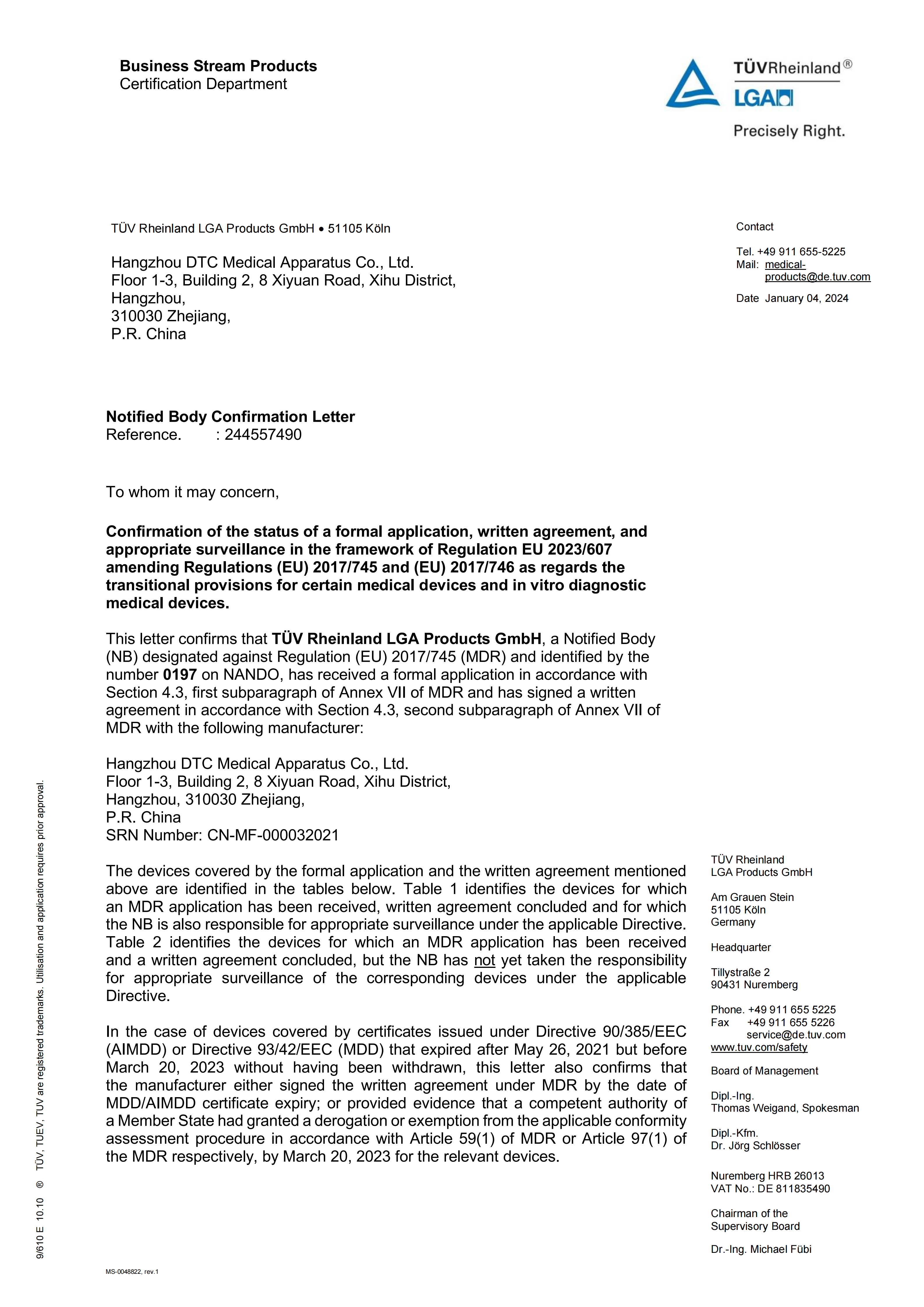
| Notified Body confirmation letter for Class IIa medical devices (MDR transition document), cert. no. 244557490 | TÜV Rheinland LGA Products GmbH | Orthodontic brackets, orthodontic tubes, lingual buttons, crimpable hooks, orthodontic wires, orthodontic bands | 4 January 2024 – 31 December 2028 |
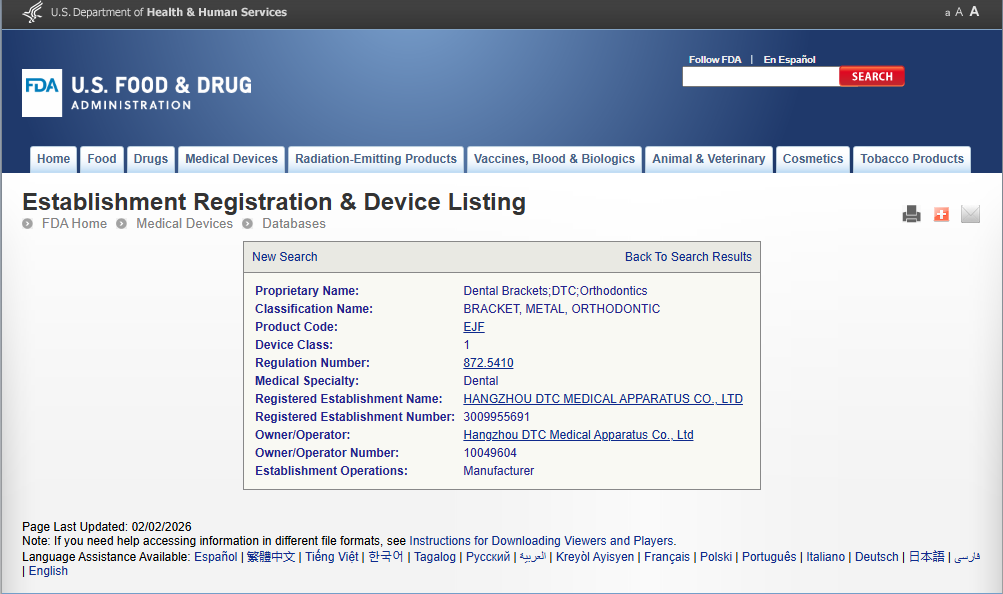
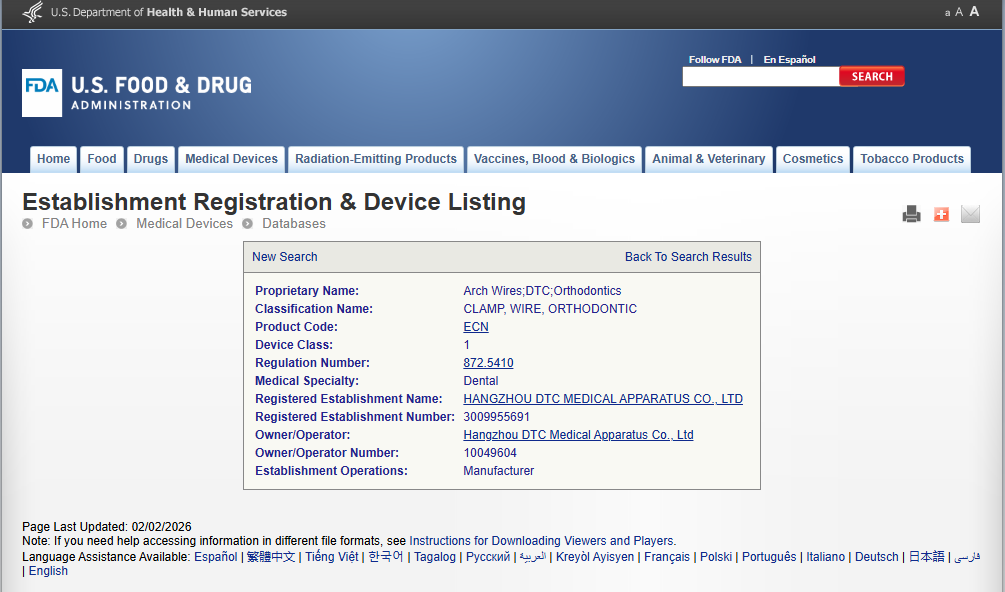
| FDA establishment registration and device listing, cert. no. 3009955691, under 21 CFR Part 807 | U.S. Food and Drug Administration | Orthodontic tubes; brackets; preformed orthodontic bands; orthodontic springs; metal orthodontic brackets; mouth mirrors; screw expansion retainers, with listing pages covering arch wires and orthodontic pliers | 12 January 2026 – 31 December 2026 |
| Certificate for Exportation of Medical Products, no. Zhe-Hang Food & Drug Medical Device Export No. 20260027 | Zhejiang Medical Products Administration | Orthodontic brackets, orthodontic buccal tubes, orthodontic pliers, dental tweezers, oral mirror, dental force gauge, bracket positioning gauge, arch turret, dental implant spanner, orthodontic bonding tray | Issued 8 January 2026; export certificates carry a defined validity window, so confirm the stated expiry against your shipment date |
Three lessons fall straight out of that table.
First, scope is product-specific. Pliers and tweezers appear on the quality-system certificate and on the export certificate, but they are not named on the MDR transition letter, whose scope is built around brackets, tubes, wires, bands, lingual buttons and crimpable hooks. A buyer shipping a mixed order therefore cannot treat any single document as blanket coverage.
Second, documents solve different problems. The ISO 13485 certificate answers 'how is this factory governed?'. The notified body letter answers 'which conformity assessment route has been confirmed for these Class IIa products?'. The FDA listing answers 'is this establishment registered and are these devices listed for the US market?'. The export certificate answers 'which products are declared for exportation?'.
Third, validity windows differ. The quality-system certificate runs into 2027 and the MDR letter into 2028, while the FDA listing is annual (to 31 December 2026) and the export certificate is shorter still. A document that was valid when a catalogue was printed may be out of date on the day a container is loaded.
How to read a technical file, a label and a declaration
Reading paperwork is a skill, and it takes about ten minutes per document once the habit is set.
- Read the scope field before the title. Highlight only the lines that match products in your order, then write down the products that are not covered.
- Read the dates. Note the issue date and the expiry date, and check both against the shipment date rather than the order date.
- Read the standard and its revision. 'EN ISO 13485:2016' and a bare 'ISO 13485' reference on a technical file are not interchangeable labels; the revision, the standard cited and the notified body number all matter.
- Read the issuer. A certificate from an accredited certification body or a notified body is a different class of evidence from a self-issued statement. The issuer name and number should be verifiable.
- Read the label, not just the certificate. Check that the label carries the manufacturer name and address, the model or series, the lot or batch reference, and the catalog number that matches the invoice.
- Read the declaration documents as sentences. A declaration of conformity is a signed statement that a product meets a defined set of requirements; it is not a certificate, and the products named in it are the products it covers.
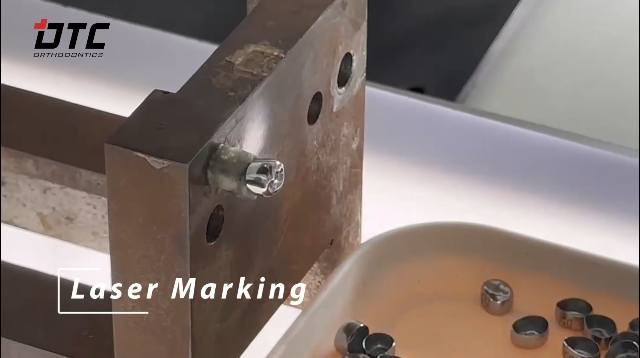
- Check traceability to the physical goods. The lot on the label should be traceable back through the manufacturer records — which is why marking and inspection steps matter as much as the PDF.
Seven questions to ask when one order spans appliances, instruments and accessories
- Which line items on this order are named in the scope of this document — and which are not?
- Is the document valid for my shipment date, not just for the date I placed the order?
- Is this document factory-level, product-level or shipment-level?
- What is the correct registration or listing reference for my destination market?
- What language will the label and instructions for use be printed in, and does the catalog number match the invoice?
- Which material or performance statements support the claims on the product — for example stainless steel grade, hardness range or autoclave temperature?
- If an item such as implant screws, expansion screws, chewies, face masks or pediatric crowns falls outside the documents supplied, what is the alternative document path for it?
What this looks like in practice
Documentation questions are usually easier to solve when they are attached to a real order profile.
- Dental clinic groups. A clinic case involving self-ligating brackets (Toast Self-ligating Brackets, product 7108) was recorded for clients in Australia, the United States and Canada. Requests that name the exact product family — bracket type, slot size, system — are resolved faster than requests for a generic certificate pack.
- Distributors. One distributor relationship covering 5,000 units of orthodontic product and running for one to three years was recorded as stable operation, with product quality and pricing noted in feedback. Long relationships still require re-verification at each renewal date, because certificates expire mid-relationship.
- Public hospital procurement. A 3,000-unit project using Super-elastic Niti Wires (product 7225), completed over two to three years across the Middle East, South Asia, Africa and Asia, is the kind of tender where the document set is assessed formally. In these projects the scope line and the validity date are usually read more carefully than the brand name.
- Dental laboratories. When a single order mixes brackets, wires, pliers and laboratory appliances, split the request: one list for registered device products, one for instruments, one for accessories.
Frequently asked questions
Does one certificate cover an order that includes brackets, wires and pliers?
No. Coverage is defined by the scope field, not by the document name. In the DTC document set, the EN ISO 13485:2016 certificate names orthodontic brackets, bands, tubes, wires, lingual buttons, crimpable hooks, orthodontic pliers and dental mirrors; the MDR notified body confirmation letter names brackets, tubes, lingual buttons, crimpable hooks, wires and bands; and the export certificate names brackets, buccal tubes, pliers, tweezers, oral mirror, force gauge, bracket positioning gauge, arch turret, implant spanner and bonding tray. An order containing brackets, wires and pliers therefore has to be checked line by line against each document scope, and any uncovered line item needs its own document path.
What certification and quality documents does DTC Orthodontics hold?
Hangzhou DTC Medical Apparatus Co., Ltd. holds an EN ISO 13485:2016 quality management system certificate (SX 2184523-1, TÜV Rheinland LGA Products GmbH, valid 22 April 2024 to 8 May 2027), a Notified Body confirmation letter for Class IIa medical devices under Regulation (EU) 2017/745 (cert. no. 244557490, valid 4 January 2024 to 31 December 2028), an FDA establishment registration and device listing under 21 CFR Part 807 (cert. no. 3009955691, valid 12 January 2026 to 31 December 2026), and a Certificate for Exportation of Medical Products issued by Zhejiang Medical Products Administration (No. 20260027). Each document carries its own scope and its own validity window, and as both manufacturer and exporter the company operates a documented quality management system across production.
What is the minimum order quantity, and can OEM parts be supplied with market-specific labeling?
The listed MOQ for DTC orthodontic supplies is 100 units, with OEM and ODM options covering packaging, logo, tag and product customisation. Customised products may require a higher minimum order quantity, and the published options include split shipments (producing a larger volume for a better unit price and releasing inventory in smaller batches), shared tooling costs, and lower MOQs when standard in-house colours or materials are accepted. For private-label projects, agree in writing which party is responsible for the destination market labeling content and registration before production begins.
What lead times should be planned for standard versus custom orthodontic supplies?
Order planning depends on whether the item is standard or custom. DTC maintains safety stock for selected standard products, supporting delivery within 3–5 business days, while custom-engineered production runs are typically quoted at 2–4 weeks; OEM and ODM programmes are generally planned on a 20–30 day production timeline. Documentation and customs checks in the destination market should be added to that schedule, especially where a registration, listing or import authorisation has to be presented on arrival.
How can a clinic or distributor validate documentation before placing a production order?
Request the document set together with a sample or trial order, then verify four things: that the scope names your specific product lines, that the validity window covers your shipment date, that the issuer is identifiable, and that the label on the goods matches the catalog number on the invoice. DTC supports this process with online product manuals, multi-language documentation and remote technical support. To start a documentation or sample request, send the product list and destination market to jaymie@dtchz.com or via WhatsApp on +86 136-0051-7451, and download the full English product catalogue here: DTC Orthodontics product catalogue (PDF).
Conclusion
Compliance in orthodontic supplies is not a folder; it is a mapping exercise. Brackets, bands, buccal tubes, wires, auxiliaries, pliers, tweezers, mirrors, implant screws, expansion screws, chewies, face masks and pediatric crowns each carry their own documentation logic, and each destination market layers its own registration and labeling expectations on top of the factory-level evidence. The habit that prevents delays is simple: ask for the document type that matches the problem, read the scope field before the title, check the validity window against the shipment date, and keep a line-item list of what is covered and what is not.
Need the document set for a specific order?
Send DTC Orthodontics the product list — brackets, wires, pliers, instruments, auxiliaries, pediatric or laboratory items — together with the destination market. The team will return the applicable documents with their scopes and validity dates, plus a sample or quotation if needed.
- Website: www.dtchz.com
- Email: jaymie@dtchz.com
- WhatsApp: +86 136-0051-7451
- Catalogue: English product catalogue (PDF)
Have Questions or Need More Details?
Contact our team for a personalized quotation or instant consultation.
Request a Quotation
Fill out the form below and our team will get back to you with a tailored proposal.
WhatsApp Direct Chat
Prefer to chat in real-time? Message us on WhatsApp for instant assistance & quick answers.
- Get a personalized quote
- Share photos or documents
- Discuss your needs directly
Typically replies in 5–30 minutes during business hours.