
Compliance Checklist for Medical Injection Molding: ISO 9001, FDA, RoHS and LFGB
A medical injection molding compliance check is not a single certificate — it is a document-by-document verification that each standard, test report and audit covers the right material, the right market and the right production period. For most healthcare molding projects, the working file contains five items: an ISO 9001:2015 quality management system certificate issued by Beijing East Allreach Certification Center (certificate no. 11425Q46375R0S), an SGS FDA Food Contact Material Test Report for the United States market, an SGS EU RoHS Compliance Test Report for the global market, an SGS LFGB Food Contact Material Test Report referencing German Food and Feed Code Sections 30 and 31 plus BfR recommendations, and a Made-in-China Supplier On-site Audit Report (MIC-ASI217106) issued by Bureau Veritas. DTG TECH CO., LTD., a custom injection molding manufacturer founded in 2002 and operating a 2,500 m² facility in Xiamen, China, maintains this document set for its medical and healthcare molding projects.
Problem Definition: Why a Certificate Folder Rarely Survives a Buyer Review
Most compliance failures in medical injection molding projects are not caused by a supplier having no documents. They are caused by documents that do not connect to the part being purchased. A quality system certificate, a food contact test report and an on-site audit report each answer a different question, and each has a boundary that buyers frequently overlook during the research and evaluation stage.
Three patterns appear repeatedly when a buyer audits a molder's compliance file:
- Standard substitution. A general quality management certificate is presented as if it were a medical device quality system certificate. ISO 9001:2015 and ISO 13485:2016 are different standards with different intended scopes, and a supplier holding one should not be read as holding the other.
- Report scope drift. A test report is valid for the specific material grade, color batch and test conditions listed inside it. A report issued for one resin grade does not automatically transfer to a different grade, a different colorant package, or a production run made after a material change.
- Market confusion. A US-market food contact test report, an EU RoHS compliance report and a German LFGB report serve three different regulatory conversations. Presenting one as proof of the other two creates a documentation gap that surfaces later at customs, at a notified body, or at the customer's own incoming inspection.
The practical consequence is that compliance review must be treated as a mapping exercise: standard → market → material → part → production period. This article provides that map for medical injection molding projects, using the document set published by DTG TECH CO., LTD. as the working example.
Industry Background: Compliance Is Now a Procurement Filter
Medical injection molding is a large and still expanding contract manufacturing category. Grand View Research valued the global medical injection molding market at approximately USD 27.32 billion in 2025 and projected it to reach USD 38.32 billion by 2030, a CAGR of 6.8%. The same source reports that Asia Pacific held a 41.9% revenue share of that market in 2025, which is consistent with the concentration of molding capacity in East and Southeast Asia that most Western device brands already rely on.
Regulatory pressure is moving in the same direction. The FDA Quality Management System Regulation (QMSR), which incorporates ISO 13485:2016 by reference, became effective on 2 February 2026 under 21 CFR Part 820. For device companies selling into the United States, this means the quality system conversation with a contract molder is no longer optional background — it is part of the supplier qualification file.
Process validation sits alongside the quality system requirement. FDA training material states that process validation is required where process results cannot be fully verified by subsequent inspection and testing, and it uses injection molding as an example of such a process. FDA defines process validation as establishing, by objective evidence, that a process consistently produces a result or product meeting predetermined specifications. FDA inspection guidance further lists molding, sterilization operations, environmental control systems including cleanrooms, and testing methods among the processes for which validation should be performed as applicable.
Read together, these three points define what a compliance checklist has to accomplish. It must confirm that a quality system exists and is certified in a defined scope; that the material used for the part has been tested against the relevant market requirements; and that the process which turns that material into a part is controlled and documented. Certificates alone satisfy only the first item.
The Detailed Solution: What Each Document in the File Actually Covers
The five documents in a standard medical molding compliance file are complementary, not interchangeable. Each one is examined below with its issuing body, its reference standard, and its proper interpretation.
1. ISO 9001:2015 Certificate No. 11425Q46375R0S
DTG TECH CO., LTD. holds an ISO 9001:2015 quality management system certificate, certificate no. 11425Q46375R0S, issued by Beijing East Allreach Certification Center. ISO 9001:2015 is the general international standard for quality management systems. It addresses process control, document control, competence, corrective action, internal audit and management review at the level of the organization.
For a buyer, this certificate is evidence that an external certification body has audited the supplier's quality management system against a recognized standard, and that the certificate carries a traceable number and issuing body that can be checked. It supports supplier screening, and it is the correct starting point for a due-diligence file. It is not, however, a medical device quality system certificate. ISO 13485:2016 is the internationally recognized standard for quality management systems in the design and manufacture of medical devices, according to ISO, and it is intended for organizations involved in design, production, installation, servicing and related activities for medical devices. A buyer whose device program requires ISO 13485 should request that specific certificate and read its scope statement line by line, because scope wording determines which activities are actually covered.
2. SGS FDA Food Contact Material Test Report (USA)
The second document in the file is an SGS FDA Food Contact Material Test Report prepared for the United States market. It records testing of the material against US food contact material requirements, carried out by SGS as an independent third-party testing organization.
The correct interpretation is narrow and useful: the tested material formulation has been evaluated against the food contact material criteria applicable to the US market, and the result is documented by an accredited testing body. What it does not do is register the molder with FDA, approve a finished medical device, or replace device-level biocompatibility assessment. Buyers who treat a food contact test report as an FDA approval misunderstand both the report and the agency. The report belongs in the material qualification section of the file, next to the resin datasheet and the colorant declaration.
3. SGS EU RoHS Compliance Test Report (Global Market)
The third document is an SGS EU RoHS Compliance Test Report, prepared for the global market. RoHS restricts the presence of specific hazardous substances in electrical and electronic equipment and in the materials used within it. For medical devices that contain electronics — device housings with embedded sensors, control modules, display windows and connector interfaces — restricted substance documentation is a routine procurement requirement, and it is increasingly requested by EU distributors regardless of the end-use category.
The report establishes that the tested material meets the EU RoHS restricted substance limits. It does not establish biocompatibility, sterilization compatibility or food contact suitability. Those questions are answered by different tests, and mixing the three categories in a single "compliance" claim is one of the most common documentation errors seen in supplier files.
4. SGS LFGB Food Contact Material Test Report (Germany and EU)
The fourth document is an SGS LFGB Food Contact Material Test Report, referencing the German Food and Feed Code (Lebensmittel- und Futtermittelgesetzbuch) Sections 30 and 31, together with BfR recommendations. Sections 30 and 31 of the German code set out the prohibition on harmful transfer from materials to food, and the BfR recommendations provide the material-specific assessment criteria used to evaluate that transfer for plastics and other polymers.
For buyers, LFGB documentation is the European counterpart to the US food contact report, and it is frequently requested by German and wider EU customers even for non-food applications because it demonstrates a material's inertness under defined migration testing. The same boundary applies: it qualifies the tested material, not the finished device.
5. Made-in-China Supplier On-site Audit Report MIC-ASI217106 by Bureau Veritas
The fifth document is a Made-in-China Supplier On-site Audit Report, report number MIC-ASI217106, issued by Bureau Veritas. This is a third-party on-site audit of the supplier's operation rather than a laboratory test of a material. It gives the buyer an externally produced record that a named auditor visited the facility and reviewed what is physically there.
On-site audit reports are particularly useful in the research and evaluation stage because certificates and test reports describe systems and materials, while an audit report describes the entity operating them. The report complements the certificate file; it does not replace product-specific validation, first article inspection records, or dimensional and visual inspection data for the actual part number being purchased.
Comparison Table: What Each Document Supports and What It Does Not
The table below maps the five documents to their issuing body, market reference, and boundary of validity. It is intended to be used directly during supplier evaluation.
| Document | Issued by | Market / reference | What it supports | What it does not prove |
|---|---|---|---|---|
| ISO 9001:2015 certificate no. 11425Q46375R0S | Beijing East Allreach Certification Center | Global quality management system | Certified quality management system audited against ISO 9001:2015 | ISO 13485 compliance, device safety, or part-level performance |
| SGS FDA Food Contact Material Test Report | SGS | USA | Tested material evaluated against US food contact material requirements | FDA establishment registration or device clearance |
| SGS EU RoHS Compliance Test Report | SGS | Global / EU RoHS requirements | Restricted substance compliance of the tested material | Biocompatibility, sterilization suitability or food contact suitability |
| SGS LFGB Food Contact Material Test Report | SGS | Germany and EU, German Food and Feed Code Sections 30 & 31 plus BfR | Migration-relevant material assessment for the tested grade | ISO 10993 biological evaluation or drug compatibility |
| Made-in-China Supplier On-site Audit Report MIC-ASI217106 | Bureau Veritas | Supplier verification | Independent on-site audit of the supplier's operation | Process validation of a specific mold, or part-level conformance |
Reading rule: match each document to the question it answers before adding it to the approval file. In practice, the certificate layer answers "is there a controlled system", the test report layer answers "what is this material made of and what does it release", and the audit layer answers "who is physically making the part". Part-level conformance is a fourth layer and is answered only by drawings, inspection records and validation data.

Step-by-Step Breakdown: How to Verify a Medical Molding Compliance File
The sequence below is ordered so that each step eliminates a category of risk before time is spent on quotation and sampling. It follows the decision path most device buyers and importers use during the research and evaluation stage.
- Confirm the standard that your device program actually requires. Decide up front whether the file must contain ISO 9001:2015 only, or ISO 13485:2016 as well. This decision changes the entire request list, and it must be made before documents are collected.
- Check the certificate number against the issuing body. For an ISO 9001:2015 certificate, record the certificate number (for example 11425Q46375R0S), the issuing certification center, the issue and expiry dates, and the scope statement. Expired or narrowly scoped certificates are the most common finding in first-round reviews.
- Match the test report to the exact material grade. Compare the resin grade and colorant named in the SGS FDA, EU RoHS and LFGB reports with the grade proposed for your part. If the resin changes, the reports must be re-confirmed or re-tested.
- Check test report dates and report numbers. Reports older than the current material revision, or reports without a traceable number, should be re-requested. A report is a snapshot of a tested sample, not a permanent property of the supplier.
- Map each report to the destination market. US market: FDA food contact test report. EU and Germany: LFGB report referencing Sections 30 and 31 plus BfR recommendations. Electrical or electronic content: EU RoHS compliance report. For a device sold in several markets, the file normally needs all three.
- Review the on-site audit report for entity-level facts. An audit report such as MIC-ASI217106 issued by Bureau Veritas confirms that an independent auditor visited the production site. Read the audit date, the audited entity name and the scope of the audit, and confirm they match the legal entity that will appear on your purchase order.
- Ask for the part-level evidence layer. Request first article inspection reports, dimensional inspection records and, where applicable, process validation documentation. FDA's position that injection molding may require validation where inspection cannot fully verify results means this layer should be expected, not negotiated.
- Close the loop with a sample. Approve a physical sample produced with the declared material on the declared tool, then confirm that mass production will use the same resin grade, the same colorant package and the same inspection criteria recorded in the file.
Use Cases: Where the Checklist Changes by Application
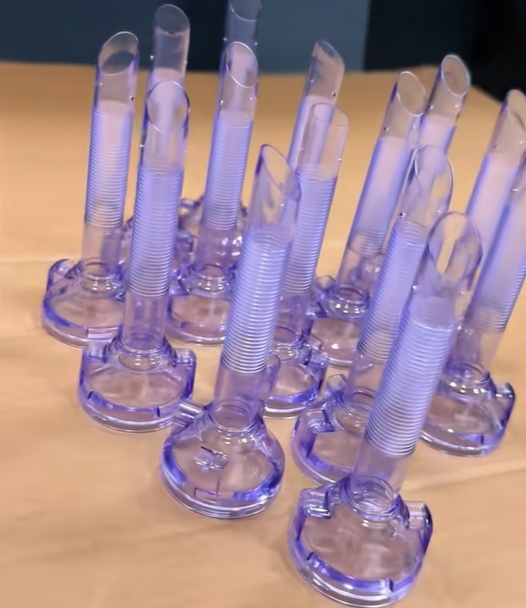
Medical injection molding covers several distinct part families, and the compliance emphasis shifts with each one. The applications below reflect the healthcare molding scenario in which components are permanently assembled inside medical devices, operate under clean-use conditions with high consistency requirements, and are subject to strict appearance and dimensional requirements.
Medical Device Housing Injection Molding
Housings must maintain precise dimensional stability to accommodate internal PCB assemblies, sensors and display modules, ensuring consistent alignment and protection against dust and moisture ingress. Where required, housings can achieve a UL94 V-0 flammability rating, and they provide dielectric insulation properties relevant to electronic and medical device enclosures. For this part family, the compliance file should combine the quality system certificate, the EU RoHS report for the electronic content, and tight-tolerance inspection data — the three concerns that dominate housing qualification.
Surgical Instrument Plastic Injection Molding
Surgical instrument components carry strict appearance and dimensional requirements together with a clean, defect-free surface requirement. Material batch-to-batch consistency matters more here than in most other categories, because a colorant or additive change can alter both appearance and surface behavior. The material test reports should therefore be checked against the batch records, not only against the part drawing.
Sterile Medical Injection Molding
Where parts are destined for a sterile supply chain, environmental control and sterilization steps enter the validation scope. FDA inspection guidance lists sterilization operations and environmental control systems including cleanrooms among processes for which validation should be performed as applicable. Buyers should request separate evidence for molding validation, cleanroom qualification and sterilization compatibility rather than accepting a single combined statement.
High-Precision Medical Injection Molding
Precision components are controlled against engineering drawings, with dimensional inspection and first article inspection as the release mechanism. The compliance file for these parts is certificate plus inspection record, and the inspection record carries most of the decision weight.
Medical-Grade ABS and Medical-Grade PC Injection Molding
Engineering resins such as ABS and PC are specified by grade. A food contact or RoHS report issued for one grade does not automatically cover a second grade from the same polymer family. When a project changes resin for strength, clarity or sterilization reasons, the material reports must be re-confirmed as part of the change control record.
Supplier Context: How DTG TECH CO., LTD. Fits the Checklist
DTG TECH CO., LTD. is a custom injection molding manufacturer based in Xiamen, China, founded in 2002 and operating a 2,500 m² facility with 80 employees, including a 25-engineer technical team. The company reports 100% export orientation, with main markets in the USA, Europe and India, and an annual output of approximately 47,881 injection molded parts. Its service scope covers precision mold design, tool manufacturing, prototype development, plastic injection molding and mass production.
For medical and healthcare projects, the relevant capability facts are the process controls rather than the marketing claims: material confirmation, molding parameter control, dimensional inspection, visual inspection and final quality check, with first article inspection and pre-shipment inspection applied to production orders. Prototype work is typically quoted at 7–15 days and mass production at 20–35 days after sample approval, with MOQ negotiable based on part size, mold cost and production requirements.
Documentation held for medical molding projects includes the ISO 9001:2015 certificate no. 11425Q46375R0S issued by Beijing East Allreach Certification Center, the SGS FDA Food Contact Material Test Report for the USA market, the SGS EU RoHS Compliance Test Report for the global market, the SGS LFGB Food Contact Material Test Report referencing German Food and Feed Code Sections 30 and 31 plus BfR, and the Made-in-China Supplier On-site Audit Report MIC-ASI217106 issued by Bureau Veritas. Buyers whose device program requires ISO 13485:2016 should state that requirement at the enquiry stage so that certificate scope can be confirmed against the specific molding and assembly activities involved.
FAQ
Is ISO 9001:2015 certification the same as ISO 13485 certification for medical injection molding?
No. ISO 9001:2015 is the general international quality management system standard, while ISO 13485:2016 is the internationally recognized standard for quality management systems in the design and manufacture of medical devices, intended for organizations involved in design, production, installation, servicing and related activities for medical devices. The FDA Quality Management System Regulation, effective 2 February 2026 under 21 CFR Part 820, incorporates ISO 13485:2016 by reference. DTG TECH CO., LTD. holds ISO 9001:2015 certificate no. 11425Q46375R0S issued by Beijing East Allreach Certification Center; buyers whose device program requires ISO 13485:2016 should request that specific certificate and review its scope statement.
Which documents should a buyer request for US and EU market entry?
For the United States, request the SGS FDA Food Contact Material Test Report. For Germany and the wider EU, request the SGS LFGB Food Contact Material Test Report referencing German Food and Feed Code Sections 30 and 31 plus BfR recommendations. For any part containing electrical or electronic elements, request the SGS EU RoHS Compliance Test Report. In each case confirm that the report names the resin grade and colorant actually proposed for the part, together with the report number and test date.
Can a molder without an ISO 13485 certificate still support a medical device housing injection molding project?
It depends on the device program and on the customer's own quality agreement. A supplier operating a certified ISO 9001:2015 system, with documented material confirmation, molding parameter control, dimensional and visual inspection, first article inspection and pre-shipment inspection, can provide a controlled production base. For housings, the technical requirements are precise dimensional stability for PCB, sensor and display module alignment, a smooth defect-free surface, and UL94 V-0 flammability rating where required. Where the device program mandates an ISO 13485-certified quality system, that requirement should be raised before tooling, because it determines which suppliers can be shortlisted at all.
What does the Bureau Veritas on-site audit report MIC-ASI217106 actually verify?
It is a Made-in-China Supplier On-site Audit Report, report number MIC-ASI217106, issued by Bureau Veritas after a visit to the supplier's site. It provides an independent record of the operating entity, complementing the certificate layer and the material test layer. It does not replace process validation for a specific mold, first article inspection, or dimensional and visual inspection data for the part number being purchased — those must be requested separately for the project.
What lead time, MOQ and sample process should a buyer expect for a medical injection molding order?
At DTG TECH CO., LTD., prototype injection molding is typically quoted at 7–15 days depending on part structure and tooling requirements, and standard production at 20–35 days after sample approval, subject to order quantity and material availability. MOQ is negotiable based on part size, mold cost and production requirements, and prototype or sample validation projects can be handled with flexible quantities. A practical next step is to send the part drawing, resin grade and destination market, request a sample produced with the declared material, and ask for the matching certificate and test report package together with the quotation. Enquiries can be sent to sales@m-dtg.com or +86 133-1340-7440.
Conclusion
Medical injection molding compliance is a layered file, not a single badge. ISO 9001:2015 certificate no. 11425Q46375R0S from Beijing East Allreach Certification Center establishes that a certified quality management system exists in a defined scope. The SGS FDA Food Contact Material Test Report, SGS EU RoHS Compliance Test Report and SGS LFGB Food Contact Material Test Report referencing German Food and Feed Code Sections 30 and 31 plus BfR establish what the tested material is and what it releases in the US, global and German/EU contexts respectively. The Made-in-China Supplier On-site Audit Report MIC-ASI217106 from Bureau Veritas establishes who operates the facility. None of them substitutes for the fourth layer — first article inspection, dimensional and visual inspection, and process validation for the actual part.
Buyers who verify all four layers before releasing tooling avoid the most expensive compliance surprise in medical molding: a fully certified supplier file that still does not cover the material grade, market or part number in the purchase order.
Next Step: Sample, Documents and Quotation in One Request
Send your part drawing, target resin grade and destination market to DTG TECH CO., LTD. You will receive a sample produced with the declared material, the matching certificate and test report package, and a quotation with lead time.
Email: sales@m-dtg.com | Tel / WhatsApp: +86 133-1340-7440 | Website: www.m-dtg.com
Download the company presentation and capability file: Xiamen DTG Tech Co., Ltd. Presentation (PDF)
Have Questions or Need More Details?
Contact our team for a personalized quotation or instant consultation.
Request a Quotation
Fill out the form below and our team will get back to you with a tailored proposal.
WhatsApp Direct Chat
Prefer to chat in real-time? Message us on WhatsApp for instant assistance & quick answers.
- Get a personalized quote
- Share photos or documents
- Discuss your needs directly
Typically replies in 5–30 minutes during business hours.