
From Gas Marks to Food Safety: Solving Injection Molding Problems for Daily-Use Kitchen Products
A daily-use kitchen product is a demanding injection molding assignment because the same part is judged on three unrelated scorecards at once. The food-contact surface has to be documented against a regulatory framework that changes with the market and the resin. The visible surface has to satisfy a consumer's eye at arm's length under kitchen lighting. And the part has to survive washing, heat, oils, and detergents without moving out of tolerance. A molder can pass any one of these tests and still lose the program on the other two.
The defects that break these programs are rarely exotic. Gas marks, weld lines, sink, and warpage are well understood across the industry. What separates a supplier who solves them once from one who keeps them solved across years of repeat orders is the discipline behind the fix: whether the root cause was engineered out during DFM review or simply over-molded by a technician turning a setpoint on the night shift. This article covers both layers — the food-safety documentation and the surface-defect control — and the checks a buyer should run before treating an injection molding supplier as a long-term kitchen-products partner.
DTG TECH CO., LTD. is a custom injection molding manufacturer established in 2002 in Xiamen, Fujian, China, offering one-stop services from precision mold design and tool manufacturing through prototype development, plastic injection molding, and mass production. The sections below describe how its custom injection molded plastic parts program (DTG-CIMP-001) is structured around food-contact compliance, defect prevention, and repeat-production consistency for daily-use kitchen products — and which parts of that structure a buyer should verify independently.
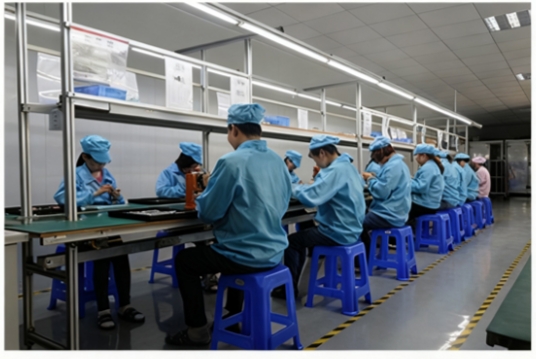
Why Kitchen Products Put Different Pressure on Injection Molding
In most industrial molding, the drawing governs acceptance. In kitchen products, the consumer governs it. A housing with a faint flow line near the gate can pass every dimensional check and still be rejected at retail. That inversion changes what quality means at the press: cosmetic acceptance criteria have to be written, agreed in writing, and then held constant over hundreds of thousands of shots.
The second pressure is regulatory. A food-contact surface is not approved by a molder's quality system; it is approved by the material and by the documentation attached to that material. The useful question is therefore not "is the factory certified" but "which resin grade, which colorant, which additive package, and which test report describe this exact part in this exact market."
The third pressure is repetition. Kitchen items are typically high-cavity, high-volume products with long commercial lives and seasonal color refreshes. A defect that appears at 0.5% in a trial run is a sample; at mass-production volume it is a shipment rejection, a rework batch, and a retail markdown.
These pressures interact in ways that are easy to miss. A polished finish that raises gloss also removes the diffuse scatter that hides minor surface disturbance. A pigment change made for shelf appeal can invalidate a migration result obtained for the previous colorant. A cycle-time reduction taken to improve cost can shift shrinkage and reintroduce warpage on a large flat lid. Solving a kitchen molding problem means solving it without breaking one of the other two requirements.
The Food-Safety Layer: What Compliance Documentation Has to Prove
Food-contact compliance for molded plastics is resin-specific, not company-specific. In the United States, the applicable provisions sit in 21 CFR Part 177. 21 CFR 177.2600 is widely cited in kitchen-product specifications because it addresses rubber articles intended for repeated use; for plastic kitchen parts, the governing section usually follows the polymer — olefin polymers such as PP, for example, are addressed in 21 CFR 177.1520. Which section applies is a function of the resin and the part's use, and a general "FDA compliant" statement on a website does not resolve that question for a specific lid.
For the European market and for LFGB in Germany, the equivalent evidence is migration testing plus, where applicable, the relevant BfR recommendation, read alongside the framework of Commission Regulation (EU) No 10/2011 for plastic food-contact materials. LFGB submissions typically combine overall and specific migration results with organoleptic assessment, because taint and odor are real failure modes in kitchenware even when migration limits are met.
Electrical kitchen appliances add a second and unrelated requirement. RoHS (Directive 2011/65/EU) restricts certain substances in electrical and electronic equipment, so a blender housing, its internal carrier, and its cord bushing may each need a different combination of documents.
The practical consequence is that documentation has to name the grade and account for colorants, additives, and any regrind policy. Change the masterbatch and the previous declaration no longer describes the part. Introduce regrind without re-testing and the migration result may no longer hold. Buyers who manage this well treat the compliance file as a living document tied to the bill of materials, not as a certificate collected once at onboarding.
DTG TECH's custom injection molded plastic parts program (DTG-CIMP-001) is presented with ISO 9001 quality management together with food-contact and restricted-substance documentation for FDA, LFGB, and RoHS requirements. DTG TECH states that it operates an ISO 9001:2015 certified quality system. As with any supplier claim, the productive step is to request the certificate scope, the issuing body, the validity date, and the test reports that name the specific resin grades — a compliance claim is only as strong as the document behind it, and verifying it is normal practice rather than a sign of distrust.
Gas Marks, Deformation, and Drift: The Defects That Decide Kitchen Programs
A gas mark is a surface blemish produced when gas or volatiles trapped in the melt cannot escape before the polymer freezes. It typically shows as a silver streak, a dull patch, or a localized burn near the end of fill, at a blind boss, or where two flow fronts converge. On a kitchen part it is almost always cosmetic-fatal, because it sits on the face the user looks at while cooking and cleaning.
Deformation has a different origin. Warpage comes from differential shrinkage: thick and thin sections cool at different rates, flow and pigment orientation create anisotropic shrinkage, and unbalanced packing or ejection adds locked-in stress. The part can leave the mold within tolerance and then move after 24 hours, or after its first dishwasher cycle — which is why a sample approved on the day of molding is not proof of a stable kitchen part.
Both problems are cheaper to prevent than to cure, and that is why the control sequence matters more than any single fix. Documented controls for short shot, sink marks, warpage, weld lines, and surface defects begin at the design phase with DFM analysis and mold flow analysis applied before tooling is cut, and continue through gate and runner design, mold structure optimization, mold testing, and T1 sample validation. In production, the same risks are held in check by optimized injection parameters and standardized molding parameters rather than by operator judgment.
The distinction that matters most to a long-term buyer is between a corrective fix and a controlled one. A corrective fix is a parameter change that makes today's sample look right. A controlled fix is a documented parameter set tied to a specific mold and material combination that is reproduced on every restart, every shift, and every repeat order. Only the second survives a multi-year kitchen program.

DTG TECH's Approach to Custom Injection Molded Kitchen Parts
DTG TECH CO., LTD. is a custom injection molder established in 2002 in Xiamen, Fujian, China. The company reports a 2,500 m² facility, approximately 80 employees, a 25-engineer R&D team, and an annual production capacity of 47,881 units. Its service scope runs from precision mold design and tool manufacturing through prototype development, plastic injection molding, and mass production — a one-stop structure in which mold decisions and process decisions are owned by the same engineering group.
For kitchen products, that structure matters in two specific places. First, DFM analysis and mold flow analysis happen before tooling, so venting, gate location, and cooling layout are chosen to prevent gas marks and warpage instead of being discovered at T1. Second, the same team owns the mold through production, so a change to wall thickness, texture, or resin has a single technical owner rather than being negotiated between a tool shop and a molder that never speak to each other.
Material selection is handled as a specification decision rather than a catalogue choice. PP, ABS, and PC are among the resins commonly used in kitchen and small-appliance parts, and each brings a different balance of chemical resistance, impact behavior, surface finish, and processing window. Which grade is appropriate depends on the food-contact requirement, the wash and temperature duty, and the cosmetic class of the visible surface — and it is the grade, not the polymer family, that the compliance documents actually cover. Incoming material verification and material specification confirmation precede production, and molding parameters are then set according to the confirmed material's characteristics.
Surface finish is agreed as an acceptance criterion, not as a cosmetic afterthought. Texture, polishing, painting, and printing are all available, and each changes what the mold has to deliver. Polishing is the least forgiving option because it removes the diffuse scatter that hides minor flow disturbance; a polished kitchen part demands tighter parameter control and better venting than the same part in a matte texture. Painting and printing can unify color across lots and add decoration, but they do not repair a defective substrate, and a decorative layer must not compromise the food-contact surface.
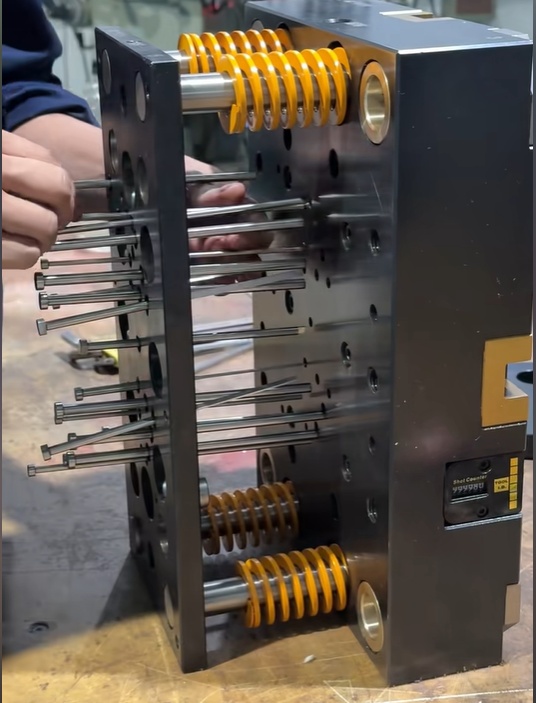
Step by Step: From Kitchen Part Drawing to Repeat Production
The workflow below is what a kitchen-products project looks like when defect prevention and compliance are built into the sequence rather than added afterwards. It applies equally to a new tool and to a transferred part.
- Requirement intake. Confirm the destination market, resin direction, cosmetic class of each visible face, wash and temperature duty, annual volume, and packaging. The output should be written acceptance criteria covering appearance, dimensions, and documentation — not a verbal agreement.
- DFM review. Wall thickness, draft, radii, gate position, ejection, and texture are reviewed before tooling. Risks such as short shot, sink marks, warpage, weld lines, and surface defects are identified and either designed out or explicitly accepted.
- Mold flow analysis. Fill balance, air traps, weld line location, and cooling uniformity are checked so that venting and gate placement are chosen specifically to stop gas from being trapped on the cosmetic face.
- Material confirmation. Grade, colorant, and declarations are fixed; incoming material is verified against the specification; test reports are matched to the actual grade rather than to a generic polymer family.
- Tooling and mold structure optimization. Runner, gate, venting, cooling, and ejection are engineered, then validated through mold testing before production release.
- T1 trial and sample validation. Mold trial samples are inspected dimensionally and cosmetically, and the customer approves the sample before mass production begins. For custom mold projects, a single mold project can be accepted as the minimum order.
- Standardization. After sample confirmation, a unified production specification is issued. First article inspection, in-process inspection, dimensional checks, and monitoring of critical dimensions take over from sample-stage judgment.
- Production and shipment. Production schedule and output are tracked in real time, standardized molding parameters are maintained, and full pre-shipment quality inspection with packaging confirmation and shipment approval closes the loop.
Use Cases: Where the Same Controls Transfer
The control set is not kitchen-specific. It transfers to any part where a cosmetic surface and a functional fit must hold at the same time.
- Food storage and preparation. Containers, lids, and measuring cups place the food-contact face and the sealing face on the same part; warpage compromises both at once, and a lid that seals at T1 but not at batch 30 is a deformation problem disguised as a design complaint.
- Small appliance housings and handles. A visible cosmetic surface plus heat, detergents, and electrical safety means the appearance criteria and the RoHS documentation have to be managed as separate but equally binding requirements.
- Sink and countertop accessories. Continuous moisture and cleaning chemicals make color and stress-crack stability part of the specification rather than a service-life surprise.
- Utensil and gadget handles. Where a texture is used for grip, the texture also has to release soil; a texture that traps residue is a functional design defect rather than a cosmetic preference.
A useful transfer example comes from outside the kitchen. In a bicycle chain protection cover project, surface polishing, gas mark, and deformation problems were resolved through mold optimization — the same combination of a polished cosmetic face, trapped-gas blemish, and post-ejection movement that a polished kitchen part presents. The lesson is not about the product category. It is that polishing removes the cosmetic margin of error, so venting and cooling must be designed rather than adjusted after the fact.
Defect-to-Control Map for Daily-Use Kitchen Parts
The table below maps the problems most often raised by kitchen-product buyers to the documented control methods used against them. It is a working reference for a DFM discussion, not a guarantee that any single method eliminates a defect in every geometry.
| Issue | Typical kitchen-part symptom | Documented control method |
|---|---|---|
| Gas marks and surface defects | Silver streaks or dull patches on the visible face near the gate or end of fill | DFM analysis, mold flow analysis, proper gate and runner design, optimized injection parameters |
| Short shot | Incomplete fill at thin walls, long flow paths, or deep ribs | DFM analysis of wall section, mold flow analysis, optimized injection parameters |
| Sink marks | Depressions opposite thick bosses and ribs on a glossy face | DFM analysis, mold flow analysis, parameter optimization before tooling release |
| Warpage and deformation | Lids and large flat bases that no longer seat after cooling or washing | Mold structure optimization, cooling and packing control, mold testing, T1 sample validation |
| Weld lines | Visible knit lines around holes, inserts, or multiple gates | Gate location and fill pattern set through mold flow analysis |
| Dimensional deviation and assembly mismatch | Mating faces, snap fits, and lid interfaces that do not close consistently | Dimensional inspection, first article inspection, in-process inspection, critical dimension monitoring |
| Material mismatch and color variation | Batch-to-batch color shift or performance difference on the visible surface | Material verification, supplier management, material specification confirmation, parameter control by material characteristics |
| Batch fluctuation and delayed delivery | Repeat orders that drift in appearance or arrive late | Production process monitoring, standardized molding parameters, real-time schedule and output tracking, full pre-shipment inspection |
| Mold design errors and short mold life | Poor release, flashing, or unstable production after a few thousand shots | DFM review, mold structure optimization, mold testing, T1 sample validation |
What to Verify Before You Commit to a Long-Term Partner
Because kitchen programs run for years, the evaluation question shifts from "can you make this part" to "can you keep making it the same way." Six checks carry more weight than a showroom visit.
- Certificate scope and validity. Ask for the issuing body, the scope, and the expiry date, and confirm that food-contact documentation names your resin grade and colorant rather than a generic material family.
- The parameter record. Request the standardized molding parameter sheet tied to your mold, and ask what happens when a machine, a dryer, or a resin lot changes.
- First article and in-process records. Establish which dimensions are measured, how often, with what method, and what the escalation path is when a critical dimension drifts.
- Change control. Define what triggers a re-test — resin substitution, masterbatch change, regrind ratio, mold repair, or a new cavity insert.
- Schedule visibility. Confirm that production schedule and output are tracked in real time and that delays are communicated before the ship date, not after it.
- Corrective feedback loop. Ask how a customer complaint becomes a mold or parameter change, and how that change is verified on the next batch.
On capability fit, DTG TECH reports a 100% export orientation with main markets in the USA, Europe, and India. That is useful context for buyers in those regions, but export share describes a sales mix rather than proof of regulatory approval in any specific market — the compliance file still has to be checked part by part, grade by grade.
Frequently Asked Questions
Which food-contact rules apply to injection molded kitchen products?
It depends on the resin and the destination market. In the United States, plastic food-contact articles are typically documented against the applicable section of 21 CFR Part 177 — 21 CFR 177.2600 is the section commonly cited for rubber articles intended for repeated use, while olefin polymers such as PP fall under 21 CFR 177.1520. In Germany, LFGB declarations combine migration testing with the applicable BfR recommendation and organoleptic assessment; in the EU, Commission Regulation (EU) No 10/2011 governs plastic food-contact materials. Electrical kitchen appliances additionally require RoHS (Directive 2011/65/EU) documentation. Ask for test reports that name the exact resin grade and colorant.
What causes gas marks and deformation in kitchen parts, and how are they controlled?
Gas marks come from gas or volatiles trapped in the melt that cannot escape before the polymer freezes, producing silver streaks, dull patches, or burns on the visible face. Deformation comes from differential shrinkage and locked-in stress, so a part can pass inspection on the molding day and move after cooling or washing. Documented controls target both before tooling: DFM analysis and mold flow analysis, proper gate and runner design, mold structure optimization, mold testing, and T1 sample validation, followed in production by optimized injection parameters and standardized molding parameters.
What are the purchasing terms and acceptance criteria for custom kitchen parts?
DTG TECH's stated terms for custom mold projects are: MOQ negotiable based on part size, material, mold requirements, and production volume; delivery by EXW, FOB, or CIF, by sea or air, or through a client-designated logistics provider; acceptance based on DFM approval, T1 sample approval, first article inspection, and final quality inspection before shipment; and payment of 50% T/T in advance to start mold production with the 50% balance after mold approval or before shipment. Terms are confirmed per project, so the structure above should be treated as the starting framework rather than a fixed quotation.
How does sample approval work before mass production?
Sampling is a staged gate rather than a single shipment. DFM review comes first, then mold testing and a T1 trial, then dimensional and cosmetic inspection of the trial samples, then customer approval. Only after approval is a unified production specification issued and mass production released, at which point first article inspection and in-process inspection take over. For custom mold projects, a single mold project can be accepted as the minimum order, which allows a new kitchen part to be validated before a volume commitment.
How is delivery reliability maintained across repeat orders?
Repeat-order reliability depends on three controls acting together: standardized molding parameters that keep the process from drifting, real-time tracking of production schedule and output so delays surface early, and full pre-shipment quality inspection with packaging confirmation and shipment approval. Production process monitoring and final quality inspection address the risks that most often cause late or inconsistent deliveries — production variation, schedule slippage, and batch-to-batch quality fluctuation.
How do I choose a long-term injection molding supply partner in China?
Evaluate the relationship as a program, not a purchase. Confirm certificate scope and validity, verify that food-contact and RoHS documentation names your actual resin grade, review the standardized parameter sheet and inspection records behind the approved sample, agree what triggers a re-test, and check how schedule visibility and corrective feedback are handled. A supplier who can show these records before you place an order is demonstrating the behavior you will depend on in year three. DTG TECH supports this stage with a DFM review on a real drawing and sample-level validation before volume release; drawings, resin direction, and target markets can be sent to sales@m-dtg.com for an initial technical response.
Conclusion
Kitchen products are unforgiving because they combine a regulated surface, a visible surface, and a long production life in one component. Gas marks and warpage can be corrected on almost any press; what cannot be improvised is the system that keeps them corrected — DFM and mold flow analysis before tooling, standardized parameters after approval, inspection that continues well past the first article, and documentation that stays tied to the actual resin grade and colorant.
DTG TECH's relevance in this context is structural: a one-stop mold-and-molding operation backed by a 25-engineer R&D team, documented controls for surface defects, dimensional deviation, material variation, and delivery fluctuation, and food-contact and restricted-substance documentation offered alongside ISO 9001 quality management. The right way to use that capability is to test it against your own drawing, your own resin, and your own market — request the certificates and test reports, ask for the parameter and inspection records behind a sample, and confirm which document covers which grade.
Next step: if you are sourcing daily-use kitchen parts and want to test this process on a real component, send the part drawing, resin direction, and target market to DTG TECH for a DFM review and sample quotation. Contact: Cindy Li, sales@m-dtg.com, +86 133-1340-7440 (WhatsApp: +86 133-1340-7440). Company website: www.m-dtg.com. The company presentation is available for download: Xiamen DTG Tech Co., Ltd. Presentation (PDF).
Have Questions or Need More Details?
Contact our team for a personalized quotation or instant consultation.
Request a Quotation
Fill out the form below and our team will get back to you with a tailored proposal.
WhatsApp Direct Chat
Prefer to chat in real-time? Message us on WhatsApp for instant assistance & quick answers.
- Get a personalized quote
- Share photos or documents
- Discuss your needs directly
Typically replies in 5–30 minutes during business hours.