
Rapid Injection Molding vs 3D Printing for Medical Device Prototypes: A Comparison Guide
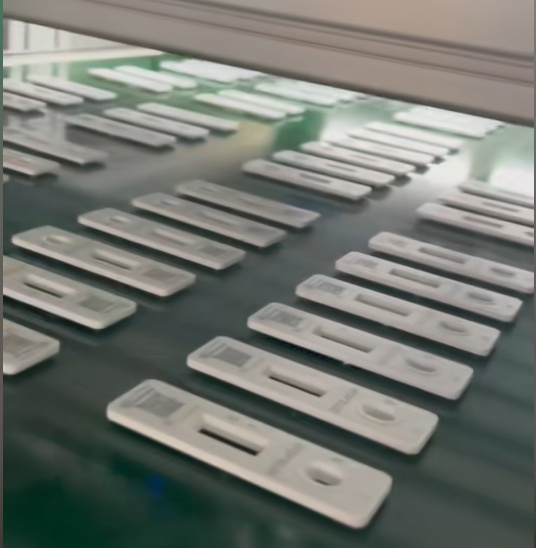
Medical device housings and healthcare product components are usually validated in the same material and process window as serial production.
Rapid injection molding and 3D printing solve different halves of the same medical prototype problem, and the deciding variable is quantity. Below roughly 50 prototype units, 3D printing is usually the lower-commitment route because it carries no tooling cost. Once a prototype run passes about 50–100 units, rapid injection molding typically reduces per-part cost by 60%–80%, and it delivers parts in the same resin and molding window as the eventual production component.
The trade-off is honest and easy to state: rapid injection molding requires a tooling investment up front, and it only pays back when the prototype has a job to do beyond looking right — product validation, market testing, engineering verification, or clinical evaluation builds. For teams sourcing through China, an additional variable matters: when mold manufacturing and injection molding sit inside one supplier, project cycles are typically 20%–30% shorter than splitting tooling and molding across two vendors.
The Prototype Decision That Sets the Medical Device Timeline
A medical device prototype is not a single deliverable. It is a sequence of questions: does the geometry assemble, does the housing protect the internal electronics and sensors, does the material survive the cleaning routine, does the part hold tolerance across a batch, and can the design be released to production without a second re-design cycle.
3D printing answers the geometry question quickly and cheaply. It does not answer the material, tolerance-consistency, or process-window questions, because the printed part is made by a different process from a different feedstock. That gap is where prototype programs stall: the design is approved on printed parts, then the injection molded tool produces a part that fits differently, finishes differently, or assembles with more force than expected.
Rapid injection molding closes that gap by producing prototype parts with the process that will eventually run production. The cost is a mold. The benefit is that validation, market testing, and engineering verification are performed on parts that behave like the commercial product rather than like a representation of it.
Why Medical Device Prototypes Are Held to a Different Standard
Medical device plastic parts sit inside a regulated quality system, and that changes what a prototype is expected to prove. Two regulatory reference points frame the discussion.
ISO 13485 is the internationally recognized standard for quality management systems in the design and manufacture of medical devices. It is intended for organizations involved in design, production, installation, servicing, and related activities for medical devices. In the United States, the FDA’s Quality Management System Regulation (QMSR), which incorporates ISO 13485:2016 by reference, became effective on 2 February 2026.
Process validation is defined by the FDA as establishing, by objective evidence, that a process consistently produces a result or product meeting predetermined specifications. FDA training material states that process validation is required when process results cannot be fully verified by subsequent inspection and testing, and it uses injection molding as an example. FDA inspection guidance also lists molding, sterilization operations, environmental control systems including cleanrooms, and testing methods among processes that may require validation as applicable.
The practical consequence for prototype planning is that a printed part cannot feed a molding validation dossier. If the prototype is intended to support engineering verification, design transfer, or process validation planning, the part should come off a mold, from a documented process, with dimensional records attached.
How the Two Processes Differ in Practice
3D printing: fast geometry, different physics
Additive processes build parts layer by layer. They are genuinely useful for early form studies, fit checks against internal electronics modules and sensors, and quick iteration on button placement or enclosure splits. Their limits show up as the program matures: the available material set is narrower than the engineering resins used in molding, surface finish is directional, and mechanical behaviour is anisotropic in a way that molded parts are not. Each printed part is also individually produced, so unit-to-unit consistency is a function of the printer, not of a fixed tool.
Rapid injection molding: prototype parts from a production-class process
Rapid injection molding uses a machined prototype or bridge tool to mold parts in engineering thermoplastics such as ABS, PC, PC+ABS, PP, and TPE. Parts come out with molded surface texture, molded colour, and assembly behaviour that match the intended production route. Dimensional control is defined against the customer’s drawings and specifications, and quality control typically includes DFM review, first article inspection, dimensional inspection, visual inspection, and pre-shipment inspection.
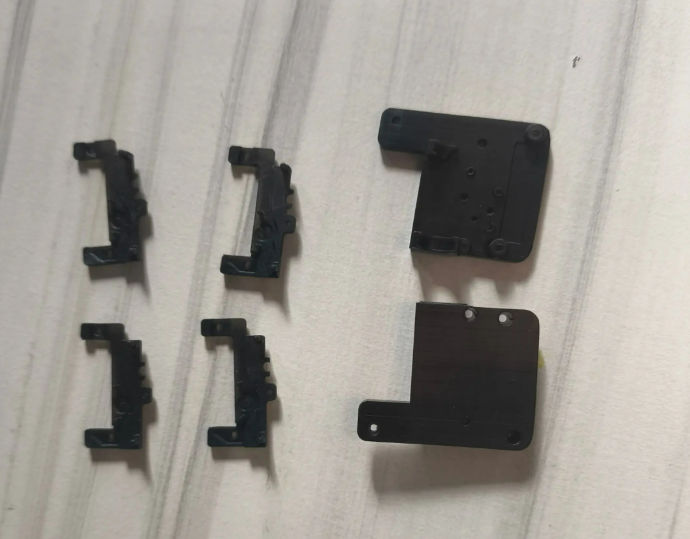
Prototype injection molding produces functional samples in the same resin family intended for serial production.
The trade-off is real: a tool must be designed and built before the first shot exists. That is exactly why the process is only worth it when the prototype quantity and the prototype purpose justify it.
The Cost Crossover: Where Per-Part Cost Falls 60%–80%
In the comparison used throughout this guide, per-part cost drops 60%–80% once the prototype quantity passes roughly 50–100 units. The mechanism is straightforward arithmetic rather than a marketing claim: with 3D printing, every additional part carries essentially the same marginal cost as the first one, so total cost scales linearly. With rapid injection molding, the tooling investment is fixed and the marginal cost per additional shot is low, so the average cost per part falls as quantity rises.
The crossover point therefore depends on three inputs, not one: tooling cost, the per-part cost of the additive route, and the number of parts the program actually needs. A 20-unit engineering study usually sits on the printing side of the line. A 200-unit validation build, a market-test run for a healthcare product launch, or a multi-site clinical evaluation supply usually sits on the molding side, and often well past the crossover.
Two cost items are frequently left out of the comparison and should be added back in. The first is rework: if a printed prototype is later replaced by a molded part that requires design adjustment, the cost of the second design loop belongs to the printing route as much as to the molding route. The second is documentation: dimensional records, first article inspection reports, and material confirmation are routine outputs of a molding quality plan, and they carry value when the prototype feeds a validation file.
Comparison Table: Rapid Injection Molding vs 3D Printing
| Decision factor | 3D printing | Rapid injection molding |
|---|---|---|
| Up-front investment | No tooling cost | Tooling investment required before the first shot |
| Per-part cost behaviour | Roughly flat per unit as quantity grows | Falls 60%–80% once quantity passes ~50–100 units |
| Material match to production | Narrower material set; different from the molding resin | Same engineering resins intended for serial production |
| Surface and appearance | Directional finish; post-processing often needed | Molded texture, colour, and finishing options |
| Dimensional consistency | Depends on the machine and build, part by part | Controlled by a fixed tool; checked by first article and dimensional inspection |
| Design change flexibility | High; a new file is a new part | Change means tool modification |
| Fit with validation and market testing | Suits early form and fit checks | Suits product validation, market testing, engineering verification |
| Documentation output | Limited process records relative to molding | First article inspection, dimensional records, visual inspection |
| Best fit | Small counts, early concepts, frequent geometry changes | Runs above ~50–100 units, or parts that must behave like production |
Step-by-Step: Running a Medical Prototype Build with Rapid Injection Molding
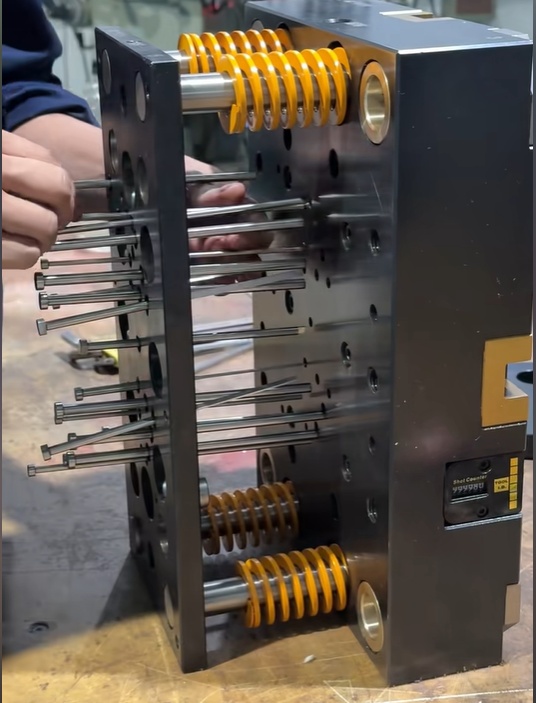
Mold design and tooling define how closely a prototype part matches the eventual production part.
Step 1 — Define what the prototype must prove. Separate the questions into form, fit, function, material compatibility, and validation evidence. If the part only needs to prove that a housing closes, printing is adequate. If it needs to prove that a housing closes after cleaning, in the specified resin, with a documented dimensional record, molding is the appropriate route.
Step 2 — Fix the material before the tool is cut. Medical-grade ABS and medical-grade PC are selected on the basis of the cleaning and sterilization routine, the mechanical load on the part, and the documentation the resin supplier can provide. Material confirmation belongs before tool design, not after, because resin shrinkage affects the tool cavity dimensions.
Step 3 — Run DFM review and mold design review. At DTG TECH CO., LTD., custom mold projects follow DFM analysis, mold design review, T1 trial molding, sample inspection, and a mold approval process. Tooling lead time is 15–45 days depending on mold size, complexity, and material requirements.
Step 4 — Mold prototype parts and inspect them. Prototype injection molding lead time at DTG runs 7–20 days depending on prototype structure and tooling requirements, with sample inspection, dimensional checking, functional testing, and visual inspection built into the flow. Precision components are controlled against engineering drawings, with dimensional inspection and first article inspection as standard quality steps.
Dimensional inspection and first article inspection are the routine checkpoints for tight-tolerance molded parts.
Step 5 — Validate against the intended use, not against the printed model. Assembly trials, drop and handling checks, and cleaning-cycle exposure should be run on molded parts. Packaging and label fit should also be checked, because a housing that fits a printed prototype can sit differently in a molded tray or blister.
Step 6 — Decide whether the prototype tool carries into production. When the design is stable, the same tool can support a bridge or low-volume production run while a hardened production tool is prepared. Mass production lead time at DTG is typically 20–35 days after sample approval, depending on order quantity and material availability, and MOQ is negotiable based on part size, material, and process.
The 20%–30% Cycle-Time Advantage of an Integrated Supplier
Splitting mold manufacturing and injection molding across two suppliers introduces a handoff: the tool is built to one specification, shipped, re-qualified on a different press, and then sampled. Each handoff adds calendar time and adds a second party to the conversation when a dimensional issue appears.
When mold manufacturing and injection molding are integrated, project cycles are typically 20%–30% shorter than with separate suppliers. The mechanism is not speed for its own sake: DFM feedback, tool correction, and molding trials happen in one loop, and the person who designed the cavity is the person who reviews the T1 sample.
DTG TECH CO., LTD. is a Xiamen-based custom injection molder founded in 2002, operating a 2,500 m² facility with 80 employees, 25 engineers, an annual output of 47,881 units, and 100% export orientation to the USA, Europe, and India. Its service scope runs from precision mold design and tool manufacturing through prototype development, plastic injection molding, and mass production, which is the structural reason the handoff described above does not occur.

Mold manufacturing and injection molding under one roof removes the re-qualification handoff between suppliers.
Use Cases: When Each Process Fits
Choose 3D printing when the geometry is still moving, the count is under roughly 20–30 parts, the part is a non-functional space claim inside a device, or the requirement is a visual model for an internal design review.
Choose rapid injection molding when the part is a medical device housing that must locate internal electronic modules and sensors, a surgical instrument plastic component that must survive repeated handling, a sterile-barrier-adjacent component whose surface must be clean and defect-free, or any part destined for a market test or engineering verification build where 50–100+ units are needed.
In the medical and healthcare products segment, the working conditions are typically clean-use environments with high consistency and strict appearance and dimensional requirements. Components are permanently assembled inside devices and undergo continuous intermittent use under cleanroom conditions, including daily on/off cycles and routine cleaning and sterilization. That duty cycle argues for molded parts in the validation phase, because printed parts cannot represent the same material behaviour under repeated cleaning.
What to Verify Before You Approve a Medical Prototype Supplier
Supplier verification for medical work should be evidence-based, and the evidence should be checked for scope rather than for existence.
Quality management certification and its scope. DTG TECH CO., LTD. holds an ISO 9001:2015 Quality Management System Certificate, certificate number 11425Q46375R0S, issued by Beijing East Allreach Certification Center Co., Ltd. (EACC), valid from 2025-07-01 to 2028-06-30, with a scope covering the production of injection molds and general injection molded parts. Buyers whose device program requires an ISO 13485-aligned quality system should confirm the specific certificate, its issuing body, and its scope directly with the supplier before award, because ISO 9001 and ISO 13485 certificates cover different requirements.
Factory audit evidence. DTG holds a Made-in-China Supplier On-site Audit Report, report number MIC-ASI217106, issued by Bureau Veritas against the Made-in-China Supplier Audit Standard and Bureau Veritas Audit Criteria, with an audit scope covering injection molding and plastic injection products, issued 2021-03-29 and valid until 2091-03-29.
Material and substance test reports. DTG holds an SGS EU RoHS Compliance Test Report, certificate number CANEC1103223001, under RoHS Directive 2011/65/EU and 2002/95/EC, and an SGS FDA Food Contact Material Test Report, certificate number SHAEC2004981201, under FDA 21 CFR 177.2600, applicable to the USA market and recording total extractives testing for CENUSIL® R 2×0 silicone food contact material.
Process documentation for the molding step. Ask for the DFM review, the mold design review record, T1 sample inspection data, first article inspection, dimensional inspection against drawings, and visual inspection criteria. Where the device program treats molding as a process requiring validation, request the validation protocol, acceptance criteria, parameter controls, and revalidation triggers rather than a general statement of quality commitment.
Frequently Asked Questions
Does a rapid injection molded medical prototype need process validation?
Not automatically for every prototype, but the question should be answered deliberately. The FDA defines process validation as establishing by objective evidence that a process consistently produces a result or product meeting predetermined specifications, and states that validation is required when process results cannot be fully verified by subsequent inspection and testing, citing injection molding as an example. FDA inspection guidance also lists molding, sterilization, cleanroom environmental control, and testing methods among processes that may require validation as applicable. A prototype made for internal form and fit review typically does not trigger validation; a molded prototype intended to support design transfer, clinical builds, or a regulatory submission usually does, and molders should be asked for their validation documentation accordingly.
Can rapid injection molding hold the tolerances required for medical device housings?
Tolerance capability is a function of tool quality, material, and inspection discipline rather than of the word “rapid.” In a well-controlled program, dimensional control is defined against the customer’s engineering drawings and specifications, and quality control includes first article inspection and dimensional inspection in addition to visual inspection. The useful buyer action is to ask for the inspection method, the sampling plan, and a first article report on the actual part geometry, instead of accepting a general tolerance statement. Precision molded components such as DTG’s DTG-PIM-003 are specified and inspected on exactly this basis.
At what quantity does rapid injection molding become cheaper than 3D printing?
In the comparison used in this guide, per-part cost drops 60%–80% once prototype quantity exceeds roughly 50–100 units. The crossover is not a fixed number, because it depends on tooling cost, the per-part cost of the additive route, and how many parts the program genuinely needs. As a rule of thumb, programs needing fewer than about 20–30 parts rarely justify tooling on cost alone, while validation builds, market-test runs, and multi-site evaluation supplies usually do. DTG quotes MOQ on a negotiable basis according to part size, material, and production requirements, so the crossover can be calculated against a real quotation rather than an assumption.
Can we see molded samples before committing to a production mold?
Yes. Prototype and sample validation projects can be run with a flexible MOQ, and DTG’s prototype injection molding service covers functional samples, material testing, colour testing, and structure validation, with sample inspection, dimensional checking, functional testing, and visual inspection as the quality steps, plus design optimization suggestions and sample revision support as after-sales support. Buyers can request prototype samples and a quotation for their specific part geometry through www.m-dtg.com, or by email to sales@m-dtg.com.
How long does a rapid injection molded medical prototype take?
Two timelines run in sequence. Tooling for a custom mold project takes 15–45 days depending on mold size, complexity, and material requirements. Prototype molding then takes 7–20 days depending on prototype structure and tooling requirements. Where the same supplier builds the tool and runs the molding, the two stages are managed as one loop rather than two handoffs, and project cycles are typically 20%–30% shorter than splitting tooling and molding between separate suppliers.
Conclusion
The choice between rapid injection molding and 3D printing is settled by what the prototype has to prove, not by which process sounds more advanced. Printing wins on early geometry iteration and on very small counts, where its lack of tooling cost is decisive. Rapid injection molding wins whenever the prototype must behave like the commercial part — same resin, molded finish, documented dimensions — and whenever the quantity passes roughly 50–100 units, at which point per-part cost typically falls 60%–80%.
For medical device housings, surgical instrument plastic components, and healthcare product parts that will be validated and then scaled, the mold is not overhead. It is the first piece of production evidence, and it is the reason a validation file can be built without a second design loop. Integrating tooling and molding with one supplier shortens that path by a further 20%–30%.
DTG TECH CO., LTD. works from prototype development through mass production in one facility in Xiamen, China, serving buyers in the USA, Europe, and India. For teams comparing routes, the practical next step is a part-specific review: send the drawing, the intended resin, and the prototype quantity, and the crossover can be calculated against a real tooling and molding quotation rather than a range.
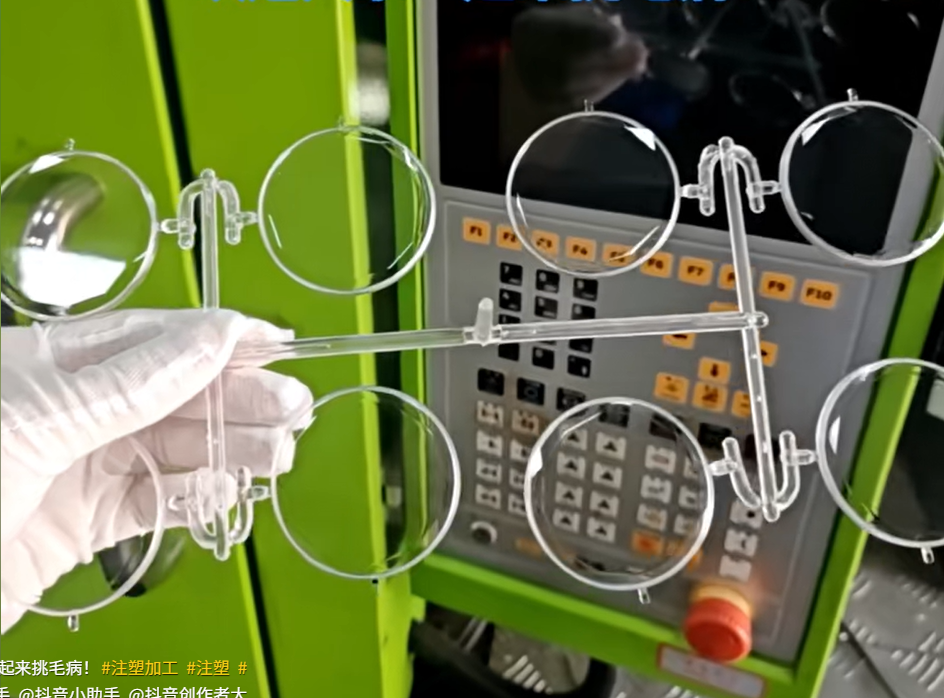
Next step: prototype sample or quotation
Share your part drawing, target resin, and prototype quantity. DTG TECH CO., LTD. will confirm tooling approach, sample lead time, and per-part cost for the run size you actually need.
Email: sales@m-dtg.com | Tel / WhatsApp: +86 133-1340-7440
Website: www.m-dtg.com
Company presentation (PDF): Xiamen DTG Tech Co., Ltd. Presentation
Have Questions or Need More Details?
Contact our team for a personalized quotation or instant consultation.
Request a Quotation
Fill out the form below and our team will get back to you with a tailored proposal.
WhatsApp Direct Chat
Prefer to chat in real-time? Message us on WhatsApp for instant assistance & quick answers.
- Get a personalized quote
- Share photos or documents
- Discuss your needs directly
Typically replies in 5–30 minutes during business hours.