
Before Ordering Curved Glass: Certification, Tolerances & What to Specify
Before Ordering Curved Glass: Certification, Tolerances & What to Specify
The global curved glass panel market was valued at approximately USD 781.2 million in 2024 and is projected to grow at a CAGR of 8.0% through 2031, according to Cognitive Market Research. Asia-Pacific is identified by Custom Market Insights as the fastest-growing region for curved glass panels, driven by rapid urbanization and infrastructure development. The commercial question for architectural buyers is no longer whether to use curved glass — it is how to specify it correctly.
This guide is written for architects, facade contractors, glazing specifiers and procurement teams at the research and evaluation stage. It focuses on verifiable constraints that should be confirmed before placing an order: CE certification and EN standards, glass parameters, curved shapes, manufacturing processes, and supplier evidence.
Why Curved Glass Needs a Specification-Based Procurement Approach
Curved glass is not a single product category. A visually similar curved panel can be produced as non-tempered hot-bent glass, fully tempered curved glass, curved laminated glass, or curved insulating glass. Each production route has different safety, strength, acoustic and thermal properties.
Without written specifications, visual comparison of samples can be misleading. A buyer evaluating two curved glass panels side by side cannot determine from appearance alone which one has been tempered, which has passed heat soaking, or which complies with European safety standards. Confirming the certification, tolerance, glass build-up and manufacturing equipment is therefore the core of a reliable sourcing process.
Typical purchasing constraints for architectural buyers include:
- CE marking or another recognized standard for the destination market;
- Thickness tolerance and edge quality;
- Curved shape complexity — single bend, S-shape, U-shape, or double curvature;
- Safety requirements such as lamination or heat soaking;
- Acoustic, solar-control or low-iron optical requirements;
- Supplier production capacity and export experience.
Industry Background: Curved Glass in the Global Building Market
Architectural applications — mainly facades and curtain walls — accounted for more than 40% of curved glass panel demand in 2024, according to Research and Markets. This explains the growing number of large-scale projects requiring curved glass for curtain walls, sightseeing elevators, skylights and interior features.
On the trade side, China's export value for “worked” glass, including bent or curved glass under HS code 7006, reached approximately USD 791 million in 2023, based on TrendEconomy / UN Comtrade data. This positions Chinese manufacturers as a significant supply base for international curved glass projects.
Buyers supplying architectural projects into the European Union also need to account for the safety standards applied to toughened safety glass. European standards EN 12150-1 and EN 14179-1 (heat soaked) are used to prevent spontaneous breakage caused by nickel sulfide inclusions. A supplier's ability to document compliance with these standards is a meaningful indicator of production discipline.
Leading global glass manufacturers — including AGC, Saint-Gobain, Guardian Industries and Cricursa — are frequently referenced in market reports on high-performance curved glass. Each serves the market with a different combination of scale, product range and specialization, which will be compared later in this article.
Specifications to Verify Before Ordering Curved Glass
1. Certification and EU Market Compliance
For projects in the European Union or European Economic Area, CE marking confirms that a glass product meets a harmonized standard under the Construction Products Regulation. Buyers should request the certificate number, the issuing body and the applicable standard, and check that the certificate covers the destination market.
For DYGLASS products, three curved-glass building products hold CE certificates issued by ECTI CERT Ltd:
- Curved tempered glass (DY-GH01) — Certificate No. BGTC20260403-02, complying with EN 12150-1:2015+A1:2019, valid for the EU/EEA market.
- Curved laminated glass (DY-JJ01) — Certificate No. BGTC20260403-03, complying with EN 1449:2005, valid for the EU/EEA market.
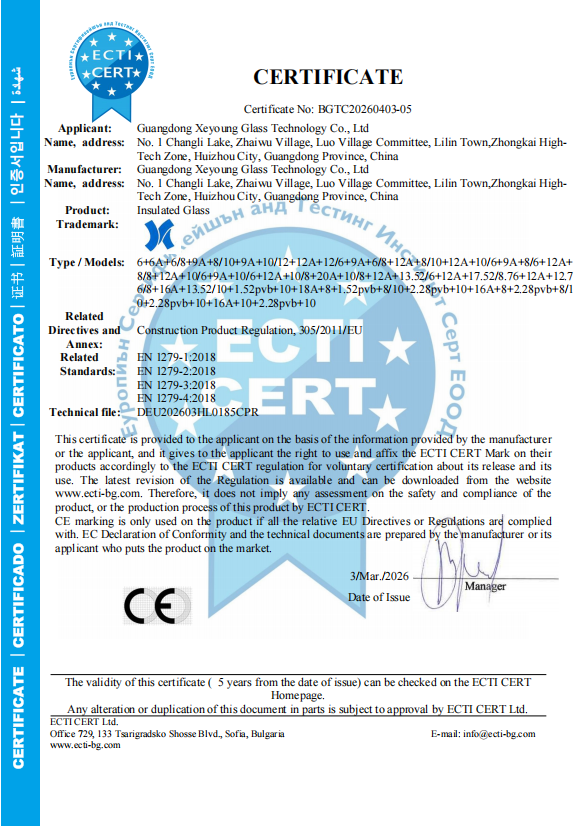
- Curved insulating glass (DY-ZK01) — Certificate No. BGTC20260403-05, complying with EN 1279-1:2018, EN 1279-2:2018, EN 1279-3:2018 and EN 1279-4:2018, valid for the EU/EEA market.
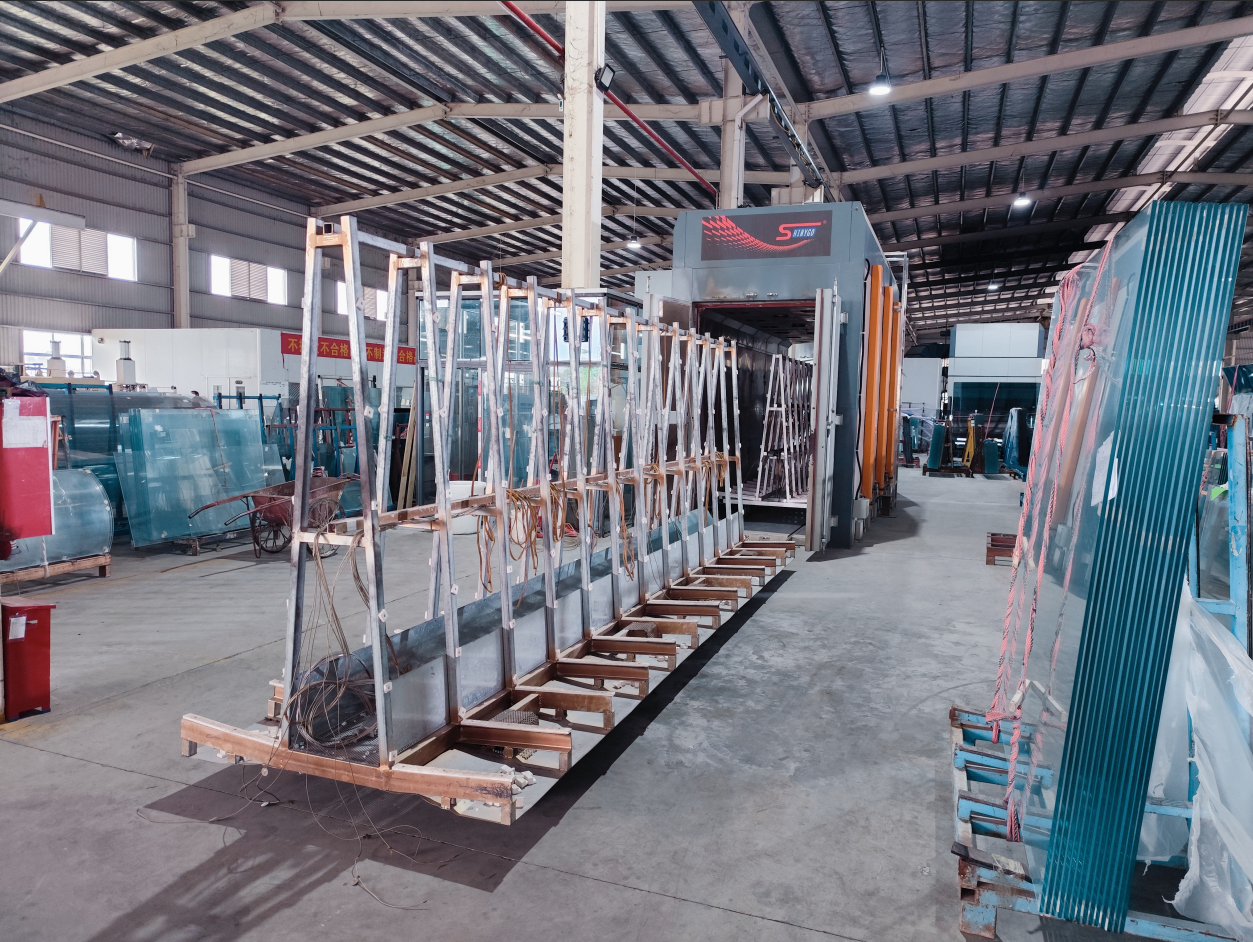
Heat soaking deserves special attention in architectural glass procurement. EN 14179-1 describes heat-soaked thermally toughened safety glass, a process that reduces the risk of spontaneous breakage caused by nickel sulfide inclusions. The European regulatory framework sets the baseline for safety glass; project specifications for glazing above ground level often include heat soaking as an additional safeguard. DYGLASS's production base includes a dedicated heat soak furnace, so buyers should confirm whether heat-soak treatment is included in their specification.
2. Glass Parameters and Tolerances
Once certification is confirmed, the next step is to specify the physical parameters of the glass. The tables below summarize the dimensions and performance values used for DYGLASS's three core product lines.
| Parameter | Curved Tempered Glass (DY-GH01) |
|---|---|
| Thickness | 3 mm, 4 mm, 5 mm, 6 mm, 8 mm, 10 mm, 12 mm, 15 mm, 19 mm |
| Tolerance | ±0.5 mm |
| Light Transmittance | ≥91% |
| Edge Work | Polished / Grinded / Beveled |
| Typical Applications | Curtain Wall, Façade, Shower Room, Balustrade, Furniture, Elevator |
| Parameter | Laminated Curved Glass (DY-JJ01) |
|---|---|
| Thickness Range | 6.38 mm – 50 mm |
| Interlayer Type | PVB, SGP, EVA |
| Interlayer Thickness | 0.38 mm, 0.76 mm, 1.14 mm, 1.52 mm, 2.28 mm |
| Glass Substrate | Tempered, Float, Low-Iron, Tinted Glass |
| Light Transmittance | 85%–92% (clear), 10%–70% (tinted) |
| Sound Insulation | 35 dB – 45 dB |
| Parameter | Curved Insulating Glass (DY-ZK01) |
|---|---|
| Thickness Build-up | 6 mm + 12A + 6 mm / 8 mm + 16A + 8 mm (custom available) |
| Glass Type | Clear Float / Low-E / Tempered / Low-Iron |
| Spacer Bar | Aluminum / Warm Edge |
| Gas Fill | Air / Argon / Krypton / Xenon |
| Light Transmittance | 70%–89% |
| Sound Insulation | 30 dB – 45 dB |
These parameters support configurations such as low iron curved glass for high optical clarity, sound insulated curved glass for transport-adjacent buildings, UV-blocking laminated curved glass with PVB interlayers, and explosion-proof/bulletproof laminated curved glass for higher-security applications. The exact specification should be chosen according to the project's structural, environmental and safety requirements.
3. Production Capability and Curved Shape Range
Manufacturing capability determines whether a supplier can execute complex shapes with acceptable precision. DYGLASS — operated by Shenzhen Dayang Special Glass Co., Ltd. — was established in 2017, operates a 30,000 m² production base in Shenzhen, employs around 130 staff, and reports an annual output of 600,000 square meters. Approximately 60% of output is exported to markets including the UAE, Bahrain, Saudi Arabia, the United States, the Philippines and Vietnam. The company is an Alibaba Verified Supplier and has passed SGS test reports.
The production base at Shenzhen includes:
- Cutting line and edge grinding line;
- Drilling line;
- Tempered line 1 for flat and curved glass;
- Tempered line 2 for concave, convex and irregular curved glass;
- Double curved tempering line;
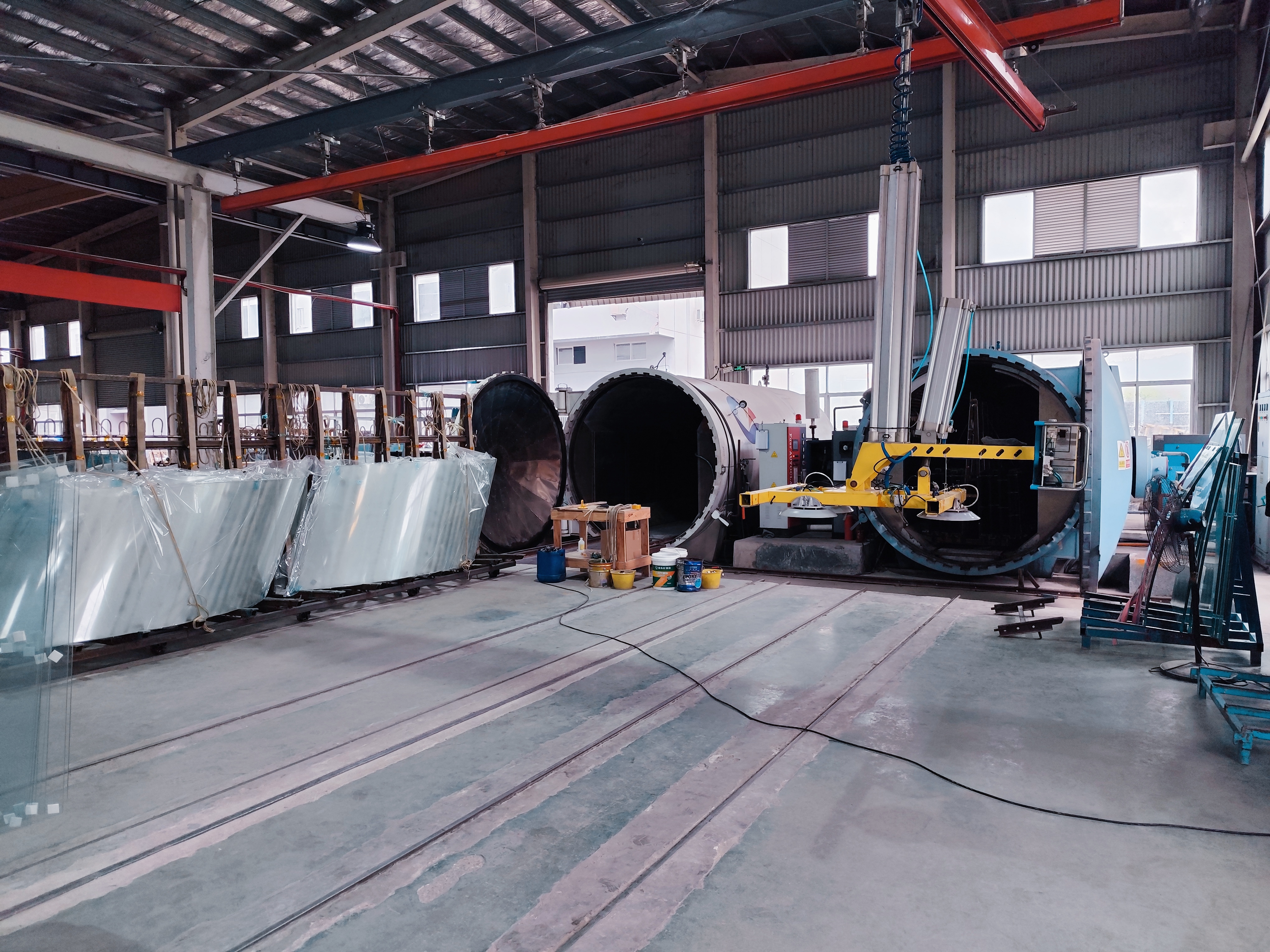
- Laminating autoclave;
- Insulating glass line;
- Heat soak furnace.
DYGLASS states that it can process any surface shape of multi-curved tempered glass, including double curved, triple curved, trapezoid curved, spherical curved, pyramidal curved, S-shape curved, cylindrical curved, and positive-and-negative curved tempered glass. Buyers requiring S-shaped curved glass for sightseeing elevators, U-shaped curved glass for architectural features, or double curved glass for curtain wall nodes should verify that the supplier owns the corresponding bending and tempering equipment.
Step-by-Step Sourcing Breakdown for Curved Glass
- Define the application and safety classification. Identify whether the glass will be used in skylight, curtain wall, shower enclosure, elevator or furniture, and select the base safety standard accordingly.
- Confirm the destination-market certification. For EU/EEA projects, require CE documentation and note the standard numbers: EN 12150-1 for tempered glass, EN 1449:2005 for laminated glass, the EN 1279 series for insulating glass, and EN 14179-1 for heat-soak treatment.
- Select the curved shape and geometry. Distinguish between single-bend hot curved glass, single-curved tempered glass, S-shape, U-shape, and true double-curved glass. Drawings should include radius, chord height, opening dimensions and tolerances.
- Choose the glass build-up. Decide whether low-iron glass, tinted glass, laminated interlayers, Low-E coating, argon fill, or thicker build-ups are required to meet optical, acoustic and thermal targets.
- Send a complete RFQ. Provide drawings, dimension limits, thickness, edge work (polished, grinded or beveled), hole patterns, certification requirements, quantities and delivery destination.
- Audit the supplier's factory evidence. Check that the supplier owns curved tempering lines, double-curved tempering equipment, an autoclave for lamination, CNC-controlled forming, and a heat soak furnace where applicable.
- Request samples and test reports. Cross-check samples against the stated thickness tolerance (±0.5 mm for DY-GH01), edge quality and optical performance.
Application Cases: Matching Curved Glass Specs to Project Scenarios
Curved Glass for Curtain Walls
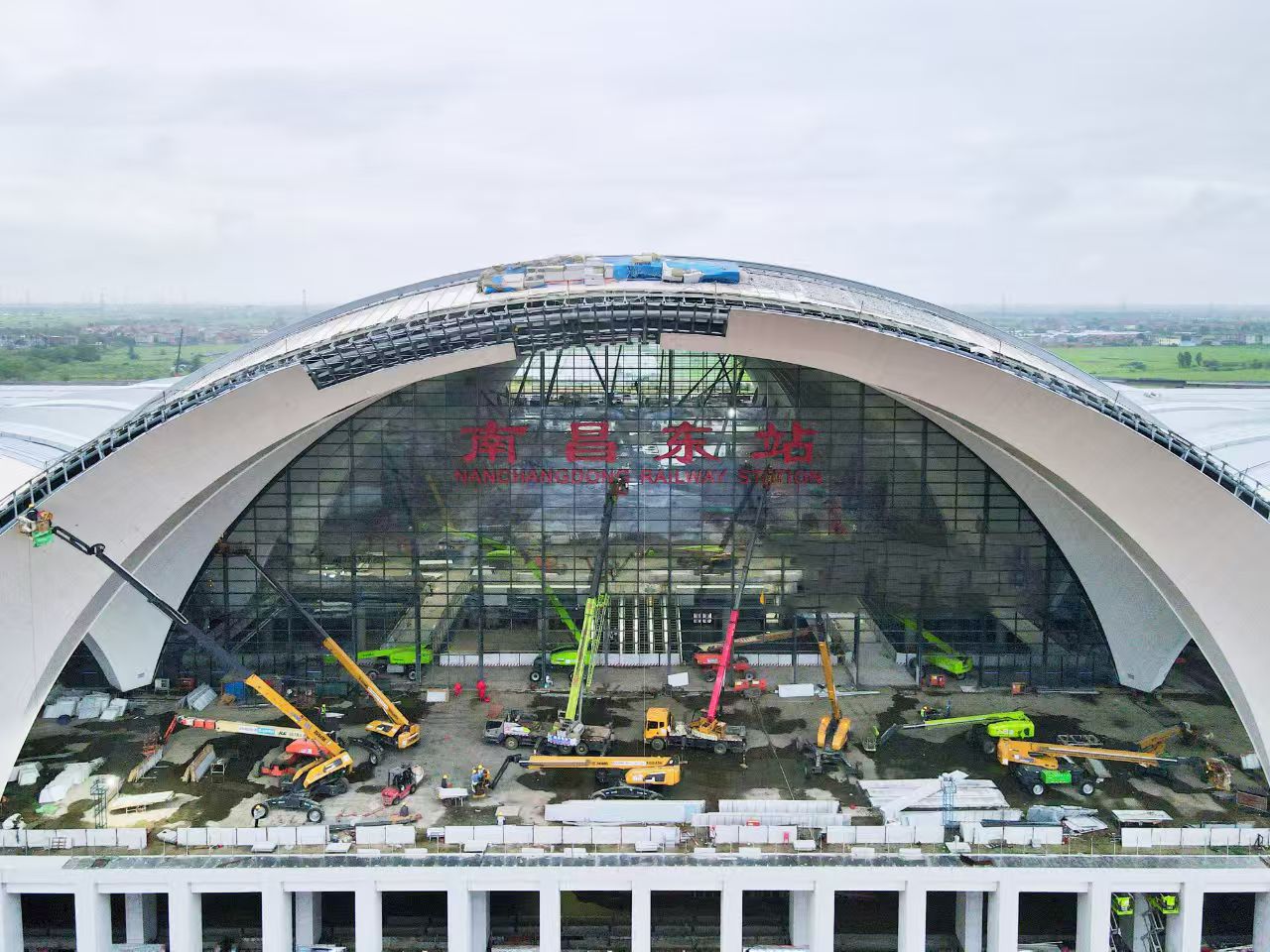
Architectural applications represent the largest share of curved glass demand. Double-curved and multi-curved tempered glass are used in building facades where the envelope follows a sculptural geometry. Examples processed in the China market include Guangzhou Financial City and Nanchang East Railway Station.
Curved Glass for Sightseeing Elevators
S-shape, U-shape and cylindrical curved glass are commonly used in panoramic elevators to create a continuous glazed surface. Laminated curved glass adds a post-breakage retention layer, supporting the safety requirement of elevator shafts and lift lobbies. Curved tempered glass thickness is usually matched to the opening size and wind load.
Curved Glass for Shower Rooms
For shower enclosures, curved tempered glass with polished or grinded edges is standard practice. Glass thickness in the DY-GH01 range is selected according to panel width and mounting method. Drilled holes for hinges and fittings should be processed before tempering to avoid edge damage.
Curved Glass for Coffee Tables and Furniture
In furniture and interior decoration, hot-bent glass and single curved glass are used for coffee tables, display cases and partitions. Low-iron glass is preferred when edge-on clarity and color neutrality are important. This application is less demanding than a structural facade, but edge quality and dimensional accuracy remain part of the specification.
Curved Glass for Skylight Roofs
Skylight roofs need curved glass that can carry overhead loads and retain fragments after breakage. Curved laminated glass with PVB or SGP interlayers is often specified, sometimes combined with Low-E coating or argon-filled cavities for thermal performance. The autoclave capacity of a supplier is a practical indicator of its ability to produce curved laminated units.
Comparison: Curved Glass Supplier Profiles at a Glance
The table below compares DYGLASS with global curved glass players frequently cited in market research. The comparison is based on general industry knowledge; specific certification and factory evidence for DYGLASS comes from company documents.
| Comparison Factor | DYGLASS (Shenzhen Dayang Special Glass) | AGC | Saint-Gobain | Guardian Industries | Cricursa |
|---|---|---|---|---|---|
| Headquarters | China (Shenzhen) | Japan | France | USA | Spain |
| Position in Glass Industry | Custom curved and building glass manufacturer | Global glass and materials manufacturer | Global glass and materials manufacturer | Global glass manufacturer | Curved architectural glass specialist |
| Curved Glass Focus | Multi-curved, double-curved, trapezoid, spherical, pyramidal, S-shape, cylindrical and positive/negative curved tempered glass; laminated and insulating curved glass | Broad portfolio including architectural glass | Broad portfolio including architectural glass | Broad portfolio including float and architectural glass | Highly specialized curved glass for architectural projects |
| Documented CE Certification in This Guide | DY-GH01 — EN 12150-1:2015+A1:2019; DY-JJ01 — EN 1449:2005; DY-ZK01 — EN 1279 series; issued by ECTI CERT Ltd | Not listed in this guide | Not listed in this guide | Not listed in this guide | Not listed in this guide |
| Production Evidence in This Guide | 30,000 m² plant; flat/curved tempering lines; double curved tempering line; autoclave; insulating line; heat soak furnace; 130 employees; 600,000 m² annual output | Not listed in this guide | Not listed in this guide | Not listed in this guide | Not listed in this guide |
| OEM / Customization | OEM and ODM orders accepted; custom curved shapes processed | Not detailed in this guide | Not detailed in this guide | Not detailed in this guide | Project-based custom fabrication is its core model |
How to read this table: for a global-scale project with a general building-glass package, a multinational tier-1 supplier may be the established contracting channel. For a custom curved-glass requirement — an S-shaped lift, a double-curved entrance canopy, or a short-series laminated skylight — a specialized curved-glass manufacturer evaluates the drawing, selects the bending route and controls the tolerance during production without filtering the requirement through a broad standard product range.
Frequently Asked Questions
Which certifications should curved glass carry for European projects?
For the EU/EEA market, CE marking is the key compliance document. DYGLASS's curved tempered glass model DY-GH01 holds CE Certificate No. BGTC20260403-02 under EN 12150-1:2015+A1:2019. Its curved laminated glass model DY-JJ01 holds Certificate No. BGTC20260403-03 under EN 1449:2005. Its curved insulating glass model DY-ZK01 holds Certificate No. BGTC20260403-05 under EN 1279-1:2018, EN 1279-2:2018, EN 1279-3:2018 and EN 1279-4:2018. All three certificates are issued by ECTI CERT Ltd.
What is heat-soaked curved glass and why does it matter?
Heat soaking is a safety-focused process described in EN 14179-1 for thermally toughened safety glass. It accelerates the expansion of nickel sulfide inclusions that could otherwise cause spontaneous glass breakage later. For architectural projects, specifying heat-soaked curved glass or confirming that the supplier operates a heat soak furnace reduces a well-known risk in tempered glass. The DYGLASS production base includes a heat soak furnace.
Which curved shapes can a manufacturer process?
DYGLASS can process any surface shape of multi-curved tempered glass, including double curved, triple curved, trapezoid curved, spherical curved, pyramidal curved, S-shape curved, cylindrical curved, and positive-and-negative curved tempered glass. Its facility includes a concave/convex and irregular curved tempering line and a double curved tempering line.
What factors affect the price of curved glass?
Curved glass pricing depends mainly on curvature complexity, panel size, thickness, glass build-up, edge work, heat-soak requirement, order volume and destination. A single-bent panel in a standard size will be faster and more economical than a double-curved or S-shaped assembly. Buyers can only obtain a reliable budget after sending drawings and quantities to the manufacturer.
Can I request samples or a quotation from DYGLASS?
Yes. DYGLASS invites glass inquiries from project teams and distributors and accepts OEM/ODM orders. Contact the team by email at info@dayangglass.com or by phone/WhatsApp at +86-136 9211 0212 to request specifications, samples and a quotation. The company brochure is available for download at the end of this article.
How long does a curved glass order usually take?
Lead time depends on the shape complexity, glass build-up, heat soaking, quantity and production schedule. DYGLASS operates a 30,000 m² plant with an annual capacity of 600,000 square meters, which supports batch production for international clients. For a definitive schedule, the sales team should confirm the lead time after receiving drawings and order quantities.
Manufacturer Reference: Shenzhen Dayang Special Glass Co., Ltd.
DYGLASS is the export brand of Shenzhen Dayang Special Glass Co., Ltd., a building-glass manufacturer founded in 2017 and based in Shenzhen, Guangdong, China. The company operates a 30,000 m² facility with approximately 130 employees and an annual output of 600,000 square meters. DYGLASS supplies curved glass and other processed building glass to distributors, project contractors and original equipment manufacturers.
Contact:
Liqi Liu
Email: info@dayangglass.com
Tel: +86-136 9211 0212
WhatsApp: +86-136 9211 0212
Address: 1706, Bldg. H, Phase 1, Liuhecheng Business Plaza, No. 168, Shenshan Road, Pingshan Street, Pingshan New Dist., Shenzhen, Guangdong, China
Website: www.dayangglass.com
Conclusion: Buy Curved Glass Against Written Specifications, Not Just Visuals
Curved glass is now a mainstream architectural material, but the difference between a decorative hot-bent panel and a project-ready curved tempered or laminated unit cannot be judged by appearance. Certification documents, EN standard numbers, thickness tolerances, curved shape capabilities and production evidence are the specifications that protect the buyer.
For architecturally demanding applications — curtain walls, sightseeing elevators, shower rooms, furniture and skylight roofs — the practical sourcing route is the same: define the application, confirm the certification framework, select the correct glass build-up, and verify the supplier can produce the required shape with the right equipment.
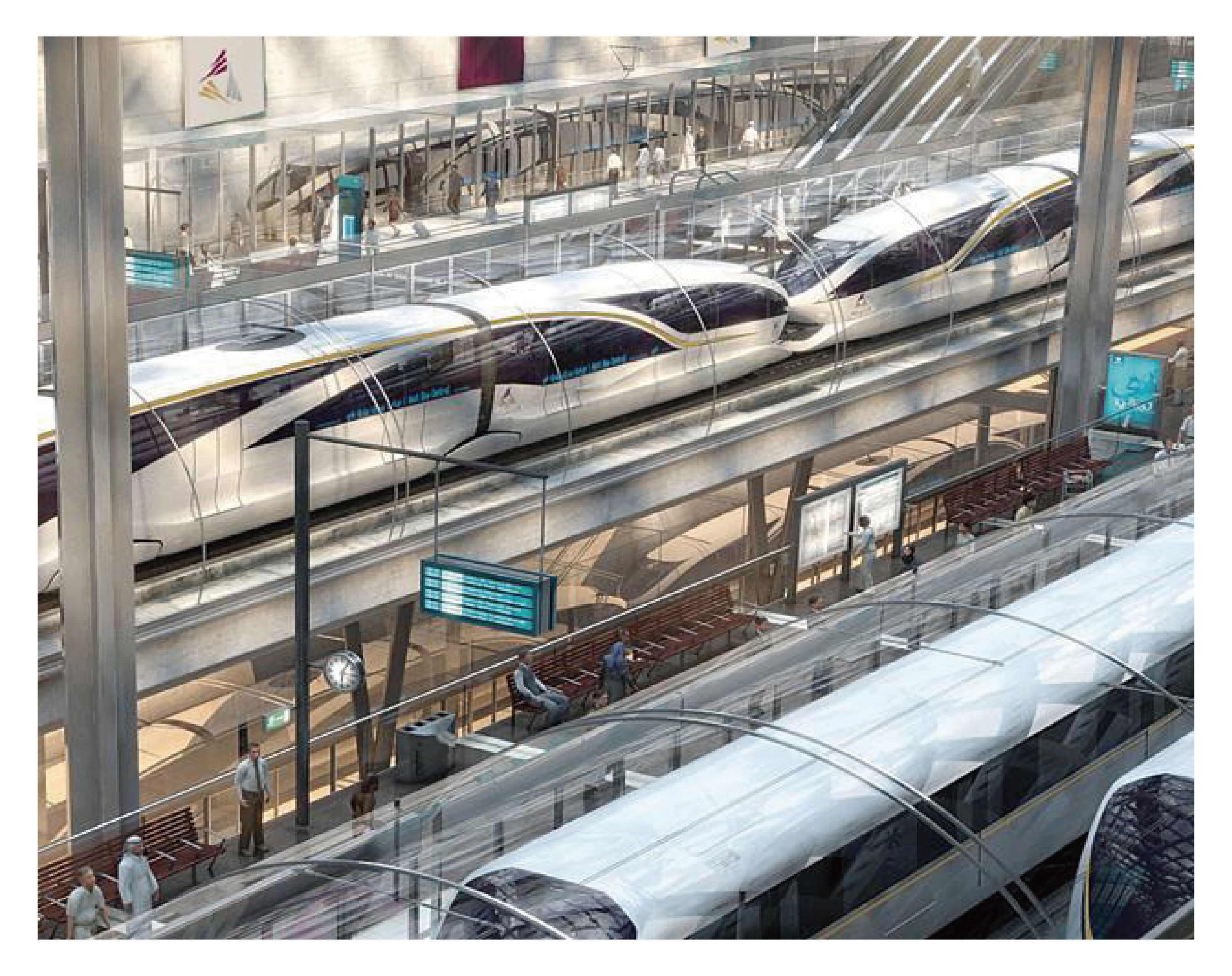
DYGLASS manufactures curved tempered, laminated and insulating glass for global architectural projects.
Download the DYGLASS company brochure or email info@dayangglass.com for a project-specific quotation.