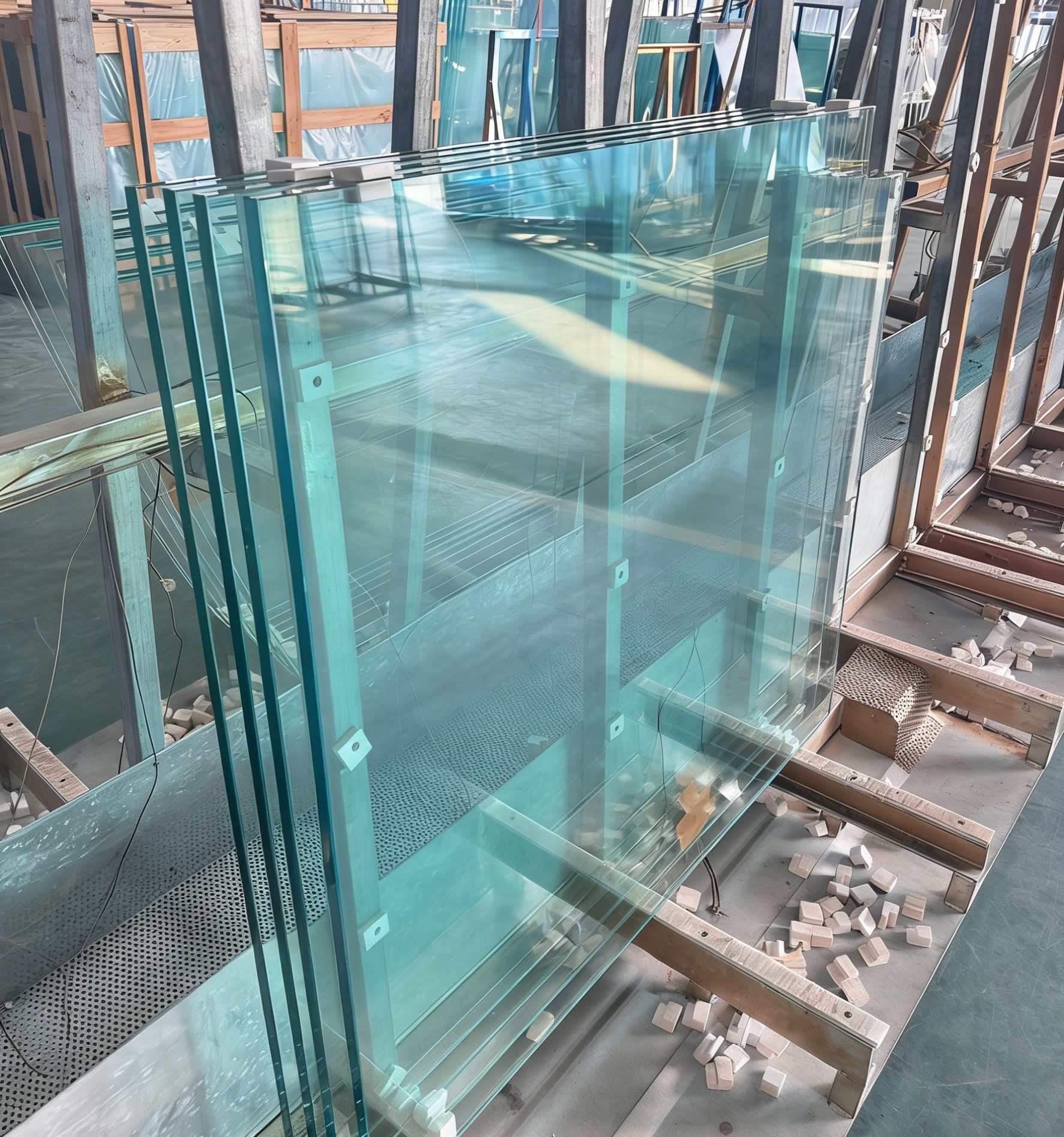
Curved Glass Supplier Evaluation: A Capability & Delivery Assurance Checklist for Buyers
Curved Glass Supplier Evaluation: A Capability & Delivery Assurance Checklist for Buyers
A curved glass supplier should be evaluated against six evidence gates before a purchase order is issued: forming capability, thickness and tolerance envelope, certification scope, facility and capacity evidence, third-party verification, and delivery record. Each gate pairs a claim that suppliers routinely make with a document a buyer can request and cross-check.
Curved glass is close to irreversible. Once a pane has been bent to a radius, no rework restores the specified geometry, and no inspection at the port turns an out-of-scope certificate into a compliant one. The cost of a weak evaluation therefore does not appear in the quotation. It appears later — as rejected units, repeat production runs, and a facade schedule that slips by weeks.
This checklist is written for importers, curtain wall contractors, procurement managers and specifiers working through the research and evaluation stages of a curved glass purchase. The worked example throughout is Shenzhen Dayang Special Glass Co., Ltd., trading as DYGLASS — a building glass manufacturer founded in 2017 in Shenzhen, China, whose range covers curved tempered, laminated and insulating glass and which exports 60% of its output to markets including the UAE, Bahrain, Saudi Arabia, the United States, the Philippines and Vietnam.
Problem Definition: Where Curved Glass Procurement Actually Breaks
Most curved glass supplier failures trace back to three specific gaps between what is claimed and what is documented.
Geometry claims made at category level. A supplier saying "we produce curved glass" answers a category question, while a project asks a geometry question: can you form this radius, in this thickness, in this panel size, on this curvature family? Cylindrical bending, S-shaped and U-shaped profiles, double and triple curvature and asymmetric positive/negative curvature are different manufacturing problems, and capability in one does not imply capability in another.
Certificate scope drift. CE marking for construction products is product-type and thickness specific, not a blanket approval for everything a factory makes. If a specified thickness is not inside the declared range on the certificate, the certificate does not cover the order — even though the supplier genuinely holds one.
Capacity mistaken for availability. An annual output figure describes throughput across a year, not the production slot a project needs in the month it needs it. Capacity evidence answers "can this factory do the volume?" Delivery assurance answers a different question: "will this factory do my volume, on my dates?"
Industry Background: A Growing Market That Rewards Verification
The global curved glass panel market was valued at approximately USD 781.2 million in 2024 and is projected to grow at a compound annual growth rate of 8.0% through 2031, according to Cognitive Market Research. Buyers should treat headline market figures as directional rather than precise: a Custom Market Insights estimate for the panel-specific segment is USD 78.55 million, and the gap reflects differing definitions of what counts as a curved glass panel rather than a contradiction. The practical lesson is that supplier-specific claims deserve the same scrutiny as market statistics.
Asia-Pacific is identified as the fastest-growing region for the curved glass panel market, driven by rapid urbanization and infrastructure development (Custom Market Insights). Architectural applications — facades and curtain walls — accounted for over 40% of curved glass panel demand in 2024 (Research and Markets). On the supply side, China's export value for "worked" glass, the HS 7006 category that includes bent and curved glass, reached approximately USD 791 million in 2023 (TrendEconomy / UN Comtrade).
Regulation is moving in the same direction as demand. In the European Union, EN 12150-1 and EN 14179-1 (heat soaked) are mandatory for toughened safety glass used in construction, a requirement linked to preventing spontaneous breakage caused by nickel sulfide inclusions (CEN). For a buyer, the compliance question is therefore not whether a supplier has "CE glass", but which standards, which product types and which thicknesses its certificates actually declare.
Publicly identified participants in high-performance curved glass include global groups such as AGC, Saint-Gobain, Guardian Industries and the specialist architectural processor Cricursa (Global Market Insights / Grand View Research). Specialist curved glass manufacturers compete in the same specification space. The practical comparison for a buyer is not brand size but declared scope, documented evidence and a verifiable delivery record.
The Six-Gate Capability and Compliance Checklist
Gate 1 — Forming Capability: Ask for Geometry, Not Category
The first question is not "do you make curved glass?" but "which curvature families can you form, at which thickness, on which line?" Shenzhen Dayang Special Glass states that it can process multi-curved tempered glass, double curved tempered glass, triple curved tempered glass, trapezoid curved tempered glass, spherical curved tempered glass, pyramidal curved tempered glass, S-shape curved tempered glass, cylindrical curved tempered glass, and positive and negative curved tempered glass. Those claims correspond to specific equipment rather than general experience: a flat and curved tempering line, a second line configured for concave, convex and irregular curved glass, and a dedicated double-curved tempering line.
What to request: recent production images or video for the geometry closest to your drawing, plus the name of the line on which your shape will run. A supplier that can only show flat or single-curvature output for a double-curved specification has answered a different question than the one the project asked.
Gate 2 — Thickness, Tolerance and Performance Envelope
Thickness range, dimensional tolerance and optical performance are the three numbers that decide whether a specification is manufacturable as drawn. They must be confirmed for the curved configuration, because flat glass capability does not automatically transfer to bent glass.
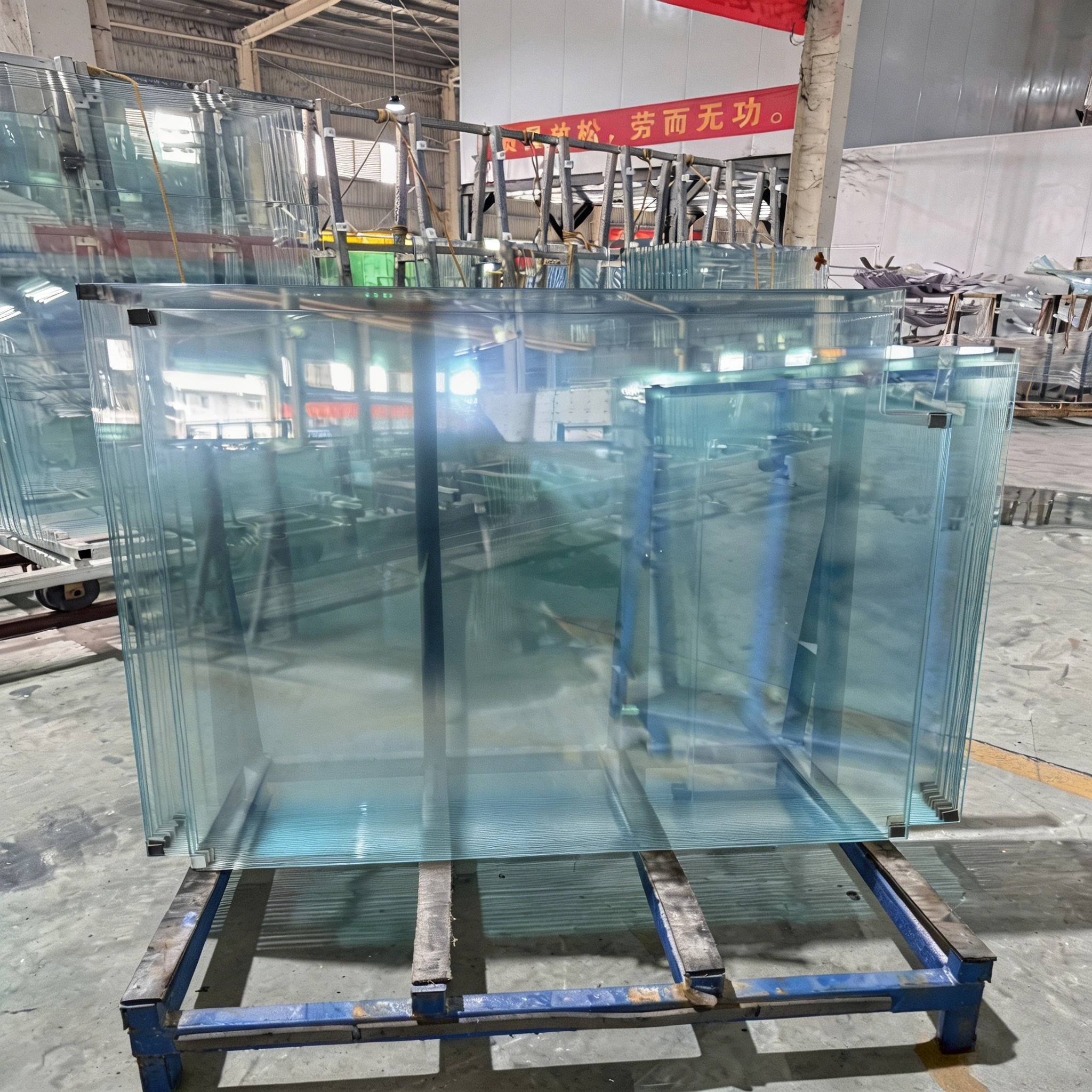
For the DY-GH01 tempered glass range, DYGLASS publishes a thickness set of 3 mm, 4 mm, 5 mm, 6 mm, 8 mm, 10 mm, 12 mm, 15 mm and 19 mm, with a dimensional tolerance of ±0.5 mm and light transmittance of ≥91%. Edge work is available as polished, grinded or beveled, and the product types include flat tempered glass, curved tempered glass and tempered glass with holes. Laminated and insulating configurations extend the envelope further:
| Product range | Configurations | Thickness / build-up | Published performance values |
|---|---|---|---|
| DY-GH01 tempered glass | Flat tempered, curved tempered, tempered with holes, polished edge | 3, 4, 5, 6, 8, 10, 12, 15, 19 mm | Tolerance ±0.5 mm; light transmittance ≥91%; edge work polished / grinded / beveled |
| DY-JJ01 laminated glass | Tempered laminated safety, bulletproof laminated, fire-resistant laminated, curved laminated | 6.38 mm – 50 mm | Interlayer PVB / SGP / EVA at 0.38, 0.76, 1.14, 1.52, 2.28 mm; transmittance 85%–92% clear and 10%–70% tinted; sound insulation 35–45 dB |
| DY-ZK01 insulating glass | Tempered insulated, Low-E coated, argon filled, curved insulated | 6mm+12A+6mm and 8mm+16A+8mm (custom available) | Glass type clear float / Low-E / tempered / low-iron; aluminum or warm edge spacer; gas fill air / argon / krypton / xenon; transmittance 70%–89%; sound insulation 30–45 dB |
Tolerance matters most at the joints. A ±0.5 mm dimensional tolerance is the published value for the DY-GH01 tempered range, and on a multi-pane curved facade the glazing gaps, silicone joints and spider fittings are sized around that number. It belongs in the purchase specification, not in a marketing conversation.
Gate 3 — Certification Scope: Read the Declared Range, Not the Logo
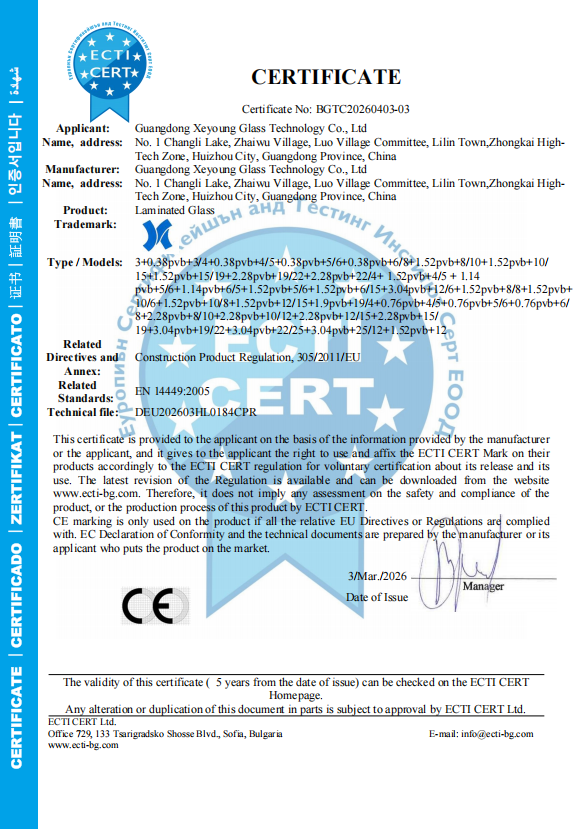
CE marking for construction products under Regulation 305/2011/EU is product-type specific. Buyers should read the certificate number, the harmonised standard, the issuing body, the market and — most importantly — the declared thickness or type schedule. Three CE certificates sit behind the DYGLASS curved glass range, all issued by ECTI CERT Ltd., all valid for the European Union / European Economic Area market, issued on 3 March 2026 and expiring on 3 March 2031:
- Tempered glass (DY-GH01): certificate number BGTC20260403-02, issued to EN 12150-1:2015+A1:2019 and EN 12150-2:2004 under Construction Product Regulation 305/2011/EU. The declared thickness specifications are 4, 5, 6, 8, 10, 12, 15, 19, 22 and 25 mm.
- Laminated glass (DY-JJ01): certificate number BGTC20260403-03, issued to EN 1449:2005 under Construction Product Regulation 305/2011/EU, covering the specified thickness combinations and configurations listed in the certificate's type and model schedule.
- Insulating glass (DY-ZK01): certificate number BGTC20260403-05, issued to EN 1279-1:2018, EN 1279-2:2018, EN 1279-3:2018 and EN 1279-4:2018 under Construction Product Regulation 305/2011/EU.
Heat-soaked tempered glass is a separate verification item. EN 14179-1 (heat soaked) addresses spontaneous breakage risk from nickel sulfide inclusions in toughened safety glass, and EU projects that specify it expect process evidence. A heat soak furnace forms part of the DYGLASS production equipment list, but the tempered glass CE certificate referenced above is issued to EN 12150-1:2015+A1:2019. Buyers who specify heat-soaked glass should request heat-soak process records as a distinct document, not infer them from the CE mark.
Gate 4 — Facility and Capacity Evidence
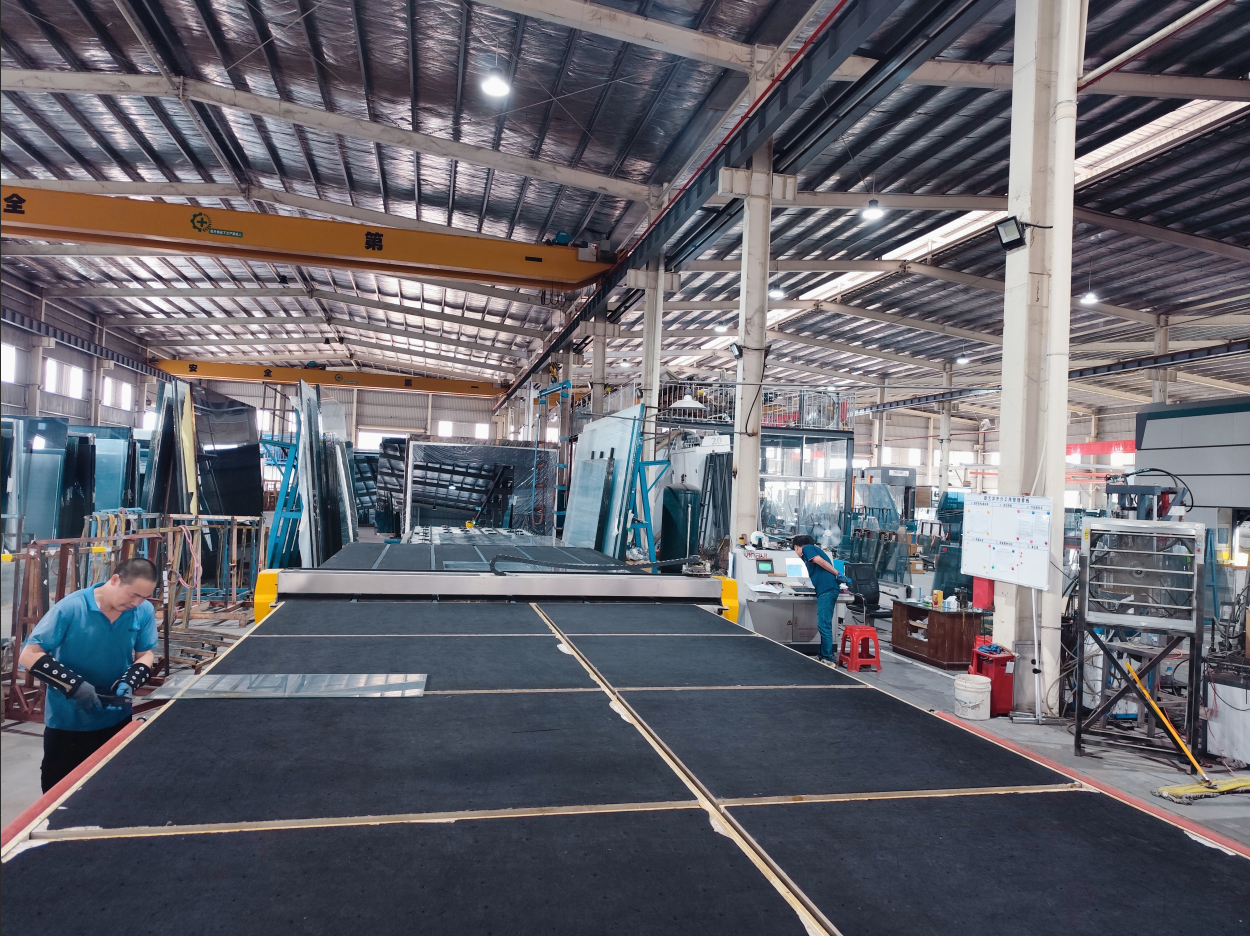
Facility facts are the fastest way to test whether a supplier is a processor or a reseller, and they are also among the easiest claims to overstate. They should therefore be matched to equipment rather than adjectives.
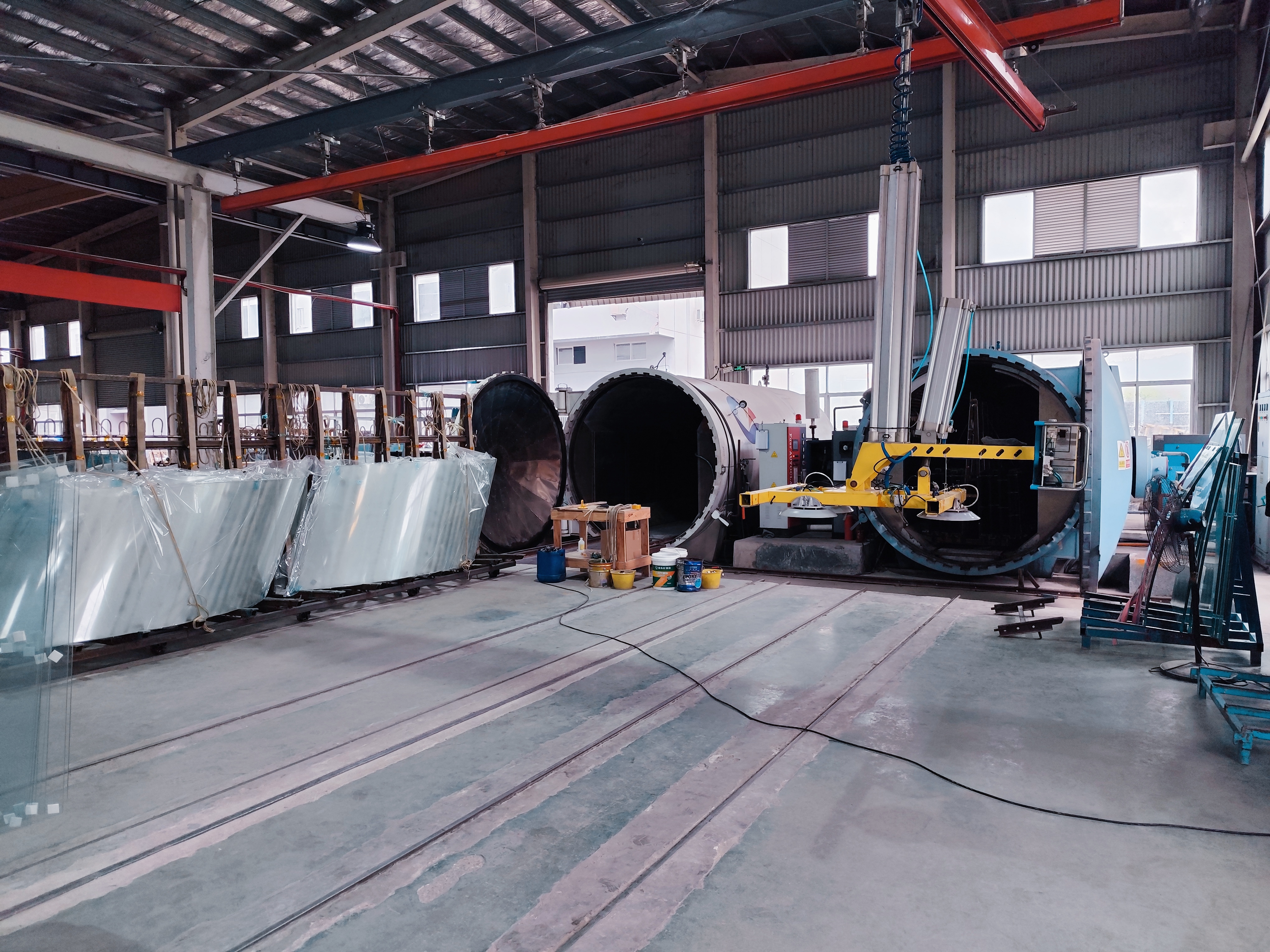
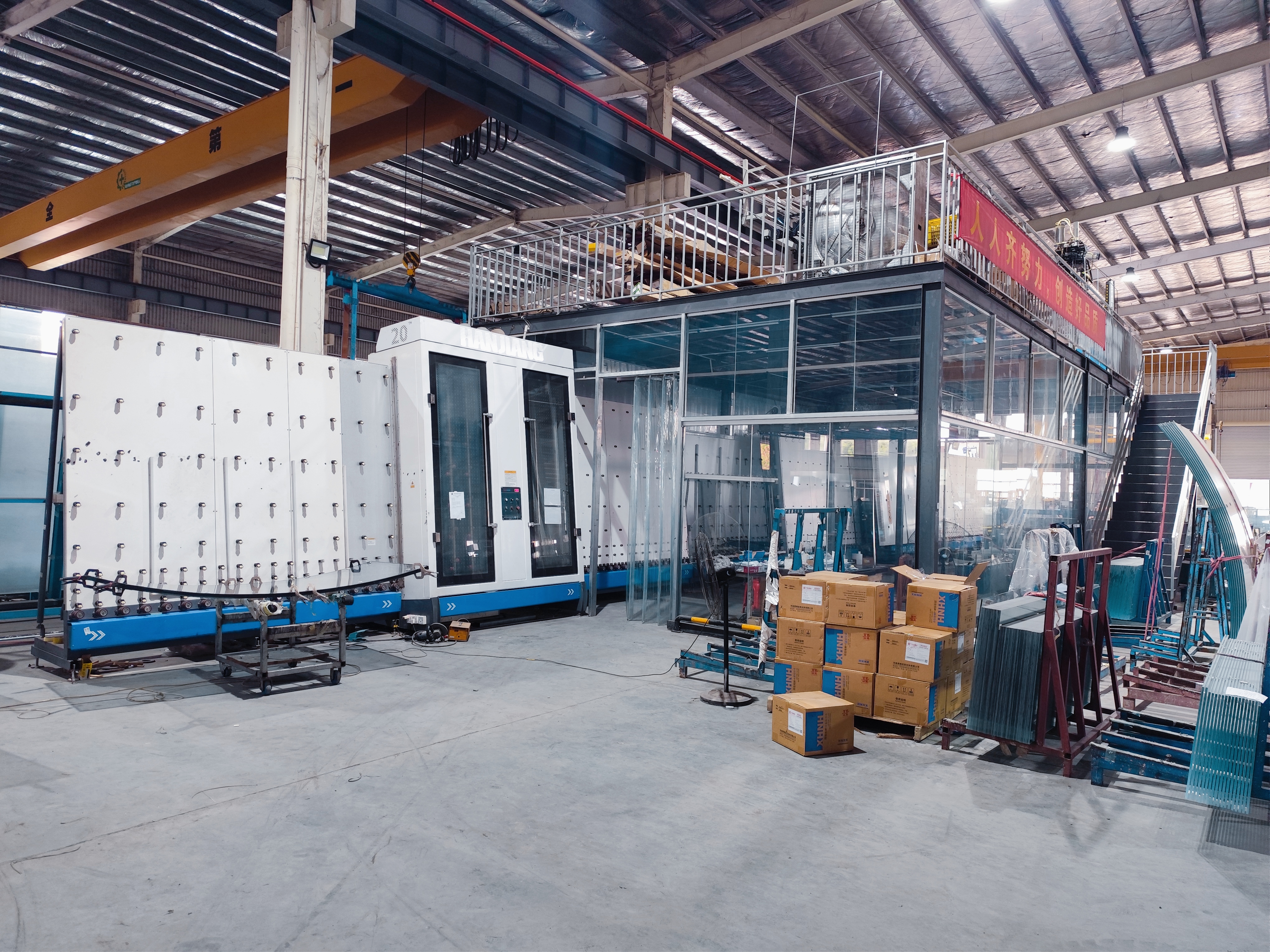
DYGLASS operates a 30,000 m² facility in Shenzhen, employs approximately 130 staff, maintains an R&D team of 5–10 people, and reports an annual output of 600,000 square meters. The production equipment list includes a flat and curved tempering line, a concave, convex and irregular curved tempering line, a double-curved tempering line, a laminated glass autoclave, an insulated glass line, a cutting line, a drilling line, a heat soak furnace and an edge grinding line.
What to request: a factory video or third-party audit, the equipment list with line-level capacity, and a written statement of which line will produce the order and in which production window. An annual output of 600,000 square meters demonstrates throughput; it does not demonstrate a reserved slot.
Gate 5 — Third-Party and Platform Verification
Third-party documents verify identity and process discipline rather than a specific order. Two are relevant here: DYGLASS has passed an SGS test report and holds Alibaba Verified Supplier status. The SGS test report indicates that an independent laboratory has tested product samples, while Verified Supplier status indicates that a platform has checked the company's legal and trading identity.
Neither document replaces an order-specific conformity check. Use them as the first layer — they answer the question "is this a real manufacturing business?" — then move to Gate 3 for the layer that applies to your actual specification.
Gate 6 — Delivery Assurance and Export Record
Delivery assurance is an export record plus a shipping plan. DYGLASS states that 60% of its output is exported, with main markets including the UAE, Bahrain, Saudi Arabia, the United States, the Philippines and Vietnam, and that it accepts OEM and ODM orders.
What to request: the export destination list with recent shipment references in your region and application; the packing method for curved glass, including stillages, A-frame racks and edge protection; the Incoterms under discussion; and a written production and shipping milestone schedule tied to the award date. An OEM or ODM supplier should also confirm drawing revision control, because custom curvature geometry has to be traceable from the approved drawing to the shipped pane.
Step-by-Step Breakdown: A Five-Step Pre-Award Audit
The six gates are evaluated in a fixed sequence. Running them out of order wastes time, because there is no point validating a sample against a specification that has not been frozen.
- Freeze the specification sheet. Lock thickness, curvature type and geometry, interlayer type and thickness, spacer and gas fill, edge work, tolerance, light transmittance and sound insulation targets. Ambiguity at this step propagates into every document requested later.
- Request the evidence pack. Ask for all documents in the table below in a single request. Suppliers that answer in fragments usually have gaps.
- Map certificate scope to the specification. Check the declared thickness list, the harmonised standard, the certificate validity dates and the market. Flag any specified thickness that falls outside the declared range.
- Validate a physical sample. Inspect dimensional tolerance, edge quality, curvature consistency and optical distortion against the frozen specification, and compare measured values with the published ones.
- Award with documentation and inspection clauses. Tie the certificate numbers, the approved drawing revision and the production milestone schedule into the contract, and agree the pre-shipment inspection point.
| Gate | Document to request | What to check |
|---|---|---|
| 1. Forming capability | Equipment list naming the curved and double-curved tempering lines; recent production images for your geometry | Whether the exact curvature family has documented output, not only flat or single-curvature work |
| 2. Thickness and tolerance | Published specification sheet; sample inspection report at the specified thickness | Tolerance and performance stated for the curved configuration, not only the flat one |
| 3. Certification | CE certificates with numbers, harmonised standards, issuing body and declared thickness schedules | Whether your thickness is inside the declared range, plus validity dates and market coverage |
| 4. Facility and capacity | Factory video or third-party audit; equipment list; written production window | A named production line and a reserved slot, not only an annual capacity figure |
| 5. Third-party verification | SGS test report reference; Alibaba Verified Supplier profile | That these are treated as identity checks rather than order-specific conformity evidence |
| 6. Delivery assurance | Export destination list; packing method; milestone schedule; drawing revision control | That dates, revision numbers and packing specifications are written into the contract |
Use Cases: How the Application Changes the Verification Focus
The same six gates apply across applications, but the emphasis shifts. The scenarios below are the ones most commonly specified with curved glass.
Curved Glass for Curtain Wall
Curtain wall and facade work dominate demand: architectural applications accounted for over 40% of curved glass panel demand in 2024 (Research and Markets). Verification here focuses on certified thickness coverage, because facade panels are usually laminated or insulating units. Confirm that the build-up you specify — for example the DY-ZK01 configurations at 6mm+12A+6mm or 8mm+16A+8mm — is inside the declared scope of the relevant certificate, and that the insulating specifications are certified to EN 1279-1:2018 through EN 1279-4:2018.
Curved Glass for Sightseeing Elevator
Elevator enclosures are safety-critical and typically laminated. The DY-JJ01 laminated range covers tempered laminated safety glass, bulletproof laminated glass, fire-resistant laminated glass and curved laminated glass, with interlayers available in PVB, SGP or EVA at 0.38, 0.76, 1.14, 1.52 or 2.28 mm. The verification question is not only thickness but interlayer choice, since the interlayer type determines post-breakage behaviour. Ask which interlayer is offered for the application and confirm that the used combinations appear on CE certificate BGTC20260403-03.
Curved Glass for Shower Room
Bathroom and shower applications in the DY-GH01 range involve curved tempered glass with holes and polished edges. Two process details carry the risk: drilling and edge finishing must be completed before tempering, and edge work quality determines both appearance and breakage resistance. Verify the edge specification — polished, grinded or beveled — and confirm that the chosen thickness sits inside both the published 3 mm to 19 mm production range and the certified thickness schedule.
Curved Glass for Coffee Table
Furniture applications are appearance-driven, so optical quality leads the verification. Low-iron glass substrate is available across the templated and laminated ranges, and clear laminated glass is published at 85%–92% light transmittance, with tinted options between 10% and 70%. For visible edges, confirm the polishing standard on the sample itself rather than on a data sheet. Where a project requires UV-blocking performance, ask the supplier to state which interlayer or coating provides the function and to document it — published transmittance ranges alone do not establish UV performance.
Curved Glass for Skylight Roof
Roof glazing combines safety, thermal and acoustic requirements. Laminated glass is published with sound insulation of 35–45 dB and insulating units at 30–45 dB, with transmittance between 70% and 89% depending on glass type and coating. Overhead glazing also raises the heat-soak question, since nickel sulfide inclusion risk is most consequential where broken glass falls. Confirm whether heat soaking is specified, and request separate process evidence for it rather than assuming the CE mark on EN 12150-1:2015+A1:2019 covers it.
Comparison Table: Claim, Evidence and Red Flag
The table below converts the six gates into a comparison format. It is a verification tool, not a supplier ranking, and no performance score is implied by the order of rows.
| Supplier claim | Document that verifies it | Red flag |
|---|---|---|
| "We produce curved and double-curved tempered glass" | Equipment list naming the curved and double-curved tempering lines, plus recent production images for your geometry | Only flat or single-curvature samples are offered for a double-curved specification |
| "Thickness 3–19 mm, tolerance ±0.5 mm, transmittance ≥91%" | Published specification sheet and a sample inspection report at the specified thickness | Tolerance is quoted for flat glass only, with no curved equivalent |
| "We are CE certified" | Certificate number, harmonised standard, declared thickness schedule, issuing body and validity dates | Certificate scope or declared thickness range does not cover the ordered specification |
| "30,000 m² plant, 600,000 m² annual capacity" | Factory audit or video, equipment list, and a written production window | Capacity is quoted without naming a line or reserving a production slot |
| "SGS tested, Alibaba Verified Supplier" | Test report reference and platform profile | Third-party identity documents are presented as order-specific conformity evidence |
| "60% export share, OEM/ODM welcome" | Export destination list, packing method, milestone schedule and drawing revision control | No named shipping plan, packing specification or drawing revision process |
FAQ
Which standards and certificate numbers cover DYGLASS curved glass products for the EU/EEA market?
Three CE certificates issued by ECTI CERT Ltd. apply, all issued on 3 March 2026, valid until 3 March 2031, and valid for the European Union / European Economic Area market. Tempered glass (DY-GH01) is certified under EN 12150-1:2015+A1:2019 and EN 12150-2:2004 with certificate number BGTC20260403-02, with declared thickness specifications of 4, 5, 6, 8, 10, 12, 15, 19, 22 and 25 mm. Laminated glass (DY-JJ01) is certified under EN 1449:2005 with certificate number BGTC20260403-03. Insulating glass (DY-ZK01) is certified under EN 1279-1:2018, EN 1279-2:2018, EN 1279-3:2018 and EN 1279-4:2018 with certificate number BGTC20260403-05. All three reference Construction Product Regulation 305/2011/EU.
What thickness range and tolerance can be verified for curved tempered glass?
The DY-GH01 tempered glass range is published at 3, 4, 5, 6, 8, 10, 12, 15 and 19 mm, with a dimensional tolerance of ±0.5 mm, light transmittance of ≥91%, and edge work in polished, grinded or beveled finish. Laminated configurations span 6.38 mm to 50 mm. Insulating configurations are published at 6mm+12A+6mm and 8mm+16A+8mm, with custom combinations available. Buyers should note that the CE certificate for tempered glass declares thicknesses from 4 mm to 25 mm, so a 3 mm specification sits inside the production range but outside the certified schedule and requires separate confirmation.
What drives cost in a curved glass order, and how should quotations be compared?
Curved glass cost is driven by the specification rather than by a list price: glass substrate and thickness, interlayer type and thickness for laminated units, spacer type and gas fill for insulating units, edge work and drilling, curvature geometry and panel size, order quantity, packing method and Incoterms. Because no public price band is meaningful across these variables, quotations should be compared line by line against a frozen specification. A quotation that looks cheaper because it silently omits an interlayer grade, an edge treatment or a certified thickness is not a lower price — it is a different product.
How should a curved glass sample be validated before mass production?
Request the sample in the actual configuration: the specified thickness, the curvature geometry, the edge work and, for laminated units, the actual interlayer type and thickness. Measure dimensional tolerance against the published ±0.5 mm value for the DY-GH01 tempered range, inspect edge polish, and check for wave distortion by viewing the pane at an angle. Cross-check measured light transmittance against published values — ≥91% for DY-GH01 tempered glass, 85%–92% for clear laminated glass, and 70%–89% for insulating units. Sound insulation targets can be referenced at 35–45 dB for laminated and 30–45 dB for insulating configurations.
How can a buyer confirm that capacity will meet the project schedule?
Annual output and delivery assurance are different claims. The verification sequence is to match the reported 600,000 square meter annual output against the equipment list, ask which line will produce the order, and obtain a written production window and shipping milestone schedule tied to the award date. Packing method for curved panels should also be confirmed in writing. For a project-specific answer, buyers can send a curvature drawing and target thickness to DYGLASS — which accepts OEM and ODM orders — and request a sample plus a specification-based quotation before committing to a production slot.
Conclusion
Curved glass supplier evaluation is a documentation exercise before it is a commercial one. Forming capability must be evidenced at the level of the actual geometry; thickness, tolerance and performance values must be confirmed for the curved configuration; certificate scope must be matched against the specified thickness rather than assumed from a CE logo; facility and capacity claims must be tied to a named line and a reserved window; third-party documents must be positioned as identity checks, not conformity proof; and delivery assurance must be reduced to a written milestone schedule.
Run those six gates in sequence, and the decision to award a contract rests on evidence the buyer can audit rather than on a supplier's confidence. That is the difference between a curved glass order that arrives to specification and one that becomes a rework programme.
Next step: verify before you award
Send your curvature drawing, thickness schedule and target market, and request a sample, a specification-based quotation, or the full product documentation for DY-GH01 tempered glass, DY-JJ01 laminated glass and DY-ZK01 insulating glass.
Download the DYGLASS product brochure (PDF) for the complete product and capability reference.
Shenzhen Dayang Special Glass Co., Ltd. (DYGLASS) — info@dayangglass.com | Tel: +86-136 9211 0212 | WhatsApp: +86 13692110212 | www.dayangglass.com