
Curved Laminated Safety Glass: PVB Thickness, Tempering & Fire Classification
Curved Laminated Safety Glass: PVB Thickness, Tempering & Fire Classification
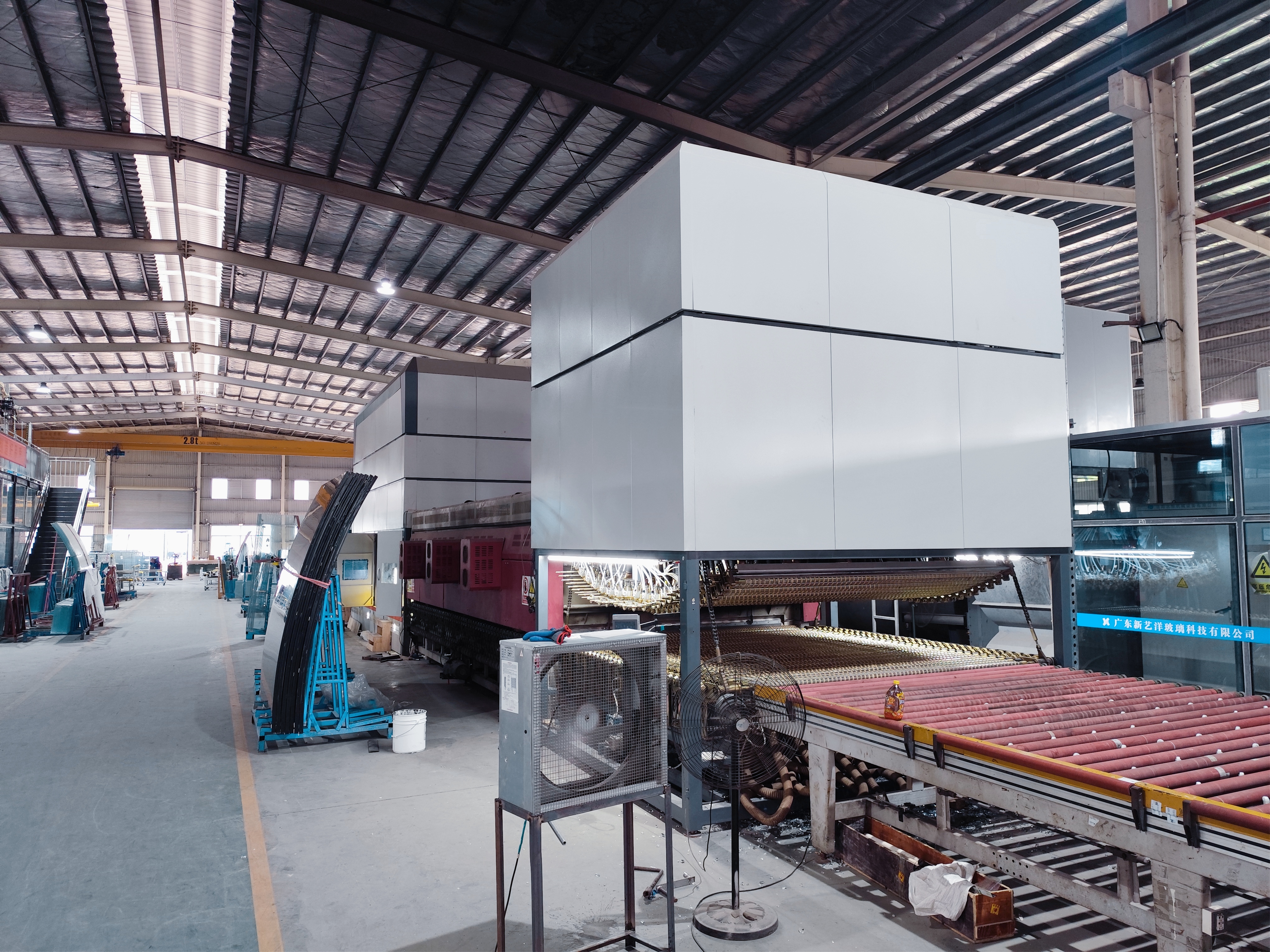
Curved laminated safety glass in the DYGLASS DY-JJ01 range is a laminated build of 6.38 mm to 50 mm total thickness, bonded with PVB, SGP or EVA interlayers available in 0.38 mm, 0.76 mm, 1.14 mm, 1.52 mm and 2.28 mm, over tempered, float, low-iron or tinted glass substrates, and covered by CE certificate BGTC20260403-03 issued by ECTI CERT Ltd. against EN 1449:2005.
Those figures, rather than the phrase laminated glass, are what decide whether a curved panel behaves as the design assumed. They are also the figures most often left to the fabricator, because the drawing simply says curved laminated glass. That shorthand conceals the difference between a safety build, a security build and a fire-classified build, and it conceals the constraints that curvature places on tempering.
This guide is written for architects, facade engineers, specifiers and buyers who are in the evaluation stage now. It explains how the interlayer and the substrate produce safety behaviour, how curvature interacts with tempering and formed geometry, how the CE certificate attached to DY-JJ01 should be read, and how fire-resistant potential is handled as a classified property of one specific build-up rather than a property of laminated glass in general.
What a curved laminated safety glass specification actually contains
A curved laminated safety glass panel is a build of two or more glass panes bonded by a polymer interlayer film and formed to a curve. The safety behaviour comes from the interlayer: it bonds the panes into a single unit and, after breakage, holds the fragments in place instead of allowing them to fall out of the frame. The curve comes from thermal forming, which in most architectural builds is carried out during tempering, so curvature and tempering are linked process decisions rather than independent options on a datasheet.
For the DY-JJ01 laminated glass product, the documented configuration envelope is:
- Total thickness: 6.38 mm to 50 mm
- Interlayer material: PVB, SGP, EVA
- Interlayer thickness: 0.38 mm, 0.76 mm, 1.14 mm, 1.52 mm, 2.28 mm
- Glass substrate: tempered glass, float glass, low-iron glass, tinted glass
- Light transmittance: 85% to 92% (clear), 10% to 70% (tinted)
- Sound insulation: 35 dB to 45 dB
- Documented product forms: tempered laminated safety glass, bulletproof laminated glass, fire-resistant laminated glass, curved laminated glass
- Certification: CE certificate BGTC20260403-03, ECTI CERT Ltd., EN 1449:2005 and Construction Product Regulation 305/2011/EU, issued 2026-03-03, valid to 2031-03-03, EU/EEA market
Two items are deliberately absent from that list, and both matter at evaluation stage. There is no universal curve radius, because the achievable radius depends on the shape, the pane thickness and the forming line used. There is also no blanket fire rating, because fire performance is classified for a specific build-up. Both are confirmed per project rather than inferred from the family specification.
Why curved laminated safety glass is specified incorrectly so often
The recurring failure pattern is simple: the visible number, total thickness, is treated as the safety number. Two builds can be quoted at the same nominal total thickness while differing in substrate, interlayer material and interlayer thickness, and those are precisely the variables that determine post-break behaviour and the documentation that can be attached to the order.
- Reading total thickness as a proxy for the interlayer. A 6.38 mm build sits at the light end of the DY-JJ01 envelope and 50 mm at the heavy end, but neither figure alone states how much interlayer the build contains. Interlayer thickness is documented separately, from 0.38 mm to 2.28 mm, and should be written explicitly in the specification.
- Assuming laminated means fire-rated. DY-JJ01 is documented in a fire-resistant laminated form, but the classification belongs to a particular build-up and is stated as per classification, not as a general property of laminated glass.
- Assuming the CE certificate covers every configuration. The certificate scope covers laminated glass in the specified thickness combinations and configurations listed in its type and models section, so the configuration on the purchase order has to appear in that list.
- Treating curvature as cosmetic. Curvature is produced by hot forming. The shape changes what the forming line can hold, where holes and cut-outs may sit, and how the pane behaves through lamination.
- Leaving the substrate decision open. Tempered glass and float glass are both documented substrate options for DY-JJ01, and they are not interchangeable where safety glazing, forming or heat treatment is required.
Industry context: demand, standards and what evaluation-stage buyers now check
Curved glass is no longer a niche architectural detail. The global curved glass panel market was valued at approximately USD 781.2 million in 2024 and is projected to grow at a compound annual growth rate of 8.0% through 2031, according to Cognitive Market Research. Custom Market Insights identifies Asia-Pacific as the fastest-growing region, driven by urbanisation and infrastructure development, and Research and Markets reports that architectural applications such as facades and curtain walls accounted for more than 40% of curved glass panel demand in 2024.
Trade data points in the same direction. China's export value for worked glass, including bent and curved glass under HS 7006, reached approximately USD 791 million in 2023, according to TrendEconomy and UN Comtrade data. Market size estimates differ between research houses depending on scope, so the directional picture and the sourcing base matter more than any single valuation figure.
On the standards side, EN 12150-1 and EN 14179-1 for heat-soaked thermally toughened safety glass are mandatory for toughened safety glass used in construction in Europe, in order to reduce the risk of spontaneous breakage from nickel sulfide inclusions, as set out by CEN. This matters for laminated curved builds because the substrate of a laminated panel is very often tempered, so the heat-soak question arrives together with the tempering decision.
For buyers benchmarking the supply base, the high-performance reference set usually includes AGC, Saint-Gobain, Guardian Industries and Cricursa, which Global Market Insights and Grand View Research identify among the top global industry players for high-performance curved glass.
What has changed in evaluation behaviour is the evidence requirement. Buyers now ask for certificate numbers and validity dates instead of certification claims, for confirmation that curved and double-curved tempering capacity exists in-house rather than being brokered, for heat-soak availability, for interlayer options beyond a single default film, and for a documented lamination step such as autoclave bonding. A supplier that can only describe a flat laminated process will usually be filtered out of a curved facade shortlist before pricing is even discussed.
Inside the DY-JJ01 build: interlayer, substrate and curvature
Interlayer material and interlayer thickness
PVB is the interlayer material documented in the DY-JJ01 material specification, alongside tempered glass; SGP and EVA are also listed as available interlayer types. The available interlayer thicknesses are 0.38 mm, 0.76 mm, 1.14 mm, 1.52 mm and 2.28 mm. Because the interlayer is the element that carries the post-break safety function, the interlayer thickness is the parameter that separates a basic safety requirement from a higher residual-strength or security requirement in the same product family.
Since the interlayer thickness options are documented independently of total thickness, they can be combined with different total build-ups. That is exactly why the interlayer figure should be written into the specification rather than left to the workshop: two panels ordered at the same total thickness can carry different interlayer builds, and the resulting performance and documentation differ accordingly.
Tempered substrate versus float substrate
DY-JJ01 documents tempered glass, float glass, low-iron glass and tinted glass as substrate options. The tempered route is covered by a separate certificate: DY-GH01 tempered glass, thickness 4, 5, 6, 8, 10, 12, 15, 19, 22 and 25 mm, thickness tolerance of plus or minus 0.5 mm, light transmittance of 91% or above, and edge work available polished, grinded or beveled, certified under CE certificate BGTC20260403-02 against EN 12150-1:2015+A1:2019 and EN 12150-2:2004.
The distinction is not cosmetic. A tempered substrate is the normal choice where safety glazing is required and it is also the substrate that allows the pane to be hot-formed into a curve. Where the design intent calls for float glass, the laminated build is still available within the 6.38 mm to 50 mm envelope, but the substrate decision should be made together with the safety requirement rather than after it.
Low-iron and tinted substrates change the optical outcome rather than the mechanical one. Within the DY-JJ01 specification, light transmittance is documented at 85% to 92% for clear builds and 10% to 70% for tinted builds, so substrate and colour selection should be fixed against the target transmittance, not against a visual sample alone.
What curvature changes in the process
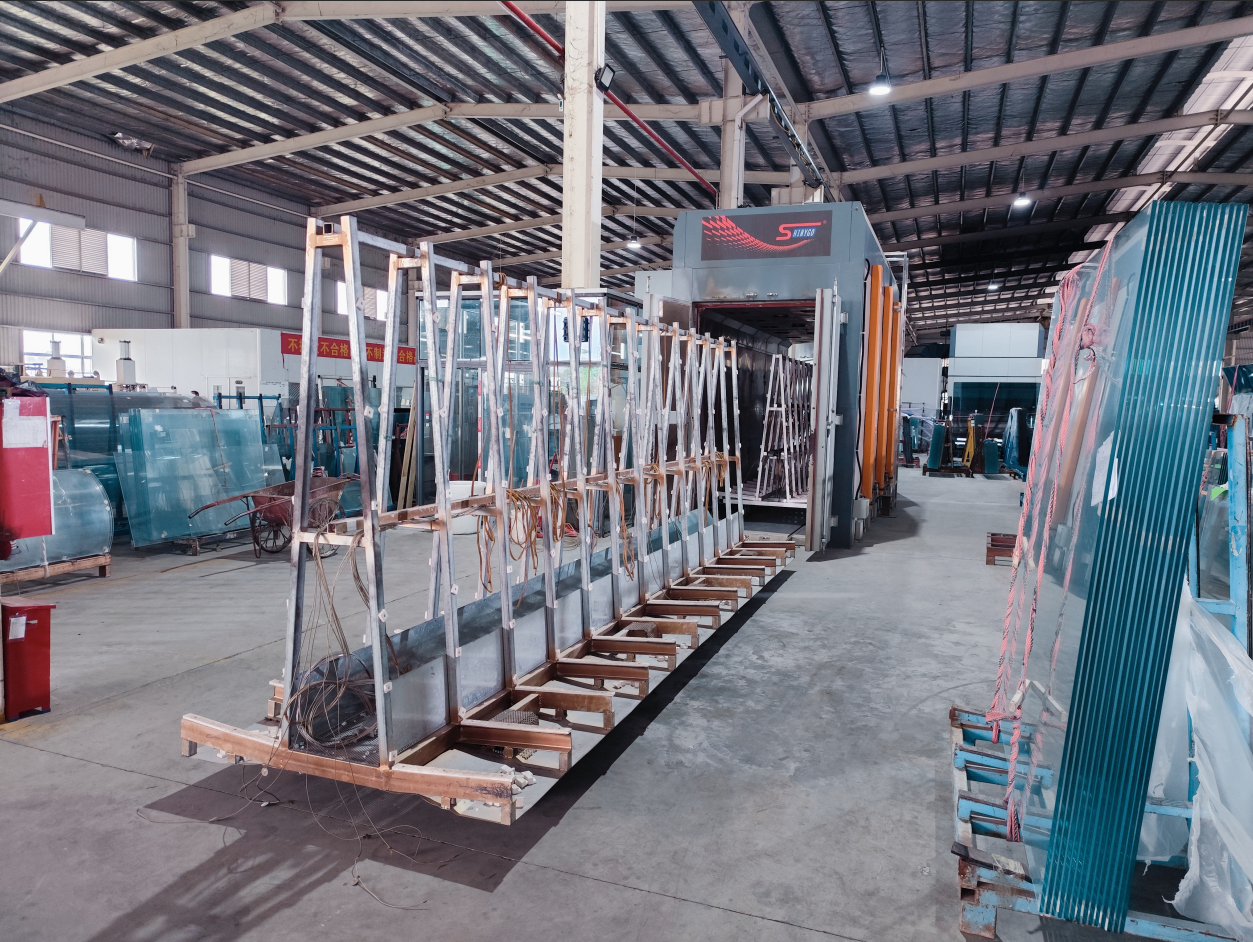
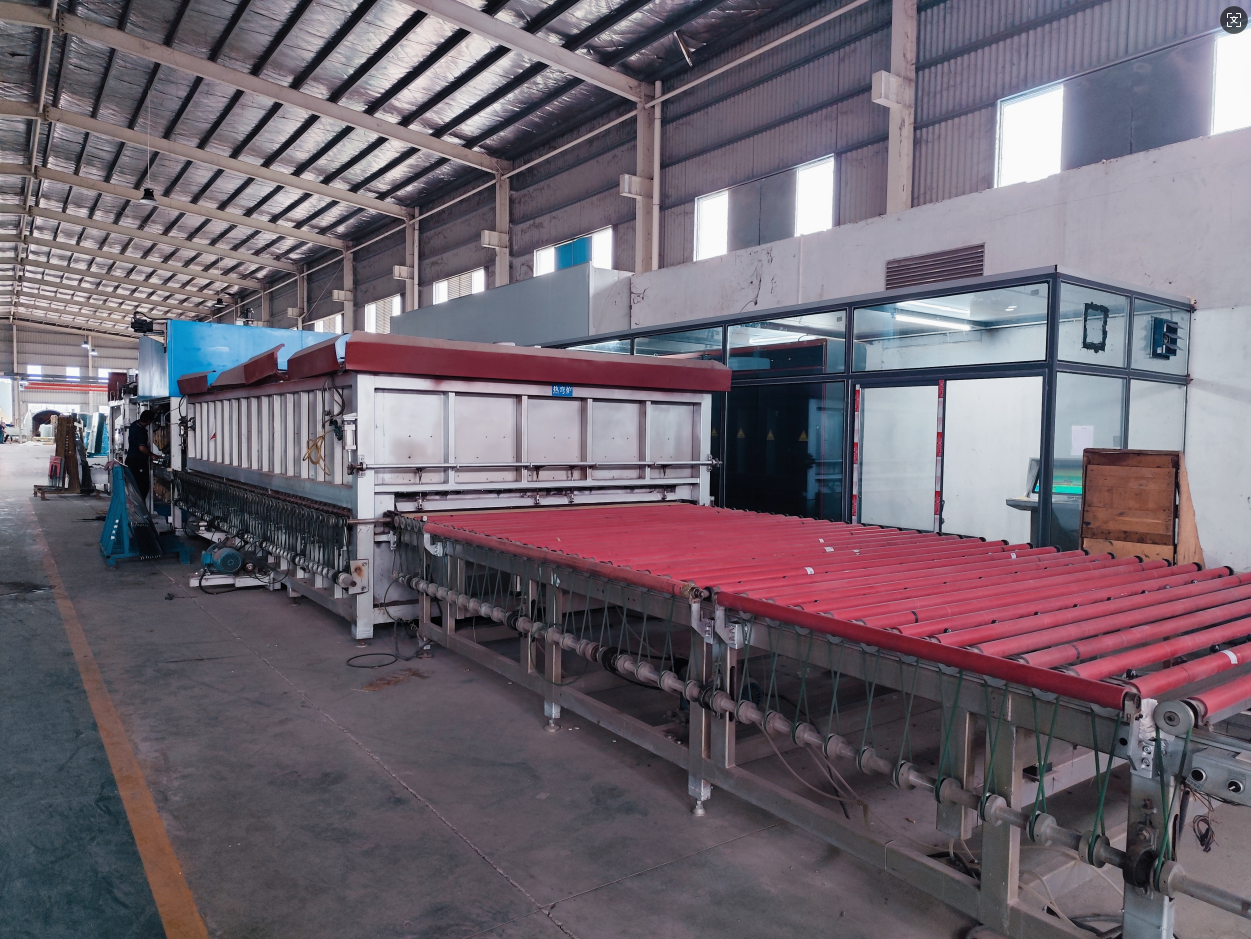
The curve is created during thermal forming, and the shape has to be within what the forming equipment can hold. DYGLASS processes multi-curved tempered glass, double curved tempered glass, triple curved tempered glass, trapezoid curved tempered glass, spherical curved tempered glass, pyramidal curved tempered glass, S-shape curved tempered glass, cylindrical curved tempered glass, and positive and negative curved tempered glass. The single-curvature and double-curvature routes use different forming capability, which is why the same panel geometry can be straightforward in one shape family and difficult in another.
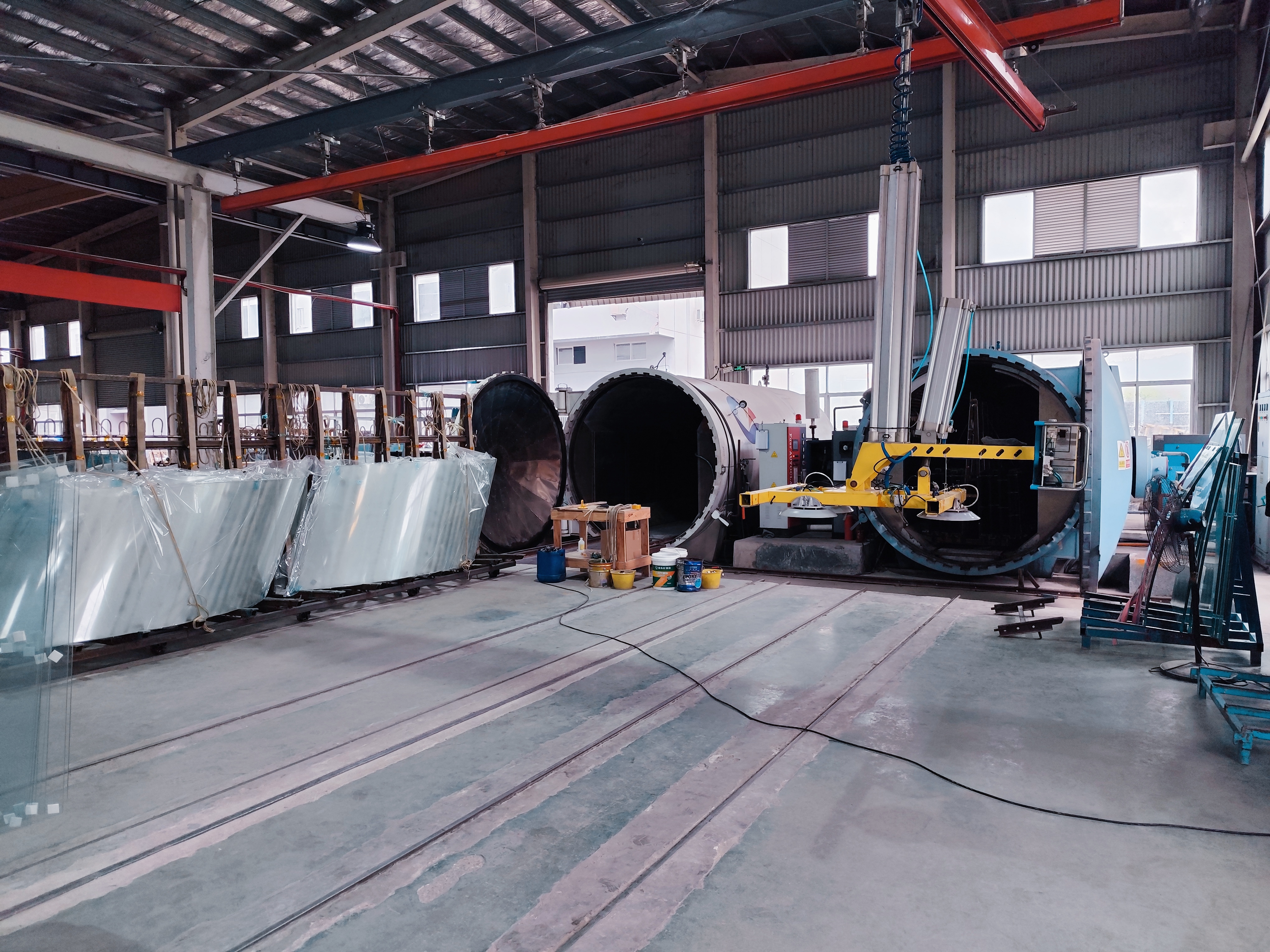
Curvature also moves the finishing decisions earlier. Holes, cut-outs and edge profiles must be completed before tempering, because a tempered pane cannot be cut or drilled afterwards. In a curved laminated build, the drilling plan, the edge treatment and the forming direction are therefore locked in before the lamination stage begins. DYGLASS operates dedicated cutting, drilling, edge grinding, flat and curved tempering, double-curved tempering, heat soak and autoclave lamination lines, so these steps sit in one production chain rather than being split across suppliers.
Curve radius is not a catalogue number. It is set by the combination of shape, pane thickness, glass type and forming line, and should be confirmed with the fabricator during technical review for each geometry. Optical distortion, sometimes described as wave distortion, follows the same rule: it is assessed on a sample or mock-up for the specific curvature, because it cannot be derived from a thickness figure. The documented tolerance in the substrate specification is plus or minus 0.5 mm on tempered glass thickness, and edge work can be delivered polished, grinded or beveled.
Certification: how to read CE certificate BGTC20260403-03
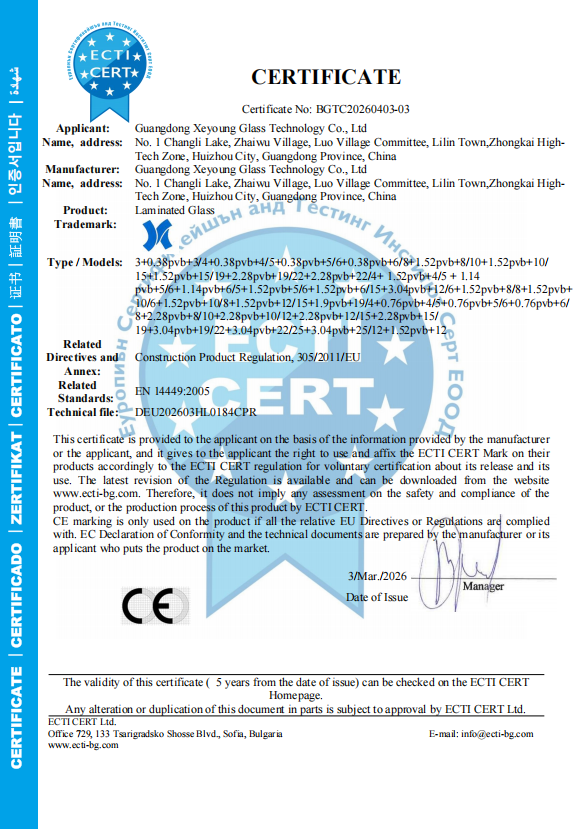
The CE certificate attached to the DY-JJ01 laminated glass product is BGTC20260403-03, issued by ECTI CERT Ltd. for the European Union and European Economic Area market. It cites EN 1449:2005 and the Construction Product Regulation 305/2011/EU, was issued on 2026-03-03 and expires on 2031-03-03. Its scope is laminated glass in the specified thickness combinations and configurations listed in the certificate type and models section.
Four checks are worth running before the order is placed:
- Certificate number, issuing body, issue date and expiry date are quoted in full.
- The standard cited on the certificate is recorded in the project file.
- The exact configuration on the purchase order, meaning total thickness, substrate and interlayer combination, appears in the type and models list.
- The substrate glass is separately covered where required. For tempered glass that is CE certificate BGTC20260403-02 under EN 12150-1:2015+A1:2019 and EN 12150-2:2004. Where an insulating unit replaces a laminated panel, the corresponding certificate is BGTC20260403-05 under EN 1279-1:2018, EN 1279-2:2018, EN 1279-3:2018 and EN 1279-4:2018.
Additional documentation available on the manufacturer side includes Alibaba Verified Supplier status and an SGS test report, both of which support supplier qualification rather than replacing the product certificates.
Fire-resistant potential and how classification is handled
Safety and fire performance in laminated glass come from different mechanisms, and they should be specified separately. Safety behaviour is produced by the interlayer bonding the panes together and retaining fragments after breakage. Fire performance is a classified property of the complete glazed build-up, determined by how that build-up responds to a standard fire exposure and declared as a classification for that specific construction.
DY-JJ01 is documented in a fire-resistant laminated form, so a fire-resistant configuration sits inside this product family. The classification itself is only meaningful as per classification for the exact build-up on the order: total thickness, substrate type, interlayer material and interlayer thickness all form part of the classified configuration. It cannot be inferred from total thickness alone, from the interlayer thickness alone, or from the fact that a panel is laminated.
Two practical consequences follow. First, a standard PVB safety build and a fire-resistant build are separate specifications and should not be substituted for one another without confirming the classification of the substitute. Second, fire documentation should be requested as a classification document for the exact build-up, and for curved panels the confirmation should state that the curved geometry is included in the classified configuration.
Selection parameters for architects and facade engineers: a step-by-step sequence
- Write the performance requirement before the thickness. State the function the glass has to perform: fragment retention, fall protection, security resistance, fire compartmentation or acoustic separation. The thickness follows from the function, not the other way round.
- Fix the substrate and the heat treatment decision. Choose tempered or float, and decide whether heat-soaked toughened glass is required for the project, given that EN 12150-1 and EN 14179-1 heat-soak practice is standard for toughened safety glass in European construction.
- Select the interlayer material and thickness explicitly. PVB is the documented baseline, with SGP and EVA also available. Then choose one of the five documented interlayer thicknesses, from 0.38 mm up to 2.28 mm, and write it into the specification as a named requirement.
- Set the total build-up inside the documented envelope. DY-JJ01 covers 6.38 mm to 50 mm. Confirm the optical target against the documented transmittance range of 85% to 92% for clear builds and 10% to 70% for tinted builds, and the acoustic target against the documented 35 dB to 45 dB range.
- Define the curvature as a manufacturable geometry. Classify the shape as single curvature, multi-curved, double curved, triple curved, S-shape, cylindrical, spherical, trapezoid, pyramidal, or positive and negative curved, and confirm the radius with the fabricator during technical review.
- Lock edges, holes and cut-outs before tempering. Because no cutting or drilling is possible after tempering, the drilling layout, edge treatment and forming sequence are fixed at this stage. Edge work can be specified as polished, grinded or beveled.
- Assemble the compliance pack. CE certificate number, standard, validity dates and confirmation that the ordered configuration is inside the certified type and models list; the substrate certificate where tempered glass is used; plus the supplier qualification evidence such as Alibaba Verified Supplier status and the SGS test report.
- Validate, then release production. Approve a sample or mock-up for curvature, colour, edge finish and distortion, then move to production. DYGLASS accepts OEM and ODM orders, so non-standard shapes and interlayer combinations can be quoted against project drawings.
Where curved laminated safety glass is used
- Curtain walls and facades. The largest demand segment globally, with architectural applications above 40% of curved glass panel demand in 2024. Curvature is combined with the laminated safety build and, in many systems, with an insulating unit behind the laminated pane.
- Sightseeing elevators. Curved laminated panels give the transparent enclosure both the shape and the fragment retention that a public vertical transport shaft requires.
- Shower rooms. Curved laminated glass combines the safety behaviour of the interlayer with edge work that can be polished, grinded or beveled, and with a low-iron or clear substrate option where neutrality of colour is required.
- Coffee tables and furniture. Here curvature is a design feature and the laminated build provides the safety behaviour, with clear transmittance in the 85% to 92% band or tinted options from 10% to 70% where colour is part of the design.
- Skylight and roof glazing. Overhead glazing places the panel above people, which is where fragment retention matters most; the documented 35 dB to 45 dB acoustic range is also relevant for roofs over occupied spaces.
- Automotive glazing. Laminated construction is listed as applicable to the automotive sector for this product, using the same PVB-based bonding principle at automotive thicknesses.
- Solar and energy applications. Laminated configurations are also documented for solar energy applications, where the interlayer protects the panel and the glass carries the optical function.
DY-JJ01 configuration options compared
The table below lists only documented DY-JJ01 options, so it can be used directly as a specification checklist during evaluation.
| Specification element | Documented options for DY-JJ01 | Why it matters in evaluation |
|---|---|---|
| Total thickness | 6.38 mm to 50 mm | Defines the overall build envelope the fabricator can laminate and curve |
| Interlayer material | PVB, SGP, EVA | Interlayer system is the element that carries the post-break safety function |
| Interlayer thickness | 0.38 mm, 0.76 mm, 1.14 mm, 1.52 mm, 2.28 mm | Sets how much interlayer is in the build, independently of total thickness |
| Glass substrate | Tempered glass, float glass, low-iron glass, tinted glass | Determines strength class, forming capability and colour behaviour |
| Light transmittance | 85% to 92% (clear); 10% to 70% (tinted) | Links substrate and colour choice to the daylight target |
| Sound insulation | 35 dB to 45 dB | Basis for acoustic requirements in facades, roofs and enclosed spaces |
| Product forms | Tempered laminated safety glass, bulletproof laminated glass, fire-resistant laminated glass, curved laminated glass | Shows which performance families exist inside one product code |
| Certification | CE BGTC20260403-03, ECTI CERT Ltd., EN 1449:2005 and CPR 305/2011/EU, issued 2026-03-03, valid to 2031-03-03, EU/EEA | Defines the configurations that can be CE marked for the EU/EEA market |
Because curved facades frequently mix laminated, tempered and insulating products in one system, the second table summarises the three CE-certified DYGLASS glass products using their documented parameters.
| Product and model | Documented configuration | Key documented parameters | CE certificate and standard |
|---|---|---|---|
| Laminated glass, DY-JJ01 | Tempered laminated safety glass, bulletproof laminated glass, fire-resistant laminated glass, curved laminated glass | 6.38 mm to 50 mm; interlayer PVB, SGP, EVA at 0.38 mm to 2.28 mm; substrates tempered, float, low-iron, tinted; transmittance 85% to 92% clear and 10% to 70% tinted; sound insulation 35 dB to 45 dB | BGTC20260403-03, EN 1449:2005, CPR 305/2011/EU |
| Tempered glass, DY-GH01 | Flat tempered glass, curved tempered glass, tempered glass with hole, polished edge | Thickness 4, 5, 6, 8, 10, 12, 15, 19, 22, 25 mm; tolerance plus or minus 0.5 mm; transmittance 91% or above; edge polished, grinded or beveled | BGTC20260403-02, EN 12150-1:2015+A1:2019, EN 12150-2:2004 |
| Insulating glass, DY-ZK01 | Tempered insulated glass, insulated glass with Low-E coating, insulated glass with argon gas, curved insulated glass | 6 mm+12A+6 mm and 8 mm+16A+8 mm, custom available; clear float, Low-E, tempered or low-iron glass; aluminium or warm edge spacer; air, argon, krypton or xenon fill; transmittance 70% to 89%; sound insulation 30 dB to 45 dB | BGTC20260403-05, EN 1279-1:2018, EN 1279-2:2018, EN 1279-3:2018, EN 1279-4:2018 |
Frequently asked questions
Does curved laminated safety glass for the EU market need a CE certificate, and what does the DYGLASS certificate cover?
Laminated glass placed on the EU/EEA market falls under the Construction Product Regulation 305/2011/EU. The DYGLASS DY-JJ01 laminated glass product holds CE certificate BGTC20260403-03, issued by ECTI CERT Ltd. against EN 1449:2005, valid from 2026-03-03 to 2031-03-03 for the EU/EEA market. The scope covers laminated glass in the specified thickness combinations and configurations listed in the certificate type and models section, so a buyer should confirm that the exact configuration on the order, including total thickness, substrate and interlayer, appears on that list. Where the substrate is tempered glass, the separate certificate BGTC20260403-02 applies under EN 12150-1:2015+A1:2019 and EN 12150-2:2004 for thicknesses from 4 mm to 25 mm.
What curved shapes and laminated builds can DYGLASS actually produce?
DYGLASS processes multi-curved, double curved, triple curved, trapezoid, spherical, pyramidal, S-shape, cylindrical and positive and negative curved tempered glass. For the laminated product, the documented build is DY-JJ01 with total thickness from 6.38 mm to 50 mm, interlayer types PVB, SGP and EVA, interlayer thicknesses of 0.38 mm, 0.76 mm, 1.14 mm, 1.52 mm and 2.28 mm, and tempered, float, low-iron or tinted substrates. Production is carried out in a 30,000 square metre facility in Shenzhen, Guangdong, China, with 130 employees, an annual output of 600,000 square metres, an R and D team of 5 to 10 people, and dedicated cutting, drilling, edge grinding, flat and curved tempering, double-curved tempering, heat soak and autoclave lamination lines. Curve radius is confirmed per project, because it depends on the shape, thickness and forming line used.
What drives the cost of a curved laminated safety glass order?
Cost is driven by the configuration rather than by a unit price, so quotations are prepared per project. The main variables are the curvature class, since single curvature and double or irregular curvature use different forming routes; the shape family, including S-shape, cylindrical, spherical, pyramidal and positive and negative curved forms; the substrate, with tempered, float, low-iron and tinted options documented; the interlayer material, choosing between PVB, SGP and EVA; the interlayer thickness across the 0.38 mm to 2.28 mm range; the total thickness up to 50 mm; the panel size; whether heat-soaked tempered substrate is required; the edge work, which can be polished, grinded or beveled; the drilling and cut-out layout; and the compliance documents required for the destination market.
How can a specific interlayer build and curvature be validated before mass production?
Validation is normally done on a sample or mock-up of the exact configuration, because curvature, colour, edge finish and optical distortion cannot be judged from a datasheet. The sample should carry the same substrate, interlayer material and interlayer thickness as the intended production build, so that the interlayer range from 0.38 mm to 2.28 mm is tested as specified. DYGLASS welcomes OEM and ODM orders and processes non-standard shapes against project drawings, which is the route used for double curved, S-shape and other formed geometries.
What determines the lead time for curved laminated safety glass, and how do we start?
Lead time is quoted per order because curved laminated glass is a batch process. The sequence runs through cutting, drilling and edge grinding, then tempering and hot forming, then lamination in the autoclave, with heat soak inserted before lamination where heat-soaked tempered substrate is specified. Lead time therefore depends on the shape class, the panel size, the tempering and forming line required, the interlayer build, and whether certification documents for the destination market have to be prepared. To start, send the drawings, the required total thickness, substrate, interlayer build and quantity to info@dayangglass.com or via WhatsApp on +86 13692110212, and a quotation and build-up confirmation will be prepared for the specified configuration.
Conclusion: fix the interlayer, the substrate and the geometry before you order
Curved laminated safety glass is not defined by the word laminated. It is defined by the interlayer, which in DY-JJ01 is PVB, SGP or EVA at 0.38 mm to 2.28 mm; by the substrate, which may be tempered, float, low-iron or tinted glass; by the total build, which spans 6.38 mm to 50 mm; and by the geometry, which must be formable on a curved or double-curved tempering line before it can be laminated. Fire-resistant potential belongs to a classified build-up and is stated as per classification for that exact configuration, never inferred from thickness.
The compliance side is now as important as the technical side. CE certificate BGTC20260403-03 issued by ECTI CERT Ltd. against EN 1449:2005 and CPR 305/2011/EU, valid from 2026-03-03 to 2031-03-03 for the EU/EEA market, defines the laminated configurations that can be placed on that market. Buyers who check the certificate number, the standard, the validity dates and the type and models list before they check the price will avoid most of the risk that curved glass projects carry.
Next step: sample, quotation or technical review
If you are evaluating curved laminated safety glass for a facade, elevator, roof, interior or automotive programme, send your drawings with the required total thickness, substrate, interlayer build and quantity. Requests for samples, quotations and technical review are handled directly by the manufacturer.
Email: info@dayangglass.com | Tel: +86-136 9211 0212 | WhatsApp: +86-13692110212 | Website: www.dayangglass.com
Product brochure (download): DYGLASS curved glass brochure
Manufacturer: Shenzhen Dayang Special Glass Co., Ltd. (DYGLASS), founded 2017, 30,000 square metre facility, 130 employees, 600,000 square metres annual output, approximately 60% export ratio, serving markets including the UAE and Dubai, Bahrain, Saudi Arabia, the United States, the Philippines and Vietnam. Address: 1706, Bldg. H, Phase 1, Liuhecheng Business Plaza, No. 168, Shenshan Road, Pingshan Street, Pingshan New District, Shenzhen, Guangdong, China.