
Curved Tempered Glass vs. Curved Laminated Glass: Head-to-Head Decision Guide
Curved Tempered Glass vs. Curved Laminated Glass: Head-to-Head Decision Guide
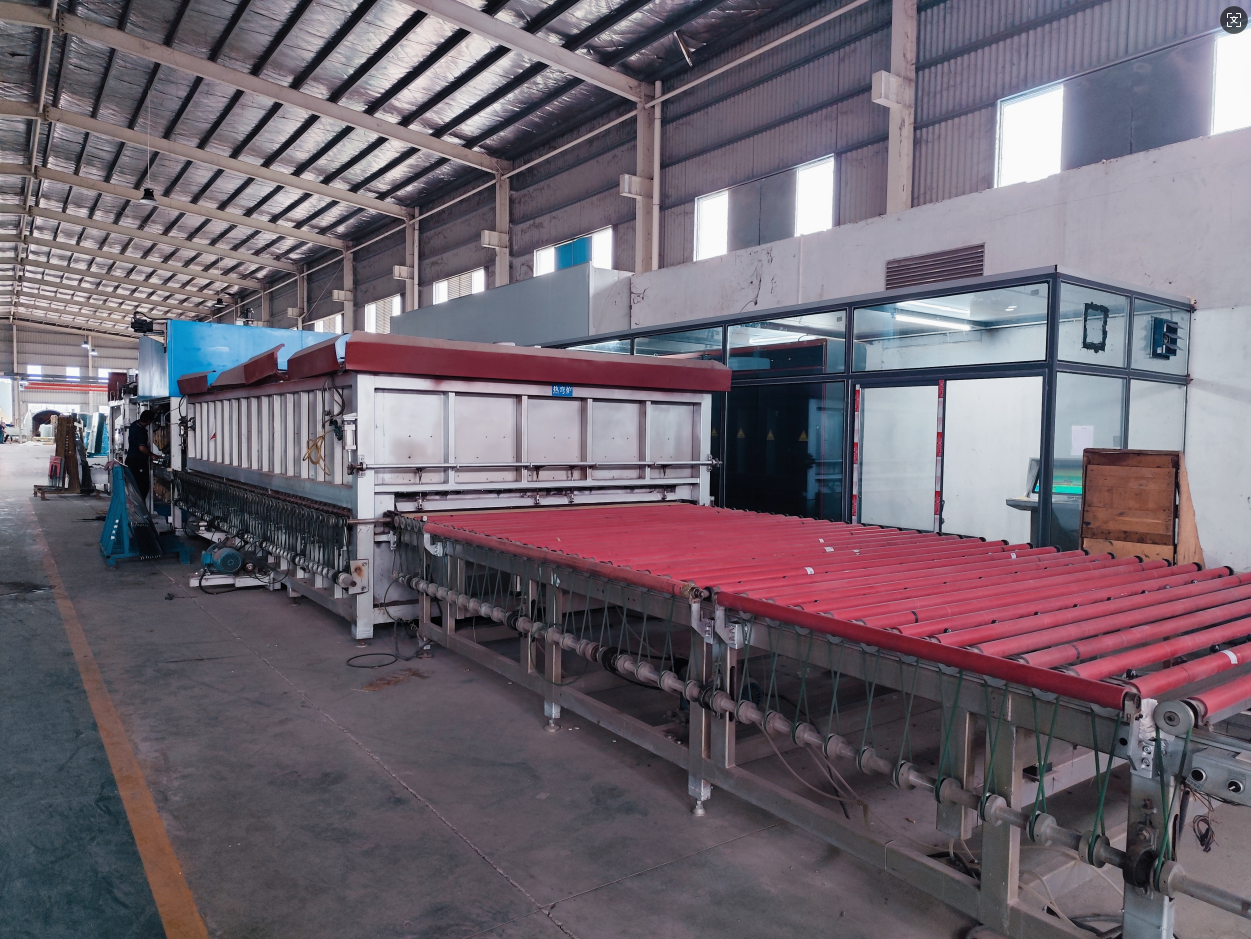
Curved tempered glass is hot-formed on dedicated tempering lines — the first fork in the road for any bent glazing specification.
Bent glazing rarely fails because a supplier was chosen badly. It fails because the wrong build-up was written into the specification. When a drawing calls for curved glass, the first real decision is not colour, coating or price — it is whether the panel should be a single-pane curved tempered glass or an interlayer-bonded curved laminated glass. This guide compares the two families as DYGLASS manufactures them: DY-GH01 curved tempered glass and DY-JJ01 curved laminated glass, across thickness, tolerance, transparency, certification, sound performance, shape capability and application fit.
The Problem: Two Bent Panels, Two Different Failure Modes
Both DY-GH01 and DY-JJ01 are curved glass. Both are sold as safety glass. Both can be delivered with CE documentation. Those similarities are exactly why the comparison goes wrong so often.
"Safety glass" describes a category, not a behaviour. The practical difference between the two families is what the panel does after it has been hit, heated or overloaded. Thermally toughened glass — the process behind DY-GH01 — releases its stored surface stress and breaks into many relatively small, granular fragments. Laminated glass — DY-JJ01 — bonds two or more glass plies to an interlayer, so fragments stay attached to the sheet instead of falling away. The label on the drawing does not tell you which of those two behaviours a project actually needs. The function of the panel does.
Three further complications sit behind that core confusion:
- The vocabulary overlaps. "Tempered laminated glass" describes a laminated assembly built from tempered plies. That is not the same product as DY-GH01 or DY-JJ01 on its own, yet the three terms are quoted interchangeably in tender documents and on shop drawings.
- Curvature adds forming limits. A build-up that is perfectly standard as flat glass may sit outside what a bending line can hold once radius, chord height and panel size are combined. Tolerance has to survive hot forming, not just cutting and edge grinding.
- Certification is thickness-specific. In the EU, a certificate covers the product and the thickness set named in its scope — not every panel the factory is technically able to bend.
Industry Background: Why the Build-Up Question Is Getting More Expensive to Get Wrong
Curved glazing is no longer a niche detail. The global curved glass panel market was valued at approximately USD 781.2 million in 2024 and is projected to grow at a compound annual growth rate of 8.0% through 2031, according to Cognitive Market Research. Scope matters when reading that number: Custom Market Insights publishes a much narrower panel-specific figure of USD 78.55 million for the same period, because different reports draw the boundary around "curved glass" differently. Either way, the direction is the same.
Two structural drivers explain the growth. First, demand is concentrated in architecture: facades and curtain walls accounted for over 40% of curved glass panel demand in 2024, according to Research and Markets. Second, supply is concentrated in Asia: Asia-Pacific is identified as the fastest-growing region for the curved glass panel market due to rapid urbanization and infrastructure development, according to Custom Market Insights. China's export value for worked glass, including bent and curved glass under HS 7006, reached approximately USD 791 million in 2023, according to TrendEconomy / UN Comtrade data.
Regulation is the third driver, and it is the one that most often decides between the two families. European safety standards EN 12150-1 and EN 14179-1 (heat soaked) are mandatory for toughened safety glass used in construction, specifically to reduce the risk of spontaneous breakage from nickel sulfide inclusions, according to CEN. That is why heat soak treatment is a specification line item rather than an optional extra on EU architectural projects — and why a supplier without a heat soak furnace and a matching certificate scope is a risk on structural glazing.
On the supply side, the well-documented global players in high-performance curved glass include AGC, Saint-Gobain, Guardian Industries and Cricursa, which specialises in architectural glass, according to Global Market Insights and Grand View Research. Buyers sourcing from Asia are usually comparing specialist processors against that benchmark rather than against each other in isolation.
The Two Candidates in Detail
DYGLASS is the brand of Shenzhen Dayang Special Glass Co., Ltd., a Shenzhen-based processor of architectural glass founded in 2017, operating a 30,000 m² factory with approximately 130 employees and an annual output of around 600,000 square metres. The two families below are the ones this comparison turns on.
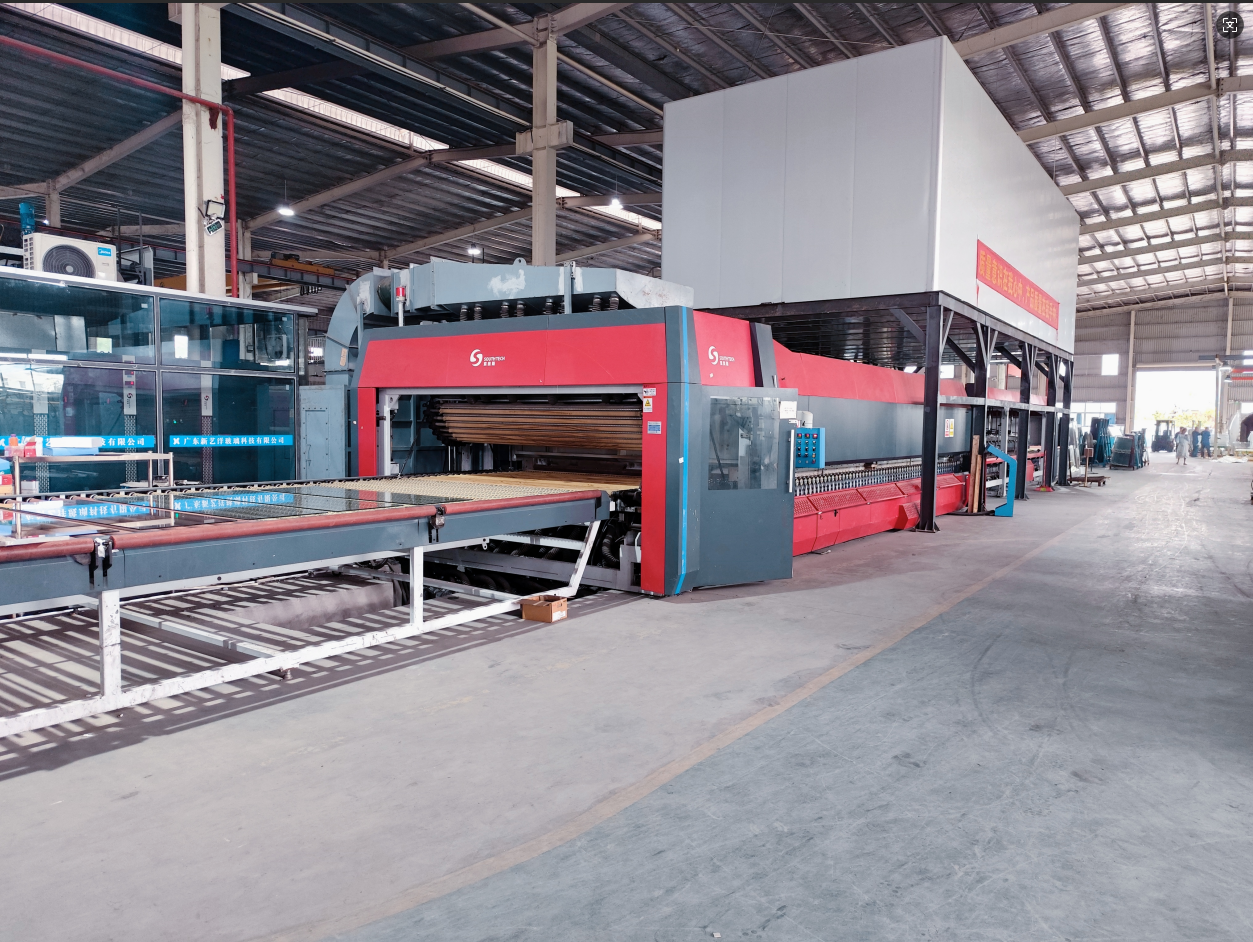
Tempering line 1 (flat and curved) — the forming stage for DY-GH01 curved tempered glass.
DY-GH01 — Curved Tempered Glass
DY-GH01 is a single-pane thermally toughened product. The glass substrate is float glass, and the family covers flat tempered glass, curved tempered glass, tempered glass with holes and polished edge work.
- Thickness range: 3 mm, 4 mm, 5 mm, 6 mm, 8 mm, 10 mm, 12 mm, 15 mm, 19 mm
- Tolerance: ±0.5 mm
- Light transmittance: ≥91%
- Edge work: polished, ground or beveled
- Listed application industries: construction, furniture, bathroom, curtain wall, office partition
- CE certification: certificate BGTC20260403-02 issued by ECTI CERT Ltd. against EN 12150-1:2015+A1:2019 and EN 12150-2:2004, under Construction Product Regulation 305/2011/EU, valid from 2026-03-03 to 2031-03-03, for the European Union / European Economic Area market
The ±0.5 mm tolerance and the ≥91% light transmittance are the two numbers that decide most DY-GH01 specifications. The tolerance matters where curved panels meet a machined frame or a fixed mullion. The transmittance figure matters in lobbies, atria and office partitions, where the glass is meant to disappear visually.
DY-JJ01 — Curved Laminated Glass
DY-JJ01 is a bonded multi-ply assembly. Two or more glass plies are joined through an interlayer, and the family covers tempered laminated safety glass, bulletproof laminated glass, fire-resistant laminated glass and curved laminated glass.
- Thickness range: 6.38 mm – 50 mm
- Interlayer type: PVB, SGP or EVA
- Interlayer thickness: 0.38 mm, 0.76 mm, 1.14 mm, 1.52 mm, 2.28 mm
- Glass substrate options: tempered glass, float glass, low-iron glass, tinted glass
- Light transmittance: 85%–92% clear; 10%–70% tinted
- Sound insulation: 35 dB – 45 dB
- Listed application industries: building and construction, real estate, architecture, interior design, automotive, solar energy
- CE certification: certificate BGTC20260403-03 issued by ECTI CERT Ltd. against EN 1449:2005 and Construction Product Regulation 305/2011/EU, valid from 2026-03-03 to 2031-03-03, covering the thickness combinations and configurations listed in its Type/Models, for the European Union / European Economic Area market
Three specification levers sit inside DY-JJ01. Interlayer type changes stiffness and post-break behaviour — PVB is the conventional choice for architectural laminated glass, SGP and EVA are selected for stiffer or more demanding builds. Substrate choice changes appearance: low-iron glass removes the green edge tint that ordinary float glass introduces, which is why low iron curved glass is specified for colour-critical facades and furniture. Interlayer thickness drives the acoustic result, which is where the 35–45 dB range becomes relevant to a sound insulated curved glass specification.
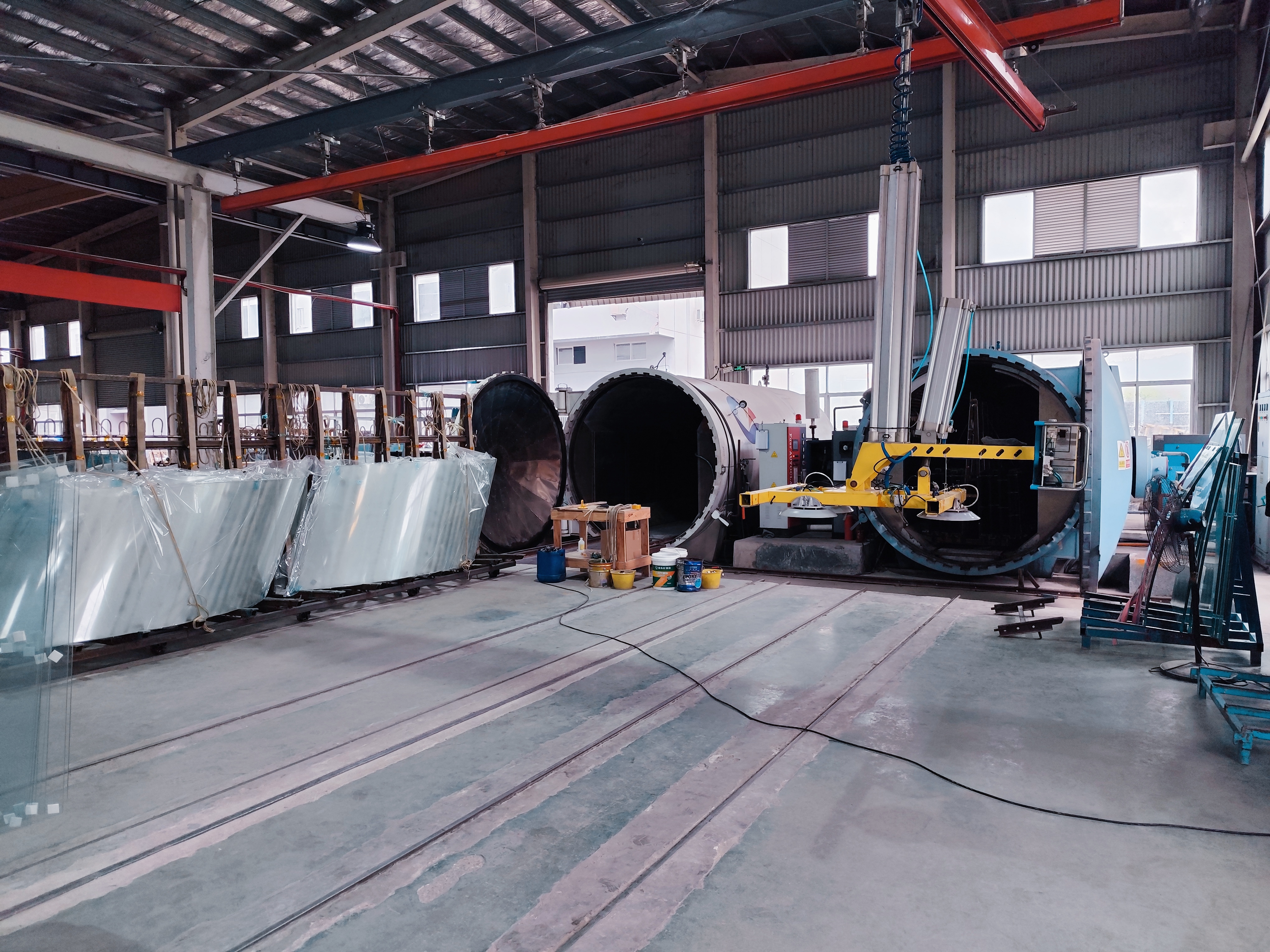
The autoclave bonding stage — the process that separates DY-JJ01 curved laminated glass from single-pane DY-GH01.
Step-by-Step Breakdown: A Decision Framework for Specifiers
The framework below resolves the tempered-versus-laminated question in six steps. It is ordered so that the irreversible decisions come first and the documentation check comes last.
- Classify the panel's role: structural, safety-critical or decorative. If the curved glass is a load-bearing or single-barrier element — a structural facade panel, a fixed curtain wall vision pane — the panel must do the work of the wall, and a single-pane tempered build-up is the starting assumption. If the panel's job is to stay in place after impact — overhead glazing, a fall path, a human-contact surface — the requirement is fragment retention, which points to lamination. If the panel is purely decorative, the decision falls back to appearance and cost.
- Ask whether anyone is underneath or behind it. This is the single fastest filter. Curved glass for a skylight roof, an overhead canopy or an upper-floor facade has a fall path beneath it. Curved glass for a shower room enclosure or a coffee table is at hand height. The consequence of breakage, not the geometry, sets the build-up.
- Fit the thickness and shape envelope to the chosen family. DY-GH01 runs from 3 mm to 19 mm; DY-JJ01 runs from 6.38 mm to 50 mm. If the design needs a very thin, very clear curved panel, the tempered family is the practical route. If the design needs a heavy multi-ply panel, laminated is the only route. Then check curvature: multi-curved, double curved, triple curved, trapezoid, spherical, pyramidal, S-shape, cylindrical and positive/negative curved tempered glass can be formed, but each shape has its own feasibility limits.
- Match the failure mode to the consequence. Granular fragmentation with no interlayer is acceptable where the panel is a single vision element with no fall path. Retained fragments on an interlayer are required where the panel is above people, in a stairwell, or in an assembly that must remain in place. This step is where most specification errors are made, because both products are described as safety glass.
- Verify the certificate scope against the actual drawing. Match the product family, the thickness on the drawing and the standard named in the certificate. Note one honest detail on DY-GH01: the product parameter list covers 3 mm to 19 mm, while the CE certificate scope for tempered glass lists 4, 5, 6, 8, 10, 12, 15, 19, 22 and 25 mm. A 3 mm curved tempered panel is therefore a case to confirm with the factory before it is written into a European specification.
- Lock the fabrication details, then validate with a sample. Edge work, hole positions, interlayer choice and surface finish are all decided at this point. Tolerances are won or lost at forming and lamination, not at cutting or edge grinding, so a change to the radius after forming has started is the most expensive change a project can make.
Use Cases: Matching the Build-Up to the Scenario
Architectural applications dominate the category, and the same logic repeats across project types. The scenarios below show how the framework resolves in practice.
- Curtain wall and facade. Facades and curtain walls accounted for over 40% of curved glass panel demand in 2024. A single curved vision pane in a curtain wall is normally specified from DY-GH01, where ±0.5 mm tolerance and ≥91% light transmittance carry the visual quality of the elevation. Where the panel sits in a fall path or must stay in place, the specification is upgraded to a laminated build-up.
- Sightseeing elevator. Curved glass for a sightseeing elevator combines tight curvature with human proximity and, in some designs, a fall-protection function. Where the panel is a fixed single pane, tempered is the usual starting point; where the glazing is required to remain intact after breakage, the laminated family is the appropriate direction.
- Shower room. Bathroom applications are explicitly listed for DY-GH01. Curved glass for a shower room is typically a single-pane tempered panel specified for clarity, with polished, ground or beveled edges, and with no interlayer where no retention requirement exists.
- Coffee table and furniture. Furniture is a listed DY-GH01 industry. Curved glass for a coffee table is usually a thin single hot curved panel chosen for optical clarity; a laminated curved top becomes the choice when a heavier appearance or fragment retention is wanted.
- Skylight roof. Overhead glazing is the clearest laminated case. Curved glass for a skylight roof normally sits above occupied space, so the design requirement is retention rather than simple strength, which points to DY-JJ01. Where the roof also separates interior from exterior noise, the 35–45 dB sound insulation of the laminated family becomes a second, independent reason to select it.
- Office partitions. Office partitions are listed for DY-GH01. Interior partitions rarely need an interlayer: clarity, tolerance and edge finish dominate, and a single tempered pane keeps the assembly simple.
- Automotive, transport and solar. Automotive and solar energy are listed DY-JJ01 industries, alongside building and construction, real estate, architecture and interior design. This is where the heavier end of the laminated family applies, including the tempered laminated safety, bulletproof laminated and fire-resistant laminated configurations named in the product data.
Comparison Table: DY-GH01 vs. DY-JJ01
The table below compares only the parameters published for each product family. Where a value is not published, the table says so rather than estimating it.
| Decision factor | DY-GH01 — Curved Tempered Glass | DY-JJ01 — Curved Laminated Glass |
|---|---|---|
| Build-up | Single monolithic thermally toughened pane (float glass substrate) | Two or more glass plies bonded through an interlayer (tempered glass plus PVB interlayer as the base material) |
| Thickness range | 3 mm – 19 mm | 6.38 mm – 50 mm |
| Dimensional tolerance | ±0.5 mm | Not published in the product parameter set — confirm against the drawing |
| Interlayer | None | PVB, SGP or EVA; 0.38 / 0.76 / 1.14 / 1.52 / 2.28 mm |
| Substrate options | Float glass | Tempered, float, low-iron or tinted glass |
| Light transmittance | ≥91% | 85%–92% clear; 10%–70% tinted |
| Sound insulation | Not stated in the product parameters | 35 dB – 45 dB |
| Product types in the family | Flat tempered, curved tempered, tempered with hole, polished edge | Tempered laminated safety glass, bulletproof laminated glass, fire-resistant laminated glass, curved laminated glass |
| CE standard | EN 12150-1:2015+A1:2019; EN 12150-2:2004; CPR 305/2011/EU | EN 1449:2005; CPR 305/2011/EU |
| CE certificate | BGTC20260403-02, ECTI CERT Ltd., 2026-03-03 to 2031-03-03 | BGTC20260403-03, ECTI CERT Ltd., 2026-03-03 to 2031-03-03 |
| Listed application industries | Construction, furniture, bathroom, curtain wall, office partition | Building and construction, real estate, architecture, interior design, automotive, solar energy |
| Typical fit | Single-pane vision areas, partitions, shower enclosures, tabletops, thin curved panels | Overhead glazing, fall-path glazing, acoustic separation, heavier multi-ply panels, transport and solar applications |
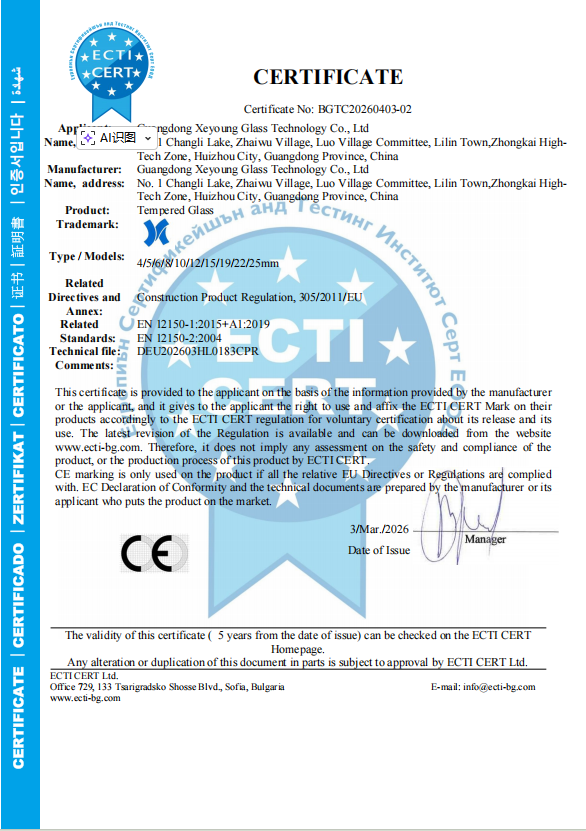
CE certificate BGTC20260403-02 — tempered glass, EN 12150-1:2015+A1:2019.
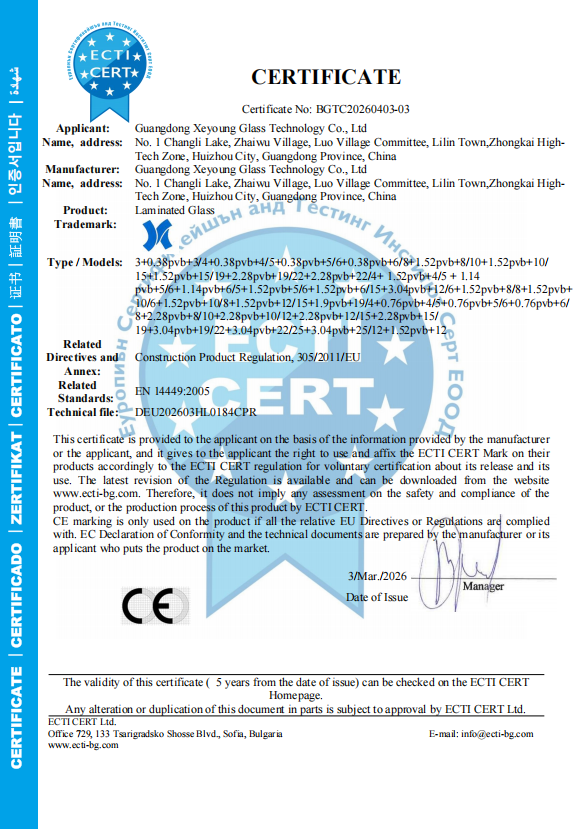
CE certificate BGTC20260403-03 — laminated glass, EN 1449:2005.
Frequently Asked Questions
Which CE standards cover DY-GH01 curved tempered glass and DY-JJ01 curved laminated glass?
DY-GH01 tempered glass, the family that includes curved tempered glass, is certified by ECTI CERT Ltd. under certificate BGTC20260403-02 against EN 12150-1:2015+A1:2019 and EN 12150-2:2004 within Construction Product Regulation 305/2011/EU, valid from 2026-03-03 to 2031-03-03; the certificate scope lists tempered glass thicknesses of 4, 5, 6, 8, 10, 12, 15, 19, 22 and 25 mm. DY-JJ01 laminated glass is certified by ECTI CERT Ltd. under certificate BGTC20260403-03 against EN 1449:2005 and CPR 305/2011/EU over the same validity period, covering the thickness combinations and configurations listed in its Type/Models. Because the DY-GH01 product parameter list starts at 3 mm while the tempered certificate scope starts at 4 mm, confirm that the exact thickness on your drawing falls inside the certificate scope for the destination market.
What curved shapes and thicknesses can DYGLASS produce for each family?
DYGLASS is the brand of Shenzhen Dayang Special Glass Co., Ltd., a Shenzhen-based architectural glass processor founded in 2017 with a 30,000 m² factory, approximately 130 employees and an annual output of around 600,000 square metres. Its curved tempered forming capability covers multi-curved, double curved, triple curved, trapezoid, spherical, pyramidal, S-shape, cylindrical and positive/negative curved tempered glass, produced on a flat-and-curved tempering line, a concave-and-convex and irregular curved line, and a double curved tempering line. DY-GH01 is offered from 3 mm to 19 mm with ±0.5 mm tolerance; DY-JJ01 runs from 6.38 mm to 50 mm with PVB, SGP or EVA interlayers and tempered, float, low-iron or tinted substrates. The plant also runs autoclave lamination, insulated glass, cutting, drilling, edge grinding and heat soak equipment.
How does choosing tempered or laminated change the project budget?
Cost for either family is driven by the drawing, not by the product name. The main drivers are glass thickness, curvature complexity, panel size, edge work, holes and cut-outs, interlayer type and thickness on the laminated route, whether heat soak treatment is required on the tempered route, and order quantity. Because the laminated route adds interlayer material and an autoclave bonding cycle, and the tempered route adds a toughening cycle plus optional heat soak, a thin single-pane curved tempered panel and a thick multi-ply laminated panel can sit far apart in cost even when the visible dimensions are identical. The only reliable comparison is a quote against the same drawing and the same quantity, which is why the framework above fixes the build-up before pricing is requested.
Can I validate a curved glass specification with a sample before ordering?
Yes — for curved glass, a physical sample or first-article panel is the normal way to validate geometry and finish before a production run. Send the drawing with the target radius, chord height, thickness, interlayer selection, edge work and any hole positions, then check three things on the sample: whether the curvature matches the drawing, whether the edge and surface finish meet the project standard, and whether the build-up matches the certificate and the written specification. Two appearance points are worth confirming at the same time: PVB interlayers in the DY-JJ01 family are commonly used to reduce UV transmission, and low-iron or tinted substrates change both colour and light transmittance — 85%–92% for clear and 10%–70% for tinted in the published DY-JJ01 range.
What affects lead time, and how do I start an order?
Lead time on curved glass is driven by the same variables as cost: curvature complexity, panel size and thickness, the interlayer and substrate selected, whether heat soak treatment or lamination cycles are required, the order quantity, and the documentation pack needed for the destination market. The single biggest avoidable delay is a drawing that changes after forming has started, because a curved panel cannot simply be re-cut. Send the final drawing, the target quantity and the required certification documents in one package so feasibility, price and schedule can be confirmed together. DYGLASS handles OEM and ODM orders and exports around 60% of its output; inquiries go to info@dayangglass.com or WhatsApp +86-136 9211 0212, and a sample request can be raised at the same time as the quotation.
Conclusion: Decide by Function, Then Verify by Certificate
The head-to-head between DY-GH01 curved tempered glass and DY-JJ01 curved laminated glass does not end in a winner. It ends in a rule. Choose the build-up by the function the panel performs: single-pane strength and clarity point to DY-GH01 at 3–19 mm with ±0.5 mm tolerance and ≥91% light transmittance, while fragment retention, acoustic separation and heavier multi-ply assemblies point to DY-JJ01 at 6.38–50 mm with a PVB, SGP or EVA interlayer and 35–45 dB sound insulation. Then verify the decision against the certificate: EN 12150-1:2015+A1:2019 with certificate BGTC20260403-02 for the tempered family, and EN 1449:2005 with certificate BGTC20260403-03 for the laminated family.
Applied in that order, the choice takes minutes rather than weeks, and the specification survives the two events that most often derail a curved glazing package: a certificate scope that does not match the drawing, and a radius change made after forming has begun.
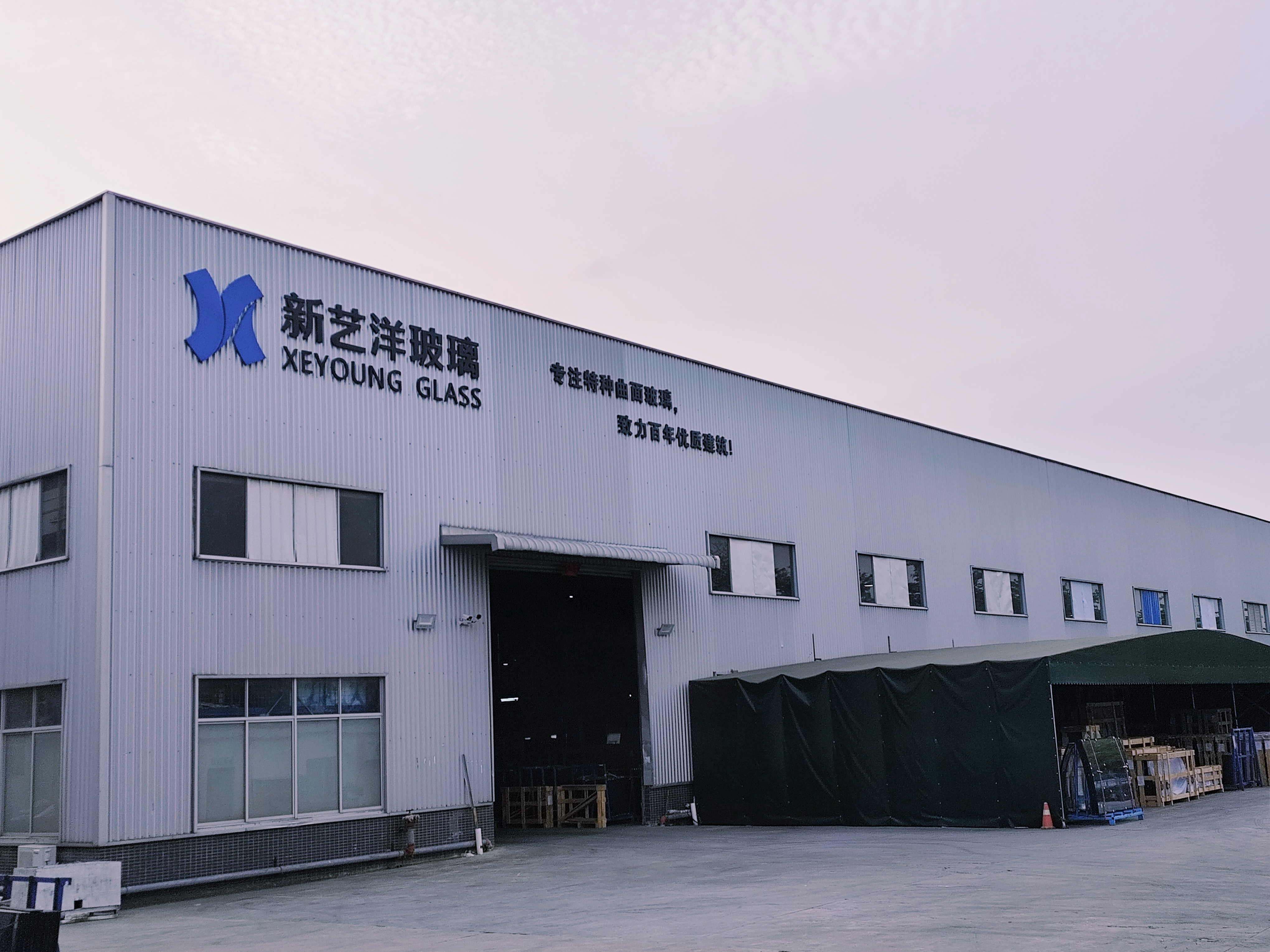
Shenzhen Dayang Special Glass Co., Ltd. — curved glass production and export from Shenzhen.
Next Step: Send the Drawing
If you are specifying curved glass for an active project, send the panel drawing, the target quantity and the required certification for your market. DYGLASS will confirm which family fits, what the shape and thickness envelope allows, and what the sample and production schedule look like.
Email: info@dayangglass.com | WhatsApp: +86-136 9211 0212
Website: www.dayangglass.com
Address: 1706, Bldg. H, Phase 1, Liuhecheng Business Plaza, No. 168, Shenshan Road, Pingshan Street, Pingshan New Dist., Shenzhen, Guangdong, China
Request a sample, a project quote, or the full technical catalogue: Download the DYGLASS product brochure (PDF).