
Curved vs. Flat Tempered Glass: Precision, Tolerance and CE Certification Compared
Curved vs. Flat Tempered Glass: Precision, Tolerance and CE Certification Compared
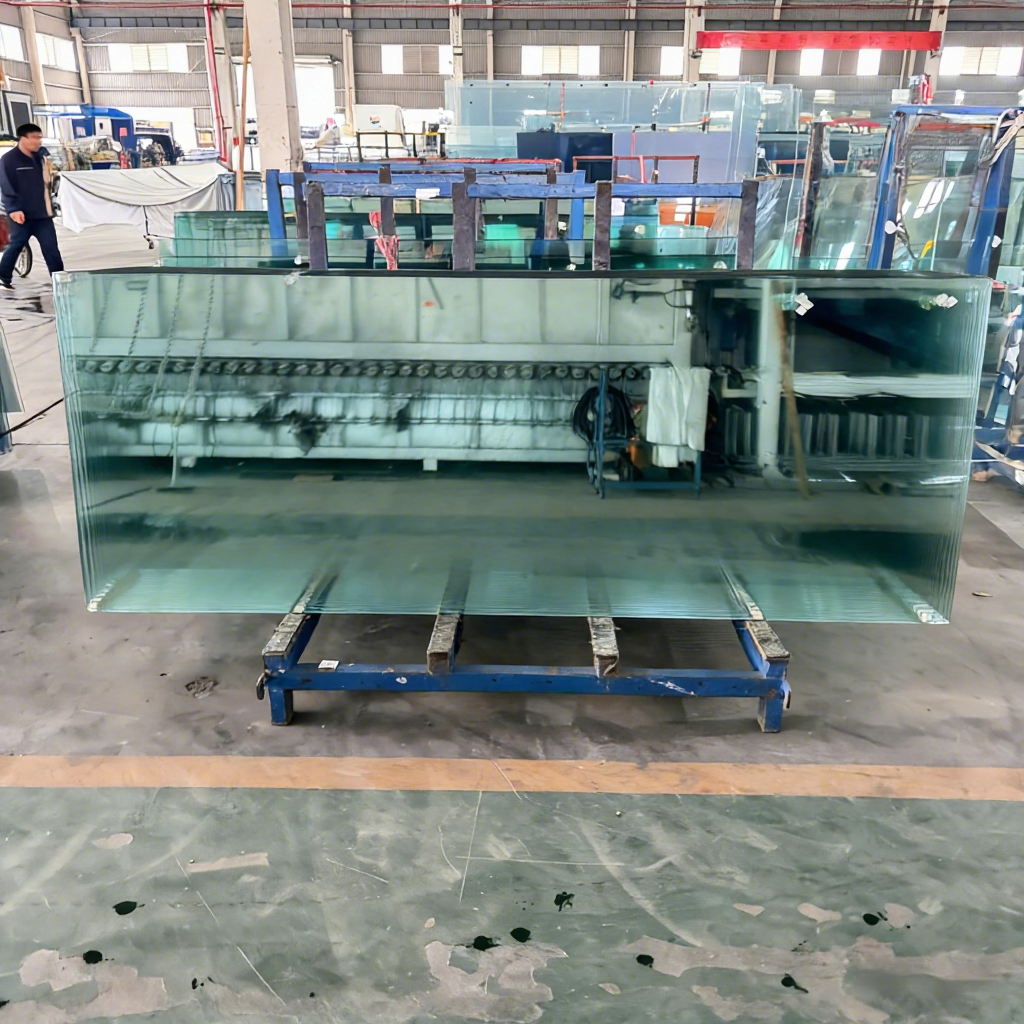
Flat and curved tempered glass are frequently treated as variations of a single product. In production they are two different routes: one stays planar through the tempering cycle, the other is bent while it is still hot and the curvature is locked in during quenching. That difference changes the tolerance logic, the edge-work sequence, the installation sensitivity and the certification scope a buyer has to verify.
The short answer for specifiers: use standard flat tempered glass when the geometry is planar, the schedule is tight and processing cost dominates. Use curved tempered glass — such as DY-GH01 — when the design itself is curved: curtain wall returns, sightseeing elevator glazing, curved shower enclosures, vaulted skylight roofs, coffee tables and feature partitions. DY-GH01 is documented at 3–19 mm thickness, ±0.5 mm bending tolerance and ≥91% light transmittance, and it carries CE marking to EN 12150-1:2015+A1:2019 under certificate BGTC20260403-02.
This guide is written for importers, distributors, façade contractors, interior fit-out buyers and OEM buyers who have to place both product types on the same project — and who need the differences stated in measurable terms rather than adjectives.
The Problem: One Purchase Order, Two Different Specifications
Most curved-glass procurement problems do not begin at the factory. They begin on the drawing set, where “tempered glass” appears as one line item covering flat and curved panels that are formed on different equipment, measured against different criteria, and covered by certificates that may not apply to both.
Five mismatches account for most of the friction:
- Tolerance is measured differently. Flat toughened glass is assessed on flatness, bow and warp across a plane. Curved glass adds a second variable: how closely the formed panel follows the specified radius and chord. A ±0.5 mm bending tolerance — the documented figure for DY-GH01 curved tempered glass — only means something when the drawing states the radius, the panel outline and the inspection method. Without those, tolerance becomes a dispute after delivery instead of a specification before it.
- Certification scope is not universal. A CE certificate for toughened safety glass refers to a defined product type, thickness range and manufacturing process. A certificate issued for flat toughened production does not automatically extend to curved production, and the reverse is equally true.
- Edge work is decided before forming. Cutting, edge grinding and drilling are carried out on the flat blank before the glass enters the tempering furnace. Tempered glass cannot be cut, drilled or re-edged afterwards. For curved panels the flat blank must also be dimensioned to the developed length of the curve, so edge and hole decisions are locked in earlier than most project teams expect.
- Visual continuity across mixed panels. In most buildings, curved panels sit inside a predominantly flat grid. If the two are produced with different transmittance or tolerance assumptions, the mismatch appears as visible steps, distorted reflections or inconsistent tint along the transition line.
- Handling and installation. Extra large curved panels require different crating, lifting and setting sequences than flat lites of the same surface area, and the installation tolerance budget is tighter because there is less adjustment available at the frame.
None of these issues are solved by a better price. They are solved by specifying the two products separately and confirming, in writing, which process and which certificate applies to each panel on the order.
Industry Background: Where Curved Glass Demand Is Growing
The commercial backdrop explains why curved specifications keep appearing in tenders that were previously flat-only. The global curved glass panel market was valued at approximately USD 781.2 million in 2024, with a projected compound annual growth rate of 8.0% through 2031, according to Cognitive Market Research. Asia-Pacific is identified as the fastest-growing region for the category, driven by rapid urbanisation and infrastructure development, according to Custom Market Insights. Architectural applications — façades and curtain walls — accounted for over 40% of 2024 demand, according to Research and Markets. China’s export value for “worked” glass under HS 7006, the customs heading that includes bent and curved glass, reached roughly USD 791 million in 2023, according to TrendEconomy / UN Comtrade.
One caution when using market figures in a business case: published estimates diverge because research houses define the category differently. Cognitive Market Research scopes the curved glass panel market at approximately USD 781.2 million for 2024, while Custom Market Insights reports a much narrower panel-specific figure. The gap reflects scope, not error. Treat any single number as directional and use your own project pipeline as the planning input.
The Solution: DY-GH01 Curved Tempered Glass and the Lines Behind It
DY-GH01 is the curved tempered glass product produced by Shenzhen Dayang Special Glass Co., Ltd., trading as DYGLASS — a building-glass manufacturer founded in 2017, located in Shenzhen near Hong Kong, operating a 30,000 m² plant with 130 employees and an annual output of 600,000 square metres. Approximately 60% of output is exported, with main markets including the UAE, Bahrain, Saudi Arabia, the United States, the Philippines and Vietnam. The company is an Alibaba Verified Supplier, holds an SGS test report, and accepts OEM and ODM orders.
Four data points define what a buyer can actually specify on DY-GH01:
| Documented parameter | Value |
|---|---|
| Thickness range | 3–19 mm |
| Bending tolerance | ±0.5 mm |
| Light transmittance | ≥91% |
| CE certification | EN 12150-1:2015+A1:2019, certificate BGTC20260403-02 |
3–19 mm thickness covers the practical spread of curved glazing specifications, from thinner interior work such as curved shower screens and furniture tops through to the heavier gauges used where span, wind load and glass build-up drive the design of curtain walls and skylight roofs.
±0.5 mm bending tolerance is the number that determines whether a curved panel seats into a frame, a point-fixed fitting or a sightseeing elevator cab without on-site correction. It is the single most important figure to align with the frame supplier before production, because the glass tolerance and the frame tolerance together define the maximum allowable gap at the interface.
≥91% light transmittance keeps curved panels visually consistent with adjacent flat panels where clarity is part of the design intent — the reason buyers search for low iron curved glass rather than a standard body tint when the two panel types sit side by side.
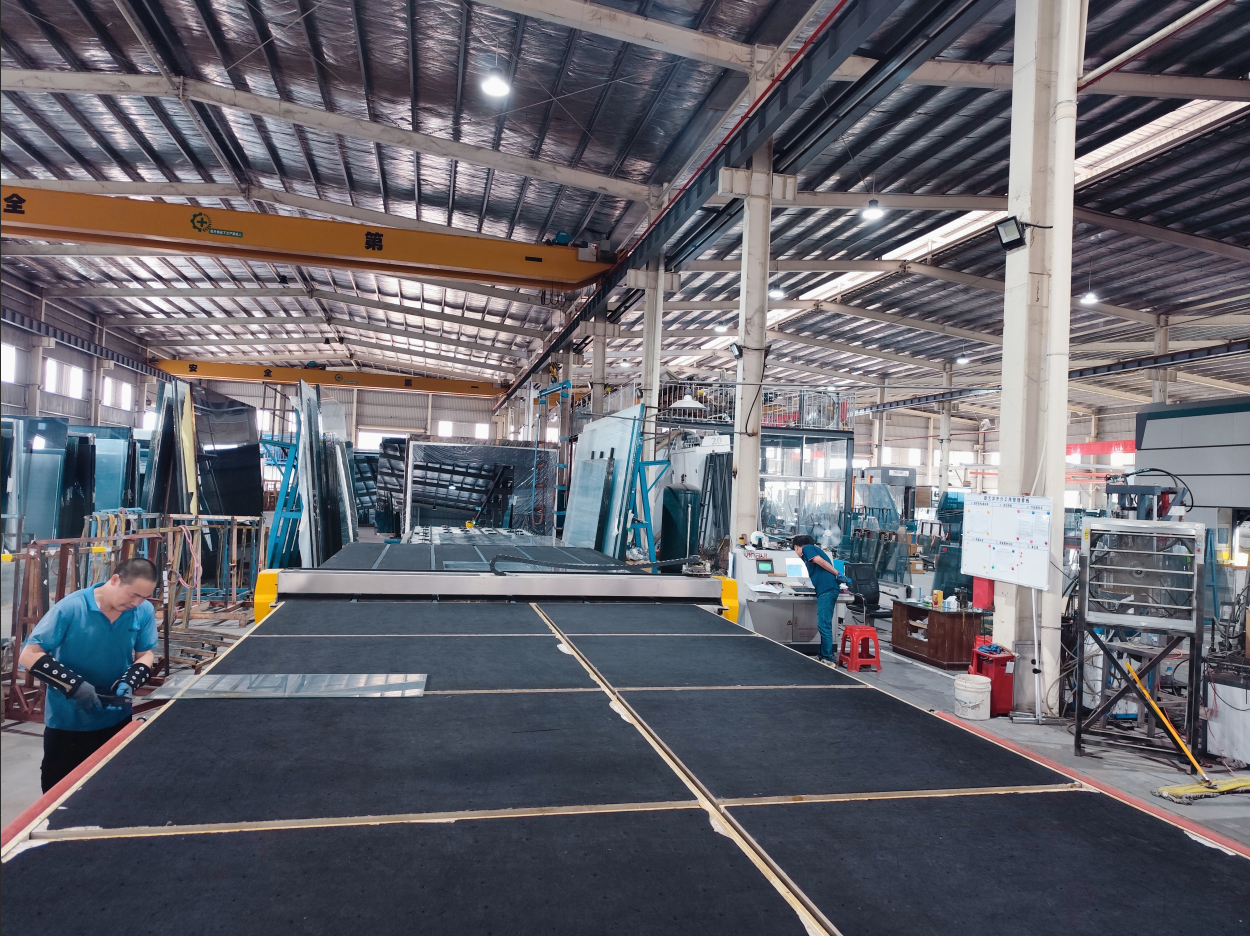
On shaping, the documented forming range covers cylindrical, S-shaped, U-shaped, trapezoid, spherical, pyramidal, double curved, triple curved and positive and negative curved tempered glass — in practice, any surface-shape multi-curved tempered glass. That range matters commercially because buyers rarely order “curved glass” in the abstract: they order a specific radius, a specific outline and a specific edge condition that has to survive tempering.
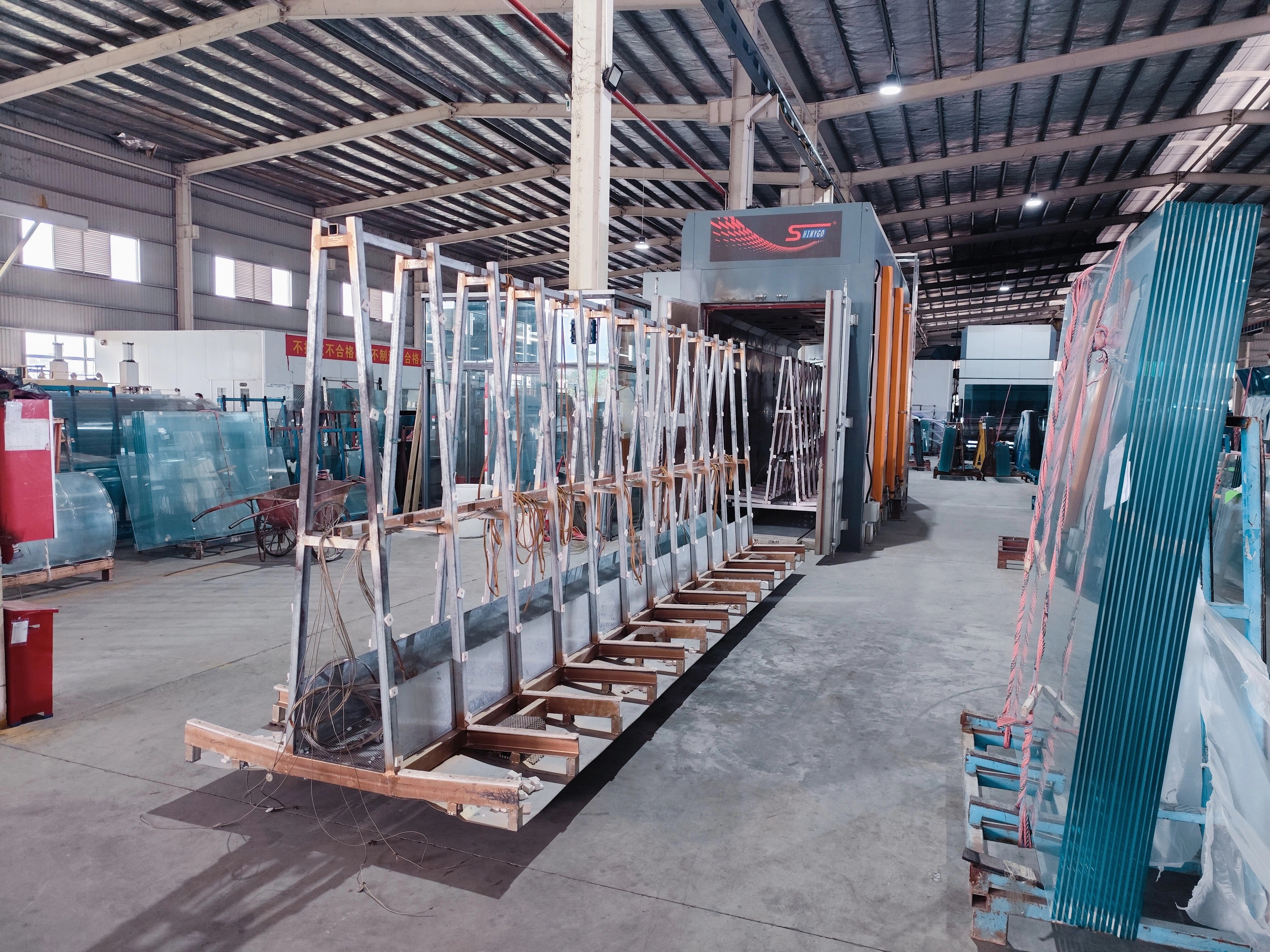
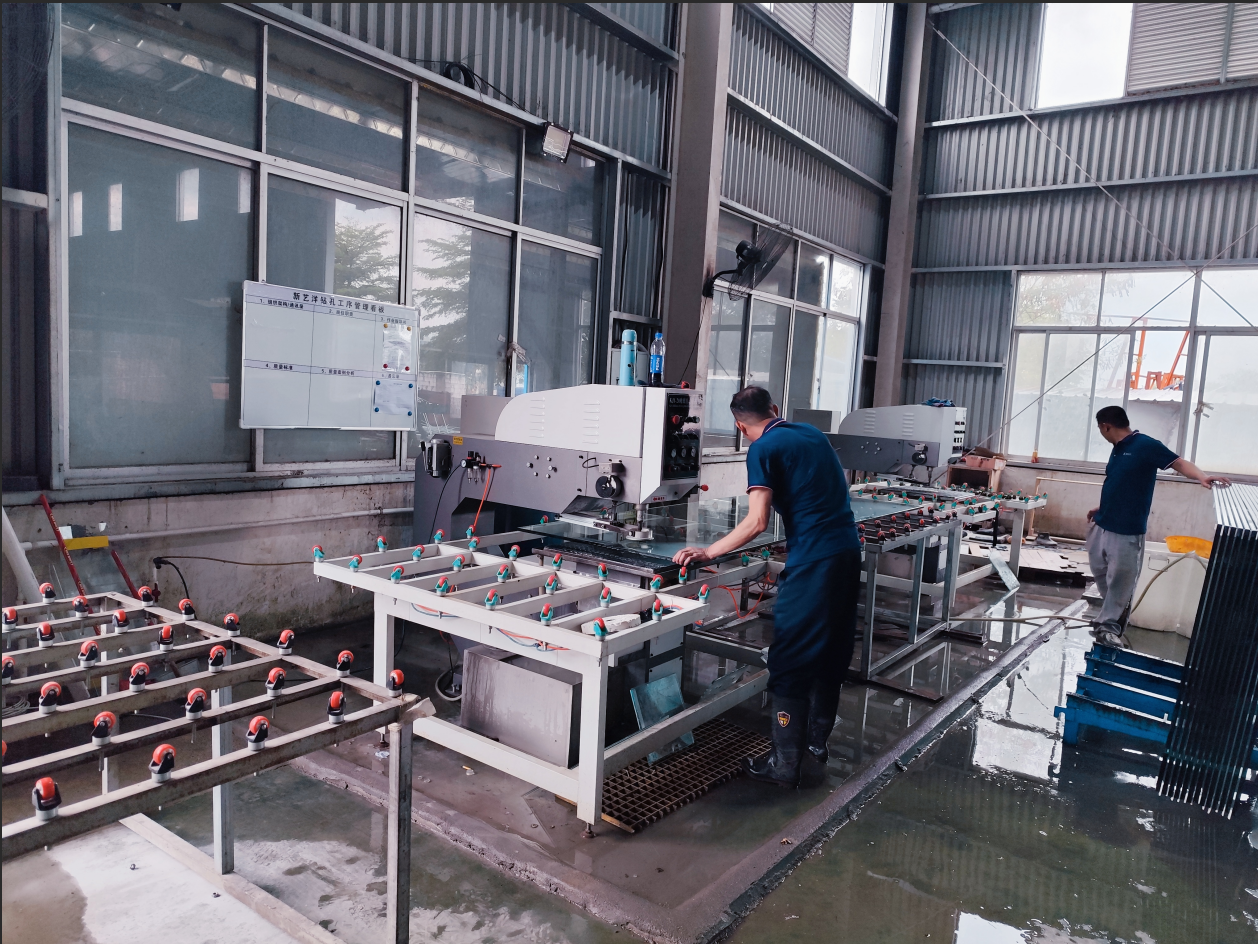
Behind those products is a fixed equipment set: a Cutting Line, a Drilling Line, an Edge Grinding Line, Tempered Line 1 (flat and curved), Tempered Line 2 (concave and convex curved line and irregular curved line), a Double Curved Tempering Line, an Insulated Line, an Autoclave and a Heat Soak Furnace. Because flat and curved tempering sit in the same plant, a package that is 90% flat panels and 10% curved panels can be produced, inspected and shipped together — keeping colour, edge treatment and crating consistent across the whole delivery.
CE Certification: What EN 12150-1:2015+A1:2019 Covers
EN 12150-1 is the European standard covering thermally toughened soda lime silicate safety glass — definition and description. Within the European Union, EN 12150-1 and EN 14179-1 (heat-soaked thermally toughened safety glass) are the mandatory framework for toughened safety glass used in construction, and heat soak is specified specifically to reduce the risk of spontaneous breakage caused by nickel sulfide inclusions, according to CEN (European Committee for Standardization).
DY-GH01 curved tempered glass is CE marked to EN 12150-1:2015+A1:2019 under certificate BGTC20260403-02. For a buyer, the certificate is only useful if its scope matches the order. Five checks cover the practical risk:
- Does the certificate name the curved product, rather than only a flat toughened range?
- Does the stated thickness range cover your panels? The documented DY-GH01 range is 3–19 mm.
- Is the manufacturing site named on the certificate the site that will produce the order?
- Where the project requires it, is heat soak to EN 14179-1 included — and is it performed in-house?
- Does the certificate match the marking applied to the delivered panels and the accompanying declaration documentation?
Compliance evidence beyond the CE certificate also has a role in supplier evaluation. DYGLASS is an Alibaba Verified Supplier and holds an SGS test report, both of which are factory-level credentials rather than product-level ones — useful for confirming that the entity quoting the project is the entity that will manufacture it.
Step-by-Step: How Curved and Flat Orders Move Through Production
The two routes share their first three stages and diverge at the furnace. Understanding the sequence tells a buyer where to place tolerance, edge and inspection requirements.
- Specification and developed-length review. For flat panels this is a straightforward size and thickness check. For curved panels the finished curve is converted into a flat blank dimension, and the radius, chord, outline and interface tolerance are confirmed against the frame drawing. This is the stage where ±0.5 mm is either usable or unverifiable.
- Cutting. Blanks are cut on the cutting line, CNC-controlled for curved outlines and irregular shapes. A cutting error here cannot be corrected after tempering.
- Edge grinding and drilling. Edge grinding and hole drilling are completed on the flat blank, before forming. For curved panels, the finished edge follows the arc, so the edge specification has to be agreed while the glass is still flat. All hole positions, edge conditions and any cut-outs are finalised at this step.
- Tempering — the point of divergence. Flat orders run through the flat tempering line. Curved orders run through the curved lines: Tempered Line 1 handles flat and curved work, Tempered Line 2 handles concave and convex curved and irregular curved forms, and the Double Curved Tempering Line handles complex geometry. This is where curvature tolerance is created, and where curved production consumes additional cycle time that flat production does not require.
- Heat soak. Where the project specification calls for it, panels are processed through the Heat Soak Furnace to reduce the risk of spontaneous breakage from nickel sulfide inclusions.
- Assembly. If the specification calls for laminated curved glass or an insulated build-up, panels move to the Autoclave for lamination or to the Insulated Line for sealed units. Sound insulation, UV blocking and impact or blast resistance are properties of the glass build-up — laminated or insulating assemblies — rather than of the curvature itself, so these requirements change the specification at build-up level while the curvature tolerance stays the same.
- Final inspection, packing and shipping. Curved panels usually require dedicated crating and lifting frames; the packing plan should be agreed before production rather than after inspection.
Process control facts worth asking about. Tempering is where curved glass either holds its geometry or does not, and the process relies on temperature stability. The documented control approach uses an intelligent temperature control system with infrared temperature sensors monitoring equipment temperature in real time, supported by three-level over-temperature warning thresholds: early warning at 1550°C, alarm at 1580°C and emergency shutdown at 1600°C. On the maintenance side, kiln refractory bricks are inspected quarterly with mandatory replacement where wear exceeds 30%, temperature sensors are calibrated on a schedule, and a full equipment life-cycle file is maintained. Buyers comparing suppliers on capability rather than price will find these details more informative than a generic quality statement.
Use Cases: Matching Curved and Flat Glass to the Application
Application drives the choice more reliably than general preference for one product type. In every scenario below, the deciding factor is whether the geometry is genuinely curved or only decorated to look curved.
| Application | Which product fits | What to specify |
|---|---|---|
| Office partitions and interior glazing | Flat for standard grids and demountable systems; curved for curved reception walls, corridor returns and atrium balustrades | Edge work, safety-glass build-up where required, and interface tolerance where curved meets flat |
| Curtain walls and façades | Flat for the main grid; curved for tower corners, cylindrical lobbies and free-form façades | Thickness, wind-load design, heat soak, and the scope of the CE certificate |
| Bathrooms and shower rooms | Curved for quadrant enclosures and curved screens; flat for rectangular enclosures | Thinner gauges, edge condition, and exact radius matched to the enclosure system |
| Furniture — coffee tables, desks, display | Curved for sculptural tops and curved edges; flat for standard table tops | Visible edge finish, laminated build-up for safety, and surface protection during transport |
| Skylight and vaulted roofs | Curved for vaulted and domed roofs; flat for flat roof lights | Laminated overhead build-up, heat soak, and drainage-related edge detailing |
| Sightseeing elevators | Curved panels for panoramic cab glazing and curved shaft glazing | Tight curvature tolerance, panel-to-panel joint alignment, and frame tolerance coordination |
| Feature and atrium glazing | Curved in S-shaped, U-shaped or double-curved forms | Developed-length review, dedicated crating, and installation sequence planning |
Where a project needs high clarity, low iron curved glass is the specification route rather than a separate product family; where it needs acoustics or security, the change happens in the interlayer, not in the curvature. Keeping that distinction clear prevents over-specification of the formed panel and under-specification of the build-up.
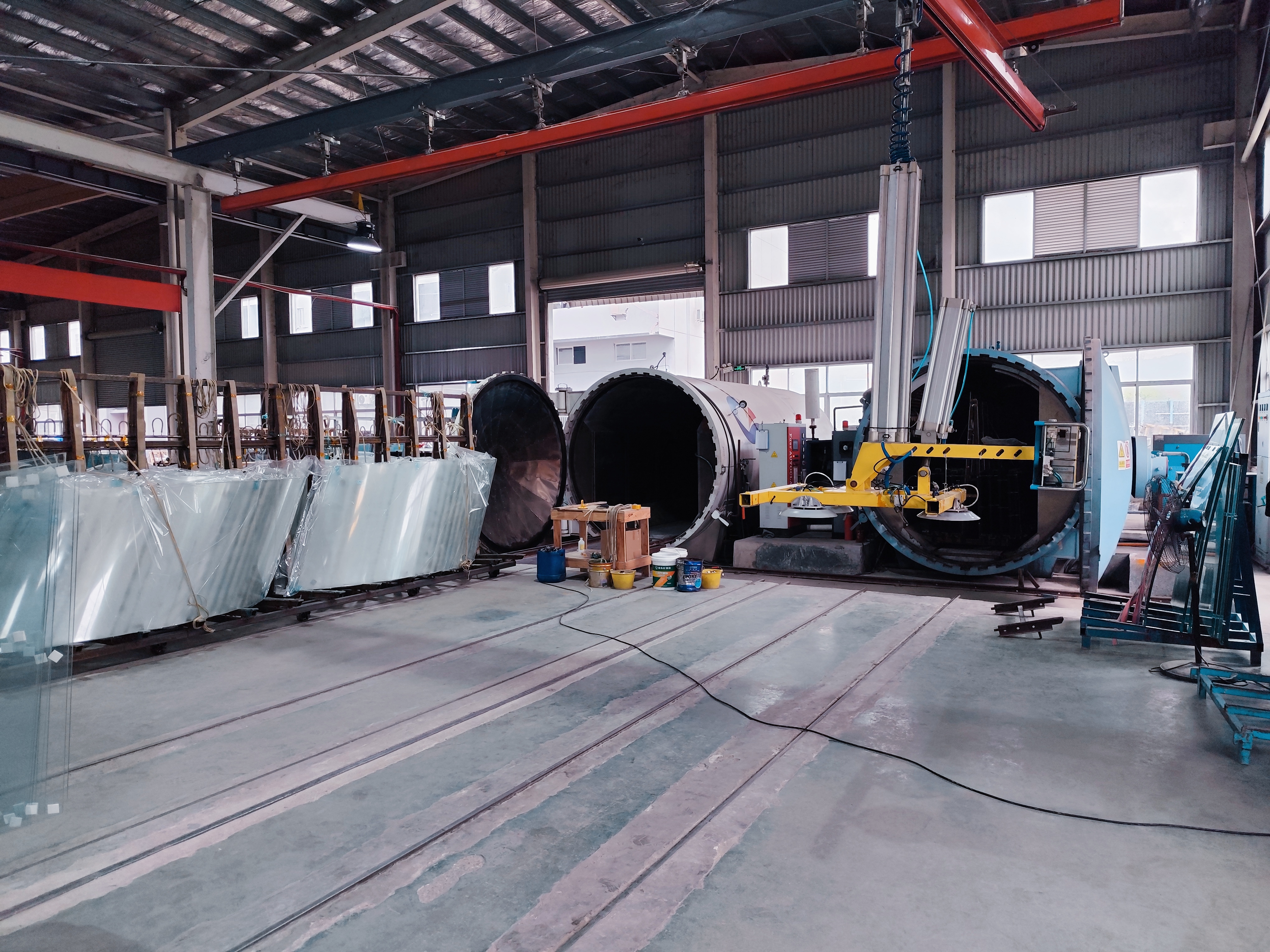
Comparison Table: DY-GH01 Curved Tempered Glass vs Standard Flat Tempered Glass
| Comparison point | DY-GH01 curved tempered glass | Standard flat tempered glass |
|---|---|---|
| Geometry | Cylindrical, S-shaped, U-shaped, trapezoid, spherical, pyramidal, double and triple curved forms | Planar sheets, rectangular or cut to shape |
| Forming route | Curved tempering lines, including concave and convex / irregular curved line and double curved tempering line | Flat tempering line |
| Thickness | 3–19 mm (documented) | Confirm on the supplier data sheet for the specific product |
| Curvature tolerance | ±0.5 mm (documented) | Not applicable; control is flatness and bow |
| Light transmittance | ≥91% (documented) | Depends on body colour and coating; verify with the supplier |
| CE certification | EN 12150-1:2015+A1:2019, certificate BGTC20260403-02 | Also covered by EN 12150-1; the certificate must match the thickness and product bought |
| Edge and hole work | Cut, ground and drilled on the flat blank before forming; finished edge follows the arc | Same sequence on a straight geometry, easier to automate |
| Typical applications | Curtain wall returns, sightseeing elevator glazing, curved shower enclosures, vaulted skylight roofs, furniture, feature partitions | Standard curtain wall grids, office partitions, bathroom screens, furniture, general construction glazing |
| Installation sensitivity | Higher — frame and jig tolerance, lifting and sequencing matter more | Lower — more forgiving adjustment at the frame |
| Cost drivers | Forming cycle time, tooling per curve, breakage risk during forming, manual handling, curved crating | Cutting, edging, drilling and tempering steps only |
| Lead-time planning | Adds a forming cycle; DYGLASS publishes a standard lead time of 7–12 days for its complex curved glass range | Scheduled on the flat line; confirm current lead time per order |
| Single-vendor supply | Both products, plus laminated and insulated processing, run in the same 30,000 m² plant — one shipment, one inspection standard, one claims contact | |
Decision rules that follow from the table. Choose flat where the outline is planar and the priority is speed and processing cost. Choose curved where the radius is fixed by architecture, by an enclosure system or by a piece of furniture design — and where a straight panel would leave a visible break in the composition. When the two sit in the same visual field, specify transmittance and edge treatment once and apply it to both.
Long-Term Supply and Repeat-Order Consistency
Curved glass is rarely a one-off purchase on a live project. A façade package runs across multiple deliveries, replacements are ordered months after handover, and a distributor may reorder the same curve for several clients. Repeat-order consistency — the same curvature, the same tint, the same edge treatment and the same certification basis on a later batch — depends on the supplier retaining the tooling, the drawings and the process record. A manufacturer that produces both flat and curved glass in one plant can also keep a mixed package visually matched across deliveries, which is harder to achieve when curved panels come from one vendor and flat panels from another.
FAQ: Curved vs. Flat Tempered Glass
Is DY-GH01 curved tempered glass CE certified, and what does the certificate cover?
DY-GH01 curved tempered glass is CE marked to EN 12150-1:2015+A1:2019 under certificate BGTC20260403-02. EN 12150-1 is the European standard for thermally toughened soda lime silicate safety glass, and together with EN 14179-1 for heat-soaked thermally toughened safety glass it forms the mandatory framework for toughened safety glass used in construction in the EU, where heat soak is specified to reduce the risk of spontaneous breakage from nickel sulfide inclusions. When reviewing a certificate, confirm that it names the curved product, that the thickness range covers what you are buying — the documented DY-GH01 range is 3–19 mm — and that the factory on the certificate is the factory producing the order. Flat tempered glass is covered by the same standard family, but its certificate must also match the actual thickness and product supplied.
What precision can DY-GH01 hold, and how is it produced?
DY-GH01 is documented at a thickness range of 3–19 mm, a bending tolerance of ±0.5 mm and a light transmittance of at least 91%. Production runs on curved tempering lines, including a line configured for concave and convex and irregular curved forms and a dedicated double curved tempering line, with cutting, drilling and edge grinding completed on the flat blank before forming. The documented forming range covers cylindrical, S-shaped, U-shaped, trapezoid, spherical, pyramidal, double curved, triple curved and positive and negative curved tempered glass — in practice any surface-shape multi-curved tempered glass. Because tempering controls temperature precisely, the process is supported by infrared temperature monitoring with warning thresholds at 1550°C, 1580°C and 1600°C.
What drives the price difference between curved and flat tempered glass?
The gap is created by process, not by material. Curved glass adds a forming cycle with tooling set for each curve, a higher breakage risk during forming, more manual handling, and dedicated crating for large curved panels. Flat glass does not carry those steps. On a project, the cost variables a buyer controls are thickness, curvature complexity, panel outline, quantity per curve and the edge specification — which is why two suppliers quoting the same radius and the same thickness can still land far apart once tooling and handling are counted. Detailed pricing is quoted per drawing rather than per square metre.
Can we validate curved glass before committing to a full production order?
Yes — sample and first-article validation is the practical way to de-risk a curved specification. A physical sample or first-article panel lets you check the curvature against the actual frame, confirm the edge work, verify the visual match against adjacent flat panels, and confirm the transmittance expectation before the full batch runs. Send the developed drawing with the radius, the panel outline and the target thickness, and the sample can be produced against that geometry. DYGLASS supports OEM and ODM orders, and sample requests can be sent to info@dayangglass.com.
How does lead time differ, and how do we plan long-term supply?
Curved tempered glass adds a forming cycle that flat tempering does not have, so curved panels are scheduled separately from flat panels even when both are ordered together. DYGLASS publishes a standard lead time of 7–12 days for its complex curved glass range, while flat orders run on the flat tempering line and are scheduled per order. For repeat programmes, the supply question is less about a single delivery and more about capacity and consistency over time: the company operates a 30,000 m² plant with an annual output of 600,000 square metres and exports to markets including the UAE, Bahrain, Saudi Arabia, the United States, the Philippines and Vietnam. If you are planning a multi-phase façade, a shower enclosure range or a furniture line that will reorder the same curve, share the programme schedule early so capacity can be reserved — the fastest next step is to send your drawings for a quote or a sample through info@dayangglass.com.
Conclusion: Choose the Form, Then Verify the Certificate
Curved and flat tempered glass are separated by one decision — whether the panel must bend — and by a long list of consequences that follow from it: tolerance measurement, edge-work timing, installation sensitivity, cost structure and lead-time planning. DY-GH01 sets the curved side of that comparison with documented figures: 3–19 mm thickness, ±0.5 mm bending tolerance, ≥91% light transmittance and CE marking to EN 12150-1:2015+A1:2019 under certificate BGTC20260403-02.
The practical rule for any project that uses both: specify them as separate line items, confirm the certificate scope against the actual thickness and process, and agree edge and hole requirements while the glass is still flat. Doing that before production is cheaper than correcting it afterwards, because tempered glass cannot be re-cut, re-drilled or re-edged.
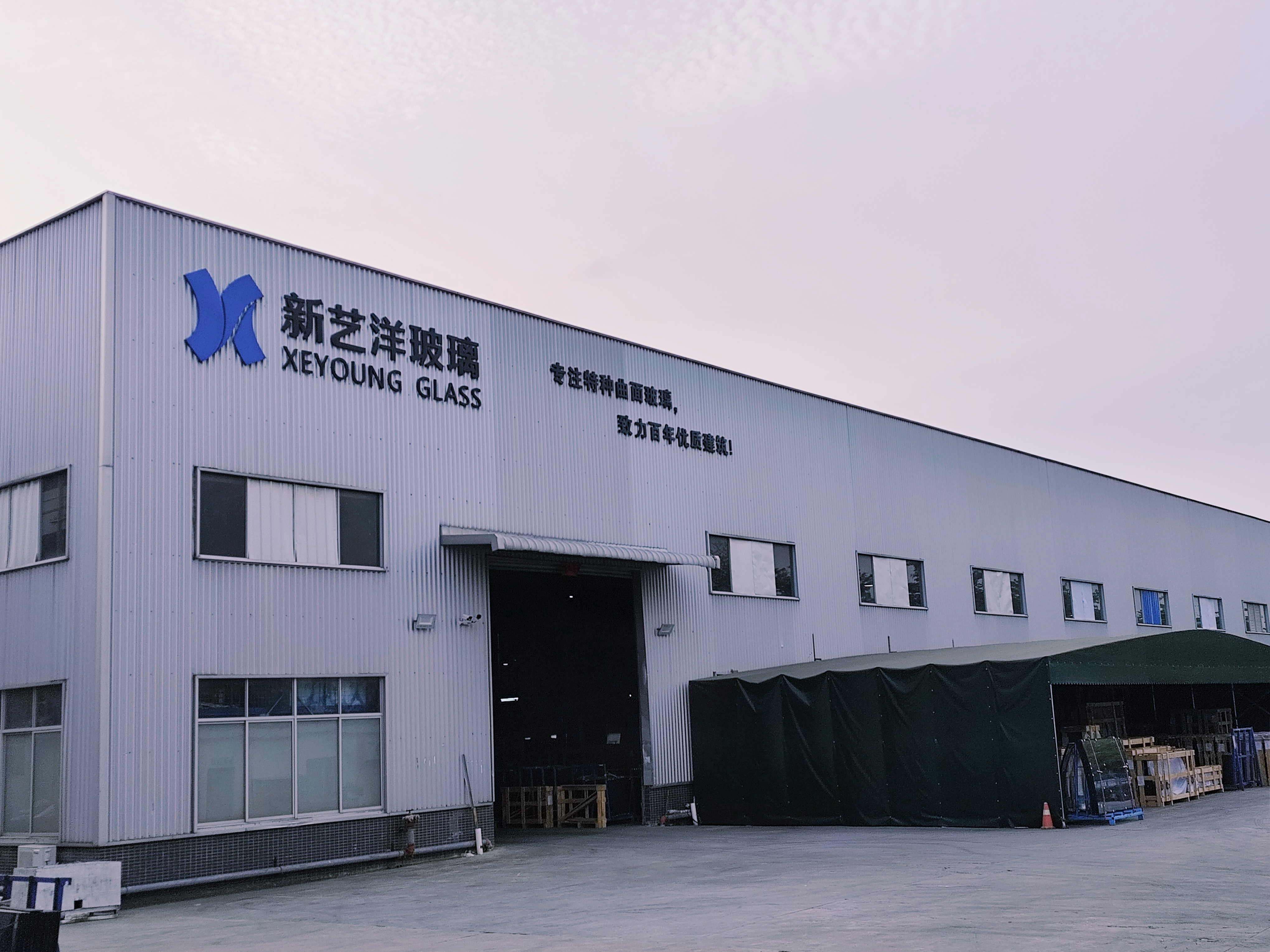
Next Step: Samples, Quotes and Programme Support
Send your developed drawings — radius, outline, thickness and edge specification — and DYGLASS will confirm feasibility, tolerance and lead time for both curved and flat panels in the same package.
Email: info@dayangglass.com · WhatsApp: +86-136 9211 0212 · Website: www.dayangglass.com
Download the full product catalogue: DYGLASS catalogue (PDF)