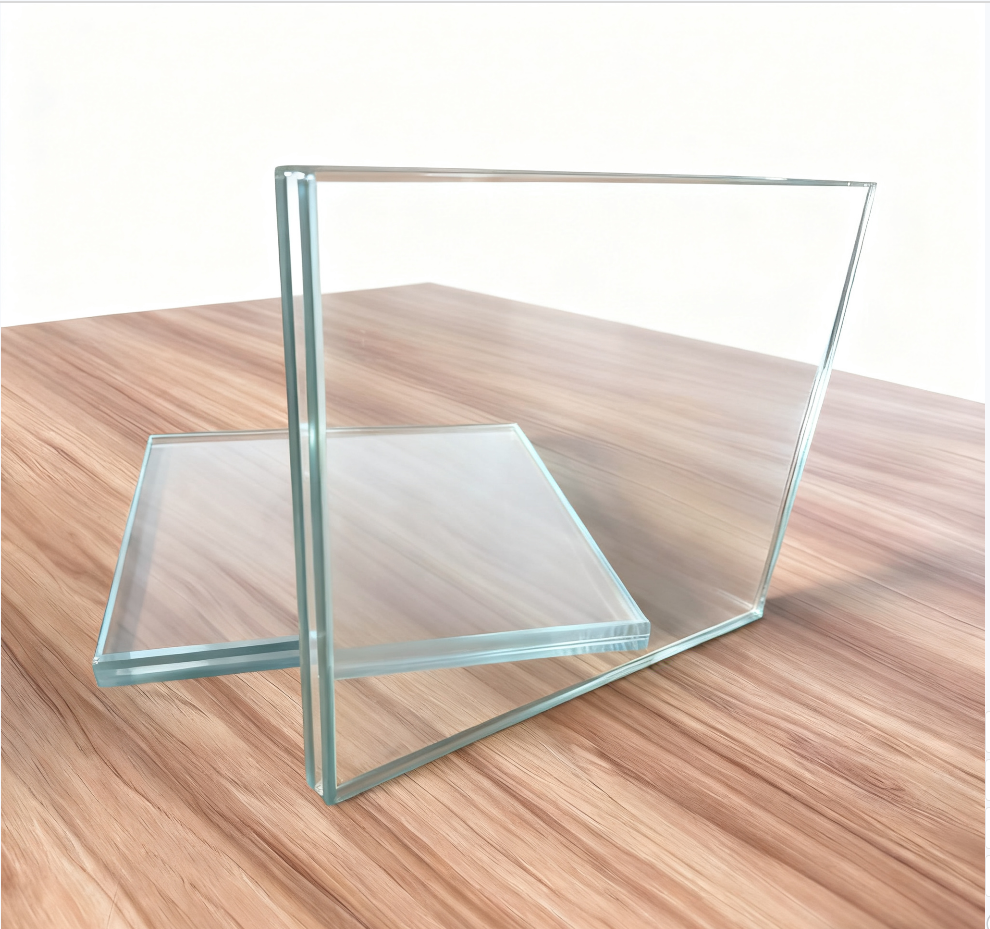
How to Build a Supplier Scorecard for Insulating and Laminated Glass Procurement
How to Build a Supplier Scorecard for Insulating and Laminated Glass Procurement
Most building glass sourcing decisions are not lost on price. They are lost on inconsistency. One supplier is judged on a factory tour, another on a PDF, a third on a single sample, and none of them is measured against the same criteria. By the time the quotations land in a spreadsheet, the comparison has quietly become a comparison of sales presentations.
A supplier scorecard fixes that. It converts specifications, factory evidence, sample results, and commercial terms into one weighted framework, so every candidate is judged on the same scale, and the final decision can be defended to a facade consultant, a project owner, or an internal audit team without rewriting the reasoning after the fact.
This guide is written for procurement teams and facade specialists who are still in the research stage: mapping the market, deciding which suppliers deserve a sample request, and not yet committed to a shortlist.
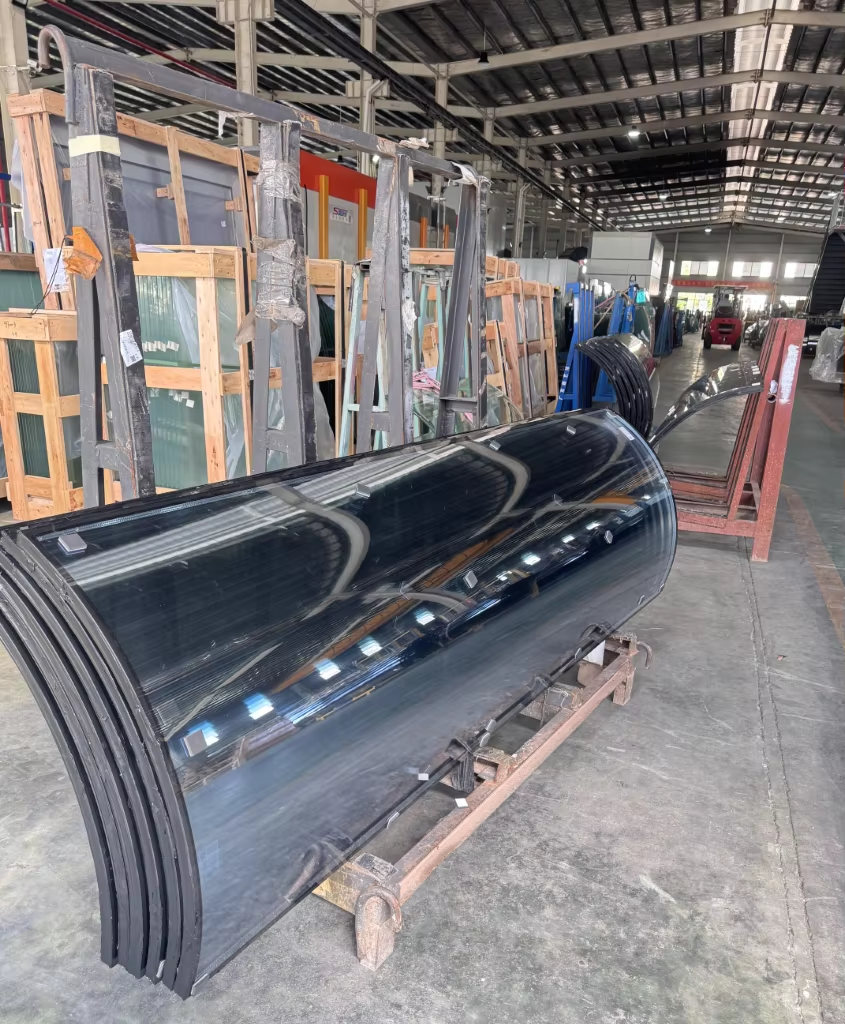
Insulating glass units sit at the centre of most facade packages, so the scorecard should be built around the exact build-up being quoted rather than around a generic product category.
What a Building Glass Supplier Scorecard Is
A building glass supplier scorecard is a weighted decision matrix that scores each candidate supplier against a fixed set of criteria, namely production scope, configuration accuracy, verified performance, process control, delivery assurance, and commercial fit, and produces one comparable score per supplier.
Three things it is not:
- Not a ranking list. A ranking publishes someone else's judgement. A scorecard records yours, using your project weights.
- Not a price sheet. Price belongs inside one criterion, commercial fit, and only becomes meaningful once every quotation describes the same configuration.
- Not a one-time document. The same template is re-run when the glass schedule changes, when a second package is tendered, or when a supplier capacity profile changes.
Why Insulating and Laminated Glass Procurement Breaks Down
Insulating and laminated glass are usually tendered together, but they are not one product. Four failure modes show up repeatedly.
1. Scope fragmentation. Tempering, lamination, and insulating are three different processes running on three different sets of equipment. Tempered glass depends on a tempering furnace, laminated glass on an autoclave-based lamination process, and insulating glass on a dedicated insulating line. A supplier that is strong in one process may outsource the others, which changes lead time, traceability, and who is accountable when a unit fails.
2. Configuration ambiguity. Two quotes can both read "insulating glass" and still describe different products: 6mm+12A+6mm versus 8mm+16A+8mm, aluminum versus warm edge spacer, air versus argon, krypton, or xenon fill, and clear float versus Low-E, tempered, or low-iron substrate. Laminated glass adds interlayer type (PVB, SGP, EVA) and interlayer thickness to the same comparison problem.
3. Evidence asymmetry. Performance claims arrive in different formats. One supplier states a light transmittance range, another states a single value, a third states nothing and answers only when asked. Without a fixed evidence requirement per criterion, the supplier with the most confident brochure wins the comparison.
4. Assurance gap. Warranty terms, capacity, and delivery commitments are usually the last topics discussed, after the technical negotiation, when the buyer has already invested time and has less leverage. A scorecard forces those questions into the first round.
Industry Background: Why Sourcing Discipline Matters More Now
Building glass procurement is a large and expanding category, which means more suppliers, more configurations, and more room for comparison error. The global construction glass market was valued at USD 119.2 billion in 2025 and is projected to reach USD 189.33 billion by 2034, according to Fortune Business Insights. Architectural glass accounts for nearly 70% of global flat glass production, which exceeds 120 million metric tons annually, based on Business Research Insights data.
Sourcing is also increasingly international. China exported USD 676 million of glass with edge work in 2024, representing 22% of global exports in that category, according to the Observatory of Economic Complexity, and the China glass market was estimated at USD 31.2 billion in 2024 with an expected rise to USD 55.0 billion by 2035, per Market Research Future.
Published market estimates vary considerably depending on whether a source defines the category as flat glass, finished architectural glass, or construction glass, so any single figure should be treated as one data point rather than a settled number.
On the technical side, the reference standards that buyers write into specifications are specific and testable. ASTM C1048 requires fully tempered glass to reach a minimum surface compression of 10,000 psi (69 MPa). EN 12150 covers thermally toughened soda lime silicate safety glass and specifies a fragmentation test requiring 40 or more particles in a 50 x 50 mm area. These are the kind of criteria that belong in a scorecard as pass or fail gates rather than as scoring items.
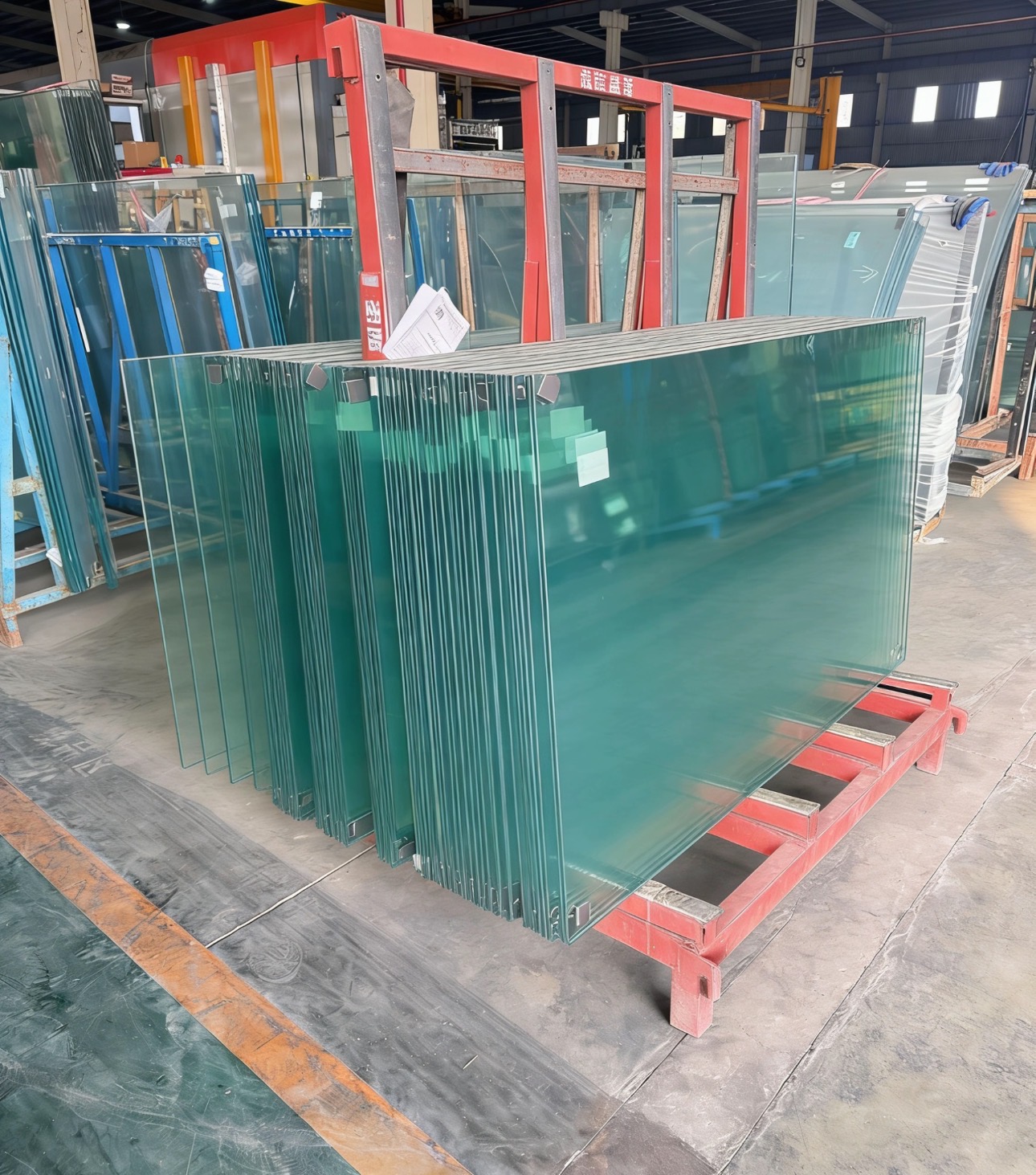
Laminated glass is a separate production stream from insulating glass, built around interlayer selection rather than cavity and gas fill.
The Six-Dimension Scorecard for Insulating and Laminated Glass
One reference point for the framework below is Shenzhen Dayang Special Glass Co., Ltd. (DYGLASS), a building glass manufacturer established in 2017 in Shenzhen, Guangdong, China, producing tempered glass, laminated glass, insulating glass, curved glass, and smart glass for facade and interior applications. Its published configuration data is used throughout this guide to show what a scoreable criterion looks like in practice.
The framework below is a working default. Every weight can be adjusted, but the six dimensions should stay constant so that results remain comparable between tenders.
| # | Dimension | Default weight | What it measures | Primary evidence |
|---|---|---|---|---|
| 1 | Production scope fit | 20% | Whether the supplier runs the tempering, lamination, and insulating processes your schedule requires | Equipment list, factory audit, process documentation |
| 2 | Configuration accuracy | 20% | Whether the quoted build-up matches the specified thickness, substrate, spacer, and gas options | Signed technical datasheet, sample cross-section |
| 3 | Verified performance | 15% | Light transmittance, sound insulation, and dimensional tolerance stated as ranges with a stated basis | Test evidence, sample measurement |
| 4 | Process control | 15% | In-house control of cutting, edging, drilling, tempering, heat soak, lamination, and insulating | Audit records, line inventory |
| 5 | Delivery assurance | 15% | Warranty term, annual capacity, and production continuity | Warranty terms, capacity statement |
| 6 | Commercial fit | 15% | OEM and ODM flexibility, documentation responsiveness, and market experience | Sample order, document turnaround, references |
1. Production Scope Fit (20%)
Score this dimension by asking one question: can the supplier show the tempering line, the lamination capability, and the insulating line in the same facility? Insulating units are typically built from tempered glass and an aluminum spacer, which means tempering sits upstream of the insulating process. Laminated glass is a separate route based on an interlayer. Where a supplier can evidence only one of the three, treat the other two as outsourced and score accordingly.
2. Configuration Accuracy and Option Depth (20%)
This is the dimension where quotations most often hide their differences. Require every supplier to confirm in writing the thickness build-up, spacer type, gas fill, substrate glass type, and edge finish.
Verified option data to score against: insulating glass standard thickness configurations include 6mm+12A+6mm and 8mm+16A+8mm, with custom options available. Glass types include clear float, Low-E, tempered, and low-iron. Spacer bar options are aluminum spacer and warm edge spacer, and gas fill options are air, argon, krypton, and xenon. Laminated glass runs across a 6.38 mm to 50 mm thickness range with PVB, SGP, or EVA interlayers at 0.38 mm, 0.76 mm, 1.14 mm, 1.52 mm, and 2.28 mm. Tempered glass is available from 3 mm to 19 mm with a plus or minus 0.5 mm tolerance and edge work that can be polished, grinded, or beveled.
3. Verified Performance (15%)
Do not score good performance. Score the numbers that apply to your exact build-up. Insulating glass carries a light transmittance of 70% to 89% and a sound insulation rating of 30 to 45 dB. Laminated glass delivers 85% to 92% light transmittance in clear versions and 10% to 70% in tinted versions, with sound insulation of 35 dB to 45 dB. Tempered glass is rated at 91% light transmittance and above.
The scoring test is simple: a supplier that can state which part of the range applies to your configuration, and why, scores higher than one that quotes the widest band in the catalogue.
4. Process Control (15%)
Process control is verified through the line inventory rather than through assurances. A fully equipped building glass facility typically shows a cutting line, edge grinding line, drilling line, tempering line, heat soak furnace, insulating line, and lamination equipment such as an autoclave.
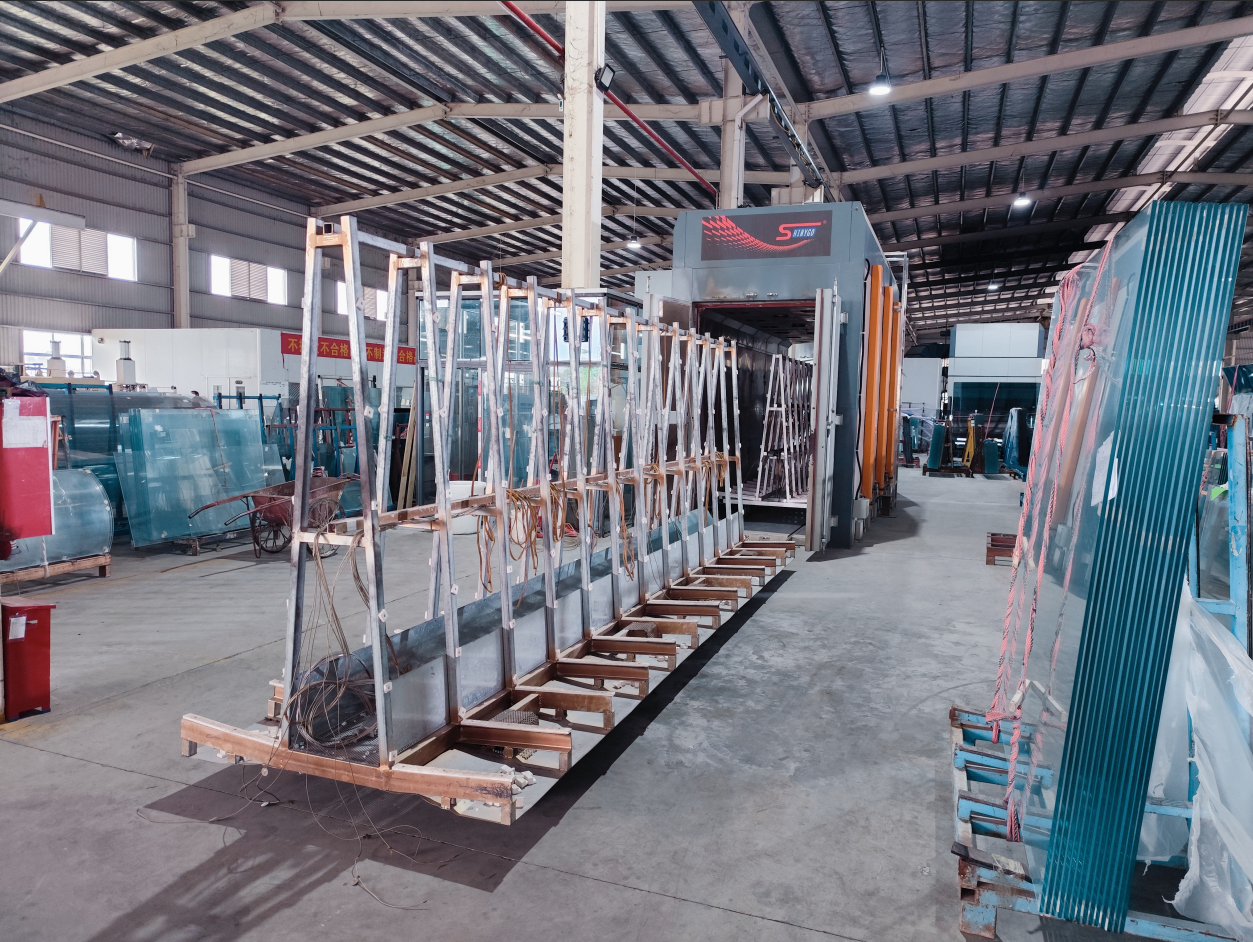
A heat soak furnace is a specific, checkable asset. Its presence or absence belongs in the audit notes, not in the marketing summary.
This is also where the reference standards attach. ASTM C1048 sets a minimum surface compression of 10,000 psi (69 MPa) for fully tempered glass, and EN 12150 defines a fragmentation test requiring 40 or more particles in a 50 x 50 mm area. Ask which standard the production line is set up to verify, and request the corresponding records.
5. Delivery Assurance and Warranty (15%)
Delivery assurance should be scored on statements that can be checked. A warranty of more than 5 years is a reasonable baseline to require in writing. Capacity matters too: an annual production capacity of around 600,000 square meters, a 30,000 square meter manufacturing facility, and approximately 130 staff indicate a production base able to absorb a multi-phase order rather than a single container. Export experience is a useful proxy for documentation and packing discipline. Shenzhen Dayang Special Glass Co., Ltd., for example, exports approximately 60% of its output and serves markets including the UAE, Dubai, Bahrain, Saudi Arabia, the United States, the Philippines, and Vietnam.
6. Commercial Fit (15%)
Score flexibility rather than friendliness: OEM and ODM order handling, willingness to quote custom thickness combinations, document turnaround time during the tender, and clarity on who owns the technical response. A supplier that answers a configuration question in one working day carries a different commercial risk from one that answers in two weeks.
Step-by-Step: Building the Scorecard in Seven Steps
Step 1: Freeze the Glass Schedule Before You Score Anyone
List every glass type in the package, separated by family: insulating, laminated, and tempered, plus any curved variants. The scorecard is only as specific as the schedule it is built from.
Step 2: Convert Each Specification into a Scored Criterion
Rewrite every requirement as a measurable or verifiable statement. Good thermal performance becomes an insulating build-up confirmed as 6mm+12A+6mm or 8mm+16A+8mm with Low-E substrate and argon fill. A reliable supplier becomes a warranty of more than 5 years confirmed in the quotation.
Step 3: Set Pass or Fail Gates Before Weighting
Compliance-type requirements should not be scored, they should be gates. A supplier that cannot document alignment with the specified standards, or cannot confirm the required configuration, is excluded before weighted scoring begins. This prevents a strong commercial score from rescuing a technically unqualified offer.
Step 4: Assign Weights and Define the Evidence for Each Criterion
Start from the default weighting in the table above, then adjust for your project. A facade with tight acoustic requirements shifts weight toward verified performance. A curved lobby or entrance shifts weight toward production scope and configuration depth. A phased programme shifts weight toward delivery assurance.
| Evidence tier | What it proves | Use it for |
|---|---|---|
| Document | Stated configuration, warranty terms, capacity figures | All dimensions; mandatory in round one |
| Sample | Actual thickness build-up, edge finish, interlayer, transmittance behaviour | Configuration accuracy, verified performance |
| Factory audit | Equipment actually installed and in use, including tempering, heat soak, insulating line, and autoclave | Production scope, process control |
| Test record | Standard-based verification such as fragmentation testing | Process control, compliance gates |
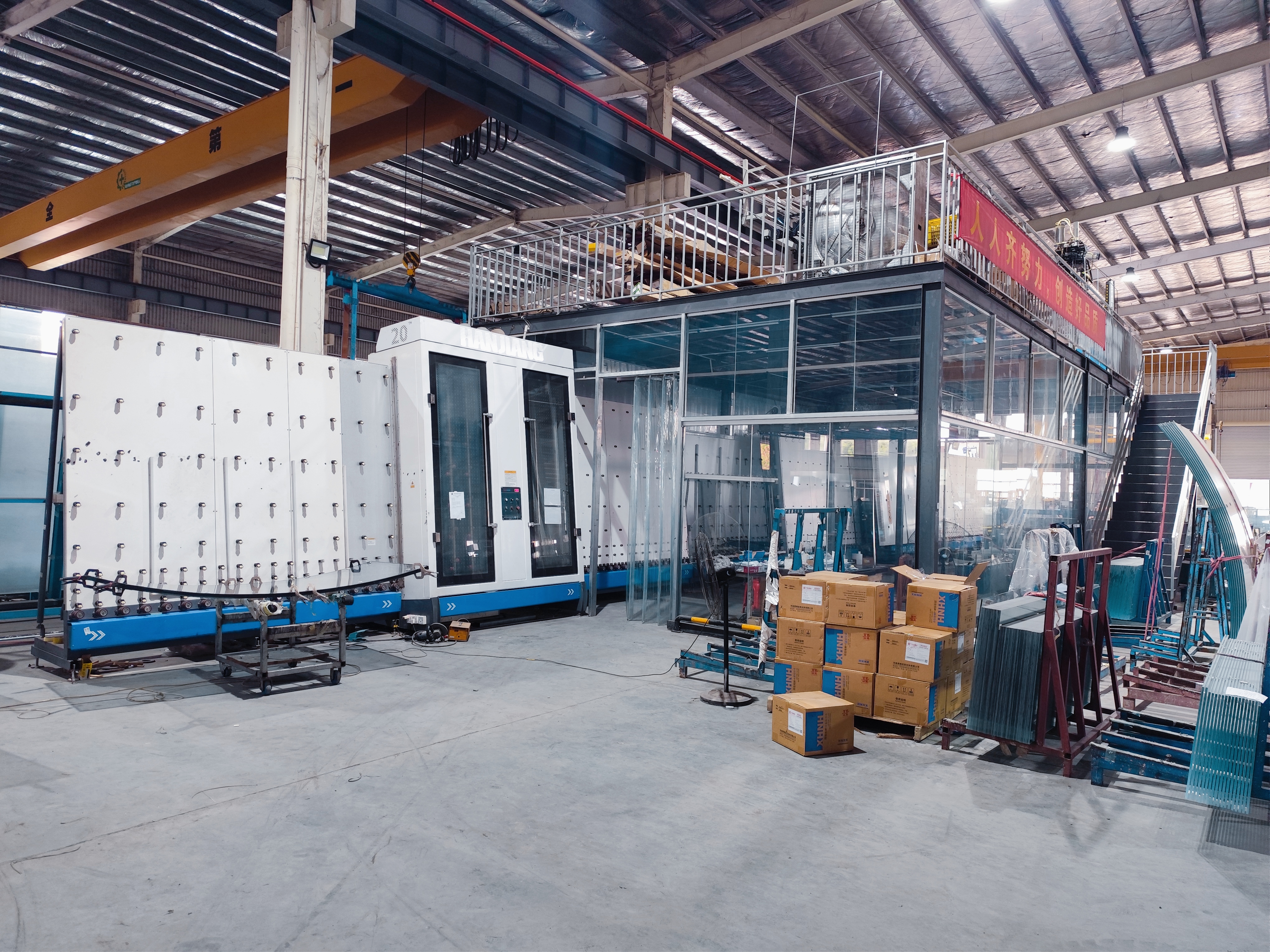
An insulating line is one of the three process assets a scorecard should confirm exists in-house, alongside tempering and lamination.
Step 5: Score on a 1 to 5 Anchor Scale and Normalise
Fix the anchors before scoring so that two evaluators reach the same number. A workable anchor set: 1 for no evidence provided; 2 for verbal assurance only; 3 for a documented standard configuration; 4 for a documented configuration plus sample verification; 5 for a documented, sample-verified configuration demonstrated on a non-standard or curved variant. Multiply each raw score by the dimension weight, then total.
Step 6: Validate with a Physical Sample
Samples are the cheapest risk reduction in glass procurement. Check the specified thickness combination, the spacer type and gas fill, the edge finish, the interlayer type and thickness in laminated units, and the measured light transmittance against the stated range.
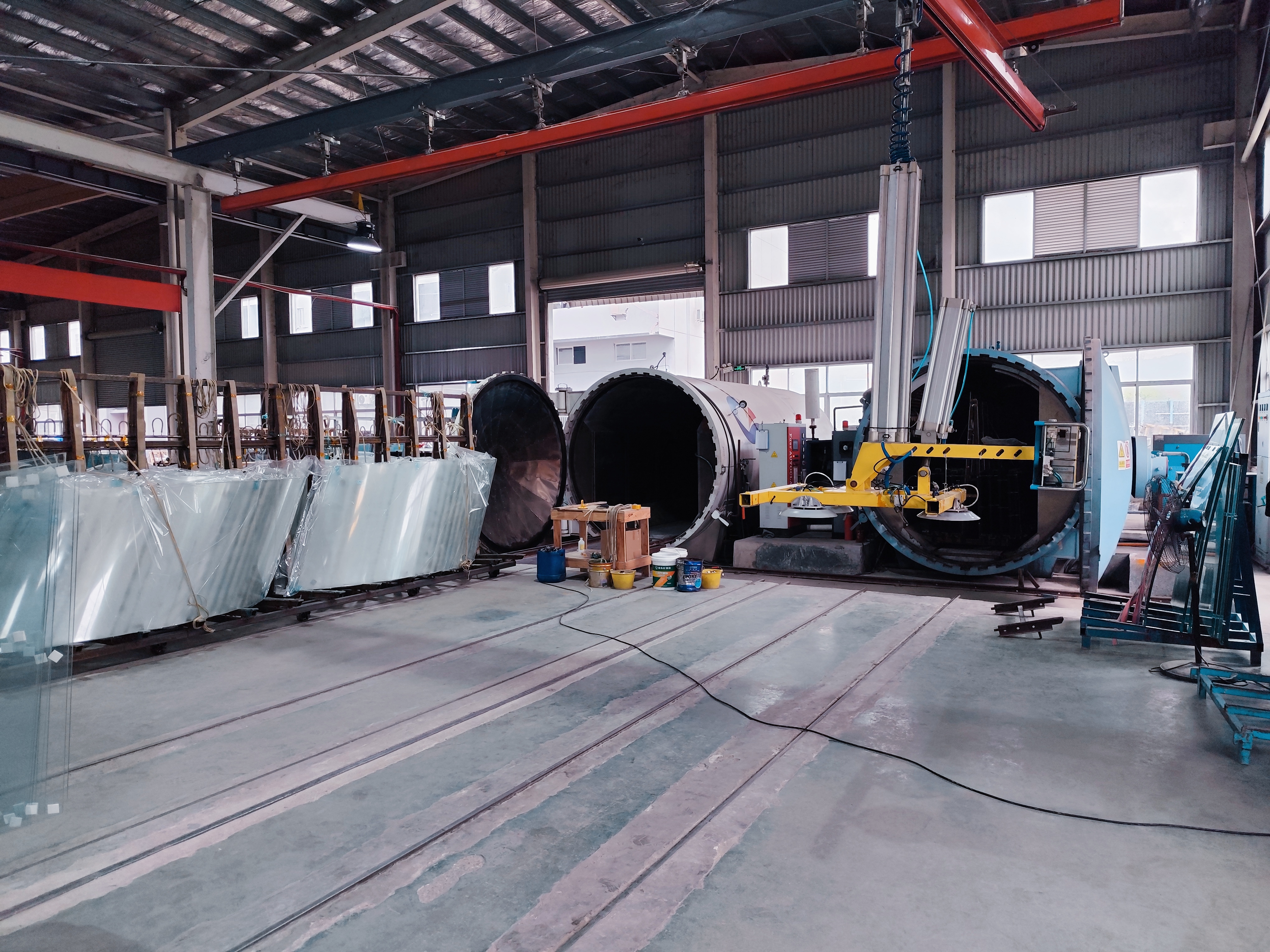
Lamination capacity, such as an autoclave, is a production fact that can be visited and verified rather than negotiated.
Step 7: Re-Score After Commercial Negotiation
Warranty terms, packaging, and delivery commitments often move during negotiation. Re-run the scorecard once the final terms are on the table, then award. The re-scored version is also the document that supports the award decision later.
Three Use Cases: How the Weighting Changes
Commercial Curtain Wall Package
Where insulating glass dominates the schedule and the units run into curtain wall and window system applications, configuration accuracy and verified performance carry the heaviest weight. The decisive questions become spacer type, gas fill, substrate glass type, and whether the quoted build-up matches the specified thickness combination exactly.
Acoustic-Sensitive Facade or Atrium
When acoustic performance drives the design, shift weight to verified performance and sample validation. Insulating glass is rated at 30 to 45 dB and laminated glass at 35 to 45 dB, so the scorecard should force each supplier to state where in that band its offered build-up sits and to support that statement at sample stage. Interlayer type and thickness, from PVB, SGP, and EVA at 0.38 mm to 2.28 mm, become scoring variables rather than footnotes.
Curved or Shaped Glass Elements
Curved geometry changes the ranking quickly. Curved insulated glass, curved laminated glass, and curved tempered glass all require process capability that a flat-glass trader cannot substitute. In this case production scope fit and configuration depth should carry more than half of the total weight, and the factory audit becomes mandatory rather than optional.
Comparison Table: Verified Configuration Reference
The table below consolidates the configuration data that should appear on a scorecard datasheet, using verified product information.
| Product family | Model | Configuration options | Light transmittance | Sound insulation | Typical application |
|---|---|---|---|---|---|
| Insulating glass | DY-ZK01 | Tempered insulated, Low-E coated, argon-filled, and curved insulated units. Thickness 6mm+12A+6mm and 8mm+16A+8mm, custom available. Substrate: clear float, Low-E, tempered, low-iron. Spacer: aluminum or warm edge. Gas fill: air, argon, krypton, xenon | 70% to 89% | 30 to 45 dB | Curtain wall and window systems; building construction and interior decoration |
| Laminated glass | DY-JJ01 | Tempered laminated safety, bulletproof, fire-resistant, and curved laminated. Thickness 6.38 mm to 50 mm. Interlayer PVB, SGP, EVA at 0.38, 0.76, 1.14, 1.52, and 2.28 mm. Substrate: tempered, float, low-iron, tinted | 85% to 92% clear; 10% to 70% tinted | 35 to 45 dB | Building and construction, real estate, architecture, interior design, automotive, solar energy |
| Tempered glass | DY-GH01 | Flat tempered, curved tempered, and tempered with hole. Thickness 3, 4, 5, 6, 8, 10, 12, 15, and 19 mm. Tolerance plus or minus 0.5 mm. Edge work: polished, grinded, beveled | 91% and above | Not applicable to this family | Construction, furniture, bathroom, curtain wall, office partition |
Two practical notes. First, the figures above are ranges, and the scorecard should require a supplier to state the position within the range for the specific build-up quoted. Second, a missing entry is not a failure, it is a question to ask before scoring.
FAQ: Building Glass Supplier Scorecard Questions
Which standards should a building glass supplier be able to document before it is scored at all?
Compliance should be a gate, not a score. At minimum, confirm alignment with the standards written into the project specification. For tempered glass, ASTM C1048 requires a minimum surface compression of 10,000 psi (69 MPa). EN 12150 covers thermally toughened soda lime silicate safety glass and specifies a fragmentation test with 40 or more particles in a 50 x 50 mm area. Ask suppliers which standard their tempering process is set up to verify and request the supporting records, because documented alignment is not the same as a verified production record.
What production scope should a supplier demonstrate for insulating and laminated glass?
Insulating capability means tempered insulated, Low-E coated insulated, argon-filled insulated, and curved insulated units, in standard thickness configurations of 6mm+12A+6mm and 8mm+16A+8mm with custom options. Laminated capability means tempered laminated safety, fire-resistant, and curved laminated glass across a 6.38 mm to 50 mm thickness range with PVB, SGP, or EVA interlayers. Tempered capability means flat, curved, and hole-drilled glass from 3 mm to 19 mm. Scale indicators such as an annual production capacity of about 600,000 square meters, a 30,000 square meter facility, and approximately 130 staff help assess whether the supplier can hold a multi-phase programme.
How should price be compared when suppliers quote different configurations?
Normalise first, compare second. Rewrite every quotation into the same build-up, meaning identical thickness combination, substrate glass type, spacer, gas fill, edge work, and interlayer specification, then compare. The cost drivers that create the differences are substrate selection (clear float, Low-E, low-iron, tinted), interlayer type and thickness from 0.38 mm to 2.28 mm, spacer choice (aluminum versus warm edge), gas fill (air, argon, krypton, xenon), and geometry such as curved units. A lower number attached to a lighter build-up is not a lower price, it is a different product.
What should a sample validation cover before final scoring?
Verify the thickness build-up against the specified combination, the spacer type and gas fill, and the edge finish, which may be polished, grinded, or beveled. For tempered glass, check the plus or minus 0.5 mm dimensional tolerance and confirm the light transmittance claim, which is rated at 91% and above. For laminated units, confirm the interlayer type and thickness and compare measured clarity against the stated 85% to 92% clear range. For insulating units, confirm the stated position within the 70% to 89% light transmittance range and the 30 to 45 dB sound insulation rating.
How should delivery assurance be built into the scorecard?
Score it on checkable commitments: a warranty of more than 5 years stated in the quotation, an annual production capacity that covers the programme, and evidence of in-house insulating and lamination lines, because outsourced stages are where delivery dates slip. Export experience is a useful signal, since a manufacturer exporting roughly 60% of output to markets such as the UAE, Dubai, Bahrain, Saudi Arabia, the United States, the Philippines, and Vietnam has already built the documentation and packing routines that export orders require. To test these criteria against a real supplier, you can request a sample and a configuration-specific quotation from Dayang Glass, where the technical team answers build-up questions directly.
Conclusion
A supplier scorecard does not make the decision for you. It makes the decision consistent, comparable, and explainable. Build it in the order this guide describes: freeze the glass schedule, convert specifications into verifiable criteria, set compliance gates, weight the six dimensions for your project, define the evidence tier for each criterion, then score and validate with a physical sample.
Run the same template across every insulating and laminated glass supplier in the tender, and the shortlist stops depending on who presented best. It starts depending on who can actually deliver the build-up you specified.
Next Step
Download the Dayang Glass product brochure for full configuration data on insulating, laminated, and tempered glass, or send your glass schedule to info@dayangglass.com for a configuration-specific quotation and sample arrangement.
Website: www.dayangglass.com | Tel and WhatsApp: +86-136 9211 0212 | Address: 1706, Bldg. H, Phase 1, Liuhecheng Business Plaza, No. 168, Shenshan Road, Pingshan Street, Pingshan New Dist., Shenzhen, Guangdong, China | Brochure PDF: Dayang Glass Product Brochure