
OEM Curved Glass: Shape, Compliance & Application Capabilities to Verify
OEM Curved Glass: Shape, Compliance & Application Capabilities to Verify
Curved glass looks simple in photos: a smooth arc, a seamless corner, a perfect bend. In procurement, however, curved glass is one of the most specification-sensitive glass products you can buy. The real question is not whether a manufacturer can bend glass. It is whether they can bend your glass, with your thickness, your interlayer, your curvature, your tolerance, and your compliance evidence.
This article is written for buyers in the evaluation-to-execution stage. You already know you need curved glass. Now you need to verify that a potential OEM partner can actually execute the project. Using DYGLASS (Shenzhen Dayang Special Glass Co., Ltd.) as a concrete example, this guide shows what to check, what evidence to request, and how to structure the conversation.
The timing matters. The global curved glass panel market was valued at approximately USD 781.2 million in 2024, with a projected CAGR of 8.0% through 2031, according to Cognitive Market Research. More projects, more players, and more complex orders mean that capability claims need to be verified against documented facts.
Why OEM Curved Glass Capability Checks Fail in Practice
Curved glass is not a standard product that can be picked from a warehouse. Every curved panel is defined by a combination of shape, radius, thickness, glass type, interlayer, coating, edge work, and hole position. When a buyer skips capability verification, common failures appear later in the project.
1. Shape capability is overpromised
A supplier may show a single bending photo and claim full curved glass capability. In reality, some factories only produce simple single-curved panels with a fixed radius. If your project includes an S-shape, a U-shape, a double-curved panel, or a combination of convex and concave curves, the factory may not be able to execute it at production quality.
2. Compliance coverage does not match the configuration
Certification is configuration-specific. A supplier may hold CE for tempered glass but not for laminated or insulated configurations. If your curved glass requires a laminated build-up or an insulated unit, the certification evidence must cover that exact family of products, not just the category name.
3. Engineering communication breaks down between 2D drawings and 3D shapes
A curved panel is a three-dimensional product. Radius, chord height, bending direction, edge alignment, and hole positions can be difficult to communicate with standard 2D drawings. If the supplier lacks the engineering experience to review the geometry with you, sample approval and mass production will both suffer.
4. Process instability creates visual defects
Curved glass quality depends on heating control, forming accuracy, cooling, and handling. Buyers searching for precision curved glass or no wave distortion curved glass are essentially asking the factory to control surface quality at a level that flat glass does not require. That requires capable equipment and disciplined process control.
For an OEM buyer, the conclusion is simple: verification should be structured, documented, and linked to your specific geometry. It should not rely on general marketing claims.
Curved Glass Demand Is Moving Toward Engineered Customization
Industry data shows that curved glass is no longer a niche decorative material. It is a design and engineering solution used across building facades, curtain walls, elevator glazing, shower enclosures, furniture, and skylights.
- Architectural applications, including facades and curtain walls, accounted for more than 40% of curved glass panel demand in 2024, according to Research and Markets.
- Asia-Pacific is the fastest-growing region for the curved glass panel market, driven by urbanization and infrastructure development, according to Custom Market Insights.
- China's export value for worked glass, including bent and curved glass under HS 7006, reached approximately USD 791 million in 2023, according to TrendEconomy / UN Comtrade.
- European safety standard EN 12150-1 and the heat-soaked standard EN 14179-1 are mandatory for toughened safety glass used in construction, in order to reduce spontaneous breakage from nickel sulfide inclusions, according to CEN.
At the same time, industry reports identify AGC, Saint-Gobain, Guardian Industries, and Cricursa as top global players in high-performance curved glass. For most project-based buyers, however, the practical question is not whether global giants exist. It is whether a responsive manufacturer can handle your specific OEM configuration, meet your compliance requirements, and deliver at the quality level your application demands.
What to Verify in an OEM Curved Glass Manufacturer: Evidence from DYGLASS
Shenzhen Dayang Special Glass Co., Ltd., known as DYGLASS, is a Shenzhen-based glass manufacturer founded in 2017. The company operates a 30,000 m² factory with approximately 130 employees and an annual output of 600,000 square meters. Around 60% of its production is exported, with main markets including UAE, Bahrain, Saudi Arabia, the United States, the Philippines, and Vietnam. DYGLASS specializes in building glass products, including laminated glass, toughened glass, smart glass, insulated glass, curved glass, and other building glass. The company welcomes OEM and ODM orders.
For an OEM buyer, the DYGLASS example is useful because it shows what a capability profile should look like when it is based on verifiable facts.
Shape capability: what curved geometries can be produced
Curved glass buyers search for many shape terms: single hot curved glass, U-shaped curved glass, S-shaped curved glass, double curved glass, and extra large curved glass. The first check is whether the factory can actually produce the geometry your drawings define.
According to the company profile, DYGLASS states that it can process any surface shape of multi-curved tempered glass, including:
- Double curved tempered glass
- Triple curved tempered glass
- Trapezoid curved tempered glass
- Spherical curved tempered glass
- Pyramidal curved tempered glass
- S-shape curved tempered glass
- Cylindrical curved tempered glass
- Positive and negative curved tempered glass
Hot curved glass, also referred to as bent glass, is the forming process behind these shapes. When a buyer specifies single hot curved glass, the factory heats flat glass and bends it into the desired arc. When the project requires U-shaped or S-shaped panels, the process becomes more complex because the glass must follow a non-uniform curve across its length or width.
For OEM buyers, the practical takeaway is this: before sending an RFQ, list the exact geometry family your project requires, and confirm the factory can produce it. Shape breadth is an important signal, but the final confirmation should always be based on your drawings.
Combination capability: curved glass with laminated, insulated, low-iron, and sound-insulated options
Most curved glass projects do not use a single float glass layer. Buyers search for laminated curved glass, low iron curved glass, sound insulated curved glass, UV block curved glass, and explosion-proof curved glass. These are not separate products. They are combinations of curved glass with other glass processing technologies.
DYGLASS has documented product parameters that help buyers understand what is possible.
| Product line | Documented parameters |
|---|---|
| Tempered glass | Thickness: 3mm, 4mm, 5mm, 6mm, 8mm, 10mm, 12mm, 15mm, 19mm; tolerance ±0.5mm; light transmittance ≥91%; edge work available in polished, grinded, or beveled |
| Laminated glass | Thickness range: 6.38mm to 50mm; interlayer types: PVB, SGP, EVA; interlayer thickness: 0.38mm, 0.76mm, 1.14mm, 1.52mm, 2.28mm; glass substrate options: tempered glass, float glass, low-iron glass, tinted glass; light transmittance: 85% to 92% for clear glass, 10% to 70% for tinted; sound insulation: 35dB to 45dB |
| Insulated glass | Thickness configurations such as 6mm+12A+6mm and 8mm+16A+8mm, with custom options; glass types: clear float, Low-E, tempered, low-iron; spacer bars: aluminum or warm edge; gas fill: air, argon, krypton, or xenon; light transmittance: 70% to 89%; sound insulation: 30dB to 45dB; available configurations include curved insulated glass |
These parameters are significant for OEM buyers. If your project specifies low iron curved glass for maximum clarity, the laminated and insulated product lines list low-iron substrate as an option. If you need sound insulated curved glass for an elevator or facade, the documented laminated sound insulation range of 35dB to 45dB gives you a starting point for specification. If you need laminated curved glass for safety, the laminated line covers curved laminated glass with PVB, SGP, or EVA interlayers.
The laminated product type list also includes tempered laminated safety glass and bulletproof laminated glass. For buyers searching for explosion-proof curved glass or high-security glazing, a laminated build-up is the relevant direction. However, actual blast or ballistic performance must be confirmed with the factory against project-specific test evidence. Do not assume that a standard laminated product automatically satisfies an explosion-proof requirement.
For UV block curved glass, PVB interlayers in laminated glass provide substantial UV filtering in most architectural applications. Buyers with a specific UV transmittance limit should state the requirement in the RFQ and ask the factory to confirm the interlayer selection performance.
Compliance evidence: CE certification and quality verification
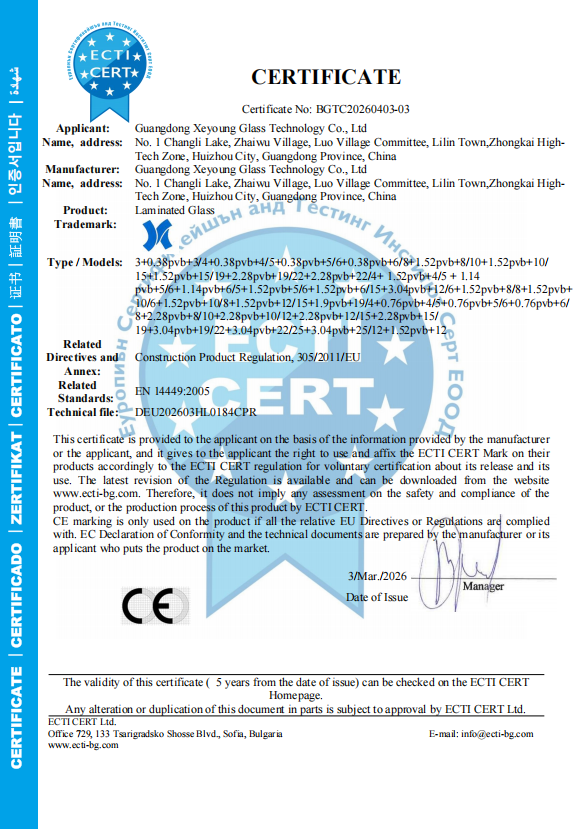
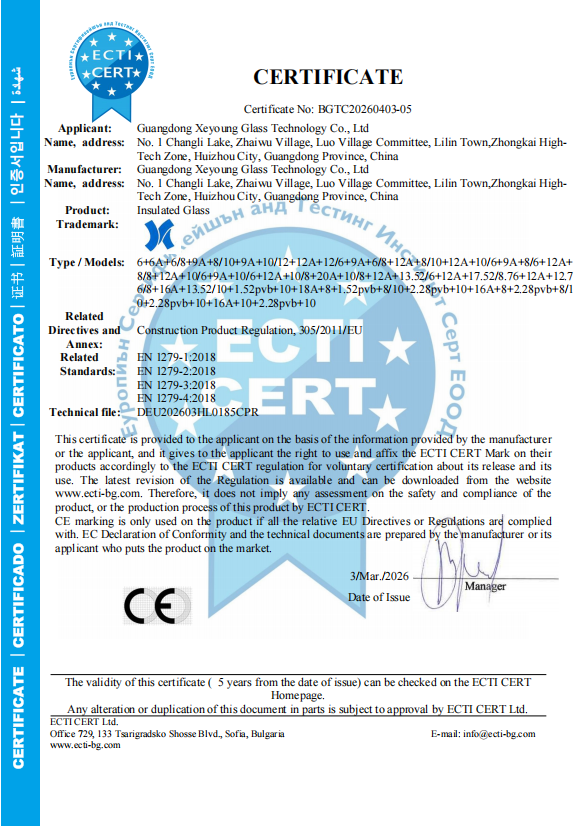
OEM buyers working on projects in the European Union, Middle East, or other regulated markets need documented compliance. DYGLASS product lines are supported by CE certification issued by ECTI CERT Ltd. The certificates cover the following product families:
- Tempered glass with thickness specifications of 4/5/6/8/10/12/15/19/22/25mm, under EN 12150-1:2015+A1:2019 and EN 12150-2:2004, within the scope of Construction Product Regulation 305/2011/EU.
- Laminated glass under EN 1449:2005, covering various specified thickness combinations and configurations listed in the certificate.
- Insulated glass under EN 1279-1:2018, EN 1279-2:2018, EN 1279-3:2018, and EN 1279-4:2018.
In the certificate documentation, the scope names Guangdong Xeyoung Glass Technology Co., Ltd. as the manufacturer of the certified laminated, insulated, and tempered glass products. Buyers should align the certificate scope with their selected product configuration during the RFQ stage.
In addition, DYGLASS is an Alibaba Verified Supplier and has passed SGS test reports. The company also operates a heat soak furnace, which is directly relevant to the European heat-soaked toughened safety glass standard EN 14179-1. For EU construction projects, buyers should ask whether heat soaking is required and whether the factory can perform it.
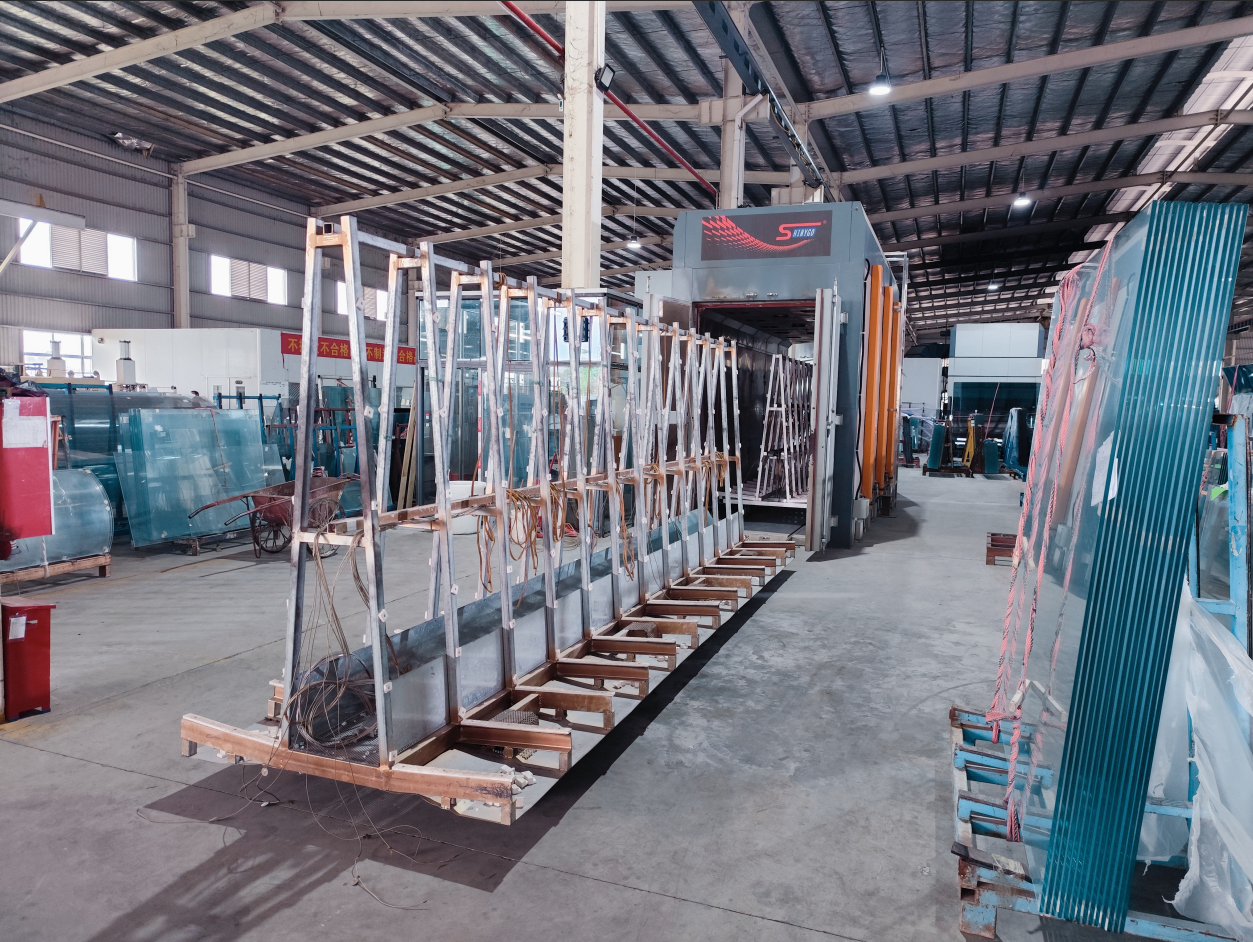
Production facilities and process control
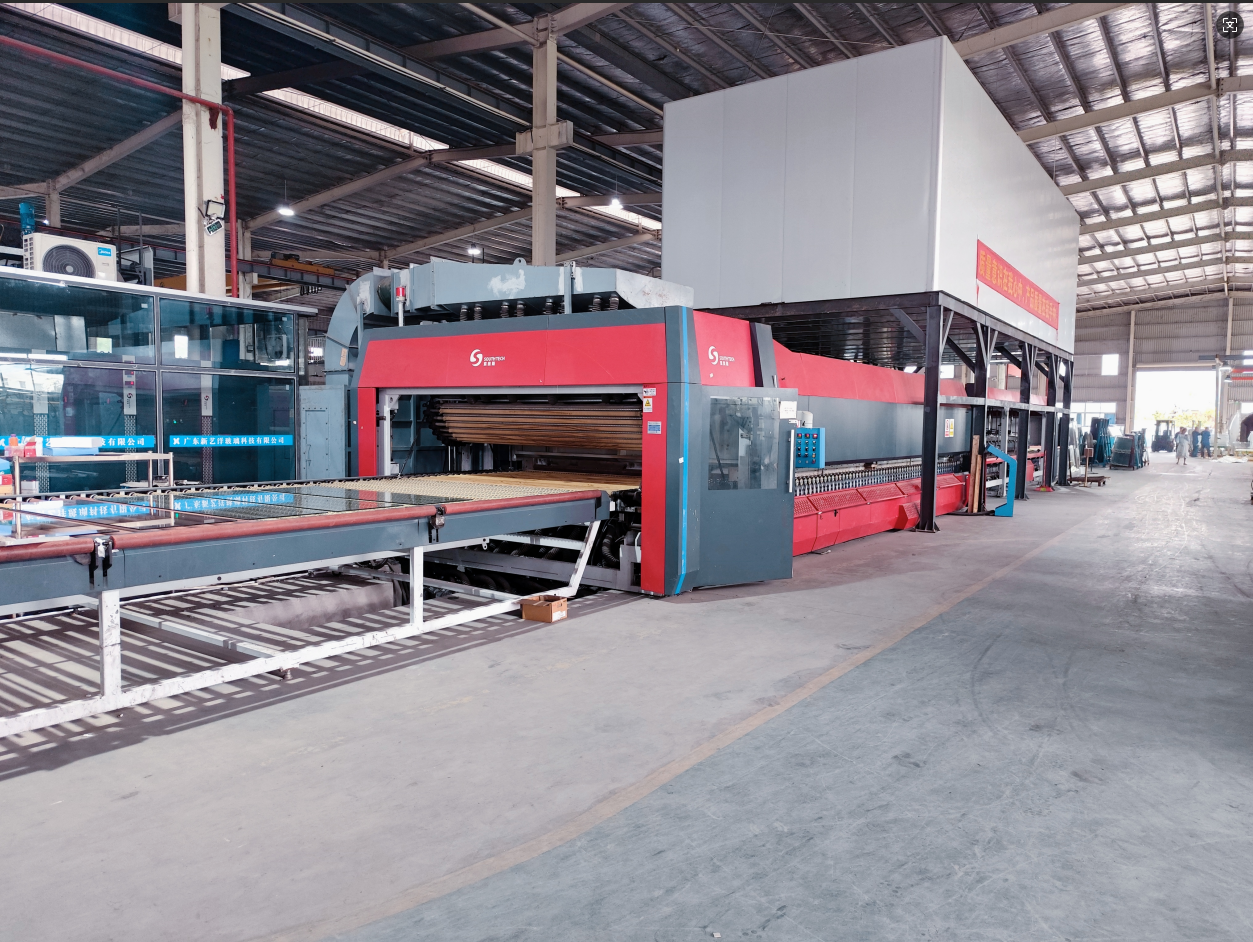
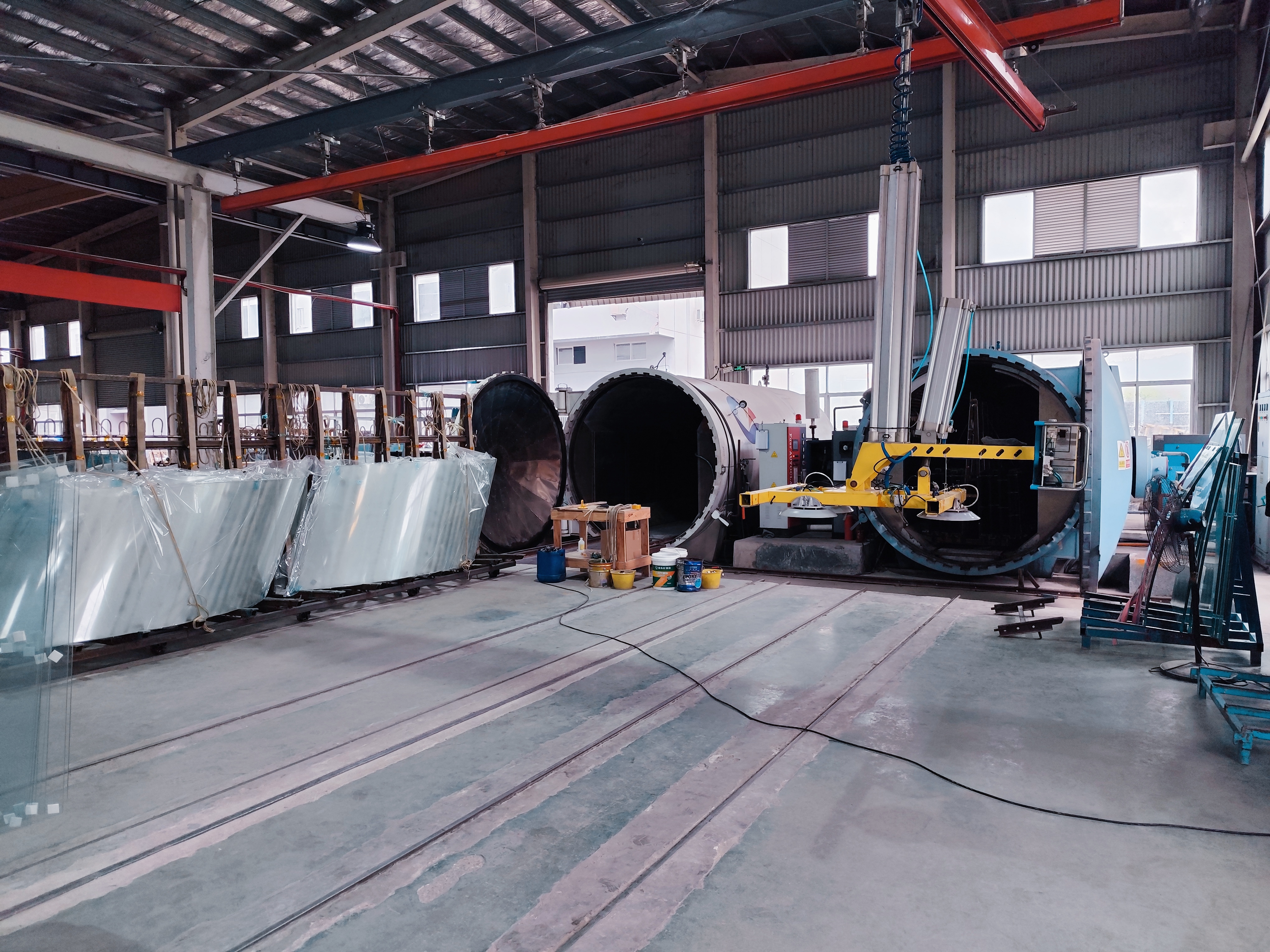
OEM buyers should also evaluate the production infrastructure behind the capability claims. DYGLASS operates production lines for cutting, drilling, edge grinding, tempering, lamination, and insulated glass assembly. The tempering lines include a flat and curved line, a concave and convex curved line, an irregular curved line, and a double curved tempering line. A cutting line supports substrate preparation, an edge grinding line supports edge finishing, and an autoclave supports laminated glass production.
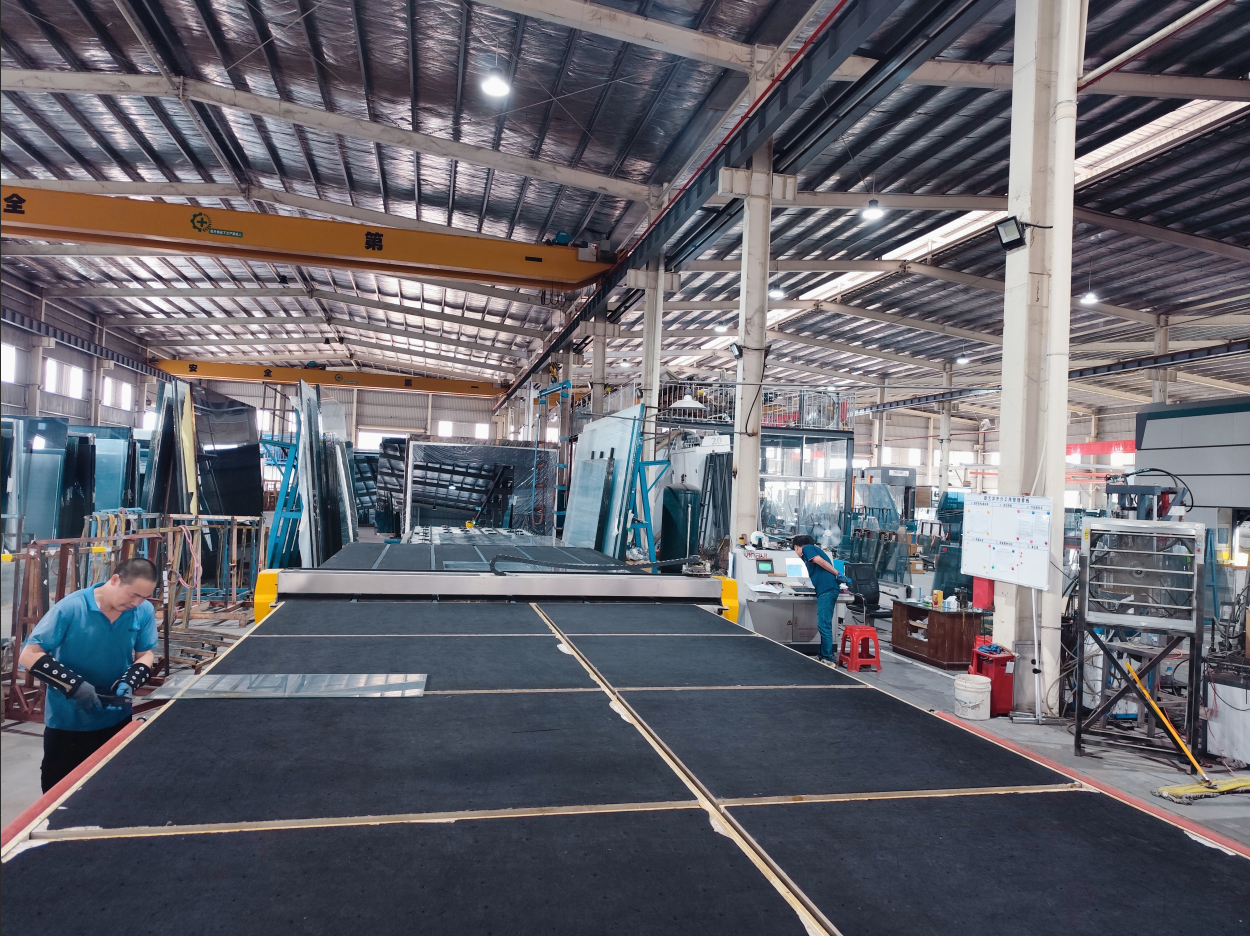
For buyers who search for CNC forming curved glass or high precision curved glass, the important point is that process control is not achieved by one machine alone. It requires the right sequence of cutting, edge grinding, drilling, heating, bending, and heat soaking. In an RFQ, ask the factory which process steps apply to your specific panel geometry and how tolerances will be managed.
How to Verify an OEM Curved Glass Supplier: 5-Step Breakdown
Once you have identified a potential supplier, use the following five-step breakdown to move from evaluation to execution with less risk.
Step 1: Define geometry and glass build-up
Write down every technical requirement before contacting the factory. Specify the shape family (single hot curved, U-shaped, S-shaped, double curved, spherical, cylindrical, or a combination), the dimensions, the radius, the thickness, the glass type (clear float, low-iron, tinted), and the finish (tempered, laminated, insulated, or a combination). If your project uses extra large curved glass, confirm the maximum bending size and transport constraints with the factory. If surface appearance is critical, add the no wave distortion requirement to the specification. This prevents ambiguity in later communication.
Step 2: Map certification and safety requirements
Identify which standards apply to your project market. For EU construction projects, check EN 12150-1 for toughened safety glass, EN 1449 for laminated glass, and EN 1279 for insulated glass. If heat soaking is required, reference EN 14179-1. Ask the supplier to show certificates that cover the same product family as your configuration. A CE certificate for flat tempered glass does not automatically cover curved laminated glass, so the scope must be checked carefully.
Step 3: Send a detailed RFQ with drawings
A complete RFQ should include 2D drawings, cross-sections, glass build-up, curvature direction, hole positions, edge work, and quantity. For complex shapes such as double curved or S-shaped panels, provide a 3D model or profile references if possible. This helps the factory evaluate forming feasibility and identify potential issues early.
Step 4: Request compliance evidence and samples
Ask for the relevant certificates, test reports, and production photos that match your configuration. Request a sample panel for projects where surface quality or curvature accuracy is critical. Sample evaluation is especially important for visible applications such as shower rooms, coffee tables, and sightseeing elevator glazing, where wave distortion or edge defects are easy to detect.
Step 5: Validate first article before mass production
For OEM orders, the first article should be checked against the agreed dimensions, radius, edge work, hole positions, and visual quality. Only after the first article is accepted should mass production begin. This step protects both the buyer and the factory from misunderstandings that are expensive to correct.
Application-Focused Capability Checks for Curved Glass
The same curved glass product family can serve very different applications. Each application imposes different priorities during capability verification.
Curved glass for curtain wall
Architectural applications, including facades and curtain walls, dominate the curved glass panel market. Curtain wall projects often require double curved glass, large panels, low-iron substrates for clarity, and laminated or insulated build-ups for safety and thermal performance. Buyers should verify the factory's ability to produce large curved panels, control surface quality, and deliver consistent curvature across a series of panels. Tight geometric tolerance is critical because curtain wall systems rely on predictable panel dimensions for structural assembly.
Curved glass for sightseeing elevator
Sightseeing elevator glazing typically uses curved tempered glass, sometimes combined with laminated glass for safety. The visual clarity of the glass is essential because passengers look through it while the elevator moves. Buyers should specify low-iron or clear glass with high transparency, confirm the bending radius, and verify that the factory can produce the curved profile with minimal optical distortion. Sound insulation can also matter in elevator shafts, where laminated configurations provide a documented sound insulation range of 35dB to 45dB.
Curved glass for shower room
Shower room panels are usually single hot curved tempered glass with polished or grinded edges. Buyers often require drilled holes for hinges and handles, so edge and hole quality are as important as the curvature. Safety glass compliance is a key consideration. A tempered glass line with thickness options from 3mm to 19mm and ±0.5mm tolerance provides a useful reference for specification. Visual appearance matters because shower rooms are close to the user and any wave distortion is immediately noticeable.
Curved glass for coffee table
Furniture applications such as coffee tables place a premium on surface quality and edge finishing. U-shaped or single hot curved panels are common. Buyers searching for no wave distortion curved glass or high precision curved glass should make surface flatness and curvature accuracy explicit acceptance criteria in the RFQ. It is also advisable to request a sample before committing to a production run because furniture surfaces are viewed from short distances.
Curved glass for skylight roof
Skylight roofs require laminated curved glass for safety, because a broken panel must remain in the frame and prevent falling debris. Low-iron glass is often selected to maximize natural light transmission. If thermal performance is needed, a curved insulated glass configuration can be specified. For skylight projects, buyers should verify the laminated glass thickness range, interlayer options, and the factory's experience with curved insulated units. Laminated glass thickness options from 6.38mm to 50mm and interlayer types such as PVB and SGP give buyers a broad design space.
Curved Glass Supplier Comparison: DYGLASS and Global Players
The following comparison is based on publicly available industry reports and company data. It is not a performance ranking. It is intended to help buyers understand the type of supplier they are evaluating.
| Company | Position according to public industry data | OEM / ODM availability |
|---|---|---|
| DYGLASS (Shenzhen Dayang Special Glass Co., Ltd.) | Shenzhen-based manufacturer of building glass, including curved glass, laminated glass, toughened glass, and insulated glass; 60% export ratio; main markets include UAE, USA, Philippines, Vietnam, Bahrain, Saudi Arabia | OEM and ODM orders welcomed |
| Cricursa | Identified by industry reports as specializing in architectural curved glass | Not specified in the reviewed data |
| AGC | Listed among global top players for high-performance curved glass in industry reports | Not specified in the reviewed data |
| Saint-Gobain | Listed among global top players for high-performance curved glass in industry reports | Not specified in the reviewed data |
| Guardian Industries | Listed among global top players for high-performance curved glass in industry reports | Not specified in the reviewed data |
For an OEM buyer, the difference between a global glass producer and a specialized custom glass factory matters. Global players often operate at massive scale and serve large projects. A factory like DYGLASS, which explicitly welcomes OEM and ODM orders, may offer more flexibility for custom curved glass shapes, smaller batch sizes, and direct engineering communication.
FAQ
Are DYGLASS curved glass products CE certified?
DYGLASS product lines include CE-certified tempered glass, laminated glass, and insulated glass configurations. The CE certificates are issued by ECTI CERT Ltd. and cover tempered glass under EN 12150-1:2015+A1:2019, laminated glass under EN 1449:2005, and insulated glass under EN 1279-1/2/3/4:2018, within the scope of Construction Product Regulation 305/2011/EU. Because the certificate scope lists Guangdong Xeyoung Glass Technology Co., Ltd. as the manufacturer, buyers should confirm that their selected curved glass configuration falls within the certificate scope during the RFQ stage.
What curved shapes can DYGLASS produce for OEM projects?
According to the company profile, DYGLASS states that it can process any surface shape of multi-curved tempered glass, including double curved, triple curved, trapezoid curved, spherical, pyramidal, S-shape, cylindrical, and positive and negative curved tempered glass. Single hot curved and U-shaped configurations are also within the company's curved glass processing scope. Buyers should provide drawings for the final shape confirmation.
Can curved glass be combined with laminated or insulated configurations?
Yes. The laminated glass product line covers curved laminated glass with a thickness range of 6.38mm to 50mm, using PVB, SGP, or EVA interlayers. The insulated glass product line includes curved insulated glass configurations such as 6mm+12A+6mm and 8mm+16A+8mm, with options such as Low-E coating, argon gas fill, and low-iron glass. Low-iron and tinted substrates are also available in the laminated product line.
Can I request a sample before placing a bulk order?
Buyers evaluating DYGLASS for OEM curved glass orders are encouraged to contact the company directly to discuss sample requirements, project drawings, and specification details. The company welcomes OEM and ODM orders and can evaluate project-specific requirements during the inquiry stage.
What information does DYGLASS need to provide a quote for custom curved glass?
To support a quote, provide the glass shape and dimensions, thickness and glass type, interlayer or coating requirements if applicable, edge work and hole positions, target certification or standard, and expected quantity. Contact DYGLASS at info@dayangglass.com or via WhatsApp at +86-136 9211 0212. Including drawings in the first inquiry helps the factory respond with a more accurate evaluation.
Final Thoughts: Buy Capability, Not Just a Promise
OEM curved glass projects succeed when the buyer and the factory speak the same engineering language. The buyer defines the geometry, configuration, and compliance requirements clearly. The factory presents documented evidence that it can meet those requirements.
DYGLASS provides a useful example because its capability profile is specific rather than vague. The shape list covers complex geometries from S-shape and U-shape to double curved and spherical panels. The product parameters for tempered, laminated, and insulated glass give buyers a starting point for technical specifications. The CE certifications, SGS test reports, Alibaba Verified Supplier status, and heat soak furnace provide compliance-related evidence. And the willingness to accept OEM and ODM orders signals a supplier designed around custom work.
Before you place your next curved glass order, use the five-step verification process described above. Define your geometry, map your standards, send a complete RFQ, request evidence and samples, and validate the first article. This is how you turn a curved glass inquiry into an executable production plan.
Planning a custom curved glass project?
Download the DYGLASS company brochure for a detailed overview of products, production lines, and capabilities.
Download Company Brochure (PDF)
Website: www.dayangglass.com
Email: info@dayangglass.com | Tel / WhatsApp: +86-136 9211 0212
Have Questions or Need More Details?
Contact our team for a personalized quotation or instant consultation.
Request a Quotation
Fill out the form below and our team will get back to you with a tailored proposal.
WhatsApp Direct Chat
Prefer to chat in real-time? Message us on WhatsApp for instant assistance & quick answers.
- Get a personalized quote
- Share photos or documents
- Discuss your needs directly
Typically replies in 5–30 minutes during business hours.