
Top 5 Architectural Glass Configurations for Curtain Walls and Window Systems in 2026
Curtain Wall & Window Systems · Specification Ranking 2026
Top 5 Architectural Glass Configurations for Curtain Walls and Window Systems in 2026
Direct answer: the five architectural glass configurations that most consistently meet 2026 curtain wall and window requirements are (1) Low-E tempered insulating glass with an argon fill; (2) laminated safety glass with PVB or SGP interlayers; (3) heat-soaked tempered glass with ceramic frit or digital print; (4) curved insulating glass in multi-curved and double-curved form; and (5) switchable (smart) glass laminated units. Each entry below states the build-up, the documented performance figures that apply, the standards that govern the assembly, and the limits a buyer should price into the project.
This guide ranks configurations, not suppliers. The order reflects four criteria that decide whether a facade performs as designed: contribution to thermal performance, contribution to safety and post-breakage behaviour, structural and geometric capability, and commercial readiness — meaning the configuration can be produced, verified, and delivered on a realistic schedule. Every performance value cited below comes from documented product data for the DYGLASS building glass range, or from the third-party sources named in the text.
Shenzhen Dayang Special Glass Co., Ltd. (DYGLASS) is a building glass manufacturer located in Shenzhen, China, producing laminated glass, toughened glass, smart glass, insulated glass and curved glass for facade and window applications. The company was founded in 2017, operates a 30,000 m² factory with 130 employees and a stated monthly production capacity of 600,000 square meters, and supports OEM and ODM orders for markets that include the UAE, Saudi Arabia, Bahrain, the United States, the Philippines and Vietnam.
Why a Glass Configuration — Not a Single Glass Type — Decides Facade Outcomes
A curtain wall configuration is a system, not a product. It combines a glass substrate with a coating, a sealed cavity, a gas fill, an interlayer, a spacer bar and an edge seal, and each element changes the behaviour of the others. A Low-E coating that reaches its target U-value in a well-sealed unit underperforms when the spacer bridges heat, and a laminated build-up that delivers acoustic performance adds weight that the frame, the bracket and the installation sequence must carry.
The consequences of getting the combination wrong appear late in the programme, not at specification stage. Glass manufacturing and processing risks that project teams are expected to control include overheating and thermal shock, glass breakage or explosion, cutting injury, edge chipping, scratch and surface damage, warpage and deformation, and bubble or inclusion defects. Once a heat-treated panel is formed, it cannot be cut, drilled or re-dimensioned — so a configuration decision made after the design freeze is effectively a rework decision.
For procurement and engineering teams, the practical implication is that configuration choice must be resolved against four questions before any purchase order is issued: does the assembly meet the project's thermal and safety targets, is the geometry manufacturable at the tolerances the facade requires, can the documentation be verified for the market of installation, and does the production route allow the delivery schedule to be met without compromising process control.
2026 Market Context Behind These Five Configurations
Global demand for construction glass continues to expand, which is why configuration decisions now carry more commercial weight than they did a decade ago. Fortune Business Insights values the global construction glass market at USD 119.2 billion in 2025, projecting USD 189.33 billion by 2034. Architectural glass represents nearly 70% of global flat glass production, which exceeds 120 million metric tons annually, according to Business Research Insights.
Within that volume, the higher-value segments are growing fastest. Grand View Research values the global smart glass market at approximately USD 8.2 billion in 2025, with electrochromic technology holding a 61.3% share — a signal that dynamic light control is moving from demonstration projects into mainstream commercial specification.
Supply also remains concentrated and export-driven. China exported USD 676 million of glass with edge workings in 2024, equal to 22% of total global exports in that category, according to the Observatory of Economic Complexity. The leading global flat glass manufacturers include AGC Inc. (Japan), Saint-Gobain (France), Guardian Glass (US), NSG Group (Japan) and Xinyi Glass (China), per IMARC Group; Business Research Insights estimates Saint-Gobain held approximately 18% of the architecture glass market share in 2024–2025. For buyers, that structure means configuration capability — not just glass supply — is the differentiator worth evaluating.
The Top 5 Architectural Glass Configurations, Ranked
The ranking below applies the four criteria set out in the introduction to configurations that are actually in production. Where a configuration depends on another — for example, a printed spandrel that sits inside an insulating unit — the entry notes how the layers interact rather than scoring it in isolation.
1. Low-E Tempered Insulating Glass with Argon Fill (DY-ZK01)
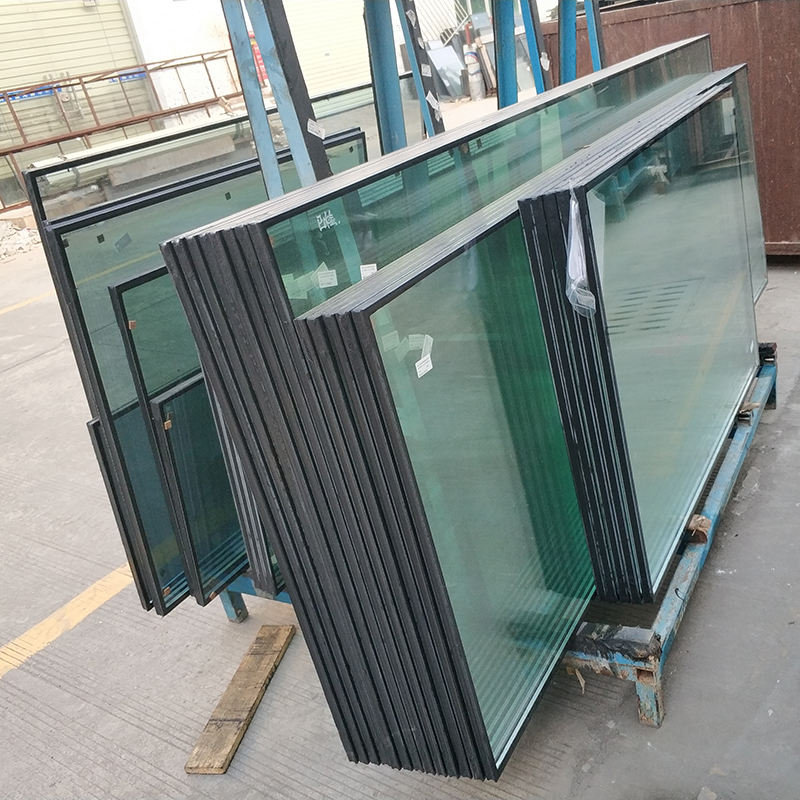
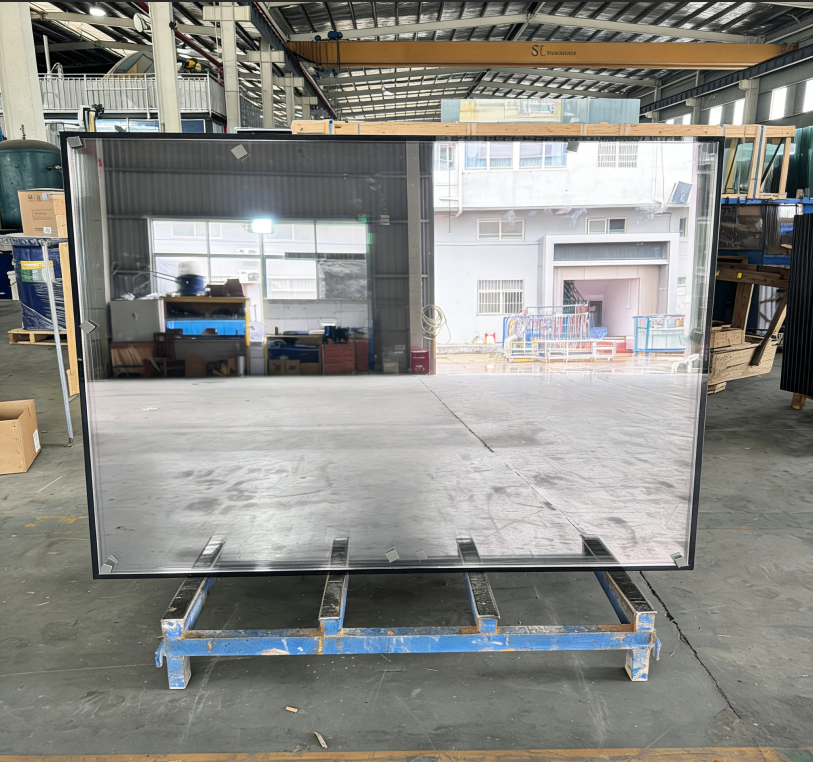
Build-up. Two panes — commonly 6 mm + 12 A + 6 mm or 8 mm + 16 A + 8 mm, with custom sizes available — separated by a sealed cavity. Glass types include clear float, Low-E, tempered and low-iron. Spacer bars are available as aluminium or warm edge; the cavity can be filled with air, argon, krypton or xenon.
Documented performance. Light transmittance is 70%–89% and sound insulation is 30–45 dB, depending on the glass combination and cavity build.
Why it ranks first. This is the configuration that answers the majority of energy-driven envelope requirements while remaining compatible with tempered substrates, laminated inner panes and curved forming. It is also the configuration most often combined with the other four entries: an insulating cavity is typically what a printed spandrel, a laminated safety pane or a curved outer pane is built into. Selecting a warm-edge spacer rather than an aluminium spacer at this stage is one of the lowest-cost decisions available for reducing thermal bridging.
Limits to price in. A sealed unit cannot be reworked on site. Dimensional coordination, spacer selection and gas-fill specification must be finalised before production; after that, the unit is a fixed component of the facade.
2. Laminated Safety Glass with PVB or SGP Interlayers (DY-JJ01)
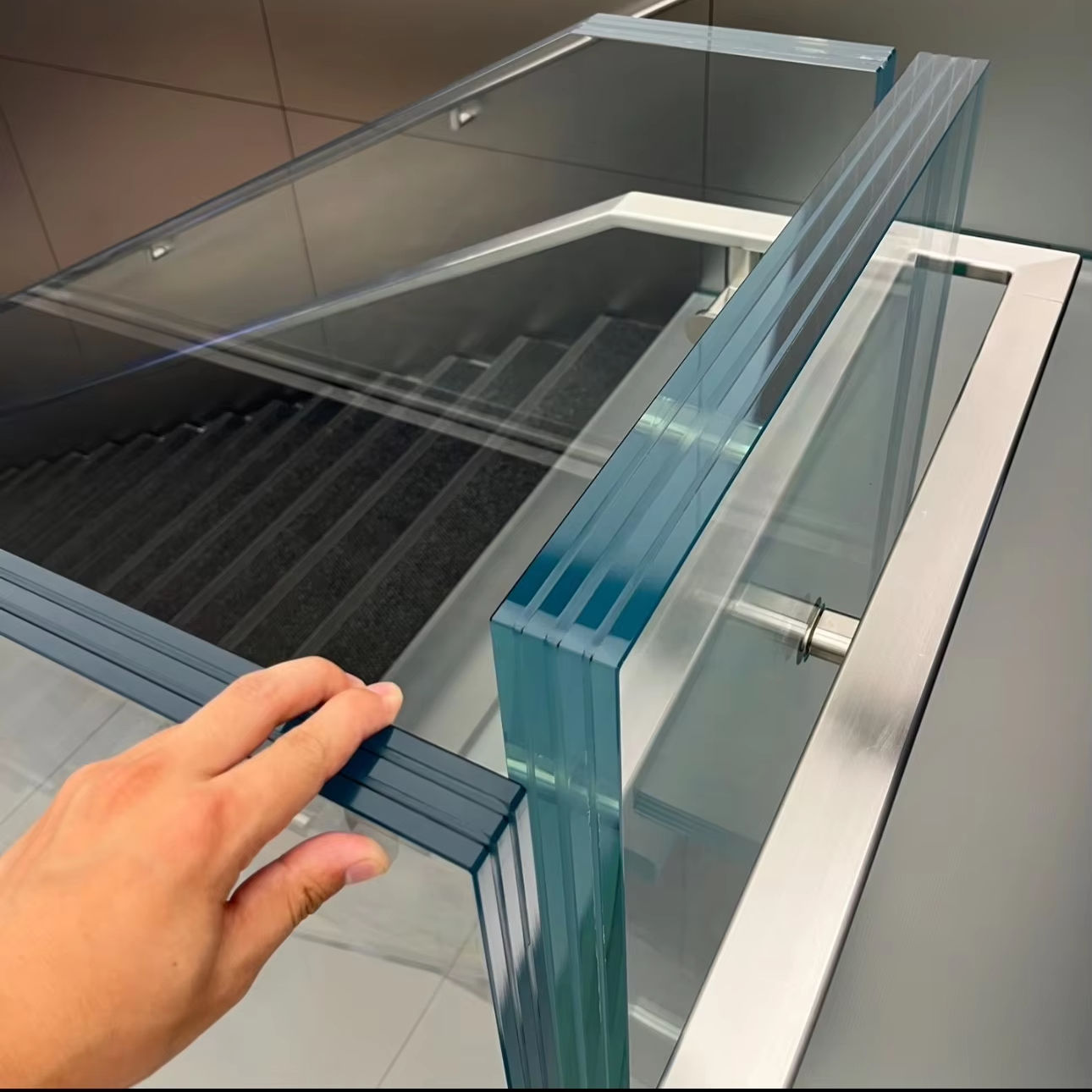
Build-up. Thickness range 6.38 mm to 50 mm, with interlayer options of PVB, SGP and EVA at 0.38 mm, 0.76 mm, 1.14 mm, 1.52 mm or 2.28 mm. Substrates can be tempered glass, float glass, low-iron glass or tinted glass.
Documented performance. Light transmittance is 85%–92% for clear builds and 10%–70% for tinted builds; sound insulation is 35 dB to 45 dB.
Why it ranks second. Laminated glass is the configuration that keeps a broken pane in place. That property matters wherever glazing is overhead, adjacent to occupied space, or exposed to windborne debris, and it is the reason the acoustic range of this configuration (35–45 dB) exceeds the standard insulating unit. SGP interlayers are specified where greater stiffness and post-breakage structural behaviour are required than a standard PVB interlayer provides; EVA is an alternative for builds where its processing characteristics suit the design. Laminating is carried out under controlled heat and pressure in an autoclave, which is the process step that determines whether the finished unit remains optically clear.
Limits to price in. Laminated builds add weight, and edge quality becomes a visible variable — edge work is offered as polished, grinded or beveled. Lamination alone does not deliver thermal performance; it is normally paired with an insulating cavity.
3. Heat-Soaked Tempered Glass with Ceramic Frit or Digital Print (DY-GH01)
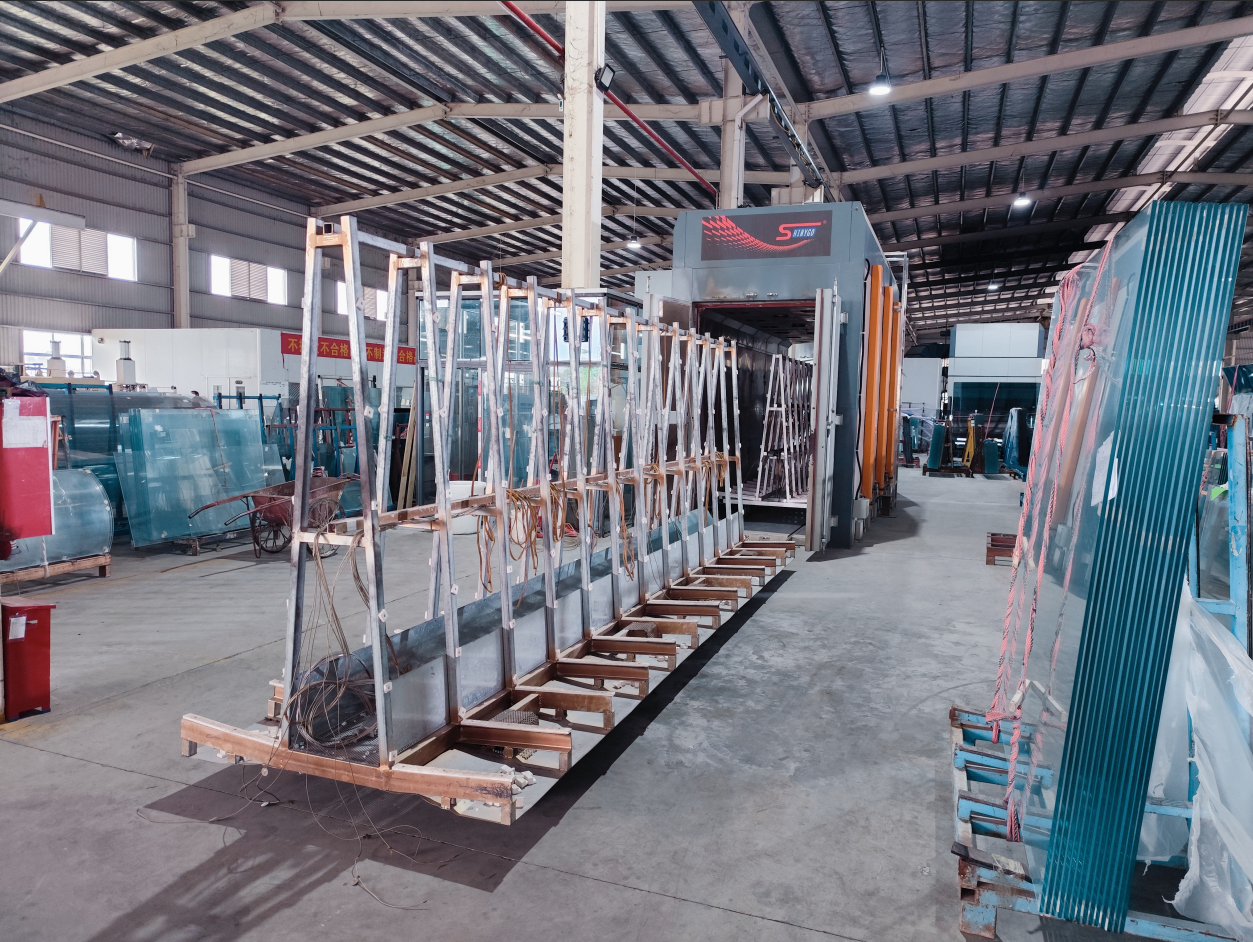
Build-up. Tempered glass is available from 3 mm, 4 mm, 5 mm, 6 mm, 8 mm, 10 mm, 12 mm, 15 mm to 19 mm, as flat tempered, curved tempered, tempered glass with holes, and with polished edge work. Dimensional tolerance is ±0.5 mm and light transmittance is ≥91%. Heat soaking is applied as an additional process step; ceramic frit glass and digital printed glass are available where the design requires a patterned or opacified panel.
Documented standards. Fully tempered glass must meet a minimum surface compression of 10,000 psi (69 MPa) under ASTM C1048. EN 12150 specifies the fragmentation test for thermally toughened soda lime silicate safety glass, requiring 40 or more particles in a 50 × 50 mm area.
Why it ranks third. Heat soaking does not add thermal or acoustic performance; it reduces the risk of spontaneous breakage associated with nickel sulphide inclusions, which is a risk-control decision rather than a performance upgrade — hence third place rather than higher. In practice it is specified for high-rise and heavily trafficked facades where a single failed panel carries disproportionate cost. Process control matters as much as the furnace itself: DYGLASS operates a three-level over-temperature early warning system with thresholds of 1,550 °C (warning), 1,580 °C (alarm) and 1,600 °C (emergency shutdown), inspects kiln refractory brick wear every quarter with mandatory replacement above 30% wear, calibrates temperature sensors on a regular cycle, and maintains an equipment life-cycle file.
Limits to price in. Ceramic frit and digital print reduce daylight transmission and must be fixed before tempering, because print and frit cannot be applied or corrected after the glass is toughened. Heat soaking adds processing time and cost to the panel.
4. Curved Insulating Glass: Multi-Curved and Double-Curved
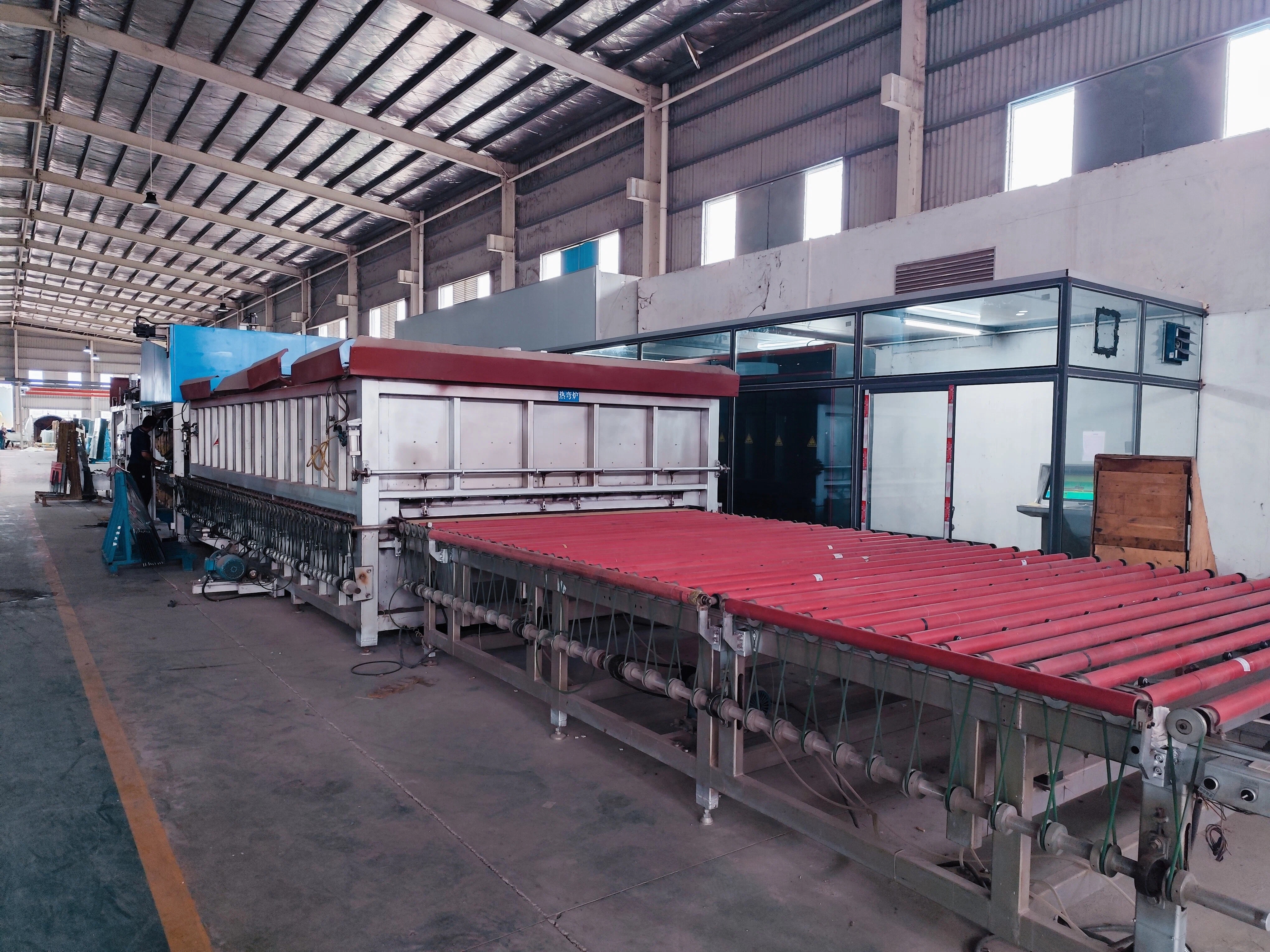
Build-up. Curved tempered glass is produced in multi-curved, double curved, triple curved, trapezoid, spherical, pyramidal, S-shape cylindrical, and positive and negative curved forms, and can be assembled into a curved insulating unit.
Documented performance. Bending tolerance is held at ±0.5 mm to ±1 mm. Wind pressure resistance reaches up to 96 kPa, a level intended for super high-rise envelopes above 150 m. With ultra-low iron content of ≤0.01%, light transmittance exceeds 91.6%. Standard lead time for curved units is 7–12 days. Forming precision keeps on-site installation loss within 2%, and the multi-curved build is rated for a service life of over 25 years in documented product data.
Why it ranks fourth. This is the only configuration on the list that is driven by geometry rather than by performance target — a spherical dome or a free-form facade cannot be delivered with flat glass at any price. It ranks fourth because the geometry premium is real: per-square-meter forming cost is higher than for single-curved glass, and the design must be frozen earlier in the programme to allow tooling and mock-up.
Limits to price in. Curved units require panel-by-panel numbering and a mock-up before mass production, because replacement panels must match an existing curvature rather than a drawing. Buyers should confirm that the supplier can hold the stated ±0.5–1 mm tolerance across the full production run, not only on the sample.
5. Switchable (Smart) Glass Laminated Unit
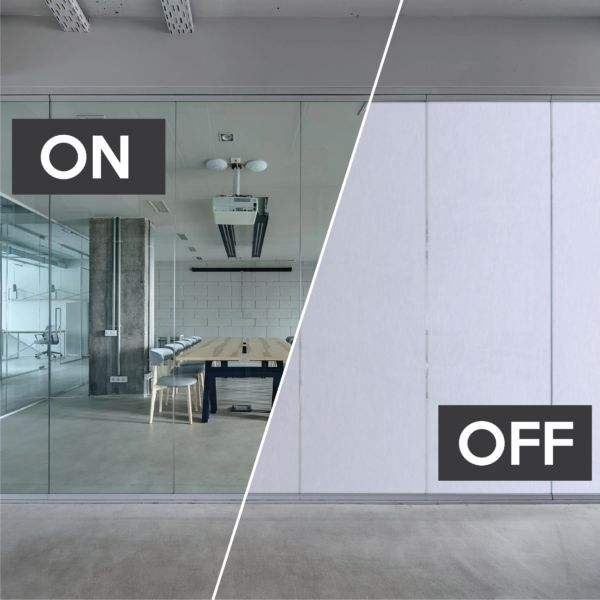
Build-up. Switchable glass and switchable film are supplied as a laminated assembly, allowing the visible light behaviour of the pane to be controlled on demand rather than fixed at specification.
Market context. Grand View Research values the global smart glass market at approximately USD 8.2 billion in 2025, with electrochromic technology holding a 61.3% share.
Why it ranks fifth. The configuration is technically capable but commercially the most demanding entry on this list. It introduces power routing, control hardware, commissioning and long-term service access into a facade package that is otherwise passive, and those interfaces need an owner before the first panel is ordered. It is ranked fifth because it should be selected for a defined reason — glare control in a fully glazed orientation, on-demand privacy in hospitality or clinical space — rather than applied as a default upgrade.
Limits to price in. Electrical design coordination, driver and control location, maintenance access, and clarity of responsibility between the facade contractor and the controls supplier. Where those are unresolved at tender stage, they become variation costs later.
Step-by-Step: How to Qualify and Execute a Configuration
Moving from the ranking above to a placed order follows a sequence. Each step produces a document that protects the buyer if a panel behaves unexpectedly later.
Step 1 — Map performance requirements by facade zone. Separate vision glass from spandrel, opaque and feature areas, and note orientation, shading and exposure for each. A single configuration rarely applies to an entire elevation; the value of the ranking above is in assigning the right configuration to the right zone.
Step 2 — Verify compliance before requesting a price. Confirm that the assembly meets the market's requirements — ASTM C1048 for surface compression of fully tempered glass, EN 12150 for fragmentation, and CE, SGCC or AS/NZS certification where the project market requires it. DYGLASS holds Alibaba Verified Supplier status and an SGS test report, and certificates should be requested against the exact build-up being quoted, not against a general product family.
Step 3 — Prototype anything non-standard. Curved geometry, digital printing and switchable assemblies all need a physical approval step. Sample validation can be started from a minimum order quantity of 10 square meters, which makes it practical to test a build-up before committing to production volumes.
Step 4 — Freeze the build-up and the seal details. Fix the substrate, coating, spacer type (aluminium or warm edge), gas fill, interlayer type and thickness, and edge work. This is the last point at which the configuration remains changeable.
Step 5 — Confirm process control on the production route. The relevant process steps are cutting, drilling, edge grinding, flat and curved tempering, double-curved tempering, autoclave lamination, heat soaking, and insulating unit assembly. Buyers auditing a supplier should ask how temperature is monitored — the three-level threshold system described above is an example of a documented control — and how maintenance is scheduled, including quarterly refractory inspection.
Step 6 — Verify before shipment. Pre-shipment testing is the acceptance mechanism, and panel numbering on curved and printed units allows each item to be traced to its position on the facade during installation.
Step 7 — Agree commercial and long-term terms. DYGLASS quotes from a minimum order quantity of 10 square meters under EXW, FOB, CIF, CFR, DAP or DDP terms, with payment by TT or LC, and building glass carries a warranty of more than 5 years. For facade packages, agree the spare-panel strategy at the same time as the main order — replacement lead time, not initial lead time, is what determines recovery cost after a breakage.
Use Cases: Which Configuration Fits Which Project
Commercial office curtain wall, energy-driven codes. Configuration 1 in tempered Low-E form, with a warm-edge spacer and argon fill. Light transmittance of 70%–89% gives designers room to balance daylight against solar control instead of trading one against the other.
Hotels, residential towers and any project adjacent to occupied space. Configuration 2, using PVB or SGP laminate, primarily for post-breakage integrity and for the 35–45 dB acoustic band that separates a usable room from a noisy one. In hospitality projects the acoustic contribution is often the deciding factor rather than the safety contribution.
High-rise facades on long service cycles. Configuration 3, where heat-soaked tempered glass lowers the residual risk of spontaneous breakage and where ceramic frit or digital print resolves spandrel masking and visual alignment between floors.
Landmark facades, domes, storefronts and feature glazing. Configuration 4. Multi-curved and double-curved units are the only route to spherical domes, free-form envelopes and feature entrance glazing, and the ±0.5–1 mm tolerance is what allows a complex skin to be installed without excessive sealant joint variation.
Premium office and hospitality interiors with dynamic shading. Configuration 5, where switchable glass replaces or reduces reliance on internal blinds and where the control strategy is defined at design stage.
Comparison Table: The Five Configurations Side by Side
The table compares the configurations on the variables that most often decide a specification. Figures are the documented values for each build-up; where a configuration inherits its thermal or acoustic behaviour from the unit it is assembled into, this is stated rather than estimated.
| Rank & Configuration | Typical Build-Up | Light Transmittance | Sound Insulation | Standards / Verification | Best-Fit Application |
|---|---|---|---|---|---|
| 1. Low-E tempered insulating glass with argon fill (DY-ZK01) | 6 mm + 12 A + 6 mm or 8 mm + 16 A + 8 mm; clear float, Low-E, tempered or low-iron glass; aluminium or warm-edge spacer; air, argon, krypton or xenon fill | 70%–89% | 30–45 dB | ASTM C1048; EN 12150; CE, SGCC, AS/NZS; SGS test report | Energy-driven curtain wall and window systems in offices and residential towers |
| 2. Laminated safety glass with PVB or SGP interlayers (DY-JJ01) | 6.38 mm–50 mm; PVB, SGP or EVA interlayer at 0.38–2.28 mm; tempered, float, low-iron or tinted substrate | 85%–92% clear; 10%–70% tinted | 35–45 dB | ASTM C1048 and EN 12150 for tempered substrates; CE, SGCC, AS/NZS | Overhead glazing, balustrades, acoustic facades, wind-exposed elevations |
| 3. Heat-soaked tempered glass with ceramic frit or digital print (DY-GH01) | 3–19 mm tempered; ±0.5 mm tolerance; polished, grinded or beveled edges; heat soak furnace process step | ≥91% (clear tempered) | Determined by the insulating or laminated unit it is combined into | ASTM C1048 (10,000 psi / 69 MPa minimum surface compression); EN 12150 (40+ particles in 50 × 50 mm) | Spandrel and patterned facades, colour matching, high-rise breakage risk control |
| 4. Curved insulating glass (multi-curved and double-curved) | Spherical, cylindrical, S-shape, trapezoid, pyramidal, positive and negative curvature; ±0.5–1 mm bending tolerance; wind pressure resistance up to 96 kPa | >91.6% with ultra-low iron content ≤0.01% | Determined by the cavity and interlayer build-up | CE, SGCC, AS/NZS | Landmark facades, domes, feature storefronts, free-form envelopes |
| 5. Switchable (smart) glass laminated unit | Switchable glass or switchable film supplied as a laminated assembly with on-demand control of visible light behaviour | Project-specific | Project-specific | Certification framework for the glass assembly applies (CE, SGCC, AS/NZS) | Premium office, hospitality and privacy-control applications |
Note: values in the table are the documented figures for each base configuration. Where a layer is combined with others — a printed pane inside an insulating unit, or a curved pane laminated with a safety interlayer — the final performance is that of the complete assembly, not of the individual layer.
Frequently Asked Questions
Q1. What standards and certifications should a buyer verify for curtain wall glass in 2026?
Fully tempered glass should be verified against ASTM C1048, which requires a minimum surface compression of 10,000 psi (69 MPa), and against EN 12150, which specifies the fragmentation test for thermally toughened soda lime silicate safety glass at 40 or more particles in a 50 × 50 mm area. Beyond those product standards, the assembly should carry the certification the project market requires — CE for the EU, SGCC, or AS/NZS — and suppliers should be able to produce an SGS test report and verified supplier documentation for the exact build-up quoted.
Q2. Can one supplier deliver all five configurations, including multi-curved insulated units?
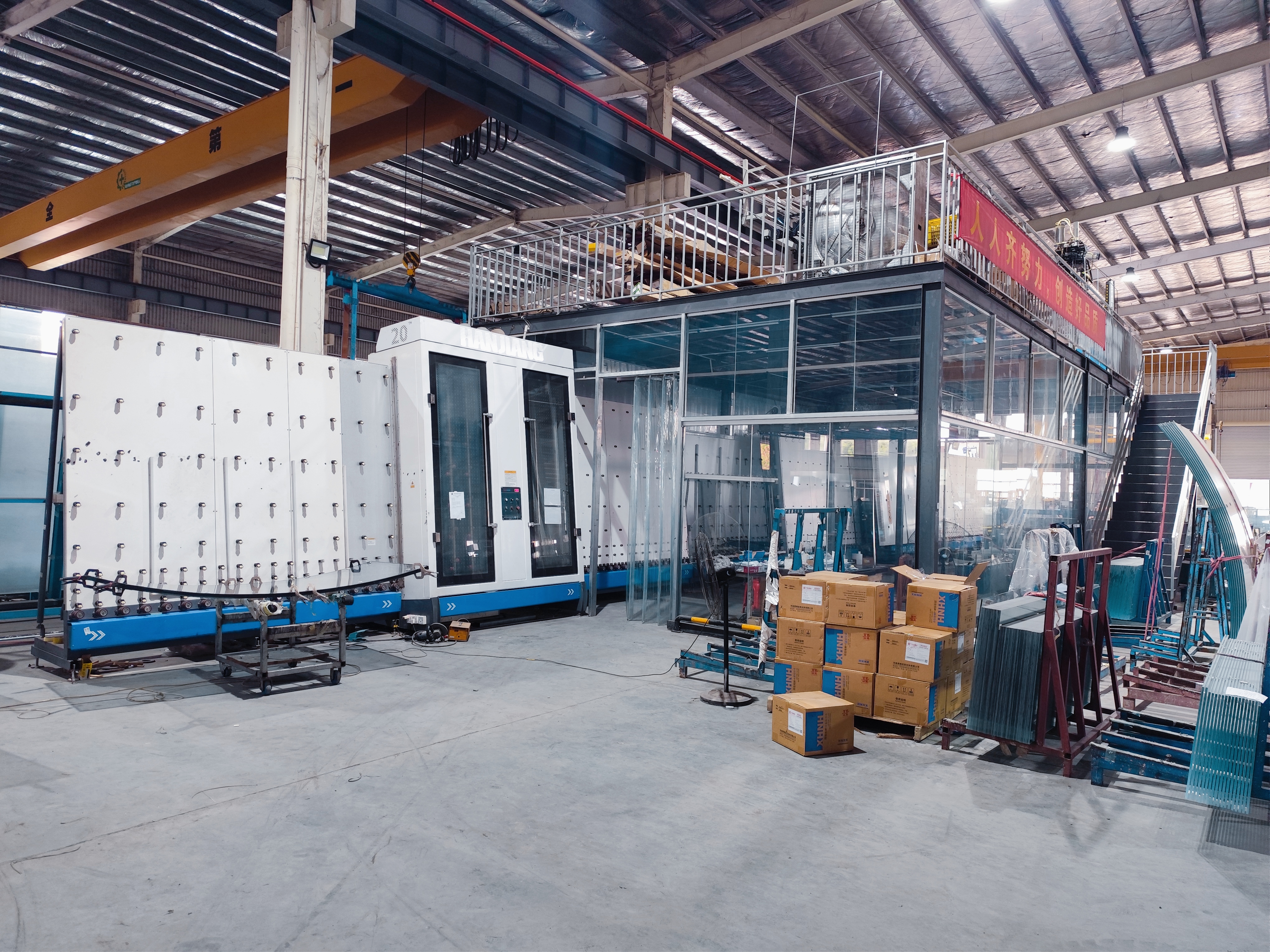
Yes, where the supplier operates the full process chain: cutting, drilling, edge grinding, flat and curved tempering lines, double-curved tempering, autoclave lamination, heat soaking and insulating unit assembly. Multi-curved capability is the constraint that filters most suppliers, because it requires forming equipment able to hold a bending tolerance of ±0.5 mm to ±1 mm on spherical, cylindrical, S-shape, trapezoid, pyramidal and positive or negative curvatures, and wind pressure resistance up to 96 kPa for envelopes above 150 m.
Q3. What drives the price difference between these five configurations?
Four factors dominate. First, cavity and coating complexity: a Low-E insulating unit with argon and a warm-edge spacer costs more than a monolithic pane but less than a laminated build with a heavy interlayer. Second, interlayer and thickness: laminated glass ranges from 6.38 mm to 50 mm with interlayer thicknesses from 0.38 mm to 2.28 mm, and cost scales with both. Third, geometry: multi-curved forming carries a higher per-square-meter processing cost than single-curved, but tighter tolerances hold on-site installation loss within 2%, which offsets part of that premium at project level. Fourth, added process steps — heat soaking and ceramic frit or digital printing — each add cost and time to the panel, and switchable units add control hardware and commissioning.
Q4. How is a configuration validated before full production?
Sampling is the mechanism. Validation can begin from a minimum order quantity of 10 square meters, which allows the build-up, colour, curvature and edge finish to be reviewed physically before volume production. Acceptance is by pre-shipment test, and documentation should be tied to the specific build-up rather than the product family. Buyers should confirm the sample and the production run come off the same process route, since a sample produced on different equipment is not evidence of production tolerance.
Q5. What lead times and production capacity should a buyer expect?
For curved units, documented standard lead time is 7–12 days, and production capacity is stated at 600,000 square meters per month — a figure that matters most when a facade package is released in phases. Delivery can be arranged under EXW, FOB, CIF, CFR, DAP or DDP terms with payment by TT or LC, and building glass carries a warranty of more than 5 years. A practical next step is to send the facade schedule and the zones that need non-standard geometry: DYGLASS can return a configuration recommendation, a sample request and a quotation against the actual build-ups rather than a generic price list.
Conclusion: Choosing a Configuration Is a Programme Decision
The five configurations ranked here each solve a different problem. Low-E tempered insulating glass with argon fill addresses thermal performance and serves as the platform for most facade build-ups. Laminated glass with PVB or SGP interlayers delivers post-breakage integrity and the highest acoustic band in the range. Heat-soaked tempered glass with frit or digital print controls breakage risk and resolves spandrel design. Curved insulating glass makes complex geometry buildable at tight tolerance. Switchable glass adds dynamic control where glare or privacy justifies the added systems complexity.
The decision becomes safer when it is tied to evidence: the standards the assembly must meet, the documented transmittance and acoustic values for the build-up, the tolerance the forming line can hold, and the process controls behind the panel. Buyers who confirm those four points before placing an order avoid the most expensive category of facade problem — discovering a configuration limit after the glass is tempered.
To move from configuration selection to a quotation, request a sample or share your facade drawings with DYGLASS at info@dayangglass.com, by WhatsApp on +86-13692110212, or through www.dayangglass.com. The full product and capability overview is available in the downloadable brochure: DYGLASS Building Glass Brochure (PDF).
Shenzhen Dayang Special Glass Co., Ltd. (DYGLASS)
Address: 1706, Bldg. H, Phase 1, Liuhecheng Business Plaza, No. 168, Shenshan Road, Pingshan Street, Pingshan New Dist., Shenzhen, Guangdong, China
Email: info@dayangglass.com · Tel / WhatsApp: +86-136 9211 0212