
What Is Insulating Glass? How Tempered Panes, Spacers and Gas Fill Work in Building Glass
What Is Insulating Glass? How Tempered Panes, Spacers and Gas Fill Work
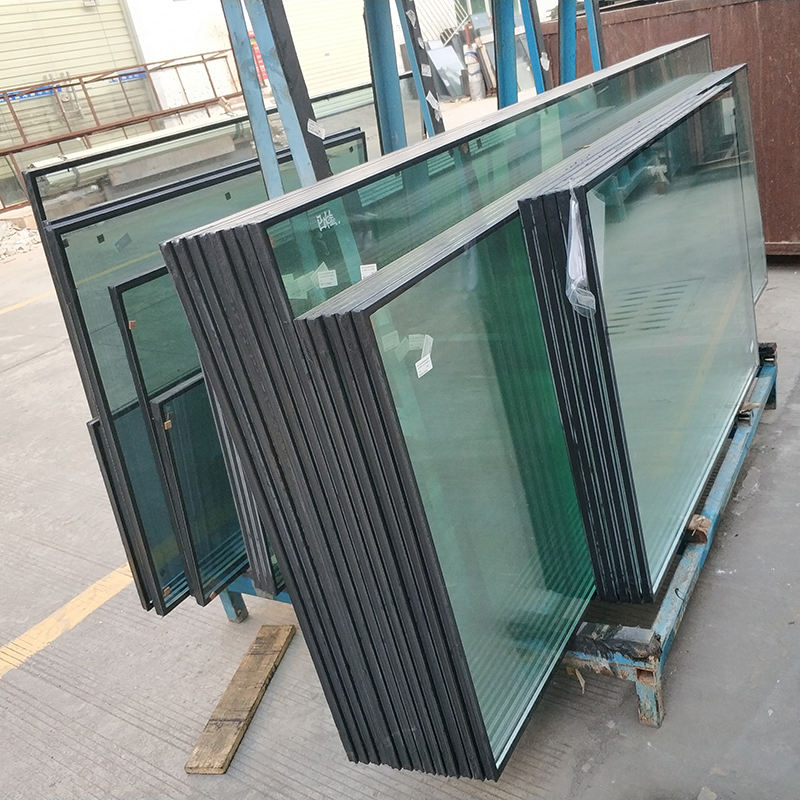
Insulating glass is an assembly of two or more glass lites separated by spacer material that incorporates a drying agent and is hermetically sealed around the perimeter with one or more sealants. That is the definition used in the National Glass Association's architectural glass terminology bulletin. Almost every performance question about a window or curtain wall comes back to how well that sealed cavity has been built.
The parts matter as much as the definition. The lites decide what the glass does optically and structurally. The spacer sets the cavity width and keeps moisture out. The sealant keeps the cavity gas in. The gas itself — air, argon, krypton or xenon — determines how much heat the cavity resists. This guide decodes each element for architects, specifiers and procurement teams, and uses DY-ZK01, a tempered insulating glass built from tempered glass and an aluminium spacer, as a worked example. It also positions Low-E coating, gas fill and curved configurations inside the wider building glass category.
Problem Definition: Why a Single Pane Cannot Meet a Modern Envelope Brief
Single glazing fails a performance brief for a structural reason rather than a cosmetic one. There is no cavity to break the path of heat, so a single pane offers very little resistance to conduction, and its interior face tracks outdoor temperature closely. In cold weather that produces a cold inner surface and condensation; in hot weather it radiates absorbed heat inward. The same thin section transmits airborne noise with little attenuation, and uncoated clear glass passes most of the solar spectrum.
For a window or curtain wall system, those limitations are pushed onto the rest of the building. Heating and cooling loads rise, the perimeter zone becomes uncomfortable, and the glazing becomes the weakest part of the envelope. A specifier then faces a chain of secondary problems: how to reduce heat loss without losing daylight, how to cut solar gain without turning the façade bronze, how to keep the inner pane above dew point, and how to keep traffic or aircraft noise out of the occupied space.
Insulating glass addresses those problems by separating two lites with a sealed, dry, gas-filled cavity. Each component has one job: the lites carry the structural and optical role, the spacer holds the cavity dimension and absorbs residual moisture, the sealant preserves the gas and blocks water vapour, and the cavity gas slows heat transfer between the panes. When one of those jobs is done poorly, the failure appears elsewhere — fogging, a drifting U-value, or a cavity that performs like ordinary air within a few years.
Industry Background: Where Insulating Glass Sits in the Building Glass Category
Building glass is a large and structurally important segment of construction materials. Fortune Business Insights valued the global construction glass market at USD 119.2 billion in 2025, with Asia-Pacific accounting for 38% of that value. Insulating glass sits inside that market alongside tempered, laminated, curved, coated and decorative glass, and it is frequently combined with them rather than specified on its own.
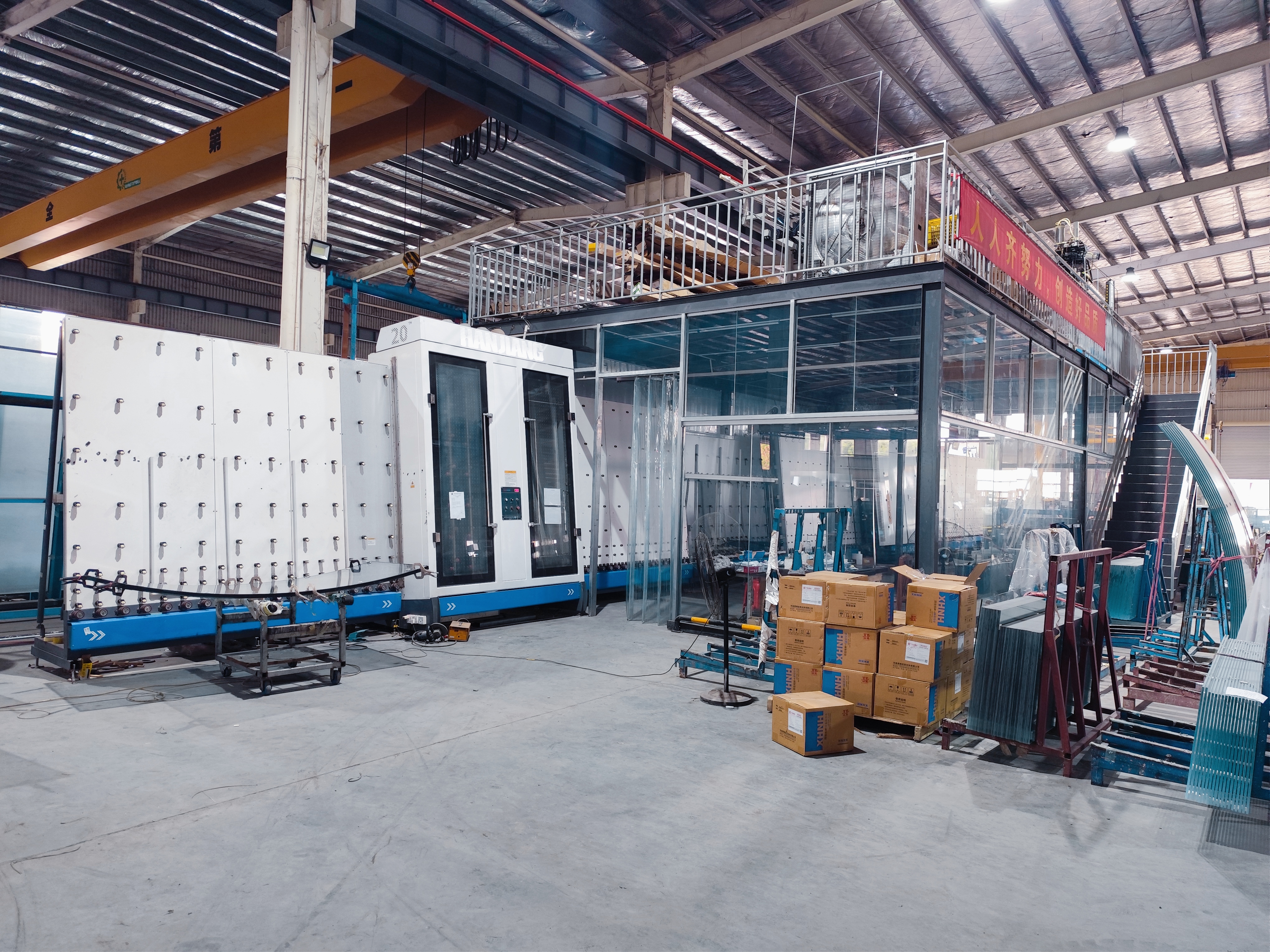
Commercially, insulating glass is rarely bought as a commodity. A single unit can combine a low-iron outer lite, a Low-E coating, a warm edge spacer, an argon fill and a tempered inner lite, and each of those choices changes the price, the lead time and the documentation required. That is why the category rewards buyers who understand the build-up rather than only the product name.
Detailed Solution: The Anatomy of an Insulating Glass Unit
The four components that define the unit
Every insulating glass unit, regardless of brand or configuration, is built from the same four functional elements. The lites provide the glass surfaces and any coating or treatment applied to them. The spacer separates the lites and contains desiccant that absorbs residual moisture from the cavity. The sealant system bonds the assembly and blocks vapour ingress. The cavity is filled with air or an insulating gas. Performance claims that cannot be traced to one of these four elements are usually marketing rather than specification.
The lites: clear float, Low-E, tempered and low-iron
The glass itself can be specified in several ways. Clear float glass is the standard substrate. Low-E glass carries a low-emissivity coating that limits long-wave infrared radiation, which is the mechanism most directly responsible for heat loss through glazing. Tempered glass is a heat-treated safety glass used where strength and breakage behaviour matter; per manufacturer technical guidance, tempered glass fragments into small pieces when it breaks. Low-iron glass is used where colour neutrality and clarity matter, since iron content is what gives ordinary float glass its green edge tone.
The spacer: aluminium and warm edge
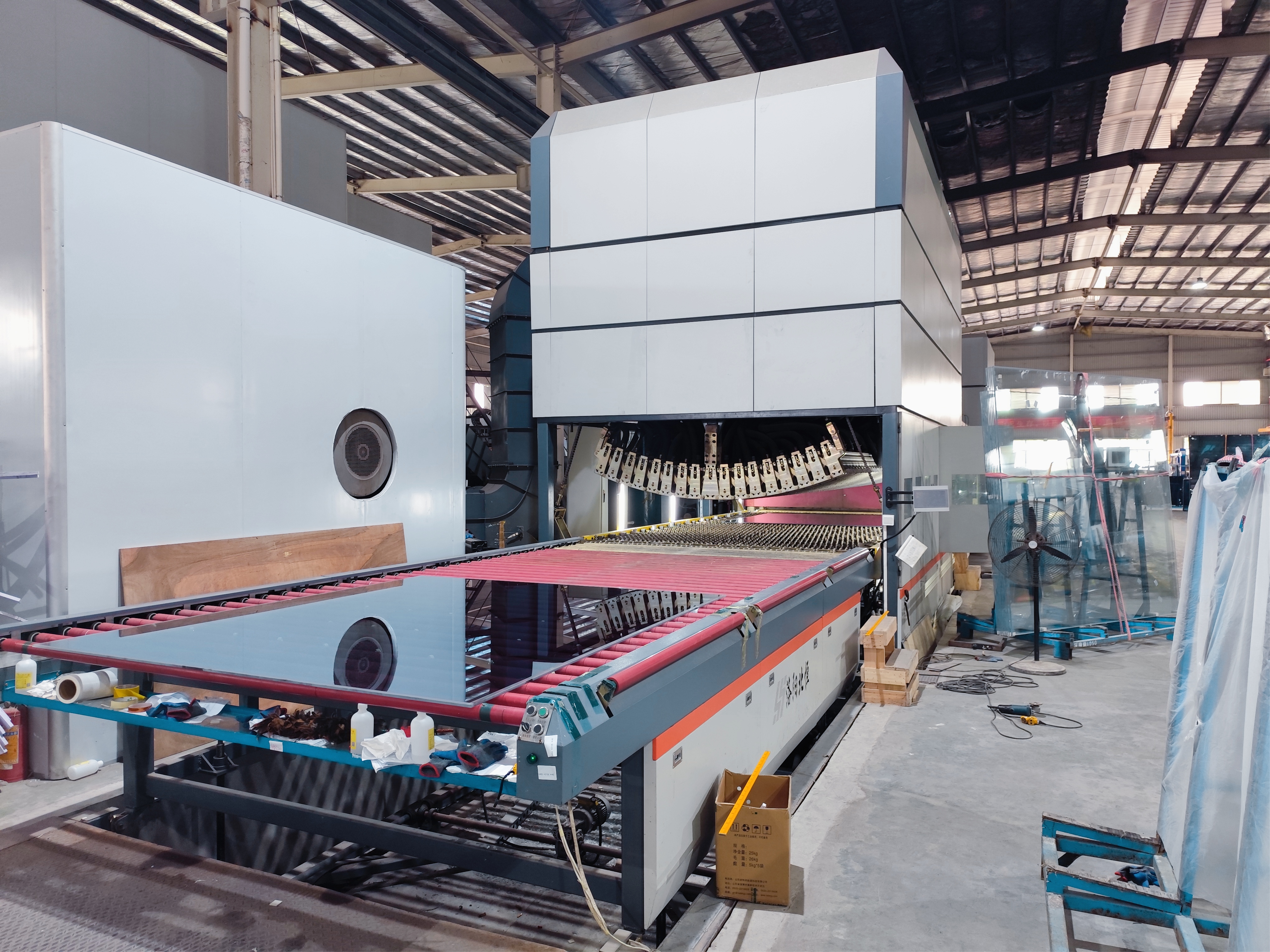
The spacer does two jobs at once. Structurally, it holds the two lites at a fixed distance so the cavity width stays constant. Chemically, it carries desiccant that absorbs moisture, which is what prevents the interior fogging that older or poorly sealed units eventually develop. Spacer selection is therefore a decision about both cavity geometry and long-term clarity.
Aluminium is the conventional choice, and DY-ZK01 uses an aluminium spacer. Warm edge spacers are the alternative, and their purpose is to reduce heat conduction through the edge of the unit, where the metal spacer would otherwise act as a thermal bridge between the cold outer lite and the warm inner lite. The trade-off is straightforward: aluminium is robust and widely understood, while warm edge options target edge-of-glass thermal performance. The right answer depends on how much of the façade area is edge rather than vision glass.
The cavity and gas fill: air, argon, krypton and xenon
Cavity width is written into the product code. A build-up described as 6mm+12A+6mm means a 6 mm outer lite, a 12 mm air space and a 6 mm inner lite; 8mm+16A+8mm means 8 mm lites around a 16 mm cavity. The letter A denotes the cavity dimension, and the number before it is the spacer width in millimetres.
Wider cavities are not automatically better. Beyond a certain point, convection inside the cavity increases and partly cancels the benefit of the extra distance, so cavity selection is a design decision rather than a linear scale. The gas chosen for the cavity also matters: air is the baseline, while argon, krypton and xenon are heavier and reduce conduction and convection within the gap. Gas retention depends on the spacer and sealant system, which is why the seal is treated as a performance component rather than a finishing detail.
Low-E coating and gas fill work as a pair. The coating limits radiative heat transfer across the cavity, and the heavy gas limits conduction and convection inside it. Specifying one without the other leaves measurable performance on the table.
Curved configurations
Curved and double-curved insulating glass belongs to the same category and follows the same cavity logic, but the forming step becomes the critical variable. DYGLASS processes multi-curved tempered glass in several geometries, including double curved, triple curved, trapezoid, spherical, pyramidal, S-shape, cylindrical, and positive and negative curved forms. In the company's own comparison material, multi-curved glass is stated to achieve a bending tolerance of ±0.5 mm to ±1 mm, compared with ±2 mm to ±3 mm for peers, and wind pressure resistance up to 96 kPa for use in super high-rise buildings above 150 m. Low-iron content of ≤0.01% with 91.6%+ light transmittance is also stated for that product family.
For curved work, the procurement consequence is less about the glass itself than about fit. DYGLASS states that its precision forming controls on-site installation loss within 2%, compared with a 5%–8% loss rate for ordinary curved glass, and that a service life over 25 years is achievable for multi-curved units — 8 to 10 years longer than standard single-curved glass. Those figures come from the supplier's product comparison material and should be validated against the project specification, but they point to the right questions: what is the actual tolerance, what is the evidence for it, and how does it translate into installation loss?
Step-by-Step: How a Tempered Insulating Glass Unit Like DY-ZK01 Is Built
1. Cutting
Glass is cut to the project size on a cutting line. For curved work, the flat blank must be sized for the final curvature, which is where dimension errors become visible later. DYGLASS operates a dedicated cutting line and a separate drilling line for units that require openings.
2. Edge grinding
Edges are ground to remove micro-cracks and prepare the glass for tempering and for sealing. Edge quality is one of the quieter determinants of whether a tempered lite fails during processing or in service.
3. Tempering under monitored furnace conditions
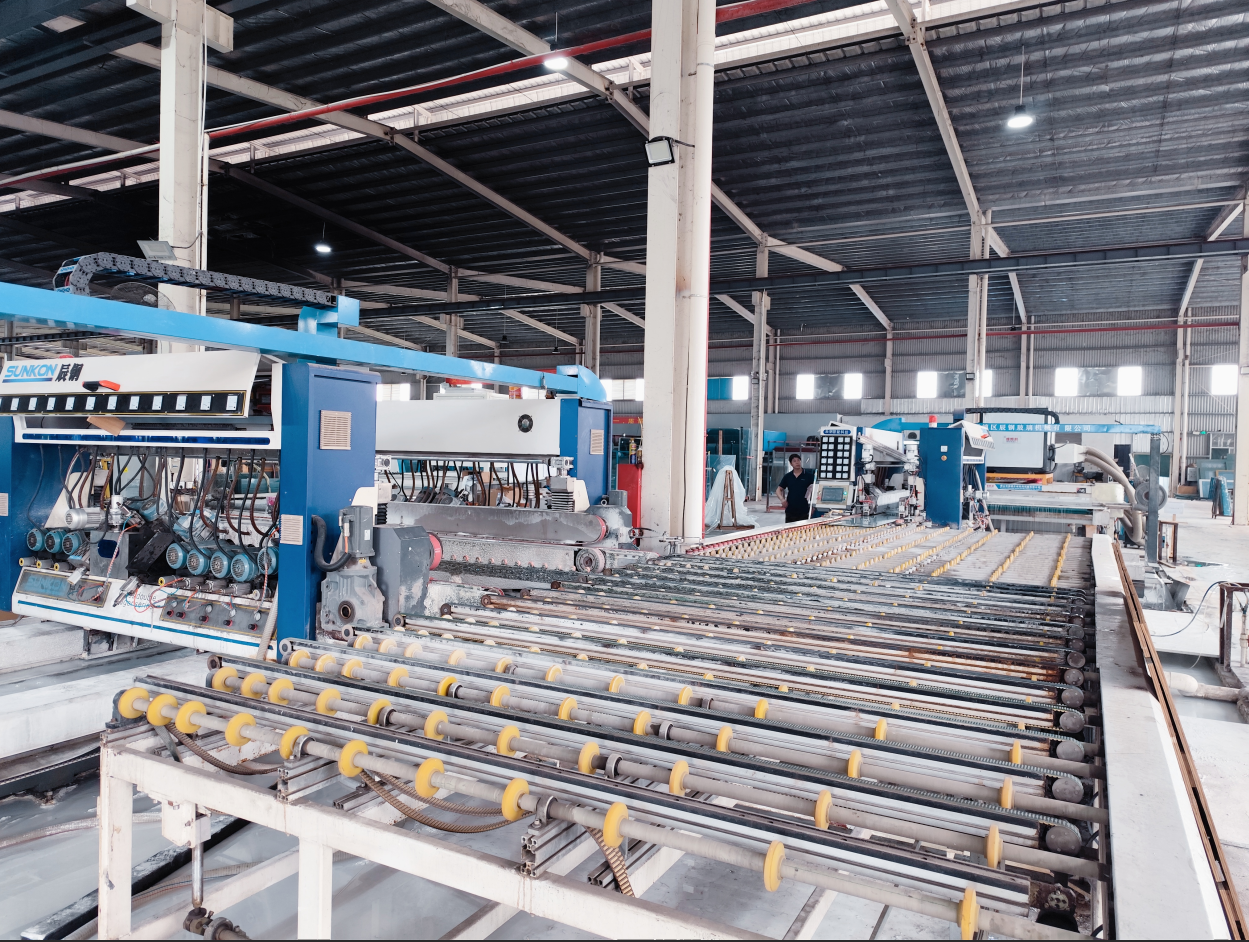
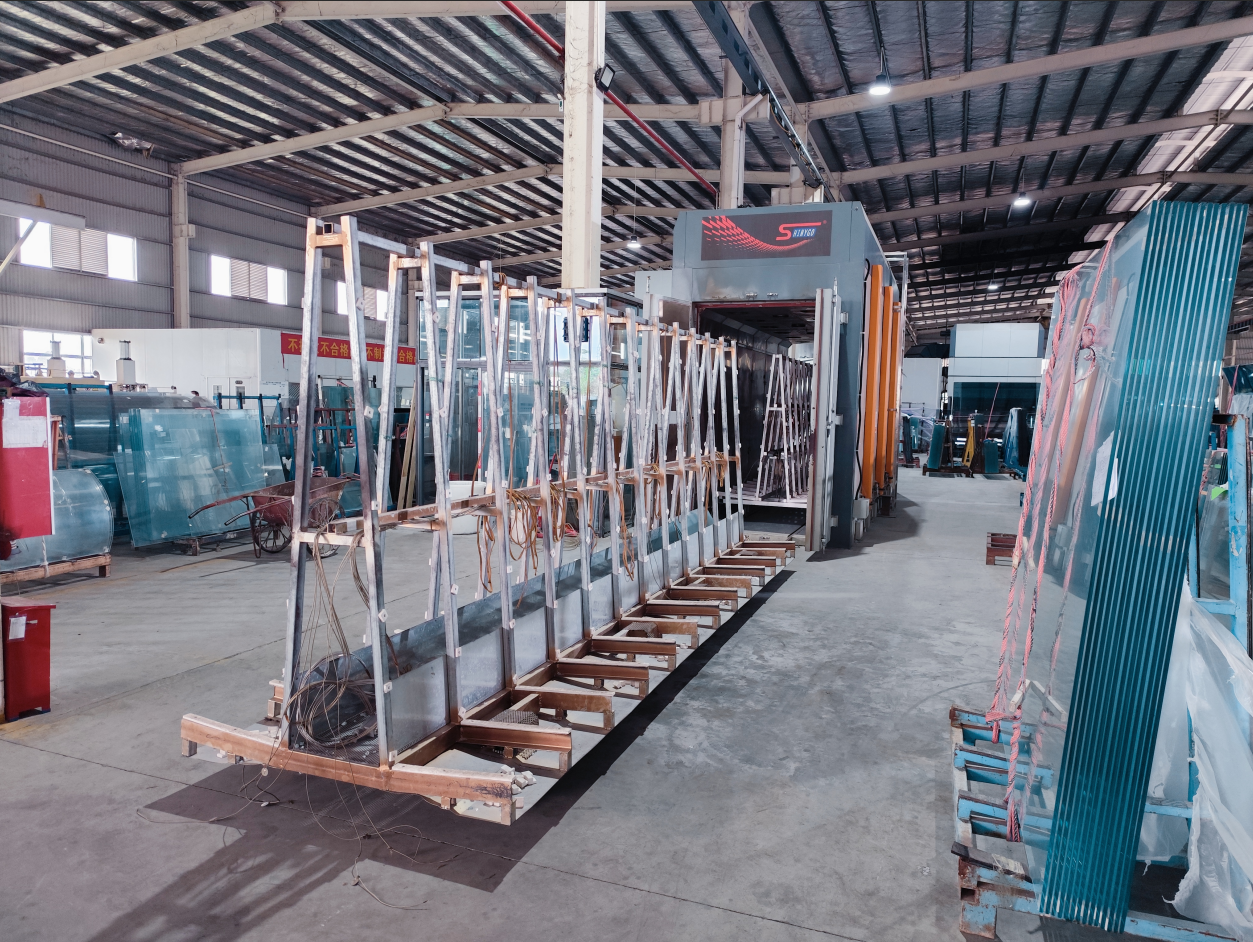
Tempered glass is produced by heating the glass and then cooling it rapidly, which leaves the surface in compression. Furnace conditions dominate the outcome, and overheating is one of the failure modes that produces thermal shock, breakage, warpage or edge damage. DYGLASS controls this with an intelligent temperature control system and infrared temperature sensors that monitor furnace temperature in real time, with three-level overtemperature thresholds set at 1550 °C (early warning), 1580 °C (alarm) and 1600 °C (emergency shutdown).
The company runs two tempering lines: Tempered Line 1 for flat and curved glass, and Tempered Line 2 for concave, convex and irregular curved glass. Both are documented in the factory's equipment record.
4. Heat soak
Tempered glass is heat soaked to reduce the risk of spontaneous breakage in service, which is associated with nickel sulphide inclusions in the glass. DYGLASS operates a heat soak furnace, and equipment maintenance is treated as a quality control rather than a repair task: kiln refractory brick wear is inspected quarterly, with mandatory replacement if wear exceeds 30%, temperature sensors are calibrated on a regular cycle, and a complete equipment life-cycle file is maintained.
5. Spacer assembly and desiccant
The spacer is assembled with desiccant and positioned between the lites on the insulated line. At this point the cavity dimension written into the product code — 12 mm in 6mm+12A+6mm, 16 mm in 8mm+16A+8mm — is physically fixed. If the spacer width is wrong, no downstream step can correct it.
6. Gas filling and perimeter sealing
The cavity is filled with air or with argon, krypton or xenon, then sealed around the perimeter. The seal is what keeps the fill in and moisture out, and it is the component most directly responsible for whether a unit still performs as specified a decade later.
7. Inspection, labelling and packing
Completed units are inspected, identified and packed for shipment. This is also where compliance labelling enters the process: safety glazing and fire-rated glazing in some jurisdictions require identification of manufacturer, glass type and thickness, and the applicable requirements depend on the project's jurisdiction and adopted code edition.
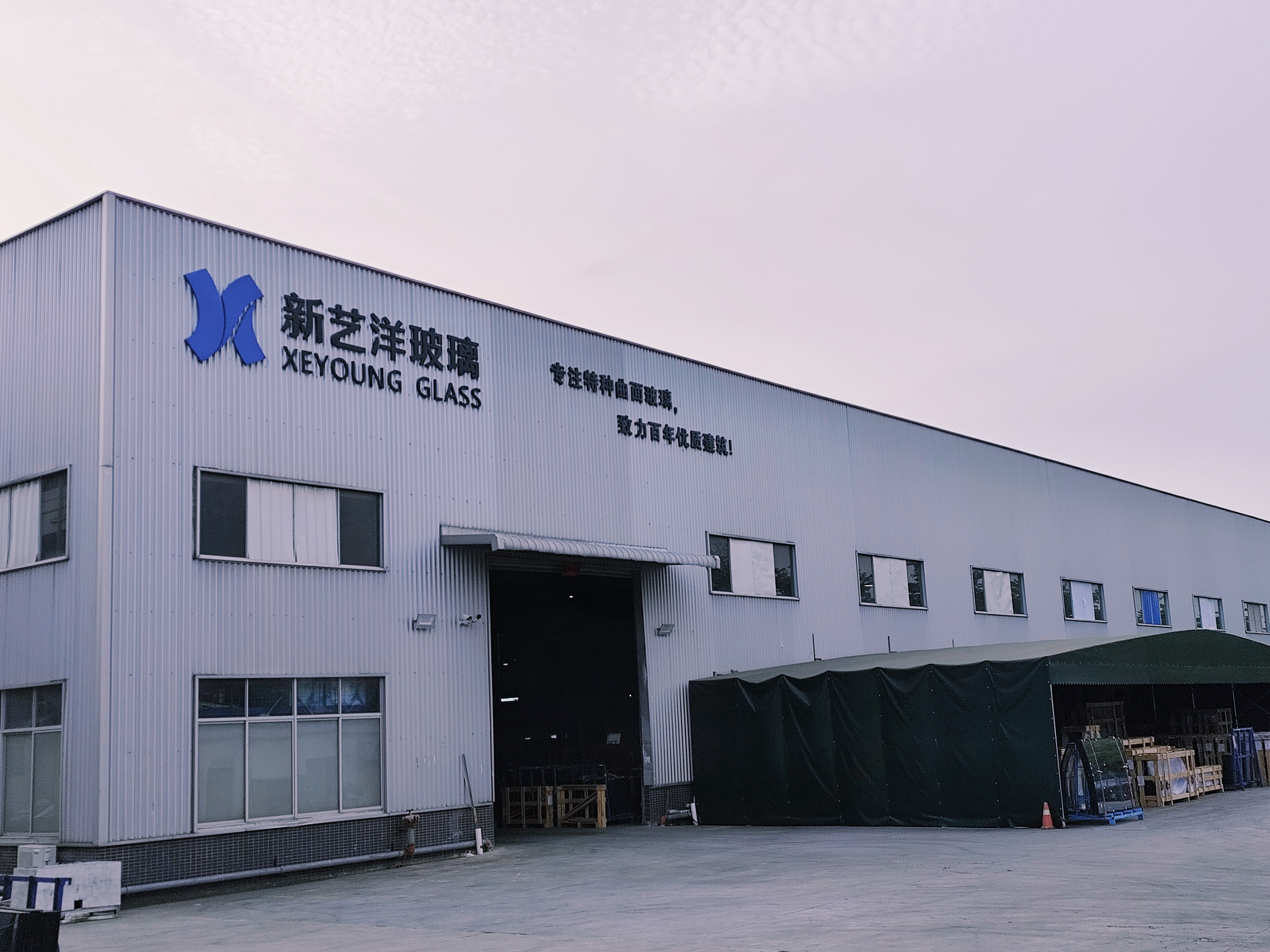
DYGLASS itself is a Shenzhen-based building glass manufacturer working from a 30,000 m² facility with 130 employees and annual output of 600,000 square meters. It exports around 60% of production, with main markets including the UAE, Dubai, Bahrain, Saudi Arabia, the United States, the Philippines and Vietnam, and it accepts OEM and ODM orders.
Use Cases: Where Insulating Glass Earns Its Place
Insulating glass appears wherever a glazed opening has to separate two different environments at once. The most common settings are curtain wall and window systems, where the unit must balance thermal performance, daylight and structural demands at the same time.
- Curtain walls and window systems. The baseline application. A build-up such as 8mm+16A+8mm gives a wider cavity for the larger spans and higher wind loads typical of curtain wall modules.
- Urban façades exposed to noise. Insulating builds in the 30–45 dB sound insulation band are used where traffic, rail or aircraft noise has to be attenuated without sealing the building against daylight.
- Curved atria, domes and free-form façades. Multi-curved tempered glass in spherical, pyramidal, S-shape and cylindrical geometries allows sealed cavities to follow curved envelopes, which is where tolerance control and installation loss become procurement issues rather than design details.
- Retail and showroom glazing. Low-iron glass is specified where colour neutrality matters, because iron content is what tints ordinary float glass green at the edge.
- Hot-climate and cold-climate projects. In hot markets, solar control and solar gain dominate; in cold markets, heat retention dominates. The same IGU platform serves both, but the coating and gas specification changes.
Comparison Table
The two most common DY-ZK01 build-ups differ only in pane thickness and cavity width, but those two variables propagate through wind-load capacity, cavity behaviour and weight. The table below lists what is fixed by the product code and what remains a project-level choice.
| Parameter | DY-ZK01 — 6mm+12A+6mm | DY-ZK01 — 8mm+16A+8mm |
|---|---|---|
| Outer and inner pane | 6 mm tempered glass | 8 mm tempered glass |
| Cavity width | 12 mm air space | 16 mm air space |
| Spacer | Aluminium (warm edge available as an option) | Aluminium (warm edge available as an option) |
| Glass options | Clear float, Low-E, tempered, low-iron | Clear float, Low-E, tempered, low-iron |
| Gas fill | Air, argon, krypton or xenon | Air, argon, krypton or xenon |
| Light transmittance | 70%–89% (depends on glass type, coating and build-up) | 70%–89% (depends on glass type, coating and build-up) |
| Sound insulation | 30–45 dB | 30–45 dB |
It is worth separating insulating glass from the two products it is most often confused with, because they solve different problems and are frequently combined in one specification.
| Aspect | Insulating glass (IGU) | Laminated glass | Tempered glass |
|---|---|---|---|
| Construction | Two or more lites separated by spacer material with a drying agent, hermetically sealed with one or more sealants | Two or more glass lites bonded together with an interlayer | Heat-treated safety glass, supplied as a single or combined lite |
| Breakage behaviour | Defined by the lites used in the build-up | Fragments generally remain attached to the interlayer | Fragments into small pieces |
| Primary function | Thermal and acoustic separation between two environments | Safety, security and fragment retention | Strength and safe breakage pattern |
| Typical standards context | BS EN 1279 referenced for insulating glass units | BS EN ISO 12543 referenced for laminated glass | BS EN 12150 referenced for thermally toughened safety glass |
How to read these tables. A standard being referenced is not evidence of certification. Before approving a supplier, ask for the certificate, the test report and the label for the exact build-up being supplied, and confirm the standard edition against the standards body or regulator for the project's jurisdiction.
FAQ
1. Which standards and verification steps apply to an insulating glass unit?
BS EN 1279 is the standard referenced for insulating glass units in the UK and European standards context, with BS EN 12150 covering thermally toughened safety glass, BS EN 1863 covering heat-strengthened glass, BS EN ISO 12543 covering laminated glass and BS EN 14449 covering conformity assessment. Australia and New Zealand apply AS/NZS 2208:2023 for safety glazing materials in buildings. In the United States, safety glazing in hazardous locations carries identification requirements for manufacturer, glass type and thickness, referenced with ANSI Z97.1, CPSC 16 CFR Part 1201 and IBC Section 2406.3. Because a reference list is not a certificate, the practical check is to request the certificate, test report and label for the exact build-up being supplied, then confirm the applicable edition with the issuing standards body or the project's authority having jurisdiction. DYGLASS is an Alibaba Verified Supplier and has passed an SGS test report.
2. What insulating glass configurations can DYGLASS produce?
DYGLASS produces tempered insulating glass such as DY-ZK01 with clear float, Low-E, tempered or low-iron glass, aluminium or warm edge spacers, and air, argon, krypton or xenon gas fills, in build-ups including 6mm+12A+6mm and 8mm+16A+8mm. Light transmittance for the range is 70%–89% and sound insulation is 30–45 dB, both depending on glass type, coating, cavity width and gas fill. Curved capability covers multi-curved, double curved, triple curved, trapezoid, spherical, pyramidal, S-shape, cylindrical, and positive and negative curved tempered glass. Manufacturing takes place in a 30,000 m² facility with 130 employees and annual output of 600,000 square meters, supported by an R&D team of 5–10 people, and OEM and ODM orders are accepted.
3. What actually drives the cost of an insulating glass unit?
Cost is driven by the build-up rather than the product name. The main variables are pane thickness, cavity width, spacer type (aluminium versus warm edge), gas fill, Low-E coating, low-iron glass, whether panes are tempered and heat soaked, panel size, and whether the unit is flat or curved. Published European benchmarks illustrate how much the glass type alone moves the number: average installation cost in Europe in 2024 was USD 128 per square meter for laminated glass and USD 91 per square meter for tempered glass, per commercial research reported in the HTNXT verified data package. For curved projects, installation loss often outweighs unit price: DYGLASS states that its multi-curved glass controls on-site installation loss within 2%, compared with a 5%–8% loss rate for ordinary curved glass. Buyers should model total installed cost, not unit price alone.
4. Can a configuration be validated before mass production?
Yes — validation is the right approach because IGU performance is a function of the combination, not of individual components. DYGLASS accepts OEM and ODM orders and works with buyers on project-specific configurations. A validation request should state the target build-up (for example 8mm+16A+8mm), glass type, coating, spacer type, gas fill, panel size, curvature if any, and the performance target being tested. Documentation to request alongside the sample includes the applicable standard reference, the test report for the build-up, and the labelling information required in the destination market. Sample and configuration requests can be raised directly through the company's technical contact at www.dayangglass.com.
5. What lead time should be planned for a project?
Lead time scales with complexity rather than volume alone. Flat, standard build-ups in common configurations move through cutting, grinding, tempering, assembly and sealing on a predictable cycle, while curved geometry, low-iron glass, warm edge spacers, heat soaking and non-standard cavity widths each add processing steps. DYGLASS publishes a standard lead time of 7–12 days for multi-curved glass, which it states is 30% faster than the industry average. Because final timing depends on the confirmed build-up, panel size, curvature, coating and order quantity, lead time should be locked at quotation stage rather than assumed from a catalogue. To confirm timing for a specific specification, contact the team at info@dayangglass.com or via WhatsApp at +86 136 9211 0212.
Conclusion: What to Take Into the Specification
Insulating glass is not a product so much as a construction: two or more lites, a spacer with desiccant, a sealed perimeter and a gas-filled cavity. Everything a specifier or procurement team argues about — U-value, daylight, condensation, noise, cost — resolves into those four elements. Reading a build-up such as 6mm+12A+6mm or 8mm+16A+8mm correctly, knowing whether the panes are clear, Low-E, tempered or low-iron, and knowing whether the spacer is aluminium or warm edge, is enough to evaluate most offers on the table.
Three checks separate a strong specification from a weak one. First, define the build-up explicitly instead of describing it by product name. Second, verify compliance at the build-up level, not the company level — a referenced standard is not a certificate, and labelling requirements differ by jurisdiction. Third, for curved work, treat tolerance and installation loss as commercial terms rather than technical footnotes, because they usually move total installed cost more than unit price does.
DYGLASS — the building glass brand of Shenzhen Dayang Special Glass Co., Ltd. — manufactures tempered, laminated, insulated, curved, smart and energy-saving building glass for curtain wall and window applications, and supplies more than 60% of its output to export markets. Its portfolio includes switchable smart glass and PDLC film alongside the insulating and curved products described here.
Next Step: Request a Specification Review or Sample
Send your build-up, sizes, coating, spacer and gas requirements, and the DYGLASS team will confirm feasibility, tolerances and timing. OEM and ODM orders are welcome.
Download the DYGLASS product catalogue (PDF) | www.dayangglass.com | info@dayangglass.com | WhatsApp: +86 136 9211 0212
Have Questions or Need More Details?
Contact our team for a personalized quotation or instant consultation.
Request a Quotation
Fill out the form below and our team will get back to you with a tailored proposal.
WhatsApp Direct Chat
Prefer to chat in real-time? Message us on WhatsApp for instant assistance & quick answers.
- Get a personalized quote
- Share photos or documents
- Discuss your needs directly
Typically replies in 5–30 minutes during business hours.