
5T–12T or 12T–220T? A Project-Fit Guide to Tower Crane Capacity Configurations
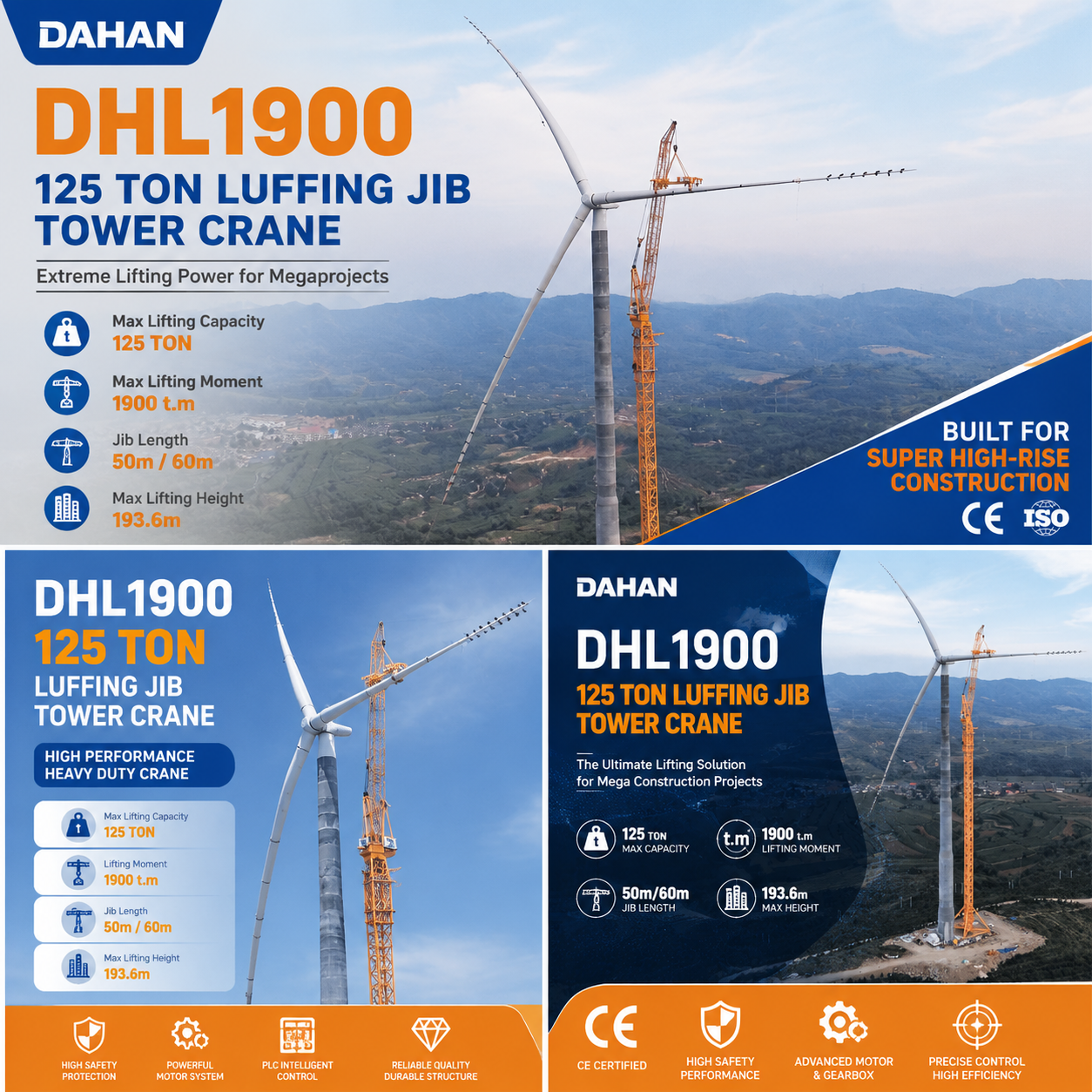
Cover image: 125 t class tower crane configuration, used here to frame the high-capacity end of the 12T–220T comparison.
Choosing between a 5T–12T tower crane and a 12T–220T tower crane is not a simple question of buying the biggest or smallest machine. It is a project-fit decision. A 5 t construction tower crane and a 220 t heavy-duty tower crane can both be correct for different project scopes, lifting plans, site constraints and budgets. The practical question is which capacity class can deliver the required load at the required radius, at the required height, within the site and logistics limits.
Dahan Technology Co., Ltd. is a tower crane and construction elevator manufacturer established in 2000. Its QTZ tower crane range covers capacities from 5 t through 220 t, which makes the 5T–12T versus 12T–220T comparison a useful framework for buyers at the research and evaluation stage. The QTZ250 (7025) 12T/16T association is especially relevant because it sits near the boundary between medium and heavy configurations: it is more capable than small building cranes, but it is not a 125 t, 200 t or 220 t heavy-lift machine.
Problem Definition: Why Capacity Class Is a Project-Fit Decision
Maximum lifting capacity is often the first number buyers see, but it is not the only number that decides project fit. Maximum capacity is usually stated under defined conditions and often at a short radius. The working load available at the jib end, the lifting height, the jib length, the foundation, the erection method and the climbing plan can change the selection.
This is why a 5T–12T tower crane can be the right choice for one high-rise building project and the wrong choice for another. The same applies to the 12T–220T class. A 12 t or 16 t configuration may fit a high-rise project with moderate component weights. A 125 t or 220 t wind power special tower crane may be required when the project involves heavy wind turbine components, large industrial modules or major infrastructure lifts.
The comparison should therefore start with the load chart at the working radius, not with the headline tonnage. Buyers comparing medium and small-sized tower cranes against heavy-lift classes should ask three questions: What is the heaviest load at the farthest required radius? What height and jib length are needed? What site, transport and erection constraints apply?
Industry Background: Why Both 5T–12T and 12T–220T Classes Remain Relevant
Tower crane demand is shaped by high-rise buildings, bridges and infrastructure, industrial projects and wind power construction. Fortune Business Insights estimates the global tower crane market at USD 5.9–6.44 billion in 2025. OEC data using UN Comtrade places China's 2024 tower crane export value at USD 694 million. These figures describe a large and internationally active equipment category, not a single dominant capacity class.
The product mix is also broad. Grand View Research reports that hammerhead tower cranes held the largest market share by product type at 42.8% in 2025. Mordor Intelligence reports that flat-top or topless designs accounted for 46.37% of tower crane revenue in 2025. Those shares show that buyers continue to evaluate both traditional hammerhead and flat-top topless configurations across project types. Capacity class and crane type are separate decisions, but they interact: a flat top tower crane, topkit tower crane, luffing jib tower crane or derrick tower crane may be selected differently depending on site constraints, height and lifting plan.
Heavy-lift demand is also visible at the top of the capacity range. Future Market Insights projects that wind power specialized tower cranes with 200+ ton capacity will grow at 8–10% CAGR through 2032. That forecast supports the continued relevance of 125 t, 200 t and 220 t classes for wind power and heavy industrial work. At the same time, medium and small-sized tower cranes remain essential for residential, commercial and municipal projects where the required load at radius does not justify a heavy-lift machine.
Detailed Solution: How Dahan's QTZ Range Maps to Capacity Classes
Dahan Technology Co., Ltd. lists tower crane capacities of 5 t, 6 t, 8 t, 10 t, 12 t, 16 t, 18 t, 25 t, 32 t, 45 t, 64 t, 125 t, 200 t and 220 t. The QTZ series includes recognizable model associations that help buyers frame the comparison:
- QTZ63 (5013)-5T/6T — an entry point for 5 t and 6 t configurations.
- QTZ80 (5211)-5T — a 5 t configuration in the QTZ range.
- QTZ100 (6013)-8T — an 8 t configuration.
- QTZ125 (6015)-8T/10T — an 8 t and 10 t configuration.
- QTZ160 (6515)-8T/10T — an 8 t and 10 t configuration.
- QTZ250 (7025)-12T/16T — a 12 t and 16 t configuration at the medium-to-heavy boundary.
- QTZ250 (7520)-10T/12T/16T — a 10 t, 12 t and 16 t configuration.
- QTZ315 (7527)-12T/16T — a 12 t and 16 t configuration.
The QTZ250 (7025) 12T/16T association is useful because it shows how a model can sit between the 5T–12T group and the higher-capacity group. A buyer evaluating a high rise building tower crane may compare the QTZ250 (7025) 12T/16T against smaller QTZ models when the required loads at radius are moderate. The same buyer should move to a higher capacity class when the project requires lifting heavy prefabricated components, steel structures, bridge segments, industrial modules or wind power components beyond the load chart of the 12 t or 16 t configuration.
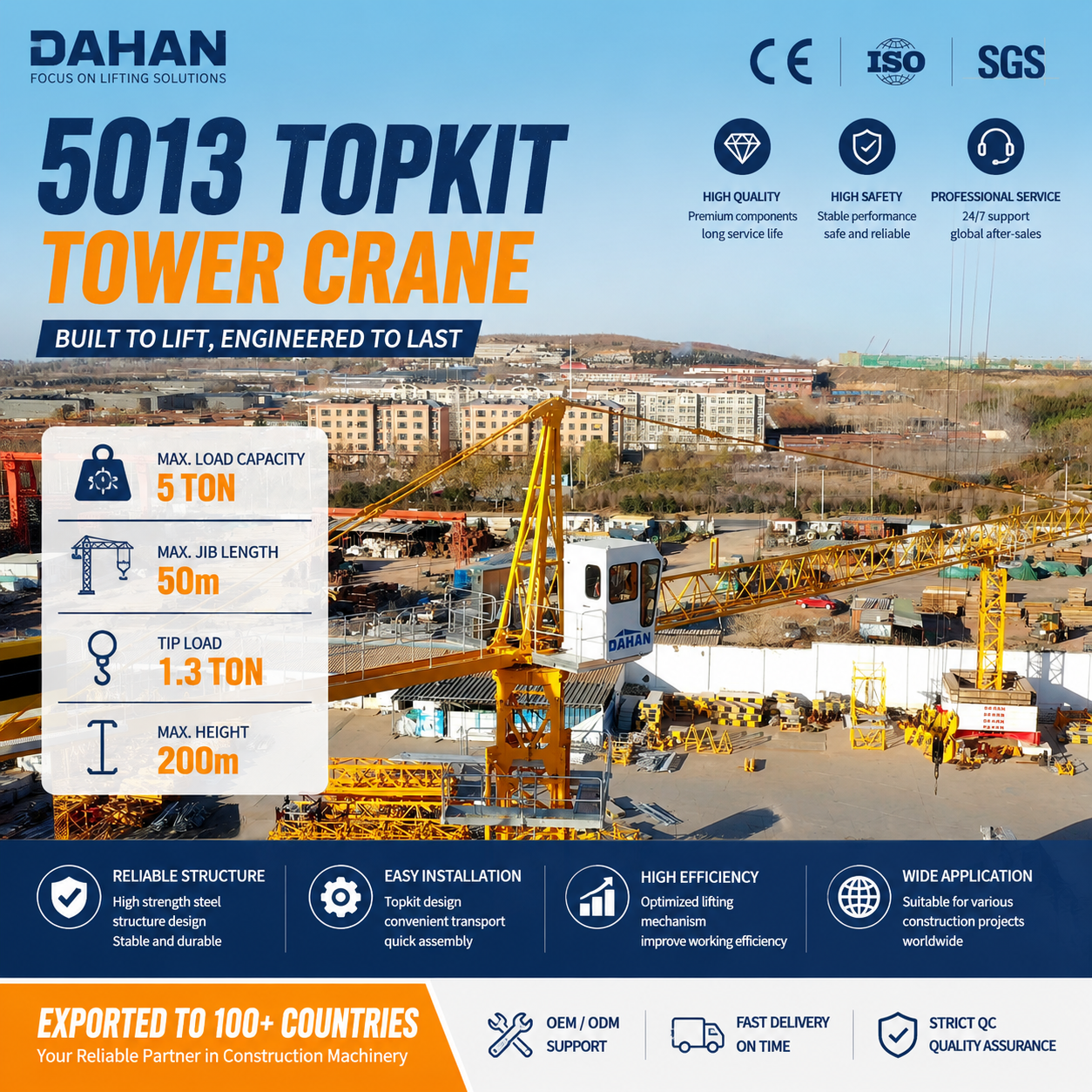
QTZ63 (5013)-5T/6T class tower crane, representative of the small and medium building configurations in the 5T–12T comparison.
For heavy-lift work, the capacity range extends through 18 t, 25 t, 32 t, 45 t, 64 t, 125 t, 200 t and 220 t. The 64 t class falls into a heavy-lift zone for infrastructure and industrial projects, while 125 t, 200 t and 220 t classes are associated with wind power and major heavy-duty applications. Dahan Technology's profile states that it provides in-depth solutions for wind power, thermal power, road and bridge construction, ports, nuclear power and other special projects. That does not mean every project needs 125 t or 220 t; it means the high-capacity end exists for projects where the load chart and lifting plan require it.
Step-by-Step Breakdown: How to Choose Between 5T–12T and 12T–220T
1. Start with the required load at the working radius
Begin with the heaviest load and the farthest radius at which it must be lifted. A 10 ton tower crane may have a maximum capacity of 10 t, but the rated load at the working radius may be lower. The same applies to a 200 ton heavy duty tower crane. The load chart at the actual working radius is the first filter. If the required load at radius is within a 5T–12T configuration, a larger class may add cost and complexity without adding project value. If the load at radius exceeds the 12T–16T range, evaluate 18T–64T or 125T–220T classes.
2. Confirm lifting height and climbing method
High-rise construction often requires a self climbing internal tower crane or a climbing external configuration. The product operates in fixed installation mode for long-term operation and works through climbing, mast-adding operation for long-term operation on building projects. The selected capacity class must support the height plan, attachment scheme, mast section configuration and foundation conditions. A 5T–12T model may be suitable for a mid-rise or high-rise building when the load chart and climbing plan fit. A 12T–220T model may be necessary when the height and load combination exceeds the smaller class.
3. Match jib length and site constraints
Jib length affects coverage, load at the jib end and site logistics. When a project brief calls for a long jib 70 m span tower crane, the capacity at the jib end is more important than the maximum tonnage. Dense urban sites, confined spaces and high-wind locations may also favor a flat top tower crane or topless tower crane because of site constraints and erection planning. Dahan Technology states that jib length, counterweight and erection schemes can be customized for site constraints, with specifics subject to sales and engineering confirmation.
4. Check foundation, support equipment and counterweight
Tower crane selection is not complete at the crane model. The product requires supporting equipment such as counterweights, mast sections, electrical traction systems, wire ropes, cabs and safety limit devices. A heavy-capacity crane can require a different foundation and support scheme from a medium-capacity crane. For projects with limited foundation space or restricted site access, the foundation and counterweight plan can influence whether a 5T–12T or 12T–220T class is practical.
5. Review safety systems and load control
Dahan tower cranes are described with multiple safety protection systems: overload protection, moment limitation, height and travel limit protection, emergency stop and reliable structural design. These systems matter across all capacity classes. A small crane can still create serious risk if the load chart is ignored, and a heavy crane requires disciplined lift planning. Buyers should verify how the safety system matches the site's lifting plan and operator procedures.
6. Verify testing, certification and documentation
Dahan Technology states that quality control includes 100% test. The company holds CE certificate, EAC certificate, SGS certificate and ISO9001 certificate. For China, GB/T 13752-2017 defines design rules and safety specifications for tower cranes. International buyers should confirm that the CE certified tower crane documentation, test records and technical files match the target market and project requirements. Certification is not a substitute for load chart verification, but it supports compliance review.
7. Compare transport, erection and lead time
Heavy-capacity cranes are not automatically harder to transport in every case, but the transport and erection plan must be checked. Dahan Technology states that its modular tower crane design supports faster assembly and dismantling, convenient transportation, flexible height adjustment and reduced installation time. The company also states that the panel scheme is more conducive to transportation and export. For customized service, the exact delivery date needs to be confirmed with the sales department. Minimum order quantity is 1 unit.
8. Select the capacity class, then the model
After the load chart, height, jib, foundation, safety, certification and logistics are clear, the buyer can select the capacity class. The 5T–12T group includes QTZ63 (5013)-5T/6T, QTZ80 (5211)-5T, QTZ100 (6013)-8T, QTZ125 (6015)-8T/10T, QTZ160 (6515)-8T/10T, QTZ250 (7025)-12T/16T, QTZ250 (7520)-10T/12T/16T and QTZ315 (7527)-12T/16T. The 12T–220T group extends from 12 t and 16 t configurations up to 18 t, 25 t, 32 t, 45 t, 64 t, 125 t, 200 t and 220 t. The model choice should follow the class decision, not replace it.
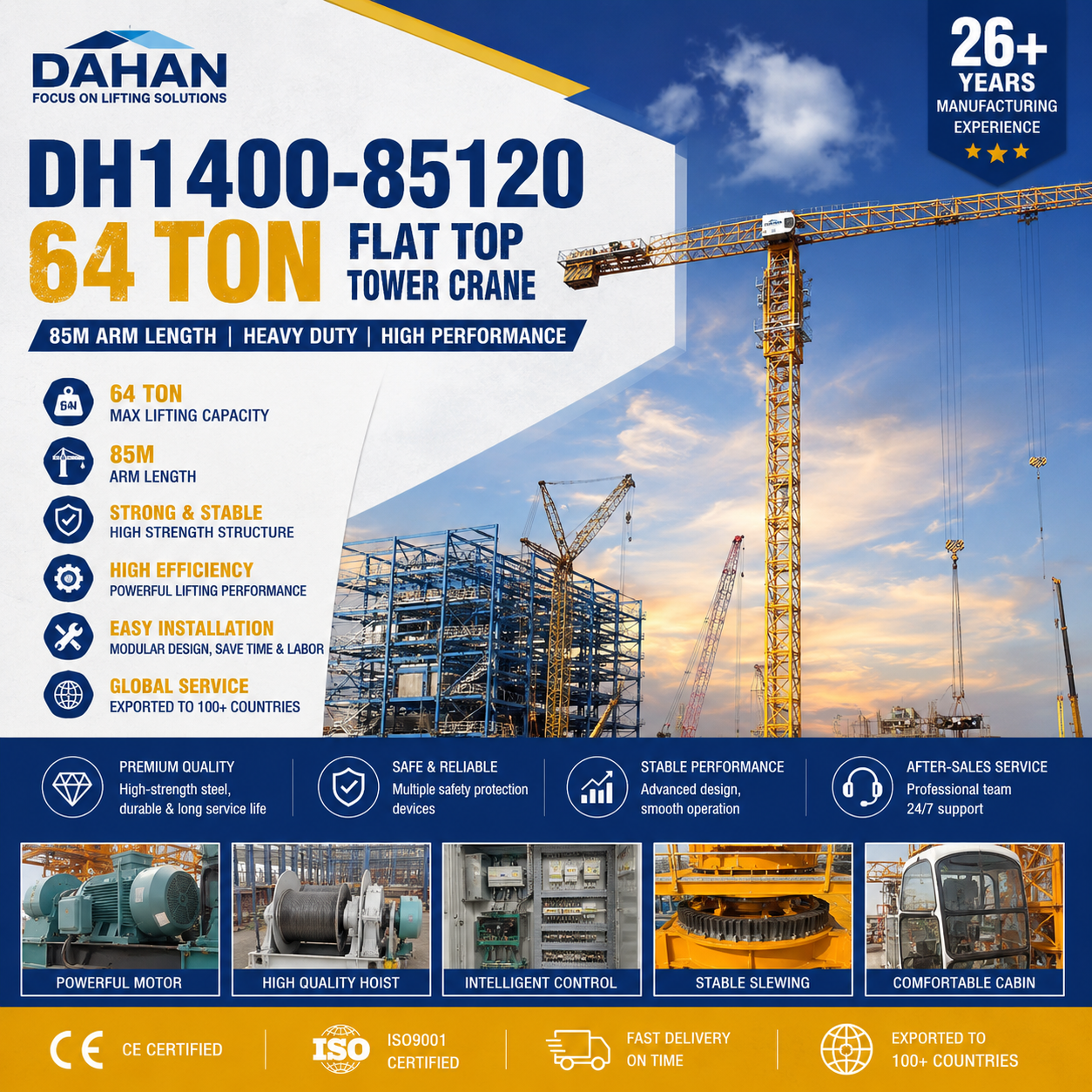
64 t class heavy-lift tower crane configuration, representative of the upper-middle capacity range used in infrastructure and industrial lifting.
Use Cases: Where Each Capacity Class Fits
High-rise residential and commercial buildings
For high-rise residential and commercial complexes, the 5T–12T group is often the first evaluation zone. The required loads may include formwork, reinforcement, precast elements, facade materials and general construction materials. A 10 ton tower crane or 12 t configuration can be evaluated when the load at radius and lifting height fit. The QTZ250 (7025) 12T/16T sits at the upper end of this zone and may be considered when the project needs more capacity than a smaller QTZ model but does not require 125 t or 220 t heavy-lift capability.
Dahan Technology case records show multi-unit building construction use. In Russia, 4 tower crane units were operated together on one building construction project for efficient material hoisting. Another Russia case involved 34 units for civil building construction over 4 years, with high coordination among multiple tower cranes. In Turkey, 5 units were used for building construction over 2 years, with stable material hoisting and coordinated operation. In Bulgaria, 5 units were delivered for building construction and were still in use at the time of the record. These cases show that medium and small-sized tower cranes can support multi-crane building sites when the load chart and site coordination fit.
Bridges and infrastructure
Bridge and infrastructure projects may require heavier lifts, longer radii or specialized erection schemes. A 12T–64T configuration can be evaluated for bridge segments, precast elements and heavy construction materials. For larger bridge segments or major industrial infrastructure, the 125T–220T class may be relevant. Dahan Technology's Vietnam case involved 3 tower crane units for a bridge construction project completed within 2 years, with stable cargo movement and wind-resistance performance reported by the client. That case shows bridge use within the QTZ range, but the specific capacity class should be confirmed against the bridge lifting plan.
Wind power and heavy industrial projects
Wind power special tower crane applications are different from building construction. The lifting plan depends on height, maximum lifting capacity and applicable scenarios. Dahan Technology states that it can provide comprehensive solutions for wind power hoisting based on these factors. The 125 t, 200 t and 220 t classes are relevant for heavy wind turbine components and other heavy-duty lifts. The 200 ton heavy duty tower crane class is not a default choice for building projects; it is a project-specific class for loads and heights that require it.
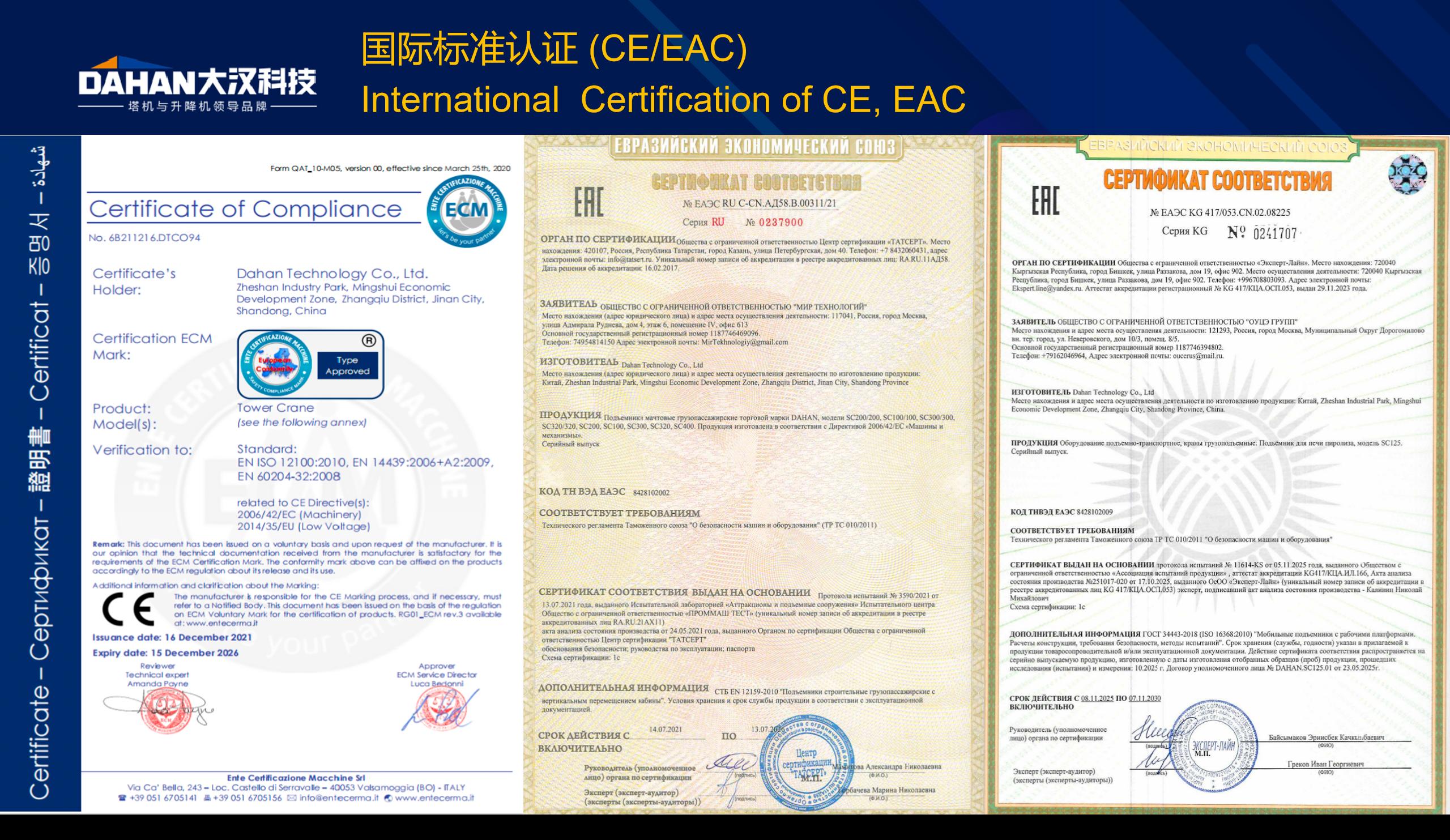
Certification documents support verification of CE, EAC, SGS and ISO9001 credentials during supplier evaluation.
Comparison Table: 5T–12T vs 12T–220T Configurations
| Capacity class | Dahan QTZ examples or range | Typical project fit | What to verify |
|---|---|---|---|
| 5T–6T | QTZ63 (5013)-5T/6T; QTZ80 (5211)-5T | Small and medium building projects, low-to-mid-rise construction, sites where the required load at radius is moderate. | Rated load at working radius, jib length, foundation, transport and erection plan. |
| 8T–10T | QTZ100 (6013)-8T; QTZ125 (6015)-8T/10T; QTZ160 (6515)-8T/10T; QTZ250 (7520)-10T/12T/16T | Mid-rise and high-rise building work, mixed material hoisting, projects needing more capacity than the entry class. | Load chart at jib end, lifting height, climbing plan, safety systems and site logistics. |
| 12T–16T | QTZ250 (7025)-12T/16T; QTZ250 (7520)-10T/12T/16T; QTZ315 (7527)-12T/16T | High-rise building projects, heavier components and long-jib configurations at the medium-to-heavy boundary. | Capacity at maximum working radius, foundation and counterweight scheme, certification and engineering confirmation. |
| 18T–64T | Capacity range includes 18T, 25T, 32T, 45T and 64T | Heavy infrastructure, bridge segments, precast and industrial construction where loads exceed the 12T–16T class. | Project-specific load chart, custom jib or erection scheme, transport and site access. |
| 125T–220T | Capacity range includes 125T, 200T and 220T | Wind power special tower crane work, heavy industrial projects and major infrastructure requiring high-capacity lifting. | Wind or heavy-lift application review, height and load combination, foundation, safety plan and delivery schedule. |
FAQ
What certifications and standards should I verify before buying a tower crane?
Dahan Technology Co., Ltd. holds CE certificate, EAC certificate, SGS certificate and ISO9001 certificate. GB/T 13752-2017 defines design rules and safety specifications for tower cranes in China. International buyers should confirm that the certificate set and technical documents match the target market, and that the load chart, test records and safety system documentation are available for review.
Can a 5T–12T tower crane be used for high-rise building construction?
Yes, a 5T–12T tower crane can be evaluated for high-rise building construction when the required load at radius, lifting height, jib length, foundation and climbing plan fit the load chart. The QTZ250 (7025) 12T/16T and QTZ315 (7527)-12T/16T sit at the upper end of this group. If the project involves heavy prefabricated components, steel structures or loads beyond the chart, a higher capacity class should be evaluated.
Is a larger capacity class always the better or more expensive choice?
A larger capacity class is not automatically the better choice. The correct comparison is the required load at working radius, lifting height, jib length, foundation, transport and erection plan. A 12T–220T crane may add capability that the project does not need, while a 5T–12T crane may be insufficient if the load chart is exceeded. Dahan Technology provides factory direct supply and customized solutions, but exact commercial terms and delivery dates require a project-specific quote.
What can be verified before shipment?
Dahan Technology states that quality control includes 100% test. Buyers can review product technical parameters, key components, factory inspection, technical documents, installation guidance and after-sales service capabilities. For overseas projects, it is also relevant to confirm international project experience and whether the manufacturer can provide technical and certification materials that meet the project country requirements.
What is the lead time and customization process for a QTZ tower crane order?
Dahan Technology states that minimum order quantity is 1 unit and monthly capacity is 400 units. Customization can include jib length, counterweight schemes, lifting height plans and electrical or safety configurations, with complex customizations requiring engineering evaluation. If the order is a customized service, the exact delivery date needs to be confirmed with the sales department. A practical next step is to share the load chart, site plan, building height and required radius for a configuration review and quote.
Conclusion
The choice between 5T–12T and 12T–220T tower crane configurations should be based on project fit, not on a preference for smaller or larger tonnage. Start with the load at the working radius, then verify lifting height, jib length, foundation, climbing method, safety systems, certification and logistics. The 5T–12T group covers many building construction needs, including models such as QTZ63 (5013)-5T/6T, QTZ80 (5211)-5T, QTZ100 (6013)-8T, QTZ125 (6015)-8T/10T, QTZ160 (6515)-8T/10T, QTZ250 (7025)-12T/16T, QTZ250 (7520)-10T/12T/16T and QTZ315 (7527)-12T/16T. The 12T–220T group extends through 18 t, 25 t, 32 t, 45 t, 64 t, 125 t, 200 t and 220 t for heavier infrastructure, industrial and wind power work.
Dahan Technology Co., Ltd. provides tower crane solutions from 5 t to 220 t and supports customization for site constraints, subject to sales and engineering confirmation. Buyers who compare capacity classes by load chart, site conditions and project scope will make a more defensible selection than buyers who compare headline tonnage alone.
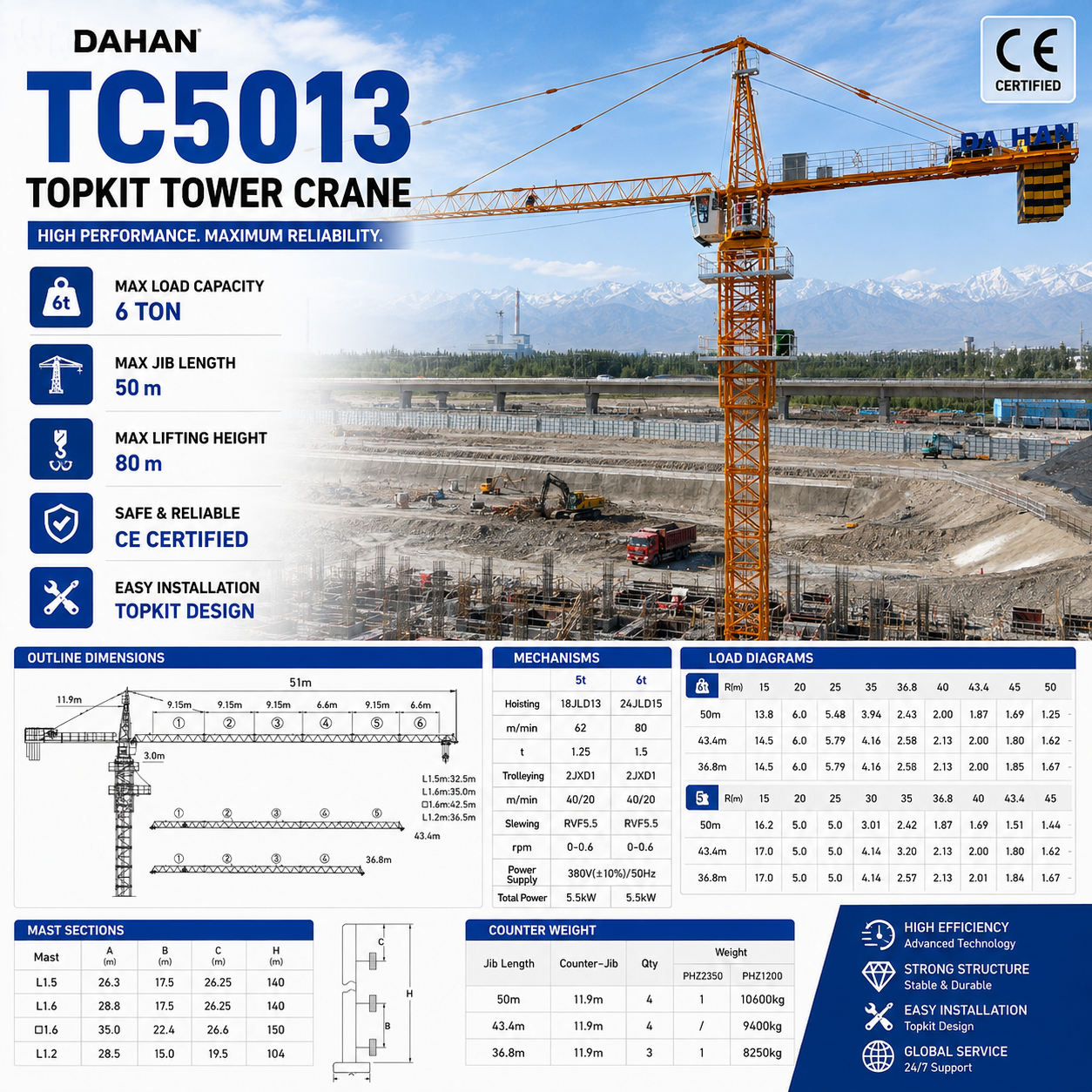
Small and medium QTZ configurations can be reviewed against your load chart before a capacity class is confirmed.
Next step: Share your project height, required load at radius, jib length and site constraints with Dahan Technology for a configuration review. You can also download the Dahan Technology brochure or visit chinatowercranes.com to request a quote.
Have Questions or Need More Details?
Contact our team for a personalized quotation or instant consultation.
Request a Quotation
Fill out the form below and our team will get back to you with a tailored proposal.
WhatsApp Direct Chat
Prefer to chat in real-time? Message us on WhatsApp for instant assistance & quick answers.
- Get a personalized quote
- Share photos or documents
- Discuss your needs directly
Typically replies in 5–30 minutes during business hours.