Flat Top vs Topkit Tower Cranes: Comparing QTZ Configurations for High-Rise and Infrastructure
Flat Top vs Topkit Tower Cranes: Comparing QTZ Configurations for High-Rise and Infrastructure
Selecting the right tower crane configuration for a high-rise or infrastructure project is a decision that balances site constraints, lifting requirements, and long-term project economics. In the QTZ tower crane series, the two most common structural types are the flat top (topless) and the topkit (hammerhead) configurations. Both are available from Dahan Technology Co., Ltd., a Chinese tower crane manufacturer established in 2000, and both can be customized for specific lifting height, jib length, and capacity needs. This article compares flat top and topkit QTZ configurations across modular design, jib length, mast height, lifting capacity, electrical system options, and shared safety systems, helping buyers shortlist the right structural type for their next project.
Problem Definition: Why Structural Type Matters in Tower Crane Selection
High-rise building and infrastructure projects often face tight site boundaries, overlapping crane zones, and strict installation schedules. The structural type of a tower crane directly affects how easily the machine can be erected, how much space it needs to slew, and how it performs under wind loads. Flat top and topkit designs solve different site problems. A flat top tower crane has no tower head or tie rods above the jib, which reduces the overall height during assembly and allows multiple cranes to work close together without risking jib collisions. A topkit tower crane, also known as a hammerhead crane, uses a traditional tower head with tie rods, offering a robust and proven structure for heavy lifting and long jib applications. Buyers evaluating QTZ configurations must decide which structural type aligns with their project's airspace, lifting duty, and customization requirements.
Industry Background: Market Trends in Tower Crane Configurations
Global tower crane demand is driven by urbanization and high-rise construction. The global tower crane market size was estimated at USD 5.9 to 6.44 billion in 2025. China remained the leading exporter of tower cranes in 2024, accounting for USD 694 million in export value. By product type, hammerhead tower cranes held the largest market share at 42.8% in 2025, while flat-top (topless) designs accounted for 46.37% of tower crane revenue in 2025, reflecting their efficiency in dense urban airspace. Wind power specialized tower cranes with 200+ ton capacity are projected to grow at 8-10% CAGR through 2032. These trends show that both flat top and topkit configurations remain essential, and the choice depends on project-specific factors rather than a single market preference.
Detailed Solution: Flat Top vs Topkit QTZ Configurations
Dahan Technology Co., Ltd. manufactures tower cranes in the QTZ series, covering flat top, topkit, luffing jib, and derrick types. The QTZ series includes models from QTZ63 (5013)-5T/6T up to QTZ315 (7527)-12T/16T, with lifting capacities spanning 5 tons, 6 tons, 8 tons, 10 tons, 12 tons, 16 tons, 18 tons, 25 tons, 32 tons, 45 tons, 64 tons, 125 tons, 200 tons, and 220 tons. All models use high-strength steel and are applicable to building construction, real-estate engineering, infrastructure projects, and municipal engineering.
Modular Design and Site Fit
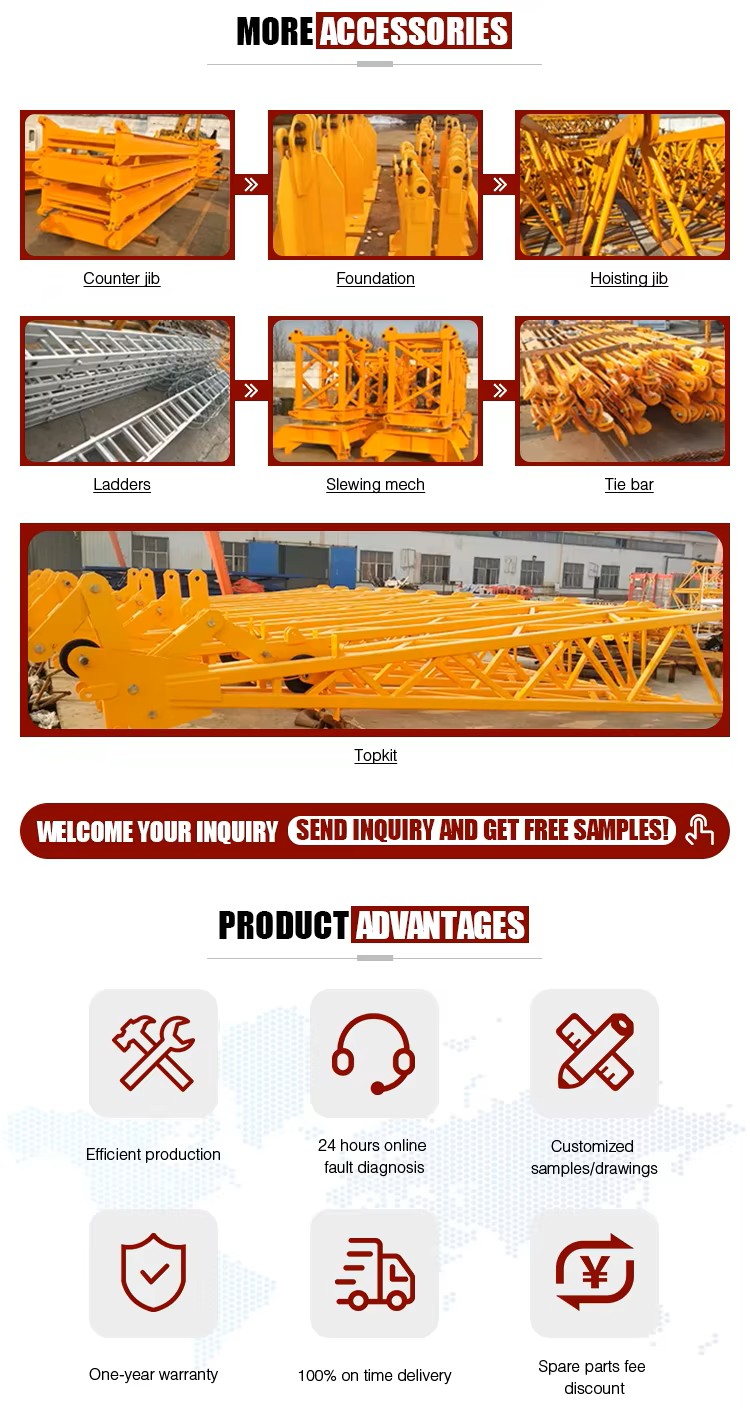
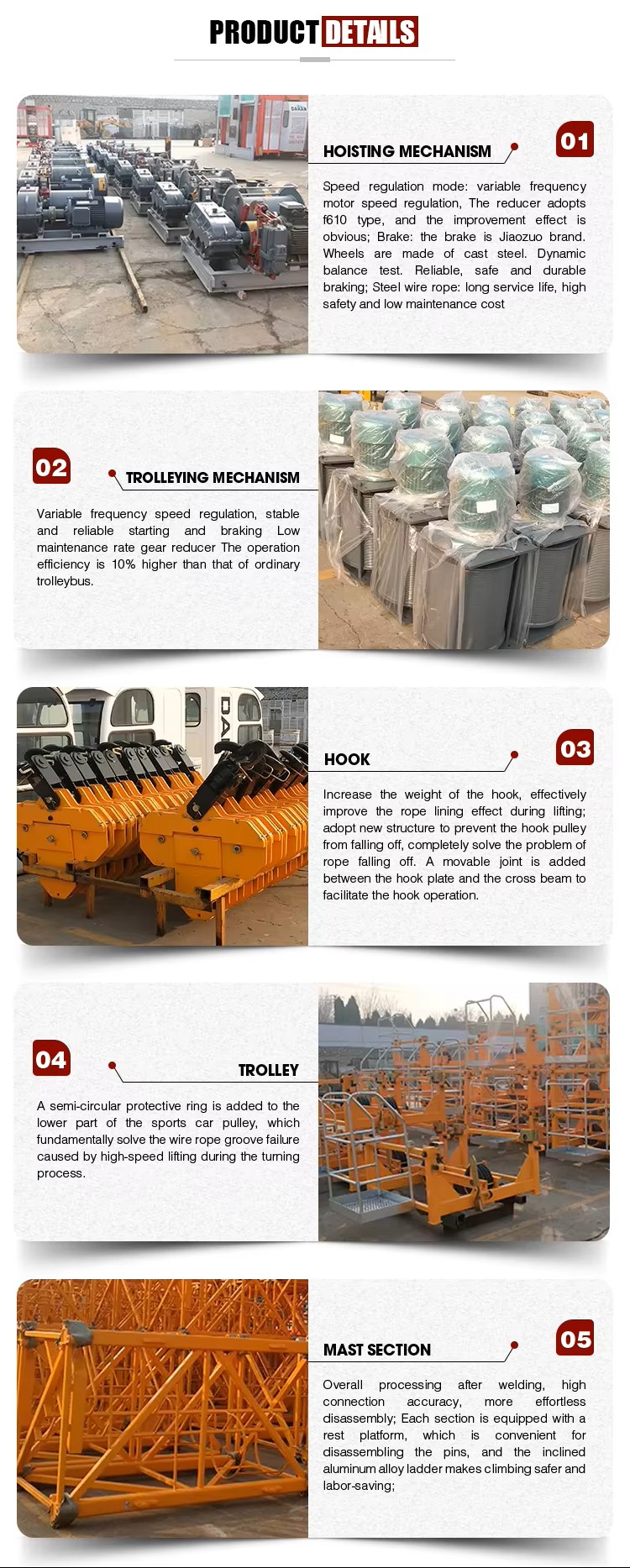
Both flat top and topkit QTZ cranes use modular mast sections, jib sections, and counterweight schemes. The standard sections of Dahan Technology products are compatible with Potain, which simplifies spares and interchangeability for international fleets. Flat top cranes offer an advantage in dense urban sites because the absence of a tower head reduces the assembly height and allows the jib to be lowered to the ground for erection and dismantling. Topkit cranes use a traditional tower head with tie rods, which can be assembled at ground level and then raised, a method that suits open sites and heavy lifting operations. For projects with limited overhead clearance, flat top is often preferred. For projects requiring maximum lifting capacity at long jib lengths, topkit remains a strong candidate.
Jib Length, Mast Height, and Lifting Capacity
QTZ model designations include jib length and tip load indicators. For example, the QTZ63 (5013) has a 50-meter jib with a 1.3-ton tip load; QTZ80 (5211) has a 52-meter jib with 1.1-ton tip load; QTZ100 (6013) has a 60-meter jib with 1.3-ton tip load; QTZ125 (6015) has a 60-meter jib with 1.5-ton tip load; QTZ160 (6515) has a 65-meter jib with 1.5-ton tip load; QTZ250 (7025) has a 70-meter jib with 2.5-ton tip load; QTZ250 (7520) has a 75-meter jib with 2.0-ton tip load; QTZ315 (7527) has a 75-meter jib with 2.7-ton tip load. These configurations are available in both flat top and topkit structural types, subject to engineering evaluation. Mast height can be customized, and self-climbing internal tower cranes are available for high-rise cores. Lifting capacity ranges from 5 tons to 220 tons, including 200-ton heavy-duty models for wind power and other special projects. Long jib 70m span tower cranes and 10-ton tower cranes are part of the standard offering.
Electrical System Options and Customization
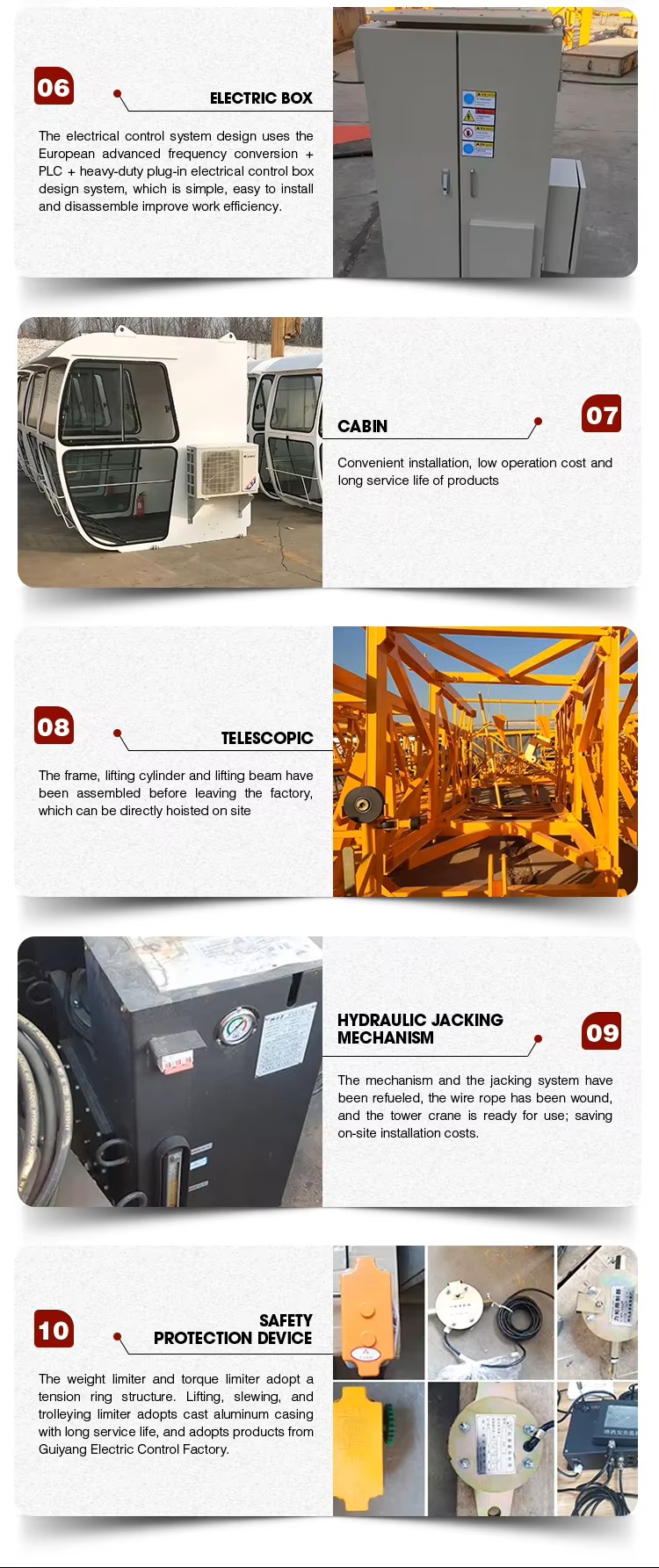
Dahan Technology provides customizable jib lengths, counterweight schemes, lifting height plans, and electrical/safety configurations. Full frequency control (full frequency control tower crane) is available for smooth operation and energy efficiency. Complex customizations require engineering evaluation before production. The manufacturer offers OEM and ODM production services, complete machine delivery, and heavy-tonnage crane R&D and export. A minimum order quantity of 1 unit supports low-volume custom production and prototype orders. Certificate authentication documentation is available to support CE compliance documentation requirements.
Shared Safety Systems
Both flat top and topkit QTZ configurations incorporate standard tower crane safety systems. These typically include overload protection, moment limitation, height and travel limit protection, and emergency stop functions. Safety limit devices and matched equipment such as counterweights, mast sections, electrical traction systems, wire ropes, cabs, and safety limit devices are part of the delivery. The safety systems are designed to protect the crane, the load, and personnel during lifting operations, regardless of structural type.
Certifications and Compliance
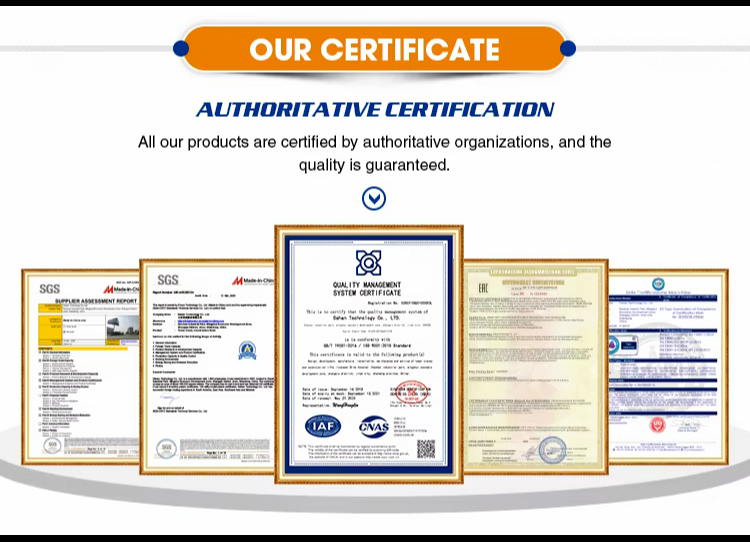
Dahan Technology tower cranes are supported by relevant certifications. The company holds an EAEU Conformity Certificate (EAC) with certificate number ЕАЭС RU С-СН.АД58.В.03025/25; Серия RU №0576066, covering QTZ series tower cranes and valid through 2030-12-29. An ECM Certificate of Compliance (CE) with certificate number 6B211216.DTCO94 covers tower cranes under EN ISO 12100:2010, EN 14439:2006+A2:2009, and EN 60204-32:2008, valid through 2026-12-15. The company also holds ISO 9001:2015 certification for design, development, manufacturing, installation, and maintenance of tower cranes and construction lifts. These certifications help buyers meet market-specific compliance requirements.

Step-by-Step Breakdown: How to Shortlist Flat Top or Topkit
- Define the project type and site constraints. High-rise urban projects with limited airspace often favor flat top. Infrastructure projects with heavy lifts and open sites may favor topkit.
- Calculate required lifting capacity, jib length, and mast height. Use the maximum component weight, working radius, and building height. The QTZ series covers 5T to 220T, with jib lengths up to 75 meters in standard models.
- Evaluate assembly and dismantling methods. Flat top cranes can lower the jib to the ground, reducing assembly height. Topkit cranes typically assemble at ground level and raise the tower head.
- Review electrical and safety options. Full frequency control, customized electrical configurations, and standard safety systems are available. Confirm the required safety devices.
- Verify certifications for the target market. CE, EAC, and ISO 9001 documentation may be required. Check the certificate scope and validity.
- Engage the manufacturer's engineering team. Complex customizations require engineering evaluation. Dahan Technology provides in-house engineering teams for OEM/ODM projects.

Use Cases: Matching Structural Type to Project Scenarios
High-Rise Building Construction
For high-rise residential and commercial complexes, flat top tower cranes are often shortlisted because they allow multiple cranes to operate in overlapping zones without tower head interference. Self-climbing internal tower cranes can be used for core construction. Topkit cranes are also used for high-rise projects when heavy prefabricated components or long jib reaches are required.
Infrastructure and Bridge Projects
Bridge construction and large public works often require heavy lifting at long radii. Topkit tower cranes with high lifting moments are suitable. In a Vietnam bridge project, three QTZ tower cranes completed the bridge construction over a two-year period, with customer feedback noting stable hoisting and strong wind-resistance performance.
Municipal and Dense Urban Sites
Municipal engineering and dense urban sites benefit from flat top cranes because they reduce the required overhead clearance and can be dismantled more easily. A Russian trader used four QTZ tower cranes for building construction over three years, highlighting efficient material hoisting with multiple cranes working together.
Wind Power and Heavy Industry
Wind power special tower cranes and 200-ton heavy-duty tower cranes are available for wind turbine hoisting and large industrial projects. These heavy-tonnage models are part of the QTZ series and can be configured for extreme conditions.
Comparison Table: Flat Top vs Topkit QTZ Configurations
| Feature | Flat Top (Topless) QTZ | Topkit (Hammerhead) QTZ |
|---|---|---|
| Structure | No tower head or tie rods above jib; simpler assembly | Traditional tower head with tie rods; robust design |
| Modular Design | Modular sections; easier to lower jib for erection | Modular sections; compatible with Potain standard sections |
| Jib Length | Customizable; standard models up to 75 m | Customizable; standard models up to 75 m |
| Lifting Capacity | 5T to 220T across QTZ series | 5T to 220T across QTZ series |
| Typical Applications | High-rise, municipal, dense urban sites | High-rise, infrastructure, heavy lifting |
| Safety Systems | Overload protection, moment limitation, height/travel limit, emergency stop | Overload protection, moment limitation, height/travel limit, emergency stop |
| Electrical Options | Configurable; full frequency control available | Configurable; full frequency control available |
| Certification | CE, EAC, ISO 9001 | CE, EAC, ISO 9001 |
| 2025 Market Share / Revenue Share | 46.37% of revenue (flat-top designs) | 42.8% market share (hammerhead cranes) |
FAQ
What certifications are available for QTZ tower cranes from Dahan Technology?
Dahan Technology holds an EAEU Conformity Certificate (EAC) for QTZ series tower cranes, valid through 2030-12-29, and an ECM Certificate of Compliance (CE) covering tower cranes under EN ISO 12100:2010, EN 14439:2006+A2:2009, and EN 60204-32:2008, valid through 2026-12-15. The company also holds ISO 9001:2015 certification for design, development, manufacturing, installation, and maintenance of tower cranes and construction lifts. Certificate authentication documentation is available to support CE compliance documentation requirements.
Does Dahan Technology have in-house engineering teams for custom tower crane projects?
Yes. Dahan Technology provides OEM and ODM production services for tower cranes, including complete machine delivery and heavy-tonnage crane R&D and export. The company has an in-house engineering team that evaluates complex customizations before production. Customizable options include jib lengths, counterweight schemes, lifting height plans, and electrical/safety configurations.
What is the minimum order quantity for a custom QTZ tower crane?
A minimum order quantity of 1 unit supports low-volume custom production and prototype orders for tower cranes. This allows buyers to order a single unit for testing or specific project needs.
Can I order a single unit for sample validation?
Yes. The minimum order quantity of 1 unit enables low-volume custom production and prototype orders. Buyers can request a single unit to validate configuration, performance, and compliance before larger procurement.
What is the lead time for a customized tower crane?
For customized services, the exact delivery date needs to be confirmed with the sales department. Lead time depends on the specific configuration, customization scope, and production schedule. Contact Dahan Technology directly for a project-specific quotation and lead time.
Conclusion: Shortlisting the Right QTZ Configuration
Flat top and topkit tower cranes each serve distinct project needs within the QTZ series. Flat top configurations offer advantages in dense urban airspace, easier assembly, and multiple crane coordination. Topkit configurations provide a proven, robust structure for heavy lifting and long jib applications. Both types share standard safety systems, customizable electrical configurations, and certifications such as CE, EAC, and ISO 9001. Dahan Technology Co., Ltd. manufactures both types with lifting capacities from 5 tons to 220 tons, supported by in-house engineering teams and OEM/ODM capabilities. To determine which structural type fits your high-rise or infrastructure project, review your site constraints, lifting requirements, and compliance needs, then consult the manufacturer's engineering team for a tailored solution.
Ready to evaluate a QTZ tower crane for your project?
Download the Dahan Technology product brochure for complete specifications and configurations.
Download the Dahan Technology Brochure
For sample requests, quotations, or engineering consultation, contact Dahan Technology Co., Ltd. via the website www.chinatowercranes.com.