
Preventing Tower Crane Overload and Limit Risks: Safety Systems That Solve Site Problems
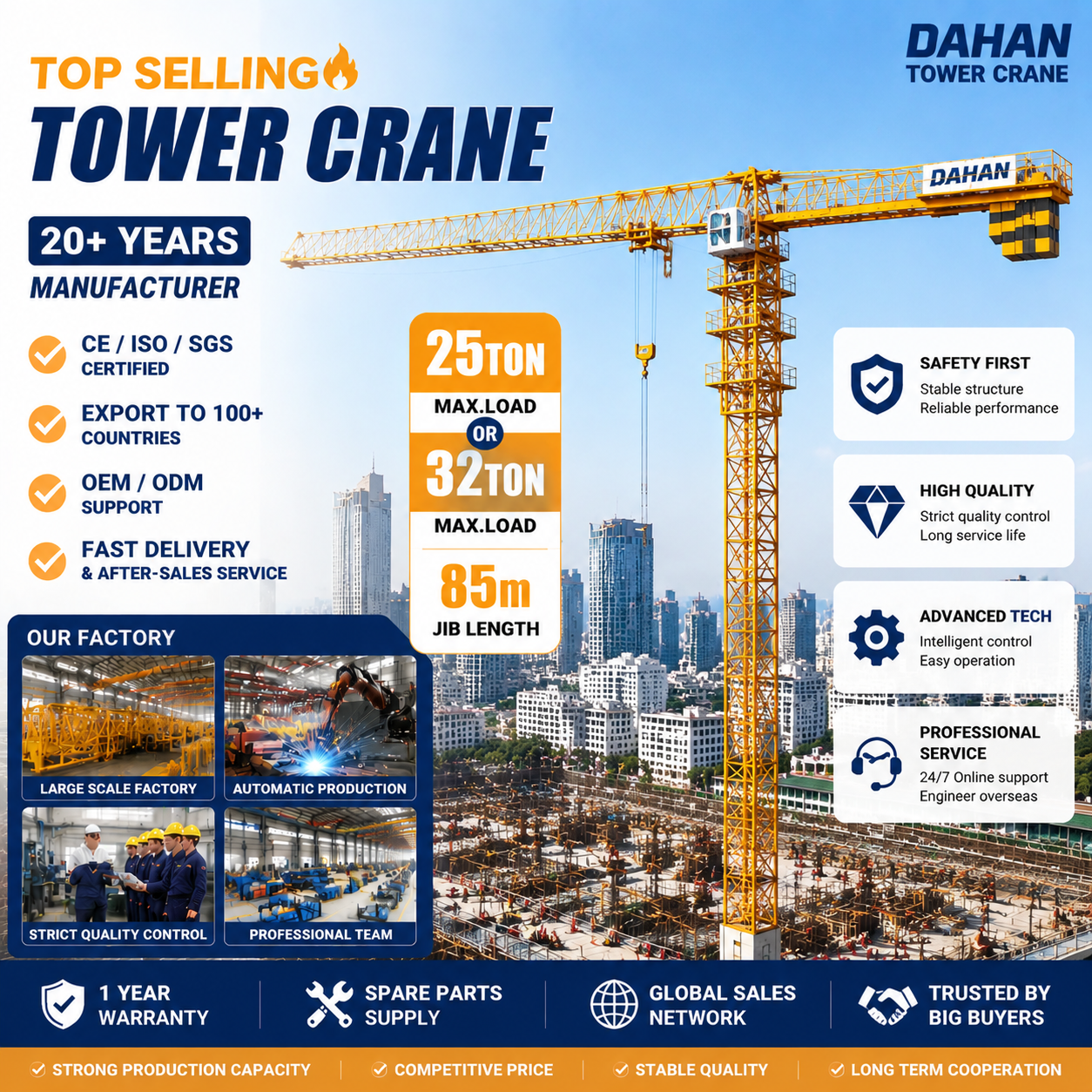
A tower crane's protective devices are only valid for the jib length, counterweight and working height the crane was actually erected to.
Tower crane overload incidents rarely start with a broken component. They start with a mismatch between the lift being made and the data the crane was erected to: a load that has drifted to a longer radius, a jib or counterweight change that was never written back into the device settings, or a height limit that was not re-verified after the crane climbed. The safety system is the layer that catches this mismatch — provided it has been configured against the same documented numbers as the machine on site.
This guide works backwards from the site problem. It examines four recurring risks — overload, excessive load moment, height and travel limit violations, and loss of control in an emergency — and maps each one to the protection function that addresses it, the configuration data that function depends on, and the checks a buyer or site engineer should require before the first load leaves the ground. It is written for procurement teams, fleet owners and site engineers evaluating QTZ tower crane configurations at decision stage.
Where Overload and Limit Risks Actually Begin
A tower crane does not have one lifting capacity. It has a capacity curve. Maximum lifting capacity describes the heaviest load the machine can lift, while lifting moment describes the combined lifting capability across working radii, normally expressed in t·m. As working span increases, the load the crane can lift usually decreases. Most site-level overload events happen inside that gap between the headline number and the actual radius in use.
- Radius creep. The load is planned at a short radius and picked at a longer one — because the truck parked further away, because the trolley position was judged by eye, or because the load swung out during slewing.
- Moment exceedance with legal individual parameters. The load is inside the rated capacity, the radius is inside the working span, and the combination is still outside the rated load moment for that jib configuration.
- Height limit violations. Hook block over-hoisting into the jib or trolley, most often on sites where the working height changed after climbing and the height limit was not re-set.
- Travel limit violations. Rail-mounted cranes travelling beyond the end-of-travel position, typically where rail ends, buffers or the travel stopping point are obstructed or poorly marked.
- Configuration drift. Jib length, counterweight or erection scheme changes on site without the corresponding device settings being re-verified.
- Bypassed protection. A limiter isolated to finish a pour, and never restored — the failure mode that turns a protected machine into an unprotected one within a single shift.
Why the Risk Persists Even on Well-Equipped Sites
The protective technology itself is mature. The gap is between protection existing and protection being correct for the specific configuration on site. Several market-level conditions keep that gap open.
Tower crane demand remains concentrated in high-rise and urban construction. Global market size is estimated at USD 5.9–6.44 billion in 2025 across Fortune Business Insights and Grand View Research estimates, and China remained the leading exporter in 2024 with USD 694 million of tower crane export value, based on OEC figures using UN Comtrade data. Flat-top (topless) designs accounted for 46.37% of tower crane revenue in 2025 according to Mordor Intelligence, reflecting their efficiency in dense urban airspace. Denser sites mean tighter slewing envelopes, more adjacent structures and more lifts where radius discipline matters.
Design rules exist and are referenced in procurement. GB/T 13752-2017, issued through the Standardization Administration of China, defines design rules and safety specifications for tower cranes and supersedes the 1992 version. Dahan Technology Co., Ltd., a Chinese manufacturer of tower cranes and construction hoists established in 2000, is a national standard revision unit in the tower crane industry — which is why the safety discussion below is framed around documented configuration rather than around device marketing.
The practical issue for buyers is that safety limit devices are supplied as part of a matched equipment set — alongside counterweights, mast sections, electrical traction systems, wire ropes and cabs — not as standalone accessories. Their correct behaviour depends on the model, jib length, counterweight and working height they were matched to, and on the technical documents that travel with the crane.
The Four Safety Functions and the Site Problem Each One Solves
A tower crane safety system is a set of independent layers rather than a single cut-off. Each layer covers a different failure pattern, and each depends on different configuration data.
1. Overload Protection: The Rated-Capacity Layer
Overload protection compares the lifted load against the rated capacity that applies at the current working radius and stops the hoisting motion before the rating is exceeded. It directly addresses the classic overload scenario: a load heavier than the crane is permitted to lift in that position. Its limitation is equally important to understand — it protects the load-versus-rating relationship, but a load that is legal in weight at an illegal radius is a moment problem, which is handled by the next layer.
2. Moment Limitation: The Radius-Aware Layer
Moment limitation monitors load moment — load multiplied by working radius — against the rated moment of the jib configuration. This is the layer that catches radius creep and long-radius picks, including lifts made near the jib tip where the permissible load is far below the machine's maximum capacity. Because the permissible moment changes with jib length, any change to the jib configuration invalidates the previous setting.
3. Height and Travel Limit Protection: The Envelope Layer
Height limiting prevents the hook block from being hoisted into the jib or trolley, and it is the function most sensitive to structural change: every mast section added during climbing changes the working height, so the setting must be re-verified after each climbing operation. Travel limiting performs the equivalent function on rail-mounted travelling tower cranes, stopping travel before the end of the track. Both functions define the physical envelope within which the operator can work; neither can compensate for an envelope that was never recalculated.
4. Emergency Stop: The Manual Layer
Emergency stop sits outside the automatic logic. It is the operator-initiated layer used when something outside the programmed conditions is happening — a load moving toward a person, a signal misread, an unexpected obstruction. Its value depends on two conditions: the stop must be reachable and identifiable from the operator position, and it must be function-tested at commissioning and at defined intervals thereafter, not assumed.
A Six-Step Verification Sequence for Buyers and Site Engineers
- Define the real lift envelope. Record the heaviest load, the furthest radius at which it must be placed, the maximum hook height and the pick orientation. Selection should be based on building height, maximum lifting weight, maximum working radius, lifting height, site conditions and lifting conditions — not on maximum capacity alone.
- Read the load curve at the working radius. Confirm rated capacity at the actual radius rather than at the maximum capacity point, and confirm that the rated moment for the jib length covers the worst-case lift.
- Configure the structure to the site. Jib length, counterweight and erection schemes can be customized for site constraints, with specifics confirmed by sales and engineering. A configuration chosen for transport convenience rather than site fit creates avoidable limit risks later.
- Match device settings to that configuration in writing. Overload, moment, height and travel settings should be documented against the jib length, counterweight and working height actually supplied, and the document should be handed over with the technical file.
- Re-test after every structural change. Erection, climbing, jib changes and foundation changes all alter the parameters the protection layers depend on; each is a trigger for re-verification, not a routine formality.
- Keep the layers maintainable. Confirm spare-part availability for limit devices, confirm operator and rigger training responsibilities, and set an inspection interval that matches site intensity.
Use Cases: Where These Configurations Matter Most
Dahan Technology tower cranes are used across residential buildings, commercial complexes, industrial plants, infrastructure projects, large-scale steel-structure projects and energy-engineering projects. The safety emphasis shifts by project type.
- Residential and commercial complexes. Frequent lifts at moderate radii; moment limitation and radius discipline dominate, because loads are rarely at the machine's maximum capacity but are constantly repositioned.
- Industrial plants and large steel structures. Heavy components at defined radii; overload and moment protection are exercised close to the rated envelope, so the accuracy of the documented load curve matters more than the headline tonnage.
- Infrastructure, bridges and major public works. Long-radius coverage and lifting height changes; height limit re-verification after climbing becomes a recurring task.
- Energy projects. The company's stated scope includes wind power, thermal power, road and bridge, port and nuclear power projects, where heavy lifts and controlled working envelopes are central to the method statement.
- Dense urban and narrow sites. Slewing space limitations make the choice between flat-top and luffing jib configurations a safety decision as much as a productivity one.
Decision Comparison: Matching Configuration and Protection Focus to the Site
| Site condition | Configuration that fits | Why it matters for safety | What to verify |
|---|---|---|---|
| Open site, standard building height, generous airspace | Flat-top tower crane | Horizontal lifting jib with a simple structure that is relatively easy to install and dismantle | Load curve at working radius; moment limiter setting against jib length |
| Narrow site, dense neighbouring buildings, restricted slewing space | Luffing jib tower crane | Slewing is achieved by elevating the jib rather than sweeping it through occupied airspace | Permitted radius range; luffing and slewing limit settings; rated moment for the jib configuration |
| High-rise construction with repeated climbing | Fixed or climbing (mast-adding) configuration | Every mast section changes working height, so the height limit must follow the structure | Height limit re-set record after each climb; attachment scheme documentation |
| Long, linear site with rail-based coverage | Travelling tower crane | Travel along the track must be stopped before the end position | End-of-travel position, buffer condition, travel limit function test |
The second decision is which risk each protection layer is expected to cover. The table below links a site event to the function that should stop it, and to the verification point at procurement.
| Site event | Protection layer | Verification point at procurement |
|---|---|---|
| Load heavier than the rating at the radius in use | Overload protection | Rated capacity curve supplied and consistent with the stated jib length |
| Legal load lifted at an excessive radius | Moment limitation | Rated moment for the configuration documented; setting shown in the technical file |
| Hook block hoisted into the jib or trolley | Height limit protection | Setting matched to working height and re-verified after climbing |
| Travel beyond the end of the track | Travel limit protection | Stop position, buffers and function test agreed in the commissioning checklist |
| Unexpected motion or signal failure | Emergency stop | Location, accessibility and function test at commissioning |
Supplier Decisions That Affect Safety Outcomes
Because safety devices are configuration-dependent, the supplier's ability to document and support a specific configuration is part of the safety case. Two supplier profiles illustrate the trade-off.
Dahan Technology Co., Ltd. focuses on building hoisting machinery, with core products covering tower cranes and construction hoists. For safety-relevant procurement, the relevant capabilities are technical support, installation guidance, spare-parts supply and project-oriented after-sales service; model selection and configuration tailored to lifting load, working radius, lifting height, site conditions and project budget; and the documentation that goes with them. The company holds CE, EAC, SGS and ISO9001 certificates, works with distributors in more than 60 countries and regions, and specifies standard sections compatible with Potain, with materials selected for low-temperature and extreme conditions. Available capacity classes run from 5 t through 220 t, covering residential, commercial, industrial, infrastructure and heavy-lift energy work.
XCMG operates as a large comprehensive construction-machinery manufacturer with a global service system and broad after-sales capability, and is positioned for large-scale comprehensive procurement, big-ticket engineering projects and buyers with high requirements for a comprehensive brand system, global service capacity and large-project experience. The difference is one of positioning and service mode rather than of protection technology: a broad platform versus a focus on building hoisting machinery with project adaptability and direct manufacturer technical response.
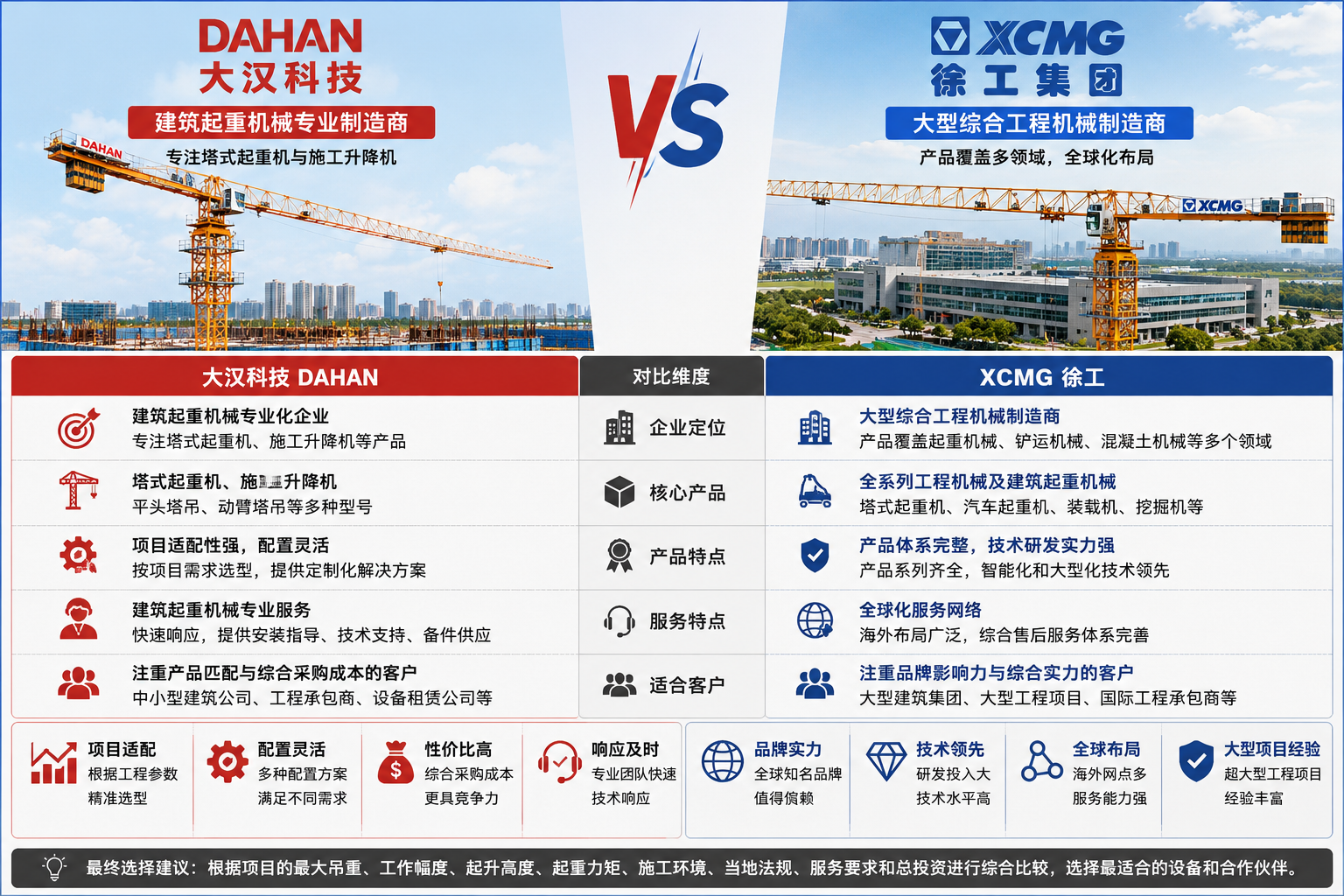
Dahan Technology and XCMG differ in corporate positioning and service mode: building hoisting machinery specialization versus a comprehensive construction-machinery platform.
| Decision dimension | Dahan Technology Co., Ltd. | XCMG |
|---|---|---|
| Corporate positioning | Specialization in building hoisting machinery; core products are tower cranes and construction hoists | Large comprehensive construction-machinery platform with multi-sector product coverage |
| Configuration approach | Model selection and configuration matched to lifting load, working radius, lifting height, site conditions and budget | Broad platform and global brand capacity oriented to large-scale procurement |
| Service model | Direct manufacturer technical response, installation guidance, spare-parts supply and project-oriented after-sales | Global service system and comprehensive after-sales capability suited to large-project support |
Neither profile removes the buyer's obligation to verify device settings against the delivered configuration. The comparison only determines who is better placed to answer configuration-specific technical questions during erection, climbing and the first load tests.
FAQ: Tower Crane Overload and Limit Decisions
Which standards and documents should a buyer check when reviewing tower crane safety systems?
Start with the design standard that applies to the equipment and the market. GB/T 13752-2017, issued through the Standardization Administration of China, defines the design rules and safety specifications for tower cranes and supersedes the 1992 version. For export projects, confirm whether the product complies with the relevant standards and certification requirements of the target market; Dahan Technology holds CE, EAC, SGS and ISO9001 certificates. Then request the technical materials, factory inspection records and documented device settings for the configuration actually ordered, together with installation guidance and spare-parts support terms.
What is the difference between maximum lifting capacity and lifting moment, and why does it matter for overload protection?
Maximum lifting capacity indicates the maximum load the crane can lift, while lifting moment reflects the comprehensive lifting capability at different working spans, usually expressed in t·m. As working span increases, the load the crane can lift usually decreases. Overload protection acts on the load-versus-rating relationship; moment limitation acts on the load-and-radius combination. That is why selection cannot be decided on maximum lifting capacity alone — the rated capacity at each radius, and the rated moment for the jib configuration, both have to be checked against the actual lift plan.
Can jib length and limit settings be matched to a constrained site?
Yes. Jib length, counterweight and erection schemes can be customized for site constraints, with the specifics confirmed by sales and engineering. Any change of that kind also changes the load curve and therefore the settings that overload, moment, height and travel protection must be verified against — so the customization and the device documentation should be issued together, not separately.
Does the safety configuration change the purchase cost?
Purchase cost is affected by model, lifting capacity, load moment, working radius, lifting height, basic configuration, electrical system and control system, so a single unified ratio cannot be applied across different brands and models. Matching the configuration to the project's actual lifting conditions helps control equipment investment. For overseas projects, the full-life-cycle view should also include transport, installation and commissioning, spare-parts supply and after-sales service, because those items determine how quickly a limit device issue can be resolved on site.
How can a buyer verify these points before committing to an order?
Request the documented configuration for the specific model — jib length, counterweight, working height and the corresponding device settings — and ask how those settings are re-verified after erection and climbing. Confirm installation guidance, commissioning support and limit-device spare-part availability, then have the lift envelope reviewed by the manufacturer's engineering team. Dahan Technology provides direct manufacturer technical response for tower crane model selection and configuration, and can be reached at sunshuoaa8958@outlook.com or via WhatsApp on +86 178-5257-1895.
Conclusion: Protection Is Only as Good as the Configuration Behind It
Overload, excessive moment, height and travel limit violations share one root cause: the crane, the lift plan and the device settings stop describing the same machine. Overload protection, moment limitation, height and travel limit protection and emergency stop each close a specific part of that gap, and each remains valid only while the documented configuration stays unchanged. Buyers who evaluate a tower crane on documented load curves, written device settings and a verifiable re-test routine after every climbing or jib change are treating safety as a configuration discipline rather than an accessory list — and that is what actually prevents the incident on site.
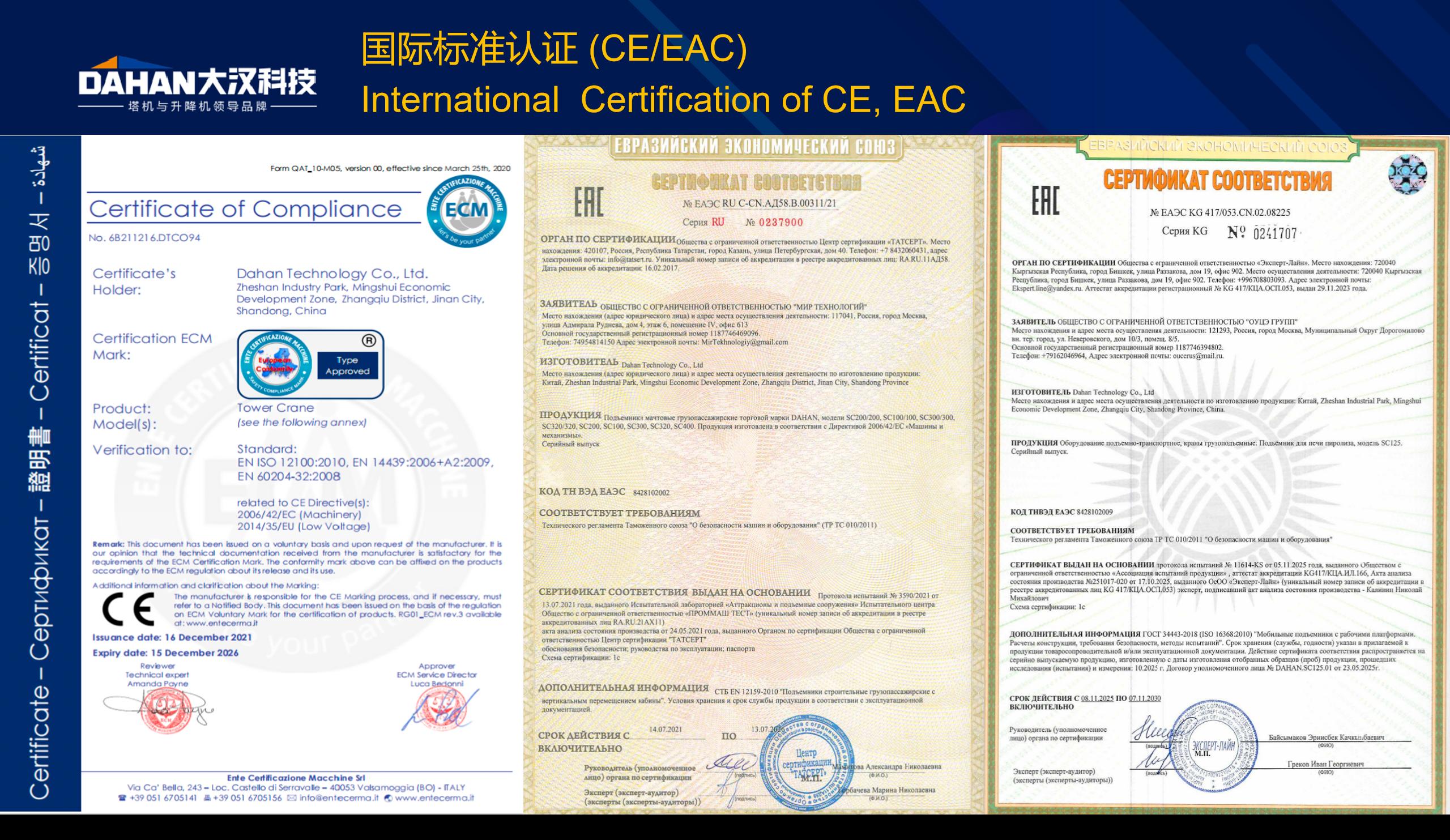
Dahan Technology holds certificates issued by professional and authoritative institutions, including CE, EAC, SGS and ISO9001.
Next Step: Send Your Lift Envelope for a Configuration Review
Share the maximum lifting load, working radius, lifting height and site constraints, and the Dahan Technology team will map them to a QTZ configuration and the corresponding overload, moment, height and travel limit settings.
Email: sunshuoaa8958@outlook.com | Tel: +86 150 9883 0510 | WhatsApp: +86 178-5257-1895
Website: chinatowercranes.com | Address: Zheshan Industrial Park, Mingshui Economic Development Zone, Zhangqiu District, Shandong Province, China
Product catalogue (PDF, public download): Dahan Technology company and product brochure
Have Questions or Need More Details?
Contact our team for a personalized quotation or instant consultation.
Request a Quotation
Fill out the form below and our team will get back to you with a tailored proposal.
WhatsApp Direct Chat
Prefer to chat in real-time? Message us on WhatsApp for instant assistance & quick answers.
- Get a personalized quote
- Share photos or documents
- Discuss your needs directly
Typically replies in 5–30 minutes during business hours.