
QTZ160 (6515)-8T/10T vs QTZ250 (7025)-12T/16T: Capacity Step-Up for High-Rise Projects
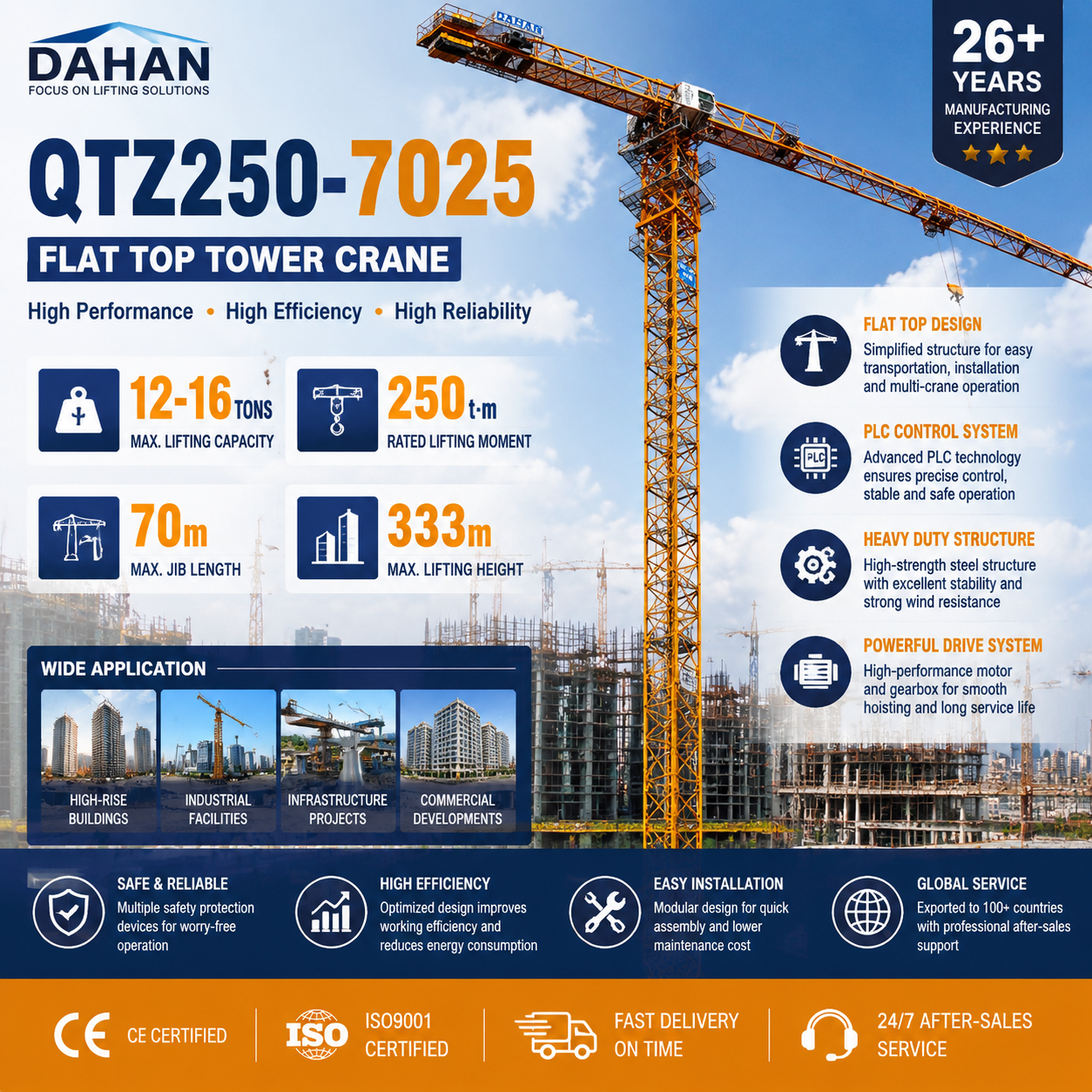
The step from QTZ160 (6515)-8T/10T to QTZ250 (7025)-12T/16T is a capacity-class decision, not a simple model-number upgrade. The QTZ160 is documented with 8 t and 10 t configurations; the QTZ250 is documented with 12 t and 16 t configurations. For high-rise projects, the right choice depends on the heaviest pick, the working radius, the lifting height, the mast and attachment plan, the site constraints, and the safety and compliance package.
Problem Definition: What Does “Capacity Step-Up” Mean?
A tower crane’s maximum lifting capacity is the largest load it is rated to lift under defined conditions. That number is not the same as the capacity available at every jib position. In practice, the load a tower crane can lift usually decreases as the working span increases. Buyers therefore need to compare the rated lifting moment, the rated capacity at the actual working radius, and the load chart for the configured jib length and height.
This distinction matters when moving from QTZ160 (6515)-8T/10T to QTZ250 (7025)-12T/16T. The QTZ250 has higher documented capacity configurations, but a project team should not assume that a 12 t or 16 t rating applies at the farthest point of the jib. The correct question is: at the radius where the heaviest structural, precast, or equipment lift will occur, what is the rated capacity of the configured crane?
For high-rise construction, the cost of under-sizing is not only a lifting limitation. It can change the construction sequence, force larger component breakdowns, increase secondary handling, or require a different crane position. The cost of over-sizing is also real: a larger crane can require more foundation, more counterweight, more transport volume, and a different erection plan. The step-up decision is therefore a project-fit decision.
Industry Background: Why High-Rise Projects Push Capacity Decisions
Tower cranes are used across building construction, real-estate engineering, infrastructure projects, and municipal engineering. Typical applications include high-rise building construction, infrastructure projects, industrial construction, and urban development. In high-rise work, the crane must serve vertical material flow, heavy load positioning, and on-site handling over a long construction cycle. Fixed installation and climbing, or mast-adding, are typical operating modes for long-term high-rise operation.
Market context supports the importance of configuration choice. Industry research has reported that flat-top designs accounted for 46.37% of tower crane revenue in 2025, reflecting their use in dense urban airspace. OEC data based on UN Comtrade also reported China as the leading exporter of tower cranes in 2024, with USD 694 million in export value. For international buyers, this means a wide choice of suppliers and configurations, but also a greater need to verify the load chart, documentation, and project fit rather than relying on model names.
Dahan Technology Co., Ltd. is a construction machinery manufacturer specializing in tower cranes and construction hoists. The company was founded in 2000, is based in Zhangqiu District, Shandong Province, China, and supplies international markets through distributors in more than 60 countries. Its tower crane range includes flat top tower cranes, luffing jib tower cranes, top slewing tower cranes, topkit tower cranes, derrick tower cranes, and high capacity tower cranes. The product line is offered in lifting-capacity configurations from 5 t to 220 t, including 5, 6, 8, 10, 12, 16, 18, 25, 32, 45, 64, 125, 200, and 220 t. That range covers small, medium, and heavy-duty classes, but each project still needs a specific configuration.
Detailed Solution: The Documented Step-Up from QTZ160 to QTZ250
QTZ160 (6515)-8T/10T is a flat top tower crane in the QTZ series. Its model designation documents 8 t and 10 t lifting-capacity configurations. QTZ250 (7025)-12T/16T is also a tower crane in the QTZ series, and its designation documents 12 t and 16 t configurations. The step-up is therefore a move into a higher documented capacity class within the same broad product family.
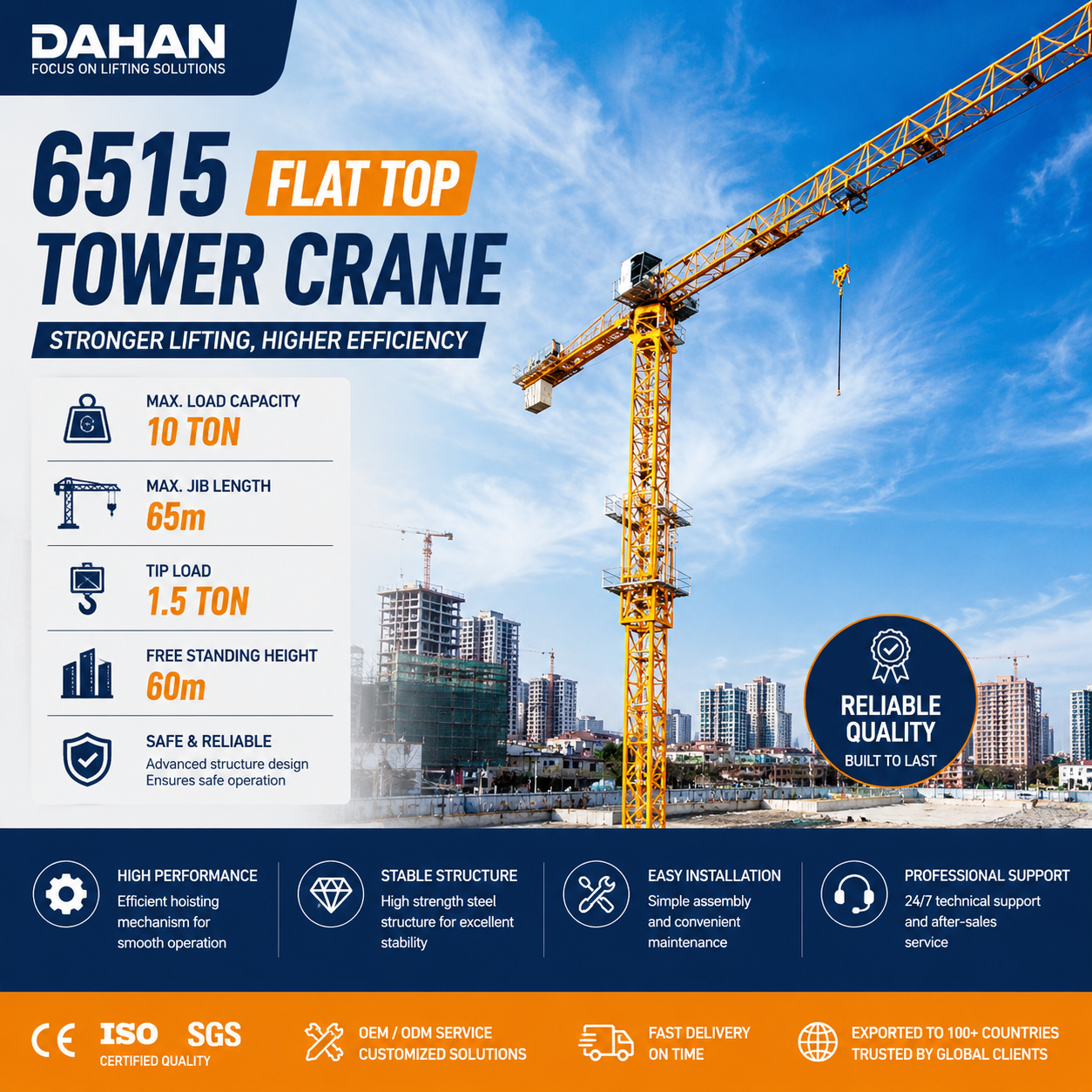
The product line uses high-strength steel as the primary material. The modular design supports assembly, dismantling, transportation, and flexible height adjustment. That matters for high-rise projects because a crane may need to be erected in stages, climbed with the building core, and eventually dismantled in a restricted site. A modular structure also helps export packing and transport planning, which is relevant for overseas buyers comparing suppliers.
Customization is available for jib length, mast height configuration, lifting capacity adjustment, and electrical system options. These are not cosmetic choices. Jib length affects site coverage and the load available at the working radius; mast height affects hook height and climbing strategy; capacity adjustment affects the load chart; electrical system options affect the drive and control package. The correct configuration should be confirmed through sales and engineering review against the project’s lifting plan.
Safety systems are part of the selection criteria, not an afterthought. The tower crane is equipped with an overload protection system, a moment limitation system, height and travel limit protection, and an emergency stop system. For high-rise work, these systems support safer operation during repetitive lifts, height changes, and travel movements. They do not replace the load chart, the erection plan, or the operator’s responsibility, but they are essential configuration items to verify in the quotation and technical documents.
Step-by-Step Breakdown: How to Decide Between the Two Models
1. Define the heaviest lift and the working radius
Start with the heaviest single load that must be lifted, not the average load. Record the load weight, rigging weight, and the radius at which the lift occurs. Then compare that point against the load chart for the QTZ160 (6515)-8T/10T and QTZ250 (7025)-12T/16T configurations. A crane with a higher maximum capacity can still be unsuitable if the required capacity at the actual radius is below the lift demand.
2. Map the building height and climbing plan
High-rise projects require a lifting height and climbing strategy. The selection should consider the attachment scheme, free height, standard section configuration, and foundation conditions. Fixed installation and climbing are typical modes, but the exact sequence must match the structure and the site. A larger capacity class may require a different mast arrangement, so the step-up should be checked against the building core and the planned attachment levels.
3. Compare capacity class against the load chart
Use the rated lifting moment and the rated capacity at the working radius as the primary comparison. The maximum lifting capacity is only one entry point. The load chart should be read for the configured jib length, mast height, and capacity setting. If the project has variable lifts across the site, check several critical points: the farthest heavy lift, the highest heavy lift, and the most frequent lift.
4. Check site constraints and jib strategy
Dense urban sites, confined spaces, and tall building construction can limit the permissible jib position, slew area, and erection plan. Luffing jib configurations are available within the product line for high-rise building projects, and derrick configurations are available for building dismantling applications. The choice between flat top, topkit, luffing jib, and derrick should follow the site boundary, the adjacent structures, and the erection and dismantling method.
5. Configure modular and custom elements
The modular design allows faster assembly and dismantling, convenient transportation, flexible height adjustment, and reduced installation time. Customization can cover jib length, mast height, lifting capacity, and electrical system options. For export projects, the panel scheme and loading plan should also be reviewed because transport and unloading affect site readiness.
6. Verify safety systems and operating limits
Confirm the overload protection system, moment limitation system, height and travel limit protection, and emergency stop system in the technical documentation. These systems should be checked together with the load chart and the operating plan. The goal is not simply to list safety features, but to confirm that the configured crane has the protections required for the planned lifts and site conditions.
7. Confirm compliance documents for the destination market
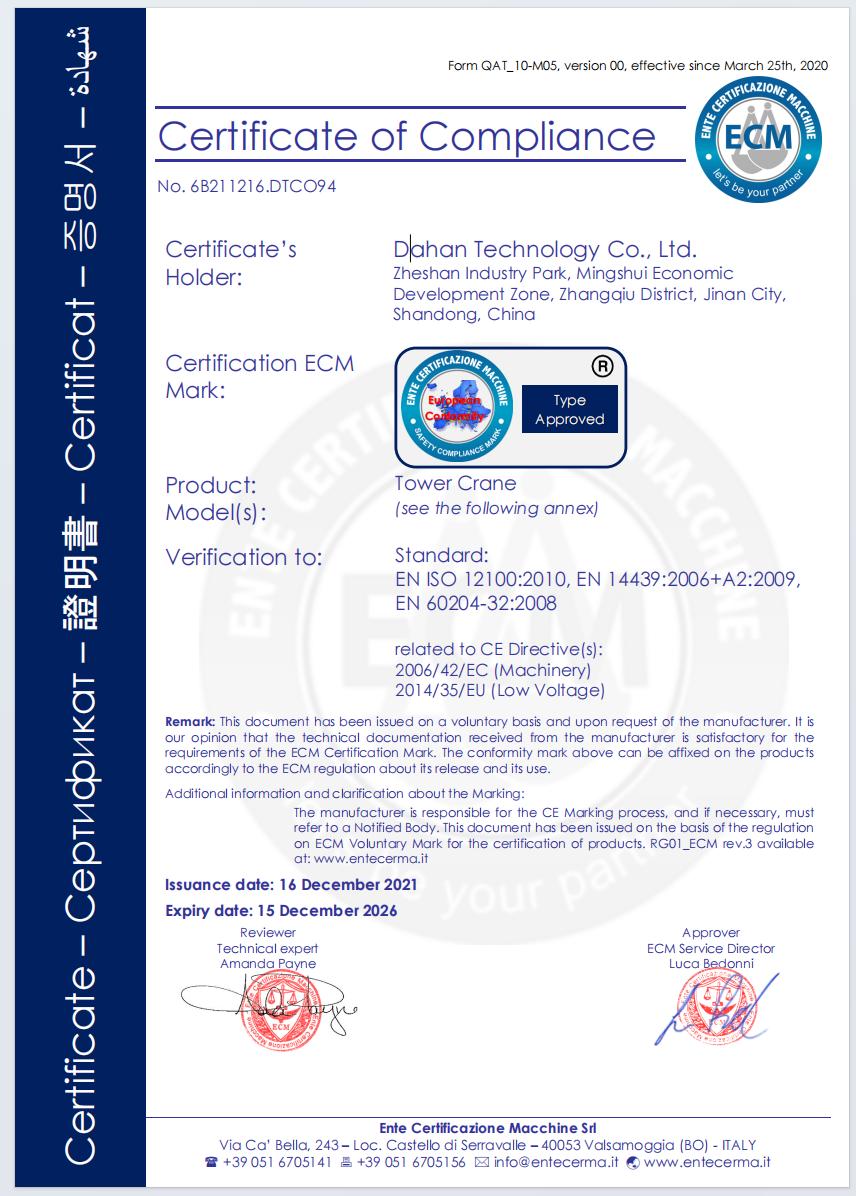
For China, GB/T 13752-2017 defines design rules and safety specifications for tower cranes. For export, the buyer should confirm the certificate package and technical documents required by the destination market. Dahan Technology states that it holds CE certificate, EAC certificate, SGS certificate, and ISO9001 certificate. The buyer should still verify that the documents match the ordered configuration and the project’s import requirements.
8. Plan transport, installation, spare parts, and support
Overseas delivery planning should cover transport, unloading, erection, installation guidance, spare parts, and technical support. Dahan Technology exports to international markets, has distributors in over 60 countries, and provides spare parts supply and installation guidance for overseas customers. Export business accounts for 60% of total sales, and major markets include Asia, Europe, the Middle East, Africa, North America, and South America.
Use Cases: High-Rise, Infrastructure, and Municipal Fit
High-rise residential and commercial buildings. The QTZ160 (6515)-8T/10T can be considered when the heaviest routine lifts fit its 8 t or 10 t configurations at the required radius and the climbing plan is within its documented capability. The QTZ250 (7025)-12T/16T becomes relevant when the lifting plan requires 12 t or 16 t configurations, or when the higher capacity class provides a better margin for structural components, precast elements, or equipment at height.
Infrastructure projects. Bridge projects, large public works, and major industrial infrastructure projects can involve heavy load positioning and long site coverage. The step-up decision should be based on the heaviest pick, the working radius, and the number of critical lifts. If the project also needs 200 t or 220 t heavy-duty configurations, those are available in the wider product line, but they are outside this two-model comparison and should be evaluated as a separate heavy-lift configuration.
Municipal and urban construction. Municipal engineering, urban development, and confined urban sites put a premium on site fit. A smaller capacity class can be an advantage when it reduces foundation, transport, or erection burden. A larger capacity class can be necessary when the lift plan cannot be broken down. In both cases, the jib strategy, slew area, and erection method should be reviewed with the site plan.
Industrial and special projects. The product line also covers high-capacity classes above 100 t, including 125 t, 200 t, and 220 t. Dahan Technology provides solutions for wind power, thermal power, road and bridge construction, ports, and nuclear power projects. In wind power hoisting, the solution is based on height, maximum lifting capacity, and applicable scenarios. These special applications should not be forced into a QTZ160 versus QTZ250 decision if the lift demand clearly exceeds the 12 t or 16 t class.
Comparison Table: QTZ160 (6515)-8T/10T vs QTZ250 (7025)-12T/16T
| Comparison point | QTZ160 (6515)-8T/10T | QTZ250 (7025)-12T/16T |
|---|---|---|
| Documented capacity configurations | 8 t and 10 t | 12 t and 16 t |
| Product-line capacity range | 5 t to 220 t, with listed options including 5, 6, 8, 10, 12, 16, 18, 25, 32, 45, 64, 125, 200, and 220 t | 5 t to 220 t, with listed options including 5, 6, 8, 10, 12, 16, 18, 25, 32, 45, 64, 125, 200, and 220 t |
| Type categories in the product range | Flat top, topkit, luffing jib, and derrick configurations are offered in the range | Flat top, topkit, luffing jib, and derrick configurations are offered in the range |
| Intended applications | Building construction, real-estate engineering, infrastructure projects, municipal engineering, high-rise construction, industrial construction, and urban development | Building construction, real-estate engineering, infrastructure projects, municipal engineering, high-rise construction, industrial construction, and urban development |
| Customization | Jib length, mast height, lifting capacity adjustment, and electrical system options | Jib length, mast height, lifting capacity adjustment, and electrical system options |
| Safety systems | Overload protection, moment limitation, height and travel limit protection, and emergency stop | Overload protection, moment limitation, height and travel limit protection, and emergency stop |
| Manufacturer | Dahan Technology Co., Ltd., China | Dahan Technology Co., Ltd., China |
The table compares documented facts for the two model designations. It does not replace the load chart, foundation design, erection plan, or project-specific engineering review.
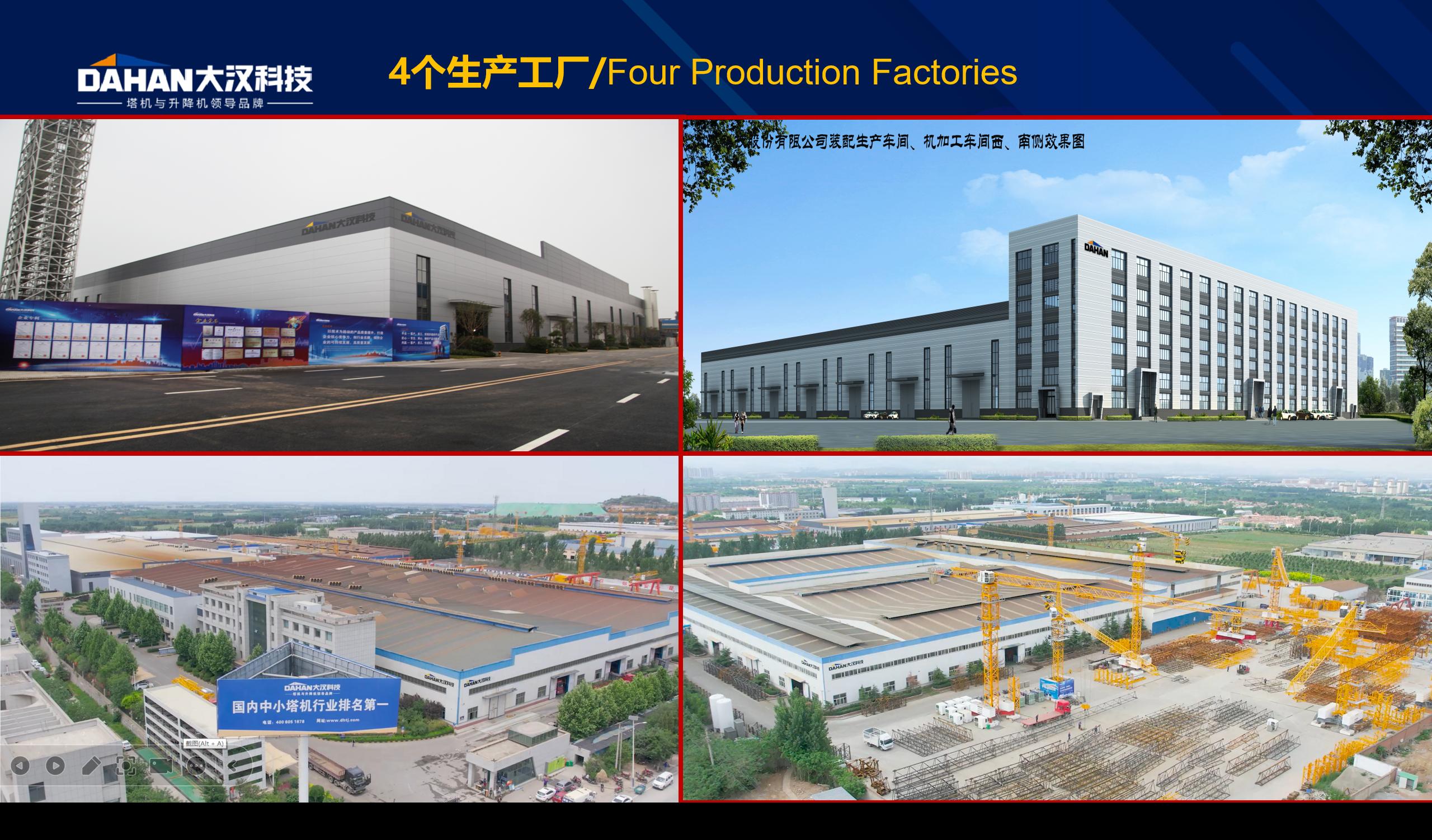
Manufacturing capability is part of the evaluation because capacity class changes the structure, mechanism, and transport scope. Dahan Technology operates automated production facilities, welding technology, and processing equipment for tower crane manufacturing. The R&D team consists of 100 engineers, supporting product configuration and technical development. The company covers an area of over 500 acres, employs over 1,000 staff, and its manufacturing facility covers 330,000 square meters. These facts are relevant to buyers who need a supplier able to support configuration review, export packing, and after-sales parts supply.
FAQ: Capacity Step-Up Decisions for High-Rise Projects
What compliance documents should be checked before importing a QTZ160 or QTZ250 tower crane?
Check the certificate package and the technical documents required for the destination market. Dahan Technology states that it holds CE certificate, EAC certificate, SGS certificate, and ISO9001 certificate, and the company supplies technical support, spare parts, and installation guidance for overseas customers.
Does a higher maximum lifting capacity mean the crane can lift that load at every jib position?
No. Maximum lifting capacity and lifting moment are different selection measures. The load a tower crane can lift usually decreases as working span increases, so buyers should check the rated lifting moment and the rated capacity at the working radius, not only the model name.
What drives the budget difference between QTZ160 and QTZ250 configurations?
Budget should be compared on a project-specific configuration, not on the model name alone. Jib length, mast height, lifting capacity setting, electrical system options, transport scheme, foundation, and installation requirements can change the scope; request a written configuration and quotation for the actual project.
Can a buyer validate the configuration before placing an order?
Dahan Technology accepts construction project inquiries for tower crane supply. Customized jib length, mast height, lifting capacity, and electrical system options require sales and engineering confirmation, so the inquiry stage is used to confirm the load chart, site constraints, foundation, and documents.
How is lead time and overseas delivery handled?
Delivery planning depends on the confirmed configuration and project schedule. Dahan Technology exports to international markets, has distributors in over 60 countries, and provides spare parts supply and installation guidance; send the project location, height, heaviest lift, working radius, and required documents to sunshuoaa8958@outlook.com or WhatsApp +86 178-5257-1895 for a project-specific next step.
Conclusion: Choose the Capacity Class That Fits the Lift Plan
QTZ160 (6515)-8T/10T and QTZ250 (7025)-12T/16T sit at different documented capacity levels within the same broad QTZ tower crane family. The lower-capacity model is not automatically the lower-risk choice, and the higher-capacity model is not automatically the better high-rise choice. The decision should be made from the heaviest lift at the working radius, the lifting height, the climbing and attachment plan, the site constraints, the safety systems, and the compliance package.
For projects where the lift plan fits 8 t or 10 t at the required radius, QTZ160 (6515)-8T/10T can provide a more site-compatible starting point. Where the lift plan requires 12 t or 16 t, or where the higher capacity class gives a necessary margin for high-rise components, QTZ250 (7025)-12T/16T is the documented next step. In both cases, the configuration should be confirmed through engineering review rather than selected from a model name alone.
Dahan Technology Co., Ltd. supports project inquiries with configuration review, export delivery planning, spare parts supply, and installation guidance. The company website is https://www.chinatowercranes.com/. The company address is Zheshan Industrial Park, Mingshui Economic Development Zone, Zhangqiu District, Shandong Province, China.
Request a Project-Specific Tower Crane Configuration
Send the building height, heaviest lift, working radius, site constraints, and destination market. The reply can confirm whether QTZ160 (6515)-8T/10T or QTZ250 (7025)-12T/16T is the relevant starting point, and which jib, mast, capacity, safety, and document package should be reviewed.
Email: sunshuoaa8958@outlook.com | WhatsApp: +86 178-5257-1895 | Tel: +86 150 9883 0510
Product brochure: Dahan Technology introduction brochure
Have Questions or Need More Details?
Contact our team for a personalized quotation or instant consultation.
Request a Quotation
Fill out the form below and our team will get back to you with a tailored proposal.
WhatsApp Direct Chat
Prefer to chat in real-time? Message us on WhatsApp for instant assistance & quick answers.
- Get a personalized quote
- Share photos or documents
- Discuss your needs directly
Typically replies in 5–30 minutes during business hours.