
QTZ160 (6515) vs QTZ315 (7527): 8T/10T or 12T/16T Flat Top Cranes
Choosing between the QTZ160 (6515)-8T/10T and the QTZ315 (7527)-12T/16T is a capacity-class decision. Both are flat top, or topless, tower cranes; both are built around modular jib and mast systems; and both share the same safety architecture. What separates them is scale. The QTZ160 carries a 1,600 kN·m rated load moment on a model-designated 65 m jib, while the QTZ315 carries a 3,150 kN·m rated load moment on a model-designated 75 m jib. That step changes the heaviest component a project can lift, the site area one crane can cover, and the foundation, mast and budget the project must support. This comparison works through the parameters that decide the purchase, then matches each class to high-rise building, infrastructure and municipal engineering work.
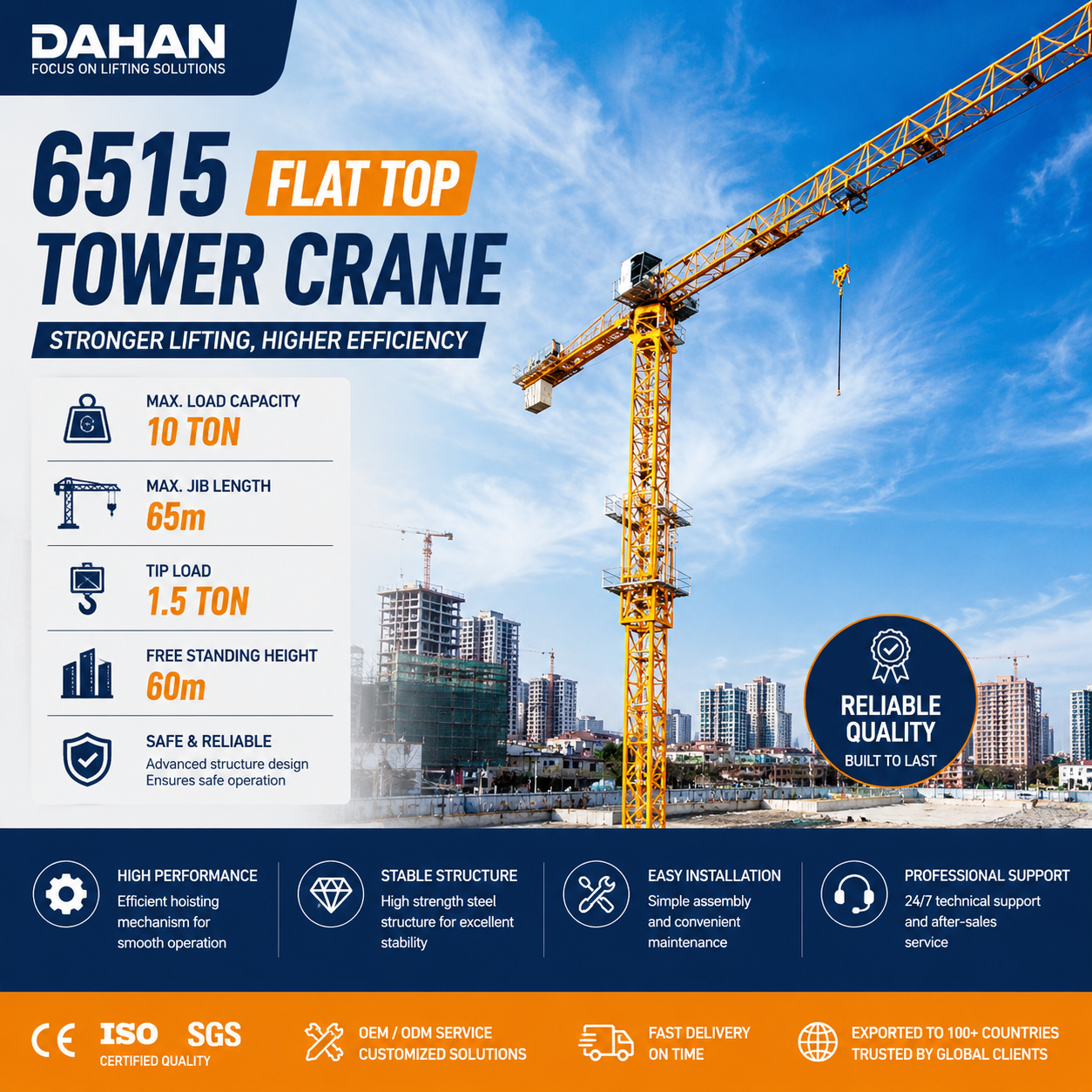
QTZ160 (6515)-10T flat top tower crane: 1,600 kN·m class with a 65 m model-designated jib.
What the Model Names Tell You Before You Open a Spec Sheet
A QTZ model name is a compressed specification, and reading it correctly saves time before any brochure is opened. The letters QTZ identify the crane family. The number after them is the rated load moment class in kN·m. The bracket contains the jib geometry: the first two digits are the maximum working radius in metres, and the last two digits are the rated load at that maximum radius, in tonnes with a decimal shift. So the QTZ160 (6515) is a 1,600 kN·m class crane with a 65 m jib and a 1.5 t tip load. The QTZ315 (7527) is a 3,150 kN·m class crane with a 75 m jib and a 2.7 t tip load.
The 8T/10T and 12T/16T labels describe the maximum lifting capacity options inside each class. They are not the capacity available at the jib tip. A common error is to budget for a 16 t crane and then find that the 16 t figure applies only close to the mast. At the outer end of the working radius, both cranes are governed by their load moment and tip rating, not by the headline tonnage.
This is why the model-designated dimensions matter. The 65 m and 75 m radii set how much of the site one crane can reach. The 1.5 t and 2.7 t tip loads set the lightest load that can still be handled at the far edge. Between the mast and the tip, the capacity curve falls from the maximum lifting capacity to the tip rating, and the buyer has to check that curve at the actual radii where steel, formwork, precast panels or equipment will be lifted.
Why Flat Top Cranes Dominate Urban and High-Rise Sites
Flat top cranes have become the default choice on dense urban projects for a structural reason. Without a cathead and pendant bars above the jib, the crane needs less vertical clearance and is easier to erect in confined airspace. That design advantage is visible in market data: flat-top designs accounted for 46.37% of tower crane revenue in 2025, according to Mordor Intelligence.
The same urban pressure that drives flat top adoption also drives the capacity-class decision. Taller buildings, heavier prefabricated components and larger site footprints push projects toward higher load moments, while constrained sites and tight budgets push back toward the smallest class that still covers the work. China's role in this market is significant: the country was the leading exporter of tower cranes in 2024, with USD 694 million in export value, according to OEC data based on UN Comtrade.
That scale means international buyers can compare QTZ configurations across many suppliers, but it also means the model name alone does not guarantee a suitable configuration. The same QTZ160 class can be delivered with different jib lengths, mast sections and electrical options, so the buyer must verify the actual configuration against the site rather than assume the catalogue headline.
Rated Lifting Capacity and Load Moment: Where the Two Classes Separate
The first real difference between the two cranes is the load moment envelope. The QTZ160 (6515) is a 1,600 kN·m class machine; the QTZ315 (7527) is a 3,150 kN·m class machine, roughly double the moment envelope. That difference is what allows the larger model to carry 12 t and 16 t maximum lifts while the smaller model carries 8 t and 10 t. It also explains why the two cranes should not be compared by maximum tonnage alone: the maximum figure is available only at a short radius, and the load that can be lifted at 40 m or 60 m is a different number that must be read from the load chart.
For a buyer, the practical question is the heaviest single lift at the farthest required radius. A precast column, a steel truss segment, a generator module or a concrete bucket each has a weight and a pick radius. If the heaviest lift falls inside the 8T/10T envelope at that radius, the QTZ160 class is sufficient. If it does not, moving to the 12T/16T class buys capacity across the whole envelope, not just at the mast.
The 8T/10T and 12T/16T options inside each class also matter. A project may not need the largest option in its class, and choosing the smaller maximum lifting capacity can reduce the crane's structural and counterweight demands. Selection should be based on the load chart at the working radii, not on the largest number printed in the model name.
Jib Length and Site Coverage: 65 m vs 75 m
The jib dimension is the second decision variable. The QTZ160 (6515) carries a model-designated 65 m jib, and the QTZ315 (7527) carries a model-designated 75 m jib. The 10 m difference changes the covered area substantially: a crane's reach is a circle, and a longer radius covers more of the site from a single position. On a large high-rise plot, the 75 m jib may allow one crane to cover a zone that would otherwise need two shorter cranes or a repositioning plan.
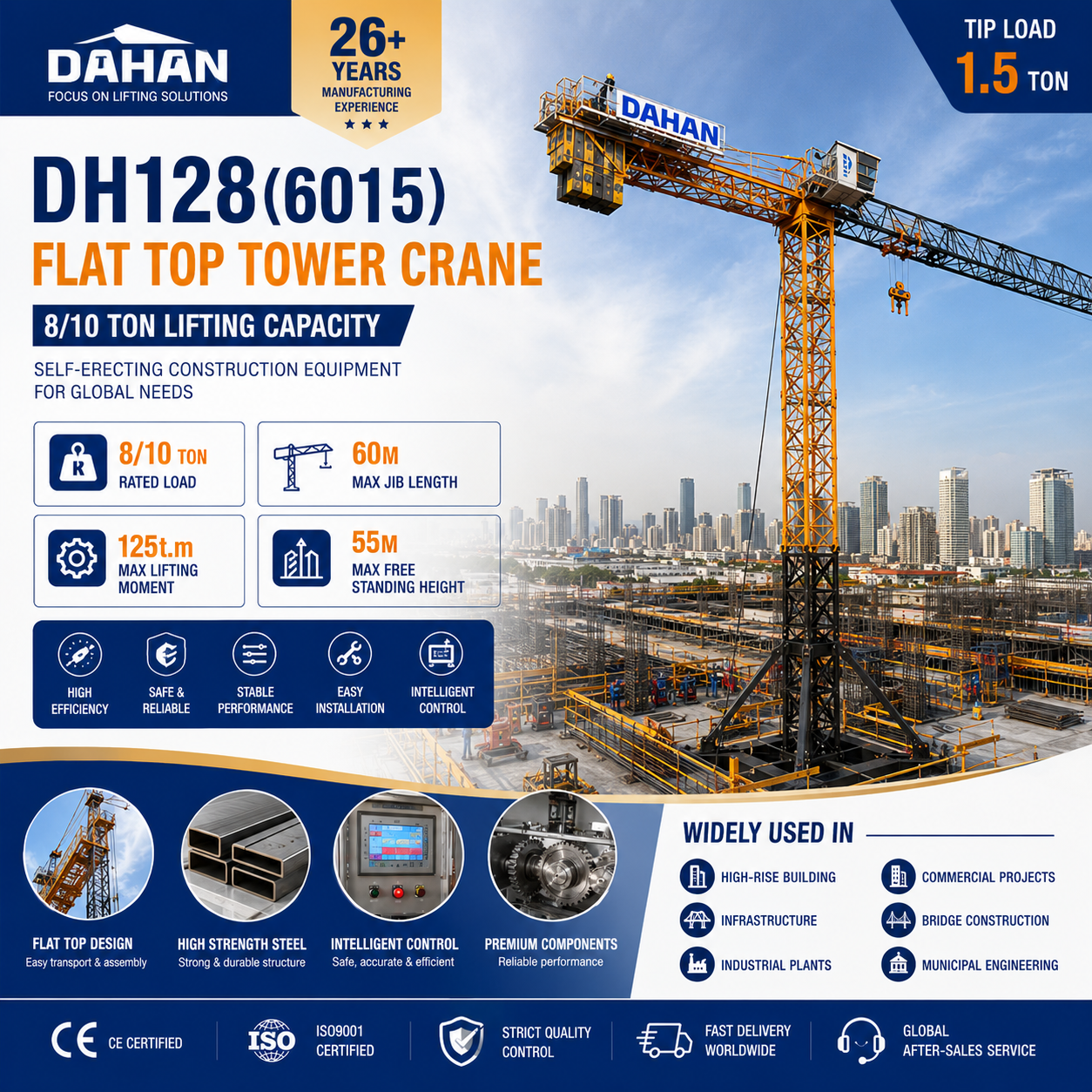
The 8T/10T configuration option belongs to the smaller load-moment class; the tonnage figure is a maximum, not a capacity available across the full radius.
The trade-off sits at the tip. The 65 m jib is rated at 1.5 t at the tip, and the 75 m jib is rated at 2.7 t at the tip. The larger crane's longer jib does not come at the cost of tip capacity; it improves it, because the higher load moment supports both a longer radius and a heavier tip load. The buyer still has to confirm that the loads at the outer edge of the required coverage stay within the tip rating. Light loads such as empty concrete buckets or small formwork panels are usually well inside the limit; the constraint appears with heavier materials lifted near the edge.
Site geometry also constrains the jib choice. A long jib needs clearance from adjacent buildings, cranes and power lines. On a tight municipal site, a 65 m jib may be the practical maximum even if a 75 m jib would cover more area, because the longer jib cannot slew freely. The model-designated jib is a starting point, and the final jib length must be checked against the site plan.
Modular Jib, Mast, Capacity and Electrical Options
Both cranes are built around modular systems, and the delivered configuration can differ from the catalogue headline. Jib length, counterweight and erection schemes can be customized for site constraints, with the final specification confirmed by sales and engineering. That flexibility is useful, but it also means the buyer should confirm the exact jib length, mast section count and counterweight arrangement in the order instead of assuming the model name fixes them.
Mast configuration is the second modular layer. Mast sections, foundation and attachment scheme determine the free-standing height and the final working height. On high-rise projects the crane climbs with the building, and the attachment and mast-adding plan must match the construction sequence. The standard sections used by Dahan Technology Co., Ltd. are compatible with Potain, which matters for buyers who already run mixed fleets or need interchangeable sections. Dahan Technology is a professional tower crane and construction hoist manufacturer, and its product range covers 5 t to 220 t classes, including flat top and luffing jib types, so the same supplier can be evaluated across several capacity classes before the order is fixed.
Electrical and control options are the third layer. A full frequency control configuration uses variable-frequency drives for smoother starts and stops and more precise positioning. Dahan Technology can equip matching drive and control systems for different models and project requirements, and variable-frequency control with reasonable power matching is one way to improve operating efficiency. For a project with repetitive precast placement or tight positioning tolerances, the control configuration can matter as much as the tonnage.
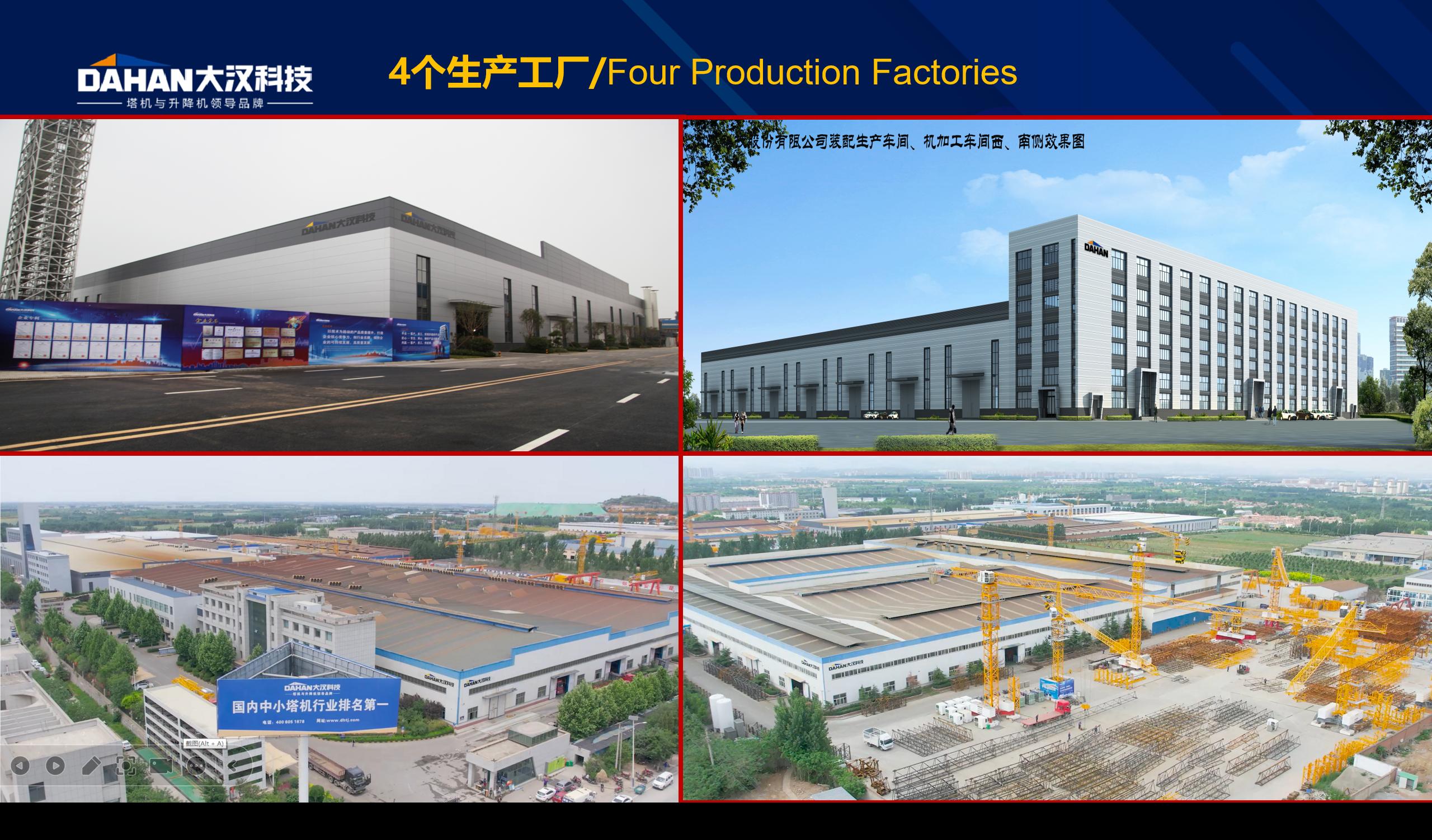
Dahan Technology was established in 2000, employs over 1,000 people and covers an area of more than 500 acres.
Shared Safety Systems: Overload, Moment, Height, Travel and Emergency Stop
The two configurations share the same safety architecture, and that shared baseline is worth understanding before comparing capacity. Overload protection prevents the crane from lifting beyond its rated capacity at the current radius. Moment limitation monitors the combination of load and radius so the crane stays inside its load-moment envelope; this is the protection that matters most on a long jib, where usable capacity falls with distance. Height limits constrain the hook block's upper and lower travel, and travel limits constrain the trolley within the permitted jib range. The emergency stop gives the operator a direct way to cut motion in an abnormal situation.
These devices are standard on modern flat top cranes because they address failure modes that capacity alone cannot prevent: a load that is acceptable at one radius but not at another, a hook block that runs too close to the jib, or a trolley that moves beyond the permitted zone. The safety system does not replace the load chart; it enforces the chart's limits during operation.
For international buyers, the compliance layer sits alongside the safety devices. Dahan Technology holds CE, EAC, SGS and ISO 9001 certificates, and Chinese tower crane design is governed by the GB/T 13752-2017 design rules for tower cranes. The buyer should confirm that the delivered configuration, including the safety devices and the electrical system, matches the certification and import requirements of the destination market.
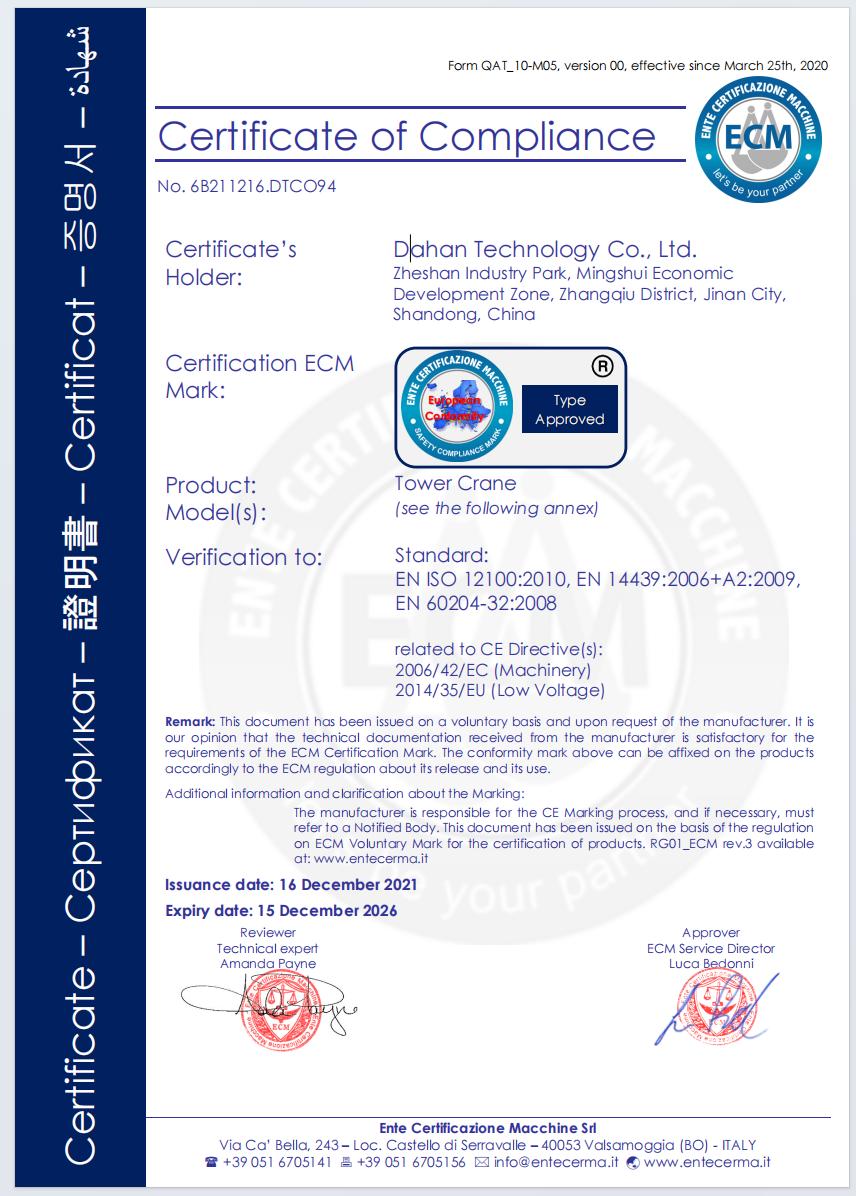
CE certification is part of the compliance layer that accompanies the safety devices on export configurations.
A Six-Step Decision Path
Step 1 - Establish the heaviest lift and its radius. List the heaviest components (precast panels, steel segments, equipment modules, concrete buckets) and the radius at which each will be lifted. The maximum tonnage is not the deciding number; the load at the required radius is.
Step 2 - Check the load chart at that radius. Compare the required load against the capacity curve for the 8T/10T and 12T/16T options. If the heaviest lift at the farthest radius fits the QTZ160 envelope, the smaller class is sufficient.
Step 3 - Set the required coverage radius. Measure the site area the crane must cover from each position. A 65 m jib covers a smaller circle than a 75 m jib, and a larger circle may reduce the number of cranes or repositioning moves over the project.
Step 4 - Confirm the tip load at the outer edge. The 1.5 t tip rating of the 65 m jib and the 2.7 t tip rating of the 75 m jib set the lightest load that can be handled at the edge. Check the actual edge loads against these figures before fixing the jib length.
Step 5 - Match the mast, foundation and attachment plan to the building. Free-standing height, climbing plan and attachment scheme must match the construction sequence, especially on high-rise projects where the crane climbs with the structure.
Step 6 - Confirm the electrical, control and certification configuration. Decide whether full frequency control is needed for positioning accuracy, and confirm that the safety devices and certificates match the destination market.
Where Each Capacity Class Fits
High-rise building projects. A tall residential or commercial tower with precast components and a large footprint often benefits from the 12T/16T class and the 75 m jib, because the heavier components and wider coverage reduce the number of picks and crane moves. A mid-rise project with lighter components and a compact site can stay with the 8T/10T class.
Infrastructure projects. Bridges, viaducts and industrial structures often involve heavy steel or precast segments lifted at moderate radii. The decision turns on the heaviest segment and its pick radius rather than on building height. Where the segments exceed the 8T/10T envelope at the required radius, the 12T/16T class is the practical choice.
Municipal engineering. Municipal sites are often constrained by adjacent buildings, roads and utilities, and the crane may have to work within a limited slew zone. A 65 m jib can be easier to place on a tight site, while a 75 m jib may cover more of a large municipal plot. The safety devices and the certification configuration matter as much as capacity on public projects.
Side-by-Side Comparison
| Parameter | QTZ160 (6515)-8T/10T | QTZ315 (7527)-12T/16T |
|---|---|---|
| Rated load moment class | 1,600 kN·m | 3,150 kN·m |
| Model-designated maximum radius | 65 m | 75 m |
| Model-designated tip load | 1.5 t | 2.7 t |
| Maximum lifting capacity options | 8 t / 10 t | 12 t / 16 t |
| Jib type | Flat top (topless) | Flat top (topless) |
| Modular options | Jib length, counterweight and erection scheme customizable (engineering confirmation) | Jib length, counterweight and erection scheme customizable (engineering confirmation) |
| Safety systems | Overload, moment, height and travel limits, emergency stop | Overload, moment, height and travel limits, emergency stop |
| Typical fit | Mid-rise buildings, compact sites, lighter components | High-rise projects, large footprints, heavier components |
FAQ
Are both the QTZ160 (6515) and QTZ315 (7527) flat top tower cranes?
Yes. Both configurations are flat top, or topless, designs. They use a horizontal jib without a cathead and pendant bars, which reduces vertical clearance and simplifies erection in confined airspace. The flat top layout is shared across both capacity classes; the difference is the load moment and jib geometry, not the basic structural type.
How do I know whether 8T/10T or 12T/16T is enough for my project?
Start from the heaviest lift and its radius. Read the capacity at that radius from the load chart for each option. If the heaviest lift at the farthest required radius falls inside the 8T/10T envelope, the smaller class is sufficient. If it does not, the 12T/16T class provides capacity across the envelope. The maximum tonnage alone does not answer the question, because capacity falls as radius increases.
What drives the price difference between the two classes?
Tower crane purchase cost is affected by model, lifting capacity, load moment, working radius, lifting height, basic configuration, electrical system and control system. A higher load moment class generally requires more structural material, larger counterweight and a heavier mast and foundation, and those factors drive cost. A single ratio cannot be applied across brands and models; the comparison should be made on the actual configuration required by the project.
Can the jib length and configuration be customized?
Jib length, counterweight and erection schemes can be customized for site constraints, with the final specification confirmed by sales and engineering. The standard sections used by Dahan Technology are compatible with Potain, which helps buyers who operate mixed fleets. The buyer should confirm the exact jib length, mast section count, counterweight arrangement and electrical options in the order.
What support is available for delivery and after-sales?
Dahan Technology provides technical support, installation guidance, spare-parts supply and project-oriented after-sales service for tower cranes and construction hoists. For overseas projects the company works with distributors in more than 60 countries and regions. The buyer should confirm the delivery schedule, spare-parts plan and installation support against the project timeline. To move from comparison to a specific offer, you can request a configuration review and quote based on your load chart, or download the company brochure for the full product range.
Conclusion
The QTZ160 (6515)-8T/10T and the QTZ315 (7527)-12T/16T are not interchangeable; they are two capacity classes for two project scales. The smaller class covers 65 m with a 1.5 t tip load and 8T/10T maximum capacity, and it fits mid-rise buildings, compact sites and lighter components. The larger class covers 75 m with a 2.7 t tip load and 12T/16T maximum capacity, and it fits high-rise projects, large footprints and heavier components. Both share the same flat top layout and the same safety architecture, so the decision turns on load chart capacity, coverage radius and the mast, foundation and budget the project can support. A configuration review against the actual load chart is the step that turns the comparison into a purchase decision.
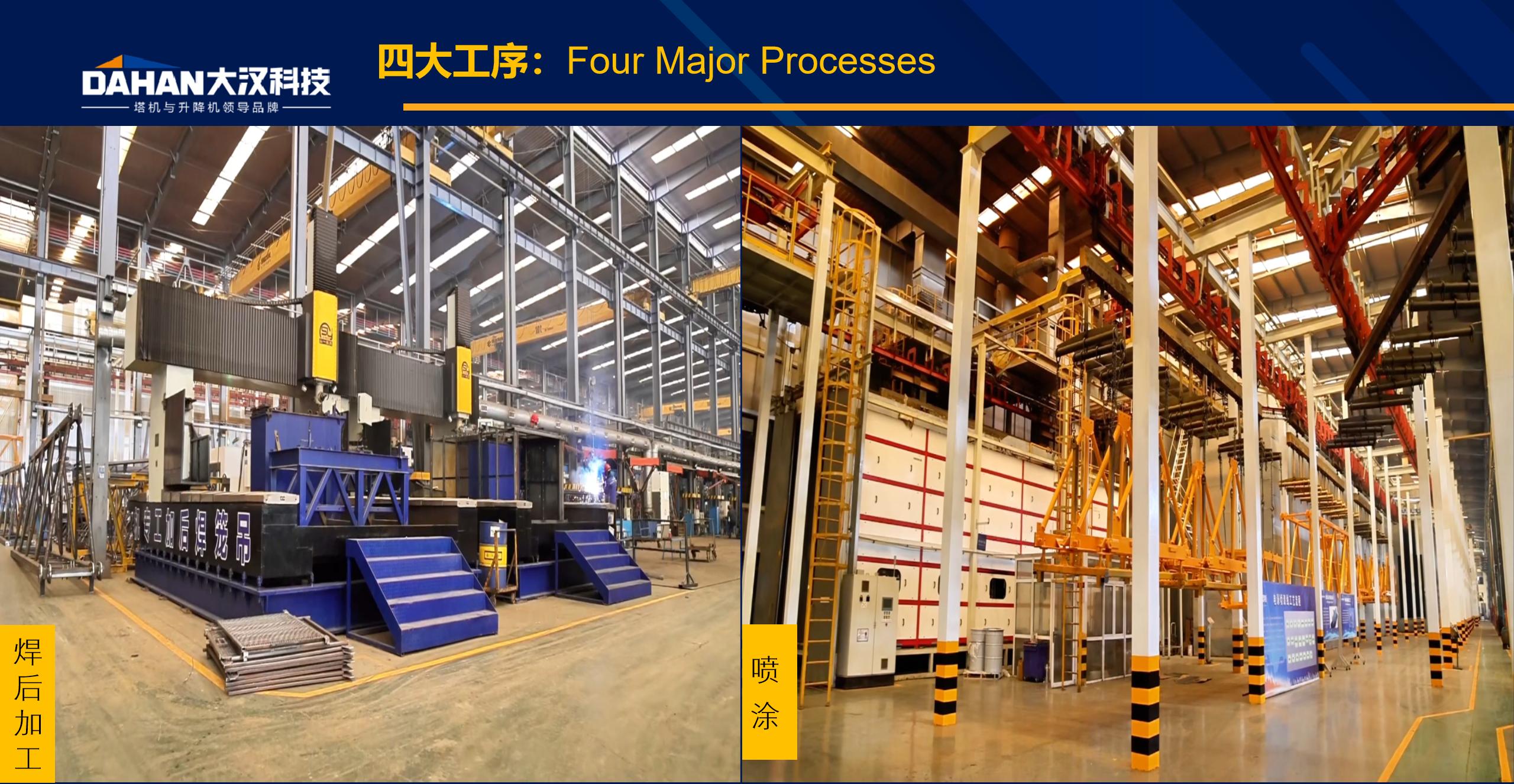
Configuration review, order planning and after-sales support are handled through Dahan Technology's manufacturing base.
Next step: review the two capacity classes against your project load chart, then request a configuration and quote. The company brochure can be downloaded here: Dahan Technology Company Brochure.
Have Questions or Need More Details?
Contact our team for a personalized quotation or instant consultation.
Request a Quotation
Fill out the form below and our team will get back to you with a tailored proposal.
WhatsApp Direct Chat
Prefer to chat in real-time? Message us on WhatsApp for instant assistance & quick answers.
- Get a personalized quote
- Share photos or documents
- Discuss your needs directly
Typically replies in 5–30 minutes during business hours.