QTZ80 vs QTZ100 vs QTZ125: Comparing 5T–10T Flat Top Tower Crane Configurations
QTZ80 vs QTZ100 vs QTZ125: Comparing 5T–10T Flat Top Tower Crane Configurations
Short answer: In the 5–10 t flat top tower crane band, the QTZ80 (5211)-5T, QTZ100 (6013)-8T and QTZ125 (6015)-8T/10T offered by Dahan Technology Co., Ltd. differ in three practical ways — lifting-moment class and rated capacity (5 t / 8 t / 8 t–10 t), the jib-and-tip-load figures encoded in the model designation (5211 / 6013 / 6015), and certification listing coverage for the destination market. They share the same documented safety architecture — overload protection, moment limitation, height and travel limit protection, and an emergency stop system — and the same modular high-strength steel structure. The decision is driven by the load that must be lifted at maximum radius, not by the headline hook load.
Why maximum lifting capacity is the wrong comparison axis
Maximum lifting capacity is the heaviest load a crane can lift, and it is reached at a short radius close to the mast. The rated lifting moment expresses the crane's combined lifting capability across its working spans, and because the permissible load normally decreases as working radius increases, two cranes with identical maximum capacity can behave very differently at the far end of their jibs.
Selection guidance published for this product family follows the same logic: the model should be determined from building height, maximum lifting weight, maximum working radius, lifting height, site conditions and lifting conditions, and the meaningful parameters are maximum lifting capacity, maximum working radius, rated lifting moment, lifting height, lifting speed and working class. For high-rise or super-high-rise work, the attachment scheme, free height, mast-section configuration and foundation conditions also enter the calculation. A crane should not be selected from the maximum capacity figure alone.
That is precisely why a comparison of a 5 t crane and an 8 t crane that never leaves the headline capacity number is not a comparison. The three models below are separated by moment class and by how much load each one can carry at 52 m or 60 m of jib.
Industry background: where 5–10 t flat top cranes sit
Flat top (topless) designs accounted for 46.37% of tower crane revenue in 2025, according to Mordor Intelligence, a share driven by their suitability for dense urban airspace and by easier jib assembly at height. Hammerhead cranes still held the largest share by product type in the same year at 42.8%, according to Grand View Research, which indicates that flat top is a dominant configuration rather than a replacement for every other type.
Global market size for 2025 is estimated in the range of USD 5.9–6.44 billion across two published estimates (Grand View Research and Fortune Business Insights); the two figures differ mainly in how narrowly the segment is defined. China remains the leading exporter of tower cranes under HS code 842620, with USD 694 million of export value in 2024, based on UN Comtrade data published by OEC. In China, the design rules and safety specifications for tower cranes are set out in GB/T 13752-2017, which superseded the 1992 version — the same standard family that appears in the conformity documentation of the QTZ series cranes discussed here.
Reading the three designations before comparing anything
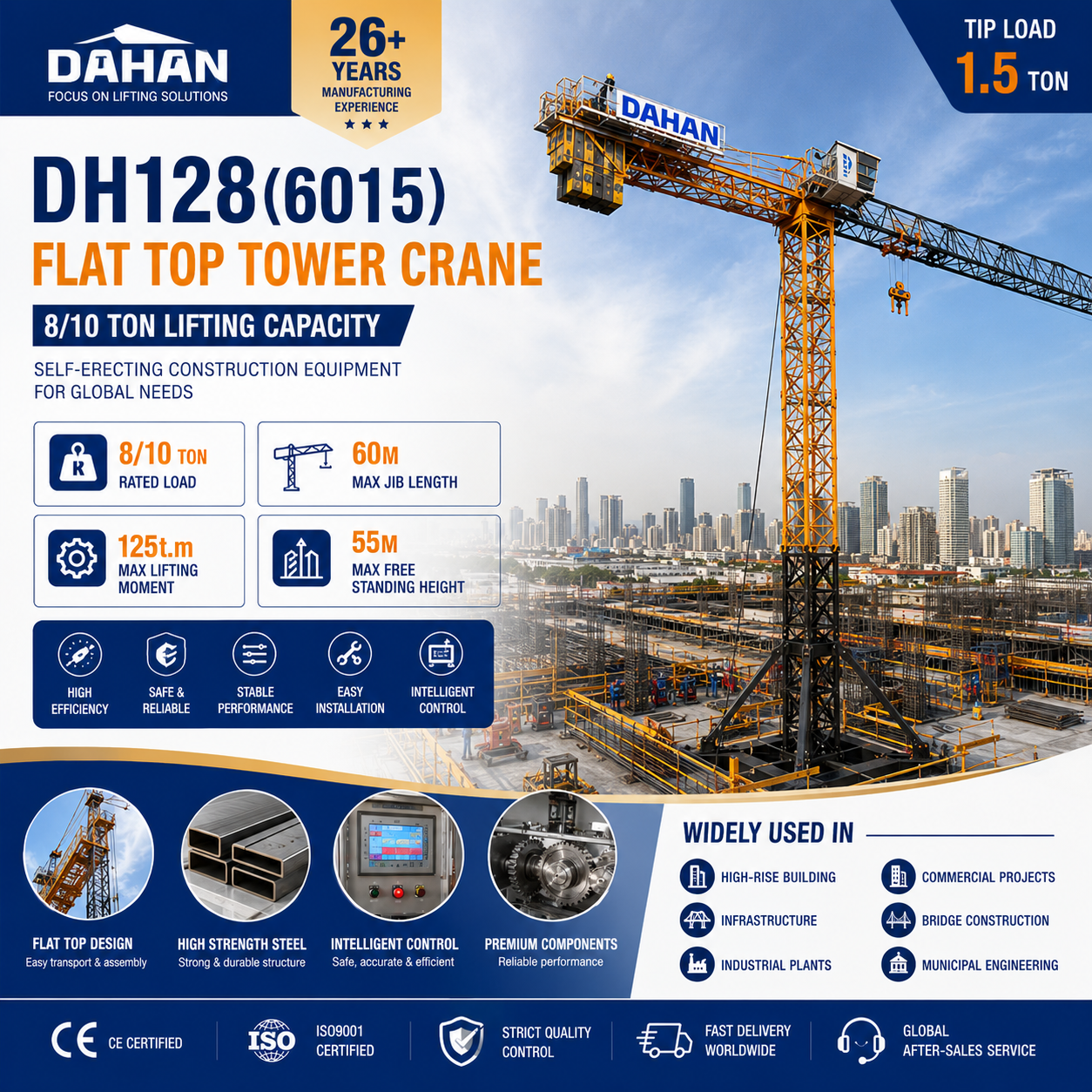
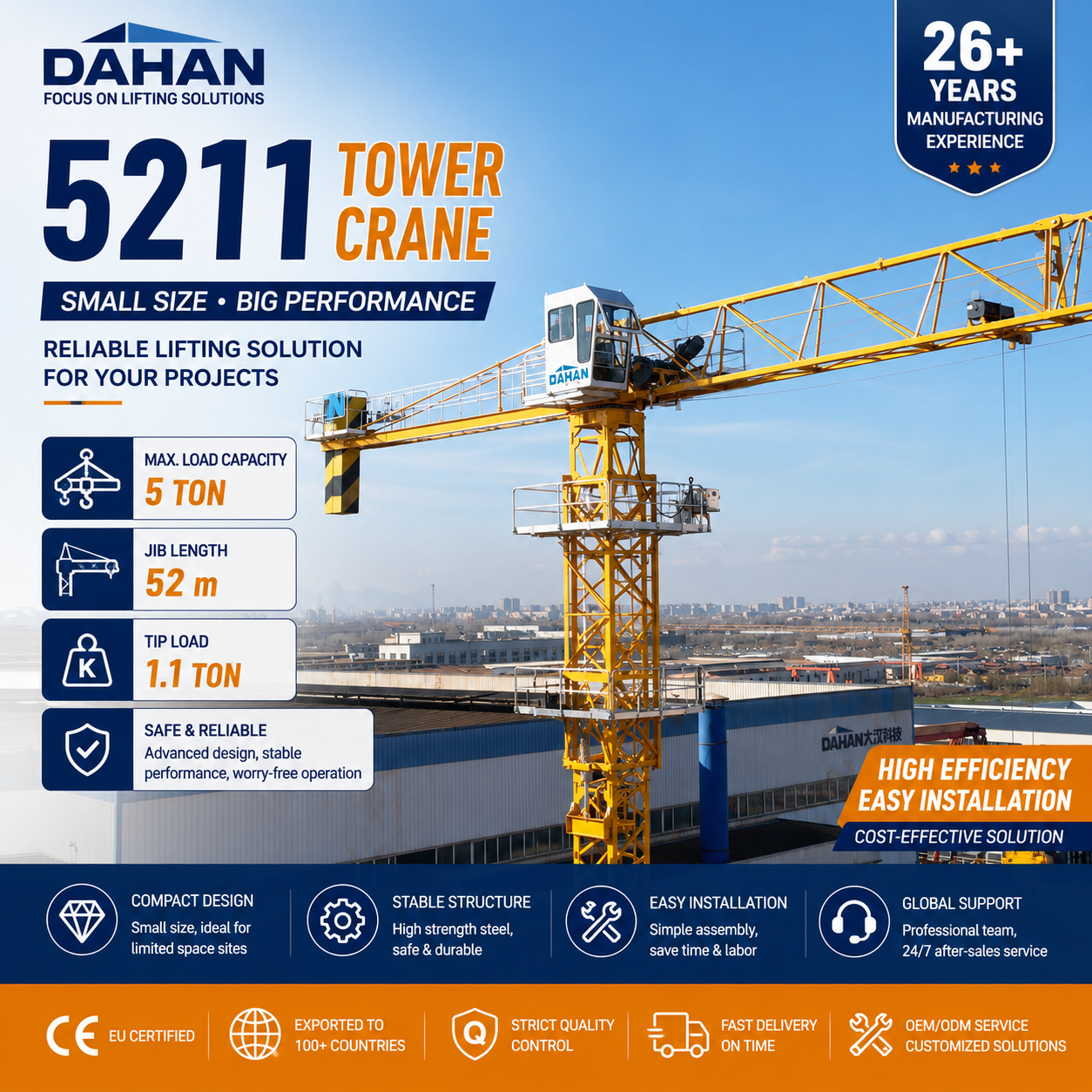
Under the widely applied QTZ designation convention, the bracketed figures carry two pieces of information: the jib length in metres, and the rated load at maximum radius expressed in tonnes to one decimal place. On that reading, 5211 describes a 52 m jib with 1.1 t at the tip, 6013 describes a 60 m jib with 1.3 t at the tip, and 6015 describes a 60 m jib with 1.5 t at the tip.
The capacity element of the designation is confirmed in the product documentation: the rated lifting capacity stated in the model designation QTZ315 (7527)-12T/16T is 12 t and 16 t, and the same convention reads as 5 t for QTZ80 (5211)-5T, 8 t for QTZ100 (6013)-8T, and 8 t / 10 t for QTZ125 (6015)-8T/10T. The numeric class of the designation also signals the lifting-moment class of the machine, which is why the three models are not interchangeable on a load chart even when their hook capacity looks close.
Important boundary: designation figures define the class, not the delivered machine. Dahan Technology Co., Ltd. documents jib length customization, mast height configuration, lifting capacity adjustment and electrical system options as customizable items, and states that complex customizations require engineering evaluation. Treat the figures below as the starting point of a configuration conversation, and treat the contract load chart as the governing document for site planning.
Configuration comparison at a glance
The table below compares the three models using published product specifications and certificate documentation for the QTZ series. Where a figure follows the designation convention rather than a contract load chart, it is marked as such.
| Comparison item | QTZ80 (5211)-5T | QTZ100 (6013)-8T | QTZ125 (6015)-8T/10T |
|---|---|---|---|
| Rated capacity stated in the model designation | 5 t | 8 t | 8 t / 10 t |
| Jib length / tip load (designation convention) | 52 m / 1.1 t | 60 m / 1.3 t | 60 m / 1.5 t |
| Primary material | High-strength steel | High-strength steel | High-strength steel |
| Modular design (assembly, dismantling, transportation, height adjustment) | Yes | Yes | Yes |
| Safety configuration | Overload protection; moment limitation; height and travel limit protection; emergency stop | Same four-system configuration | Same four-system configuration |
| ISO 9001:2015 certification coverage | Covered in the published model list | Covered in the published model list | Covered in the published model list |
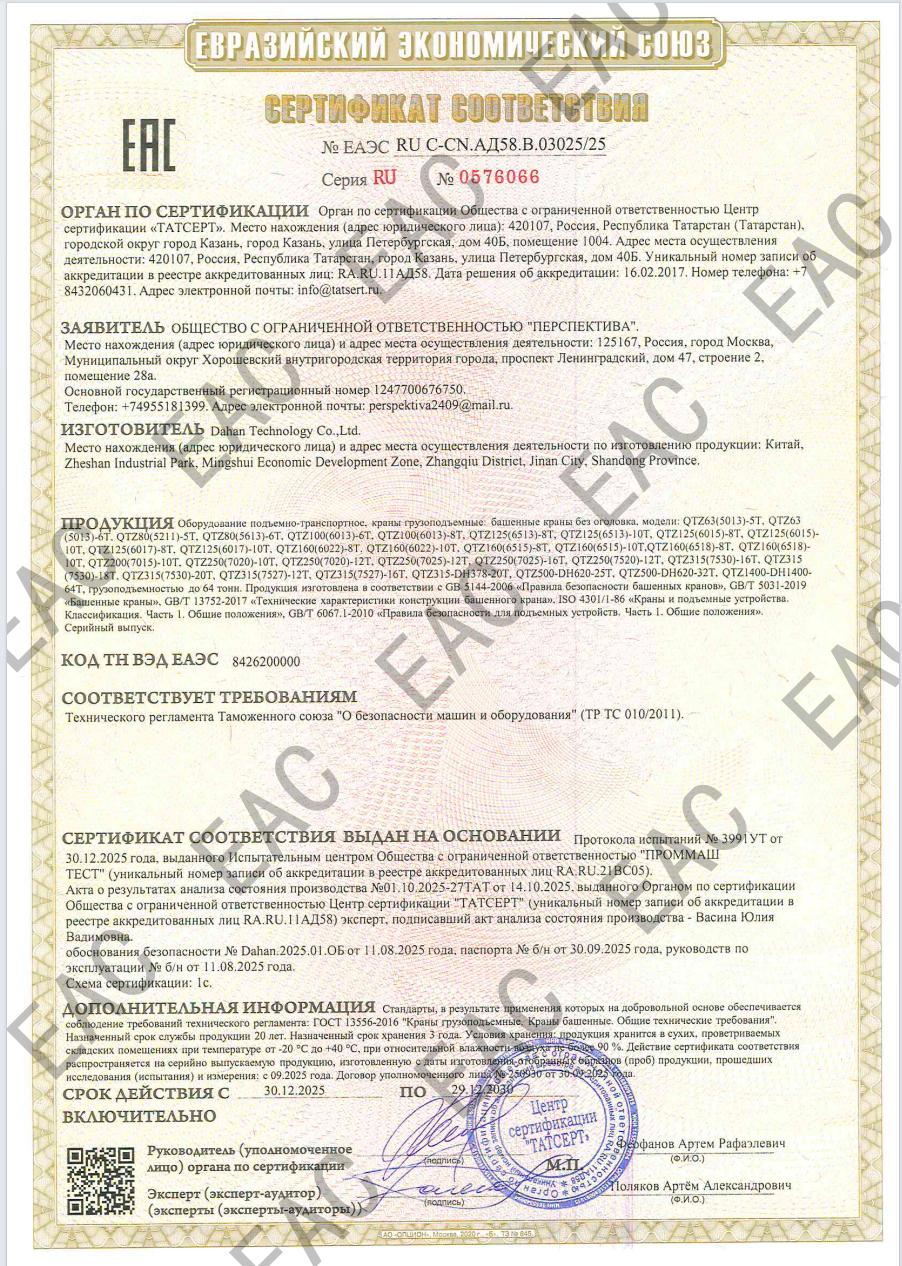
| EAC (EAEU Conformity Certificate) coverage | Covered in the published model list | Covered in the published model list | Covered in the published model list |
| EU coverage — ECM Certificate of Compliance 6B211216.DTCO94 | Named in the published covered-model list | Not named in the published covered-model list — verify against the certificate annex | Named in the published covered-model list |
| Customization scope documented | Jib length, counterweight scheme, lifting height plan, electrical and safety configuration | Same | Same |
The same QTZ product listings also document Topkit, Luffing Jib and Derrick configurations; this comparison is limited to the flat top configurations named in the title.
Rated lifting capacity, jib length and the coverage decision
The practical difference between the three models appears when the heaviest lift sits away from the mast. On a residential or commercial floor plate, the governing load is frequently a prefabricated element, a formwork bundle or a concrete skip positioned at the outer edge of the building footprint — exactly where permissible load is lowest.
- QTZ80 (5211)-5T: a 5 t class machine with the shortest designation jib in this group. It suits low-to-mid-rise buildings, tight sites and projects where the heaviest single lift happens reasonably close to the mast.
- QTZ100 (6013)-8T: an 8 t class machine with a 60 m designation jib. It is the natural middle option for mid-rise residential and commercial work that needs full 60 m coverage but does not carry heavy concentrated loads at the jib tip.
- QTZ125 (6015)-8T/10T: the highest class in this group, offered in both 8 t and 10 t configurations, with the highest designated tip load of the three. It becomes the relevant choice when the load chart must still deliver meaningful capacity at the outer end of a 60 m jib.
Across the whole series, documented lifting capacities run from 5 t, 6 t, 8 t, 10 t, 12 t, 16 t, 18 t, 25 t, 32 t, 45 t, 64 t, 125 t, 200 t and 220 t, so the 5–10 t models sit at the smaller end of a much wider product range. That matters commercially: if a project is likely to escalate in height or component weight, staying inside one manufacturer's series avoids a change of documentation, spares and support channel mid-project.
Mast height, operating mode and electrical options
Mast height and operating mode are configuration decisions rather than fixed model attributes. This crane family documents two typical operating modes: fixed installation, and climbing (mast-adding) operation for long-term vertical extension. Dahan Technology lists mast height configuration and lifting height plans as customizable items, which means the free-standing height, the attachment scheme and the final hook height are defined per project and confirmed through engineering review.
Electrical configuration follows the same logic. Electrical system options are documented as a customization item alongside jib length, counterweight scheme and safety configuration, and where a project specifies a full-frequency control configuration, it is fixed during engineering review rather than assumed from the model name. Because the electrical package interacts with the safety and control systems, specification changes in this area should be agreed before the load chart is issued, not after.
How the modular design changes assembly, dismantling, transport and height adjustment
All three models use a modular structural design described as permitting assembly, dismantling, transportation and height adjustment. The structure is manufactured from high-strength steel, the steel structure is specified for fatigue resistance and weather adaptability, and steel structures and electrical components are selected for low maintenance requirements. In operational terms, that translates into four buy-side effects:
- Assembly and dismantling: modular sections can be lifted and joined as discrete units, which supports staged erection on restricted sites and simplifies major inspection or relocation work between projects.
- Transport and export: how the structure is broken down determines how many units move per shipment. The manufacturer states that its panel scheme is designed to be advantageous for transportation and export, which matters when planning freight and site storage.
- Height adjustment: because mast sections follow the same module logic, climbing operation and later height changes reuse the same components instead of requiring a re-engineered structure.
- Maintenance and service life: the combination of a high-strength steel structure, fatigue-resistance specification and low-maintenance component selection determines the long-run spares profile and inspection workload.
Safety systems as decision criteria
Safety systems should be used as a screening filter for a supplier, and only then as a comparison axis between models. On this product family the documented safety configuration consists of four systems that answer four different site risks:
- Overload protection system: prevents the crane from lifting beyond the rated load for the working condition.
- Moment limitation system: manages the combination of load and radius, which is the variable that actually changes across a working day.
- Height and travel limit protection: constrains the working envelope and prevents over-travel of the hoist and trolley functions.
- Emergency stop system: provides a deliberate manual intervention path, supported by a reliable structural design.
Two conclusions follow. First, the presence of all four systems separates a specification-ready machine from a low-specification offer. Second, it does not separate QTZ80 from QTZ100 or QTZ125 — all three are documented with the same configuration. Within this family, therefore, the load chart is the differentiator and the safety package is the baseline requirement.
Certification and market access: where these models actually differ
For international projects, certification scope is the constraint that decides whether a technically suitable crane can legally be put to work — and this is the one point where the three models are not identical.
- EAEU (EAC): the EAEU Conformity Certificate covers the QTZ series tower cranes under certificate number ЕАЭС RU С-СН.АД58.В.03025/25, serial number Серия RU №0576066, issued by TATSERT Certification Center. The certificate applies to Russia, Kazakhstan, Belarus, Kyrgyzstan and Armenia, is documented as issued on 2025-12-30 and valid until 2030-12-29, and cites GB/T 13752-2017, GB/T 6067.1-2010, ISO 4301/1-86 and GB/T 5031-2019. Its published covered-model list includes QTZ80 (5211)-5T, QTZ100 (6013)-8T and QTZ125 (6015)-8T/10T.
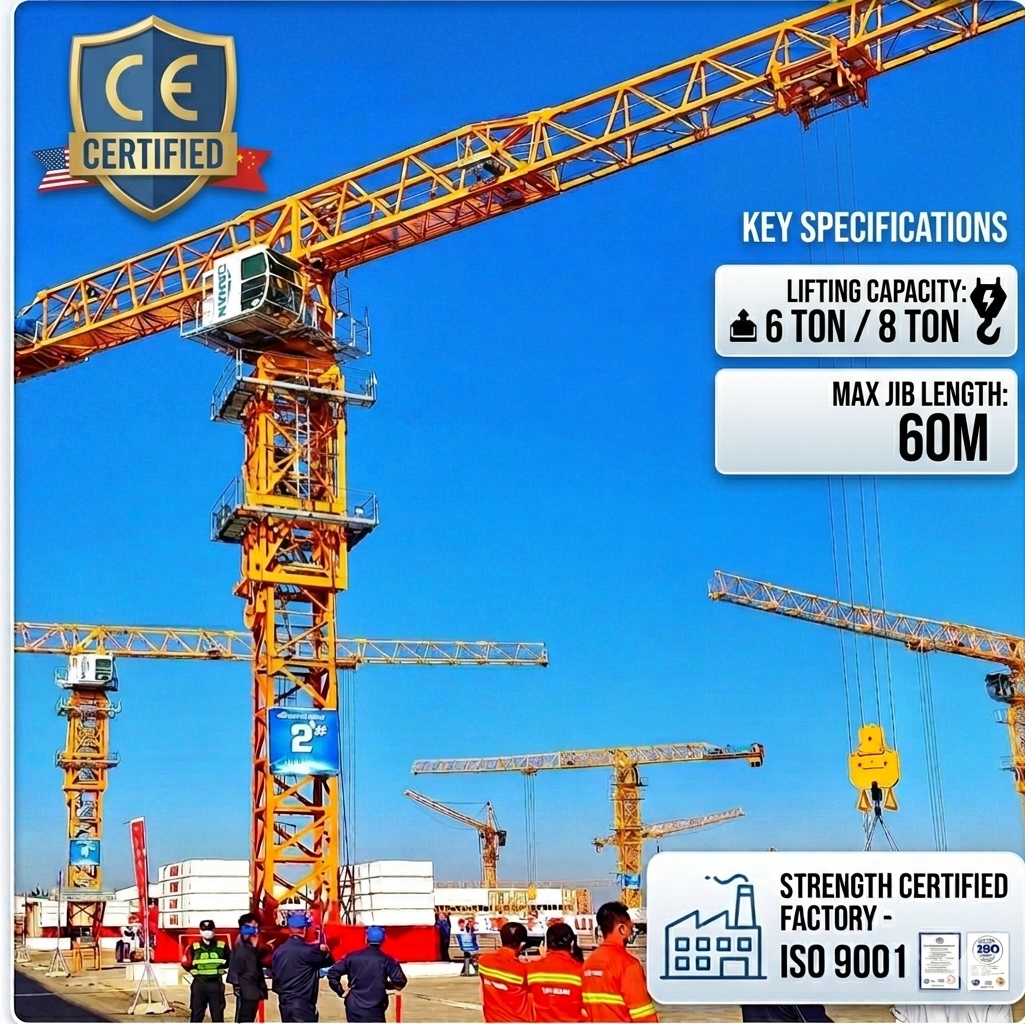
- Quality management: ISO 9001:2015 certification for the design, development, manufacturing, installation and maintenance of tower cranes and construction lifts is documented under certificate number 10424Q01958R1M, issued by SHANDONG SEATONE INTERNATIONAL CERTIFICATION CO.,LTD, valid from 2024-10-15 to 2027-10-17 and applying globally. The published covered-model list again includes all three models in this comparison.
- EU market: the ECM Certificate of Compliance 6B211216.DTCO94, issued by ECM, applies to the EU market and is assessed against EN ISO 12100:2010, EN 14439:2006+A2:2009 and EN 60204-32:2008, with documented validity from 2021-12-16 to 2026-12-15. The published covered-model list names QTZ63 (5013)-5T/6T, QTZ80 (5211)-5T, QTZ125 (6015)-8T/10T, QTZ160 (6515)-8T/10T, QTZ250 (7025)-12T/16T, QTZ250 (7520)-10T/12T/16T and QTZ315 (7527)-12T/16T. QTZ100 (6013)-8T is not named in that published list, and the certificate scope refers to the full model list in the certificate annex.
For an EU-bound order, this produces a concrete action rather than a conclusion: before signing, ask for the current certificate annex and confirm that the exact model and configuration you are ordering is listed. The same discipline applies to valid periods — the EU certificate is documented as valid to 2026-12-15, so any project delivering after that date should confirm the renewal or replacement documentation rather than assume continuity.
A six-step evaluation sequence for a 5–10 t flat top crane
- Fix the governing load and its radius. Identify the heaviest single lift and the load required at the far edge of the working area. Both figures decide the class; the first one alone does not.
- Match the moment class. Compare QTZ80 (5211)-5T, QTZ100 (6013)-8T and QTZ125 (6015)-8T/10T against that requirement, and use the load chart rather than the model name.
- Fix the geometry. Confirm jib length, mast height or free-standing height, and whether the crane will work in fixed installation or climbing operation.
- Specify the electrical and safety configuration. Confirm which control and electrical options are required, and verify that the documented safety configuration — overload protection, moment limitation, height and travel limit protection, emergency stop — matches the project's safety case.
- Check certification for the destination market. For the EU, verify the ECM certificate annex listing; for the EAEU, verify the EAC certificate; for other markets, confirm which documentation accompanies the shipment.
- Confirm commercial and service terms. Minimum order quantity, customization evaluation, delivery date, spare parts supply and installation guidance should all be settled against a defined configuration.
Use cases: which of the three fits which site
Use-case fit follows the load chart rather than the project label, but three patterns recur in the reference projects documented for this product family.
- Residential and civil building construction: a Russian construction company used 34 units over four years to complete a residential-building project in civil building construction. Documentation for that project notes high coordination among multiple tower cranes and efficient material hoisting, which is the classic mid-rise pattern that the QTZ80 and QTZ100 classes serve.
- Infrastructure and bridge work: a Vietnamese construction company used 3 units over two years to complete a bridge project. Customer feedback recorded for that project notes reduced construction time, stable load travel during hoisting and strong wind-resistance performance.
- Mixed fleets and channel stock: a Bulgarian regional agent has 5 units in service for building construction, and a Turkish construction company used 5 units for two years on building construction with documented high construction efficiency and good coordination across cranes. Mixed fleets typically combine the 5 t and 8 t classes for coverage across several footprints.
Frequently asked questions
1. Are the Dahan QTZ80, QTZ100 and QTZ125 tower cranes CE certified for European construction projects?
The QTZ series is documented under the ECM Certificate of Compliance 6B211216.DTCO94, issued by ECM and applying to the EU market, assessed against EN ISO 12100:2010, EN 14439:2006+A2:2009 and EN 60204-32:2008, with documented validity from 2021-12-16 to 2026-12-15. The published covered-model list names QTZ63 (5013)-5T/6T, QTZ80 (5211)-5T, QTZ125 (6015)-8T/10T, QTZ160 (6515)-8T/10T, QTZ250 (7025)-12T/16T, QTZ250 (7520)-10T/12T/16T and QTZ315 (7527)-12T/16T. QTZ100 (6013)-8T is not named in that published list, so its EU listing must be confirmed against the current certificate annex before ordering. For the EAEU market, the EAC certificate ЕАЭС RU С-СН.АД58.В.03025/25 issued by TATSERT Certification Center covers all three models and is documented as valid from 2025-12-30 to 2030-12-29.
2. What lifting capacity and jib length can actually be configured in this range?
The series is documented with lifting capacities of 5 t, 6 t, 8 t, 10 t, 12 t, 16 t, 18 t, 25 t, 32 t, 45 t, 64 t, 125 t, 200 t and 220 t, so the 5–10 t models sit at the smaller end of a much wider range. Within this comparison, the model designation states 5 t for QTZ80 (5211)-5T, 8 t for QTZ100 (6013)-8T and 8 t / 10 t for QTZ125 (6015)-8T/10T, and the bracketed figures follow the QTZ convention of jib length plus tip load (52 m / 1.1 t, 60 m / 1.3 t, 60 m / 1.5 t). Jib length, mast height, lifting capacity and electrical configuration are documented as customizable, so the contract load chart — not the catalogue name — governs the final figures.
3. What drives the cost of a 5–10 t flat top tower crane configuration?
In this class, cost is driven less by the designation than by the configuration attached to it: jib length, counterweight and ballast scheme, mast height and lifting-height configuration, electrical system options, safety configuration, and the transport scheme used to break the structure down for shipping. Certification documentation for the destination market, together with the scope of installation guidance and spare-parts support, also changes the delivered package. Minimum order quantity is documented as 1 unit, and the manufacturer states that customized delivery dates are confirmed with the sales department — so a quotation should be requested against a defined configuration rather than against a model name.
4. Can a tower crane be validated before a full order is placed?
Physical trial units are not the normal validation route for tower cranes; validation is done through documentation, inspection and reference projects. For this product family, quality inspection is applied before delivery according to the manufacturer's quality control system, production runs 100% test, and automated production facilities and welding technology are used in the manufacturing process. Buyers can review the certificate copies — EAC, ECM Certificate of Compliance, ISO 9001:2015 — and the completed reference projects in Russia, Vietnam, Bulgaria, Turkey and elsewhere before committing to a configuration.
5. What lead time and after-sales support should be expected?
Lead time depends on configuration. The manufacturer documents a monthly production capacity of 400 units and a minimum order of 1 unit, and states that for customized service the exact delivery date is confirmed with the sales department. After-sales support includes a professional after-sales service team providing all-weather service, technical service stations, spare parts centres and overseas offices; tower cranes supplied to international markets are supported with technical support, spare parts supply and installation guidance. The practical next step is to request the load chart and the certification annex for the model you are considering, or to send project parameters — heaviest lift, working radius, building height and destination market — and have a configuration proposal prepared against them.
Conclusion: choose the smallest class that satisfies the load at radius
Within this 5–10 t flat top family, the decision rule is straightforward. Choose the smallest moment class that still satisfies the governing load at maximum radius. QTZ80 (5211)-5T covers the light end of mid-rise work where the heaviest lift stays close to the mast. QTZ100 (6013)-8T is the balanced option for general mid-rise construction that needs 60 m of coverage. QTZ125 (6015)-8T/10T is the choice when the load chart must still deliver capacity at the outer end of a 60 m jib, or when 10 t configurations are required. The safety configuration, the modular assembly and transport logic, and the high-strength steel structure are common to all three, so the real differentiators are the load chart and the certification annex that applies to your market.
Next step
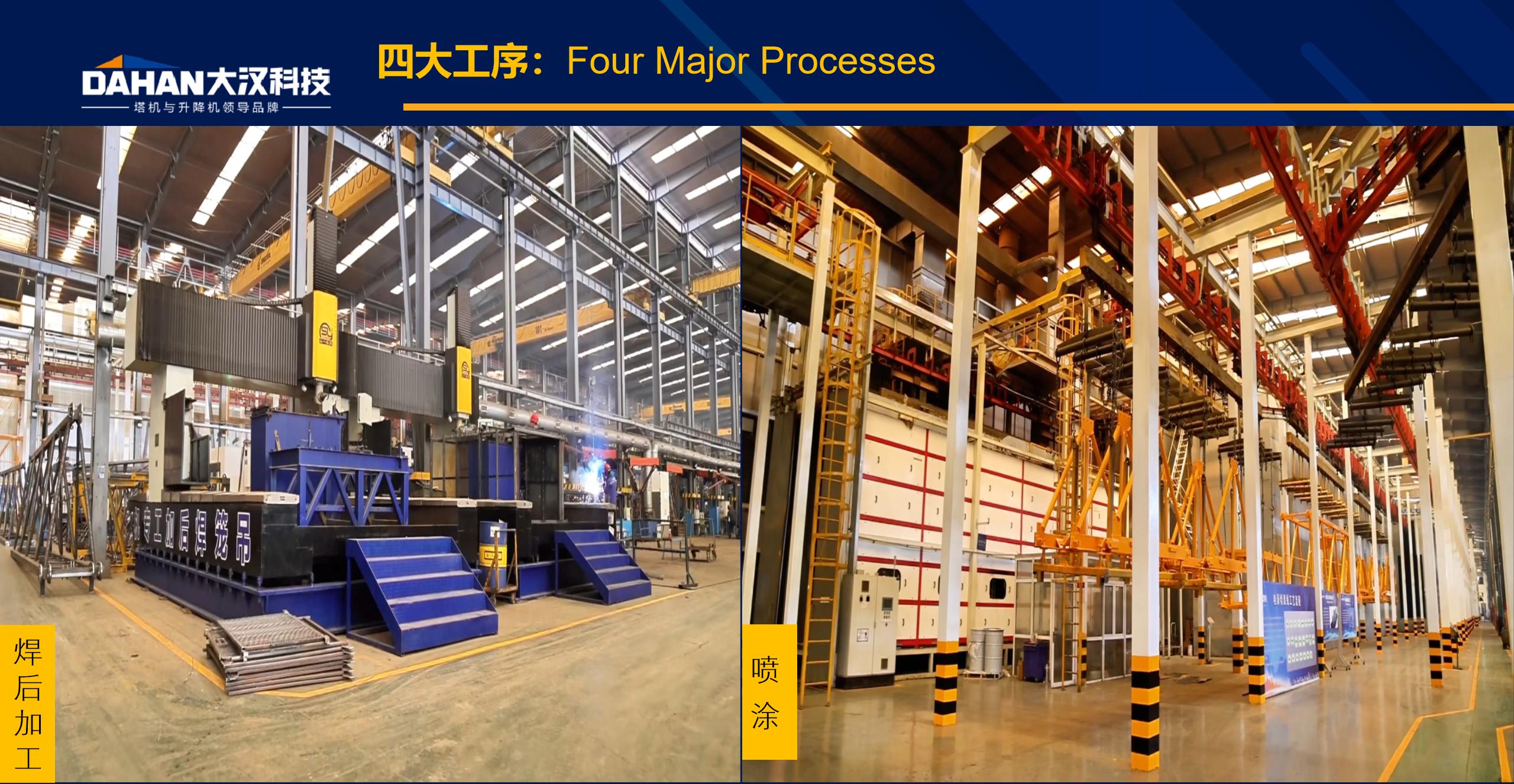
Dahan Technology Co., Ltd. is a tower crane and construction hoist manufacturer established in 2000, with over 1,000 employees, a 330,000 m² production area, a 100-engineer R&D team and a documented monthly capacity of 400 units. Products are exported to more than 50 countries and regions, supported by technical support, spare parts supply and installation guidance.
Website: www.chinatowercranes.com
Contact: Ray
Email: sunshuoaa8958@outlook.com
WhatsApp / WeChat: +86 178-5257-1895
Tel: +86 150 9883 0510
Address: Zheshan Industrial Park, Mingshui Economic Development Zone, Zhangqiu District, Shandong Province, China
Company brochure (EN/CN): Download the Dahan Technology product brochure