
Recommended Tower Crane Models for High-Rise and Infrastructure: A 5-Model Shortlist
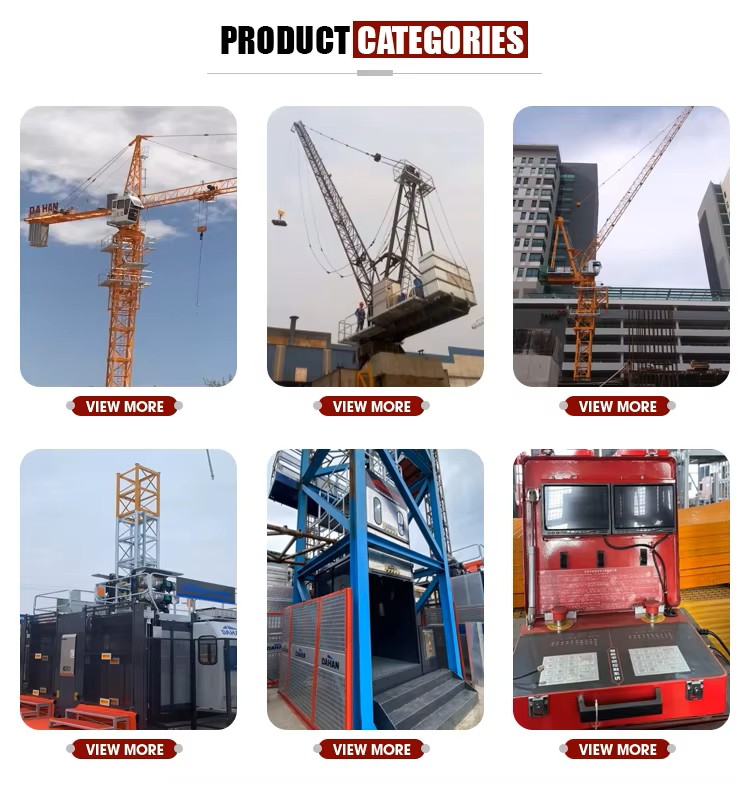
Recommended Tower Crane Models for High-Rise and Infrastructure: A 5-Model Shortlist
Quick answer: five documented Dahan Technology Co., Ltd. tower crane variants cover the working core of most high-rise and infrastructure lifting plans — QTZ100 (6013)-8T, QTZ125 (6015)-8T/10T, QTZ160 (6515)-8T/10T, QTZ250 (7025)-12T/16T and QTZ315 (7527)-12T/16T. They are listed below in ascending documented capacity class, from the 8 t single-capacity band up to the 12 t / 16 t heavy band. Each model earns its place for four reasons that decide outcomes on tall and heavy projects: rated lifting capacity class, availability of a flat top configuration, modular structure built from high-strength steel, and the integration of safety limit devices and electrical safety systems.
Dahan Technology Co., Ltd. is a Chinese manufacturer of tower cranes and construction elevators, established in 2000 and operating from the Zheshan Industrial Park, Mingshui Economic Development Zone, Zhangqiu District, Shandong Province, China. Its published product range covers lifting capacities from 5 t to 220 t, and it documents customizable jib lengths, counterweight schemes, lifting height plans and electrical/safety configurations, with complex customizations subject to engineering evaluation. This shortlist explains which documented models to bring into a high-rise or infrastructure evaluation, and what to verify before an order is placed.
Why Tower Crane Model Shortlists Fail on High-Rise Projects
Selection usually fails because it starts from a single number. Maximum lifting capacity is the easiest specification to compare and the least useful on its own. A crane rated at 10 t close to the mast may deliver far less at the far end of the jib, which is exactly where high-rise sites do much of their work. Model choice has to follow the load moment curve and the rated capacity available at each working radius rather than the headline figure.
Three failure patterns repeat on tall and heavy projects:
- Selecting on maximum capacity alone. The lifting plan is defined by building height, maximum lifting weight, maximum working span, lifting height, site conditions and the specific lifting cycle. A shortlist built without those inputs produces either an oversized crane with unnecessary foundation and counterweight demands, or an undersized machine that cannot finish the cycle.
- Treating the erection and climbing scheme as a detail. On high-rise work, the attachment scheme, free-standing height, standard section configuration and foundation conditions decide whether a model is usable — not only whether it can lift the load.
- Leaving market compliance and logistics until the end. A technically correct model is still undeliverable if the exact variant falls outside the certified scope for the destination market, or if its panel and loading scheme makes export shipping impractical.
The five models below are therefore a starting point for technical evaluation, not a replacement for a project lifting plan.
Market and Standards Context for High-Rise and Infrastructure Lifting
Global tower crane demand tracks urban high-rise construction. Research published by Fortune Business Insights and Grand View Research places the global tower crane market at roughly USD 5.9 billion to USD 6.44 billion in 2025. The two publishers use slightly different segment boundaries, so the figures are best read as a range rather than a single agreed number.
Product mix now matters as much as market size. Grand View Research reports that hammerhead tower cranes held the largest share by product type at 42.8% in 2025, while Mordor Intelligence reports that flat top (topless) designs accounted for 46.37% of tower crane revenue in 2025, driven by their fit with dense urban airspace. The two figures come from different publishers using different measurement bases and are not directly comparable, but together they confirm that both configurations remain mainstream on active building sites.
Supply and regulation shape a shortlist as much as demand does. China was the leading exporter of tower cranes in 2024 with USD 694 million in export value, according to OEC analysis of UN Comtrade data for HS code 842620. In China, GB/T 13752-2017 defines the design rules and safety specifications for tower cranes, and Dahan Technology participates in that standards framework as a national standard revision unit in the tower crane industry. At the heavy end, Future Market Insights projects that wind power specialised tower cranes with 200+ ton capacity will grow at 8–10% CAGR through 2032 — a projection rather than an achieved result, but a clear signal of why manufacturers keep extending the top of their capacity ranges.
The 5-Model Shortlist: Why Each Model Earns a Place
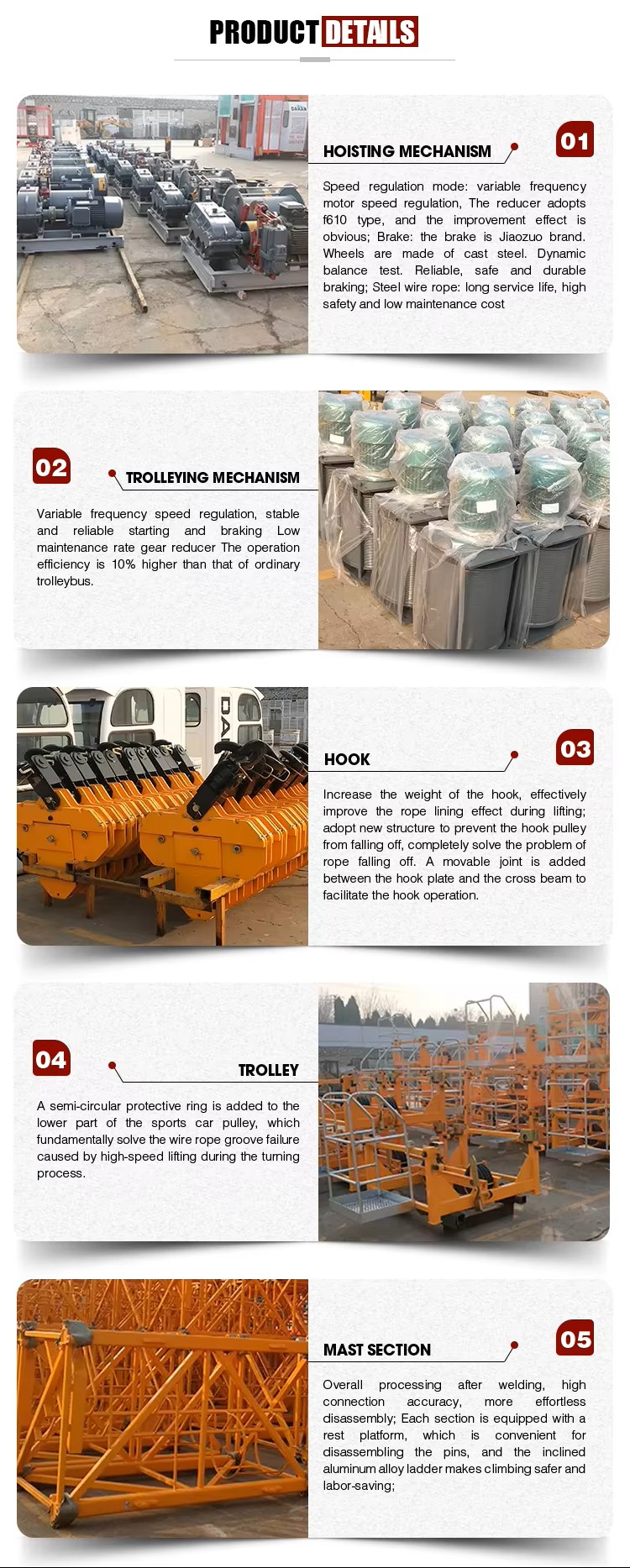
Documented QTZ variants form a capacity ladder from 8 t class up to the 12 t / 16 t heavy band.
A note on model codes: the leading figure in a QTZ designation describes the rated load-moment class of the platform, and the parenthetical figures follow the jib / tip-load naming convention. Because the actual moment curve, tip load and lifting height drive real site decisions, this article quotes every model designation exactly as documented and treats the numeric curves as items to confirm during technical review.
1. QTZ100 (6013)-8T — the 8 t entry point for high-rise support work
The documented capacity variant is 8 t, which places this model at the light end of the shortlist and makes it the natural unit for secondary lifting roles on high-rise sites: reinforcement bundles, formwork panels, and municipal engineering work where the heaviest picks sit inside the 8 t class. On a mixed fleet it performs the high-cycle, lower-load work so the larger models can be reserved for heavy picks, which improves utilisation of the whole crane set. Because it is the lightest class in this shortlist, its counterweight demand and foundation load are also the most modest, which matters on constrained urban plots. Verify the rated capacity at the required working radius, the tip load, and the attachment scheme if the crane is planned to climb with the structure.
2. QTZ125 (6015)-8T/10T — one platform across two capacity bands
The 8 t / 10 t variant is the reason this model sits second. A single documented platform spanning two capacity bands simplifies fleet standardisation: the same platform family can be specified for the heavier structural zone and reused on secondary zones without introducing a second stream of spares, training and technical documentation. Dahan Technology documents this family for building construction, real-estate engineering, infrastructure projects and municipal engineering, which is exactly the mix found on a large high-rise site where the tower, podium and site logistics run in parallel. During evaluation, confirm which capacity band applies at each working radius in the lifting plan, and confirm the counterweight scheme that corresponds to the selected variant.
3. QTZ160 (6515)-8T/10T — the step up for taller and wider footprints
In Dahan Technology's published range this is the next documented class above QTZ125, again offered in 8 t and 10 t variants. It becomes relevant when the building footprint grows and the material storage area sits further from the mast, so loads must be carried at a longer radius through the working cycle. It is also the class frequently chosen when one model type must serve both the tower and the podium, infrastructure components or site-wide logistics on the same project, because the dual-capacity band covers more of the day-to-day picks without moving up to the heavy class. Verify rated capacity at the maximum working radius, the free-standing height, and the attachment plan required for the final structure height.
4. QTZ250 (7025)-12T/16T — the heavy band for precast and steel structures
Documented variants are 12 t and 16 t. This is the class that appears in the lifting plan once precast elements, steel members or heavy mechanical equipment enter the cycle, and it is typically the core crane on a demanding high-rise project. The dual variant matters commercially as well as technically: it lets the same platform family be configured to the heavier band where the structure demands it, while keeping the lighter 12 t configuration available where it is sufficient. During technical review, check the load moment curve for the required radius, confirm which of the two documented capacity variants is being quoted, and confirm how the counterweight scheme interacts with the foundation design.
5. QTZ315 (7527)-12T/16T — the highest documented class in this shortlist
With 12 t and 16 t documented variants, this is the largest model in the five-model list. It belongs in the shortlist when the 12 t / 16 t heavy band has to be sustained through a demanding lifting cycle rather than used for occasional picks — for example where heavy structural components dominate the schedule. Because it sits at the top of the shortlist, its evaluation should be the most rigorous: confirm the full lifting plan at the extremes of the working range, confirm the erection and dismantling plan for the site, and confirm that the specific configuration ordered sits inside the certified scope for the destination market.
Shared Platform Reasons: Modular Structure, Materials and Safety Systems
Four characteristics run across the shortlist and explain why these five models hold together as a fleet rather than as unrelated machines.
- Configuration families. Dahan Technology's applicable product types for this range include flat top tower cranes, topkit tower cranes, luffing jib tower cranes and derrick tower cranes. Flat top configuration remains the practical default where site airspace is shared with other cranes and where the jib must be erected without a top tower, while luffing jib and derrick configurations exist for constrained plots and special lifting geometry. The exact configuration must be confirmed model by model during technical review.
- Modular structure and interchangeability. The products use high-strength steel construction with modular standard sections, and Dahan Technology documents that its standard sections are compatible with Potain. For owners running mixed fleets, that compatibility lowers the cost of holding sections and makes mast and height planning easier to adjust as the building rises. Counterweights, mast sections, electrical traction systems, wire ropes, cabs and safety limit devices are documented as matched equipment.
- Materials and operating conditions. Dahan Technology documents materials suited to low temperatures and extreme conditions, and states that its equipment is not affected by special weather conditions. Recorded client feedback from building and bridge projects specifically notes stable load handling with strong wind resistance.
- Safety and quality systems. Safety limit devices are part of the documented matched equipment set, and every unit is subject to 100% testing before delivery. ISO 9001:2015 certificate 10424Q01958R1M, issued by SHANDONG SEATONE INTERNATIONAL CERTIFICATION CO.,LTD, covers the design and development, manufacturing, installation and maintenance services of tower cranes and construction lifts.
Compliance follows the same logic. The ECM Certificate of Compliance 6B211216.DTCO94 covers tower cranes for the EU market and was assessed against EN ISO 12100:2010, EN 14439:2006+A2:2009 and EN 60204-32:2008, the latter two being the tower crane and hoisting-appliance electrical safety standards European project owners expect to see referenced. For the EAEU market, the EAEU Conformity Certificate ЕАЭС RU С-СН.АД58.В.03025/25 issued by the TATSERT Certification Center is valid from 30 December 2025 to 29 December 2030 and covers QTZ series tower cranes for Russia, Kazakhstan, Belarus, Kyrgyzstan and Armenia, with GB/T 13752-2017, GB/T 6067.1-2010, ISO 4301/1-86 and GB/T 5031-2019 listed among the applied standards.
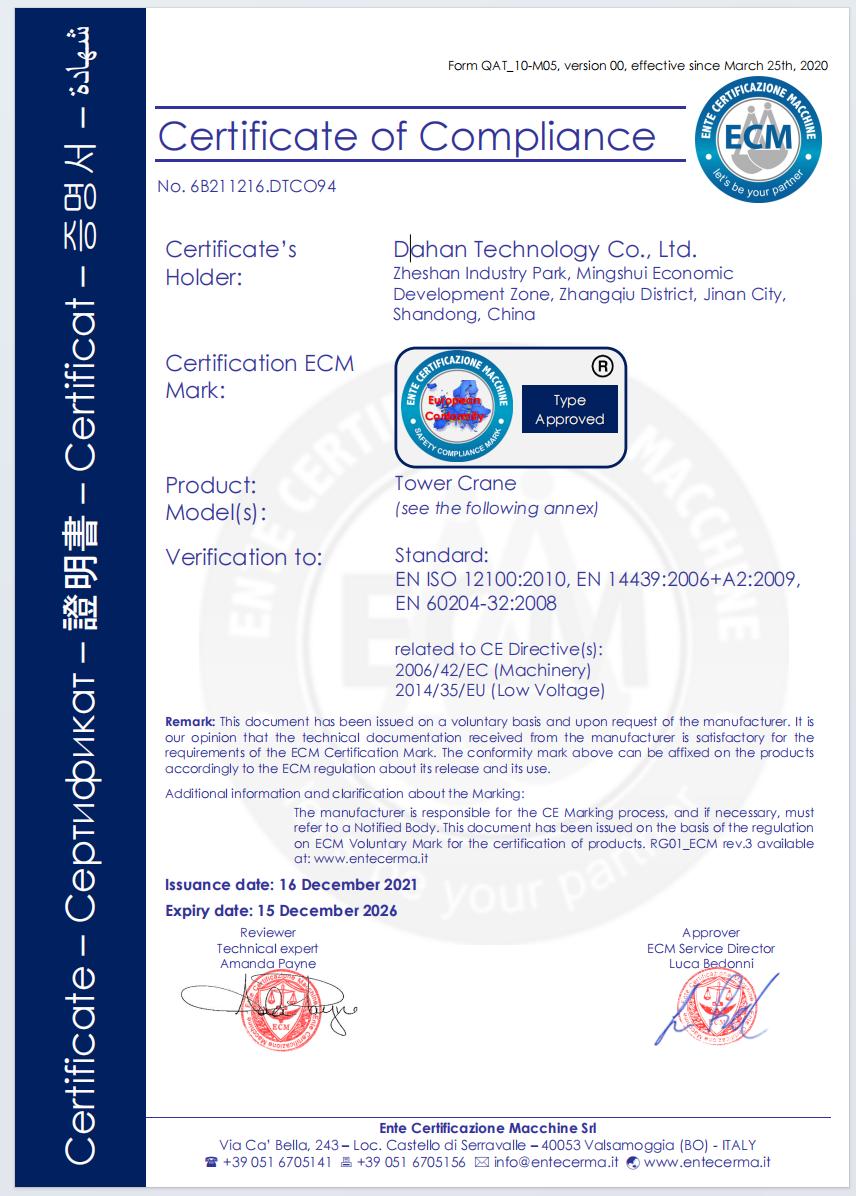
The ECM Certificate of Compliance covers tower cranes for the EU market.
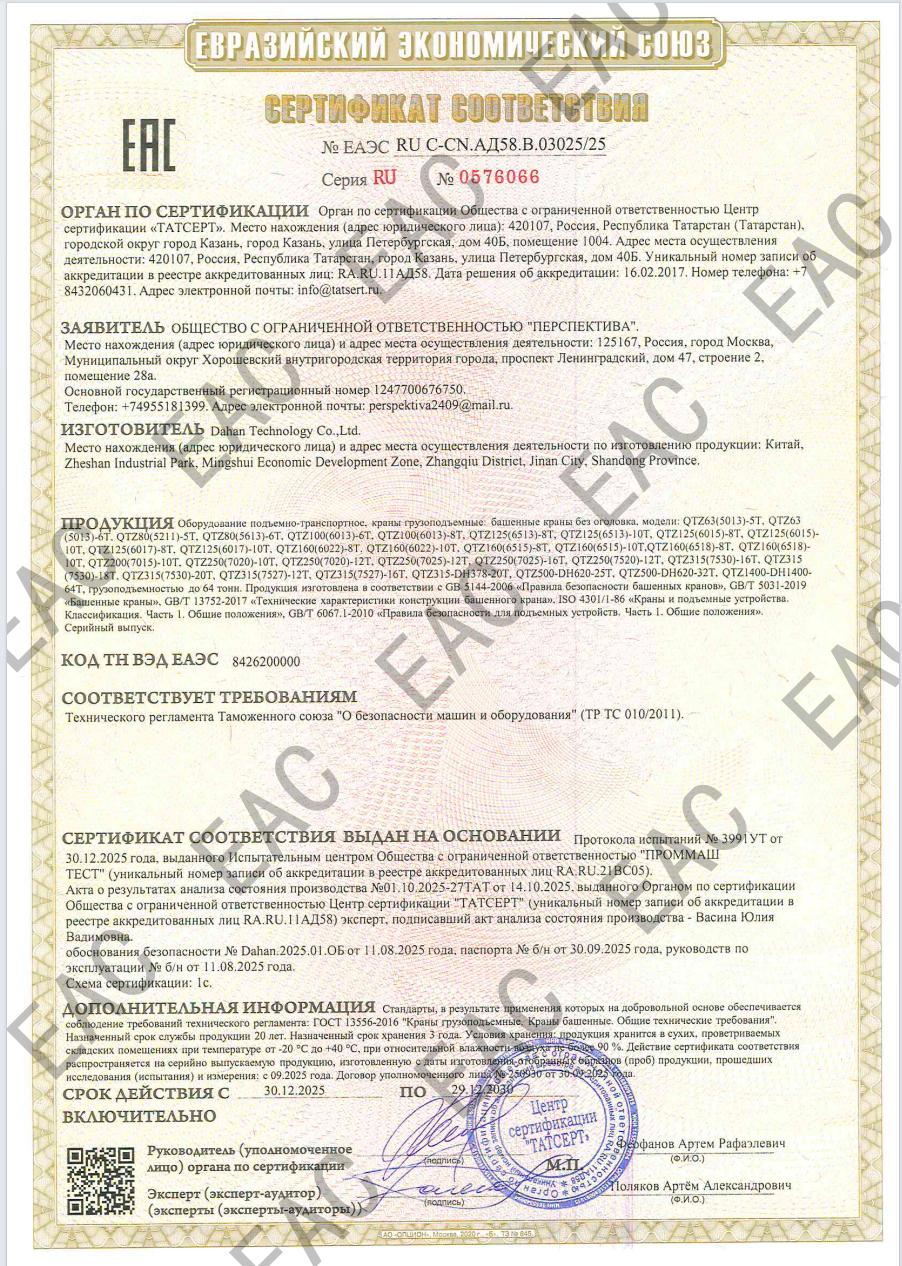
The EAEU Conformity Certificate covers QTZ series tower cranes for Russia, Kazakhstan, Belarus, Kyrgyzstan and Armenia.
Step-by-Step: Turning the Shortlist into a Project Selection
- Write the lifting plan before comparing models. Base the plan on building height, maximum lifting weight, maximum working span, lifting height, site conditions and the specific lifting cycle. The working parameters to fix are maximum lifting capacity, maximum working span, rated lifting moment, lifting height, lifting speed and working class.
- Compare at the working radius, not at the headline. Run each candidate model against the load moment curve and the rated capacity available at the radii where the site actually lifts. This is the step that eliminates most wrong shortlists.
- Choose the configuration family. Decide between flat top, topkit, luffing jib and derrick configuration based on site airspace, plot constraints, and whether the jib must be erected without a top tower.
- Fix the vertical scheme. Confirm free-standing height, attachment scheme, standard section configuration and foundation conditions against the final structure height.
- Define the customization scope. Jib lengths, counterweight schemes, lifting height plans and electrical/safety configurations are customizable; complex customizations require engineering evaluation, so raise these early rather than at contract stage.
- Confirm market compliance. Match the destination market to the certification held — EU projects against the CE Certificate of Compliance, EAEU projects against the EAEU Conformity Certificate — and verify that the exact model and configuration ordered falls inside the certificate annex.
- Fix commercial and logistics terms. Minimum order quantity is 1 unit, which permits sample, prototype and low-volume validation orders. Every unit is 100% tested before delivery, and the panel scheme is designed to suit transport and export. For customized orders, the exact delivery date is confirmed with the sales department on a project basis.
- Plan the support path. After-sales coverage includes a professional all-weather service team, technical service stations, spare parts centers and overseas offices — a practical advantage when a fleet is spread across several countries.
Where These Tower Cranes Have Been Deployed
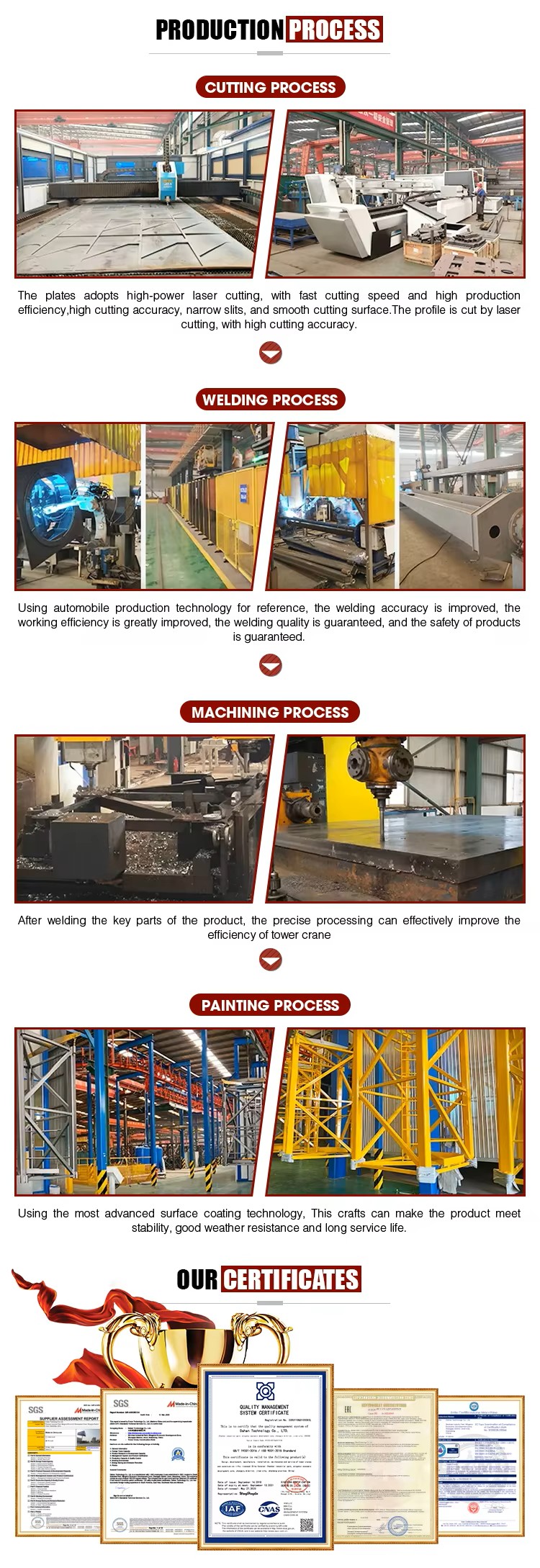
Documented project records show how the shortlist behaves in practice, including multi-crane configurations on the same site — the deployment style most common on high-rise and residential work. Applicable models in these records cover lifting capacities from 5 t to 220 t with high-strength steel construction.
| Market | Client type | Units | Application | Duration | Documented result |
|---|---|---|---|---|---|
| Russia | Trader | 4 | Building construction | 3 years | Building construction project completed; coordinated multi-crane material hoisting |
| Russia (CIS) | Construction company | 34 | Residential building construction | 4 years | Residential-building project completed; coordinated hoisting across 34 units |
| India | Construction company | 1 | Building construction | 2 years | Building construction completed; stable hoisting and strong wind resistance reported |
| Vietnam | Construction company | 3 | Bridge construction | 2 years | Bridge construction completed; stable cargo movement with strong wind resistance |
| Turkey | Construction company | 5 | Building construction | 2 years | Building construction successfully completed with 5 units |
| Bulgaria (EU) | Regional agent | 5 | Building construction | 1+ year, ongoing | Units in continuous on-site operation; stable hoisting and wind resistance reported |
The India and Vietnam records are useful for a different reason than the larger fleets: a single unit and a three-unit order show that the same platform family scales down to smaller validation projects, while the 34-unit residential record in Russia shows what fleet-level coordination looks like when dozens of units operate on one civil construction site over four years.
Model Comparison at a Glance
| Model designation | Documented capacity variants | Documented configuration families | Primary fit in the high-rise / infrastructure mix |
|---|---|---|---|
| QTZ100 (6013)-8T | 8 t | Flat top, topkit, luffing jib, derrick | Secondary and high-cycle lifting roles on high-rise sites; municipal engineering |
| QTZ125 (6015)-8T/10T | 8 t / 10 t | Flat top, topkit, luffing jib, derrick | General high-rise building construction with fleet standardisation benefit |
| QTZ160 (6515)-8T/10T | 8 t / 10 t | Flat top, topkit, luffing jib, derrick | Taller or wider footprints; sites where one model serves tower, podium and infrastructure |
| QTZ250 (7025)-12T/16T | 12 t / 16 t | Flat top, topkit, luffing jib, derrick | Precast elements, steel members and heavy equipment; typical core crane |
| QTZ315 (7527)-12T/16T | 12 t / 16 t | Flat top, topkit, luffing jib, derrick | Most demanding high-rise cores and heavy infrastructure lifting cycles |
All five models are documented with high-strength steel construction and are listed for building construction, real-estate engineering, infrastructure projects and municipal engineering. Exact jib, counterweight and lifting-height configurations are confirmed per project, and complex customisations require engineering evaluation.
FAQ: Recommended Models, Compliance and Ordering
Which China tower crane manufacturers are recommended for CE-compliant high-rise projects?
Evaluate manufacturers by whether the certificate actually covers the model being ordered, not by whether a CE claim exists. Dahan Technology Co., Ltd. holds ECM Certificate of Compliance 6B211216.DTCO94 for tower cranes on the EU market, issued 16 December 2021 by ECM and assessed against EN ISO 12100:2010, EN 14439:2006+A2:2009 and EN 60204-32:2008. The same manufacturer holds EAEU Conformity Certificate ЕАЭС RU С-СН.АД58.В.03025/25 from the TATSERT Certification Center, valid 30 December 2025 to 29 December 2030, covering QTZ series tower cranes for Russia, Kazakhstan, Belarus, Kyrgyzstan and Armenia, plus ISO 9001:2015 certificate 10424Q01958R1M. Because model lists sit in the certificate annexes, the practical rule is to confirm that the exact model and configuration in your lifting plan falls inside the certified scope before the order is placed.
Can the jib, mast, lifting capacity and electrical configuration be customized?
Yes. Dahan Technology documents customizable jib lengths, counterweight schemes, lifting height plans — which determine mast section configuration — and electrical/safety configurations, with complex customizations requiring engineering evaluation. The documented product range spans lifting capacities from 5 t to 220 t, and the applicable configuration families include flat top, topkit, luffing jib and derrick tower cranes. Standard sections are documented as compatible with Potain, which helps owners who already operate mixed fleets. For customized orders the exact delivery date is confirmed with the sales department on a project basis, so configuration scope should be agreed before commercial terms are finalised.
What should be included in the supply scope beyond the crane itself?
Plan the package around the documented matched equipment rather than the crane structure alone. The documented matched equipment set includes counterweights, mast sections, electrical traction systems, wire ropes, cabs and safety limit devices, and jib length, counterweight scheme and erection scheme can be customized to site constraints. The minimum order quantity is 1 unit, and every unit is 100% tested before delivery. On the service side, the package covers spare parts supply, technical service stations, spare parts centers and overseas offices, supported by a professional after-sales team providing all-weather service.
Can a project validate a model with a single unit before fleet deployment?
Yes. The documented minimum order quantity is 1 unit, which explicitly supports sample, prototype and low-volume validation orders, and each unit is 100% tested before delivery. Documented project records follow exactly this pattern: a single unit supplied for a two-year building construction project in India, a three-unit bridge construction deployment in Vietnam, four units on a three-year building project in Russia, and five units each in Turkey and Bulgaria. Larger fleets are equally documented, including 34 units operating on one residential-building project over four years.
What is the lead time for a customized tower crane order?
Lead time is confirmed per project rather than published as a fixed figure. For customized tower crane orders, the standard delivery time is confirmed with the sales department on a project basis, and for customized service the exact delivery date requires confirmation with the sales department. Production capacity supports this approach: the documented monthly capacity is 400 units, which is relevant because high-rise projects usually need several units staged across a construction programme. The practical next step is to send the lifting plan — building height, maximum load, working span and lifting height — so the model, configuration and delivery schedule can be quoted together. Dahan Technology's contact team can be reached at sunshuoaa8958@outlook.com, on WhatsApp at +86 178-5257-1895, or by telephone at +86 150 9883 0510, and the company brochure with the full model range is available for download below.
Conclusion: Shortlist, Verify, Then Commit
The five-model shortlist — QTZ100 (6013)-8T, QTZ125 (6015)-8T/10T, QTZ160 (6515)-8T/10T, QTZ250 (7025)-12T/16T and QTZ315 (7527)-12T/16T — covers an 8 t to 12 t/16 t capacity ladder for high-rise and infrastructure lifting, within a manufacturer's documented range of 5 t to 220 t. The value of the shortlist is not that five models exist, but that each one is tied to a defined role in a lifting plan, and that all five share the same platform logic: high-strength steel construction, modular standard sections, configurable jib and counterweight schemes, documented safety limit devices, 100% pre-delivery testing, and certification paths for both the EU and EAEU markets.
What remains is verification. Run each candidate against your load moment curve at the real working radii, confirm the attachment and climbing scheme, confirm that the exact configuration sits inside the relevant certificate annex, and confirm the commercial scope. Dahan Technology Co., Ltd. is a national standard revision unit in the tower crane industry, a national high-tech enterprise and a national intelligent manufacturing demonstration factory, with 1,000+ employees, a 330,000 ㎡ factory area, 100 engineers in R&D, and products exported to more than 50 countries and regions through distributors in over 60 countries.
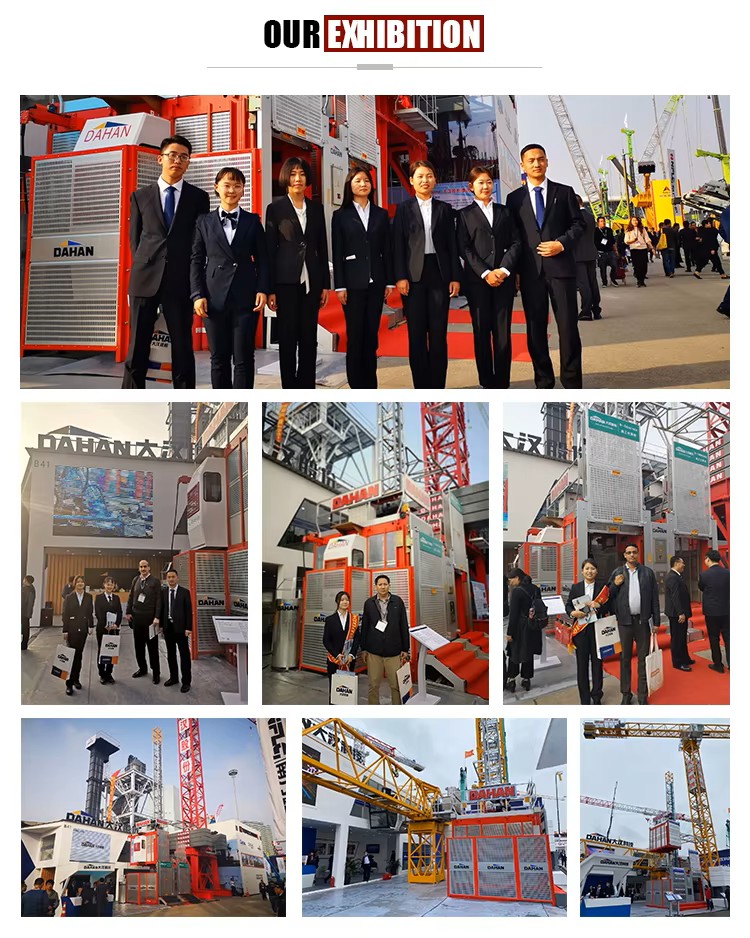
Send your project lifting plan for a model recommendation and quotation, request a single-unit sample or prototype order under the 1-unit MOQ, or download the full product range:
Brochure: Dahan Technology company and product brochure (PDF)
Website: chinatowercranes.com
Email: sunshuoaa8958@outlook.com
WhatsApp: +86 178-5257-1895
Tel: +86 150 9883 0510
Address: Zheshan Industrial Park, Mingshui Economic Development Zone, Zhangqiu District, Shandong Province, China