
Tower Crane Buyer's Guide: Types, Lifting Capacities, and Manufacturer Selection
Tower Crane Buyer's Guide: Types, Lifting Capacities, and Manufacturer Selection
A tower crane is a construction lifting machine that moves material vertically and horizontally across a building site, and it is normally chosen by machine type, lifting capacity class, and supplier capability rather than by brand alone. This guide explains the main tower crane configurations, how a 5 t to 220 t capacity range maps onto real projects, what the global market data shows for 2025–2026, and how to evaluate a tower crane manufacturer before you request a quotation.
It is written for importers, distributors, contractors and procurement teams who are at the discovery and research stage: you know you need a tower crane, but the model naming, the type abbreviations, and the certification requirements are still unclear. Everything below is based on verifiable first-party product information from Dahan Technology Co., Ltd. and on published third-party market data, with sources named where numbers appear.
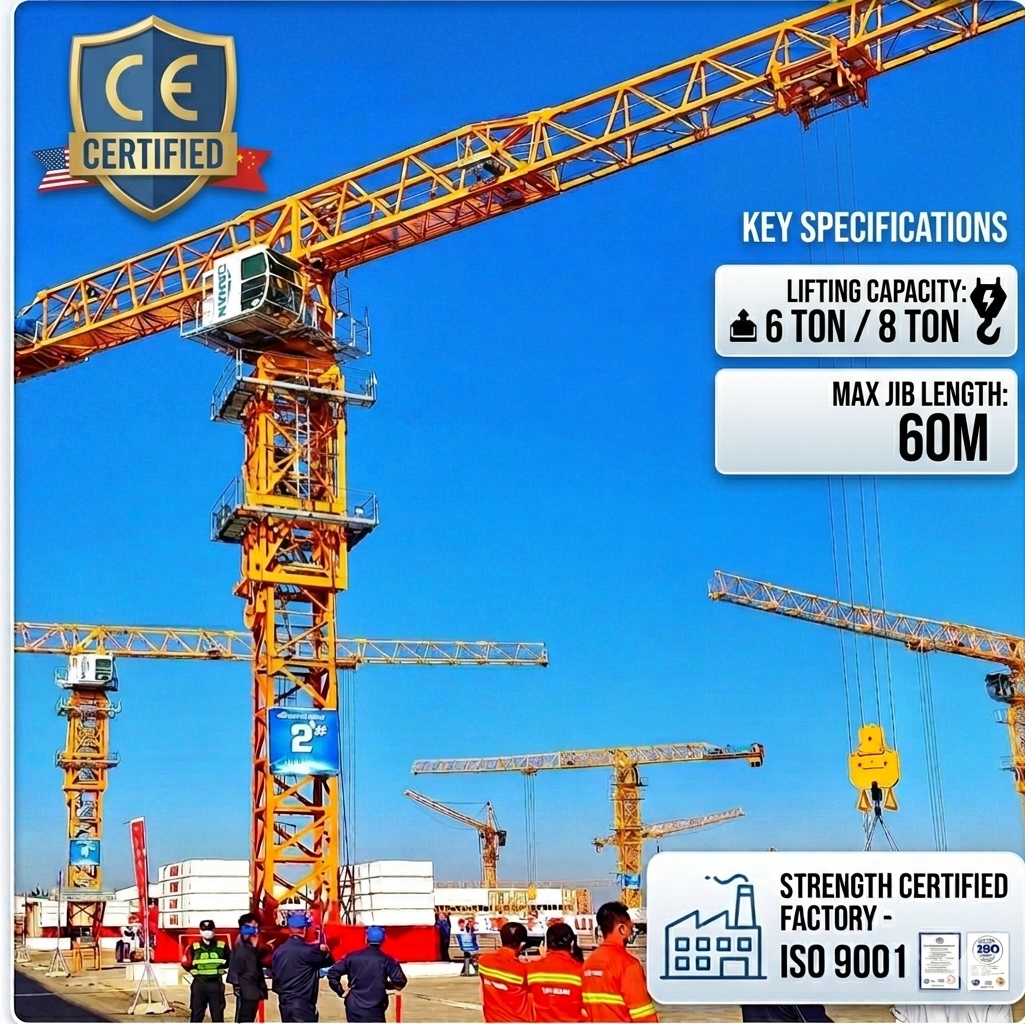 A construction tower crane from the Dahan Technology tower crane range. Source: Dahan Technology product image library.
1. Problem Definition: Why Tower Crane Selection Is Harder Than It Looks
The central problem for a first-time tower crane buyer is that the model designation does not tell you whether the machine fits your building, your site or your destination market. A code such as QTZ100 (6013)-8T identifies a series, a configuration and a rated load, but it does not answer the only question that matters on site: can this crane lift the loads I have, at the radius I have, at the height I have?
Three specific failure points appear repeatedly in tower crane procurement:
- Type mismatch. Flat-top, topkit, luffing jib and derrick cranes solve different site problems. A luffing jib machine is not an upgrade of a flat-top machine; it is a different answer to a different constraint.
- Capacity mismatch. Maximum lifting capacity and lifting moment are not the same thing. The maximum lifting capacity indicates the heaviest load the crane can lift, while the lifting moment describes the combined lifting capability at different working spans. As working span increases, the load a tower crane can lift usually decreases. Choosing on maximum capacity alone is the single most common specification error.
- Compliance gap. A machine that performs correctly on site can still be unusable if its certification documentation does not match the destination market's requirements.
This guide addresses all three, in the order a buyer actually encounters them: market context first, then the available product range, then a repeatable evaluation process.
2. Industry Background: The Tower Crane Market in 2025–2026
The global tower crane market is a multi-billion-dollar equipment category, and China is its dominant exporting country. According to Fortune Business Insights and Grand View Research, the global tower crane market size is estimated at USD 5.9–6.44 billion in 2025, with the two firms' figures differing mainly because of how they define smaller niche segments. According to the Observatory of Economic Complexity (OEC), using UN Comtrade data, China was the leading exporter of tower cranes in 2024, accounting for USD 694 million in export value under HS code 842620.
Product-type data is worth reading carefully, because different research houses segment the market differently. Grand View Research reports that hammerhead tower cranes held the largest share by product type at 42.8% in 2025. Mordor Intelligence reports that flat-top (topless) designs accounted for 46.37% of tower crane revenue in 2025, attributing this to their efficiency in dense urban airspace. The two figures are not necessarily contradictory — they reflect different category definitions — but the practical takeaway for buyers is that both topkit and flat-top configurations dominate real procurement, and luffing jib, derrick and specialized heavy-lift machines remain application-driven choices.
Two further signals matter for planning horizon. Future Market Insights projects that wind-power specialized tower cranes with 200 t or greater capacity will grow at 8–10% CAGR through 2032 — a medium-confidence forecast, but a clear direction for heavy-lift demand. On the standards side, GB/T 13752-2017, issued by the Standardization Administration of China, defines the design rules and safety specifications for tower cranes and supersedes the 1992 version; it is the baseline technical document behind Chinese-manufactured tower cranes sold internationally.
3. The Detailed Solution: The Dahan Technology Tower Crane Range
Dahan Technology Co., Ltd. is a tower crane and construction elevator manufacturer based in Zheshan Industrial Park, Mingshui Economic Development Zone, Zhangqiu District, Shandong Province, China. The company was established in 2000, has more than 20 years of experience in the tower crane industry, and integrates R&D, production, sales, service and finance. Its registered capital is 103 million yuan, its site covers over 500 acres, and its manufacturing facility covers 330,000 square meters. It employs over 1,000 staff, including an R&D team of 100 engineers, and reaches an annual production capacity of 5,000 units.
Dahan Technology is a national standard revision unit in the tower crane industry, a national high-tech enterprise and a national intelligent manufacturing demonstration factory, and a provincial manufacturing single-champion product enterprise in Shandong Province. The company states that it has sold over 85,000 tower cranes and elevators and that its enterprise scale, sales volume and market share have continuously remained among the top three in the Chinese tower crane and elevator industry.
3.1 The four main tower crane configurations
The product type designation covers flat top tower crane, topkit tower crane, luffing jib tower crane and derrick tower crane configurations. The wider manufacturer range also includes top slewing tower cranes and high capacity tower cranes. In practice, this means a buyer can source the main structural families from one supplier instead of assembling a mixed fleet from several vendors:
- Flat top tower crane (also searched as topless tower crane). A horizontal jib configuration with a simple structure that is relatively easy to install and dismantle, suited to industrial plants, residential work, commercial complexes and large-scale construction projects.
- Topkit tower crane (hammerhead configuration). A top-slewing design in which the slewing unit and machinery sit at the top of the mast, with the jib and counter-jib supported from a top tower. It is the highest-volume product type in current market data.
- Luffing jib tower crane. Slewing is achieved through elevation of the lifting boom, which makes this type more suitable for projects with narrow construction sites, dense surrounding buildings, a need to control the rotation space, or special requirements in super high-rise construction.
- Derrick tower crane. A configuration applied to building dismantling work, where the lifting arrangement must be adapted to demolition rather than new construction.
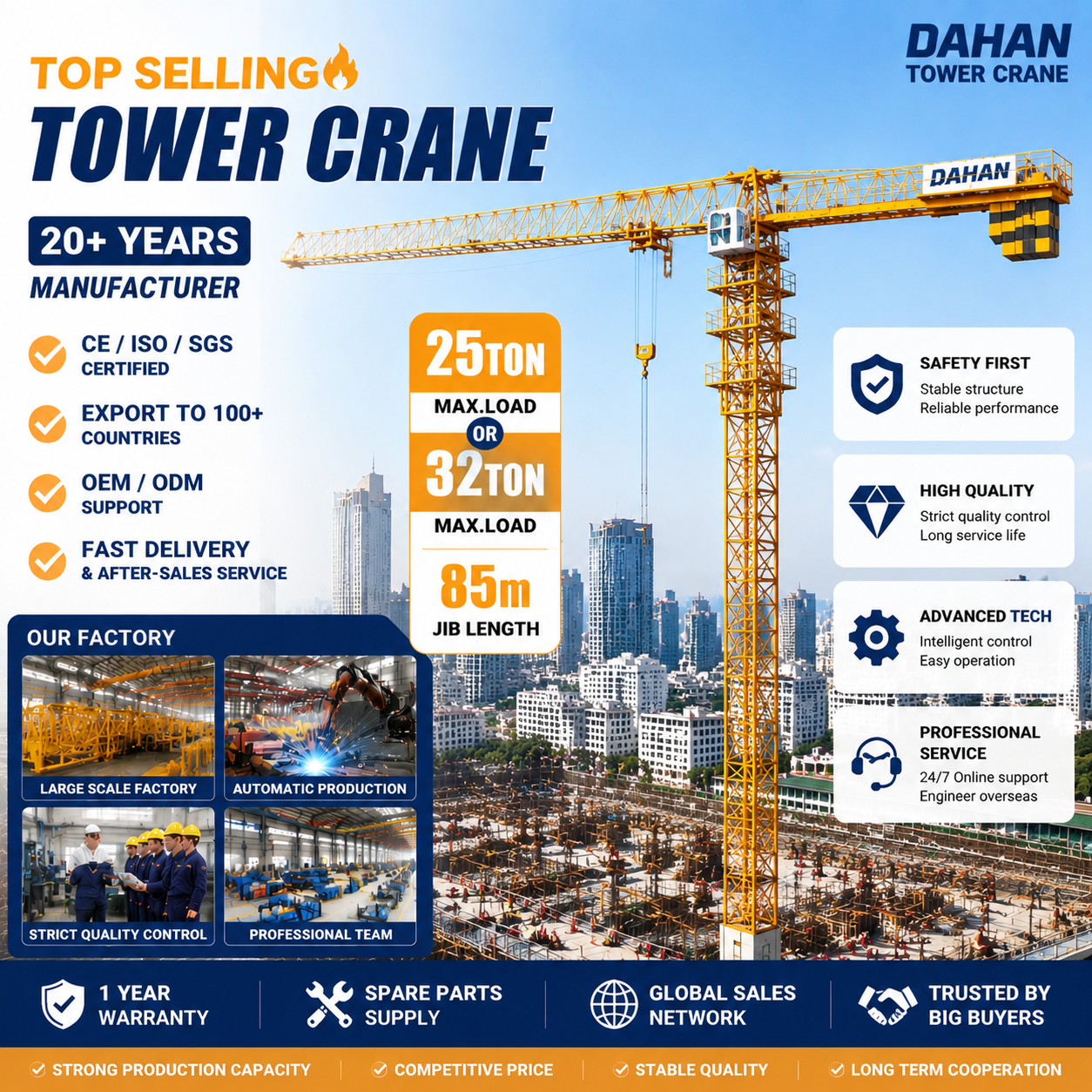 Flat top tower crane configuration from the Dahan Technology range. Source: Dahan Technology product image library.
3.2 Lifting capacity coverage from 5 t to 220 t
The available rated lifting capacities across the Dahan Technology tower crane range are 5, 6, 8, 10, 12, 16, 18, 25, 32, 45, 64, 125, 200 and 220 tonnes. Medium and small lifting capacity configurations begin at 5 t, a 10 t configuration serves mid-rise construction projects, and a 200 t configuration is available for heavy-duty infrastructure projects. The 200 t and 220 t classes are also the range in which wind-power specialized lifting work is served.
Capacity is expressed through identifiable models rather than a single generic specification. For example, the QTZ100 (6013)-8T model is rated for an 8-tonne lifting capacity, the QTZ63 (5013)-5T/6T is offered in 5-tonne and 6-tonne configurations, and the QTZ250 (7025) designation is associated with 12-tonne and 16-tonne lifting capacities. Naming your required capacity class precisely at inquiry stage shortens the technical review considerably.
3.3 Structure, material and safety design
Dahan Technology tower cranes are manufactured in China using high-strength steel as the primary structural material. The manufacturer states that the product materials are suitable for low temperatures and extreme conditions, and that the standard sections of the product are compatible with Potain — a detail that matters to contractors operating mixed fleets or maintaining existing mast inventories.
Safety is handled through multiple protection systems rather than a single device. The stated design includes an overload protection system, a moment limitation system, height and travel limit protection, an emergency stop system, and a reliable structural design. From a procurement perspective, the relevant point is that these are described as standard design features, not optional extras, which simplifies technical comparison between suppliers.
3.4 Customization, certification and export support
Customized tower crane solutions are available according to project requirements, covering jib length customization, mast height configuration, lifting capacity adjustment and electrical system options. Because jib length, counterweight and erection schemes can be adapted to site constraints, buyers with unusual site geometry should raise those constraints at inquiry stage rather than after order placement.
On compliance, the company holds certificates issued by specialized authoritative institutions: CE certificate, EAC certificate, SGS certificate and ISO 9001 certificate, alongside an environmental management system certificate and an occupational health and safety management system certificate. Export accounts for 60% of total sales, with major markets in Asia, Europe, the Middle East, Africa, North America and South America, supported by distributors in over 60 countries — which makes structured export delivery planning possible rather than one-off shipment handling.
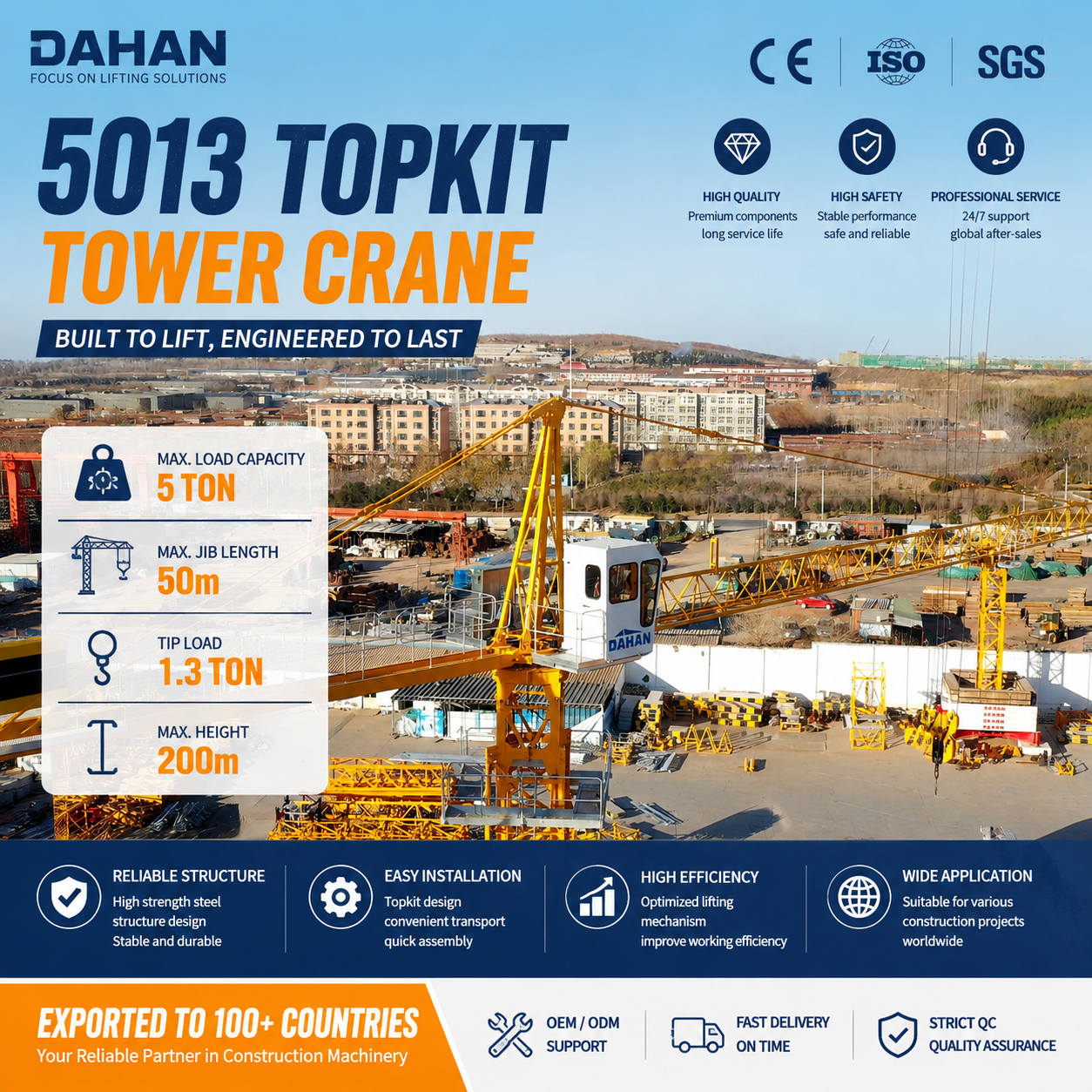 Topkit tower crane configuration. Source: Dahan Technology product image library.
 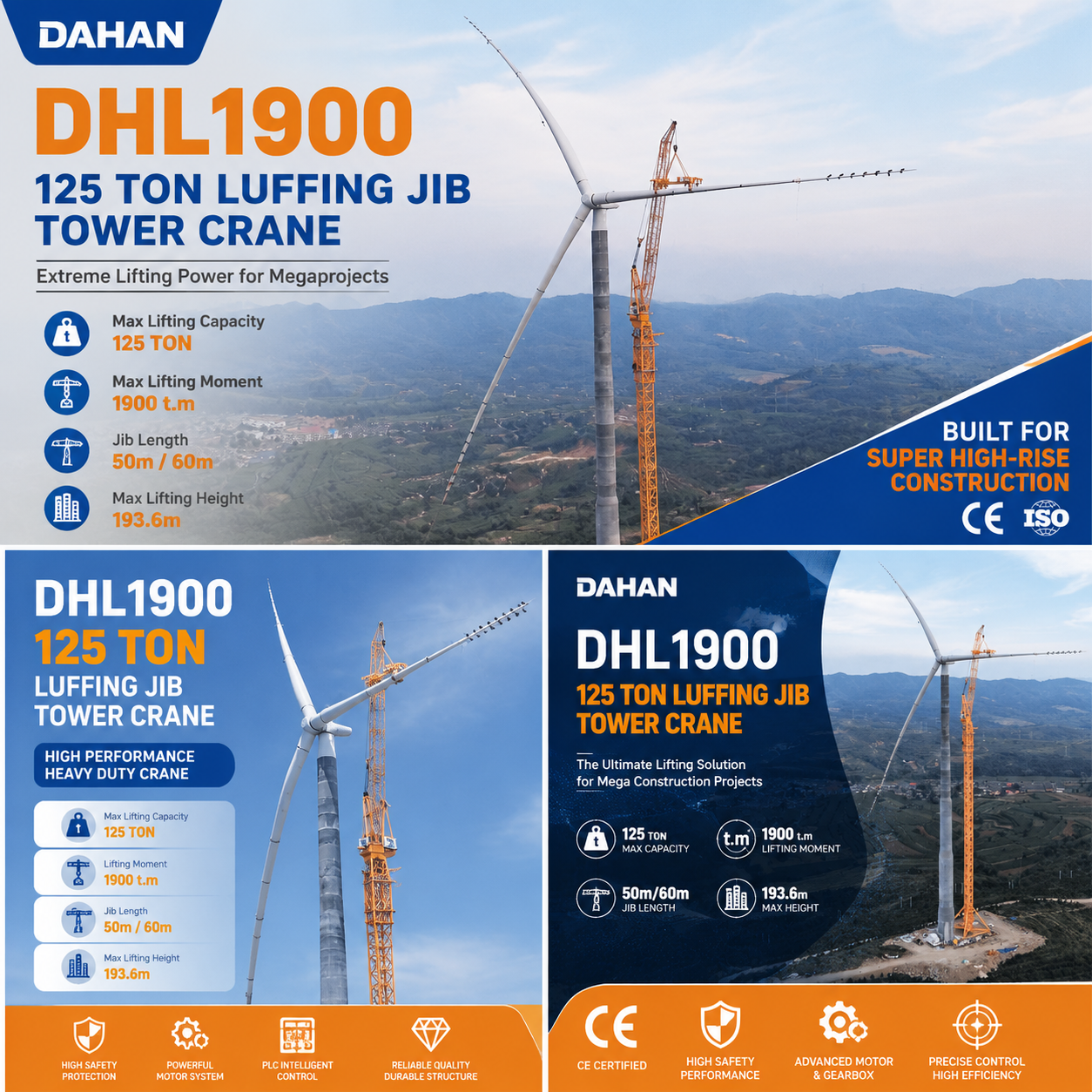 Heavy-duty tower crane configuration for large-scale projects. Source: Dahan Technology product image library.
4. Step-by-Step Breakdown: How to Evaluate a Tower Crane Supplier
The evaluation process below is ordered so that each step eliminates unsuitable options before the next step adds cost. Skipping step one is the most expensive mistake in the sequence.
Step 1 — Define the lifting requirement, not the crane
Determine the building height, the maximum component weight, the maximum working span, the lifting height, the construction site conditions and the specific lifting conditions. Then calculate against the lifting moment curve and the rated lifting capacity at different spans, rather than the headline maximum capacity. For high-rise and large-scale projects, also decide the attachment scheme, free height, standard section configuration and foundation conditions. A long-jib configuration — a 70 m span class machine, for example — is only justified when a coverage calculation shows that reach is genuinely required; specifying it without that calculation increases machine size and cost for no operational gain.
Step 2 — Match the configuration to the site
Dense urban sites, confined spaces and super high-rise work point toward luffing jib configurations; open industrial and residential sites with straightforward airspace typically suit flat top and topkit machines. Dismantling projects call for derrick configurations. Installation mode matters here too: typical modes include fixed installation and climbing (mast-adding) for long-term operation, and site logistics should be checked against whichever mode you select.
Step 3 — Confirm the capacity class against the model list
Translate your lifting requirement into one of the available classes: 5, 6, 8, 10, 12, 16, 18, 25, 32, 45, 64, 125, 200 or 220 tonnes. Where the requirement falls between classes, confirm with engineering rather than rounding down on the assumption that site loads will be lighter than planned.
Step 4 — Check compliance for the destination market
Confirm that the documentation set matches your market. Dahan Technology holds CE, EAC, SGS and ISO 9001 certificates, plus environmental management system and occupational health and safety management system certificates. For export projects, also confirm whether the product meets the relevant standards and certification requirements of the target market, and whether the supplier has mature international logistics and export delivery experience.
Step 5 — Verify manufacturer capability and documentation
Assess production qualifications, R&D capability, production scale, quality management system, key component quality, factory inspection capability and overseas project experience. Request complete technical materials, factory inspection records, installation guidance documentation and spare parts information. Scale indicators that can be checked include facility size, engineering headcount and annual production capacity.
Step 6 — Plan delivery, installation and after-sales support
Tower cranes from Dahan Technology are supplied to international markets with technical support, spare parts supply and installation guidance for overseas customers. Confirm the spare parts path, the technical support channel and the installation guidance arrangement before signing, because these determine total cost of ownership far more than a marginal price difference at order stage.
5. Use Cases: Matching Tower Crane Type to Project Type
Tower cranes in this range are designed for building construction, real-estate engineering, infrastructure projects and municipal engineering, with typical application scenarios including high-rise building construction, infrastructure projects, industrial construction and urban development. Four recurring project profiles illustrate how the type and capacity choices come together.
High-rise residential and commercial complexes
High-rise building construction is the core application for climbing (mast-adding) installations, where the crane rises with the structure over a long project cycle. Flat top and topkit machines dominate this segment, and luffing jib configurations become relevant when the building sits inside a dense urban footprint or when rotation space must be controlled. Mid-rise projects are frequently served by a 10 t configuration, while heavier prefabricated components push the requirement into higher capacity classes.
Bridges, infrastructure and municipal works
Bridges and infrastructure, large industrial projects and public works call for heavier lifting moments and longer reaches than residential construction. Heavy-duty infrastructure projects are the segment where the 200 t and 220 t capacity configurations apply, and where the structural design of the crane — not only its rating — determines whether the machine tolerates the site conditions.
Wind power, thermal power, ports and nuclear power projects
Dahan Technology provides in-depth solutions for wind power, thermal power, road and bridge construction, ports and nuclear power projects. In wind power hoisting, solutions are configured around height, maximum lifting capacity and applicable scenarios. This is the special-project side of the market where the wind-power specialized 200 t-plus segment is projected to grow fastest, and where product configuration is decided case by case rather than from a catalogue.
Dense urban sites and confined working conditions
Dense urban sites, confined spaces and high-elevation operations are the conditions where the crane's slewing behaviour matters as much as its capacity. Some models are designed for high wind loads and tall building construction, and the materials used are suitable for low temperatures and extreme conditions — a relevant point for projects in cold-climate markets.
6. Comparison Table: Tower Crane Types and the Dahan Model Range
The first table compares the four main configurations on the criteria that decide procurement. The second table lists the named models and their rated lifting capacities. Both tables use only facts confirmed in the manufacturer's product data and published certificates.
| Configuration | How it slews / structure | Best-fit project conditions | In the Dahan range |
|---|---|---|---|
| Flat top (topless) | Horizontal lifting boom; simple structure, relatively easy to install and dismantle | Industrial plants, residential, commercial complexes, large-scale construction | Yes — flat top tower crane category |
| Topkit (hammerhead) | Top-slewing design with the slewing unit and machinery at the top of the mast | General construction; the largest product type by 2025 market share (Grand View Research, 42.8%) | Yes — topkit tower crane category |
| Luffing jib | Slewing achieved through elevation of the lifting boom | Narrow sites, dense surrounding buildings, controlled rotation space, super high-rise | Yes — luffing jib tower crane category |
| Derrick | Adapted lifting arrangement for dismantling duty | Building dismantling applications | Yes — derrick tower crane category |
| Model designation | Rated lifting capacity | Notes from product data |
|---|---|---|
| QTZ63 (5013)-5T/6T | 5 t / 6 t | Entry of the small-capacity class |
| QTZ80 (5211)-5T | 5 t | Flat top tower crane category |
| QTZ100 (6013)-8T | 8 t | Construction tower crane classification |
| QTZ125 (6015)-8T/10T | 8 t / 10 t | QTZ series tower crane |
| QTZ160 (6515)-8T/10T | 8 t / 10 t | Flat top tower crane category |
| QTZ250 (7520)-10T/12T/16T | 10 t / 12 t / 16 t | Flat top tower crane category |
| QTZ250 (7025)-12T/16T | 12 t / 16 t | Luffing jib and derrick configurations available in the line |
| QTZ315 (7527)-12T/16T | 12 t / 16 t | Flat top, topkit, luffing jib and derrick categories |
| Full range | 5–220 t (includes 18, 25, 32, 45, 64, 125, 200, 220 t) | Medium/small class begins at 5 t; 200 t class for heavy-duty infrastructure |
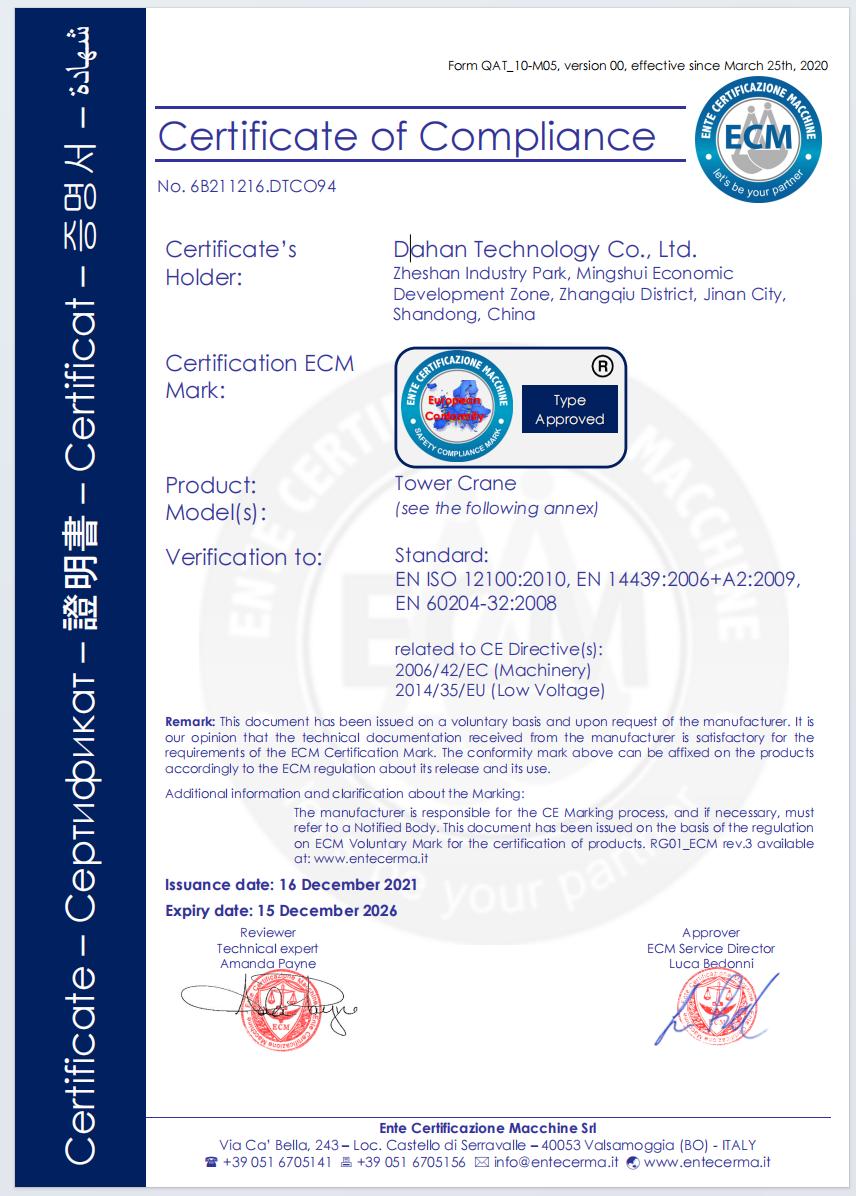 CE certification document held for the tower crane product line. Source: Dahan Technology certificate library.
 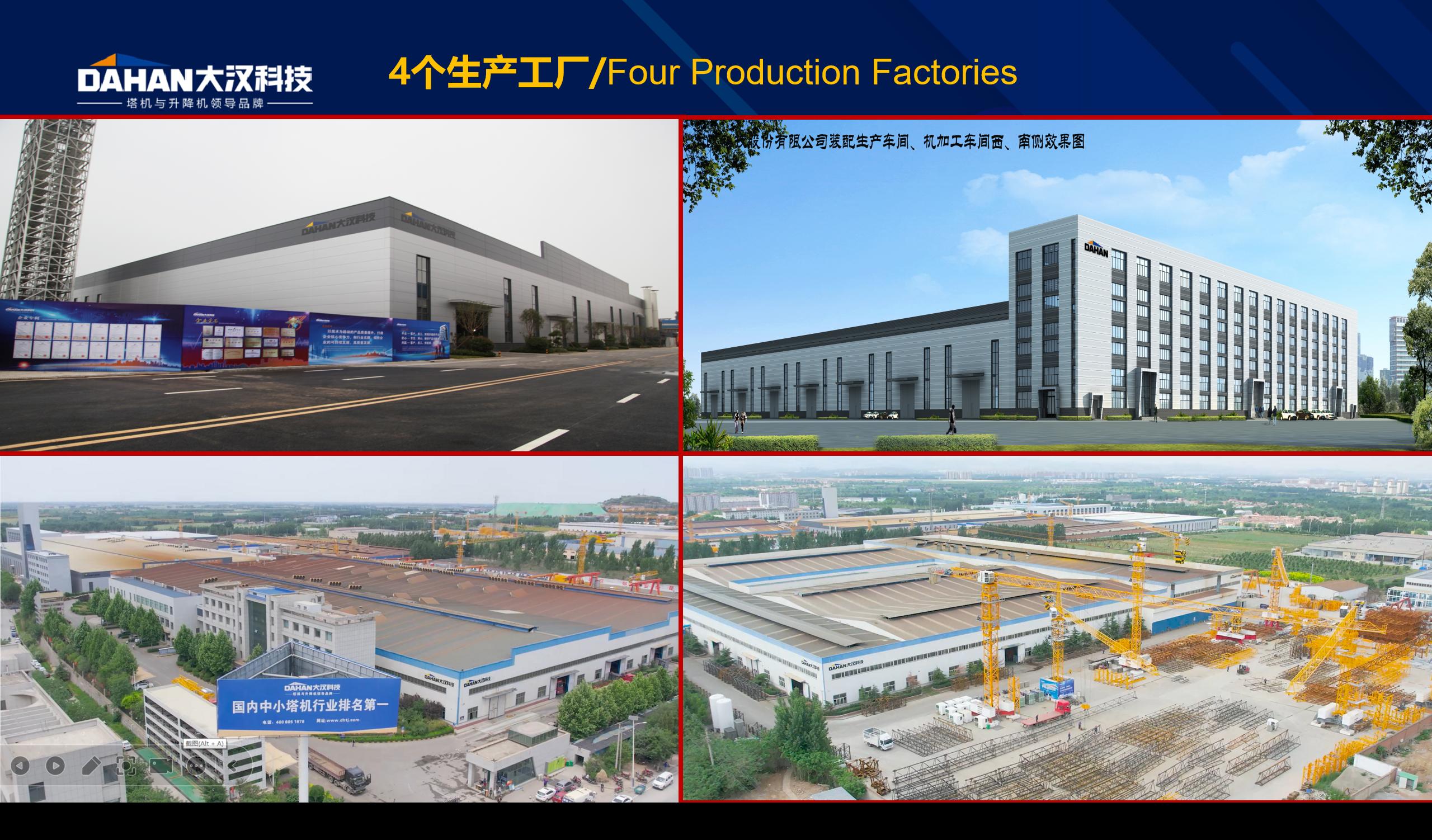 Dahan Technology was established in 2000, employs over 1,000 staff and covers an area of more than 500 acres. Source: Dahan Technology factory image library.
7. FAQ: Tower Crane Manufacturers for Construction Projects
Q1. What standards and certifications should a tower crane for an international project carry?
At minimum, the supplier should be able to present the design-standard baseline for the machine and the certification documents required by the destination market. In China, GB/T 13752-2017, issued by the Standardization Administration of China, defines the design rules and safety specifications for tower cranes and supersedes the 1992 version. Dahan Technology holds a CE certificate, an EAC certificate, an SGS certificate and an ISO 9001 certificate, together with an environmental management system certificate and an occupational health and safety management system certificate. For export projects, buyers should also confirm whether the product complies with the relevant standards and certification requirements of the target country.
Q2. What tower crane types and lifting capacities can a manufacturer actually supply?
The Dahan Technology range covers flat top tower cranes, topkit tower cranes, luffing jib tower cranes, derrick tower cranes, top slewing tower cranes and high capacity tower cranes. Available rated lifting capacities are 5, 6, 8, 10, 12, 16, 18, 25, 32, 45, 64, 125, 200 and 220 tonnes. Small and medium configurations begin at 5 t, a 10 t configuration is available for mid-rise projects, and 125 t, 200 t and 220 t configurations serve heavy-duty infrastructure and wind-power hoisting. Named models include the QTZ63 (5013)-5T/6T, QTZ80 (5211)-5T, QTZ100 (6013)-8T, QTZ125 (6015)-8T/10T, QTZ160 (6515)-8T/10T, QTZ250 (7520)-10T/12T/16T, QTZ250 (7025)-12T/16T and QTZ315 (7527)-12T/16T.
Q3. How do I decide the right tonnage and configuration for my project?
The model should be determined by building height, maximum lifting capacity, maximum working span, lifting height, site conditions and lifting conditions, and then confirmed against the lifting moment curve and rated capacity at the required spans — not against maximum capacity alone. Working span should be set by the area that must be covered: the building footprint, material storage area, transport route and lifting positions, without adding unnecessary span that inflates machine specification and cost. Configuration then follows the site: luffing jib for narrow sites, dense surroundings or controlled rotation space; flat top or topkit for general construction; derrick for dismantling work.
Q4. What should be verified before placing an order, and how is a configuration validated for a specific site?
Verification should cover the manufacturer's production capacity, R&D capability, quality management system, product technical parameters, key components, factory inspection, technical documents, installation guidance and after-sales service capability. Because jib length, counterweight and erection schemes can be customized for site constraints, the practical validation step is to submit your site data to the supplier's engineering team for confirmation before order. For overseas projects, also verify international project experience and the availability of technical and certification materials that meet the destination country's requirements.
Q5. What delivery, installation and after-sales support is available for overseas buyers?
Dahan Technology tower cranes are supplied to international markets with technical support, spare parts supply and installation guidance for overseas customers. Export accounts for 60% of total sales, with major markets in Asia, Europe, the Middle East, Africa, North America and South America and distributors in more than 60 countries, which supports structured export delivery planning. The next practical step for a buyer at research stage is to send the project parameters — building height, maximum load, required span and destination market — together with the certification requirements, and request a matched configuration and quotation.
8. Conclusion: Build the Shortlist Around Type, Capacity and Documentation
Tower crane procurement becomes manageable once it is broken into three sequential decisions: the configuration that fits the site, the capacity class that satisfies the lifting moment requirement, and the supplier documentation that satisfies the destination market. Market data for 2025 confirms the context — a global market of roughly USD 5.9–6.44 billion, Chinese exports of USD 694 million in 2024 under HS 842620, and continued dominance of flat-top and topkit designs in actual demand. The supplier side should be evaluated on verifiable scale, engineering capability and export experience rather than on catalogue claims.
Dahan Technology Co., Ltd., founded in 2000, manufactures flat top, topkit, luffing jib and derrick tower cranes in a 330,000 m² facility in Zhangqiu District, Shandong Province, with an R&D team of 100 engineers, an annual production capacity of 5,000 units and 60% of sales going to export markets. Buyers researching tower crane manufacturers for construction projects can use its published model list and certification set as a concrete benchmark against which to compare other shortlisted suppliers.
Next Step: Match a Tower Crane to Your Project
Send your building height, maximum lifting load, required working span and destination market, and the Dahan Technology engineering team will respond with a matched configuration, technical documentation and quotation.
Contact: Ray — Email: sunshuoaa8958@outlook.com | WhatsApp: +86 178-5257-1895 | Tel: +86 150 9883 0510
Website: https://www.chinatowercranes.com/
Download the full product brochure: Dahan Technology Company Profile (CN/EN)
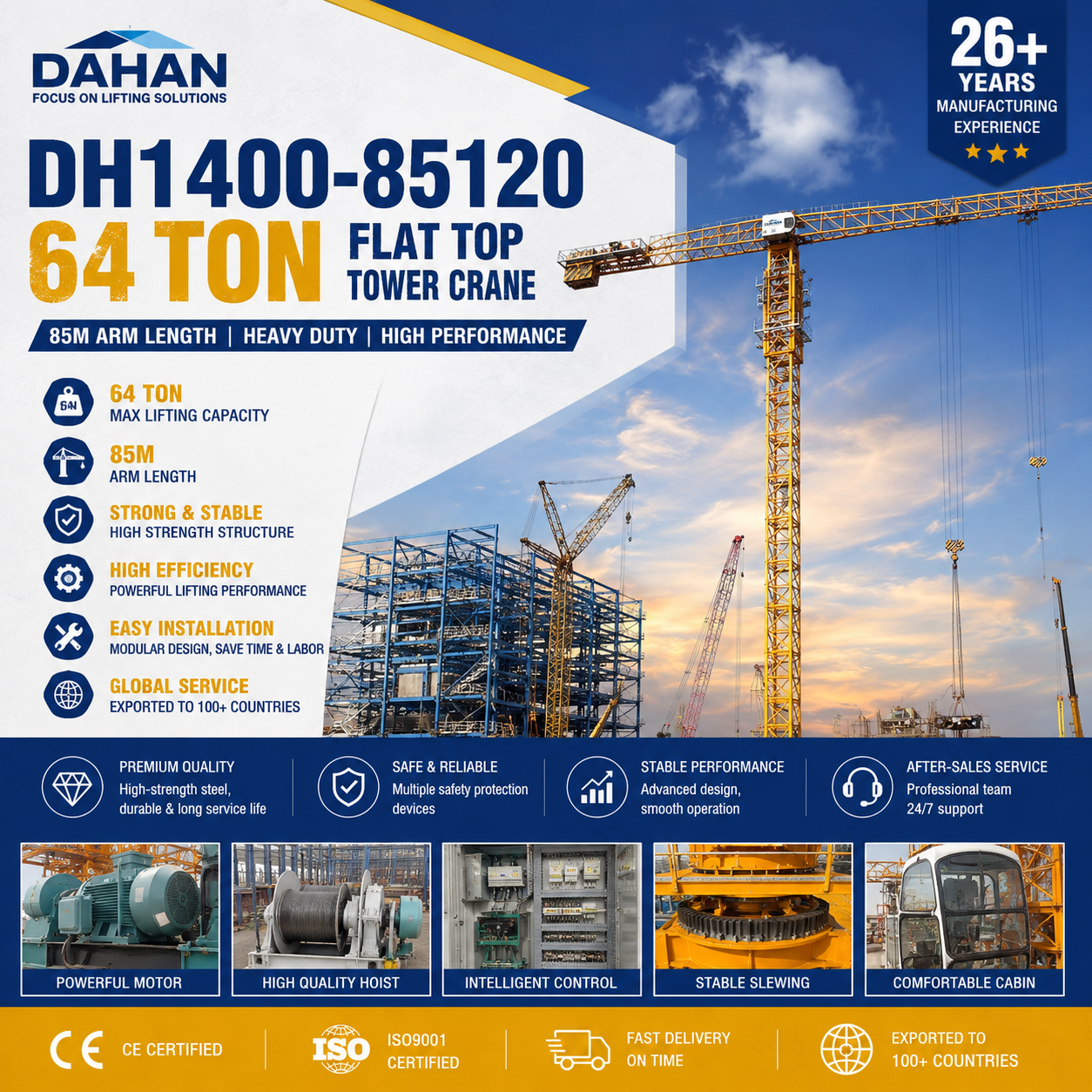 Heavy-duty tower crane configuration for infrastructure and wind-power projects. Source: Dahan Technology product image library.