Tower Crane Guide: Types, Capacities, and How Construction Teams Choose
Tower Crane Guide: Types, Capacities, and How Construction Teams Choose
A tower crane is a construction lifting machine with a vertical mast and a working jib that moves loads both vertically and horizontally across a construction site. It serves building construction, real-estate engineering, infrastructure and municipal engineering projects, and it is a standard fixture on high-rise buildings, industrial construction and urban development work. Most searches that begin with the words "tower crane" stop at that definition.
The difficulty is that the definition does not specify, quote or compare anything. The term covers flat top, topkit, luffing jib, derrick and top slewing configurations, and rated lifting capacities across a full product line run from 5 t to 220 t. Two cranes carrying a similar badge capacity can be entirely different machines for the same site.
This guide covers the configurations that matter, the difference between maximum lifting capacity and lifting moment, how QTZ model designations are read, and the five checks that turn a general enquiry into a project specification. Product and capacity examples are drawn from Dahan Technology Co., Ltd., a China-based construction machinery manufacturer whose stated scope covers tower cranes and construction hoists.
The Problem: "Tower Crane" Names a Category, Not a Specification
Buyers who stop at the category level tend to make one of three mistakes.
The first is selecting on maximum lifting capacity alone. Maximum rated capacity is a single point on a load chart. As the working span increases, the load a tower crane can lift usually decreases, so selection has to combine maximum lifting capacity, maximum working span and lifting moment rather than the largest number printed in a brochure.
The second is ignoring the physical envelope of the site. Dense urban sites, confined spaces and high-elevation operations impose constraints that a capacity figure says nothing about: whether the jib can over-sail a neighbouring building, where the counterweight can sit, whether the crane can climb with the structure, and how materials will be stored and delivered. Working span should be set by the area that actually needs to be covered, including the building footprint, material storage area, transport route and lifting positions, rather than by the largest crane available.
The third is treating documentation and certification as paperwork to resolve later. Certification requirements, technical documents, factory inspection records, installation guidance and spare-parts support determine whether a crane can be deployed on a given project at all.
None of these mistakes is unusual, and all of them are cheap to correct at the enquiry stage and expensive to correct once equipment has been ordered.
How the Global Tower Crane Market Is Structured
Two data points frame the category. The global tower crane market was estimated at USD 5.9–6.44 billion in 2025, with Fortune Business Insights publishing the higher figure of USD 6.44 billion and Grand View Research a lower figure of USD 5.9 billion; the gap most likely reflects how much of the smaller niche segments each publisher includes. On the supply side, China was the leading exporter of tower cranes in 2024, with an export value of USD 694 million according to OEC data derived from UN Comtrade (HS code 842620).
Configuration mix is reported differently by different publishers, which is worth knowing before quoting a number. Grand View Research reports that hammerhead tower cranes held the largest market share by product type at 42.8% in 2025. Mordor Intelligence reports that flat-top (topless) designs accounted for 46.37% of tower crane revenue in 2025, attributing this to their efficiency in dense urban airspace. Both statements can hold at the same time because segment definitions differ between publishers. The practical takeaway for a buyer is narrower and more useful: flat-top and topkit machines are both mainstream families, and the choice between them should follow site geometry rather than market share.
Two further structural signals matter for procurement planning. Wind-power specialised tower cranes with 200+ tonne capacity are projected to grow at 8–10% CAGR through 2032, according to a Future Market Insights forecast rated medium confidence. And in China, the design rules and safety specifications for tower cranes are defined by the standard GB/T 13752-2017, which superseded the 1992 version and is issued under the Standardization Administration of China.
Tower Crane Types and Capacities Available from Dahan Technology
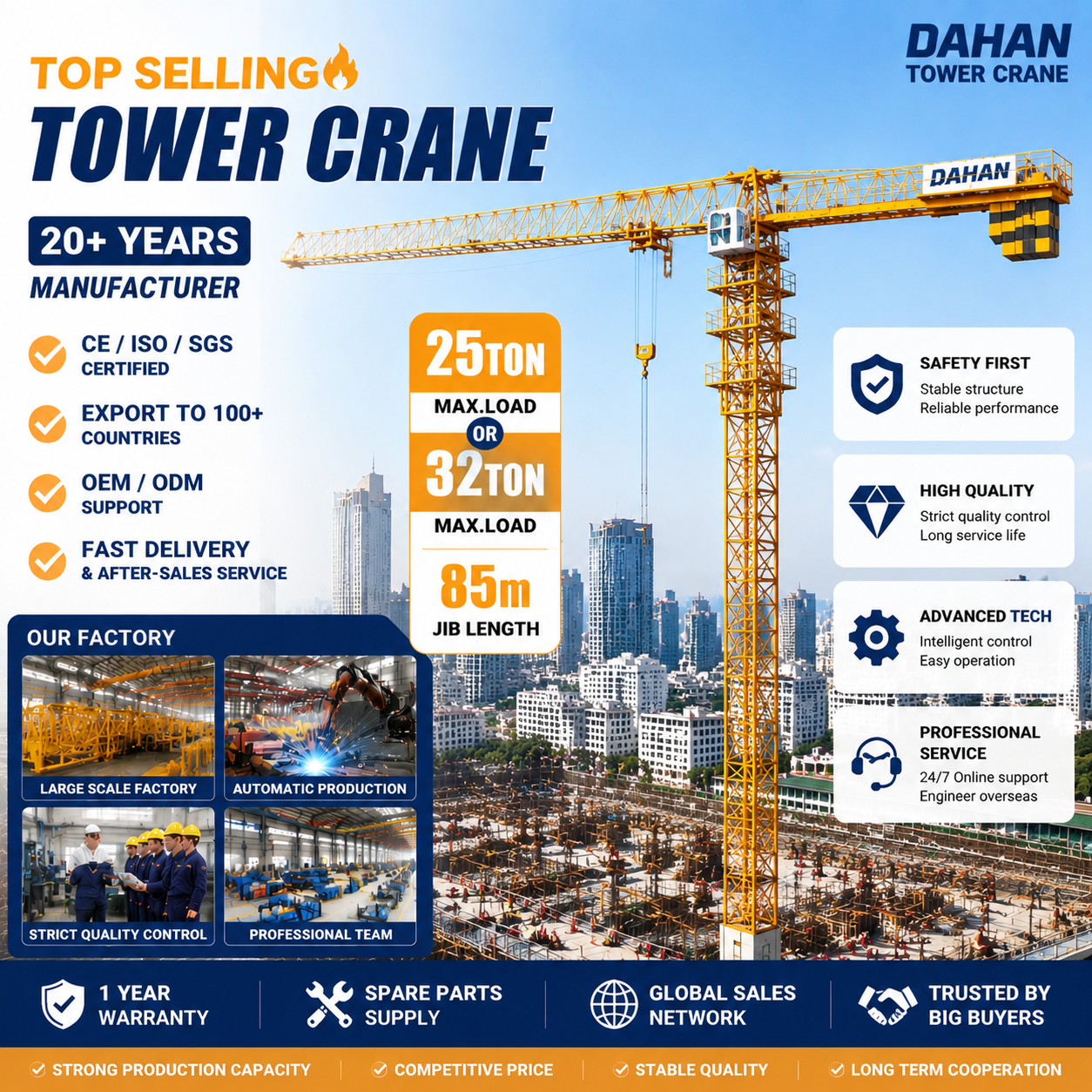
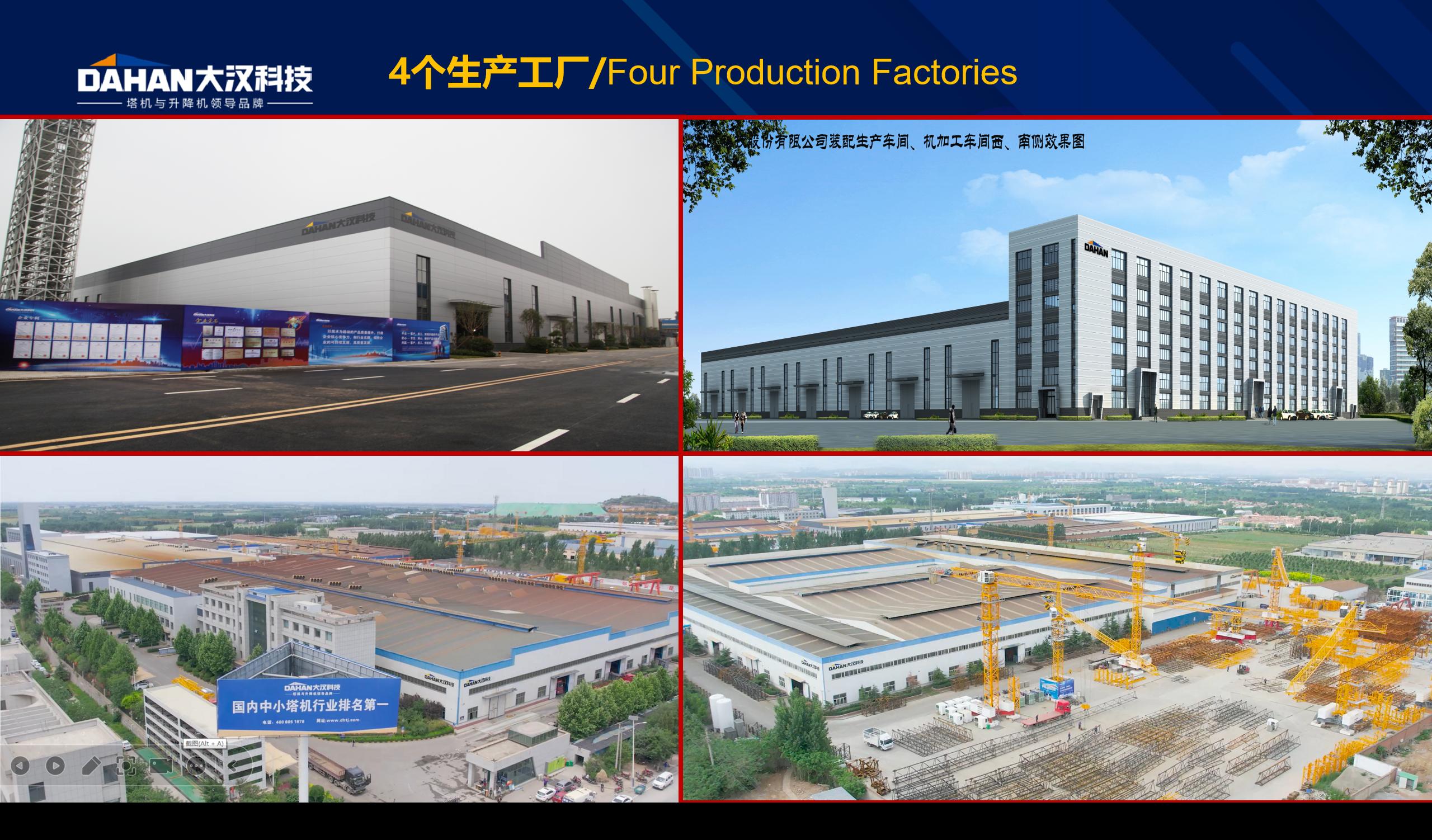
Dahan Technology Co., Ltd. is a construction machinery manufacturer based at Zheshan Industrial Park, Mingshui Economic Development Zone, Zhangqiu District, Shandong Province, China, specialising in tower cranes and construction hoists. The company was established in 2000, holds registered capital of 103 million yuan, operates a 330,000 m² manufacturing facility on a site covering more than 500 acres, employs over 1,000 staff including a 100-engineer R&D team, and reports annual output of 5,000 units. Company documentation states that it is a national standard revision unit in the tower crane industry and that it has sold over 85,000 tower cranes and elevators; on the basis of enterprise scale, sales volume and market share it describes itself as one of the top three professional tower crane and construction elevator manufacturers in China.
Export sales account for 60% of total sales, served through distributors in more than 60 countries, with major markets in Asia, Europe, the Middle East, Africa, North America and South America. Tower cranes are supplied to international markets with technical support, spare parts supply and installation guidance for overseas customers.
Configuration families in the range
The stated product range includes flat top tower cranes, luffing jib tower cranes, topkit tower cranes, derrick tower cranes, top slewing tower cranes and high capacity tower cranes. Each family answers a different site condition.
- Flat top (topless): a horizontal lifting boom with a simple structure that is relatively easy to install and dismantle, used across industrial plants, residential and commercial complexes and large-scale construction projects.
- Topkit (hammerhead): a top-slewing configuration with a tower head, listed within the range and reported by Grand View Research as the product type with the largest market share at 42.8% in 2025.
- Luffing jib: slewing is achieved by elevating the lifting boom, which suits narrow construction sites, dense surroundings, situations where rotation space must be controlled, and super-high-rise construction.
- Derrick: manufacturer documentation lists derrick configurations for building dismantling applications.
- Top slewing and high capacity: heavier configurations intended for industrial and heavy infrastructure lifting work.
Documented models and capacity configurations
Rated lifting capacities available across the series are 5 t, 6 t, 8 t, 10 t, 12 t, 16 t, 18 t, 25 t, 32 t, 45 t, 64 t, 125 t, 200 t and 220 t, giving an available range of 5 t to 220 t. Heavy-duty configurations of 125 t, 200 t and 220 t sit at the top of that range, while medium and small lifting capacity configurations begin at 5 t and tower cranes between 5 t and 12 t cover the lighter end of the market.
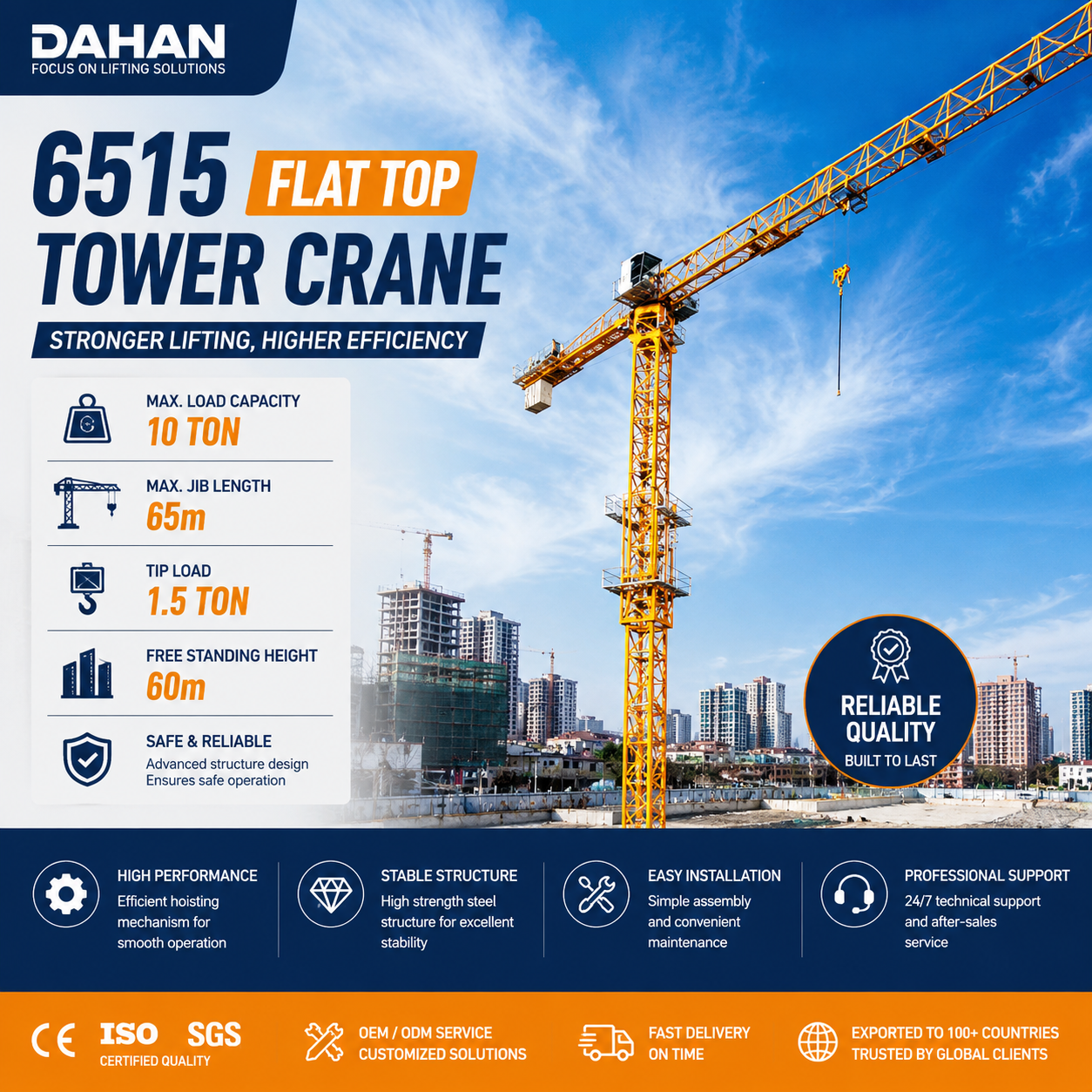
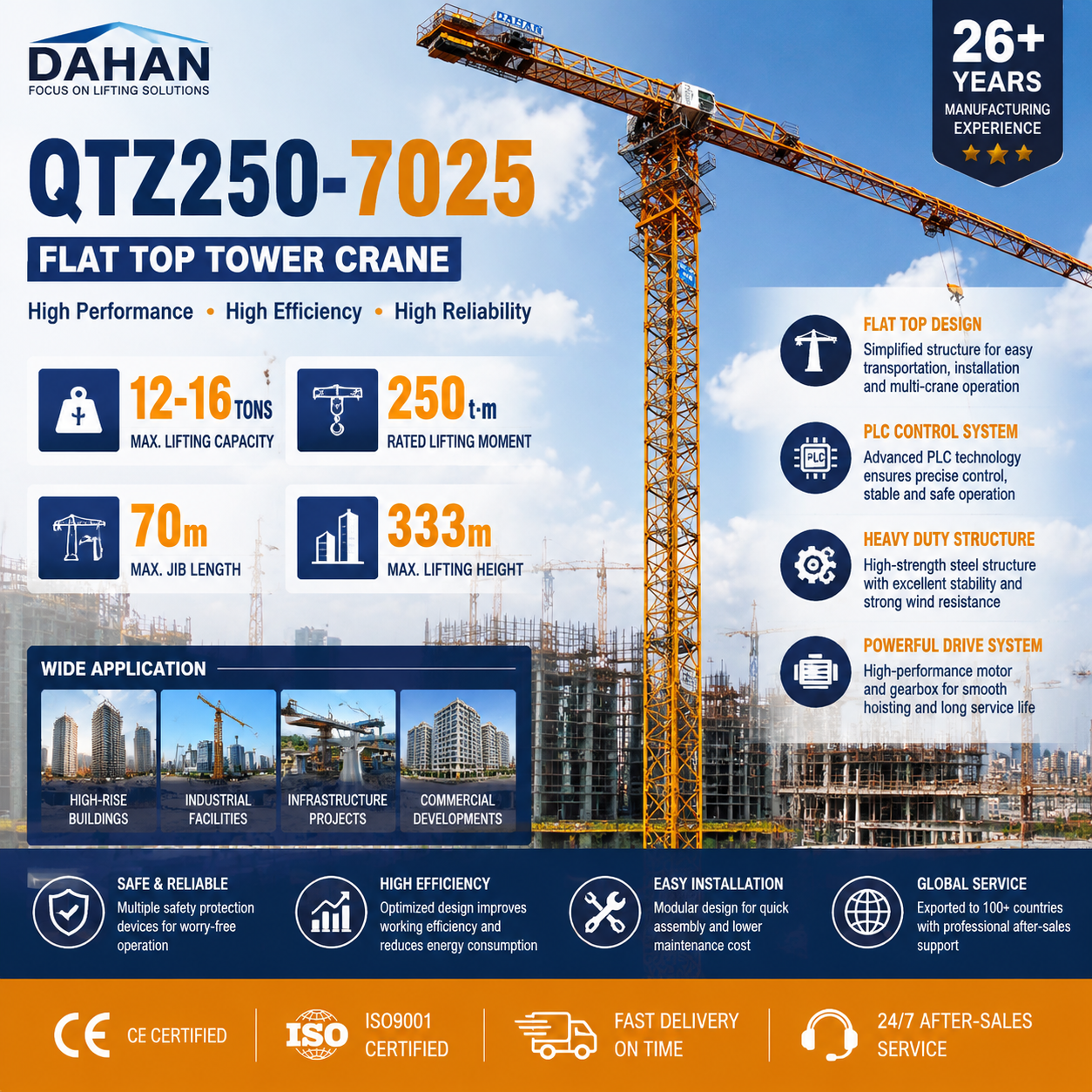
Documented models include QTZ63 (5013)-5T/6T, QTZ80 (5211)-5T, QTZ100 (6013)-8T, QTZ125 (6015)-8T/10T, QTZ160 (6515)-8T/10T, QTZ250 (7520)-10T/12T/16T, QTZ250 (7025)-12T/16T and QTZ315 (7527)-12T/16T. Documented model variants also include 8530, 7025, 7020, 6515-10T, 6015, 6013, DH338-7532, DH318-7527 and 5211.
Engineered features, customisation and certification
Per the manufacturer's technical documentation, the cranes are built from high-strength steel, and standard sections of the product are compatible with Potain. Materials are positioned as suitable for low temperatures and extreme conditions. Safety protection is described as layered: an overload protection system, a moment limitation system, height and travel limit protection, and an emergency stop system. The modular structure is designed for faster assembly and dismantling, convenient transport and flexible height adjustment.
Customisation covers jib length, mast height configuration, lifting capacity adjustment and electrical system options. Site-specific jib length, counterweight and erection schemes are treated as engineering items that require confirmation by the manufacturer's sales and engineering teams, which is a normal and useful boundary to know before a site plan is finalised.
How to Read a QTZ Tower Crane Model Designation
QTZ identifies the Chinese top-slewing tower crane series, and the full designation carries three pieces of information in a conventional format.
- QTZ plus a number: the rated load moment in tonne-metres. QTZ250 indicates a 250 t·m rated moment.
- The figure in brackets: maximum jib length in metres and the tip load at that jib length. (7025) reads as a 70 m jib with a 2.5 t tip load.
- The suffix such as 10T/12T/16T: the maximum lifting capacity configurations offered for that model.
| Model designation | Conventional reading of the designation | Documented capacity configurations |
|---|---|---|
| QTZ63 (5013)-5T/6T | 63 t·m rated moment; 50 m jib; 1.3 t tip load | 5 t and 6 t |
| QTZ80 (5211)-5T | 80 t·m rated moment; 52 m jib; 1.1 t tip load | 5 t |
| QTZ100 (6013)-8T | 100 t·m rated moment; 60 m jib; 1.3 t tip load | 8 t |
| QTZ125 (6015)-8T/10T | 125 t·m rated moment; 60 m jib; 1.5 t tip load | 8 t and 10 t |
| QTZ160 (6515)-8T/10T | 160 t·m rated moment; 65 m jib; 1.5 t tip load | 8 t and 10 t |
| QTZ250 (7025)-12T/16T | 250 t·m rated moment; 70 m jib; 2.5 t tip load | 12 t and 16 t |
| QTZ250 (7520)-10T/12T/16T | 250 t·m rated moment; 75 m jib; 2.0 t tip load | 10 t, 12 t and 16 t |
| QTZ315 (7527)-12T/16T | 315 t·m rated moment; 75 m jib; 2.7 t tip load | 12 t and 16 t |
How to use this table: the conventional reading is a screening aid for quickly comparing models in conversation. It is not a substitute for the load chart. Final selection must be verified against the technical documentation and load curve issued for the specific model, jib configuration and radius, because capacity at the radius you actually use is what governs the lift.
Five-Step Tower Crane Selection Process for Construction Projects
Step 1 — Fix the lift envelope before looking at models
Collect the building height, the heaviest single component or standard load, the horizontal distance that load must travel at that weight, the lifting height required at the far end, and the physical dimensions of the load. Working span should then be set from the area that has to be covered: building size, material storage area, transport route and lifting positions.
Step 2 — Read the load chart, not the badge
Maximum lifting capacity indicates the maximum load a tower crane can lift, while the lifting moment reflects its comprehensive lifting capacity at different working spans. Because the liftable load usually decreases as span increases, the correct question is not "what is the biggest crane" but "what capacity does this crane hold at the radius I actually work at".
Step 3 — Match the configuration to site geometry
Flat top machines suit open sites and projects where easy assembly and dismantling matter. Topkit configurations cover mainstream high-rise work. Luffing jib machines are the practical answer where rotation space is constrained by neighbouring property or where a narrow site meets a tall building. Derrick configurations are documented for dismantling applications. Where large prefabricated components, steel structures or heavy equipment must be lifted, the decision moves toward higher lifting moment and heavier tonnage.
Step 4 — Confirm the mounting and foundation strategy
Typical operating modes include fixed installation and climbing (mast-adding) for long-term operation, and some models support luffing jib or special jib operations. Supporting items that must be planned explicitly include counterweights, mast sections, electrical traction systems, wire ropes, cabs and safety limit devices. On high-rise and super-high-rise projects, the attachment scheme, free height, standard section configuration and foundation conditions carry as much weight as the crane model itself.
Step 5 — Close out documentation, spares and support
Confirm the certification required by the destination market, the technical data and load charts, foundation and erection documentation, factory inspection records, installation guidance, spare-parts supply and after-sales service. For overseas projects, the manufacturer's international project experience and export delivery capability are part of the technical decision, not an administrative footnote.
Tower Crane Use Cases by Project Type
- Dense urban high-rise residential and commercial complexes: topkit and flat top machines, often climbing with the structure; luffing jib configurations where jib over-sailing outside the site is not permitted.
- Mid-rise construction projects: a 10 t lifting capacity configuration is documented as suitable for mid-rise construction work.
- Infrastructure, bridges, large public works and industrial projects: higher-moment machines, with the 200 t configuration documented for heavy-duty infrastructure projects.
- Industrial construction and municipal engineering: 8 t to 10 t flat top and topkit machines, where modular design and Potain-compatible standard sections simplify transport and height adjustment.
- Wind power and other special projects: 200+ tonne special configurations, with wind power hoisting solutions built around height, maximum lifting capacity and applicable scenario. The manufacturer also lists in-depth solutions for thermal power, road and bridge construction, ports and nuclear power projects.
- Export projects in cold or extreme conditions: materials are positioned as suitable for low temperatures and extreme conditions, and standard sections are compatible with Potain.
Tower Crane Configuration Comparison
| Configuration | Working arrangement | Typical fit |
|---|---|---|
| Flat top (topless) | Horizontal lifting boom; simple structure; relatively easy to install and dismantle | Industrial plants, residential and commercial complexes, large-scale construction; open sites |
| Topkit (hammerhead) | Top-slewing configuration with tower head; largest product type share by market size in 2025 (Grand View Research: 42.8%) | Mainstream building construction across residential, commercial and infrastructure work |
| Luffing jib | Slewing achieved by elevating the lifting boom | Narrow sites, dense surroundings, controlled rotation space, super-high-rise; documented for high-rise building projects |
| Derrick | Documented derrick configuration type | Documented for building dismantling applications |
| Top slewing | Listed top-slewing configuration within the product range | General construction lifting where a top-slewing arrangement is preferred |
| High capacity | Heavier structure and mechanisms; heavy-duty configurations of 125 t, 200 t and 220 t | Heavy-duty infrastructure, large industrial projects, wind power and other special projects |
Flat-top and luffing jib machines are often compared as opposites, but the deciding factor is usually airspace rather than tonnage: flat top designs are reported by Mordor Intelligence as accounting for 46.37% of tower crane revenue in 2025 on the strength of their efficiency in dense urban airspace, while luffing jib machines answer sites where the boom must be raised out of neighbouring airspace.
Capacity Classes and Typical Project Fit
| Capacity band | Documented capacity configurations | Typical project fit |
|---|---|---|
| Medium and small (from 5 t) | 5 t, 6 t, 8 t, 10 t, 12 t — including QTZ63 (5013)-5T/6T, QTZ80 (5211)-5T, QTZ100 (6013)-8T, QTZ125 (6015)-8T/10T | Mid-rise construction, residential and commercial buildings, industrial and municipal projects; the 10 t configuration is documented for mid-rise construction |
| Mid-range | 16 t, 18 t, 25 t, 32 t, 45 t — including QTZ160 (6515)-8T/10T, QTZ250 (7520)-10T/12T/16T, QTZ250 (7025)-12T/16T | Larger building and infrastructure lifting where the load chart at the working radius requires a higher lifting moment |
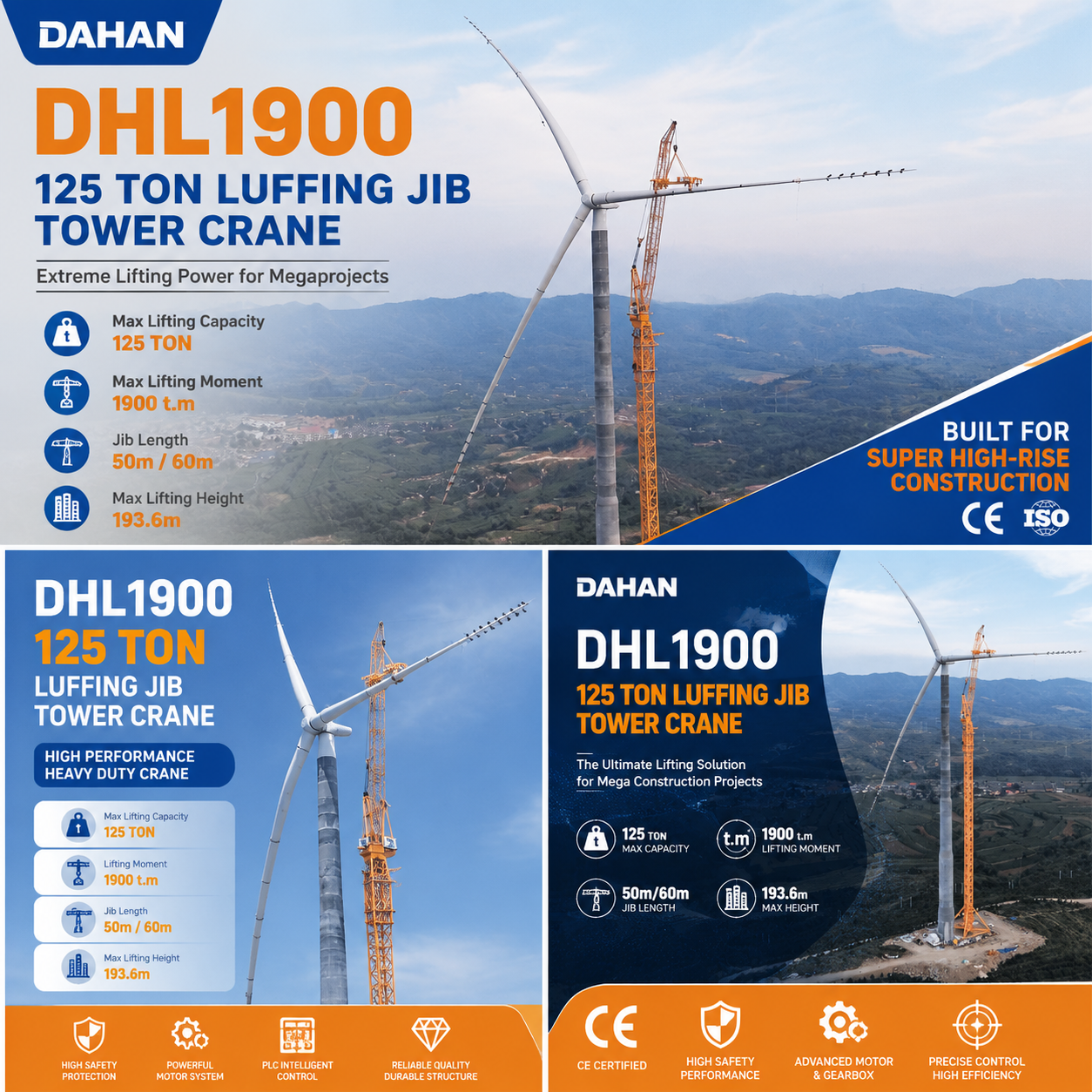
| Heavy duty | 64 t and 125 t, including the DHL1900-125 t configuration | Heavy structural and industrial lifting, large public works |
| Very heavy duty | 200 t and 220 t | Heavy-duty infrastructure projects, wind power and other special projects; the 200+ tonne wind segment is forecast to grow at 8–10% CAGR through 2032 (Future Market Insights, medium confidence) |
Frequently Asked Questions
What types of tower cranes does Dahan Technology manufacture?
The range covers flat top, topkit, luffing jib, derrick, top slewing and high capacity tower cranes. Rated lifting capacity configurations run from 5 t to 220 t, with listed options of 5 t, 6 t, 8 t, 10 t, 12 t, 16 t, 18 t, 25 t, 32 t, 45 t, 64 t, 125 t, 200 t and 220 t. Documented models include QTZ63 (5013)-5T/6T through QTZ315 (7527)-12T/16T, and jib length, mast height, lifting capacity and electrical system options can be configured to project conditions.
How do I choose the right tower crane for a construction project?
Determine the model from the building height, maximum lifting weight, maximum working radius, lifting height, site conditions and the specific lifting conditions. The key parameters are maximum lifting capacity, maximum working radius, rated lifting moment, lifting height, lifting speed and working class. For high-rise and super-high-rise projects, also review the attachment scheme, free height, standard section configuration and foundation conditions. Selection should follow technical calculation rather than the maximum capacity figure alone.
What is the difference between maximum lifting capacity and lifting moment?
Maximum lifting capacity indicates the maximum load a tower crane can lift, while lifting moment reflects its comprehensive lifting capacity at different working spans, usually expressed in t·m. Because the liftable load usually decreases as the working span increases, a correct selection compares maximum lifting capacity, maximum working span and lifting moment together rather than any single figure.
What certifications support Dahan tower cranes in international projects?
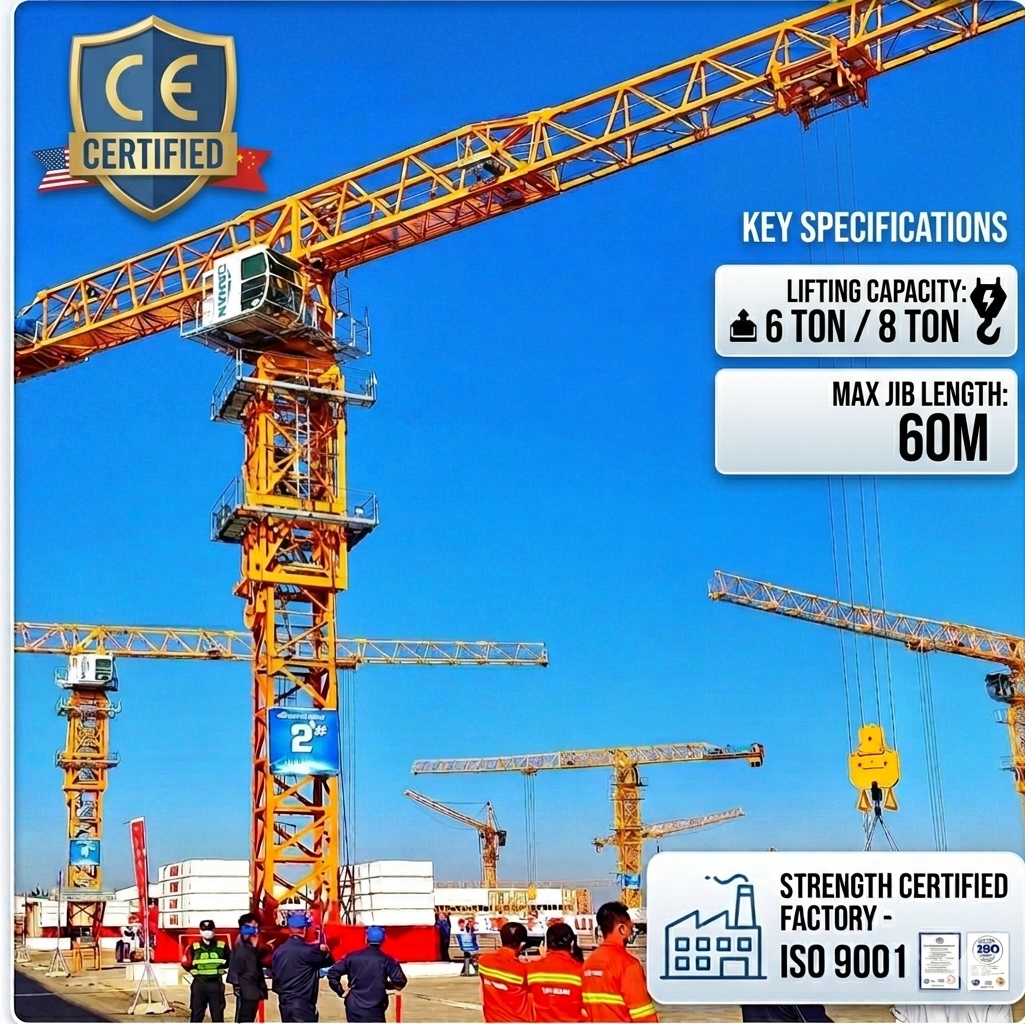
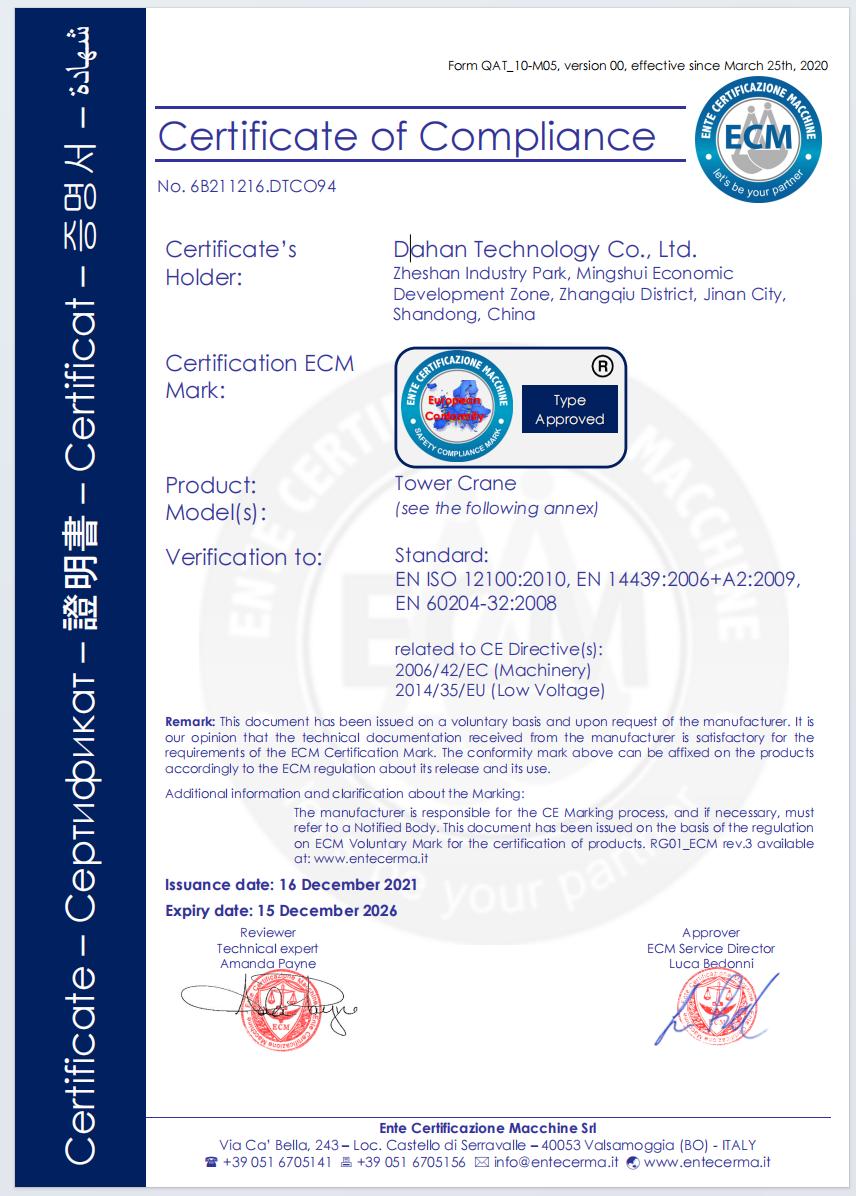
Dahan Technology holds CE, EAC, SGS and ISO9001 certificates issued by specialised authoritative institutions, together with quality, environmental, and occupational health and safety management system certificates. Tower cranes are supplied to international markets with technical support, spare parts supply and installation guidance for overseas customers, and export sales account for 60% of total sales through distributors in more than 60 countries. Buyers should still confirm the exact certification required by the destination market and the project specification before ordering.
How should I evaluate a tower crane manufacturer for a construction project?
Focus on production capacity, research and development capability, quality management, product technical parameters, key components, factory inspection, technical documents, installation guidance and after-sales service capability. For overseas projects, also confirm whether the manufacturer has international project experience and can provide technical and certification material that meets the project country's requirements. Dahan Technology Co., Ltd. can share its tower crane catalogue, model load charts and certification documents on request — a practical first step is to send the project's building height, maximum component weight, working radius and destination market, and ask for a configuration recommendation and quotation for comparison.
Conclusion: Turning a Category Search into a Project Specification
A tower crane enquiry only becomes a purchasing decision when three things are fixed: the lift envelope, the configuration that fits the site, and the documentation that allows the machine onto the project. Capacity ranges from 5 t to 220 t, and configuration families from flat top to luffing jib each exist because a specific site condition made them necessary. Selecting on the largest number available, rather than on capacity at the working radius, remains the most common and most expensive shortcut.
For construction teams evaluating tower cranes for high-rise, infrastructure, industrial or wind power projects, Dahan Technology Co., Ltd. publishes its model range, capacity configurations and certification position openly, and works with distributors in more than 60 countries on export delivery, spare parts and installation guidance.
Next step
Send your project parameters — building height, maximum component weight, working radius, lifting height and destination market — and the team will propose a suitable configuration, load chart extract and quotation. A full company and product brochure is available for download: Dahan Technology company and product brochure (PDF).
Website: www.chinatowercranes.com
Contact: Ray — Email sunshuoaa8958@outlook.com | WhatsApp +86 178-5257-1895 | Tel +86 150 9883 0510
Address: Zheshan Industrial Park, Mingshui Economic Development Zone, Zhangqiu District, Shandong Province, China