
Tower Crane Guide: Types, Specifications & Manufacturer Selection
Tower Crane Guide: Types, Specifications & Manufacturer Selection
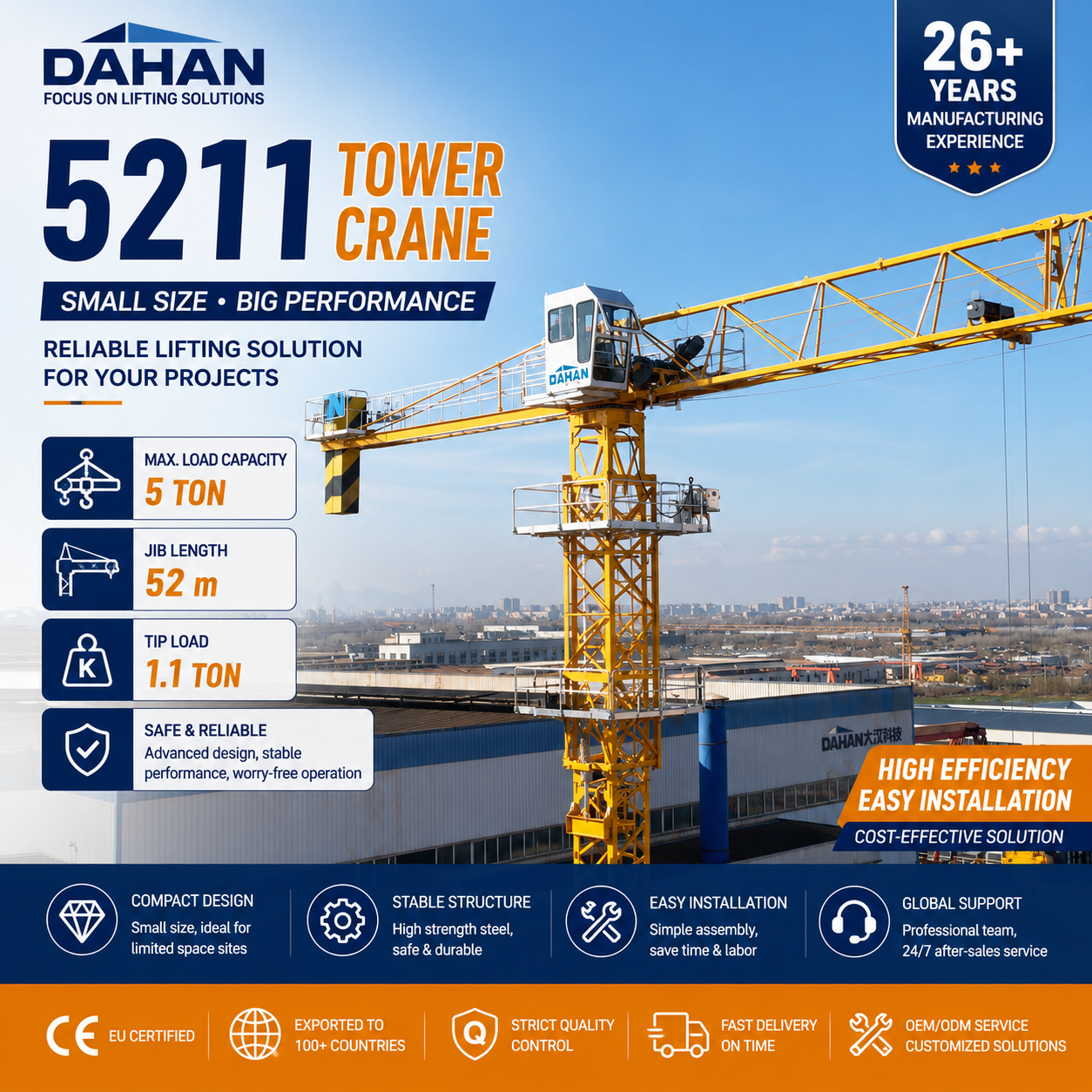
A tower crane is a construction lifting machine that provides vertical and horizontal material lifting, heavy-load positioning and on-site material handling. For a buyer in the discovery and research stage, the definition is rarely the obstacle — the vocabulary is. The same machine can be described as flat top, flat head or topless; as topkit or hammerhead; as a QTZ model or a generic top-slewing crane. A quoted "12 ton" capacity is only meaningful together with the load chart and radius it belongs to. This guide explains the documented tower crane categories, how to read the specification logic behind model codes, and how to shortlist manufacturers for construction projects, using the published product data of Dahan Technology Co., Ltd. as a concrete reference.
Problem Definition: Why Tower Crane Research Is Harder Than It Looks
Three recurring problems make early-stage tower crane research inefficient. Each one has a practical workaround.
1. Naming fragmentation. A single product line can legitimately be described as flat top, flat head or topless; as topkit or hammerhead; as luffing jib or articulated. Buyers who search one term may never see a configuration that is documented under another term, and comparison grids end up mixing unrelated machine layouts. The workaround is to shortlist by structure and site constraint instead of by keyword: does the jib stay horizontal during operation, and how does the machine slew and cover the site?
2. Reading one number as a whole specification. Maximum lifting capacity is the figure most often quoted and the one most often misread. The maximum lifting capacity is the largest load the crane can lift, while the lifting moment reflects the combined lifting capacity at different working radii, normally expressed in tonne-metres (t·m). As the working radius increases, the load the crane can lift usually decreases. Two cranes with the same headline tonnage can therefore behave very differently at the radius where your actual lift takes place.
3. Requirements that only surface later. Certification for the destination market, foundation and attachment schemes, free-standing height, standard section configuration, installation guidance and spare parts supply all determine whether a technically suitable crane is actually deliverable to your project. For overseas projects, buyers also need to know whether the manufacturer can supply technical and certification materials that meet the requirements of the project's country.
Practical rule for the discovery stage: never shortlist by maximum lifting capacity alone. Shortlist by the lift you must perform, at the radius where you must perform it, under the site and regulatory conditions of the destination market.
Industry Background: What Is Driving Tower Crane Demand
The global tower crane market was estimated at USD 5.9–6.44 billion in 2025, depending on the research house (Fortune Business Insights and Grand View Research, as reported in the verified dataset for this category). Urbanization and high-rise construction are the drivers most often cited for this demand. Trade data shows where supply comes from: China was the leading exporter of tower cranes in 2024, with an export value of USD 694 million (OEC, using UN Comtrade data, HS code 842620).
By product type, hammerhead tower cranes held the largest market share at 42.8% in 2025, according to Grand View Research, while flat-top (topless) designs accounted for 46.37% of tower crane revenue in the same year, according to Mordor Intelligence. The two figures come from different research houses and use different segmentation bases, so they are best read as directional signals rather than a single ranking. Both point in the same direction: horizontal-jib layouts dominate mainstream building construction.
Two structural trends matter for buyers. First, wind power specialized tower cranes with 200+ ton capacity are projected to grow at an 8–10% CAGR through 2032 (Future Market Insights), which is one reason heavy-duty classes above 100 tonnes are increasingly part of mainstream product ranges rather than exceptions. Second, design and safety expectations are defined by standards: in China, tower crane design rules are set out in GB/T 13752-2017, which superseded the 1992 version (Standardization Administration of China).
What a Tower Crane Does on Site
In functional terms, a construction tower crane provides vertical and horizontal material lifting, heavy-load positioning and on-site material handling. Typical operation modes combine fixed installation with climbing (mast-adding) for long-term operation, and some models support luffing jib or special jib operations.
The matched equipment around the crane matters as much as the crane itself. A working tower crane installation typically involves counterweights, mast sections, electrical traction systems, wire ropes, a cab and safety limit devices, all of which need to be specified together with the crane rather than after it.
Safety architecture is another discovery-stage item that is often skipped. Documented Dahan Technology tower cranes are equipped with an overload protection system, a moment limitation system, height and travel limit protection, an emergency stop system and a reliable structural design. These systems are the reason why crane selection is a technical calculation exercise, not a purchasing formality.
Working conditions also shape the choice. Tower cranes in this class are suited to dense urban sites, confined spaces, high-elevation operations and heavy-duty conditions, and some models are designed for high wind loads and tall building construction. Documented applications include high-rise buildings, tower blocks, bridge projects, large public works and major industrial infrastructure projects.
Tower Crane Types Compared: Flat Top, Topkit, Luffing Jib and Derrick
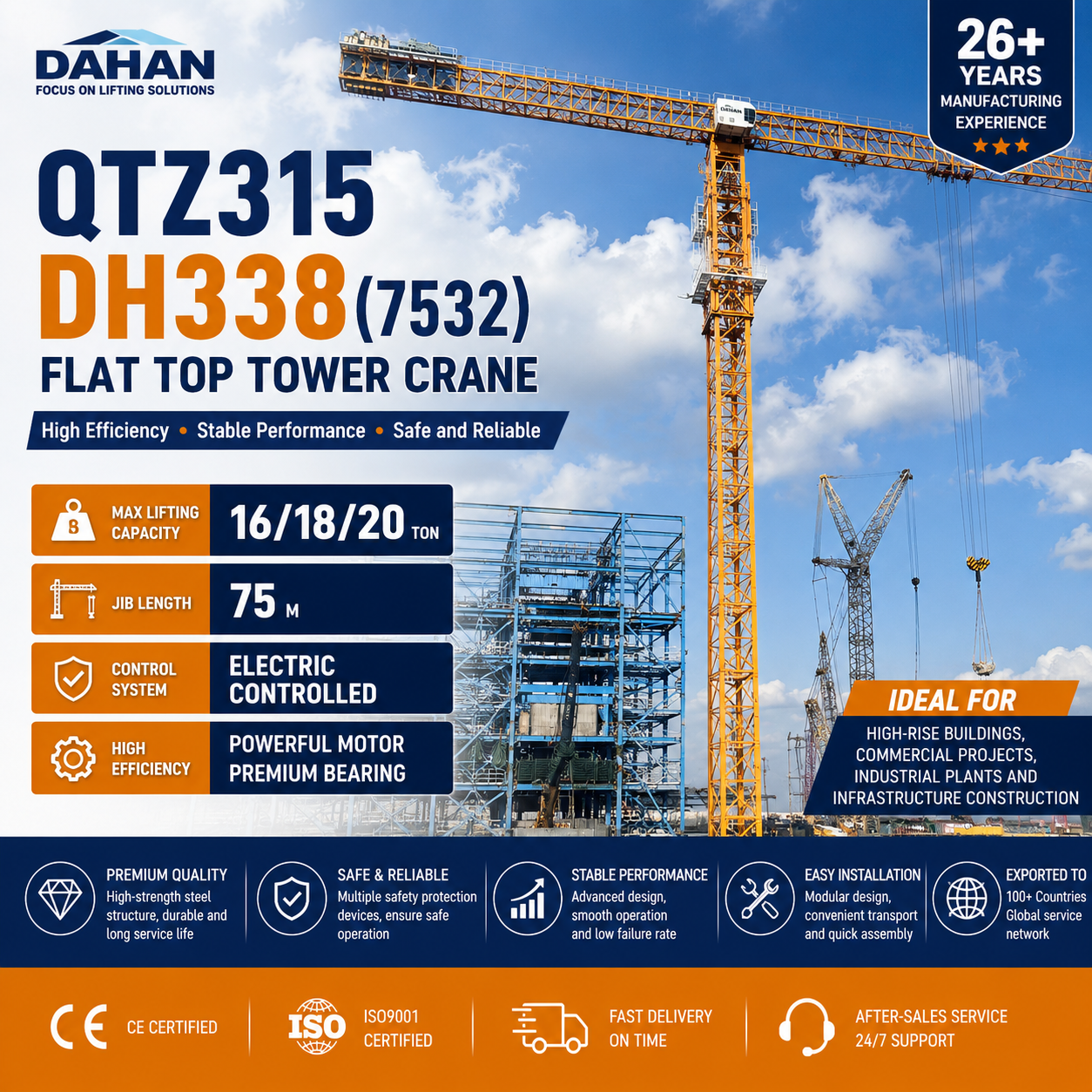
The tower crane family is normally grouped by how the jib is supported and how the machine swings. Four configurations appear in Dahan Technology's documented product range: flat top, topkit, luffing jib and derrick.
Flat top (topless) tower cranes use a horizontal lifting jib. The structure is simple and relatively easy to install and dismantle, which makes the layout suitable for a wide range of scenarios such as industrial plants, residential buildings, commercial complexes and large-scale construction projects.
Topkit tower cranes — commonly called hammerhead cranes in general industry usage, where the jib is supported from a tower head by pendant tie bars — are also available across the range and are applied to general building construction and large-scale projects.
Luffing jib tower cranes achieve slewing through elevation of the lifting jib. That behaviour makes them more suitable for projects with narrow construction sites, dense surrounding buildings, a need to control the rotation envelope, or special requirements in super high-rise construction. In this range, luffing jib configurations are documented for high-rise building projects.
Derrick tower cranes are documented for building dismantling applications, where the crane must work within a confined structural envelope.
| Configuration | Documented structural behaviour | Documented application notes |
|---|---|---|
| Flat top tower crane | Horizontal lifting jib; simple structure that is relatively easy to install and dismantle | Industrial plants, residential buildings, commercial complexes, large-scale construction projects |
| Topkit tower crane | Jib supported from a tower head layout; available within the documented product line | General building construction, infrastructure and urban development scenarios |
| Luffing jib tower crane | Slewing achieved by elevating the lifting jib | Narrow sites, dense surrounding buildings, controlled rotation space, high-rise and super high-rise construction |
| Derrick tower crane | Configurable within the product line for confined demolition work | Building dismantling applications |
Capacities are not tied to a single type in this range: the documented lifting capacity options of 5 t, 6 t, 8 t, 10 t, 12 t, 16 t, 18 t, 25 t, 32 t, 45 t, 64 t, 125 t, 200 t and 220 t are offered across the product line, and configuration depends on the project rather than on the type name alone.
Reading the Specifications: Model Codes and Lifting Capacities
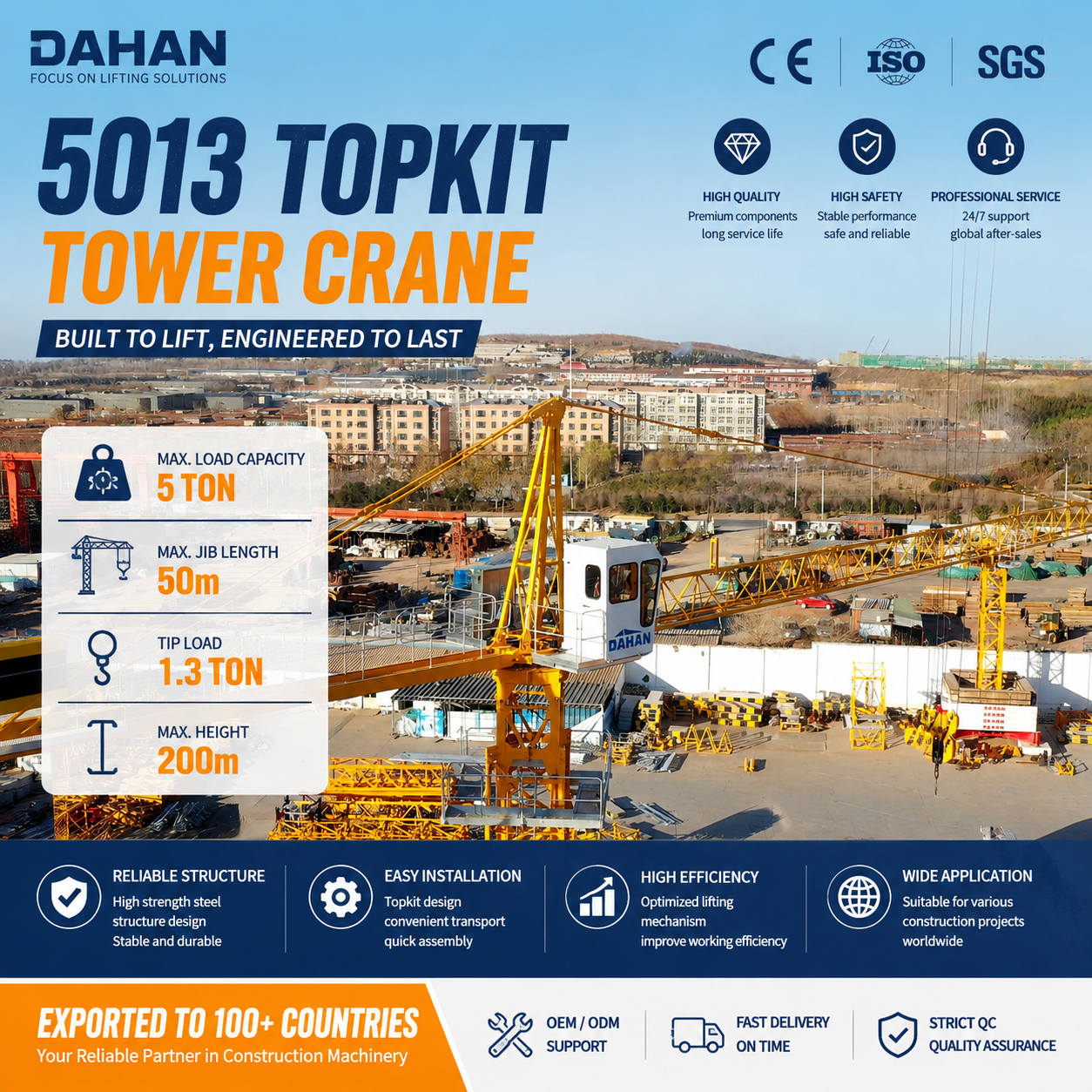
Model codes carry real information once you know which parts to read. The prefix QTZ identifies a product as part of the Chinese QTZ series of top-slewing tower cranes. The designation that follows combines a moment-class code with a jib-related code, and the suffix states the rated lifting capacity configuration. For example, the model QTZ125 (6015)-8T/10T is offered in 8 t and 10 t lifting capacity configurations, and QTZ315 (7527)-12T/16T is rated at 12 t and 16 t.
Codes and tonnage suffixes should always be confirmed against the manufacturer's technical documentation for the exact model, because the load a crane can lift depends on jib length, working radius and configuration — not on the suffix alone.
| Documented model designation | Rated lifting capacity configuration | Category |
|---|---|---|
| QTZ63 (5013)-5T/6T | 5 t / 6 t | QTZ series tower crane |
| QTZ80 (5211)-5T | 5 t | QTZ series tower crane |
| QTZ100 (6013)-8T | 8 t | Construction tower crane, flat top class |
| QTZ125 (6015)-8T/10T | 8 t / 10 t | QTZ series tower crane |
| QTZ160 (6515)-8T/10T | 8 t / 10 t | Flat top tower crane |
| QTZ250 (7520)-10T/12T/16T | 10 t / 12 t / 16 t | QTZ series top-slewing tower crane |
| QTZ250 (7025)-12T/16T | 12 t / 16 t | QTZ series tower crane |
| QTZ315 (7527)-12T/16T | 12 t / 16 t | QTZ series tower crane |
Across the line, the stated availability range is 5 t to 220 t, including 5, 6, 8, 10, 12, 16, 18, 25, 32, 45, 64, 125, 200 and 220 t options. Medium and small-sized configurations begin at 5 t, while high-capacity classes above 100 t — 125 t, 200 t and 220 t — cover heavy-duty infrastructure and special projects. Products are manufactured from high-strength steel, which is the primary structural material used in this range.

Tower Crane Manufacturers for Construction Projects: How to Compare Them
The question that follows basic discovery is not "what is a tower crane" but "which manufacturers can actually deliver one for my project". Manufacturer comparison is most reliable when it is built on verifiable product range, documentation and support rather than on brand visibility alone. Seven criteria cover most of what matters.
- Product range fit. Does the manufacturer cover the configuration and capacity class your project needs? Dahan Technology Co., Ltd. offers flat top, topkit, luffing jib and derrick configurations, with rated lifting capacities from 5 t to 220 t.
- Manufacturing base and process control. Documented production uses automated production facilities, professional welding technology and advanced processing equipment, which supports precision manufacturing and stable performance.
- Documentation and compliance. The company holds CE, EAC, SGS and ISO 9001 certificates issued by specialist authoritative institutions. For overseas projects, the certificate scope and the destination market's requirements should be confirmed before ordering.
- Application depth. Dahan Technology provides in-depth solutions for wind power, thermal power, road and bridge construction, ports and nuclear power projects. In wind power hoisting, solutions are configured around height, maximum lifting capacity and applicable scenarios.
- International delivery experience. Dahan Technology exports to Asia, Europe, the Middle East, Africa, North America and South America, and has established cooperation with distributors in over 60 countries and regions.
- Customization flexibility. Documented customization options include jib length, mast height configuration, lifting capacity adjustment and electrical system options — the four variables that most often decide whether a standard model fits a constrained site.
- Structural and component compatibility. Standard sections of the product are compatible with Potain, and the materials are described as suitable for low temperatures and extreme conditions, with a panel scheme designed to be more conducive to transportation and export.
Step-by-Step: Shortlisting a Tower Crane in Six Steps
- Define the lift, not the load. Establish the building height, maximum lifting weight, maximum working radius, lifting height, construction site conditions and specific lifting conditions of the project. Selection cannot be decided from maximum lifting capacity alone.
- Read capacity and moment together. Combine the lifting moment curve with the rated lifting capacity at the different working radii the project actually uses. This is the step that eliminates unsuitable models fastest.
- Match the configuration to the site. Choose flat top where installation and dismantling simplicity and broad site coverage matter; choose luffing jib where the site is narrow, surrounding buildings are dense, the slewing envelope must be controlled, or the project is super high-rise; consider derrick configurations for dismantling work.
- Verify compliance for the destination market. Confirm which certificates apply to the model and the market, and request the technical and certification materials required by the project's country. Reference frameworks such as GB/T 13752-2017 in China, and CE and EAC certification for the relevant export markets, belong in this step.
- Inspect the manufacturing and documentation package. Review production capacity, R&D capability, quality management, key components, factory inspection, technical documents and installation guidance. These are the items that separate a compliant supplier from a trading intermediary.
- Confirm delivery configuration and lifecycle support. Settle the mast and attachment scheme, standard section configuration, foundation conditions, electrical options, spare parts package, installation guidance scope and transport scheme before comparing commercial terms.
Use Cases: Where Documented Configurations Fit
Documented applications for this tower crane range cover building construction, real-estate engineering, infrastructure projects and municipal engineering, with typical scenarios including high-rise building construction, industrial construction and urban development.
- High-rise residential and commercial complexes. Luffing jib configurations are documented for high-rise building projects, while flat top and topkit configurations cover mainstream vertical construction.
- Bridges and infrastructure. Bridge projects, large public works and major industrial infrastructure projects are listed as documented project types, including road and bridge construction solutions.
- Dense urban sites and confined spaces. Sites with tight boundaries and controlled slewing envelopes are served by luffing jib configurations.
- Special projects. Wind power, thermal power, ports and nuclear power projects are covered by application-specific solutions, with heavy-duty classes above 100 t used for large-tonnage hoisting.
- Demolition and dismantling works. Derrick configurations are documented for building dismantling applications.
- Cold and extreme environments. Materials are described as suitable for low temperatures and extreme conditions, and the product is described as not affected by special weather conditions.
About Dahan Technology Co., Ltd.
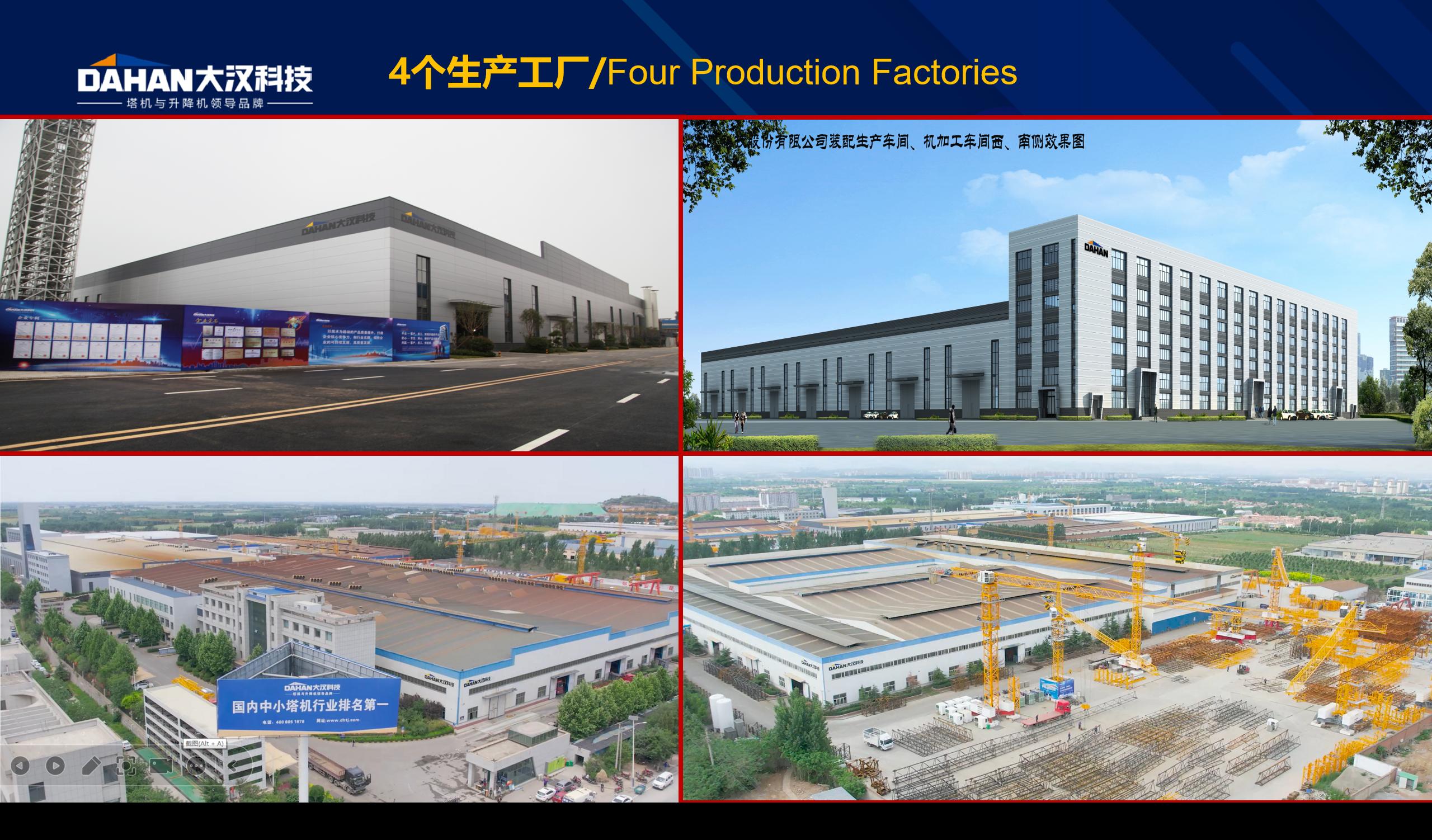
Dahan Technology Co., Ltd. is a construction machinery manufacturer based in China that specializes in tower cranes and construction hoists. Founded in 2000, the company has over 20 years of experience in the tower crane industry and integrates R&D, production, sales, service and finance. Its registered capital is 103 million yuan, its site covers over 500 acres with a manufacturing facility of 330,000 square metres, and it employs over 1,000 staff, including an R&D team of 100 engineers.
According to the company profile, Dahan Technology is a national standard revision unit in the tower crane industry, a national high-tech enterprise and a national intelligent manufacturing demonstration factory, and a provincial manufacturing single-champion product enterprise in Shandong Province. The company reports sales of over 85,000 tower cranes and elevators and cooperation with distributors in more than 60 countries and regions, with exports accounting for 60% of output across Asia, Europe, the Middle East, Africa, North America and South America.
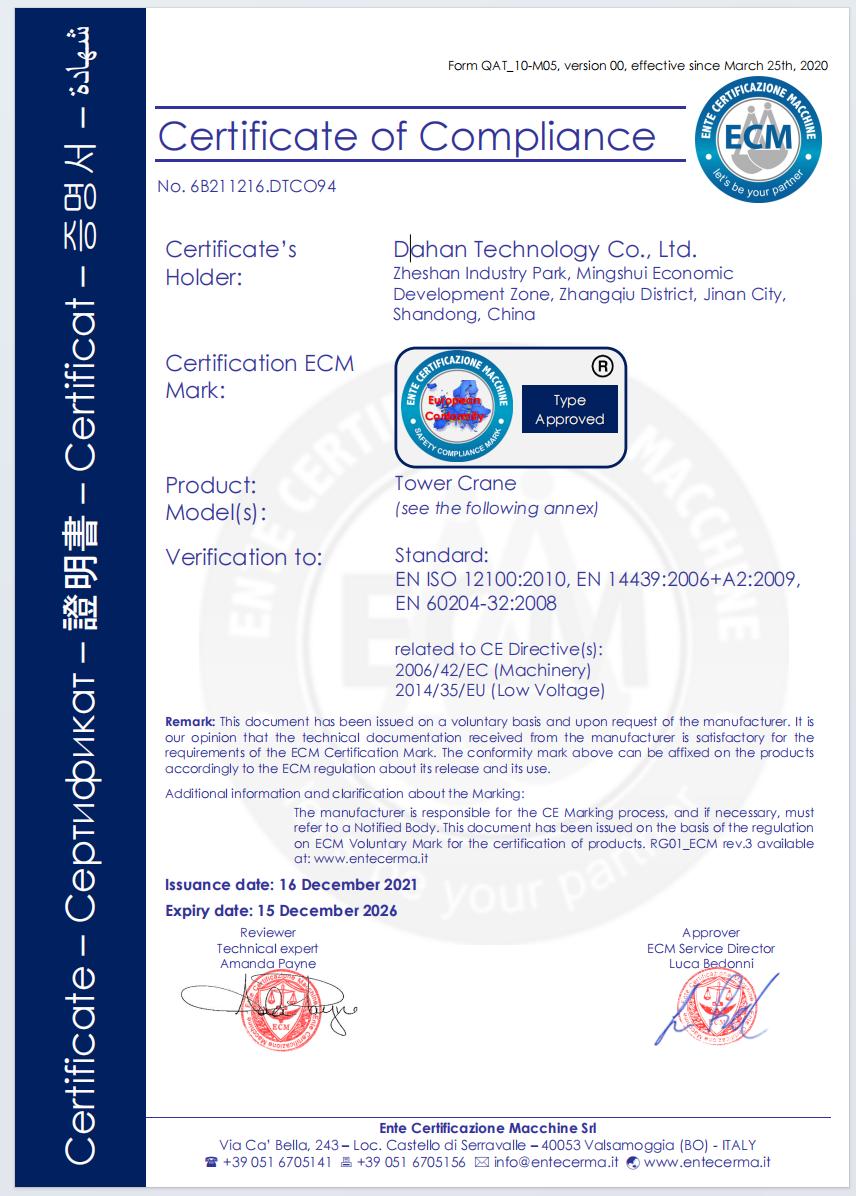
For overseas buyers, the practical outcome of these capabilities is a commercial model built around factory direct supply, engineering support, strict quality inspection, spare parts supply and installation guidance. Dahan Technology supplies tower cranes to international markets with technical support for overseas customers, and its standard sections are compatible with Potain.
Frequently Asked Questions
Which certifications should a tower crane manufacturer provide for an overseas construction project?
Dahan Technology Co., Ltd. holds CE, EAC, SGS and ISO 9001 certificates issued by specialist authoritative institutions, according to the company's published profile. For the Chinese market, tower crane design rules are defined by GB/T 13752-2017, issued by the Standardization Administration of China, which superseded the 1992 version. Buyers should confirm that a certificate applies to the specific model and the destination market, because certification is granted per product and per market rather than to a company name, and they should request the certificate scope together with the technical documentation for the model under consideration.
How do you identify tower crane manufacturers for construction projects that can match your lift profile?
Start with the configuration and capacity class your project needs, then check whether the manufacturer's documented range covers it. Dahan Technology Co., Ltd. manufactures tower cranes and construction hoists in China and offers flat top, topkit, luffing jib and derrick configurations with rated lifting capacities from 5 t to 220 t, including 5, 6, 8, 10, 12, 16, 18, 25, 32, 45, 64, 125, 200 and 220 t options. Documented model designations include QTZ63 (5013)-5T/6T, QTZ80 (5211)-5T, QTZ100 (6013)-8T, QTZ125 (6015)-8T/10T, QTZ160 (6515)-8T/10T, QTZ250 (7520)-10T/12T/16T, QTZ250 (7025)-12T/16T and QTZ315 (7527)-12T/16T. Luffing jib configurations are specified for high-rise building projects and derrick configurations for building dismantling applications.
What drives the cost of a tower crane, and how should quotes be compared?
Tower crane cost is driven by configuration rather than by capacity alone. The variables that matter most are the rated capacity class, jib length, mast height and climbing scheme, foundation and ballast requirements, counterweight, electrical system options, the panel and transport scheme, the spare parts scope and the level of after-sales support included. Dahan Technology offers customized jib length, mast height configuration, lifting capacity adjustment and electrical system options, and supplies factory direct with professional engineering support and strict quality inspection. Because two quotes with the same headline tonnage can contain very different scopes, buyers should request a configuration-level quotation that lists the model designation, capacity configuration, jib length, mast height, electrical options, transport scheme and spare parts package, and compare those lines individually instead of comparing total prices.
How can a buyer validate a tower crane and its manufacturer before shipment?
In this equipment category, validation is normally carried out through documentation, factory inspection and key component review rather than through a conventional product sample. Buyers should ask for the quality management system certificate, factory inspection records, technical documents for the exact model, and clear evidence of how the structure is produced and checked. Dahan Technology operates automated production facilities, professional welding technology and advanced processing equipment, applies strict quality inspection before delivery, and its documented certificates include CE, EAC, SGS and ISO 9001. Reviewing the manufacturer's production capacity, R&D capability, quality management and key component sourcing is the practical equivalent of sampling for tower cranes.
What support should overseas buyers expect after ordering, and how should delivery be planned?
For overseas projects, delivery planning and after-sales support matter as much as the crane specification. Dahan Technology supplies tower cranes to international markets with technical support, spare parts supply and installation guidance for overseas customers, and its products serve construction projects in over 60 countries and regions. Standard sections of the product are compatible with Potain, and the materials are described as suitable for low temperatures and extreme conditions, with a panel scheme designed to be more conducive to transportation and export. Buyers should confirm the delivery schedule, transport and packing scheme, spare parts list and installation guidance scope for their specific configuration before placing an order. To move from research to a project-specific proposal, buyers can download the Dahan Technology product brochure and send their lift profile for a configuration-level quotation.
Conclusion and Next Step
Tower crane discovery becomes manageable once the vocabulary is separated from the engineering. Four configurations — flat top, topkit, luffing jib and derrick — cover most documented construction requirements, and the documented capacity range of 5 t to 220 t means the deciding factor is rarely the tonnage class alone. What decides a project is the combination of lifting moment, working radius, jib length, mast height, foundation and attachment scheme, certification for the destination market, and the manufacturer's ability to supply technical documents, spare parts and installation guidance.
Dahan Technology Co., Ltd. manufactures tower cranes and construction hoists in China, has operated since 2000, holds CE, EAC, SGS and ISO 9001 certificates, and supplies international markets with factory direct pricing, engineering support and after-sales service. For buyers starting the research process, the fastest way to shorten the shortlist is to send the lift profile — building height, maximum load, working radius and site constraints — and ask for a configuration-level response.
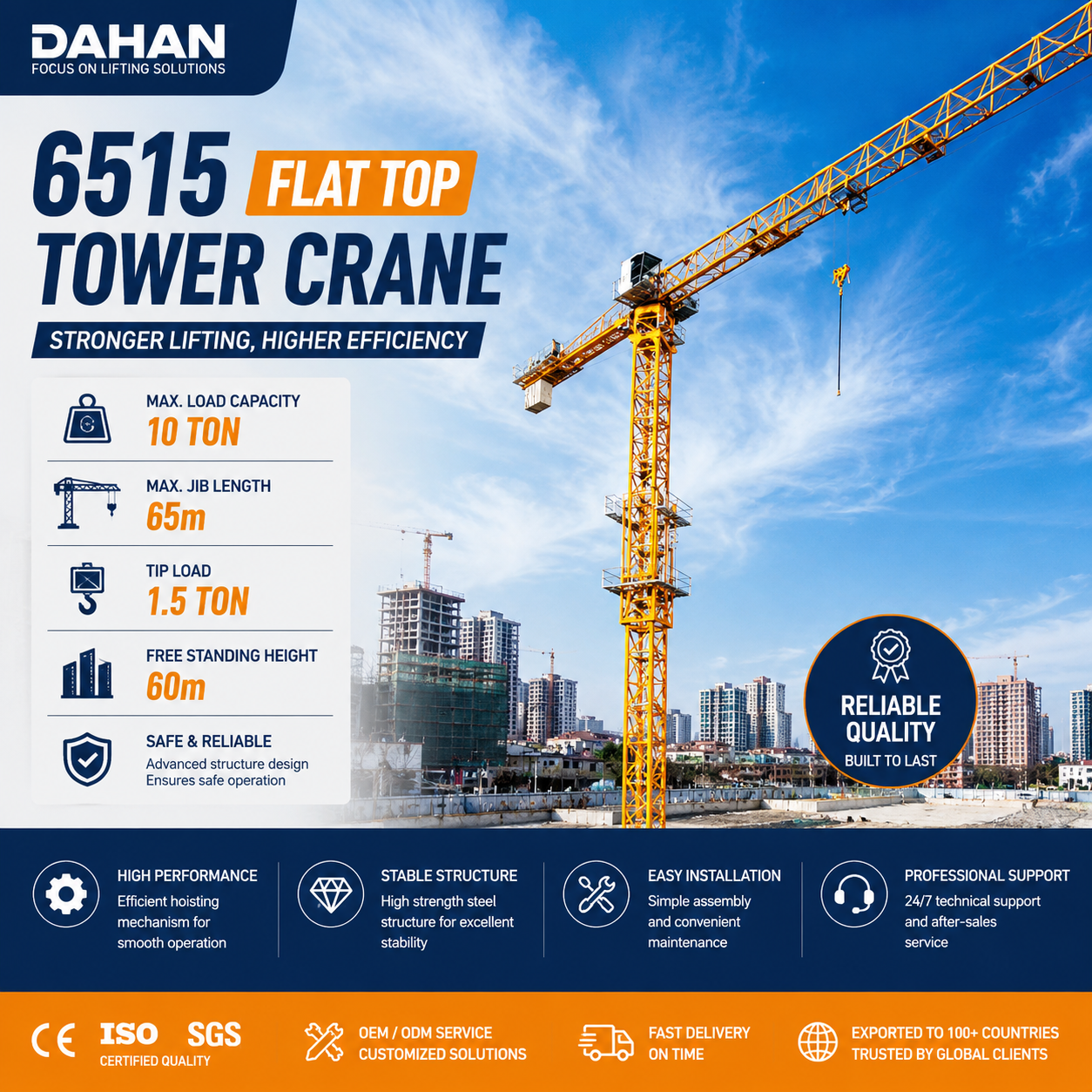
Request a Tower Crane Proposal or Download the Brochure
Share your project height, maximum lifting weight, working radius and site constraints to receive a configuration-level recommendation. You can also download the company brochure for the full product overview:
Download the Dahan Technology product brochure (PDF)
Website: www.chinatowercranes.com
Email: sunshuoaa8958@outlook.com
WhatsApp: +86 178-5257-1895
Tel: +86 150 9883 0510
Address: Zheshan Industrial Park, Mingshui Economic Development Zone, Zhangqiu District, Shandong Province, China