Tower Crane Manufacturers for Construction Projects: A Practical Discovery Guide
Tower Crane Manufacturers for Construction Projects: A Practical Discovery Guide
A tower crane is usually the longest-researched and highest-value equipment decision on a construction site, and it is also the decision that most buyers start with a single, very broad search: tower crane. At that moment the buyer typically knows the project, the building height and the heaviest load, but not yet the crane type, the capacity class or the manufacturer.
This guide is written to close that gap. It maps the main tower crane configurations, explains how rated lifting capacity and lifting moment differ, lists the QTZ model designations and lifting capacity classes offered by Dahan Technology Co., Ltd., and sets out the evaluation steps that match a crane to a site rather than to a catalogue headline.
Problem Definition: Why a Tower Crane Search Is Hard to Answer
A search for tower crane returns dealers, rental fleet operators, used-equipment listings, component suppliers and manufacturers on the same results page, and few of them label themselves clearly. Four specific problems slow buyers down at the discovery stage.
- Type language is inconsistent. The same machine may be described as a flat top tower crane, a topless tower crane or a hammerhead, depending on the region and the supplier. Without a shared vocabulary, a buyer cannot compare what is actually being offered.
- Capacity is read too quickly. A 10 ton tower crane does not lift 10 tons at every radius. Rated capacity falls as working radius increases, which is why lifting moment, expressed in tonne-metres, describes a crane more completely than a single tonnage figure.
- Manufacturer and supplier are treated as the same thing. A trading company holding stock and a production plant with an engineering team answer different questions, especially when a project needs a non-standard jib length, a specific mast height or a climbing configuration.
- Compliance arrives too late. Certification, technical documentation and market-specific requirements are often checked after commercial terms are agreed, which then delays delivery.
Getting these four points right early is what turns a broad search into a workable shortlist. The rest of this guide deals with each of them in the order a real project encounters them.
Industry Background: What the Tower Crane Market Looks Like Now
Tower crane demand tracks urban construction activity. Published market estimates place the global tower crane market at roughly USD 5.9 to 6.44 billion in 2025. The spread between the two figures reflects different definitions of which product segments are counted rather than a disagreement about direction, and both estimates attribute demand growth to urbanisation and high-rise construction.
Supply is heavily concentrated in China. According to trade data compiled by the Observatory of Economic Complexity using UN Comtrade data, China was the leading exporter of tower cranes in 2024, with USD 694 million in export value under HS code 842620. For overseas buyers, that concentration is the reason most supplier shortlists include Chinese manufacturers, and the reason documentation quality becomes a differentiator rather than a formality.
Configuration preferences are shifting as well. Grand View Research reports that hammerhead tower cranes held the largest share by product type in 2025 at 42.8%. Mordor Intelligence reports that flat-top (topless) designs accounted for 46.37% of tower crane revenue in 2025, which it attributes to their efficiency in dense urban airspace. The two figures measure different things, one measuring share by product type and the other measuring revenue share, so they are best read as directional signals rather than as a single ranking.
Specialised heavy lifting is a distinct growth segment. One commercial forecast projects that wind power specialised tower cranes with 200+ ton capacity will grow at 8 to 10 percent CAGR through 2032. That projection is a signal, not a guarantee, but it does mean large-capacity, project-specific machines deserve early attention in a procurement plan rather than being treated as a late project addition.
On the standards side, GB/T 13752-2017, issued by the Standardization Administration of China and superseding the 1992 version, defines the design rules and safety specifications for tower cranes in China. Buyers sourcing from Chinese manufacturers should expect technical documentation and design practice to reference this standard.
Detailed Solution: What Dahan Technology Co., Ltd. Supplies
Dahan Technology Co., Ltd. is a Chinese tower crane and construction elevator manufacturer based in Zheshan Industrial Park, Mingshui Economic Development Zone, Zhangqiu District, Shandong Province. Founded in 2000, the company integrates research and development, production, sales, service and finance. It states that it is a national standard revision unit in the tower crane industry, a national high-tech enterprise, and a national intelligent manufacturing demonstration factory.
Four tower crane configurations in one product line
The product line covers flat top tower cranes, topkit tower cranes, luffing jib tower cranes and derrick tower cranes. Luffing jib configurations are offered for high-rise building projects, and derrick configurations are offered for building dismantling applications. The manufacturer also describes top slewing tower cranes and high capacity tower cranes as part of its range. In practical terms, that means one supplier can quote a horizontal-jib machine for a conventional high-rise, a luffing jib crane where the slewing radius must be controlled over a congested plot, and a derrick configuration for a dismantling sequence, without the buyer coordinating several vendors.
Lifting capacity from 5 t to 220 t
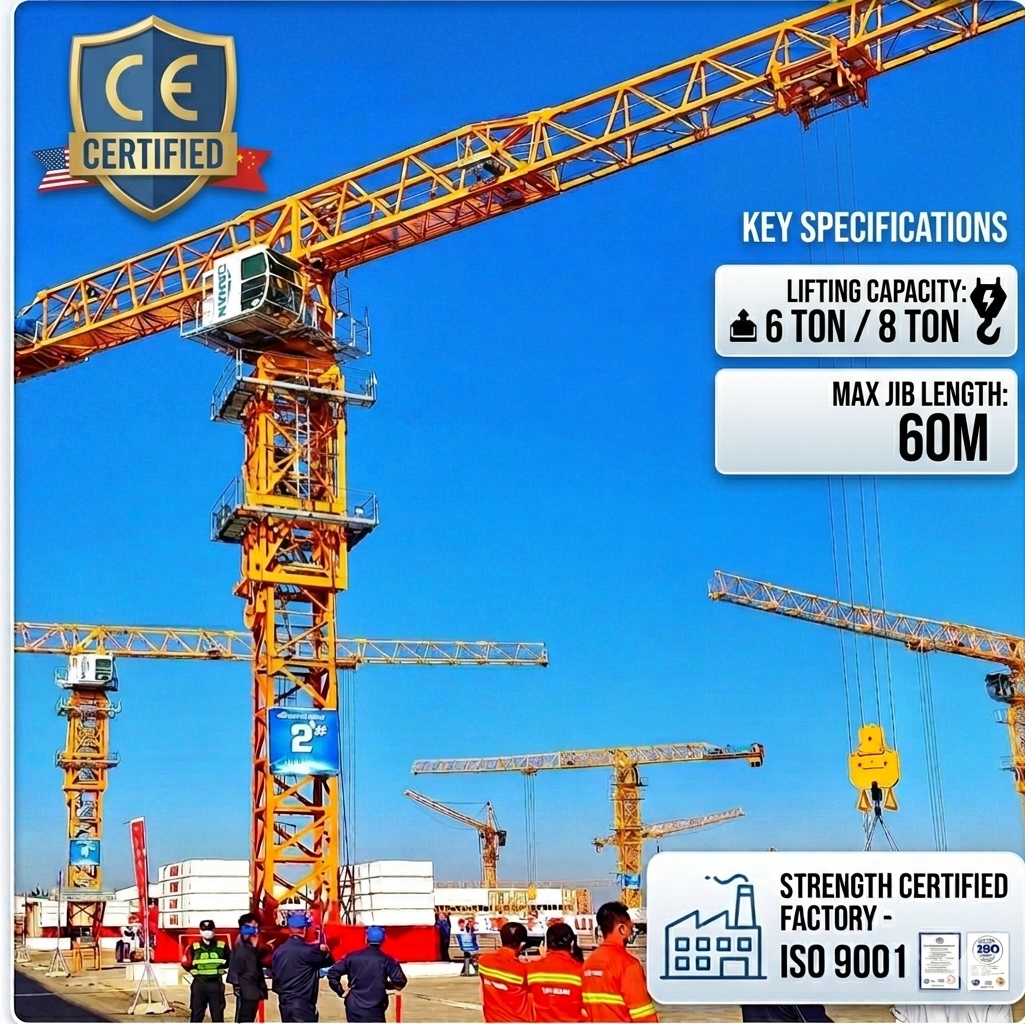
Rated lifting capacity configurations listed for the range are 5 t, 6 t, 8 t, 10 t, 12 t, 16 t, 18 t, 25 t, 32 t, 45 t, 64 t, 125 t, 200 t and 220 t. Medium and small-sized configurations begin at 5 t, while the heavy-duty end includes 125 t, 200 t and 220 t machines. For a buyer still forming a shortlist, that spread matters: both a 10 ton tower crane for a mid-rise residential block and a 200 ton heavy duty tower crane for a specialised lifting programme sit inside the same product family and the same technical support chain.
Documented QTZ models and heavy-duty variants
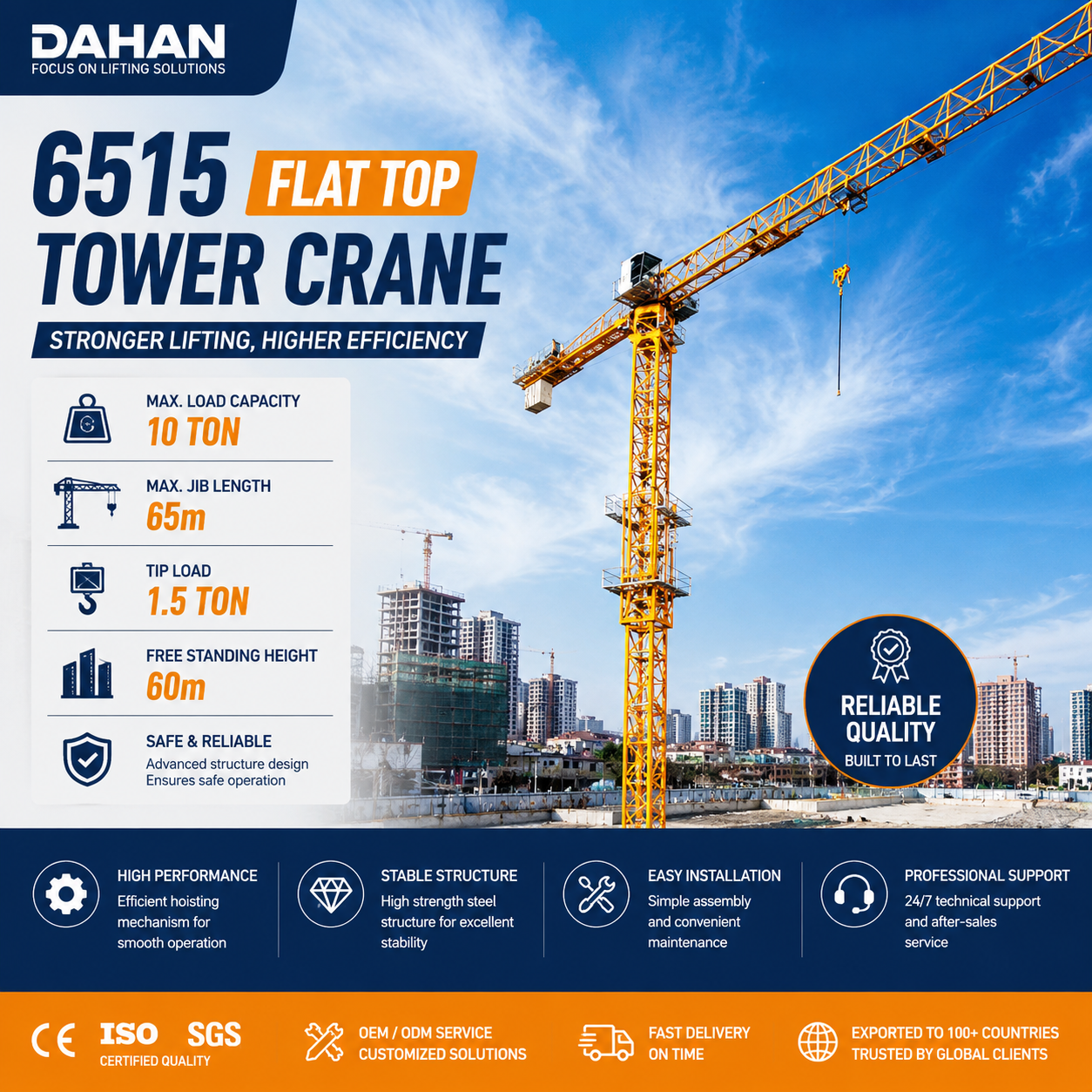
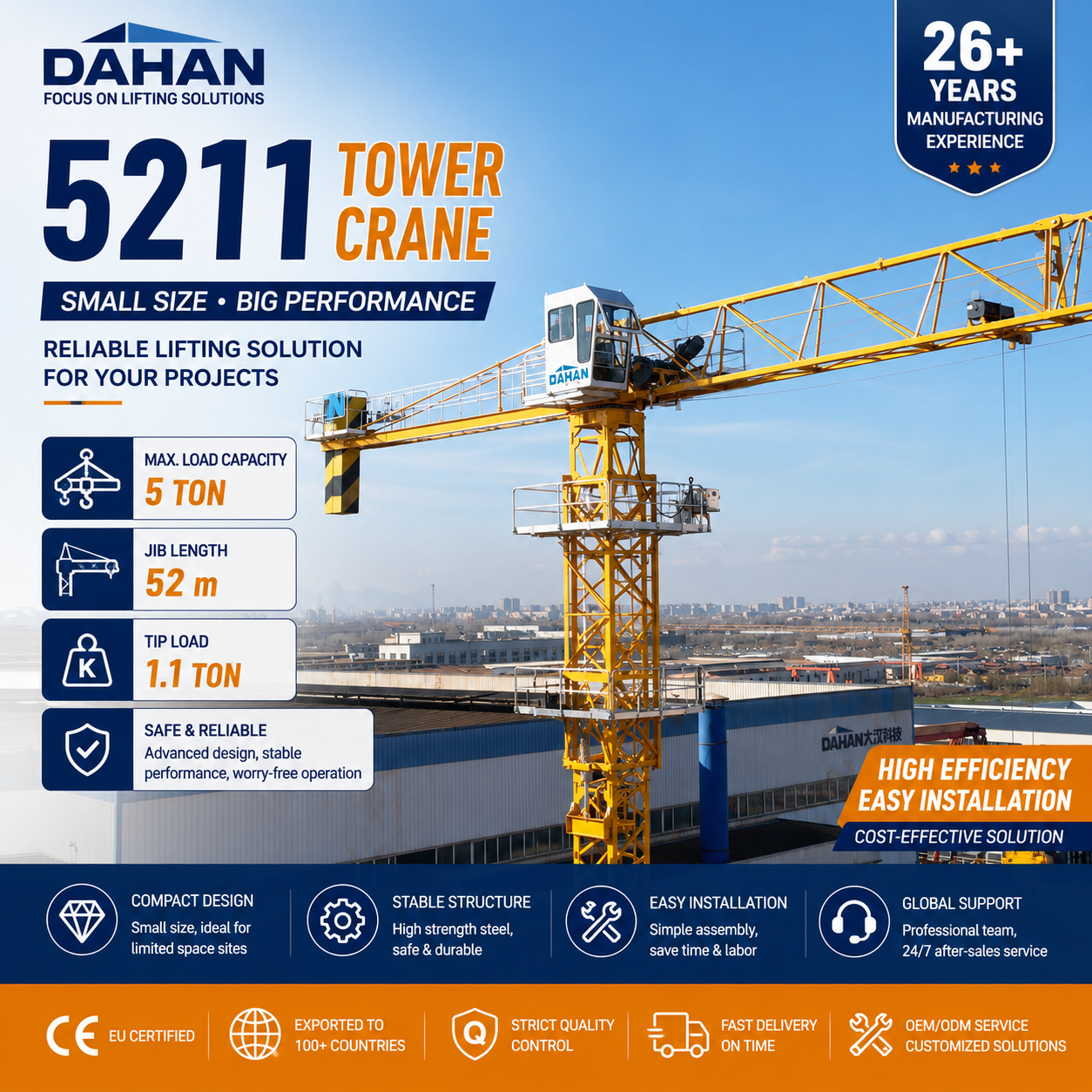
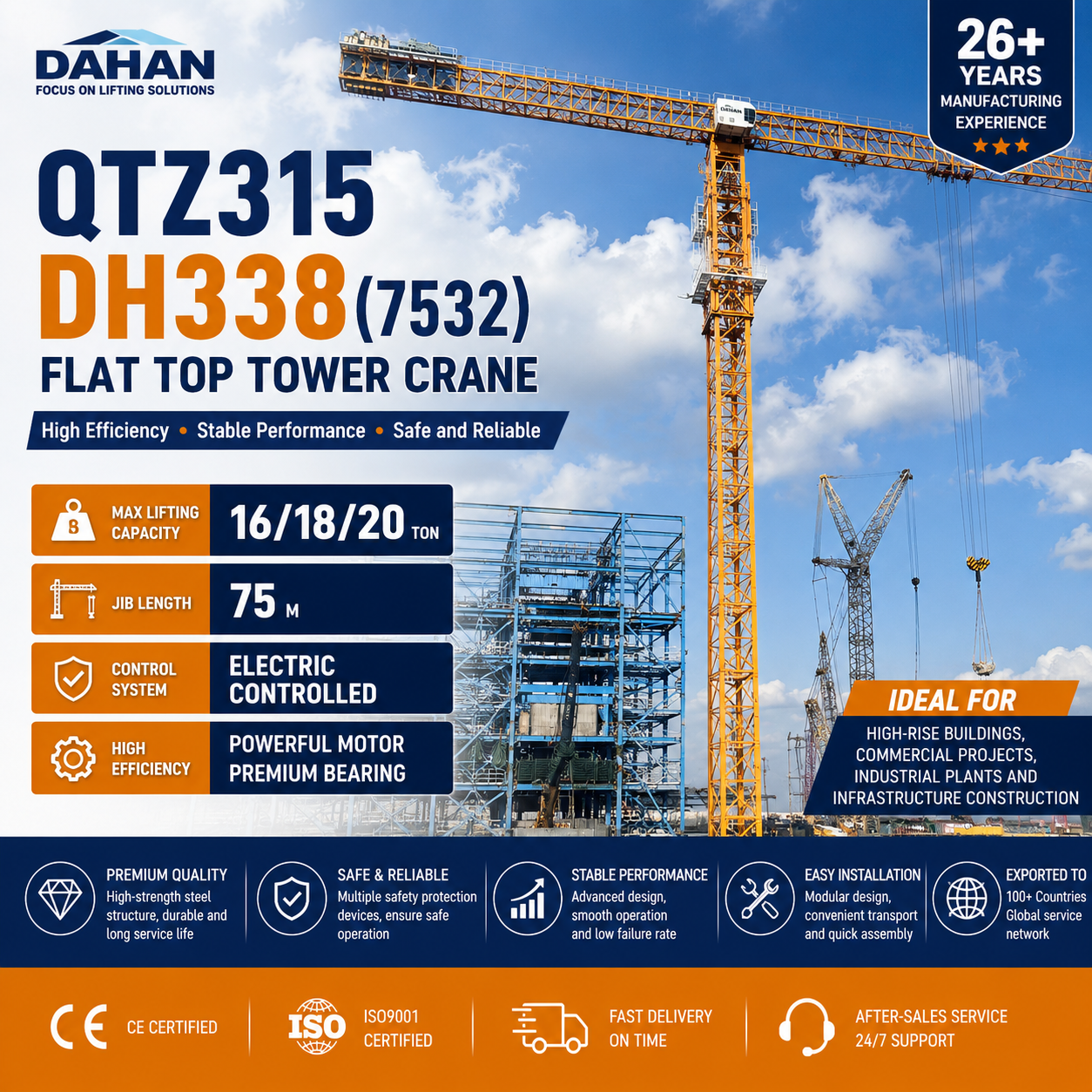
Documented model designations in the QTZ series include QTZ63 (5013)-5T/6T, QTZ80 (5211)-5T, QTZ100 (6013)-8T, QTZ125 (6015)-8T/10T, QTZ160 (6515)-8T/10T, QTZ250 (7025)-12T/16T, QTZ250 (7520)-10T/12T/16T and QTZ315 (7527)-12T/16T. Documented model variants also include 8530, 7025, 7020, 6515-10T, 6015, 6013, DH338-7532, DH318-7527 and 5211.
The QTZ prefix identifies a Chinese QTZ series top-slewing tower crane. In the naming convention commonly used across the industry, the digits inside the brackets generally indicate jib length and rated load at the jib tip, while the figures after the brackets state the rated lifting capacity carried in the model designation. For example, QTZ160 (6515)-8T/10T is configured for 8 t and 10 t lifting capacities, and the QTZ125 (6015)-8T/10T model is offered in 8 t and 10 t configurations. Buyers should always confirm the actual jib length, tip load and lifting moment curve against the manufacturer datasheet rather than reading the model number alone.
| Model designation | Series | Capacity configurations stated for the model |
|---|---|---|
| QTZ63 (5013)-5T/6T | QTZ series | 5 t and 6 t |
| QTZ80 (5211)-5T | QTZ series, flat top | 5 t |
| QTZ100 (6013)-8T | QTZ series | 8 t |
| QTZ125 (6015)-8T/10T | QTZ series | 8 t and 10 t |
| QTZ160 (6515)-8T/10T | QTZ series | 8 t and 10 t |
| QTZ250 (7025)-12T/16T | QTZ series | 12 t and 16 t |
| QTZ250 (7520)-10T/12T/16T | QTZ series | 10 t, 12 t and 16 t |
| QTZ315 (7527)-12T/16T | QTZ series | 12 t and 16 t |
| Heavy-duty configurations in the range | QTZ series | 125 t, 200 t and 220 t |
Structure, materials and export-oriented loading
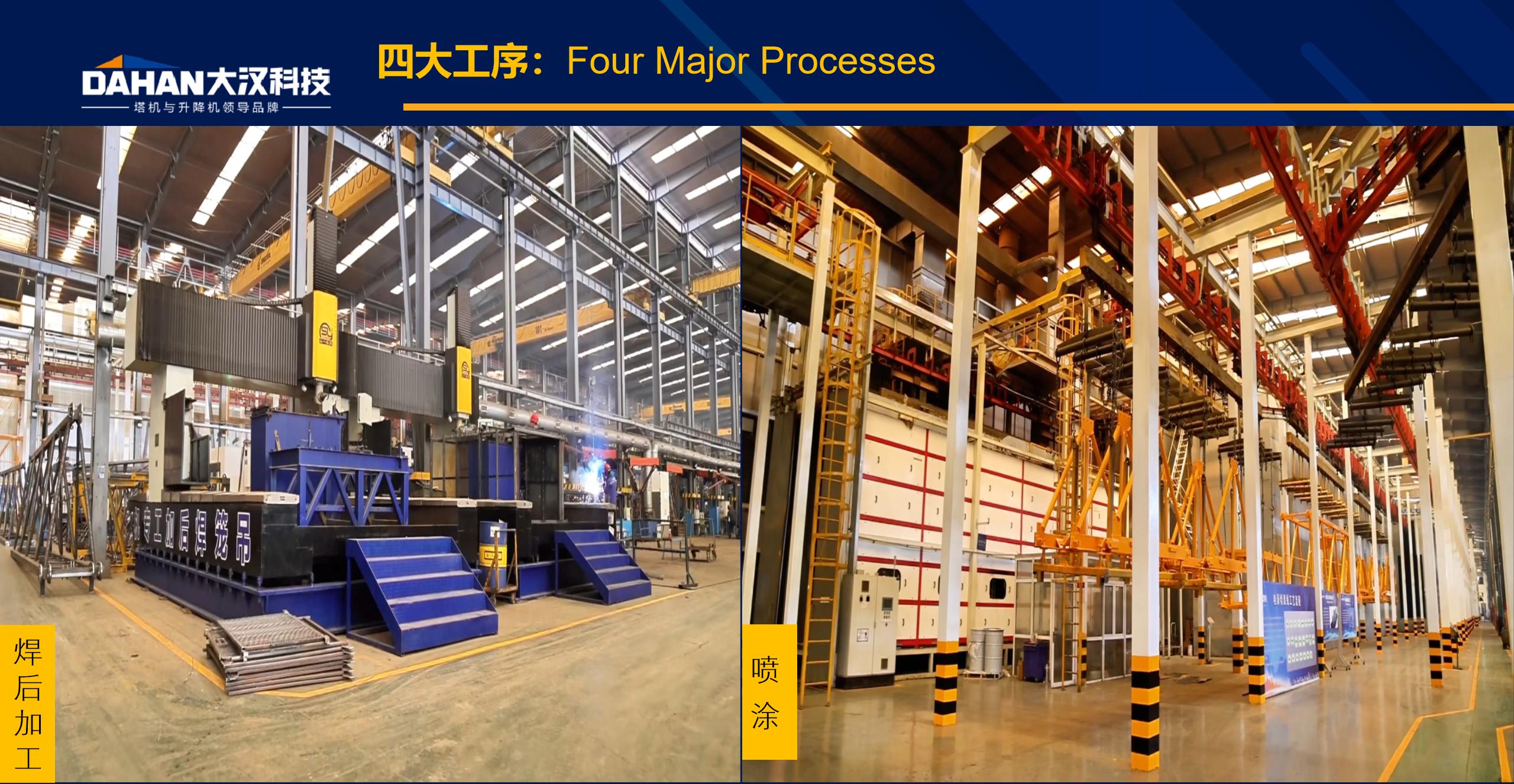
Tower cranes in this range are built from high-strength steel. The manufacturer states that the standard sections of the product are compatible with Potain, and that the materials are suitable for low temperatures and extreme conditions. The modular design is intended to allow faster assembly and dismantling, convenient transportation and flexible height adjustment, while the loading and panel scheme is described as being optimised for transport and export. For importers this is not a minor detail: the loading scheme directly affects container count, port handling and inland transport cost.
Safety systems built into the design
The stated safety package includes an overload protection system, a moment limitation system, height and travel limit protection, an emergency stop system, and a structurally reliable design. These are the systems that site engineers check first during pre-commissioning, and they are also the systems that determine whether a crane can be signed off without additional third-party modification.
Certification and market documentation
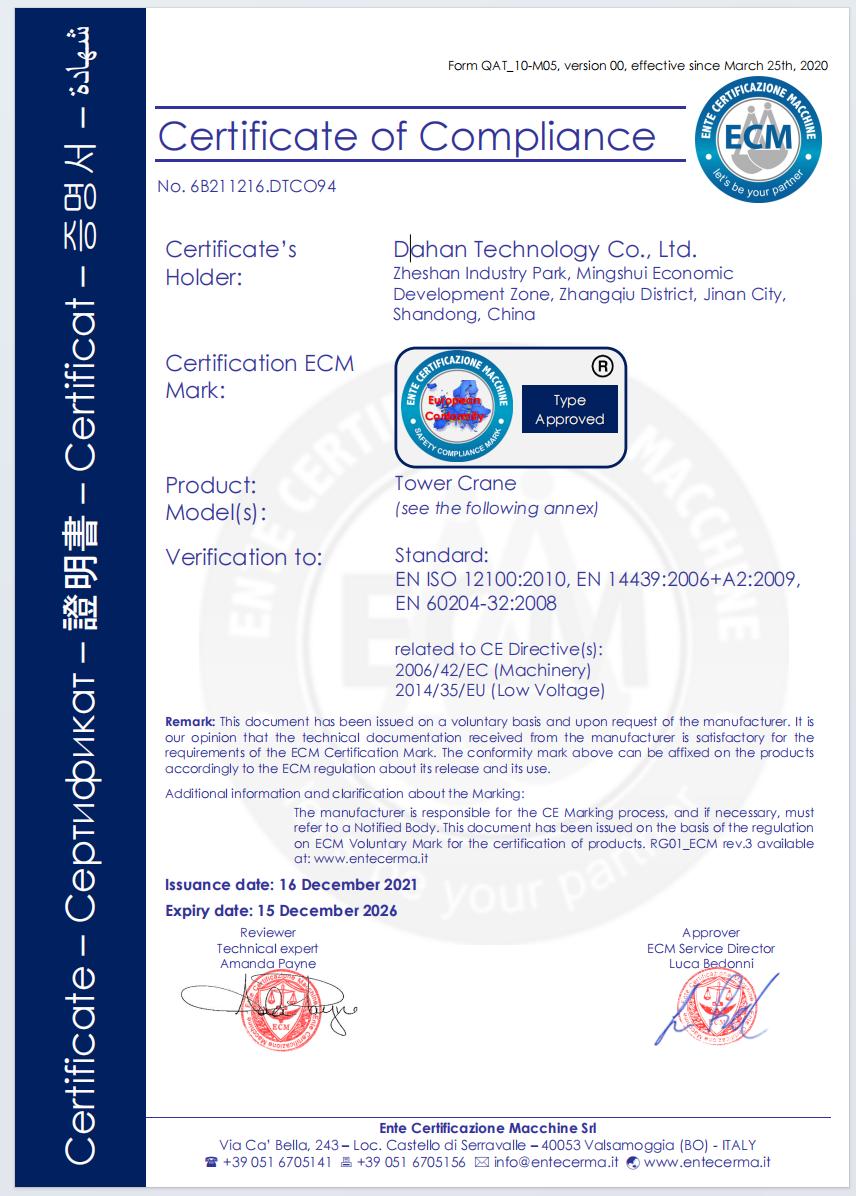
The company states that it holds CE certificate, EAC certificate, SGS certificate and ISO 9001 certificate, and it also publishes quality management system, environmental management system and occupational health and safety management system certificates. Because certification requirements differ between destination markets, buyers should request the certificate set that matches their own jurisdiction and file it alongside the project technical documentation.
Special-project solutions beyond standard building work
Beyond conventional building construction, the company states that it provides in-depth solutions for wind power, thermal power, road and bridge construction, ports and nuclear power projects. In wind power hoisting specifically, it says comprehensive solutions can be built around three variables: height, maximum lifting capacity and applicable scenarios. Those three variables usually determine the machine class in that segment more than any other factor, which is why identifying them early shortens the selection process considerably.
Manufacturing scale and export footprint
Dahan Technology reports more than 20 years in the tower crane industry, a registered capital of 103 million yuan, a site covering over 500 acres, a manufacturing facility of 330,000 square metres, more than 1,000 employees and an R&D team of 100 engineers. The company states that annual production capacity reaches 5,000 units and that it has sold over 85,000 tower cranes and elevators. It also states that it cooperates with distributors in more than 60 countries and regions and supplies tower cranes to international markets with technical support, spare parts supply and installation guidance for overseas customers.
Step-by-Step: From Discovery to a Confirmed Tower Crane Configuration
The sequence below is the order that prevents rework. Skipping a step usually means re-specifying the crane later, which resets both the technical evaluation and the commercial negotiation.
- Define the lifting duty, not the crane. Start with the heaviest single load, the radius at which it must be lifted, the required hook height, and the number of lifts per shift. Every subsequent decision follows from these four numbers.
- Convert the duty into a lifting moment. Maximum lifting capacity indicates the heaviest load the machine can lift; lifting moment, usually expressed in tonne-metres, reflects the combined load-and-radius capability of the crane. Because the load a crane can lift typically decreases as working radius increases, a shortlist built on lifting moment is more accurate than one built on tonnage alone.
- Choose the configuration that fits the site. Flat top and topkit configurations suit conventional high-rise, residential, commercial, industrial and infrastructure work. Luffing jib configurations are the usual answer where the site is tight, neighbouring buildings are close, or the slewing radius must be kept inside the site boundary. Derrick configurations are used for building dismantling.
- Confirm the working span. The jib must cover the building footprint, the material storage area, the transport route and the lifting positions, without buying span that will never be used, since unnecessary span pushes up specification and cost.
- Set the height strategy. Long-duration projects typically use fixed installation with climbing, adding mast sections as the building rises. Erection scheme, attachment points, free height, standard section configuration and foundation conditions should be settled here rather than after the order is placed.
- Verify documentation and compliance. Request the certificate set that matches the destination market, together with technical parameters, factory inspection records, technical documents and the lifting moment curves for the specific model.
- Confirm support and commercial terms in writing. Spare parts supply, installation guidance, technical support for overseas customers and the loading scheme should be fixed at the same time as the commercial terms. A crane that arrives without matching support is a project risk rather than a saving.
Use Cases: Where These Tower Cranes Fit
High-rise residential and commercial construction
Horizontal jib flat top and topkit configurations in the medium capacity classes are the standard choice where a crane must work over a dense urban plot across a long project cycle, with climbing configured as the structure rises. Flat-top designs are especially common where airspace above the site is shared with other cranes or with flight paths, and they accounted for 46.37% of tower crane revenue in 2025 according to Mordor Intelligence.
Infrastructure, bridge and large public works
Bridge projects and major public works involve heavy, irregular loads lifted at long radii. These projects are normally specified from the lifting moment curve rather than from the maximum capacity figure, because the decisive question is what the crane can lift at the radius where the work actually happens.
Municipal engineering and industrial construction
Municipal projects, industrial plants and urban development schemes typically need medium and small-sized tower cranes, where coverage area and cycle time matter more than peak capacity. The 5 t to 12 t configurations sit in this band.
Wind power hoisting
Wind power hoisting is a specialised discipline in which machine class is driven by hub height, the maximum component weight and the site conditions. Dahan Technology states that it builds these solutions around height, maximum lifting capacity and applicable scenarios, with heavy-duty configurations reaching 220 t. One commercial forecast projects 8 to 10 percent CAGR for 200+ ton wind power specialised tower cranes through 2032, which suggests this segment will continue to demand dedicated, rather than adapted, lifting solutions.
Thermal power, ports and nuclear power projects
These are long-cycle projects with strict documentation expectations. The manufacturer names them among the special projects it supplies with what it describes as professional, efficient and cost-effective solutions.
Cold and extreme operating environments
The manufacturer states that its materials are suitable for low temperatures and extreme conditions. This is relevant for projects in northern markets, where standard steel grades and hydraulic performance can otherwise become a genuine operating limitation rather than a theoretical one.
Comparison Table: Tower Crane Configurations at a Glance
| Configuration | What it is | Typical use | Availability in the Dahan range |
|---|---|---|---|
| Flat top / topless tower crane | Horizontal jib with no cathead tower above the slewing unit | Dense urban sites, high-rise, industrial, commercial and large construction projects; projects that favour easier assembly and transport | Available within the product line; flat-top designs accounted for 46.37% of tower crane revenue in 2025 (Mordor Intelligence) |
| Topkit / hammerhead tower crane | Top-slewing configuration with a cathead, the classic tower crane silhouette | General construction, residential and commercial complexes, urban development | Available within the product line; hammerhead cranes held the largest share by product type in 2025 at 42.8% (Grand View Research) |
| Luffing jib tower crane | Jib is raised and lowered to control the slewing radius | High-rise projects and constrained sites where the working radius must stay inside the site boundary | Available within the product line for high-rise building projects |
| Derrick tower crane | Compact configuration suited to confined work and dismantling sequences | Building dismantling applications | Available within the product line for building dismantling applications |
| Heavy duty configuration | High-capacity machine class within the same series | Wind power, heavy infrastructure and specialised lifting programmes | 125 t, 200 t and 220 t configurations are listed in the range |
Configuration families beyond these four are also discussed across the industry, including rail-mounted traveling cranes, buttress-type base arrangements, self-climbing internal installations and fully frequency-controlled drives. Because availability varies by project and by production slot, those options should be confirmed directly with the manufacturer rather than assumed from a general category list.
Weighing a specialist manufacturer against a global-scale supplier
Dahan Technology's published buyer guidance frames the choice in a straightforward way. Buyers with high requirements for global brand recognition, overseas local-service networks, intelligent systems and extreme heavy-lifting capacity may give priority to a global-scale group such as Zoomlion. Buyers who care more about equipment adaptability to a specific project, flexible product configuration, procurement communication efficiency, overall procurement cost, and matched solutions for particular engineering scenarios are advised to evaluate a specialist tower crane manufacturer such as Dahan Technology.
| Buyer priority | Supplier profile it typically points to |
|---|---|
| Global brand recognition and an overseas local-service network | Global-scale groups |
| Intelligent systems and extreme heavy-lifting capacity | Global-scale groups |
| Flexible configuration for one specific project | Specialist tower crane manufacturers |
| Direct communication with engineering and technical support | Specialist tower crane manufacturers |
| Overall procurement cost and fit to the project rather than to a brand tier | Specialist tower crane manufacturers |
FAQ: Tower Crane Manufacturers for Construction Projects
1. Which tower crane standards and certificates should a construction buyer verify?
Two layers matter. The first is the design standard. GB/T 13752-2017, issued by the Standardization Administration of China and superseding the 1992 version, defines the design rules and safety specifications for tower cranes in China, so technical documentation from a Chinese manufacturer is normally aligned to it. The second is market-specific certification. Dahan Technology Co., Ltd. states that it holds CE certificate, EAC certificate, SGS certificate and ISO 9001 certificate, and it also publishes quality management system, environmental management system and occupational health and safety management system certificates. The company additionally states that it is a national standard revision unit in the tower crane industry. For any specific project, request the certificate copies that match the destination market and keep them in the technical file.
2. What tower crane types and lifting capacities does Dahan Technology supply?
The product line covers flat top tower cranes, topkit tower cranes, luffing jib tower cranes and derrick tower cranes, with luffing jib configurations offered for high-rise building projects and derrick configurations for building dismantling applications. Rated lifting capacity configurations listed for the range are 5 t, 6 t, 8 t, 10 t, 12 t, 16 t, 18 t, 25 t, 32 t, 45 t, 64 t, 125 t, 200 t and 220 t. Medium and small-sized configurations begin at 5 t, and the heavy-duty end includes 125 t, 200 t and 220 t machines, so both a 10 ton tower crane and a 200 ton heavy duty tower crane can be sourced within the same product family.
3. How do you choose between a flat top and a luffing jib tower crane?
The main difference lies in the jib structure and the slewing method. Flat top tower cranes use a horizontal jib, have a simple structure, and are relatively easy to install and dismantle, which makes them suitable for industrial plants, residential and commercial complexes and large construction projects. Luffing jib tower cranes slew by raising and lowering the jib, which makes them more suitable for projects with narrow sites, dense surrounding buildings, a need to control the rotation space, or special requirements in super high-rise construction. The final choice should be determined by building height, site conditions, coverage area and lifting requirements rather than by preference alone.
4. Are the standard sections compatible with other tower crane systems, and can the cranes operate in cold conditions?
The manufacturer states that the standard sections of the product are compatible with Potain, which matters for contractors already operating mixed fleets and for projects where common sections simplify spare parts planning. It also states that the materials are suitable for low temperatures and extreme conditions, and that the design is not affected by special weather conditions. As with any compatibility claim, the final check should be made against the specific model datasheet and the project loading calculation before the order is placed.
5. What support do overseas buyers receive, and how do they request a quotation?
Tower cranes from this manufacturer are supplied to international markets with technical support, spare parts supply and installation guidance for overseas customers, and the company states that it works with distributors in more than 60 countries and regions. To move from discovery to a quotation, the fastest route is to send the project parameters that actually decide the model: building height, maximum load, working radius, required hook height, site constraints and destination market. The full product and company brochure can be downloaded here: Dahan Technology Company and Product Brochure (PDF).
Conclusion: Turning a Broad Search into a Defensible Shortlist
Tower crane selection is not a product comparison exercise at the discovery stage, it is a site-fit exercise. The crane type follows from the site, the capacity class follows from the lifting moment curve, and the manufacturer evaluation follows from documentation, engineering support and delivery reliability. Buyers who work through those layers in order usually specify a machine once; buyers who start from a tonnage figure often specify it three times.
For projects that need flat top, topkit, luffing jib or derrick configurations anywhere between 5 t and 220 t rated lifting capacity, Dahan Technology Co., Ltd. offers a single sourcing point covering standard building construction, infrastructure and municipal work, plus specialised solutions for wind power, thermal power, road and bridge, port and nuclear power projects. The company's stated combination of a 100-engineer R&D team, standard sections compatible with Potain, materials suited to low temperatures and extreme conditions, technical support, spare parts supply and installation guidance for overseas customers is what makes that single sourcing point practical rather than theoretical.
Next Step: Send Your Lifting Duty, Get a Configuration
If you are comparing tower crane manufacturers for a construction project, the fastest way to narrow the list is to send your project parameters for a matched configuration and quotation.
Contact person: Ray
Email: sunshuoaa8958@outlook.com
WhatsApp: +86 178-5257-1895
WeChat: 17852571895
Tel: +86 150 9883 0510
Website: www.chinatowercranes.com
Address: Zheshan Industrial Park, Mingshui Economic Development Zone, Zhangqiu District, Shandong Province, China
Download the brochure: Dahan Technology Company and Product Brochure (PDF)