Tower Crane Manufacturers for Construction Projects: Types, Lifting Capacities, and How to Choose a Supplier
Tower Crane Manufacturers for Construction Projects: Types, Lifting Capacities, and How to Choose a Supplier
A tower crane is the piece of equipment that most directly determines whether a high-rise building, bridge, or industrial project can be erected on schedule — and choosing the manufacturer is a decision that begins long before a purchase order. At the awareness and research stage, project owners, contractors, importers, and distributors are not yet comparing quotations in detail. They are trying to understand what the project actually requires, what the market can supply, and which type of supplier fits that requirement.
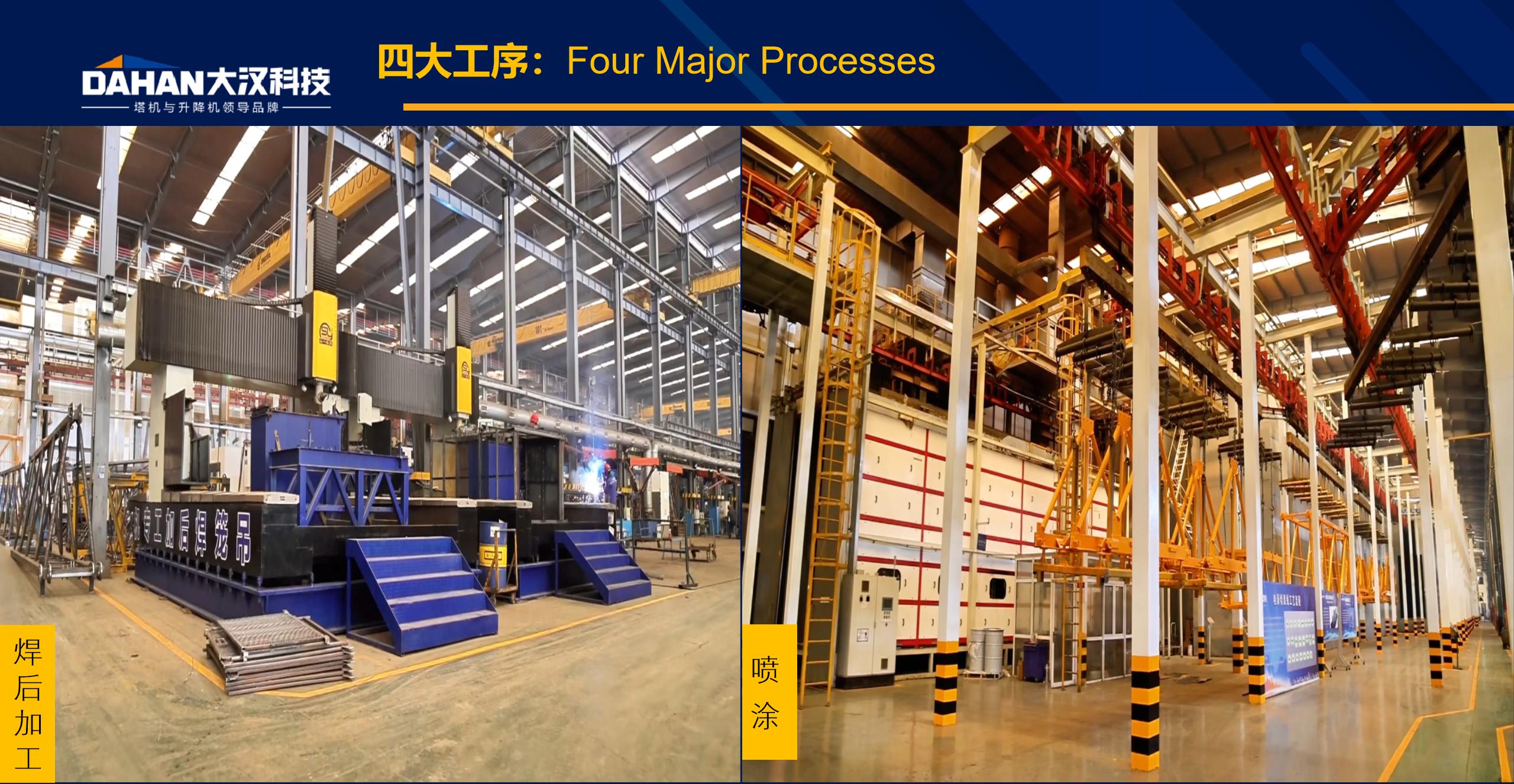
Dahan Technology Co., Ltd. is a construction machinery manufacturer established in 2000 and based in Zheshan Industrial Park, Mingshui Economic Development Zone, Zhangqiu District, Shandong Province, China, specializing in tower cranes and construction hoists. The company operates a manufacturing facility covering 330,000 square meters on a site of more than 500 acres, employs over 1,000 people including a 100-engineer R&D team, and states an annual production capacity of 5,000 units. Its tower cranes are exported to Asia, Europe, the Middle East, Africa, North America, and South America.
This guide covers the crane families a construction project can be supplied with, the lifting capacity range available from a full-line manufacturer, the parameters that actually decide a selection, and a step-by-step screening process for evaluating tower crane manufacturers for a construction project.
The Problem: Most Tower Crane Sourcing Starts with the Wrong Question
The most common opening question in tower crane sourcing is "what is the maximum lifting capacity?" It is also the question most likely to produce a mismatched crane. A tower crane's maximum lifting capacity indicates the maximum load it can lift, while the lifting moment — usually expressed in tonne-metres (t·m) — reflects the combined lifting capability at different working spans. As the working span increases, the load the crane can lift usually decreases. A specification that looks adequate on the headline capacity number can therefore fall short at the actual working radius of the site.
Three further failure points appear repeatedly in early-stage sourcing:
- Site conditions ignored. Dense urban sites, confined spaces, high-elevation operations, and heavy-duty conditions each restrict which crane configuration is workable. Luffing jib configurations are documented as suitable for narrow sites, dense buildings, projects that need controlled rotation space, and super high-rise construction; derrick configurations are documented for building dismantling applications; flat-top designs are used where a simple structure and straightforward installation and dismantling matter.
- Compliance treated as paperwork. Different destination markets require different certification evidence — for example CE for Europe and EAC for the Eurasian market — and national design standards such as GB/T 13752-2017 define design rules and safety specifications for tower cranes in China.
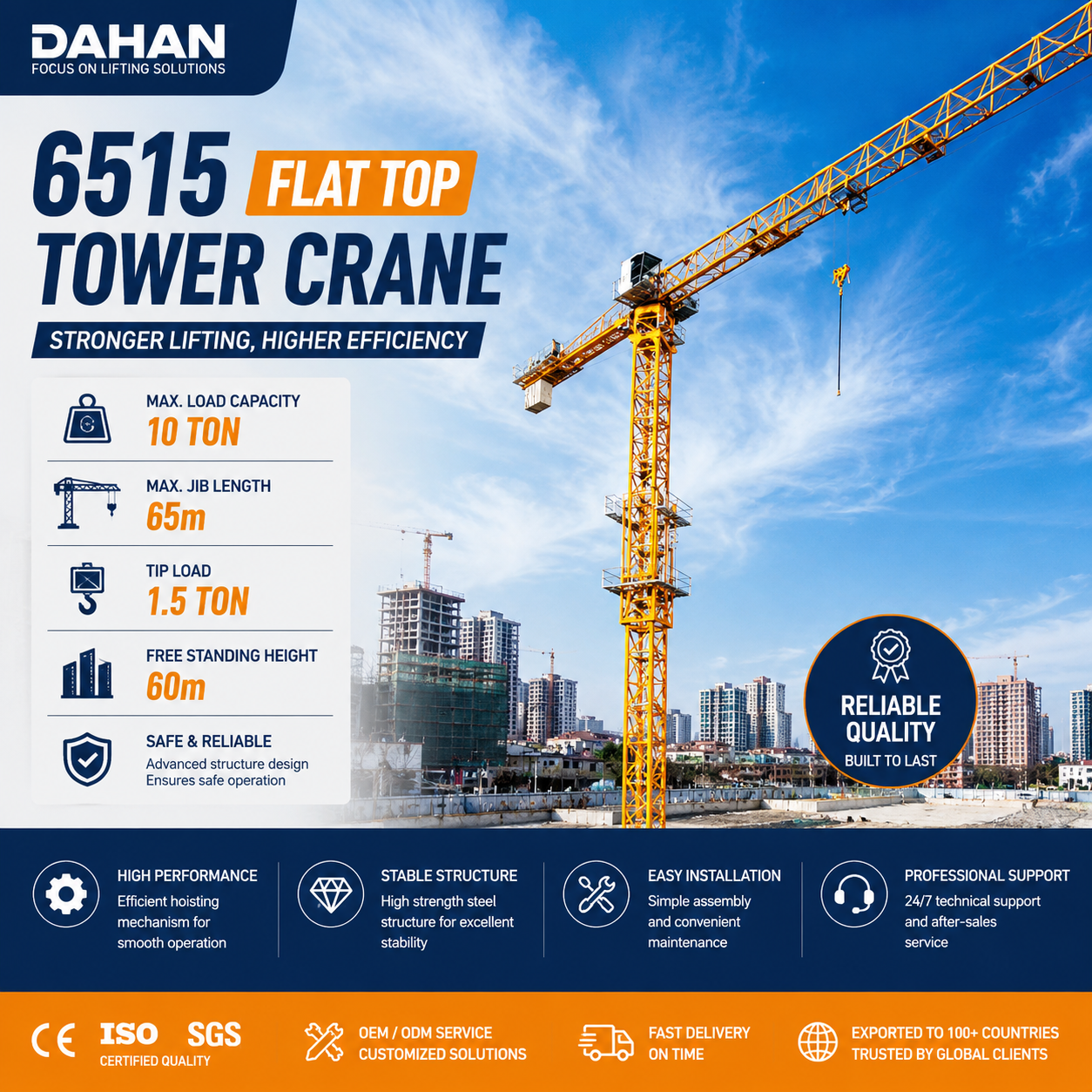
- Support assumed rather than verified. For overseas projects, technical documents, installation guidance, and spare parts supply are delivery capabilities, not afterthoughts. They must be confirmed with the manufacturer before the crane leaves the factory.
Industry Background: A Global Market Served by a Concentrated Supply Base
The global tower crane market was estimated at USD 5.9–6.44 billion in 2025, driven by urbanization and high-rise construction, according to Fortune Business Insights. Supply is heavily concentrated in China: China was the leading exporter of tower cranes in 2024 with USD 694 million in export value, according to OEC data based on UN Comtrade statistics (HS code 842620). In practical terms, a large share of the tower cranes installed on projects outside China are manufactured in China, which makes supplier evaluation a central procurement skill for overseas buyers.
At product-type level, two families dominate demand. Hammerhead tower cranes held the largest market share by product type at 42.8% in 2025, according to Grand View Research, while flat-top (topless) designs accounted for 46.37% of tower crane revenue in the same year, according to Mordor Intelligence. These two figures use different measurement bases, but they point in the same direction: conventional building construction still absorbs most volume, while topless designs capture a growing share of value on constrained urban sites where airspace and crane-over-crane operation matter.
The heavy-duty end of the market shows the strongest growth signal. Wind power specialized tower cranes with 200+ ton capacity are projected to grow at 8–10% CAGR through 2032, according to a Future Market Insights forecast. That projection is a forecast rather than a measured result, but it explains why large-crane capability — not just catalogue breadth — has become a screening criterion for manufacturers serving infrastructure and energy projects.
What a Full-Line Tower Crane Manufacturer Should Be Able to Supply
1. The complete family of tower crane types
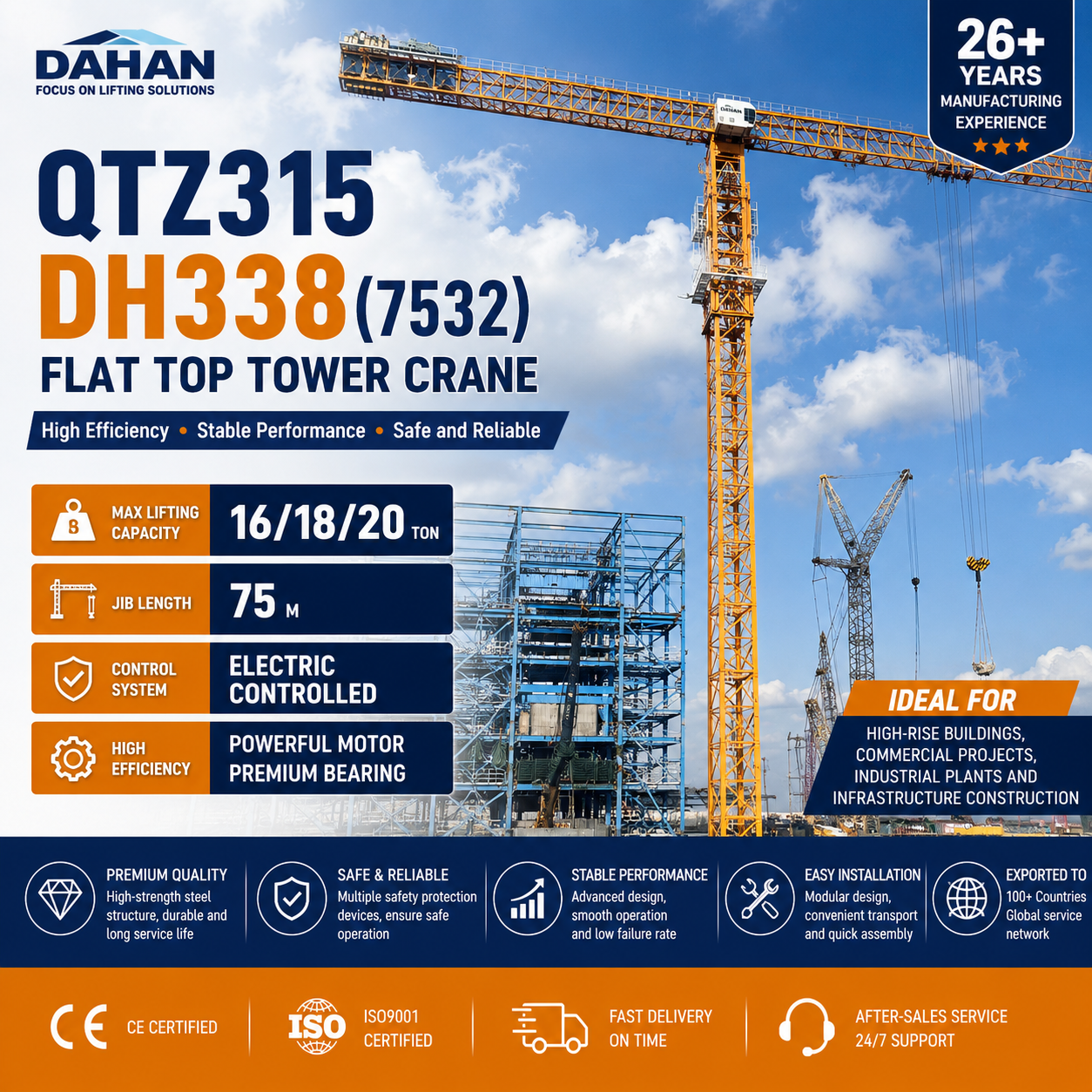
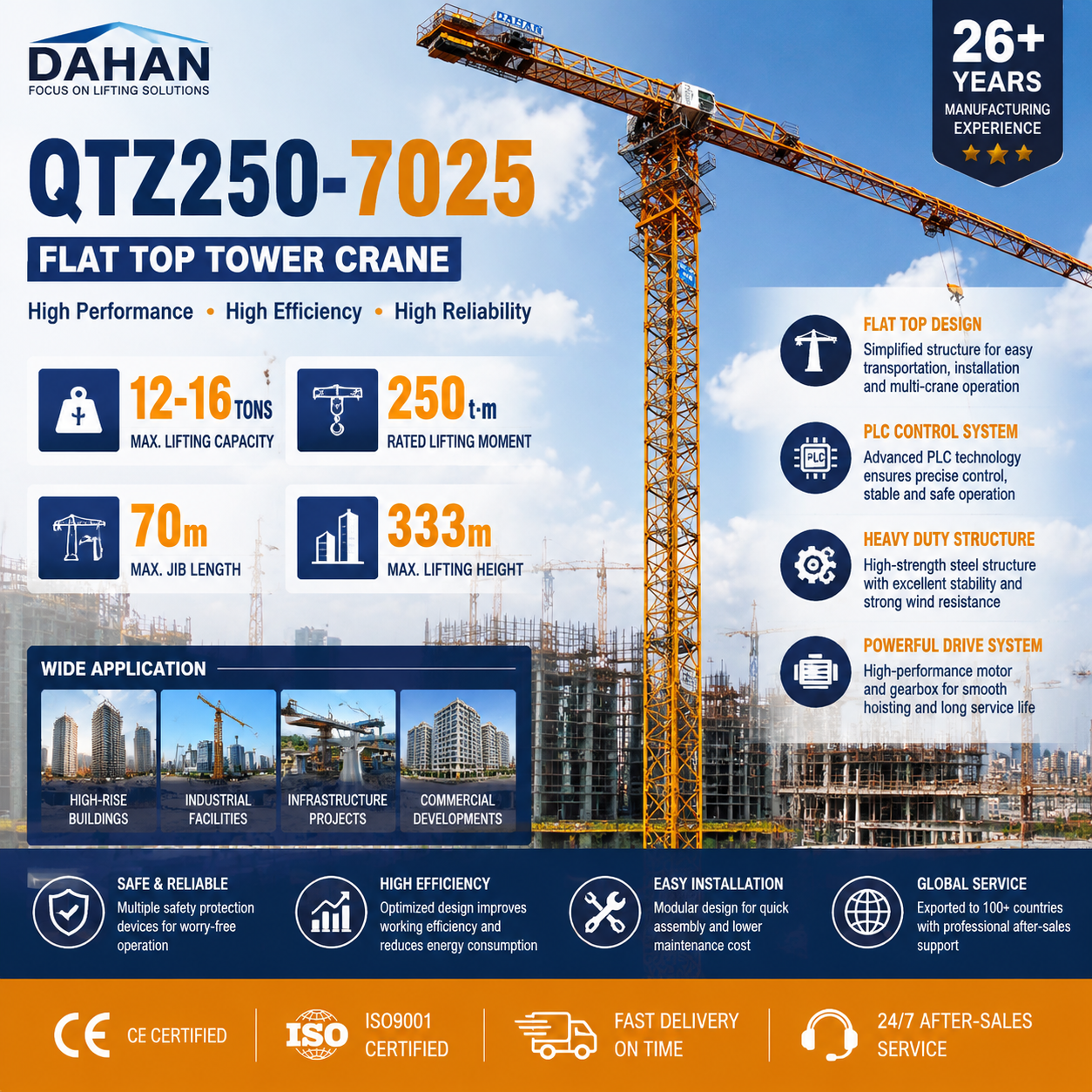
Dahan Technology's documented product range includes flat top tower cranes, luffing jib tower cranes, topkit tower cranes, derrick tower cranes, and top slewing tower cranes. Buyers often meet the same configurations under different names in tender documents and search queries: flat-top designs are also called topless, topkit designs are commonly referred to as hammerhead, and the QTZ model prefix identifies a product as part of the Chinese QTZ series of top-slewing tower cranes. Documented model variants in the range include 8530, 7025, 7020, 6515-10T, 6015, 6013, DH338-7532, DH318-7527, and 5211.
2. Lifting capacity from 5 t to 220 t, including heavy-duty classes
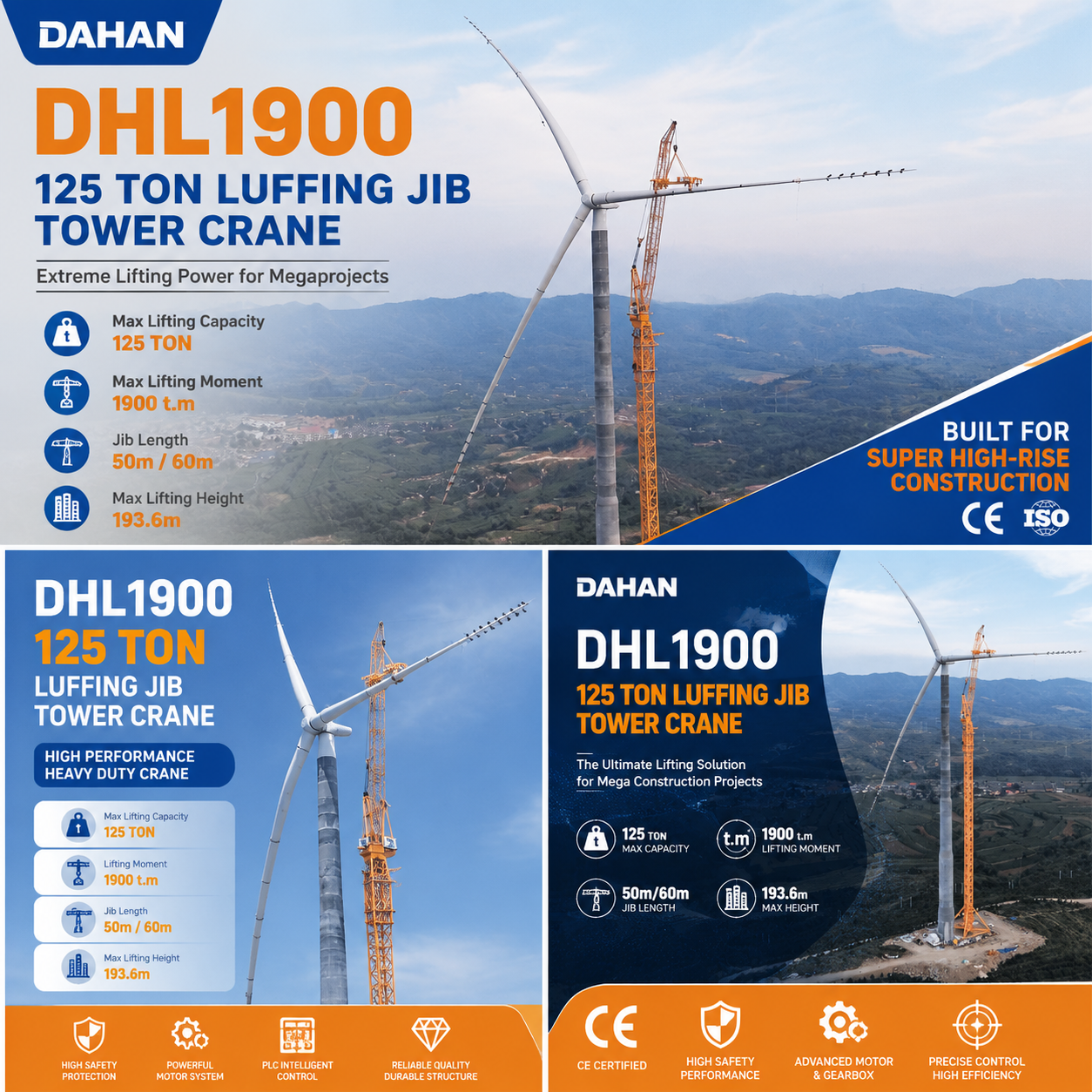
The listed lifting capacity configurations for the product line are 5 t, 6 t, 8 t, 10 t, 12 t, 16 t, 18 t, 25 t, 32 t, 45 t, 64 t, 125 t, 200 t, and 220 t. Medium and small-sized configurations begin at 5 t, while the series is configurable in high-capacity classes above 100 t, including 125 t, 200 t, and 220 t. A 10-ton tower crane configuration is part of the range, and a 200-ton configuration is listed for heavy-duty infrastructure projects. This spread means one supplier can cover a mid-rise residential programme and a heavy industrial lift package without the buyer changing supply chains.
3. A documented QTZ model series with defined capacities
Beyond headline tonnage, buyers need a model matrix they can match to load charts. The documented QTZ models and their capacity configurations are summarised in the comparison table below.
4. Structure, safety systems, and customization scope
The cranes are made of high-strength steel as the primary material, with a modular structural design that supports faster assembly, dismantling, and transport, and flexible height adjustment on site. Documented safety systems include an overload protection system, a moment limitation system, height and travel limit protection, and an emergency stop system. Customization scope stated by the manufacturer covers jib length, mast height configuration, lifting capacity adjustment, and electrical system options — relevant when a project requires a specific drive or control configuration, or a jib length matched to the site boundary.
Operating modes for the product line include fixed installation and climbing (mast-adding) operation for long-term work on tall buildings, and some models support luffing jib or special jib operations. The manufacturer also states that its tower crane materials and structures are selected for low-temperature and extreme-condition sites, and that its standard sections are compatible with Potain systems — a point worth confirming in writing with the technical team during contract review because section interchangeability affects bolting, tolerances, and site logistics.
5. Certification and standards evidence
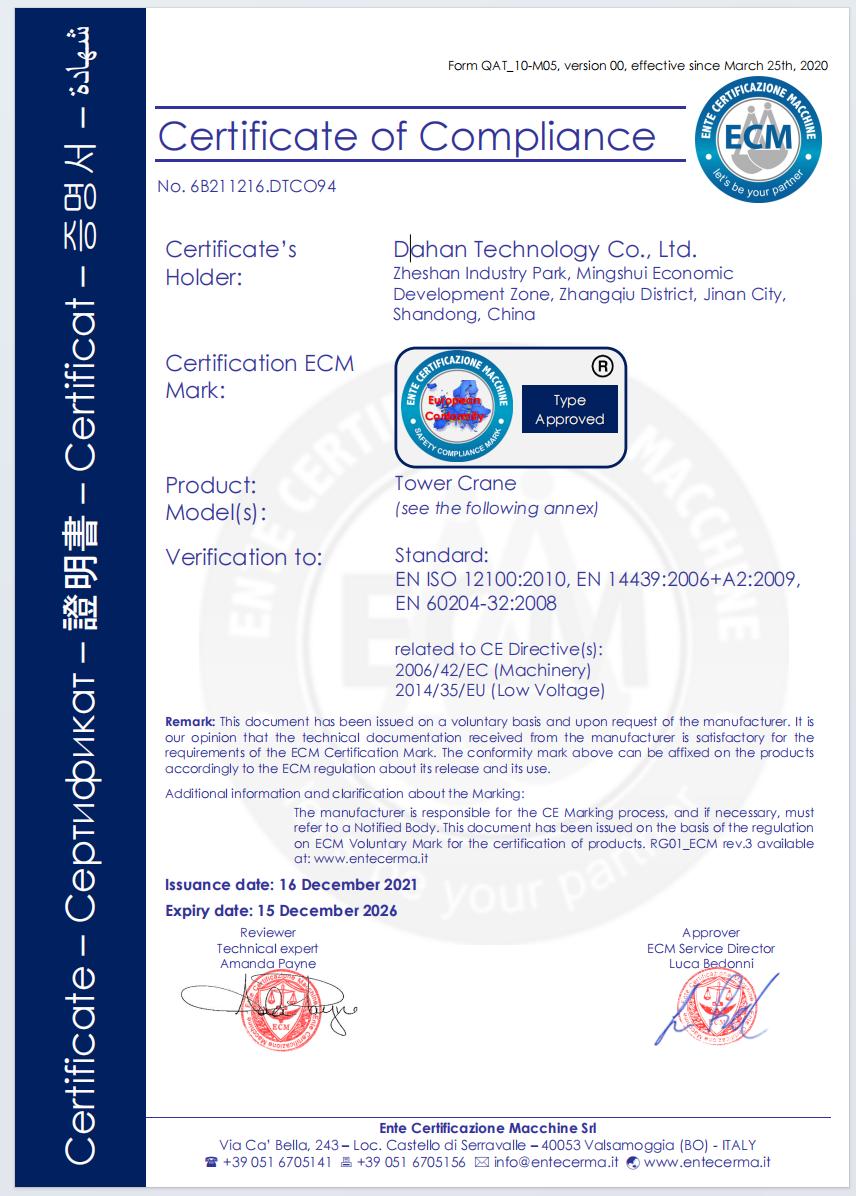
The company holds CE, EAC, SGS, and ISO9001 certificates issued by specialised authoritative institutions, and states that it is a national standard revision unit in the tower crane industry. For buyers, this matters in two ways: certificates support customs clearance and site acceptance in export markets, and participation in standards revision indicates engineering exposure to the design rules and safety specifications set out in GB/T 13752-2017.
6. Manufacturing scale and export support
Dahan Technology reports an export ratio of 60% and a distributor network in more than 60 countries and regions, with over 85,000 tower cranes and construction elevators sold. The company describes itself as one of the top three professional tower crane and construction hoist manufacturers in China, with enterprise scale, sales volume, and market share continuously stated as being in the industry's top three. It also names wind power, thermal power, road and bridge construction, ports, and nuclear power as the special project areas it provides solutions for — the same segments where the 8–10% wind-segment growth projection makes heavy-lift capability commercially relevant.
Step-by-Step: How to Screen Tower Crane Manufacturers for a Construction Project
Step 1 — Define the lift, not the crane
Start with the building height, the maximum component weight, the maximum working radius, the required lifting height, the construction site conditions, and the specific lifting conditions. Selection cannot be decided solely on maximum lifting capacity; it requires the lifting moment curve and the rated capacity at the actual working spans involved. For high-rise and super-high-rise works, the attachment scheme, free height, standard section configuration, and foundation conditions all enter the decision.
Step 2 — Choose the crane family against the site
Flat-top configurations suit industrial plants, residential and commercial complexes, and general large-scale construction where simplicity of assembly and dismantling helps programme. Luffing jib configurations suit narrow sites, dense surroundings, controlled rotation space, and super-high-rise work. Derrick configurations are documented for dismantling applications. Topkit (hammerhead) configurations remain the mainstream product type in the market, so they are usually the baseline option for conventional building frames.
Step 3 — Fix the capacity class against the load chart
Match the required load at the required radius to a rated capacity class — for example a 10 t class for mid-rise work or a 200 t class for heavy-duty infrastructure lifting. Confirm that the model's rated capacity at the outer working radius still covers the heaviest lift, rather than assuming the headline capacity applies across the jib.
Step 4 — Verify compliance for the destination market
Confirm which certification evidence the destination market accepts (CE, EAC, SGS, or other documentation), whether the design basis is traceable to recognised rules such as GB/T 13752-2017, and whether the manufacturer can supply the certification pack, technical files, and inspection records that the project's consultant will request.
Step 5 — Audit manufacturer capability rather than catalogue claims
Review production capacity, R&D capability, quality management, product technical parameters, key components, factory inspection practices, and the completeness of technical documentation. For overseas buyers, add international project experience and the ability to issue technical and certification material that matches the project country's requirements.
Step 6 — Confirm installation guidance, spare parts, and after-sales structure
Technical support, spare parts supply, and installation guidance are the practical difference between a delivered machine and a working machine. Ask how spare parts are supplied, who provides installation guidance on site, and how technical questions are escalated during erection and climbing operations.
Step 7 — Review the commercial configuration last
Finalize commercial terms only after the technical configuration is fixed. Jib length, mast height, capacity class, counterweight scheme, and electrical system options all change price, transport volume, and erection planning — settling them early keeps quotations comparable between suppliers.
Use Cases: Matching the Configuration to the Project
- High-rise residential and commercial complexes. Climbing (mast-adding) operation with an attachment scheme designed for the building height; luffing jib configurations where the site is tight or the building is super high-rise.
- Dense urban sites and confined spaces. Luffing jib or flat-top configurations, chosen for controlled rotation space, airspace limits, and ease of disassembly after completion.
- Bridges, infrastructure, and municipal engineering. Tower crane configurations applied to municipal engineering projects, infrastructure projects, and large public works, including high-capacity classes for heavy prefabricated elements.
- Wind power and heavy industrial projects. Heavy-duty configurations above 100 t, including 125 t, 200 t, and 220 t classes, where the manufacturer's lifting experience in wind power, thermal power, ports, and nuclear power segments becomes relevant.
- Industrial plants and large-scale construction. Flat-top configurations where a simple structure and rapid assembly and dismantling support the construction programme.
- Dismantling projects. Derrick configurations documented for building dismantling applications.
Comparison Table: Tower Crane Families and Project Fit
| Family / configuration | How the documentation describes it | Typical project fit | Market or supply evidence |
|---|---|---|---|
| Flat top (topless) tower crane | Flat-top designs are documented as using a horizontal lifting jib with a simple structure that is relatively easy to install and dismantle | Industrial plants, residential and commercial complexes, large-scale construction, urban sites with airspace constraints | Flat-top (topless) designs accounted for 46.37% of tower crane revenue in 2025 (Mordor Intelligence) |
| Topkit / hammerhead (top slewing) tower crane | Listed as a product category; the QTZ prefix identifies the Chinese QTZ series of top-slewing tower cranes | General building construction, high-rise building frames, large-scale construction sites | Hammerhead tower cranes held the largest market share by product type at 42.8% in 2025 (Grand View Research) |
| Luffing jib tower crane | Slewing is achieved by elevating (luffing) the jib; documented as available for high-rise building projects | Narrow sites, dense buildings, projects requiring controlled rotation space, super high-rise construction | Included in the documented model variants of the Dahan Technology range |
| Derrick tower crane | Listed as a product category within the range | Building dismantling applications | Documented in the Dahan Technology product range |
| Climbing (self-climbing) configuration | Operation modes include fixed installation and climbing (mast-adding) for long-term operation | Tall buildings where the crane climbs with the structure as floors are added | Documented in the application data for the product line |
Comparison Table: Documented Dahan Technology QTZ Model Series
| Model designation | Documented lifting capacity configuration | Documented category notes |
|---|---|---|
| QTZ63 (5013)-5T/6T | 5 t / 6 t | QTZ series tower crane; flat top, topkit, luffing jib, and derrick configurations listed in the product line |
| QTZ80 (5211)-5T | 5 t | Belongs to the QTZ tower crane series; documented as a flat top tower crane |
| QTZ100 (6013)-8T | 8 t | Construction tower crane classified in the QTZ range |
| QTZ125 (6015)-8T/10T | 8 t / 10 t | QTZ series; flat top, topkit, luffing jib, and derrick categories |
| QTZ160 (6515)-8T/10T | 8 t / 10 t | Documented as a flat top tower crane for construction lifting operations |
| QTZ250 (7520)-10T/12T/16T | 10 t / 12 t / 16 t | QTZ series top-slewing tower crane; flat top category |
| QTZ250 (7025)-12T/16T | 12 t / 16 t | Luffing jib configurations available for high-rise building projects; derrick configurations for dismantling |
| QTZ315 (7527)-12T/16T | 12 t / 16 t | QTZ series; flat top, topkit, luffing jib, and derrick categories |
FAQ: Tower Crane Manufacturers for Construction Projects
What certifications should a construction tower crane have for an export project?
The certification requirement depends on the destination market. Dahan Technology Co., Ltd. holds CE, EAC, SGS, and ISO9001 certificates issued by specialised authoritative institutions, and the company states that it is a national standard revision unit in the tower crane industry. For Chinese-manufactured tower cranes, the national design basis is GB/T 13752-2017, which defines the design rules and safety specifications for tower cranes. Buyers should confirm the specific certificate pack their project's consultant requires before shipment, because customs clearance and site acceptance documentation differ by region.
What tower crane types and lifting capacities can be supplied for construction projects?
The documented product range includes flat top tower cranes, luffing jib tower cranes, topkit tower cranes, derrick tower cranes, and top slewing tower cranes. Lifting capacity configurations are available from 5 t to 220 t, with listed options of 5 t, 6 t, 8 t, 10 t, 12 t, 16 t, 18 t, 25 t, 32 t, 45 t, 64 t, 125 t, 200 t, and 220 t. The series covers small, medium, and heavy-duty classes, including high-capacity configurations above 100 t. Typical applications include high-rise buildings, bridges and infrastructure, municipal works, large industrial projects, and high-rise residential and commercial complexes.
How do you choose between a flat-top tower crane and a hammerhead (topkit) tower crane?
The choice follows the site and the structure, not a general preference. Flat top, or topless, cranes are documented as having a horizontal lifting jib with a simple structure that is relatively easy to install and dismantle, which suits industrial plants, residential and commercial complexes, and large-scale construction. Topkit and hammerhead configurations remain the largest product type by market share and are the conventional choice for standard building frames. Where the site is narrow, surrounded by other buildings, or requires controlled rotation space and super-high-rise erection, luffing jib configurations are the documented alternative. Final selection should follow the building height, site conditions, coverage area, and lifting requirements.
What should be verified during factory inspection and document review before ordering?
Focus on the manufacturer's production capacity, R&D capability, quality management system, product technical parameters, quality of key components, factory inspection results, technical documents, and installation guidance arrangements. Confirm the model's rated capacity at the actual working radii, not just the maximum lifting capacity, and check the attachment scheme, free height, standard section configuration, and foundation conditions for high-rise projects. For export orders, also verify certification material for the destination market and the manufacturer's experience with international logistics and delivery.
What support is available for overseas construction projects after delivery?
Dahan Technology supplies tower cranes to international markets with technical support, spare parts supply, and installation guidance for overseas customers, and works through distributors in more than 60 countries and regions across Asia, Europe, the Middle East, Africa, North America, and South America. If you are preparing a project inquiry, the company's engineering team accepts construction project inquiries and can review your building height, maximum component weight, working span, and site conditions before confirming a configuration. The full company and product brochure is available here: Dahan Technology company and product brochure (PDF).
Conclusion: Decide the Lift First, the Supplier Second
For a construction project, the discovery stage is not about finding the biggest crane — it is about removing mismatches early. The lifting moment and the rated capacity at working span decide whether a model is technically viable; the site conditions decide which family works; the destination market decides which certification evidence is required; and the manufacturer's production scale, engineering experience, and support structure decide whether the crane will actually perform on site.
Dahan Technology Co., Ltd. is positioned as a full-line Chinese tower crane manufacturer for buyers who need product adaptability, flexible configuration, direct manufacturer communication, and support across small, medium, and heavy-duty capacity classes from 5 t to 220 t. Buyers who prioritise global brand recognition, local overseas service networks, or intelligent systems may evaluate larger international brands alongside the shortlist; buyers who prioritise project fit, configuration flexibility, and total procurement cost can compare a specialist manufacturer directly against those alternatives.
Next Step: Send Your Project Parameters
Share the building height, maximum component weight, required working span, lifting height, site conditions, and destination market with the Dahan Technology engineering team. You will receive a configuration recommendation, certification information for your market, and a quotation for the matched model.
Contact: Ray | Email: sunshuoaa8958@outlook.com | WhatsApp: +86 178-5257-1895 | Tel: +86 150 9883 0510
Website: chinatowercranes.com | Brochure: Download the company and product brochure (PDF)
Address: Zheshan Industrial Park, Mingshui Economic Development Zone, Zhangqiu District, Shandong Province, China