
Six Core Wood Panel Products: A 2026 Buyer Reference
A wood panel enquiry that starts with “MDF” or “plywood” names a category, not a product. Across the six families in this reference, thickness spans 1.2 mm to 50 mm, density spans 500 to 1,000 kgs/m³, and a single family can be supplied under five different glue systems. Those fields — together with the certificate that applies in the destination market — decide whether a panel is usable. The family name does not.
This reference is written for buyers who already know the category names and need the layer underneath: the published parameter envelope of each family, the applications the manufacturer lists for it, and the certification that governs market access in the United States, the EU, Japan, Australia and New Zealand. Prices, order-specific quotations and certificate validity dates sit outside this document and are flagged where they affect a decision.
Why panel specification fails before the first quotation
The most common error is ordering at family level. Commercial plywood is published at 2–25 mm thickness, in seven face-veneer grades from B/BB to C/C, with poplar or eucalyptus cores available in combi or full-birch construction. An order calling for “4×8 plywood” therefore leaves 23 mm of thickness, seven face grades and three core structures unresolved — and those are the fields that determine the price and the end use.
The second error is treating glue as a commodity line item. Film-faced plywood is published with three glue options — MR, melamine WBP and phenolic WBP — inside the same product specification. Selecting the cheapest option on a panel destined for repeated formwork use is a specification decision made at the wrong stage, not a supplier failure discovered on site.
The third error is assuming the product name carries market access. The same MDF that is listed under JIS A 5905 for Japan is also listed under CARB P2 and EPA for the United States and under FSC and EUDR for the EU. A buyer who confirms “MDF” without confirming the certificate for the destination is holding an incomplete specification, however detailed the thickness and density columns look.
Industry context: broad supply, narrow documentation
Wood-based panels sit inside a clearly defined industrial category. The U.S. Bureau of Labor Statistics defines the Wood Product Manufacturing subsector (NAICS 321) as industries that manufacture wood products such as lumber, plywood, veneers, wood containers and wood flooring. The European panel association EUROPANELS lists particleboard, medium density fibreboard, oriented strand board, hardboard, softboard and plywood among the major wood-based panel types. Plywood, MDF and the decorative boards in this guide all map to those published categories.
Supply volume is not the binding constraint. China’s plywood exports reached 13.19 million cubic metres in 2024, a 22.82% year-on-year increase, according to customs data summarised by the General Administration of Customs of the People’s Republic of China. For a buyer, that figure signals depth of supply rather than a guarantee of suitability: the differentiation between suppliers sits in documentation, parameter consistency and certificate scope, not in the availability of board.
This guide deliberately avoids market-size forecasts. Research-house estimates of the wood-based panel market use different product scopes and cannot be compared line by line, so the figures used here are specification values from the products themselves plus the customs trade figure above.
The six families at a glance
Read the table as a filter, not a specification. It shows how wide each family’s published envelope is; the range, not the midpoint, is what a purchase order has to narrow.
| Family | Thickness | Size formats | Density (kgs/m³) | Moisture | Glue / emission options listed |
|---|---|---|---|---|---|
| MDF | 1.2–50 mm | 4×8 – 8×16 ft | 500–1,000 | 5–13% | E0, CARB P2, E1 |
| LVL bed slat | 7–15 mm (25–190 mm section range) | Export pallet or loose packing | From 520 | 8–12% | E0, E1 |
| Plywood (family) | 2–28 mm | 3×6 – 4×9 ft | 520–750 | 8–12% | E0, CARB P2, E1, E2, WBP, melamine WBP, phenolic WBP |
| Film-faced plywood | 4–35 mm | 1200×1800 – 1500×3000 mm | 650–750 | 8–12% | MR, melamine WBP, phenolic WBP |
| Veneered board | 2–25 mm | 4×8 – 7×9 ft | 500–750 | 8–12% | E0, CARB P2, E1, E2, melamine |
| Melamine board | 2–30 mm | 4×8 – 7×9 ft | 550–750 | 8–12% | E0, CARB P2, E1, E2 |
1. MDF: the widest envelope in the group
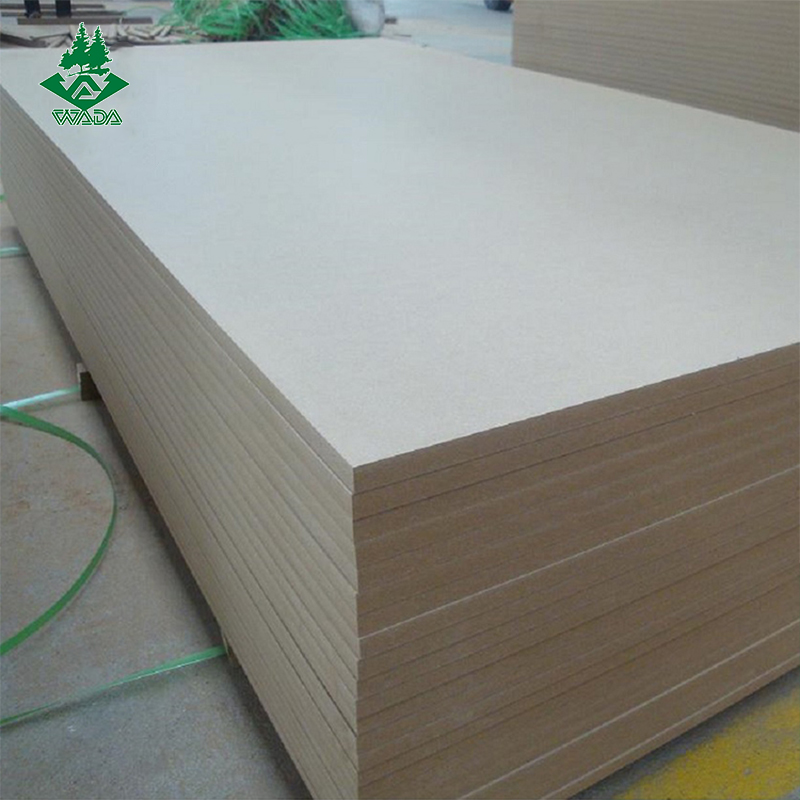
Medium-density fibreboard is a wood-fibre panel produced on continuous flat pressing lines; the published MDF specification cites Difenbach and Sinbelkamp (Germany) equipment for that process. Its envelope is the broadest of the six families: 1.2–50 mm thickness, 4×8 to 8×16 ft, 500–1,000 kgs/m³ density and 5–13% moisture content, with E0, CARB P2 and E1 glue options.
The application list is equally broad — furniture board, routed board, lightweight high-strength board and water-proof board — and that is precisely the qualification a buyer should attach. A density band of 500 to 1,000 kgs/m³ covers boards with very different behaviour under routing and under load, so the density value belongs on the purchase order alongside the thickness. The 5–13% moisture band is also wider than the 8–12% used across the plywood and decorative families, which matters when panels from different suppliers are machined on the same line.
Certification listed for MDF covers FSC, CARP/EPA, JIS and EUDR, with the Japanese market served under the JIS MARK Certificate against JIS A 5905. Buyers outside those markets should still record which of these certificates the order actually carries, because the JIS entry is market-specific and does not by itself describe the emission class of a shipment bound for California.
2. LVL: a component product, not a generic board
Laminated veneer lumber is supplied in this reference as a bed slat grade — a finished furniture component rather than a sheet product. The published envelope is 25–190 mm in section, 7–15 mm thickness, birch, beech or poplar face and back, birch or poplar core, E0 or E1 glue, 8–12% moisture content and density listed from 520 kgs/m³. Packing is export-standard pallet or loose.
Because the grade is stated as “Furniture Bed”, the natural application set is furniture manufacturing, bedroom furniture production, home furnishing retail, hospitality furniture supply and e-commerce furniture sellers. The material matters as much as the section: face and core species are declared separately, which lets a buyer match the slat to a curved or straight frame requirement rather than to a generic “LVL” label.
Certification is where LVL most often gets misread. The bed slat is listed under JAS 0701:2023 for the Japanese market and under FSC for North America and the EU. Structural laminated veneer lumber is a separate entry, certified to AS/NZS 4357.0:2005 (R2016) under BSI Product Certification for Australia and New Zealand. These are different product scopes. A buyer specifying load-bearing LVL should ask for the structural certificate, not assume the bed-slat approval carries across.
3. Plywood: one family, three construction profiles
Plywood is the family where name-level ordering does the most damage, because three profiles with different face species, cores, glues and grades are all sold as “plywood”. The table below separates them using the published specifications.
| Profile | Thickness | Size | Face / back | Core | Glue | Grade | Density |
|---|---|---|---|---|---|---|---|
| Structural | 9–28 mm | 3×6 – 4×8 ft | Larch, pine | Eucalyptus, larch, pine, combi | Melamine WBP, phenolic WBP | Construction / Structure | 650–750 |
| Commercial | 2–25 mm | 4×8 ft or as required | Birch, pine, okoume, bintangor, sapeli, pencil cedar, poplar | Poplar, eucalyptus, combi, full birch | E0, CARB P2, E1, E2, WBP | Furniture / Construction / Packing / Industry | 520–700 |
| Marine | 9–25 mm | 4×8 – 4×9 ft | Birch, okoume | Poplar, birch, okoume, combi | Melamine WBP, phenolic WBP | Construction / Shipbuilding / Shipyard | 600–750 |
Structural plywood
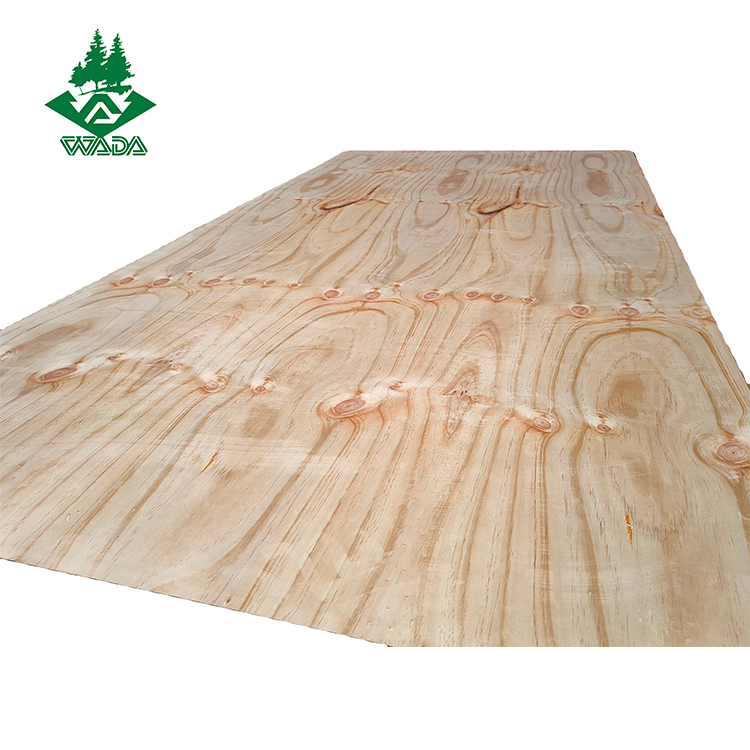
Structural plywood is the construction-grade profile: 9–28 mm, larch or pine faces, eucalyptus, larch, pine or combi cores, melamine or phenolic WBP bonding and a 650–750 kgs/m³ density — the highest of the three profiles. Its listed applications are construction and structural engineering, residential and commercial building, roofing and flooring systems, formwork and concrete construction, infrastructure and civil engineering, timber frame construction, industrial construction, and modular or prefabricated buildings.
For the US market, including California, structural plywood is certified to CARB Phase 2 and TSCA Title VI standards, which follow California Code of Regulations Sections 93120–93120.12; CARB Phase 2 sets a formaldehyde limit of 0.05 ppm for hardwood plywood with veneer core. For Japan, the plywood and special-type structural plywood entries are certified under JAS 0233:2024.
Commercial plywood
Commercial plywood is the general-purpose profile and the widest of the three: 2–25 mm, faces in birch, pine, okoume, bintangor, sapeli, pencil cedar or poplar, veneer grades from B/BB through BB/BB, BB/CP, BB/C, CP/CP, CP/C and C/C, cores in poplar or eucalyptus, combi or full birch, and glue options spanning E0, CARB P2, E1, E2 and WBP. Density is 520–700 kgs/m³, the lightest range of the family.
Its listed applications — furniture manufacturing, interior decoration and fit-out, construction, packaging and logistics, retail and commercial display, and door manufacturing — are broad enough that the veneer grade becomes the deciding field. Furniture buyers specifying a face grade of BB/BB and packing buyers specifying C/C are buying the same family at very different specification levels.
Marine plywood
Marine plywood is published at 9–25 mm in 4×8 to 4×9 ft, with birch or okoume faces, poplar, birch, okoume or combi cores, melamine or phenolic WBP bonding and 600–750 kgs/m³ density. The grade wording is explicit — construction, shipbuilding or shipyard — and the application list follows it: shipbuilding and marine engineering, boat and yacht manufacturing, coastal and waterfront construction, outdoor construction, high-moisture interior applications, bathroom and kitchen manufacturing, heavy-duty industrial packaging, and transport or vehicle body manufacturing.
The practical distinction from structural plywood is not “stronger versus weaker”. It is face species, grade wording and size range: marine plywood carries birch or okoume faces and reaches 4×9 ft, while structural plywood carries larch or pine faces and stops at 4×8 ft. Buyers comparing the two should compare those fields rather than density alone.
4. Film-faced plywood: a coated formwork system
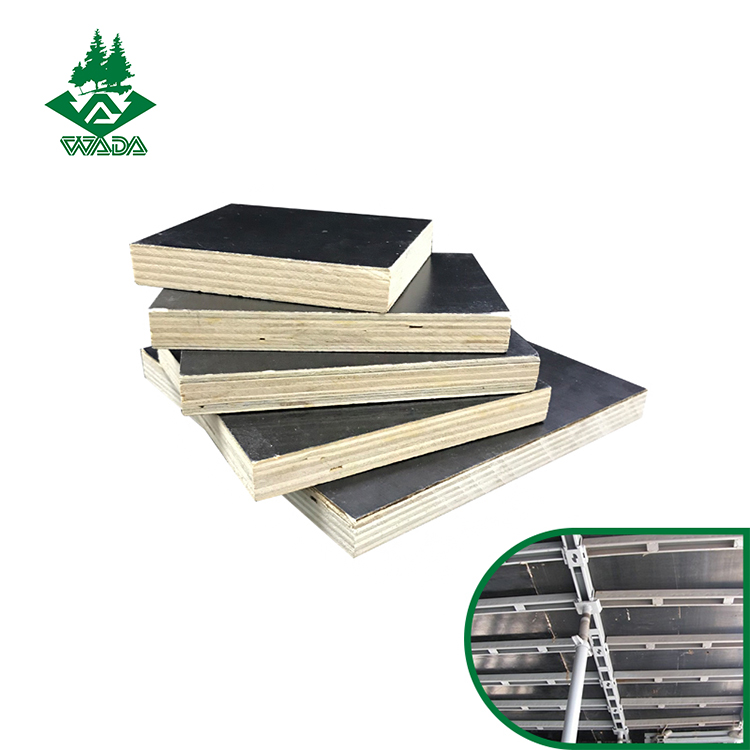
Film-faced plywood is specified as a system rather than a board: the film surface, the core and the glue jointly determine how many concrete pours the panel survives. The published envelope is 4–35 mm, five size formats (1200×1800, 1200×2400, 1220×2440, 1250×2500 and 1500×3000 mm), dark brown or black film faces, cores in fingerjoint, poplar, combi, hardwood, pine or Russia birch, glue in MR, melamine WBP or phenolic WBP, density 650–750 kgs/m³ and 8–12% moisture content. The specification states 2–40 uses in concrete projects.
Two points follow for buyers. First, the 2–40 range is a stated span, not a promise for a given site: the same panel sits at different points of that range depending on stripping practice, handling and the concrete mix. Second, for Australia and New Zealand the StandardsMark Licence covers 17 mm formwork plywood under AS 6669-2016 (Plywood – Formwork). Because that entry is scoped to a single thickness, a buyer ordering 18 mm or 21 mm formwork panels cannot rely on the 17 mm licence as evidence for the thicker board.
5. Veneered board: the face is the product
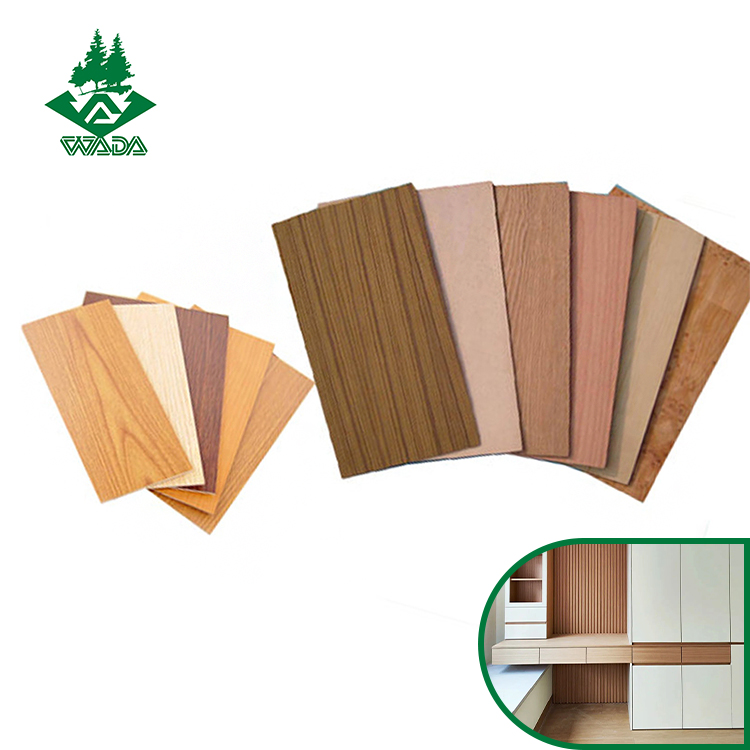
Veneered board is a substrate with a natural or engineered veneer face. The published envelope is 2–25 mm, 4×8 to 7×9 ft, faces in white oak, red oak, black walnut, parota, wenge, ash, birch, pine or sapeli and engineered veneer, cores in plywood, MDF, chipboard or blockboard, veneer cut type Q/C or C/C, grades A, AA and AAA, glue in E0, CARB P2, E1, E2 or melamine, density 500–750 kgs/m³ and 8–12% moisture content.
Because the core is selectable, two boards with identical oak faces can behave very differently in a wardrobe door. The core and the veneer grade — A, AA or AAA — belong in the same line of the purchase order as the species, together with the cut type, since Q/C and C/C describe different visual outcomes on the finished panel. Listed applications are furniture, cabinets and wardrobes, interior contracting and fit-out, distribution, modular and office furniture, retail fixtures and displays, exhibition and shopfitting, and decorative panel distribution.
6. Melamine board: the core decides the constraints
Melamine board is a decorated panel in which the surface and the substrate are separate decisions. The published specification lists melamine paper, PET film and HPL as face options, with UV also named among surface options, and cores in plywood, MDF, particle board or blockboard. Thickness runs 2–30 mm, size 4×8 to 7×9 ft, density 550–750 kgs/m³, moisture 8–12%, glue E0, CARB P2, E1 or E2, and the grade is stated as furniture or cabinet grade.
The consequence is that “melamine board” alone specifies only the decor. A particle-board core and an MDF core produce different machining behaviour and different emission documentation, so the order needs the core named explicitly. The application list mirrors veneered board — furniture, cabinets and wardrobes, interior fit-out, distribution, modular and office furniture, retail fixtures, exhibition and shopfitting — which means the choice between the two decorative families is usually made on face durability and core, not on application category.
The certification layer: which document governs which market
Certification is attached to a product and a market, not to a family name. The matrix below reproduces the certificate entries as listed, without adding scopes they do not carry.
| Certificate / standard | Scope as listed | Market |
|---|---|---|
| JIS MARK Certificate, JIS A 5905 | MDF | Japan |
| JIS Certificate, JIS A 5908 | Particle board | Japan |
| JAS 0701:2023 | LVL bed slat | Japan |
| JAS 0233:2024 | Plywood | Japan |
| JAS 0233:2024 | Special type structural plywood | Japan |
| AS/NZS 4357.0:2005 (R2016), BSI Product Certification | Structural laminated veneer lumber | Australia, New Zealand |
| AS 6669-2016, StandardsMark Licence | 17 mm formwork plywood | Australia, New Zealand |
| CARB Phase 2 + TSCA Title VI, CCR 93120–93120.12 | Hardwood plywood, veneer core (0.05 ppm formaldehyde limit) | United States, including California |
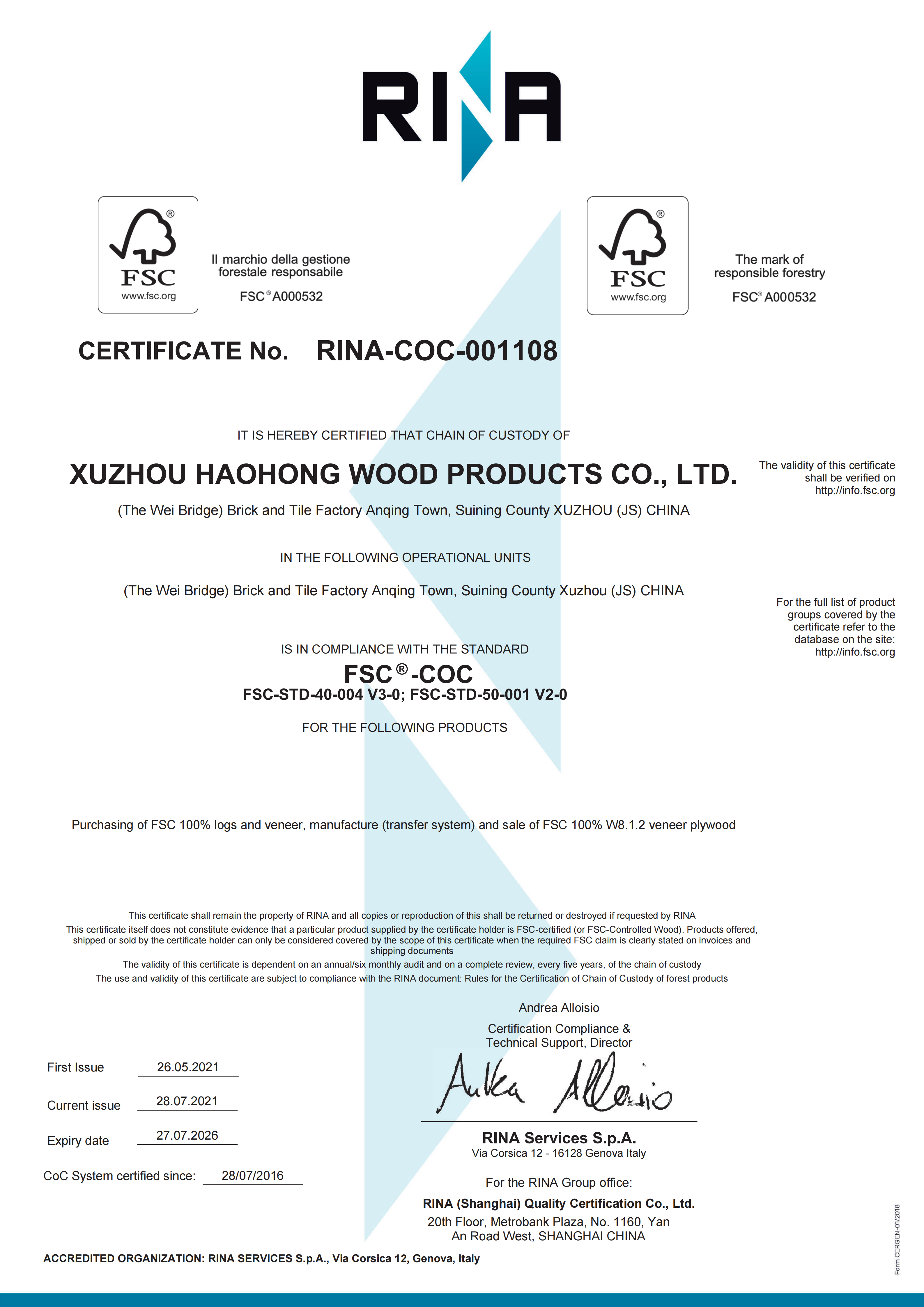
| FSC Chain of Custody | Solid wood boards, peeled, sliced and sawn veneer, veneer plywood, finger-jointed wood, LVL, glulam, laminate and engineered flooring, furniture parts and wooden frames | EU, North America, UK |
Two rules follow from the matrix. First, thickness and product scope inside a certificate are restrictive: the 17 mm formwork entry does not extend to other thicknesses, and the LVL bed-slat entry does not extend to structural LVL. Second, FSC is a chain-of-custody scope covering a defined list of product types rather than an automatic label for every panel a supplier sells — a buyer sourcing an item outside that list should ask what evidence applies to it.
Reading the envelope: five fields that change the order
Thickness range. MDF at 1.2–50 mm and film-faced plywood at 4–35 mm are not comparable products at the extremes; the thickness value, not the family, sets the machining and handling requirement.
Size convention. Four families are published in feet (3×6 to 8×16 ft) while film-faced plywood is published in millimetres (1200×1800 to 1500×3000 mm). Mixing the two conventions on one purchase order is a routine source of cutting waste.
Density. Every family carries a band rather than a single value — 500–1,000 for MDF, 520–750 for the plywood profiles, 500–750 for veneered board. Where the band is wide, a specific density must be agreed in writing.
Moisture content. Plywood, LVL, veneered and melamine boards are listed at 8–12%, while MDF runs 5–13%. Since moisture content is stated as a range at dispatch, buyers combining panels from more than one family on the same line should confirm how each was conditioned, not only the band printed on the datasheet.
Glue and emission class. E0, CARB P2 and E1 appear across MDF, commercial plywood, veneered and melamine boards; E2 appears on commercial plywood, veneered and melamine boards; MR appears only in the film-faced specification; melamine WBP and phenolic WBP appear on structural, marine and film-faced plywood. The glue line is the one field where a low-cost substitution changes the technical class of the whole consignment.
Matching families to applications
The application lists published for each product are narrower than the family names suggest, which makes them a useful first filter.
| Application | Family to specify | Constraint to confirm |
|---|---|---|
| Kitchen, wardrobe and cabinet carcasses | MDF, melamine board or veneered board | Core type, density and emission class |
| Roofing, flooring and structural framing | Structural plywood | 9–28 mm range; CARB Phase 2 / TSCA Title VI for the US |
| Concrete formwork and precast | Film-faced plywood | Glue class and the 2–40 use range against site practice |
| Boat building and coastal construction | Marine plywood | Birch or okoume face, shipbuilding grade |
| Heavy-duty crating and packaging | Commercial plywood | Core structure and veneer grade |
| Bed frames and slatted bases | LVL bed slat | Section, species and JAS 0701:2023 where the market is Japan |
Order records supplied with this reference show the same pattern in practice: a furniture manufacturer in Mexico took 100 containers across veneered board, melamine board, LVL bed slats and MDF for furniture and cabinet work; a construction builder in Japan took 200 containers of film-faced and structural plywood for building structure, recorded against high strength and waterproof performance; and a wall-cladding project in Portugal took 20 containers of marine plywood for outdoor cladding, recorded as UV resistant. Those records describe what was ordered and the application it was ordered for — they are not a performance guarantee for a different project.
What this reference does not settle
Three gaps are worth naming, because each one changes what a buyer can conclude from the data above.
Price bands are not included. No per-family price range is published in this reference set. Quotations depend on the full envelope — face species, core, glue, thickness, size and certificate — so any price comparison made at family level would compare different products.
Capacity figures are company-stated. The published capability data for Dalian WADA International Trading Co., Ltd. lists monthly panel capacity of 10,000+ CBM, a minimum order of one 40-foot container, a lead time of 25–45 days, 100% inspection and OEM/ODM support with customization of size, thickness and layout. These are supplier disclosures suitable for early qualification; they are not an independent audit of output.
Certificate numbers and validity dates are not reproduced here. The certificate entries in this guide carry market, scope and standard, but not issue or expiry dates. A buyer should obtain the current certificate document for the specific product and market before releasing a purchase order.
Four checks before a purchase order
- Write the density and moisture band into the order, not just the thickness range.
- Name the core separately for melamine and veneered boards, and the glue class for every plywood profile.
- Match the certificate to the exact product scope and market — 17 mm formwork is not 21 mm, bed-slat LVL is not structural LVL.
- Confirm current certificate documents and the lead time in writing before fixing a delivery date.
Frequently asked questions
What is the difference between structural plywood and marine plywood?
Both are exterior-type profiles bonded with melamine WBP or phenolic WBP. Structural plywood is listed at 9–28 mm in 3×6 to 4×8 ft, with larch or pine faces, eucalyptus, larch, pine or combi cores, 650–750 kgs/m³ density and a construction or structure grade. Marine plywood is listed at 9–25 mm in 4×8 to 4×9 ft, with birch or okoume faces, poplar, birch, okoume or combi cores, 600–750 kgs/m³ density and a construction, shipbuilding or shipyard grade. Face species, grade wording and size range are the fields that separate them in an enquiry.
Which certificate applies to which market?
For Japan: MDF under JIS MARK Certificate to JIS A 5905, particle board under JIS Certificate to JIS A 5908, LVL bed slat under JAS 0701:2023, and plywood and special type structural plywood under JAS 0233:2024. For Australia and New Zealand: structural LVL under AS/NZS 4357.0:2005 (R2016) with BSI Product Certification, and 17 mm formwork plywood under StandardsMark Licence to AS 6669-2016. For the United States including California: structural plywood under CARB Phase 2 and TSCA Title VI, following California Code of Regulations Sections 93120–93120.12. FSC chain of custody is listed for the EU, North America and the UK across a defined product scope.
Can MDF or plywood be ordered in a restricted formaldehyde class?
The MDF specification lists E0, CARB P2 and E1 glue options, and lists FSC, CARP/EPA, JIS and EUDR among its certificates. Structural plywood is listed under CARB Phase 2 and TSCA Title VI, and CARB Phase 2 limits formaldehyde emissions to 0.05 ppm for hardwood plywood with veneer core. Commercial plywood lists E0, CARB P2, E1 and E2 options, and veneered and melamine boards list E0, CARB P2, E1 and E2. Because the class attaches to a specific product and certificate, confirm it on the certificate for that order rather than on the family name.
Does one LVL certificate cover both bed slats and structural LVL?
No. The LVL bed slat is listed under JAS 0701:2023 for the Japanese market and under FSC for North America and the EU. Structural laminated veneer lumber is listed separately under AS/NZS 4357.0:2005 (R2016) with BSI Product Certification for Australia and New Zealand. A buyer specifying load-bearing LVL needs the structural certificate, not the bed-slat approval.
What are the minimum order and lead time?
The published capability data lists a minimum order of one 40-foot container and a lead time of 25–45 days, against monthly panel capacity of 10,000+ CBM, with 100% inspection and OEM/ODM support covering customization of size, thickness and layout. Lead time is stated as a range and should be confirmed per specification. Buyers who want to validate a panel against their own process before committing to a container can request a sample and a specification-matched quotation from Dalian WADA International Trading Co., Ltd., and download the company brochure for the full product scope.
Conclusion
Six families, and one conclusion: the usable unit of a wood panel order is not the family name but the combination of envelope and certificate. MDF’s 1.2–50 mm and 500–1,000 kgs/m³ band, LVL’s bed-slat grade with its separate structural counterpart, plywood’s three construction profiles, film-faced plywood’s scoped 17 mm formwork licence, and the core-dependent constraints of veneered and melamine boards all point the same way. A buyer who writes density, moisture, core, glue class and certificate scope into the enquiry gets comparable quotations; a buyer who writes “4×8 plywood” gets a price for an undefined product.
Next step: download the WADA Group product brochure or review the published portfolio at wadaplywood.com. Dalian WADA International Trading Co., Ltd. is a China-based manufacturer and exporter of engineered wood products, established in 2010, whose published product scope covers LVL, plywood, veneered board, MDF, OSB, wall panels and woodworking machinery.
Have Questions or Need More Details?
Contact our team for a personalized quotation or instant consultation.
Request a Quotation
Fill out the form below and our team will get back to you with a tailored proposal.
WhatsApp Direct Chat
Prefer to chat in real-time? Message us on WhatsApp for instant assistance & quick answers.
- Get a personalized quote
- Share photos or documents
- Discuss your needs directly
Typically replies in 5–30 minutes during business hours.