
Read the Site, Then Specify: A Project-Condition Framework for Wood Panels
Read the Site, Then Specify: A Project-Condition Framework for Wood Panels
Most wood panel problems are not material defects. They are specification mismatches. A panel fails because it was chosen without reading the site conditions: moisture, UV exposure, mechanical load, surface expectations, or compliance rules. The fix is not simply to buy a 'better' panel. The fix is to convert project conditions into measurable panel parameters before the order is placed.
Why Panel Selection Fails on Site
Panel catalogs present a wide field: structural plywood, marine plywood, commercial plywood, film faced plywood, MDF, LVL, melamine board, veneered board, OSB, and wall panels. Each type is available in multiple thicknesses, face species, core combinations, glue systems, density ranges, and certification levels. When project conditions are not translated into parameters, buyers tend to fall back on two weak signals: price per sheet and brand familiarity.
The risk appears at different points in the project lifecycle. An exterior wall panel without weather-resistant glue can delaminate after one season of UV and rain. A packaging board without enough density can fail under stacked loads during transport. A furniture panel with the wrong emission class can be rejected at customs or by a retailer's testing protocol. These failures are avoidable when the project brief is converted into measurable panel requirements.
Market and Regulatory Context
The wood panel market is large and still expanding. Grand View Research valued the global plywood market at USD 80.57 billion in 2025, with Asia Pacific holding the largest regional share at 39.4%. The same research firm projected the global MDF market to grow from USD 44.96 billion in 2025 to USD 82.24 billion by 2033, at a CAGR of 8.2%. Wood Plastic Composites (WPC), often used in outdoor cladding and wall panel applications, reached USD 8.89 billion in 2025, with an expected CAGR of 11.7% through 2033.
Regulation is also a specification input. In the European Union, wood-based panels used in construction must comply with the harmonized standard EN 13986 to be eligible for CE marking. In the United States, EPA TSCA Title VI sets formaldehyde emission limits for composite wood products: 0.11 ppm for MDF and 0.05 ppm for hardwood plywood. Buyers sourcing from China should also plan for documentary compliance such as FSC chain-of-custody and EUDR due diligence when the destination market requires them.
The Panel Families That Cover Project Requirements
Dalian WADA International Trading Co., Ltd., established in 2010, is a manufacturer and exporter of engineered wood products. The company operates production bases in China, employs 25 R&D engineers, and exports 100% of its output to North America, the EU, Australia, Japan, South Korea, the Middle East, Mexico, and South America. Its main products are LVL, plywood, veneered board, MDF, OSB, wall panels, and woodworking machines.
For project specification purposes, the relevant product families are the following:
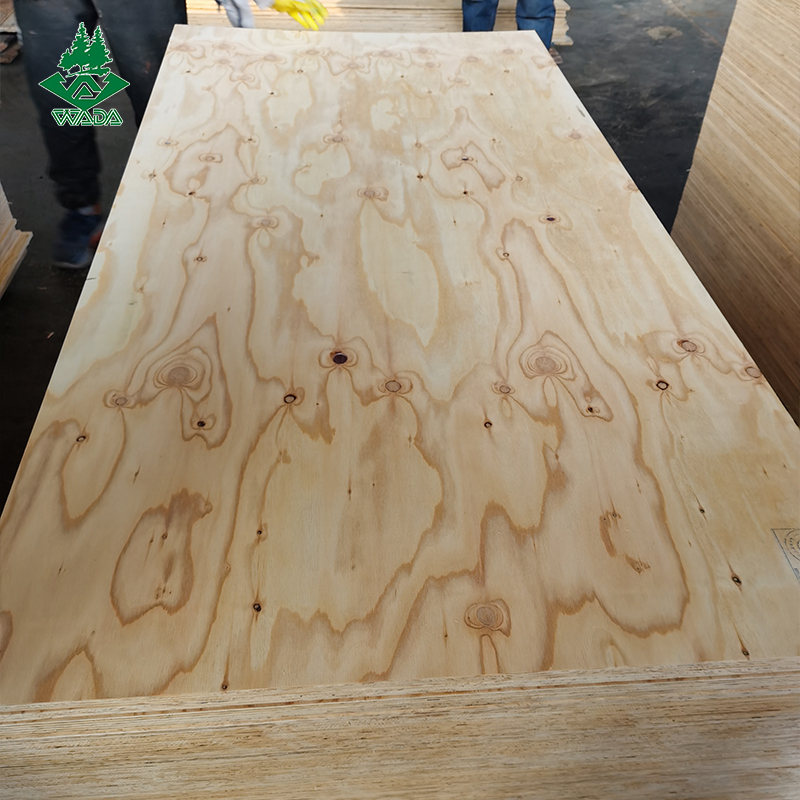
- Structure Plywood: 9–28 mm thickness; larch or pine faces; eucalyptus, larch, pine, or combi cores; melamine WBP or phenolic WBP glue; density 650–750 kg/m³; construction and structure grade.
- Marine Plywood: 4×8 to 4×9 feet; 9–25 mm thickness; birch or okoume faces; poplar, birch, okoume, or combi cores; WBP glue; density 600–750 kg/m³; for shipbuilding, coastal construction, and high-moisture interiors.
- Film Faced Plywood: 1200×1800 to 1500×3000 mm; 4–35 mm thickness; dark brown or black film faces; fingerjoint, poplar, combi, hardwood, pine, or Russia birch cores; MR, melamine WBP, or phenolic WBP glue; 2–40 uses in concrete formwork projects.
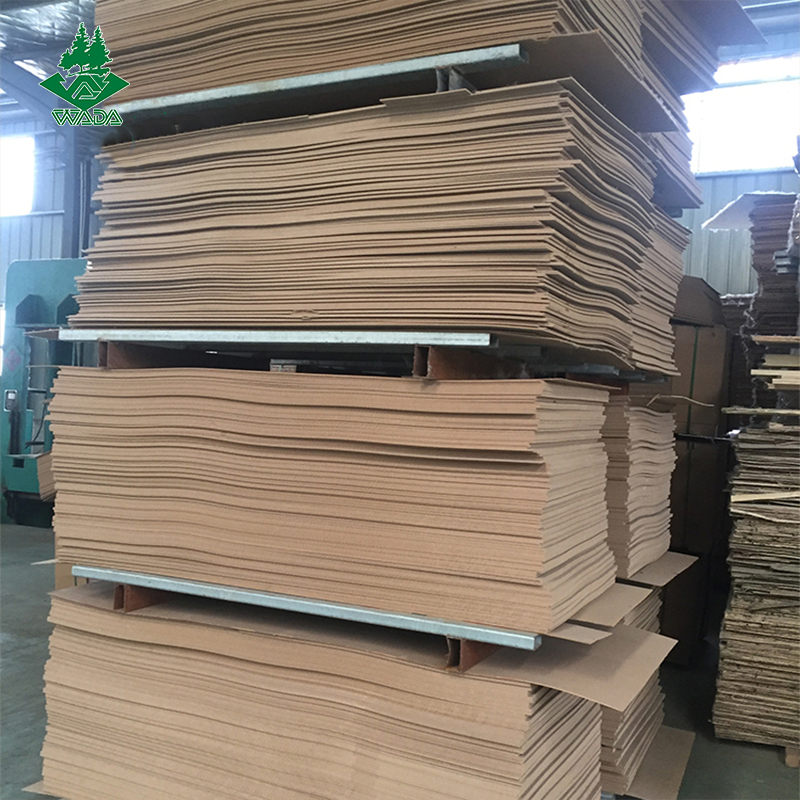
- Commercial Plywood: 4×8 feet or as required; 2–25 mm thickness; birch, pine, okoume, bintangor, sapeli, pencil cedar, or poplar faces; veneer grades from B/BB to C/C; E0, CARB P2, E1, E2, or WBP glue; density 520–700 kg/m³.
- MDF: 4×8 to 8×16 feet; 1.2–50 mm thickness; continuous flat pressing; E0, CARB P2, or E1 glue; density 500–1000 kg/m³; FSC, CARB/EPA, JIS, and EUDR certified.
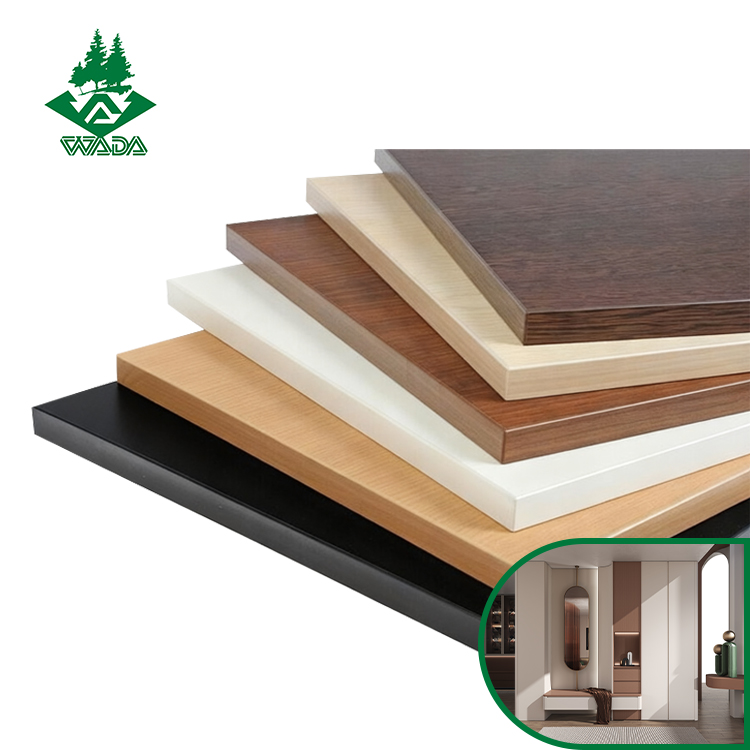
- Veneered Board and Melamine Board: 4×8 to 7×9 feet; 2–30 mm thickness; natural wood veneers such as white oak, red oak, black walnut, parota, wenge, ash, birch, pine, or sapeli, or melamine paper, PET film, and HPL faces; plywood, MDF, particle board, or blockboard cores; E0, CARB P2, E1, or E2 glue.
Step-by-Step: A Parameter-Based Specification Method
Step 1: Define the operating environment
The first specification input is where the panel will live. Indoor dry conditions, outdoor UV exposure, high humidity, and long-term water contact require different products. Application data from Dalian WADA shows that outdoor decoration projects in Mexico, used for exterior wall cladding, operate under UV exposure and require weather-resistant panels. The applicable products in that scenario are Marine Plywood or Structure Plywood. For indoor dry environments, such as interior finishing in the United States, the applicable family shifts to veneered board, melamine board, or MDF.
Step 2: Determine mechanical requirements
The second input is load. Structural support, formwork reuse, heavy-duty packaging, and furniture frames place different demands on the panel. A building structure project in Australia specifies waterproof and high-strength panels, which points to Film Faced Plywood or Structure Plywood with WBP glue. Industrial packaging in Singapore requires high load capacity for crating and protection under heavy-duty transport, which falls within the range of Commercial Plywood at 520–700 kg/m³.
Step 3: Select face, core, and glue system
Once the environment and load are defined, the next step is choosing the panel construction. For continuous furniture production in a workshop, the project requires smooth surfaces and a stable core; Veneered Board, Melamine Board, and MDF all meet that requirement. For outdoor use, the face and glue system matter more than the decorative surface: phenolic or melamine WBP glue is the relevant class for structural and marine plywood. Moisture content for most WADA panels is 8–12%, which is an important parameter to write into the specification.
Step 4: Match compliance and certification requirements
Certifications are part of the panel specification, not an optional extra. For shipments to the United States, CARB P2 and EPA compliance supports TSCA Title VI requirements. For the European market, FSC and EUDR documentation support legal and due-diligence expectations. For Japan, JAS and JIS are recognized certification marks. Dalian WADA's panels carry FSC, EUDR, CARB P2, EPA, JAS, and JIS certifications across the product range.
Step 5: Set QC and logistics parameters
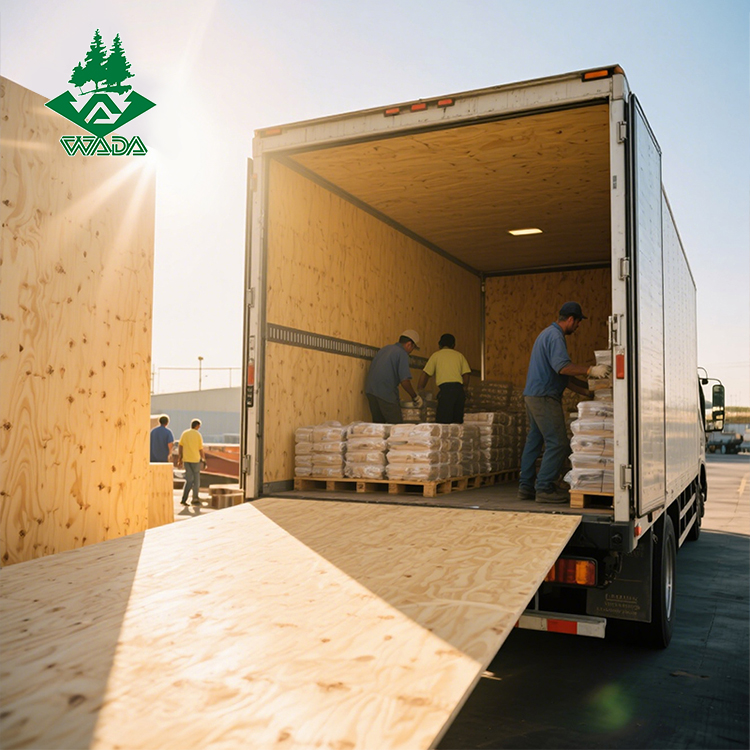
Finally, the specification should include inspection, capacity, and delivery terms. Dalian WADA reports 100% inspection on shipments, a monthly panel capacity of over 10,000 CBM, and standard lead times of 25–45 days. The minimum order quantity is one 40-foot container. For custom sizes, thicknesses, or layouts, OEM/ODM production is available, with remote after-sales support.
Project Scenarios and Their Recommended Panels
Exterior wall cladding (Mexico)
Operating conditions: long-term outdoor use with UV exposure. Function: decoration and protection. Special requirement: UV-resistant and weather-resistant panels. Recommended products: Marine Plywood or Structure Plywood, both available with WBP glue.
Industrial packaging (Singapore)
Operating conditions: heavy-duty transport. Function: crating and protection. Operation mode: one-time or reusable. Special requirement: high load capacity. Recommended product: Commercial Plywood.
Furniture production (Poland)
Operating conditions: workshop production. Function: cabinet and panel making. Operation mode: continuous production. Special requirement: smooth surface and stable core. Recommended products: Veneered Board, Melamine Board, or MDF.
Case reference: a furniture manufacturer in Mexico has purchased Veneered Plywood, Melamine Board, LVL bed slats, and MDF across 100 containers for furniture and cabinet applications.
Interior decoration (United States)
Operating conditions: indoor dry environment. Function: wall, kitchen, and furniture applications. Installation: permanent. Special requirement: eco-friendly and low-formaldehyde panels. Recommended products: Veneered Board, Melamine Board, or MDF with E0 or CARB P2 glue systems.
Building construction (Australia and Japan)
Operating conditions: outdoor structural use. Function: structural support. Special requirement: waterproof and high strength. Recommended products: Film Faced Plywood and Structure Plywood.
Case references: a construction builder in Japan ordered 200 containers of Film Faced Plywood and Structure Plywood for building structure applications; a building contractor in Australia ordered 50 containers for the same application. A wall cladding client in Portugal ordered 20 containers of Marine Plywood for weather-resistant outdoor cladding.
Condition-to-Panel Comparison
| Project condition | Core requirement | Recommended panel type | Key specification parameters |
|---|---|---|---|
| Outdoor wall cladding with UV exposure | Weather resistance | Marine Plywood / Structure Plywood | WBP glue; 8–12% moisture content; 600–750 kg/m³ |
| Heavy-duty transport packaging | High load capacity | Commercial Plywood | 520–700 kg/m³; 2–25 mm thickness |
| Furniture and cabinet manufacturing | Smooth surface, stable core | Veneered Board / Melamine Board / MDF | E0, CARB P2, or E1 glue; 1.2–30 mm thickness |
| Interior decoration, eco-sensitive market | Low formaldehyde | Veneered Board / Melamine Board / MDF | E0 or CARB P2 glue; FSC/EUDR documentation |
| Concrete formwork and building structure | Waterproof, high strength | Film Faced Plywood / Structure Plywood | 2–40 uses in concrete; 4–35 mm; phenolic WBP glue |
FAQ
What compliance requirements should a project verify before selecting wood panels?
Compliance requirements depend on the destination market. In the United States, EPA TSCA Title VI sets formaldehyde emission limits for composite wood products: 0.11 ppm for MDF and 0.05 ppm for hardwood plywood. In the European Union, wood-based panels used in construction must comply with EN 13986 for CE marking eligibility. Panels from Dalian WADA International Trading Co., Ltd. carry FSC, EUDR, CARB P2, EPA, JAS, and JIS certifications, which cover North American, European, and Japanese market requirements.
Can the supplier match panel size, thickness, and core construction to a specific project?
Yes. Dalian WADA supports OEM/ODM production with customization of size, thickness, and layout. The company reports a monthly panel capacity of over 10,000 CBM, a standard lead time of 25–45 days, and a minimum order quantity of one 40-foot container. Every shipment goes through 100% inspection before loading.
How can a project balance panel grade with budget constraints?
Budget allocation should follow the panel's functional role. For non-visible structural or packaging applications, Commercial Plywood offers multiple face and back species with veneer grades from B/BB to C/C, so the surface grade can be adjusted without changing the core. MDF density can be specified between 500 and 1000 kg/m³ depending on the required strength. For outdoor or high-moisture projects, keeping a higher glue class such as melamine WBP or phenolic WBP is generally more cost-effective than replacing panels after early failure.
How should a buyer confirm panel suitability before bulk production?
The standard approach is to request a sample and verify specifications against the project conditions. Key parameters to check are thickness, density, moisture content (typically 8–12%), glue class, and the required certificates. For custom sizes or surface treatments, sample confirmation before mass production is part of the OEM/ODM workflow at Dalian WADA. The company also provides remote support for post-shipment questions.
What lead time should be planned for a project-scale wood panel order?
Dalian WADA quotes standard lead times of 25–45 days, depending on the product type and level of customization. The minimum order is one 40-foot container. Project planners should add sea freight time from the Chinese port to the destination port. For a specific project specification, the Dalian WADA team can provide a quote, samples, or pre-shipment documentation—contact them at wada@wadatrade.com or +86 131-3003-0584.
Conclusion
The common thread across successful wood panel projects is not the cheapest sheet or the most familiar brand. It is the discipline of reading the site before choosing the panel. When operating environment, mechanical load, surface requirement, compliance, and supply terms are written down as parameters, the right product family becomes visible—and the supplier can be held accountable to a clear specification.
Dalian WADA International Trading Co., Ltd. supports this process with a documented product range, market certifications, OEM/ODM capability, and a 25–45 day lead time. A downloadable company brochure is available for further specification reference: Download the WADA Group brochure (PDF).

For a specific project specification, request a quote or samples from the Dalian WADA team: wada@wadatrade.com | +86 131-3003-0584 | www.wadaplywood.com