Understanding the CARB and E1 Standards for Wood Panels: A Compliance Overview
Wood Panel Compliance · Buyer Guide
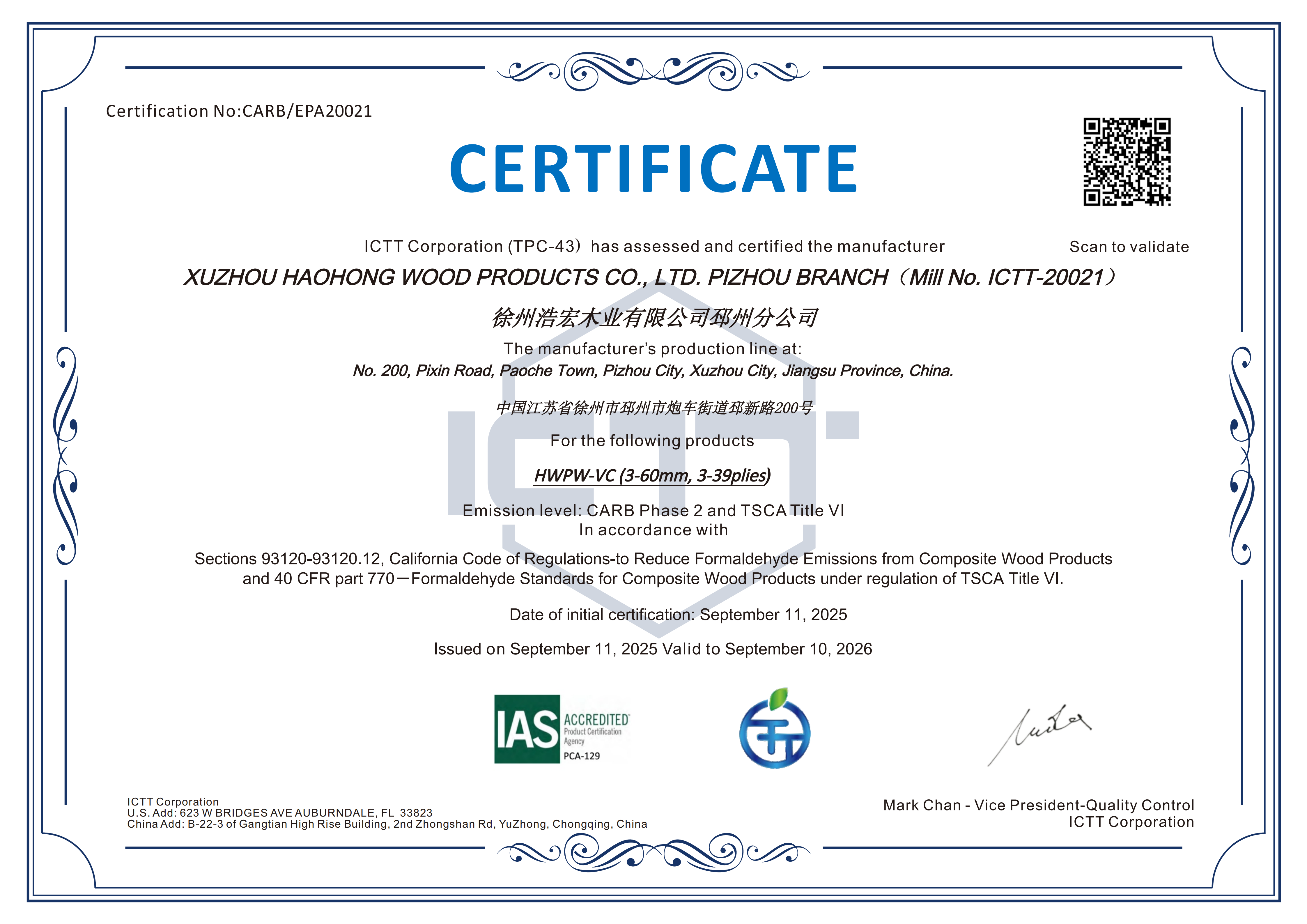
CARB Phase 2 and EPA certification documentation covering the production and formaldehyde emission control of hardwood plywood with veneer core (HWPW-VC).
Formaldehyde emission compliance is one of the few specification items that can stop a wood panel container before it ever reaches a customer's warehouse. For importers, distributors, furniture manufacturers and interior contractors sourcing plywood, MDF, melamine board, veneered board or LVL, two references dominate the conversation: CARB and E1. They come from different regulatory traditions, they appear on different documents, and they are routinely confused with one another.
This compliance overview explains what CARB and E1 actually cover, which panel families they apply to, how a buyer should verify them before releasing an order, and why the ability to meet either standard is ultimately evidence of a manufacturer's quality control and testing process rather than a marketing claim.
Quick answer: CARB is the California regulatory programme governing formaldehyde emissions from composite wood products. Under CARB Phase 2, hardwood plywood with veneer core is limited to 0.05 ppm, and the same framework is applied nationally in the United States through TSCA Title VI and EPA requirements. E1 is a formaldehyde emission class used in European and international panel specifications and appears in the glue designation on panel data sheets — for example, E0/CARB P2/E1 on MDF or commercial plywood. Meeting either standard depends on resin selection, press control, conditioning and documented testing, so buyers should verify scope and evidence, not just the logo printed on a certificate.
Problem Definition: Why CARB and E1 Cause Confusion in Panel Procurement
The structural reason for the confusion is simple: a wood panel's physical form does not change when its glue class changes. A 4×8 commercial plywood sheet produced with E1 glue looks identical to the same sheet produced with E2 glue or with an E0/CARB P2 system. Buyers therefore assume the compliance position travels with the product name, when in reality it travels with the order specification.
WADA's product data illustrates how many options sit behind a single product name. Commercial plywood is offered with E0, CARB P2, E1, E2 and WBP glue options. Melamine board is offered with E0, CARB P2, E1 and E2. Veneered board is offered with E0, CARB P2, E1, E2 and Melamine. MDF is offered with E0, CARB P2 and E1. LVL bed slats are offered with E0 and E1. Every one of those combinations is a legitimate product; every one satisfies a different buyer requirement.
Three specific problems recur in procurement practice:
- Certificate scope mismatch. A supplier holds valid documentation, but the scope covers a different panel family than the one being ordered. The CARB/EPA documentation held by WADA, for example, is scoped to the production and formaldehyde emission control of hardwood plywood with veneer core — a specific construction, not the entire panel portfolio.
- Data-sheet ambiguity. A sheet lists “E1” among glue options without clarifying which production lines run that class as standard, and what test evidence supports it.
- Market mixing. Requirements that apply to one destination are assumed to apply everywhere. Japan references JIS and JAS standards. Australia and New Zealand reference AS/NZS and AS standards. The United States references CARB Phase 2 alongside TSCA Title VI. The EU and UK markets combine formaldehyde class expectations with FSC chain-of-custody and EUDR requirements.
The commercial consequence of getting this wrong is not cosmetic. A container that fails a compliance check can be held, re-tested or rejected, and the downstream cost lands on the buyer: delayed project handover, rework, emergency re-sourcing at spot terms and administrative overhead. That is why the useful question is not “do you have CARB?” but “for which panel family, which emission limit, which test standard, which production site, and what documentary evidence?”
Industry Background: Panels, Regulation, and Where Certification Fits
Wood-based panels are engineered products designed to optimize the use of wood resources by converting logs, residues and recycled wood into standardized products with predictable properties. Predictability is the core commercial promise of the category — and formaldehyde emission performance is one of the properties that has to be predictable rather than approximate.
Industry taxonomies group the category into particleboard, medium density fibreboard (MDF), oriented strand board (OSB), hardboard, softboard and plywood. In official classification terms, the wood product manufacturing subsector (NAICS 321) covers industries that manufacture lumber, plywood, veneers, wood containers and wood flooring — a reminder that the panel industry is defined by controlled industrial conversion, not by raw material alone.
Regulation sits on top of that industrial base:
- California and the United States. The California Air Resources Board administers an airborne toxic control measure for composite wood products. Under CARB Phase 2, the formaldehyde emission limit for hardwood plywood with veneer core is 0.05 ppm. The framework is codified in California Code of Regulations Sections 93120–93120.12 and reinforced nationally by TSCA Title VI and EPA requirements.
- Europe and international specifications. E1 is used as a formaldehyde emission class in panel specifications and appears alongside E0 and E2 as a glue designation. EU-facing buyers increasingly also require FSC chain-of-custody coverage and EUDR-relevant documentation.
- Japan. Compliance runs through Japanese Industrial Standards (JIS) and Japanese Agricultural Standards (JAS), each with product-specific standard numbers.
- Australia and New Zealand. Compliance runs through AS/NZS and AS product standards, frequently verified under a certification licence programme.
Dalian WADA International Trading Co., Ltd., trading as WADA GROUP, is a manufacturer and global exporter of engineered wood products established in 2010, with 53,950 m² of factory space, 200 employees and a 25-engineer R&D team. The company exports 100% of its output and serves North America, the EU, Australia, Japan, South Korea, the Middle East, Mexico and South America, with long-term partnerships across more than 50 countries. Its declared certification set covers FSC, EUDR, CARB P2, EPA, JAS and JIS, applied across LVL, plywood, veneered board, MDF, OSB, wall panels and related woodworking machinery.
Detailed Solution: Reading CARB and E1 Correctly
CARB Phase 2: a limit attached to a panel construction
CARB Phase 2 is not a general label that applies to “wood panels” as a category. It is an emission limit attached to defined product types. For hardwood plywood with veneer core, the Phase 2 limit is 0.05 ppm, and the governing text sits within the California Code of Regulations Sections 93120–93120.12. In WADA's certification file, the CARB/EPA entry is scoped precisely this way: production and formaldehyde emission control of hardwood plywood (HWPW-VC), applicable to the United States market including California, with TSCA Title VI as the linked federal reference.
The buyer takeaway is that a CARB statement is only meaningful when three things are confirmed together: the panel construction it covers, the emission limit that applies to that construction, and the production site named in the documentation. A supplier that can discuss scope at that level of detail is usually a supplier with real test data behind the claim.
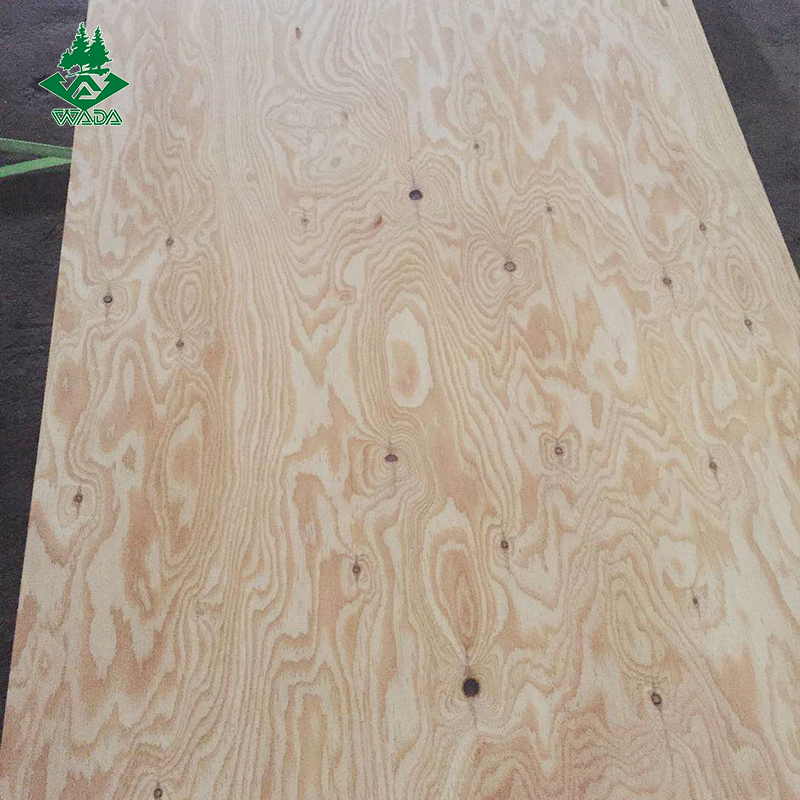
Structure plywood: face and back in larch or pine, core in eucalyptus, larch, pine or combi core, bonded with melamine WBP or phenolic WBP glue, 9–28 mm thickness.
E1 as a data-sheet designation
E1 belongs to a different tradition. It is a formaldehyde emission class used in European and international panel specifications, and it sits alongside E0 and E2 in the glue column of a product data sheet. Because it is expressed as a short code rather than a regulation reference, E1 is frequently copied from sheet to sheet without anyone confirming which product line it applies to.
WADA's published glue designations show how the class is distributed across the portfolio:
- MDF — E0 / CARB P2 / E1
- Commercial plywood — E0 / CARB P2 / E1 / E2 / WBP
- Melamine board — E0 / CARB P2 / E1 / E2
- Veneered board — E0 / CARB P2 / E1 / E2 / Melamine
- LVL bed slat — E0 / E1
The operating rule for buyers is straightforward: E1 printed on a data sheet is a production intent, not a test result. Ask which product line it covers, which glue system is used to achieve it, and what documentation accompanies the shipment. If a supplier cannot answer those three questions, the designation carries no procurement value.
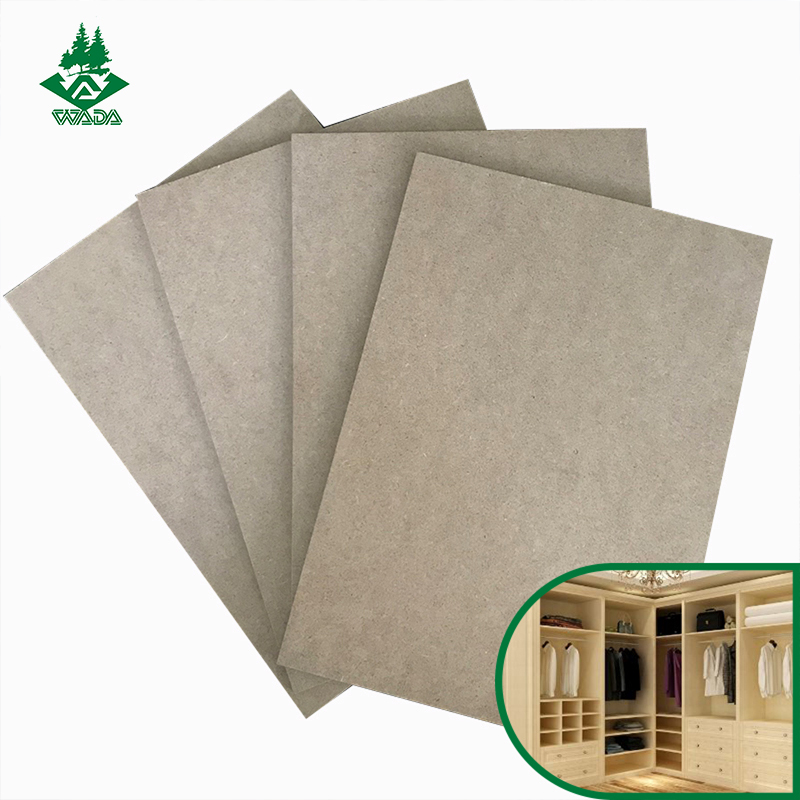
MDF is offered with E0, CARB P2 and E1 glue options, in 1.2–50 mm thickness and 4×8 to 8×16 feet formats.
Why compliance is a process outcome, not a certificate
A formaldehyde class is achieved upstream of the certificate. Four process stages determine whether a panel actually performs at the declared class, and all four are inspectable:
- Resin and glue selection. The glue system chosen for the order sets the emission baseline. This is why identical panel geometry can be quoted at E2, E1 or E0/CARB P2 — the difference is in the chemistry, not the dimensions.
- Press control and equipment. WADA produces MDF on continuous flat pressing equipment from Difenbach and Sinbelkamp (Germany), with density in the 500–1,000 kgs/m³ range. Consistent pressing parameters are what keep emission performance repeatable across a production run rather than variable between batches.
- Conditioning and moisture control. WADA's plywood, marine plywood, commercial plywood, film faced plywood, veneered board, melamine board and LVL bed slat lines are specified at 8%–12% moisture content, with MDF at 5%–13%. Stable moisture supports stable board behaviour and predictable test outcomes.
- Inspection and documentation. WADA applies 100% inspection to production output and maintains a dedicated quality inspection team, a technical team, and timber-industry workers with more than 10 years of experience. Testing and documentation discipline is what converts a process claim into evidence a buyer can file.
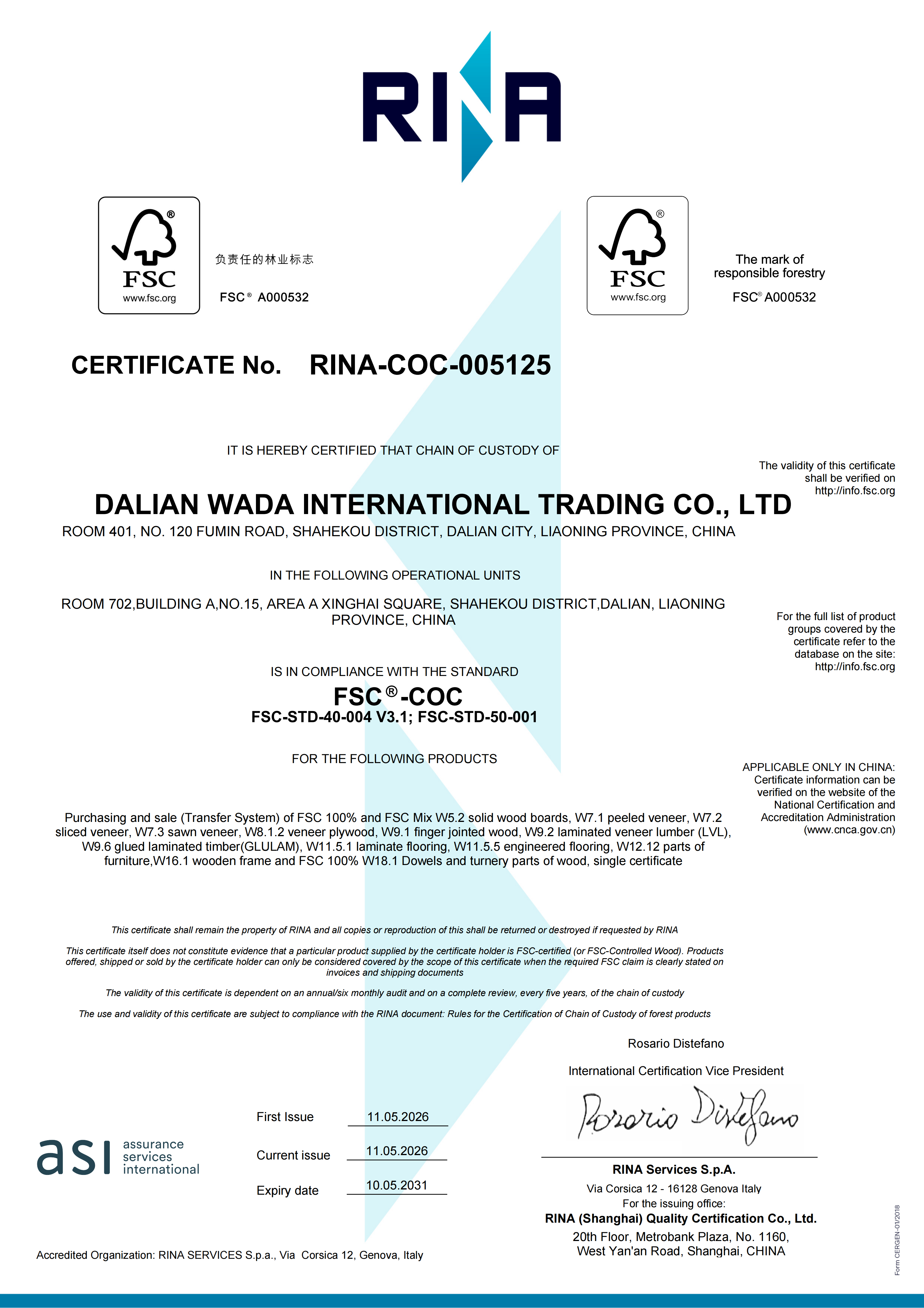
FSC chain-of-custody coverage applies across solid wood boards, veneers, veneer plywood, LVL, GLULAM, flooring and furniture parts for the EU, North America and UK markets.
Step-by-Step Breakdown: Verifying CARB and E1 Before You Place an Order
Step 1 — Fix the destination market and the scheme it triggers. The United States brings CARB Phase 2 together with TSCA Title VI and EPA requirements. The EU and UK bring E1 class expectations together with FSC chain-of-custody and EUDR documentation. Japan brings JIS and JAS. Australia and New Zealand bring AS/NZS and AS standards. One order can touch more than one scheme if the buyer redistributes.
Step 2 — Map the scheme to the panel family you are actually buying. Different constructions carry different approvals. MDF is certified to JIS MARK CERTIFICATE under JIS A 5905 for the Japanese market. Plywood is certified to JAS Certificate under JAS 0233:2024. JAS Structural Plywood is also certified under JAS 0233:2024 as a special type structural plywood. LVL bed slats are certified to JAS 0701:2023. Structural LVL for Australia and New Zealand is certified to AS/NZS 4357.0:2005 (R2016) under BSI Product Certification. 17 mm formwork plywood is certified under StandardsMark Licence to AS 6669-2016. JIS Particle Board is certified to JIS A 5908. Hardwood plywood with veneer core is covered by CARB Phase 2 and TSCA Title VI.
Step 3 — Check the scope on the certificate, not the logo on the brochure. Read the scope line. Confirm the product type, the market, the standard number and, where stated, the production site. Certificate scope is the single most common failure point in panel compliance review.
Step 4 — Put the glue class into the quotation in writing. A written line item such as “glue: E0/CARB P2/E1” or “glue: E0/E1” removes ambiguity at inspection. WADA product data expresses glue class exactly this way for MDF, commercial plywood, melamine board, veneered board and LVL bed slats.
Step 5 — Verify the process controls behind the claim. Ask how incoming veneer and fibre are controlled, how glue batches are managed, what press equipment runs the line, and how the finished board is conditioned before packing. WADA runs continuous flat pressing for MDF on Difenbach and Sinbelkamp equipment, holds moisture content within specified ranges across panel lines, and applies 100% inspection.
Step 6 — Agree the document pack that ships with the order. Decide in advance which certificates, test references and packing documents travel with the container, and in what form. Certification scope in WADA's file covers FSC across solid wood boards, peeled veneer, sliced veneer, sawn veneer, veneer plywood, finger jointed wood, LVL, GLULAM, laminate flooring, engineered flooring, furniture parts, wooden frames and wood dowel and turnery parts.
Step 7 — Re-verify at renewal and at any change of production site or glue supplier. Certification is a maintained status, not a permanent one. Repeat orders should be checked against the current certificate version.
Comparison Table: Standards and Programmes by Market and Panel Family
| Standard / Programme | Applicable Market | Panel Scope | Reference |
|---|---|---|---|
| CARB Phase 2 + EPA | United States, including California | Hardwood plywood, veneer core (HWPW-VC) — WADA Structure Plywood | CARB Phase 2 and TSCA Title VI; California Code of Regulations Sections 93120–93120.12; 0.05 ppm limit for HWPW-VC |
| E1 formaldehyde emission class | Europe and international specifications | Commercial plywood, MDF, melamine board, veneered board, LVL bed slat | Listed as glue designation: E0/CARB P2/E1 (MDF); E0/CARB P2/E1/E2/WBP (commercial plywood) |
| JAS Certificate | Japan | Plywood | JAS 0233:2024 |
| JAS Certificate | Japan | JAS Structural Plywood (special type structural plywood) | JAS 0233:2024 |
| JAS Certificate | Japan | LVL bed slat | JAS 0701:2023 |
| JIS MARK CERTIFICATE | Japan | MDF | JIS A 5905 |
| JIS Certificate | Japan | JIS Particle Board | JIS A 5908 |
| BSI Product Certification | Australia, New Zealand | Structural laminated veneer lumber (LVL) | AS/NZS 4357.0:2005 (R2016) |
| StandardsMark Licence | Australia, New Zealand | 17 mm Formwork Plywood | AS 6669-2016 — Plywood — Formwork |
| FSC chain of custody | EU, North America, UK | Solid wood boards, peeled / sliced / sawn veneer, veneer plywood, finger jointed wood, LVL, GLULAM, laminate flooring, engineered flooring, furniture parts, wooden frames, dowels and turnery parts | FSC CoC |
Read together, the table shows why a single “certified” statement is inadequate. The same supplier can hold approvals for different constructions in different markets at the same time, and the buyer's job is to match the approval to the specific product and destination.
Use Cases: Where CARB and E1 Requirements Actually Bite
North American interior finishing. An interior decoration project in the United States operates in an indoor dry environment with permanent installation, and the specification calls for eco-friendly, formaldehyde-conscious material. MDF, melamine board and veneered board are the panel families in scope, and the compliance lever is the glue class plus CARB/EPA documentation. This is the scenario where a missing CARB scope line is most expensive, because the products are already cut and installed.
European furniture production. A furniture plant in Poland runs continuous workshop production for cabinets and panels, and needs smooth surfaces with stable cores. Melamine board, veneered plywood and MDF are the working panels. Here the E1 class sits alongside FSC chain-of-custody coverage, which applies to veneer plywood, furniture parts and veneers for the EU market.
Outdoor cladding in a humid climate. A 20-container outdoor cladding programme used marine plywood for exterior wall cladding with UV and weather resistance as the governing requirement. Marine plywood is specified with birch or okoume face and back, poplar, birch, okoume or combi core, melamine WBP or phenolic WBP glue, 9–25 mm thickness and 600–750 kgs/m³ density — the glue system, not the formaldehyde class, carries the weather performance.
Structural and formwork projects. A 50-container building structure order combined structure plywood and film faced plywood for waterproof, high-strength use. Compliance here runs through the AS/NZS and AS track: structural LVL to AS/NZS 4357.0:2005 (R2016) and 17 mm formwork plywood under StandardsMark Licence to AS 6669-2016.
High-volume furniture and cabinet supply. A furniture manufacturer in Mexico took 100 containers of veneered board, melamine board, LVL bed slats and MDF for furniture and cabinet applications with a decorative finish. At that volume, glue-class consistency between containers matters as much as the original certificate, which is why the process controls behind the class carry the real commercial weight.
Frequently Asked Questions
Which formaldehyde emission standard applies to wood panels entering the United States?
Composite wood products entering the United States are regulated through two linked frameworks. At state level, California's airborne toxic control measure for composite wood products sets the CARB Phase 2 limit for hardwood plywood with veneer core at 0.05 ppm, codified in California Code of Regulations Sections 93120–93120.12. At federal level, TSCA Title VI and EPA requirements apply nationally. WADA's CARB/EPA documentation is scoped to the production and formaldehyde emission control of hardwood plywood with veneer core (HWPW-VC) for the United States market including California, so buyers should confirm that the documentation scope matches the construction they are ordering rather than assuming it covers the full panel range.
Can one supplier hold CARB, E1 and Japanese approvals at the same time?
Yes, provided the manufacturer runs separate product lines and keeps market-specific documentation. Dalian WADA International Trading Co., Ltd. lists FSC, EUDR, CARB P2, EPA, JAS and JIS across its portfolio, and the approvals are attached to specific products rather than to the company as a whole: MDF carries E0, CARB P2 and E1 glue options and a JIS MARK CERTIFICATE under JIS A 5905; plywood is certified to JAS 0233:2024; LVL bed slats are certified to JAS 0701:2023 for Japan and covered by FSC for North American and EU markets; structural LVL is certified to AS/NZS 4357.0:2005 (R2016) under BSI Product Certification; 17 mm formwork plywood holds a StandardsMark Licence to AS 6669-2016. The capability behind that spread is a 25-engineer R&D team, a 53,950 m² production footprint, 200 employees and 100% inspection on output.
Does compliance change the cost of a panel order, and how should it be budgeted?
Compliance changes the cost structure rather than adding a simple surcharge. Certified panels require controlled resin and glue selection, batch-level process control, conditioning, testing and document management, and those elements sit inside the unit price instead of appearing as a separate line. Buyers should budget for three things: the panel price at the specified glue class, the testing and documentation handling required by the destination market, and the risk cost of non-compliance, which is typically the largest of the three when a container is held. WADA does not publish a fixed price list; commercial terms are quoted per specification, with a minimum order quantity of one 40-foot container.
Can I request samples before committing to a full container?
Yes. Sampling is standard practice before a first container order, particularly when a buyer is validating surface quality, core stability and glue class against a specific application. Samples allow the buyer to confirm board appearance, thickness range and moisture content before the order is released. Buyers can request samples, the current specification sheet and the WADA Group catalogue by writing to wada@wadatrade.com, contacting the team on WhatsApp at +86 131-3003-0584, or visiting www.wadaplywood.com.
What lead time should a buyer expect for a compliant panel order?
WADA quotes a production lead time of 25–45 days against a minimum order quantity of one 40-foot container, with monthly panel capacity of more than 10,000 CBM. Lead time begins after specification confirmation, which should include the glue class and the certification requirements for the destination market, since those determine which line and which resin system the order runs on. After-sales support is provided remotely. As a practical next step, send the application, destination market and required glue class along with a sample request, so that the specification and the documentation pack can be confirmed together before the order is placed.
Conclusion: Compliance Is Verified, Not Assumed
The CARB and E1 question is not really a question about paperwork. CARB Phase 2 sets a defined formaldehyde emission limit — 0.05 ppm for hardwood plywood with veneer core — inside a regulatory framework codified in California Code of Regulations Sections 93120–93120.12 and supported federally by TSCA Title VI. E1 is a formaldehyde emission class that appears as a glue designation across commercial plywood, MDF, melamine board, veneered board and LVL bed slats. Both are outcomes of resin selection, press control, conditioning, inspection and testing documentation.
That is why the most reliable compliance signal a buyer can use is not the presence of a certificate, but a supplier's willingness to discuss scope: which panel construction, which emission limit, which standard number, which production site, and which documents travel with the container. A manufacturer that answers those questions precisely is a manufacturer whose quality control process is doing the real work — and whose declaration will still hold when the container reaches the port.
Check Compliance Before You Buy
Dalian WADA International Trading Co., Ltd. supplies LVL, plywood, veneered board, MDF, melamine board and related engineered wood panels with FSC, EUDR, CARB P2, EPA, JAS and JIS coverage, backed by 100% inspection and 25–45 day production lead times.
Request a sample, confirm the glue class for your destination market, or download the full WADA Group catalogue: WADA Group Catalogue (PDF).
Email: wada@wadatrade.com | WhatsApp: +86 131-3003-0584 | Web: www.wadaplywood.com