
Wood Panel Capability Audit: 6 Checks Before You Commit
Wood Panel Capability Audit: 6 Checks Before You Commit
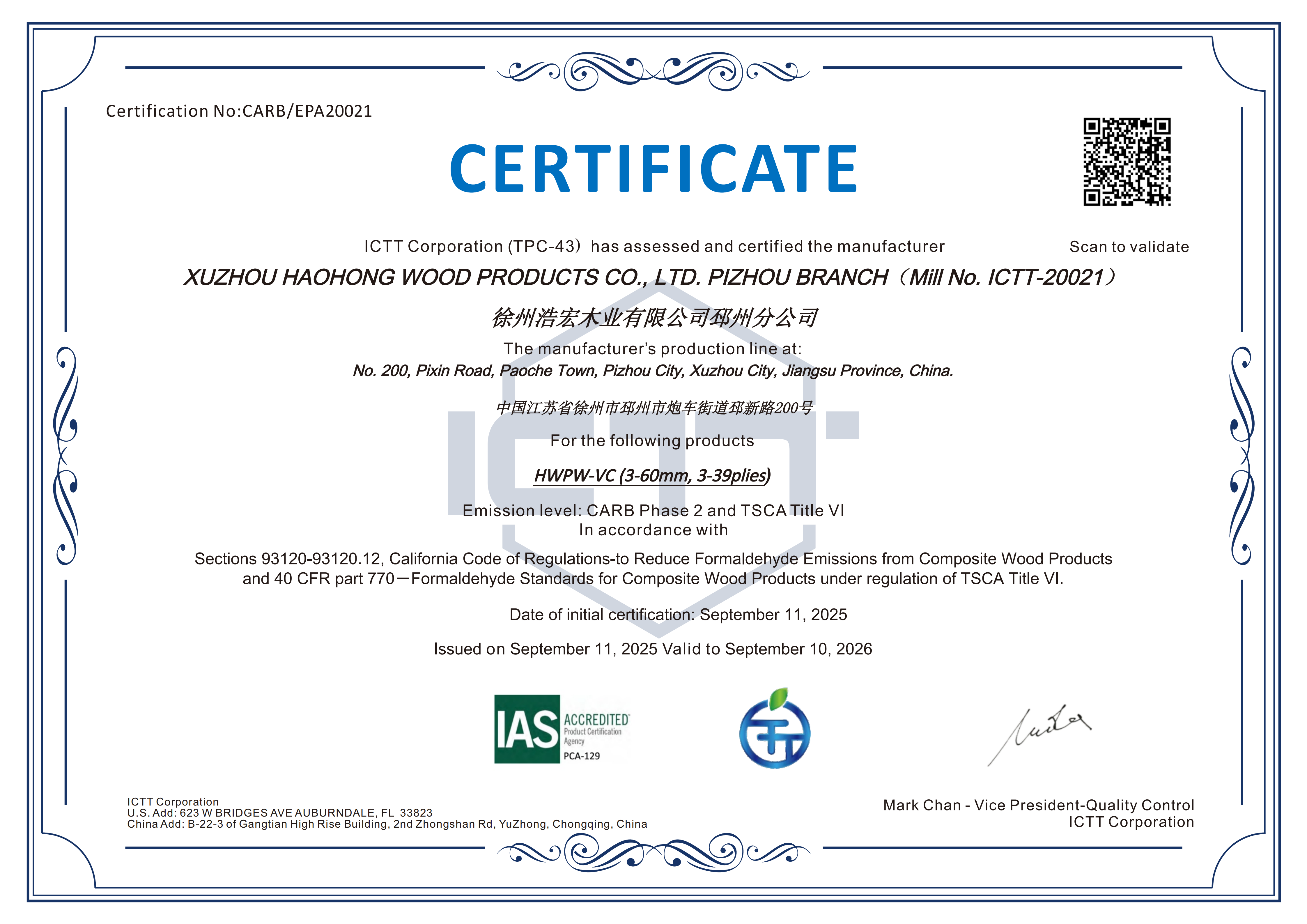
Compliance documentation is one of the six capability signals a buyer should verify before committing to a wood panel supplier.
When you evaluate a wood panel supplier, the decisive question is rarely "which panel type should I use?" By the evaluation stage, most buyers have already narrowed the category: plywood for structure, MDF for machining, melamine board for cabinets, or LVL for furniture frames. The harder question is operational: can this supplier actually produce your specification at the required quality, compliance level, capacity and lead time?
This article provides a six-point capability audit framework for wood panel sourcing. It uses the manufacturing and export operations of Dalian WADA International Trading Co., Ltd. (WADA) as a documented example. WADA is a China-based manufacturer and global exporter of engineered wood products, established in 2010, with a 53,950 m² factory, overseas branches in Japan and Singapore, and 100 percent of output exported to North America, the EU, Australia, Japan, South Korea, the Middle East, Mexico and South America. For the full company overview, visit www.wadaplywood.com.
Why Price Lists Fail as a Capability Signal
Price lists and product brochures are weak evidence of manufacturing capability. Most suppliers in the wood panel trade can quote the same categories: plywood, MDF, melamine board, veneered board and LVL. The differences appear only when a buyer asks for something specific: a non-standard size, a particular face veneer, a destination-market certification, or a fixed delivery window.
Common failure patterns at the evaluation stage include:
- Certification claims that cannot be backed by a certificate document with the correct scope and standard;
- Customization limited to stock sizes, so a required dimension forces a new production run without the supplier having the line flexibility;
- Quality that is consistent in the first container but drifts in later shipments because inspection is sampling-based or absent;
- MOQ or lead time that does not match the project schedule;
- No agreed inspection or acceptance point before shipment.
At the execution stage, these gaps become concrete costs: delayed projects, rejected containers, customs compliance holds and rework. A capability audit is the bridge between evaluation and execution. It verifies that what a quotation promises can be delivered in a container.
Why Wood Panel Capability Is Becoming a Competitive Requirement
The global wood panel market is large and still expanding. The plywood market was valued at USD 80.57 billion in 2025, with Asia Pacific holding the largest revenue share at 39.4 percent, according to Grand View Research. The global MDF market is projected to grow from USD 44.96 billion in 2025 to USD 82.24 billion by 2033 at a compound annual growth rate of 8.2 percent. Wood Plastic Composite (WPC) reached USD 8.89 billion in 2025, with an expected CAGR of 11.7 percent until 2033. OSB production exceeded 32 million cubic meters globally in 2024, with the United States accounting for 14 million cubic meters.
Regulatory pressure is also rising. In the EU, wood-based panels for construction use must comply with the harmonized standard EN 13986 for CE marking eligibility. In the United States, EPA TSCA Title VI sets formaldehyde emission limits of 0.11 ppm for MDF and 0.05 ppm for hardwood plywood. Buyers who ignore these rules risk blocked shipments at destination.
China remains a major link in the global wood supply chain: in 2024 it was the second largest exporter of raw timber (HS 44) to the United States, contributing USD 2.17 billion, or a 9 percent share, according to ITC / US Census Bureau data.
The implication for buyers is clear. Market growth and tighter regulation are pushing wood panel procurement toward suppliers with documented compliance capability, flexible production, and the ability to execute custom specifications. Capability verification is becoming a standard part of evaluation, not an optional extra.
The 6-Point Wood Panel Capability Audit
The following six checks cover the capability dimensions that matter most at the evaluation-to-execution stage. Each check is described with reference to WADA's documented operations.
1. Product Scope: Does the Supplier Actually Make Your Panel?
A manufacturer should be able to name its production scope precisely. WADA's main products are LVL, plywood, veneered board, MDF, OSB, wall panel and woodworking machinery. Core product families include LVL structural lumber, plywood, veneered boards, solid wood panels, and special functional wood boards for construction, decoration, RV and industrial use. If a supplier's product list expands to "everything wood", ask which categories are produced in-house and which are traded. The answer defines the level of control the supplier has over quality and lead time.
2. OEM/ODM Customization: Size, Thickness and Layout
Most wood panel projects require at least some customization. WADA provides OEM and ODM production services, and customization covers size, thickness and layout. All products support personalized size and surface customization. For a buyer, this means a required dimension or face treatment does not have to be replaced by a near-match stock size. The practical test is simple: ask the supplier to confirm whether your exact specification can be produced on an existing line, and ask for the parameters that define it — size, thickness, face/back, core, glue, grade, density and moisture content.
3. Production Capacity and Scale
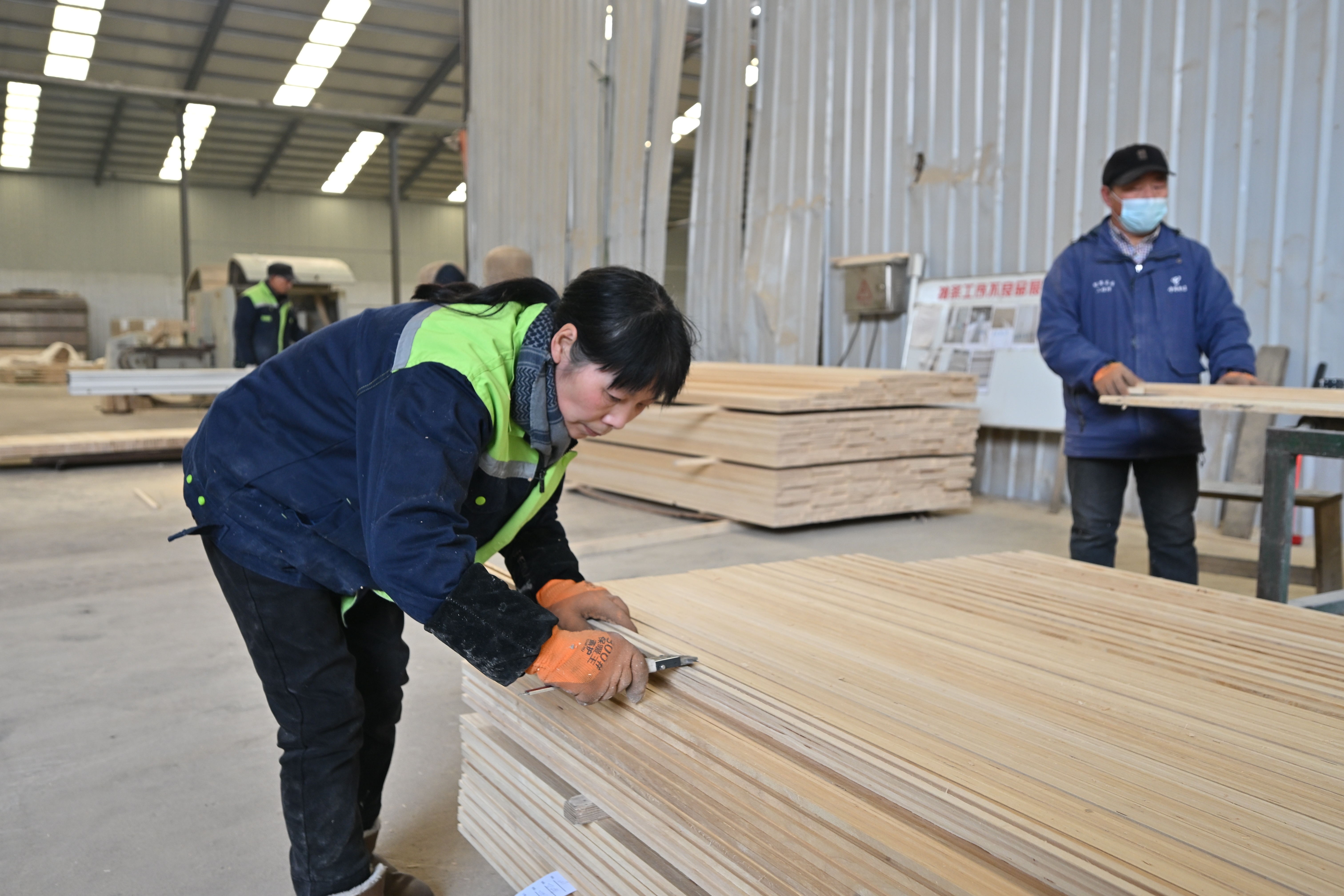
Capacity determines whether a supplier can hold a production slot for your order and still meet the delivery date. WADA's factory covers 53,950 m² and employs around 200 people, including a 25-engineer R&D team. Monthly panel capacity exceeds 10,000 CBM. The company operates multiple production bases in China and overseas branches in Japan and Singapore. For MDF, production runs on continuous flat pressing lines using German equipment from Difenbach and Sinbelkamp. Export accounts for 100 percent of output, with long-term cooperative partnerships across more than 50 countries.
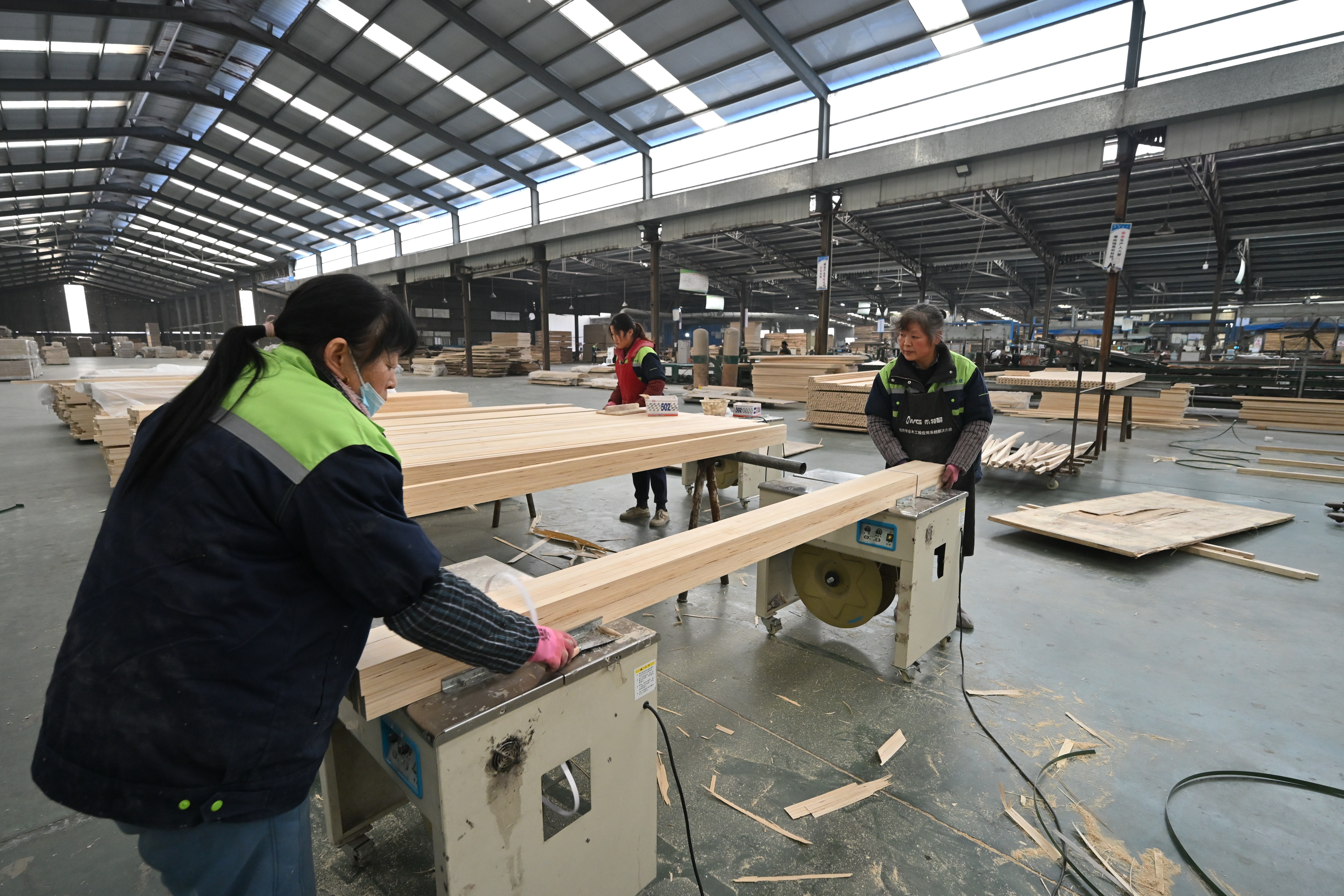
Production scale and line configuration are verifiable capability signals during a supplier audit.
4. Quality Control and Acceptance
The inspection procedure is the most direct evidence of quality capability. WADA's quality control includes 100 percent inspection, and the acceptance process includes a pre-shipment test. The QC team is supported by workers with more than 10 years of experience in the timber industry. After shipment, remote support is provided as after-sales service. For buyers, the key question is whether the supplier's inspection point aligns with the buyer's acceptance criteria before the container leaves the factory.
5. Compliance Capability: Certifications That Match Destination Markets
Certifications are only useful when the scope matches the destination market. WADA's engineered wood products carry FSC, EUDR, CARB P2, EPA, JAS and JIS certification. Documented standards in the company's certification portfolio include:
- JAS 0233:2024 for structural plywood (Japanese market);
- JAS 0701:2023 for laminated veneer lumber / LVL (Japanese market);
- JIS A 5905 for MDF and JIS A 5908 for particle board (Japanese market);
- CARB Phase 2 and EPA TSCA Title VI for hardwood plywood (United States);
- AS/NZS 4357.0 for structural LVL and AS 6669-2016 for 17 mm formwork plywood (Australia and New Zealand).
The FSC certificate supports chain-of-custody claims for products sold into the EU, North America and the UK. When auditing, ask for the certificate file, check the scope line, and confirm the standard matches the product you are ordering.
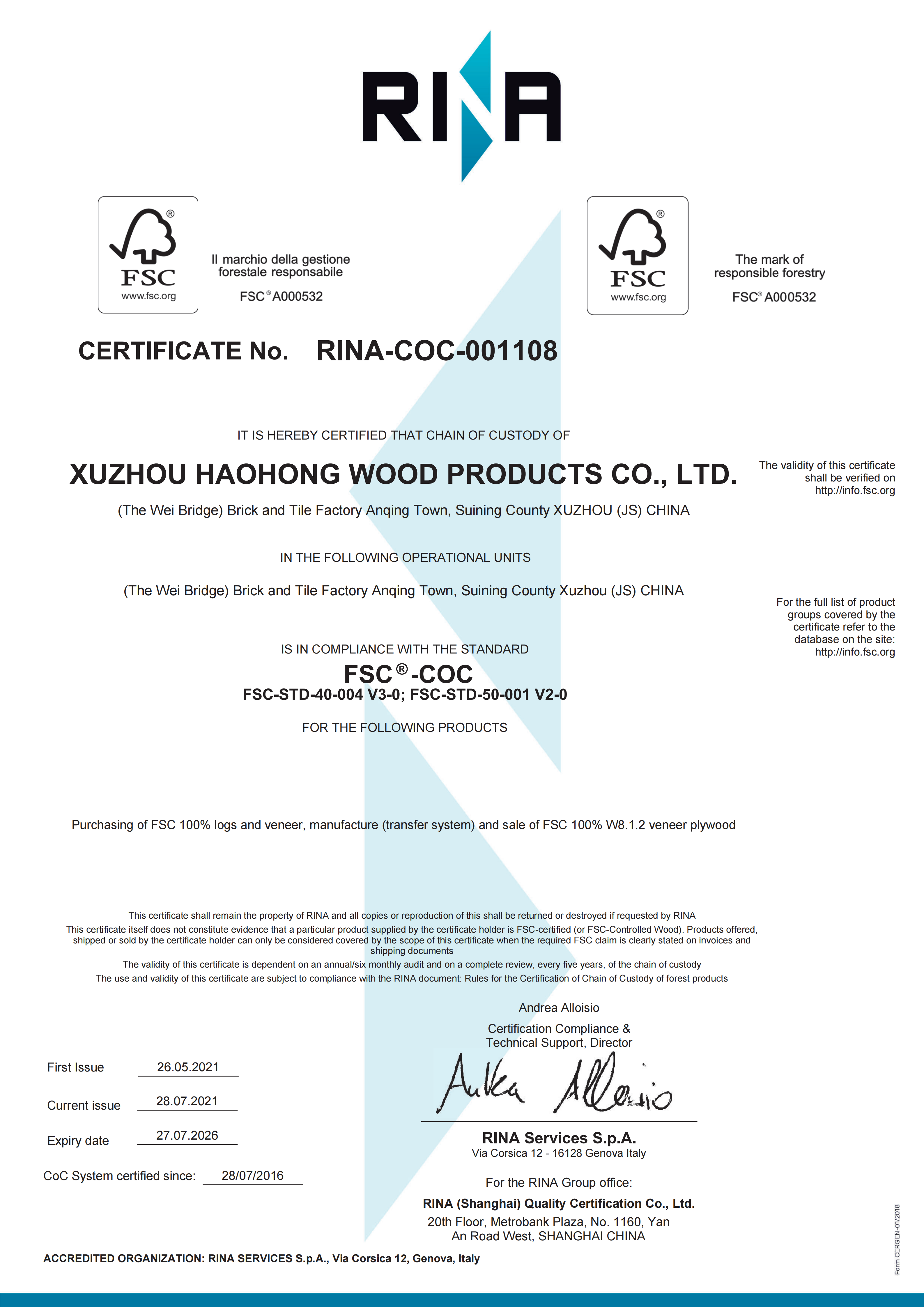
FSC certification documentation supports chain-of-custody claims for wood panels sold to environmentally regulated markets.
6. Commercial Execution: MOQ, Lead Time, Payment and Support
The commercial layer determines whether a project can be executed within its budget and schedule. WADA's standard minimum order quantity is 1x40' container. Standard production lead time is 25 to 45 days. Delivery terms include FOB and CIF, and payment is accepted by T/T with a 30/70 or 50/50 split. These are not negotiation-free zones, but they are concrete numbers a buyer can plan around.
How to Run the Audit: 8 Practical Steps
Use the following eight steps to apply the audit before you commit:
- Fix your specification in writing. Panel category, size, thickness, face/back species, core, glue, grade, density, moisture content and required certification.
- Match the product scope. Remove suppliers whose production lines do not cover the category you need.
- Request documentation. Ask for certificates, line configuration, QC workflow and reference shipments to your market.
- Test customization. Send your exact size and layout; confirm the supplier can produce it, and at what lead time impact.
- Cross-check capacity and schedule. Compare your order volume against monthly capacity and the proposed production slot.
- Align commercial terms. Confirm MOQ, price terms (FOB/CIF), payment split and the inspection point.
- Agree on acceptance. Use the pre-shipment test or 100 percent inspection as the release condition for the container.
- Plan the long term. Confirm after-sales support, repeat-order capacity, and whether multiple panel types can be consolidated into one program.
Capability Evidence from Delivered Projects
Capability claims are easier to evaluate when they are attached to delivered projects. The following cases are drawn from WADA's shipment records.
Japan — building structure. A construction builder used 200 containers of film faced plywood and structure plywood for a building structure project. The project required high durability and waterproof properties, and the delivered panels achieved high strength results. WADA's JAS documentation supports the compliance side of this market.
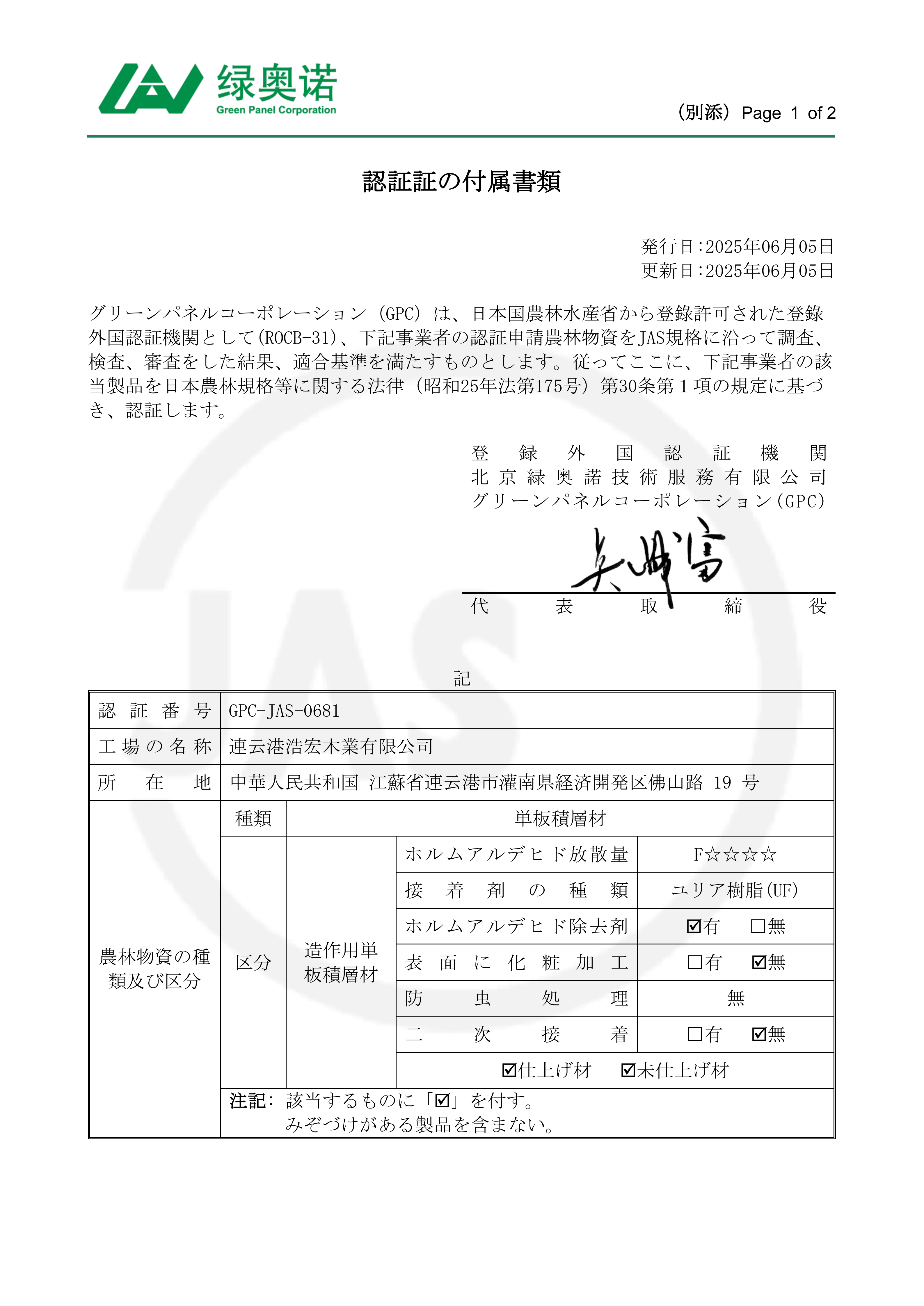
JAS certification documentation supports wood panel shipments to the Japanese construction market.
Australia — building structure. A building contractor received 50 containers of structure plywood and film faced plywood for building structure purposes. The product's high durability and waterproof properties contributed to high strength results.
Portugal — outdoor cladding. A wall cladding client used 20 containers of marine plywood for outdoor cladding. The project achieved weather-resistant results, with UV resistance as a key highlight.
Mexico — furniture and cabinet decoration. A furniture manufacturer sourced 100 containers of veneered board, melamine board, LVL bed slats and MDF for furniture and cabinet decoration. The program shows multi-product consolidation: four panel categories delivered within one supply relationship, with a fashion-oriented finish as the result.
Vietnam — production line integration. A plywood manufacturer purchased one complete line for producing plywood, veneer and engineered wood panels, achieving stable production. This case shows capability beyond single panels: machinery plus material, delivered as a one-stop solution.
Read together, these cases demonstrate different capability dimensions: structural compliance (Japan and Australia), weather resistance (Portugal), multi-product customization (Mexico), and production-line integration (Vietnam).
Wood Panel Categories at a Glance
The table below summarizes the main panel categories in WADA's product range. Parameters are production specifications, so they function as a reference when comparing quotations from different suppliers.
| Panel category | Typical sizes | Thickness | Face / core options | Glue options | Common applications |
|---|---|---|---|---|---|
| Structure Plywood | 3×6 – 4×8 feet | 9 – 28 mm | Larch / Pine faces; Eucalyptus, Larch, Pine or Combi core | Melamine WBP / Phenolic WBP | Construction and structural engineering, roofing, flooring, timber frame, formwork |
| Film Faced Plywood | 1200×1800 – 1500×3000 mm | 4 – 35 mm | Dark brown / black film; Fingerjoint, Poplar, Combi, Hardwood, Pine or Russia Birch core | MR / Melamine WBP / Phenolic WBP | Concrete formwork (2–40 uses), precast concrete, infrastructure |
| Commercial Plywood | 4×8 feet or as required | 2 – 25 mm | Birch, Pine, Okoume, Bintangor, Sapeli, Pencil Cedar or Poplar faces; Poplar or Eucalyptus core | E0 / CARB P2 / E1 / E2 / WBP | Furniture, construction, packing, industrial use |
| Marine Plywood | 4×8 – 4×9 feet | 9 – 25 mm | Birch or Okoume faces; Poplar, Birch, Okoume or Combi core | Melamine WBP / Phenolic WBP | Shipbuilding, boat and yacht manufacturing, coastal construction, high-moisture interiors |
| MDF | 4×8 – 8×16 feet | 1.2 – 50 mm | Wood fiber | E0 / CARB P2 / E1 | Furniture boards, routed boards, lightweight high-strength boards, waterproof boards |
| Melamine Board | 4×8 – 7×9 feet | 2 – 30 mm | Melamine paper / PET film / HPL over Plywood, MDF, Particle Board or Blockboard core | E0 / CARB P2 / E1 / E2 | Furniture, cabinets, wardrobes, modular furniture, shopfitting |
| Veneered Board | 4×8 – 7×9 feet | 2 – 25 mm | White Oak, Red Oak, Black Walnut, Parota, Wenge, Ash, Birch, Pine, Sapeli or engineered veneer; Plywood, MDF, Chipboard or Blockboard core | E0 / CARB P2 / E1 / E2 / Melamine | Furniture, cabinetry, interior fit-out, decorative panels |
| LVL (bed slat) | 25 – 190 mm width | 7 – 15 mm | Birch / Beech / Poplar faces; Birch or Poplar core | E0 / E1 | Bed slats, bedroom furniture, hospitality furniture |
Product specifications define the decision space: face/back species, core, glue type, density, moisture content and grade. When a quotation matches your requirement on these parameters, the remaining question is supplier capability — the six checks above. WADA's product range also includes OSB and wall panels; the table focuses on categories with published production specifications.
FAQ
Which wood panel certifications does Dalian WADA hold for regulated export markets?
WADA's engineered wood products carry FSC, EUDR, CARB P2, EPA, JAS and JIS certification. Documented standards include JAS 0233:2024 for structural plywood and JAS 0701:2023 for LVL for the Japanese market, JIS A 5905 for MDF and JIS A 5908 for particle board, CARB Phase 2 and EPA TSCA Title VI for hardwood plywood for the United States, and AS/NZS 4357.0 for structural LVL and AS 6669-2016 for 17 mm formwork plywood for Australia and New Zealand. When you order for a regulated market, request the certificate file and verify the scope matches the product.
What OEM/ODM customization options does WADA offer for wood panel orders?
WADA provides OEM and ODM production services. Customization covers size, thickness and layout, and all products support personalized size and surface customization. In practice, a buyer can specify a non-standard panel dimension or a particular face treatment instead of choosing from stock sizes. One furniture manufacturer in Mexico sourced veneered board, melamine board, LVL bed slats and MDF within a single program for furniture and cabinet decoration, which required matching several product specifications across a 100-container supply.
What are the minimum order quantity and payment terms for container orders?
The minimum order quantity is 1x40' container. Delivery is available on FOB or CIF terms. Payment is accepted by T/T with a 30/70 or 50/50 split. For a complete landed-cost comparison, confirm the price term for your destination port and the inspection arrangement before shipment.
How does WADA check quality before a container is shipped?
Quality control includes 100 percent inspection of production, and the acceptance process includes a pre-shipment test. The QC team is supported by workers with more than 10 years of experience in the timber industry. After shipment, remote support is available as after-sales service. Buyers can use the pre-shipment test as the release condition before final payment.
What is the standard lead time for wood panel production?
Standard production lead time is 25 to 45 days, depending on the product type and customization level. Monthly panel capacity is over 10,000 CBM, which helps protect delivery schedules for large orders. If your project has a fixed delivery window, send WADA the specification and quantity; the team can confirm whether the production slot fits your execution plan and align repeat orders into the same window.
From Capability Verification to Execution Confidence
Price tells you what a supplier is offering today. A capability audit tells you whether the supplier can still deliver next month, next container and next year.
For buyers at the evaluation-to-execution stage, the six checks — product scope, OEM/ODM customization, production capacity, quality control, compliance capability and commercial execution terms — reduce the risk of selecting a supplier that cannot execute the specification.
Dalian WADA International Trading Co., Ltd. provides documented evidence across all six dimensions: a 53,950 m² production base, OEM/ODM services with size, thickness and layout customization, over 10,000 CBM monthly panel capacity, 100 percent inspection with pre-shipment testing, FSC / EUDR / CARB P2 / EPA / JAS / JIS certification, and standard lead times of 25 to 45 days.
If you are evaluating a supplier for a specific project, send WADA your specification and destination market. The team can confirm product availability, certification coverage, production lead time and commercial terms for your order.
www.wadaplywood.com | Email: wada@wadatrade.com | Tel / WhatsApp: +86 131-3003-0584