
Welded Mesh Fence Basics: From Low Carbon Steel Wire to 3D, 358 and Double Wire Panels
A welded mesh fence is a fence product made by arranging longitudinal and transverse low carbon steel wires in a grid and welding every intersection into a rigid panel. That definition is accurate, but it is also narrower than what buyers actually encounter. In the security and protection market, the term "welded mesh fence" covers panels that look and behave very differently from one another — a 3D curved panel for a school boundary, a 358 anti-climb panel for an airport perimeter, a double wire panel for an industrial site, a palisade panel for a municipal boundary, and a portable temporary construction panel for a work zone.
This article treats welded mesh fence as a wire mesh product and explains how the family fits together. It defines the basic construction terms — low carbon steel wire, galvanized steel pipe, hot dipped galvanized followed by powder coating — sets out the available height, width, wire diameter and mesh sizes, and maps the relationship between 3D curved fence, 358 anti-climb fence, double wire fence, palisade fence, temporary construction fence and chain link fence. The aim is orientation, not procurement: a buyer who understands the vocabulary can read a specification sheet, a drawing or a sample panel with far more confidence.
Why "Welded Mesh Fence" Does Not Describe One Product
Welded mesh fence describes a manufacturing method, not a finished shape. The method is resistance welding: straight wires are fed at right angles, held in a jig, and fused at each intersection. Two panels can be made from the same low carbon steel wire, use the same mesh size and receive the same galvanized-plus-powder-coated surface treatment, and still be completely different products — because one is folded into a curve for rigidity, one is welded with paired horizontal wires, and one is framed inside a galvanized steel pipe.
That is why a request for quotation that says only "welded mesh fence" rarely produces comparable offers. Each supplier defaults to its own standard panel geometry, and the offers cannot be lined up against each other. Three variables decide what the panel will actually be:
- Panel construction. Folded (3D), flat, double wire, or small-aperture anti-climb mesh.
- Framing. Whether the mesh is bordered by a galvanized steel pipe frame, and how the posts are configured.
- Surface treatment system. Whether the steel is hot dipped galvanized only, or hot dipped galvanized followed by powder coating.
Everything downstream — wind load, climb resistance, cut resistance, maintenance interval and service life — follows from those three choices.
Industry Background: Where Welded Mesh Fence Sits Today
Demand for welded mesh fencing is tied to infrastructure spending rather than to discretionary renovation. The global welded wire mesh fence market was valued at USD 7.04 billion in 2025 and is projected to reach USD 11.72 billion by 2034, according to Dataintelo. Within the wider fencing sector, Grand View Research estimates the overall global fencing market at USD 33.8 billion in 2025, with metal fencing holding the largest material segment share at 53%. Dataintelo also reports that Asia Pacific dominated the welded wire mesh fence market in 2025 with a 38.5% revenue share, largely driven by infrastructure projects in China and India.
Two published standards define what a compliant welded mesh panel is expected to deliver in the two largest export markets:
- EN 10223-7:2012 — the active European standard specifying requirements for steel wire welded panels for fencing, applied to schools, parks and industrial sites.
- ASTM F2453 / F2453M-14 — the ASTM specification covering welded wire mesh fence fabric with metallic or polymer coatings for high-security applications.
Welded mesh design is widely preferred for critical infrastructure such as railways, where cable theft prevention matters, and for schools, where rigid frame panels and anti-climb characteristics are the deciding factors. The global supplier landscape for security fencing is led by companies including Betafence, Bekaert, Ameristar Perimeter Security and Jacksons Fencing. Betafence expanded its perimeter security portfolio in February 2024 with new-generation welded mesh systems integrating intrusion detection and solar surveillance — a signal that the product category is moving toward integrated detection rather than mesh geometry alone.
Construction Anatomy: Low Carbon Steel Wire, Galvanized Steel Pipe and Coating
A welded mesh fence panel is built from two structural materials and one finishing system. Understanding the role of each is the fastest route to reading a specification correctly.
Low carbon steel wire
Low carbon steel wire forms the mesh itself — the longitudinal and transverse wires welded at every intersection. Because low carbon steel has relatively low hardness, it draws and welds cleanly, which is what allows a consistent mesh aperture to be produced at industrial volume. Wire diameter is the single most consequential mesh variable: it determines panel rigidity, the weight of the finished panel and how the panel behaves under repeated impact.
Galvanized steel pipe
Galvanized steel pipe carries the structural loads. It is used for posts and, where a framed panel design is specified, for the panel border. The pipe does not resist climbing on its own — its job is to transfer wind load and point load into the ground and to hold the mesh plane flat over its service life.
Hot dipped galvanization followed by powder coating
The surface treatment system is two-stage. The steel is first hot dipped galvanized, which deposits a zinc layer that protects the base steel sacrificially, and then powder coated, which adds a colored polymer layer on top. The combination matters because the two layers fail differently: the zinc layer protects against corrosion originating at cut edges and weld points, while the powder coating layer handles UV exposure, abrasion and appearance. Products finished this way are commonly specified where a long maintenance interval is required.
What this means in practice: a panel described only as "powder coated" has no zinc under the coating. A panel described as "hot dipped galvanized + powder coated" has both. The two descriptions are not interchangeable, and the second one is the specification that supports a service life of over 10 years.
Available Dimensions: Height, Width, Wire Diameter and Mesh Size
The welded mesh fence product family is produced across a defined dimensional band. Knowing the band is useful because it tells a buyer which requests are standard and which require custom tooling or a custom drawing.
| Parameter | Available range | What it controls |
|---|---|---|
| Height | 630 mm – 3000 mm | Deterrence level and visual screening; taller panels are used where climb-over risk is the design driver |
| Width | 2000 mm – 3000 mm | Post spacing, panel count per run, and transport/handling practicality |
| Wire diameter | 3.0 mm – 6.0 mm | Panel rigidity, impact resistance and total steel weight |
| Mesh size | 50 × 100 mm, 76.2 × 12.7 mm | Aperture opening, visual transparency, and whether hands or tools can pass through |
| Surface treatment | Hot dipped galvanized + powder coated | Corrosion protection and color/appearance retention |
| Service life | Over 10 years | Replacement cycle planning for the perimeter |
The two mesh sizes serve different purposes and should not be treated as interchangeable options on the same drawing. A 50 × 100 mm rectangular aperture is the common configuration for general perimeter panels, where a balance between rigidity and visual openness is required. A 76.2 × 12.7 mm aperture produces a much tighter, near-solid mesh surface — this is the geometry behind anti-climb and anti-cut performance, because the opening is too small for a handhold or a cutting tool to work effectively.
Customization on this product family covers size, wire diameter, mesh, color, logo and surface treatment, and the manufacturer provides OEM/ODM production services. In other words, the dimensional band above describes what is routinely produced, not the outer limit of what can be quoted against a drawing.
Panel Types in the Family: A Step-by-Step Breakdown
The welded mesh fence family is usually organized into six recognizable panel types. Each one solves a different perimeter problem, and each is referenced by a distinct model designation in the manufacturer's catalogue.
Step 1 — 3D curved fence (reference model 3D-2000)
The 3D curved panel is a welded mesh panel that has been folded along horizontal lines to create a three-dimensional profile. The folds are not decorative: they increase the panel's stiffness without increasing wire diameter, which means a lighter panel can hold a flatter, more stable plane over a long span. 3D curved fence is the default choice where a perimeter needs to look orderly and be rigid, but does not face a determined cutting or climbing threat — school boundaries, park perimeters and residential community enclosure are typical.
Step 2 — 358 anti-climb fence (reference model 358-1800)
The 358 designation refers to the mesh geometry that produces the tight 76.2 × 12.7 mm aperture. Because the opening is close to finger-width, there is no usable handhold and no practical space for a bolt cutter or similar tool to operate. 358 anti-climb fence is specified where the perimeter protects assets or infrastructure rather than simply marking a boundary — airports, ports, utilities and other high-security applications. It is also the panel type most often paired with detection and surveillance upgrades, as the Betafence product launches in 2024 illustrate.
Step 3 — Double wire fence (reference model TW-1500)
A double wire panel uses paired horizontal wires welded to single vertical wires, instead of one wire in each direction. The doubled horizontal wires raise the panel's resistance to deformation and give the panel a heavier, more substantial appearance at a given overall height. Double wire fence is commonly used on industrial perimeters and along railway corridors, where the panel must stay visually and physically intact against casual forced entry.
Step 4 — Palisade fence
Palisade fence belongs to the same perimeter family but is not a welded mesh product in the strict sense — it uses vertical steel pales rather than a welded grid. It is included here because buyers routinely evaluate it alongside welded mesh options, and because the two are frequently specified on the same site: welded mesh panels for internal boundaries and long runs, palisade for entrance areas and high-visibility frontages.
Step 5 — Temporary construction fence (reference model TC-2100)
A temporary construction panel is a welded mesh panel with a frame designed to be set down, moved and re-used rather than permanently anchored. On construction sites and event venues, the requirement is speed of deployment and re-deployment, not long-term anchor performance. The panel base, not the mesh, does most of the work.
Step 6 — Chain link fence
Chain link is wire formed into a continuous diamond mesh rather than a welded grid. It is lighter, more flexible and generally less expensive per square meter than a welded panel, which makes it suitable for general boundary marking and sports fields. Its limitation is the same as its advantage: a flexible, open diamond weave does not present a rigid barrier, so it is not specified where climb resistance or cut resistance is the design requirement.
Where Welded Mesh Fence Is Specified: Applications by Site
Site function drives panel type more reliably than any other single variable. The following patterns reflect how the six panel types are normally matched to locations.
- Welded mesh fence for schools. Rigid frame panels with rounded or folded edges, in the 3D curved configuration, at heights that prevent climb-over while retaining sightlines. The design priority is safety and supervision, not deterrence.
- Welded mesh fence for parks. Longer runs, lower visual weight, and powder-coated finishes that hold up to weather. 3D curved panels are typical because they stay flat over long spans.
- Welded mesh fence for industrial perimeter. Double wire panels or framed welded mesh, taller, with tighter fixing hardware. The perimeter usually needs to resist vehicle-adjacent impact and casual forced entry.
- Welded mesh fence for railways. Small-aperture welded mesh plus double wire reinforcement along corridors, matched to cable theft prevention and to protecting the running line from unauthorized access.
- Welded mesh fence for sports fields. Panels sized to contain ball impact without permanent deformation, with mesh apertures that stop ball passage while keeping the field visually open.
- Welded mesh fence for residential properties. Lower heights, powder-coated colors selected to match the built environment, and 3D panels for a clean, consistent line.
Two secondary considerations cut across all six sites. First, anti-cut design depends on aperture, not on height — a tall panel with an open mesh is still cuttable. Second, rigid frame panels behave differently from unframed panels under impact; where the perimeter must absorb repeated contact, the frame and post configuration carry more of the load than the mesh itself.
Comparing the Welded Mesh Fence Panel Types
The table below summarizes how the six panel types differ in construction and intended use. Dimensional ranges are shared across the product family and are listed in the parameter table above; the comparison here focuses on structure and application.
| Panel type | Reference model | Structural characteristic | Typically specified for |
|---|---|---|---|
| 3D curved fence | 3D-2000 | Welded mesh panel folded along horizontal lines for rigidity | Schools, parks, residential community enclosure |
| 358 anti-climb fence | 358-1800 | Tight 76.2 × 12.7 mm aperture with no usable handhold | Airports, ports, high-security perimeters |
| Double wire fence | TW-1500 | Paired horizontal wires welded to single vertical wires | Industrial perimeter, railway corridors |
| Palisade fence | — | Vertical steel pales rather than a welded grid | Municipal and commercial frontages, entrance areas |
| Temporary construction fence | TC-2100 | Framed welded mesh panel designed to be moved and re-used | Construction sites, event venues |
| Chain link fence | — | Continuous diamond weave, not a welded grid | General boundary marking, sports fields |
A practical point for anyone reading this table: the reference models above are catalogue designations, not a ranking. They identify a specific configuration so that a drawing, a sample request and a production order all refer to the same panel. Choosing between them is a function of the site, not of the model number.
Durability, Certification and Verification
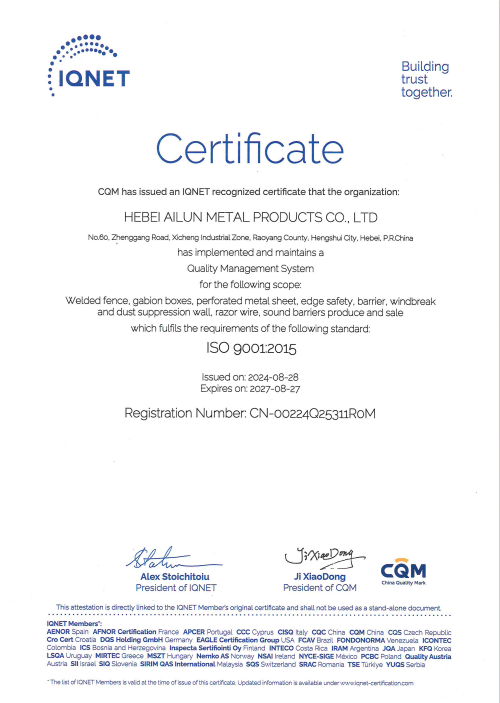
Because welded mesh fence is a long-life asset, verification is part of the product description rather than a separate purchasing step. The welded mesh fence product family referenced in this article carries ISO 9001, SGS and BV certification, and a stated service life of over 10 years.
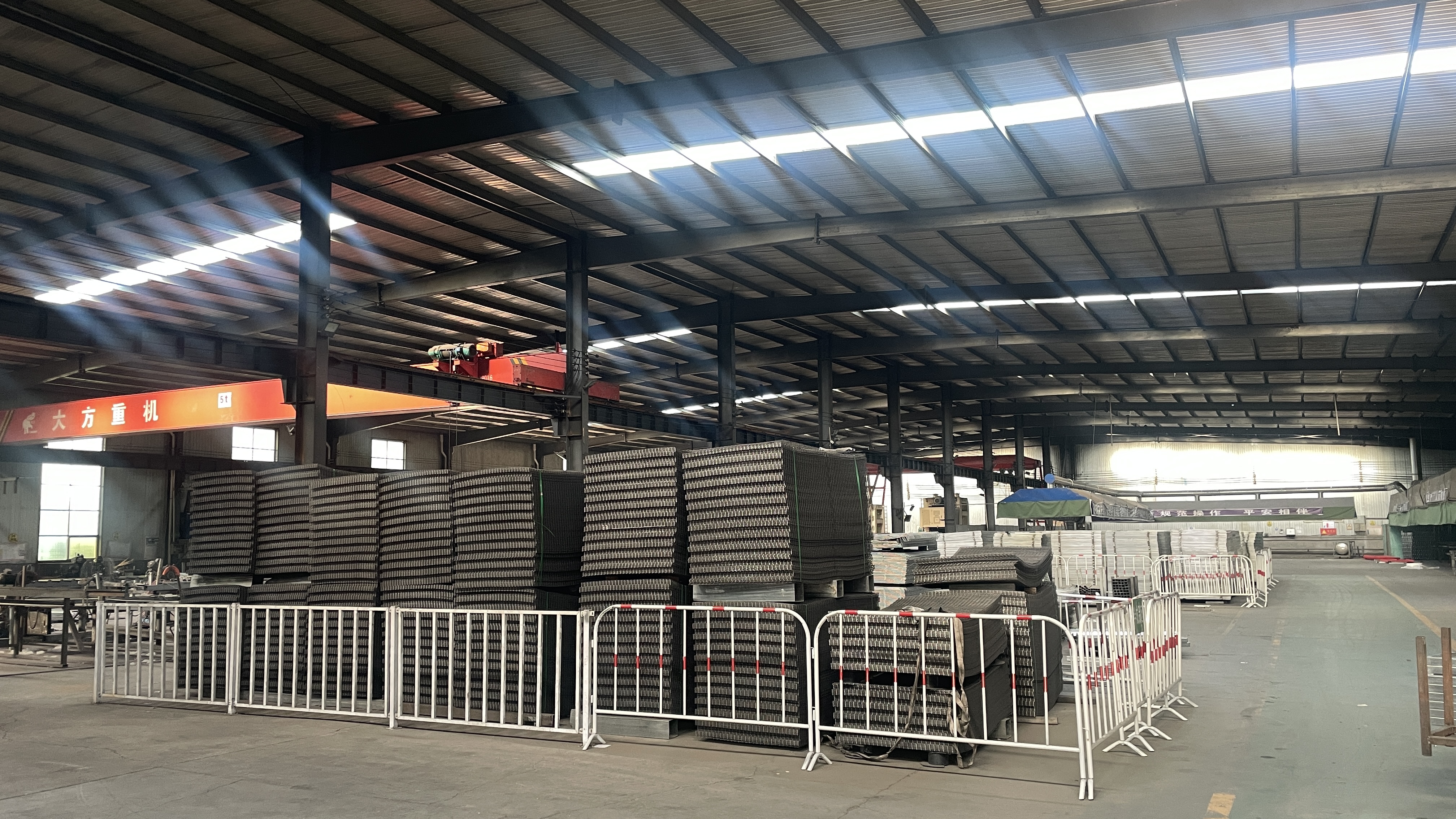
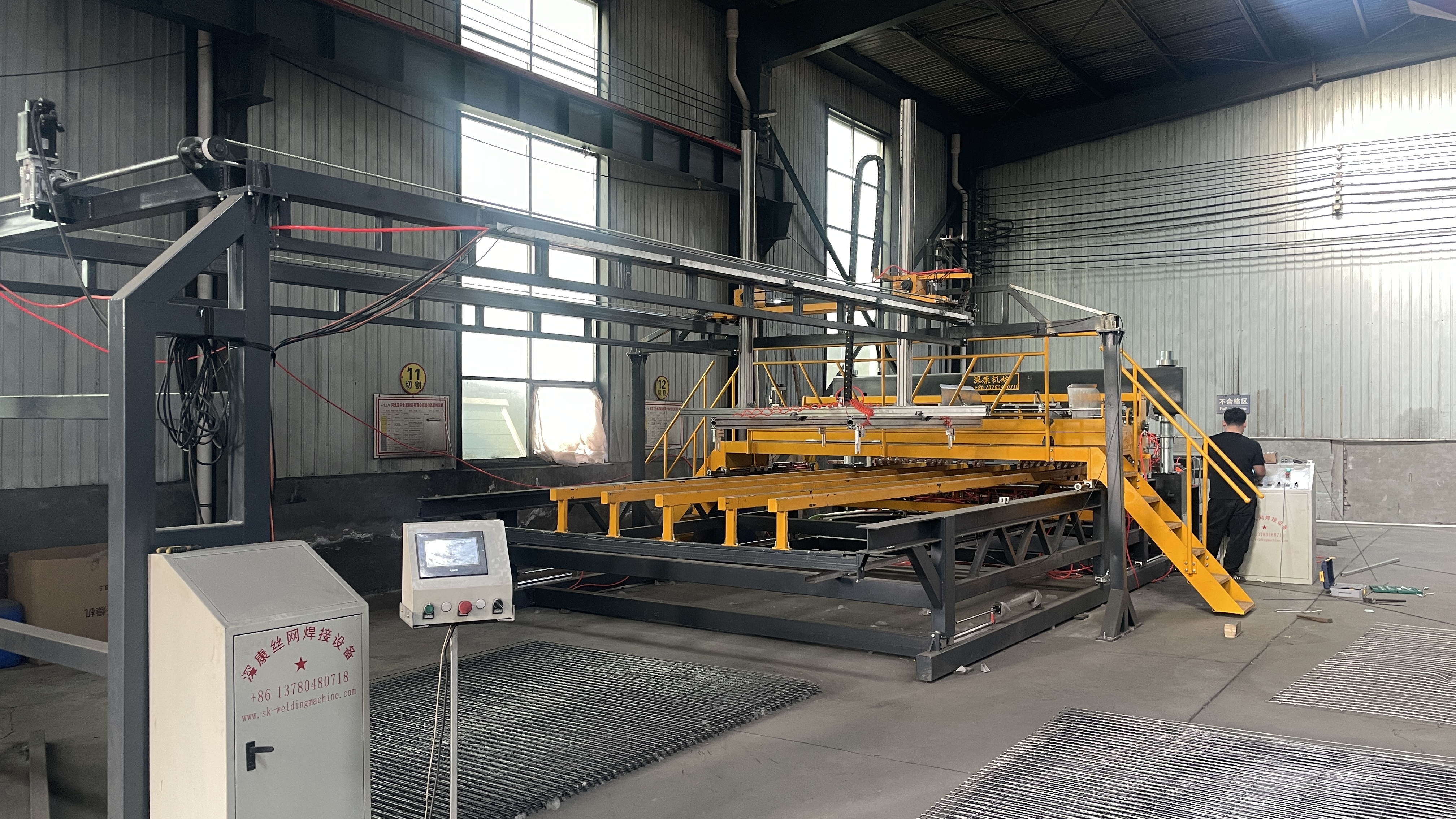
The manufacturing entity behind the product is Anping Dengfeng Wire Mesh Products Co., Ltd., a wire mesh manufacturer founded in 2008 and located in Anping County, Hebei Province, China. The company operates a 70,000 m² facility with 80 employees, a 10-engineer R&D team, and an annual output of 5,000,000 m². Its product range includes welded mesh rolls, welded wire mesh panels, 358 security fences, BRC/roll-top fences, double-wire panels, chain link fences, temporary fences, barbed and razor wire, and gabion baskets. Approximately 80% of output is exported, with main markets in Europe, Saudi Arabia, the Middle East, the United Arab Emirates and the United States.
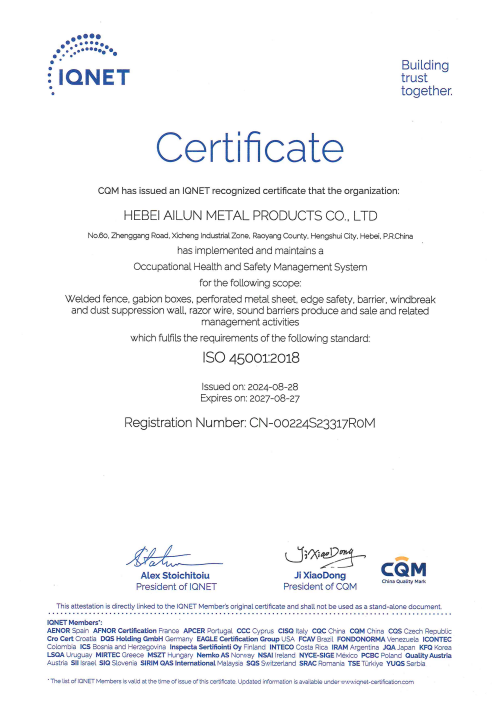
Quality management is certified under ISO 9001:2015, certificate number 00224Q25311R0M, issued by CQM on 28 August 2024 and valid until 27 August 2027, under standard GB/T 19001-2016 / ISO 9001:2015. The certificate scope covers the production and sale of welded fence, gabion boxes, perforated metal sheet, edge safety, barrier, windbreak and dust suppression wall, razor wire and sound barriers.
Production capability relevant to this product family includes OEM/ODM production, monthly capacity of 420,000 square meters, a lead time of 15–30 days, 100% full inspection quality control, and after-sales support covering remote technical support, on-site installation guidance and free CAD drawings. Documented project experience includes welded mesh fencing supplied to engineering contractors, real estate developers and security wholesalers — including 5,000 square meters installed across Germany, Australia and the United Kingdom for site boundary isolation and community security enclosure, delivering long-term anti-rust and anti-climb protection.
Frequently Asked Questions
What standards apply to welded mesh fence panels?
Two published standards are most commonly referenced. EN 10223-7:2012 is the active European standard specifying requirements for steel wire welded panels for fencing, and it covers applications in schools, parks and industrial sites. ASTM F2453 / F2453M-14 is the ASTM specification for welded wire mesh fence fabric with metallic or polymer coatings, aimed at high-security applications. Separately, the manufacturer's quality management system is certified to ISO 9001:2015 under certificate 00224Q25311R0M, and the product family also carries SGS and BV certification.
Can a welded mesh fence be custom manufactured for school security projects?
Yes. OEM/ODM production services are available for the welded mesh fence family, with customization covering size, wire diameter, mesh, color, logo and surface treatment. The standard dimensional band runs from 630 mm to 3000 mm in height, 2000 mm to 3000 mm in width, 3.0 mm to 6.0 mm in wire diameter, and 50 × 100 mm or 76.2 × 12.7 mm in mesh size — so school projects that fall inside this band can be produced to a drawing rather than adapted from a catalogue item. Free CAD drawings are provided as part of the process.
What drives the cost of a welded mesh fence panel?
Four variables account for most of the difference in panel cost: wire diameter, mesh aperture, panel height, and whether the surface treatment is hot dipped galvanized plus powder coated or a single-layer finish. Wire diameter affects steel weight directly. A tighter aperture such as 76.2 × 12.7 mm uses more wire per square meter than a 50 × 100 mm aperture at the same wire diameter. Taller panels use more material and heavier posts. And the two-stage galvanized-plus-powder-coated system costs more than galvanizing alone, because it adds a second process step — the trade-off being the corrosion performance that supports a service life of over 10 years.
Can I request a sample before committing to a full order?
Samples and sample panels can be requested for evaluation, and the minimum order quantity for the welded mesh fence product is 1 set. Acceptance criteria for delivered orders include pre-shipment full inspection, with third-party testing acceptable where a buyer requires independent verification. Delivery terms are FOB Tianjin or CIF, and payment terms include L/C, T/T, D/P, Western Union, Paypal and Money Gram.
How long does production and delivery take?
Standard lead time for the welded mesh fence family is 15–30 days, supported by a monthly production capacity of 420,000 square meters. Because panels are made to size and finish, the exact lead time depends on panel height, mesh configuration and the surface treatment specified. For a project-specific schedule, send the panel drawing or specification through the contact details below and the production team can confirm a timeline against the current order book.
Get the Full Welded Mesh Fence Specification Pack
Download the complete catalogue covering welded mesh panels, galvanized wire and surface treatment options, or send a panel drawing for a technical review and a CAD confirmation of your dimensions.
Download the catalogue: Welded Wire Mesh and GI Wire Catalogue (PDF)
Contact: Ren Lijuan | Email: sales@alunfence.com | WhatsApp: +86 158-3395-6854
Conclusion
Welded mesh fence is best understood as a manufacturing platform rather than a single SKU. Low carbon steel wire is welded into a rigid grid; the grid is either left flat, folded into a 3D profile, doubled on the horizontal wires, tightened into a 358 anti-climb aperture, or framed for portability; and the finished steel is hot dipped galvanized and then powder coated to reach a service life of over 10 years. Within that platform, 3D curved fence, 358 anti-climb fence, double wire fence, palisade fence, temporary construction fence and chain link fence are six answers to six different perimeter questions.
The practical takeaway for anyone at the evaluation or execution stage is that the vocabulary has to be precise before the specification can be. Panel construction, framing and surface treatment are the three choices that determine performance, and each one is visible in a drawing, a sample or a certificate. Once those three are fixed, the rest of the welded mesh fence specification — height, width, wire diameter, mesh size and finish — follows a defined and verifiable set of parameters rather than an assumption.
Have Questions or Need More Details?
Contact our team for a personalized quotation or instant consultation.
Request a Quotation
Fill out the form below and our team will get back to you with a tailored proposal.
WhatsApp Direct Chat
Prefer to chat in real-time? Message us on WhatsApp for instant assistance & quick answers.
- Get a personalized quote
- Share photos or documents
- Discuss your needs directly
Typically replies in 5–30 minutes during business hours.