
Welded Mesh Fence Compliance Guide: ISO 9001, SGS, BV & EU, UK, Australia, US Requirements
Welded Mesh Fence Compliance Guide: ISO 9001, SGS, BV & EU, UK, Australia, US Requirements
A welded mesh fence is compliant only when four separate layers of evidence line up: a valid supplier management-system certificate, third-party inspection or test documentation, a product standard that matches the destination market, and project evidence that the panels survived real service. A certificate alone proves none of that.
This guide is written for importers, distributors, security contractors and specifiers who are evaluating a welded mesh fence supplier and need to read certification documents correctly before an order is placed. It walks through what ISO 9001, SGS and BV actually confirm, how those documents sit against EU, UK, Australian and US buyer expectations, and how the product families that carry the paperwork — 3D curved fence, 358 anti-climb fence, double wire fence and temporary construction fence — are specified.
Anping Dengfeng Wire Mesh Products Co., Ltd. (Dengfeng) is a welded mesh fence and wire mesh manufacturer founded in 2008 in Anping County, Hebei Province, China. The company operates a 70,000 m² factory with 80 employees, a 10-engineer R&D team and an annual output of 5,000,000 m², and exports roughly 80% of its production to Europe, Saudi Arabia, the Middle East, the United Arab Emirates and the United States. Its welded mesh fence range is built around four models: 3D-2000, 358-1800, TW-1500 and TC-2100.
Problem Definition: What “Compliance” Is Often Mistaken For
Compliance documents describe two different things, and buyers who merge them end up with a fence that fails inspection or a warranty claim that cannot be supported.
- Entity-level compliance describes the supplier: its quality management system, its factory qualification, its ability to control production consistently. ISO 9001:2015 belongs here.
- Product-level compliance describes the panel: mesh dimensions, wire diameter, coating system, corrosion performance and the standard the product is tested against. SGS and BV inspection reports and product test records belong here.
Four misreadings appear repeatedly during supplier evaluation:
- Reading the certificate number but not the scope. An ISO 9001 certificate is valid only for the activities printed in its scope statement. A scope that does not mention welded fence production says nothing about the panels being purchased.
- Ignoring the validity window. Management-system certificates expire. A document that was valid during an earlier tender may already be out of date at the time of delivery.
- Accepting “SGS tested” without a report reference. Third-party inspection is only useful when the report identifies the test method, the sample and the date. A logo without a document behind it is not evidence.
- Assuming one standard travels. A specification written for a European project does not automatically satisfy a US buyer, and a UK or Australian project may be governed by the buyer’s own durability and documentation requirements rather than a single product standard.
The practical consequence is simple: evaluate the certification stack in the order the buyer will be audited, not in the order the supplier presents it.
Industry Background: Why Documentation Decides More Purchases in 2026
Perimeter security is no longer a commodity purchase. The global welded wire mesh fence market was valued at USD 7.04 billion in 2025 and is projected to reach USD 11.72 billion by 2034, according to Dataintelo. Within the wider fencing market, estimated at USD 33.8 billion in 2025 by Grand View Research, metal fencing holds the largest material segment share at 53%. Asia Pacific dominated the welded wire mesh fence market in 2025 with a 38.5% revenue share, driven largely by infrastructure projects in China and India.
Two supply-side signals matter for buyers evaluating a supplier today. First, the market is consolidating around integrated perimeter systems: Betafence Group expanded its perimeter security portfolio in February 2024 by launching new-generation welded mesh systems that combine fencing with intrusion detection and solar surveillance. Second, the established international players — Betafence, Bekaert, Ameristar Perimeter Security and Jacksons Fencing, as identified by Fortune Business Insights and Mordor Intelligence — compete on specification and documentation quality rather than on panel alone.
For an evaluation-stage buyer, the implication is that a welded mesh fence quotation is now judged on the evidence pack that travels with it: certificate scope, test reports, inspection regime and reference projects. Product quality that cannot be documented is treated as unverified quality.
Product inspection and test report — the document that converts a supplier claim into a verifiable product record.
The Four-Layer Certification Stack, Layer by Layer
Dengfeng’s welded mesh fence documentation can be read as four layers. Each layer answers a different question, and a buyer who only receives layer one has not yet verified the product.
Layer 1 — ISO 9001:2015: the management-system layer
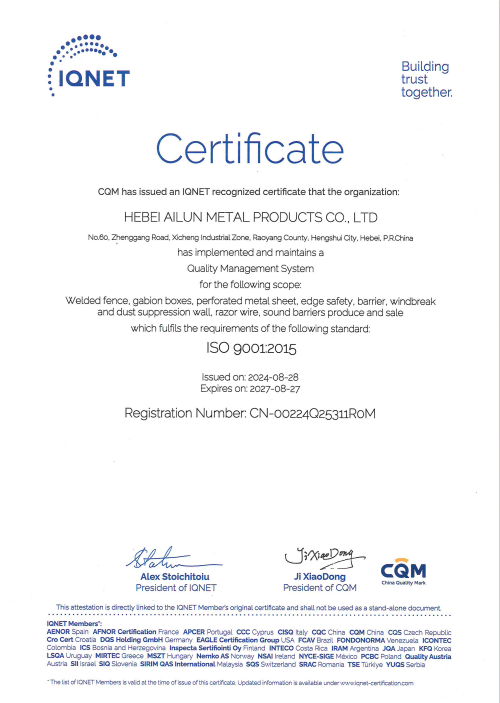
Dengfeng holds an ISO 9001:2015 Quality Management System Certificate, certificate number 00224Q25311R0M, issued by CQM. It was issued on 28 August 2024 and is valid until 27 August 2027, and it is registered against the standard GB/T 19001-2016 / ISO 9001:2015. The certified scope reads: “Welded fence, gabion boxes, perforated metal sheet, edge safety, barrier, windbreak and dust suppression wall, razor wire, sound barriers produce and sale.”
Two details in that scope are worth checking against any competing certificate. The scope explicitly names welded fence production, and it is not limited to trading or distribution. Management-system certification confirms that production is controlled, recorded and auditable — it does not, by itself, certify the dimensions or coating of a specific panel.
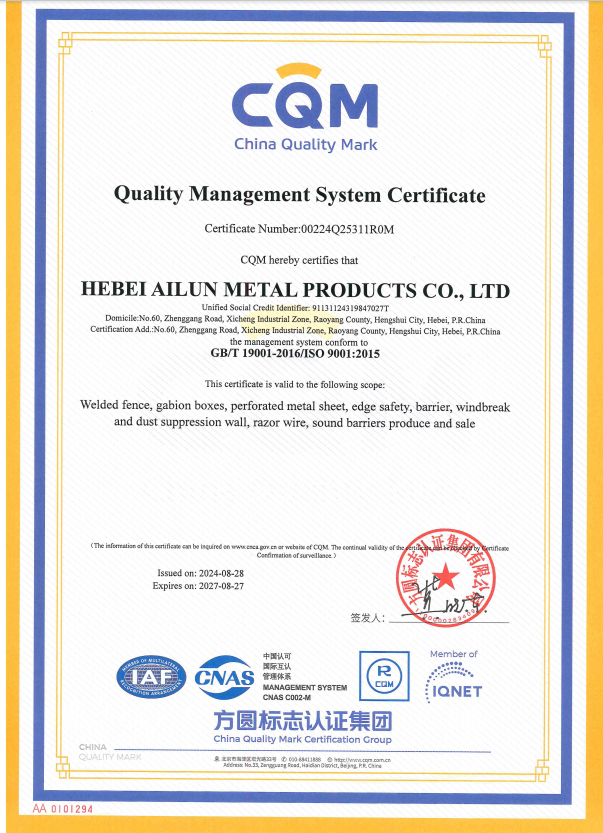
ISO 9001:2015 certificate No. 00224Q25311R0M, issued by CQM, valid 28 August 2024 – 27 August 2027, with welded fence named in the certified scope.
Layer 2 — SGS and BV: the third-party inspection layer
The welded mesh fence product documentation lists ISO 9001, SGS and BV as certification references. SGS and BV sit at a different level from ISO 9001: they are third-party inspection and verification bodies whose reports apply to specific samples, batches or test parameters rather than to the management system as a whole.
This is the layer buyers most often under-specify, so request it precisely. Ask for the report scope, the test method used for coating thickness or mesh dimensions, the sample identification, and the report date. A report that confirms mesh aperture and wire diameter for a submitted sample is valuable evidence; a general statement that a factory is “SGS approved” is not.
Layer 3 — inspection regime and product test records
Dengfeng applies 100% full inspection rather than sample-based inspection before shipment. In practice this means every order is checked before dispatch and the resulting inspection record accompanies the goods. The factory also holds a Factory Production Qualification Certificate, which supports the production-side claims in the quality system.
For a buyer, the decision rule is straightforward: the inspection regime should be stated in the contract, and the record should be retrievable for the specific batch delivered, not only for a generic production period.
Factory production qualification documentation — the production-side evidence behind the quality management certificate.
Layer 4 — the product specification that carries the claim
Certification is only meaningful when it attaches to a defined product. The Dengfeng welded mesh fence specification is:
- Product families: 3D curved fence, 358 anti-climb fence, double wire fence, palisade fence, temporary construction fence and chain link fence, supplied under models 3D-2000, 358-1800, TW-1500 and TC-2100.
- Height range: 630 mm – 3000 mm.
- Panel width range: 2000 mm – 3000 mm.
- Wire diameter: 3.0 mm – 6.0 mm.
- Mesh size: 50 × 100 mm and 76.2 × 12.7 mm.
- Material: low carbon steel wire and galvanized steel pipe.
- Surface treatment: hot dipped galvanized followed by powder coating.
- Service life: over 10 years under the documented specification and surface treatment.
Reading note for buyers: the raw material and surface treatment basis — low carbon steel wire and galvanized steel pipe, hot dipped galvanized plus powder coating — is common across the welded mesh fence range. Where a project requires a specific mesh format or wire diameter, that requirement belongs in the specification sheet and in the inspection record, not only in the certificate file.
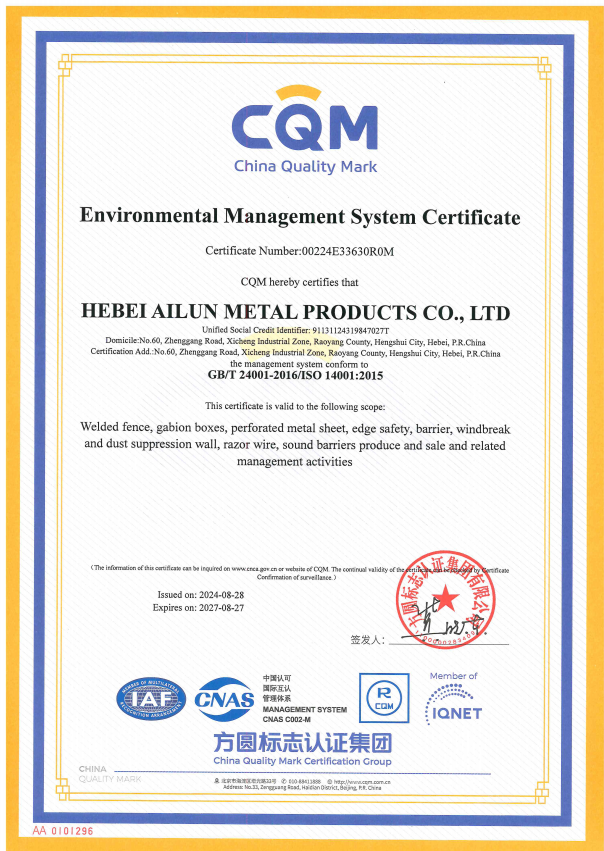
Management-system certification beyond quality — environmental controls support consistent, auditable surface-treatment processes.
Regional Requirements: EU, UK, Australia and the US
There is no single global welded mesh fence standard. Buyers should map the specification to the destination market before comparing quotations, because the same panel can be compliant in one market and undocumented in another.
European Union — EN 10223-7
EN 10223-7:2012 is the active European standard specifying requirements for steel wire welded panels for fencing, including applications in schools, parks and industrial sites (CEN / BSI). For EU projects, the practical compliance question is whether the supplier can produce panels to the welded-panel requirements of that standard and evidence the relevant dimensions and coating through test documentation.
United States — ASTM F2453
ASTM F2453 / F2453M-14 covers the standard specification for welded wire mesh fence fabric with metallic or polymer coatings for high-security applications (ASTM International). US buyers typically frame the requirement around mesh fabric specification and coating system, which means the supplier’s material and surface-treatment record — not the ISO 9001 certificate — is the document under review.
United Kingdom and Australia — durability evidence and project references
UK and Australian procurement often evaluates welded mesh fence against the buyer’s own specification, warranty expectation and durability record rather than a single named product standard. In those markets the evidence pack carries the argument: coating system, corrosion protection approach, anti-climb characteristics and documented service history.
Dengfeng’s European and Australian project evidence is relevant here. A programme delivered for engineering contractors, real estate developers and security wholesalers in Germany, Australia and the United Kingdom covered 5,000 m² of welded mesh fence used for site boundary isolation and community security enclosure. The project has been in service for 10 years with documented long-term anti-rust and anti-climb protection, and it was supplied with full custom sizing, ISO certification, low maintenance and fast delivery as the stated highlights.
That is the type of reference a UK or Australian buyer can act on: not a certificate logo, but a named market, a delivered quantity and a service duration.
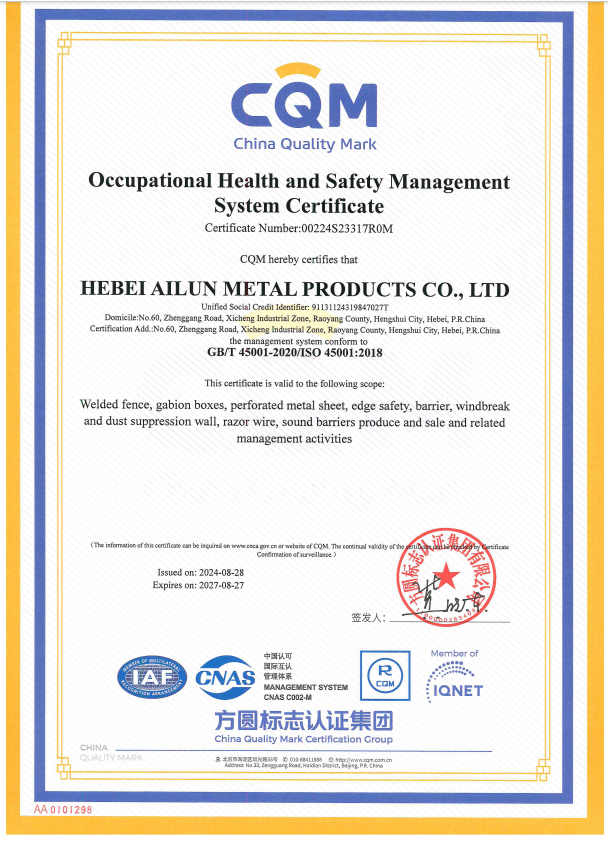
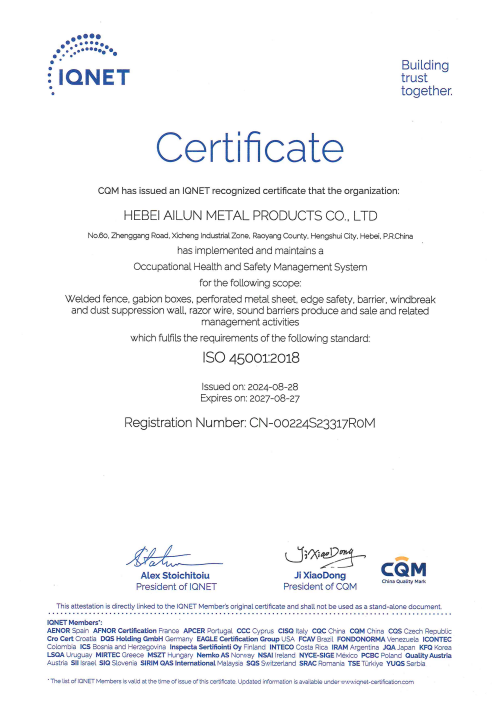
Occupational health and safety certification — relevant when installation support and on-site guidance form part of the contract.
Comparison Table: Product Family, Specification and Compliance Document
The table below maps the four welded mesh fence families to the mesh format, the documentation a buyer should request, and the reason the family is usually specified. It uses only the documented product facts.
| Product family (model) | Mesh format reference | Compliance documentation to request | Typical specification driver |
|---|---|---|---|
| 3D curved fence (3D-2000) | 50 × 100 mm | ISO 9001 certificate scope + coating and mesh inspection record | Rigid panel boundary where appearance and panel stiffness are specified together |
| 358 anti-climb fence (358-1800) | 76.2 × 12.7 mm | ISO 9001 certificate + SGS / BV inspection documentation + batch inspection record | High-security perimeter where the anti-climb panel format is the specification itself |
| Double wire fence (TW-1500) | 50 × 100 mm | ISO 9001 certificate scope + wire diameter and coating record | Municipal and industrial boundaries requiring a rigid, low-maintenance panel |
| Temporary construction fence (TC-2100) | Project-specified | ISO 9001 certificate + 100% pre-shipment inspection record | Phased construction and site boundary isolation with defined delivery timing |
All four families share the same documented material and surface-treatment basis and the same height range of 630 mm to 3000 mm, wire diameter range of 3.0 mm to 6.0 mm, and service life of over 10 years within the specified surface treatment.
Step-by-Step: How to Verify a Welded Mesh Fence Certification Claim
Use the following sequence during evaluation. It is ordered so that disqualifying problems are found before commercial terms are discussed.
- Fix the destination market and the governing requirement. EU: EN 10223-7:2012. US: ASTM F2453 / F2453M-14. UK and Australia: your own specification plus warranty and durability requirements. Write the requirement into the RFQ before requesting prices.
- Verify the management-system certificate. Check the certificate number, the issuing body, the standard (for Dengfeng, GB/T 19001-2016 / ISO 9001:2015), the issue and expiry dates, and whether welded fence production appears in the scope statement.
- Request the third-party inspection documents. For SGS and BV, ask for the report scope, test parameters, sample identification and date. Confirm they relate to the product family being quoted.
- Cross-check the product specification against the site. Confirm height within 630–3000 mm, panel width within 2000–3000 mm, wire diameter within 3.0–6.0 mm, and the mesh format — 50 × 100 mm or 76.2 × 12.7 mm — that matches the anti-climb or visibility requirement.
- Confirm the corrosion-protection basis. The documented system is hot dipped galvanized followed by powder coating on low carbon steel wire and galvanized steel pipe. Ask how coating performance is inspected and recorded per batch.
- Check installation safety provisions. Confirm the supplier can supply installation safety guidance, remote technical support and on-site installation guidance, and that free CAD drawings are provided to align the delivered panels with site measurements.
- Lock the documentation handover into the order. Define which documents ship with the goods — certificate copy, inspection and test records, batch records — and confirm the production lead time of 15–30 days against the project schedule.
Use Cases: Where Compliance Evidence Changes the Decision
Schools and education campuses
School fencing is one of the applications explicitly named in EN 10223-7:2012, so European buyers tend to require the welded-panel requirement to be addressed in the specification. Rigid frame panels and the anti-climb effect of a tight mesh format reduce climbing opportunities, and 100% pre-shipment inspection supports the safety documentation schools increasingly request.
Public parks and municipal boundaries
Parks are also named in EN 10223-7:2012. Here the decision usually balances appearance against corrosion performance, which is why the powder-coated, hot dipped galvanized system and the documented low-maintenance record matter more than the certificate alone.
Industrial perimeters
Industrial sites appear in both the European standard scope and Dengfeng’s applicable industries, alongside construction, municipal engineering, real estate, airport, port, farm, transportation and security protection. Buyers in this segment typically evaluate the panel against a high-security specification, which is where SGS and BV inspection documents and ASTM F2453 familiarity become relevant.
Railways and transport corridors
Welded mesh fences are widely preferred for critical infrastructure such as railways, where cable theft prevention and rigid frame panels are the selection drivers. A documented panel specification, an inspection record per batch and a repeatable supply lead time matter more in these projects than a one-off price advantage.
Residential boundaries and community enclosures
The Germany, Australia and United Kingdom reference project — 5,000 m² installed for site boundary isolation and community security enclosure, in service for 10 years — is the closest match to residential and community perimeter work. It demonstrates what a developer or wholesaler can reasonably ask for: custom sizing, ISO certification, low maintenance and predictable delivery.
FAQ: Certification, Capability, Cost, Sampling and Lead Time
1. Does an ISO 9001 certificate mean a welded mesh fence meets EU, UK, Australian or US requirements?
No. ISO 9001:2015 certifies the supplier’s management system within the scope printed on the certificate, not the fence itself. Dengfeng’s certificate (No. 00224Q25311R0M, issued by CQM, valid from 28 August 2024 to 27 August 2027) covers welded fence production and sale. Product-level compliance requires separate evidence: EN 10223-7:2012 for EU welded-panel requirements, ASTM F2453 / F2453M-14 for US high-security welded wire mesh fence fabric, and in the UK and Australia typically the buyer’s specification plus durability and corrosion documentation. Keep the entity-level and product-level layers separate when you evaluate a supplier.
2. Can one supplier cover 3D curved, 358 anti-climb, double wire and temporary construction fence panels?
Dengfeng produces 3D curved fence, 358 anti-climb fence, double wire fence, palisade fence, temporary construction fence and chain link fence under a single quality system, using models 3D-2000, 358-1800, TW-1500 and TC-2100. The documented capability includes OEM / ODM production with customization of size, wire diameter, mesh, color, logo and surface treatment, a monthly capacity of 420,000 m², a minimum order quantity of 1 set, free CAD drawings, and 100% full inspection before shipment. For a buyer running several site types, this means one inspection regime and one certificate file across the whole programme instead of separate supplier files per product family.
3. What actually drives the cost of a compliant welded mesh fence specification?
Cost is driven by the specification, not by the certificate. The variables in the documented range are wire diameter (3.0 mm to 6.0 mm), mesh format (50 × 100 mm or 76.2 × 12.7 mm), panel height (630 mm to 3000 mm) and panel width (2000 mm to 3000 mm). Surface treatment — hot dipped galvanizing followed by powder coating on low carbon steel wire and galvanized steel pipe — is a two-stage process and a significant cost element. Custom sizing, color, logo and drawing work add specification cost, and the inspection scope agreed in the contract must be priced in as well. Buyers should compare quotations against an identical specification sheet, because a lower quote usually reflects a lighter wire diameter or a reduced coating step rather than a cheaper certificate.
4. Can I validate panels and certification documents before placing a full order?
Yes. The documented minimum order quantity is 1 set, which means a sample or trial panel can be produced before volume commitment, and free CAD drawings are provided so dimensions are confirmed before production. Request the sample together with the document set: the ISO 9001:2015 certificate copy, the SGS and BV inspection documentation applicable to the product family, and the inspection and test record for the sample batch. Comparing the physical sample against the inspection record is the fastest way to confirm that the certificate file and the delivered product describe the same thing.
5. What is the typical lead time, and what documentation arrives with the order?
Documented production lead time is 15–30 days, depending on specification, customization and order quantity, with a monthly capacity of 420,000 m² supporting larger programmes. Because inspection is 100% full rather than sample-based, every order is checked before shipment and the inspection record is available for the delivered batch, alongside the certificate file. After-sales support includes remote technical support, on-site installation guidance and free CAD drawings. For a project-specific lead-time review, buyers can send the specification sheet, site plan or panel drawing to sales@alunfence.com or through WhatsApp on +86 158-3395-6854 for a written quotation and a document checklist.
Conclusion: Build the Evidence File Before the Order
Welded mesh fence compliance is not a single certificate and it is not a single standard. It is a stack: a management-system certificate whose scope names welded fence production, third-party SGS and BV inspection documents tied to a specific sample or batch, a 100% pre-shipment inspection regime, and a product specification that meets the destination market — EN 10223-7:2012 in the EU, ASTM F2453 / F2453M-14 in the US, and documented durability evidence in the UK and Australia.
The three elements buyers most often overlook are the ones that decide whether a project survives audit: whether the certificate scope actually covers what is being bought, whether the inspection record belongs to the delivered batch, and whether the reference project matches the destination market. Dengfeng’s documentation answers all three — ISO 9001:2015 certificate No. 00224Q25311R0M valid until 27 August 2027, ISO, SGS and BV certification references for the welded mesh fence range, 100% full inspection, and 5,000 m² delivered across Germany, Australia and the United Kingdom with over 10 years of anti-rust and anti-climb service.
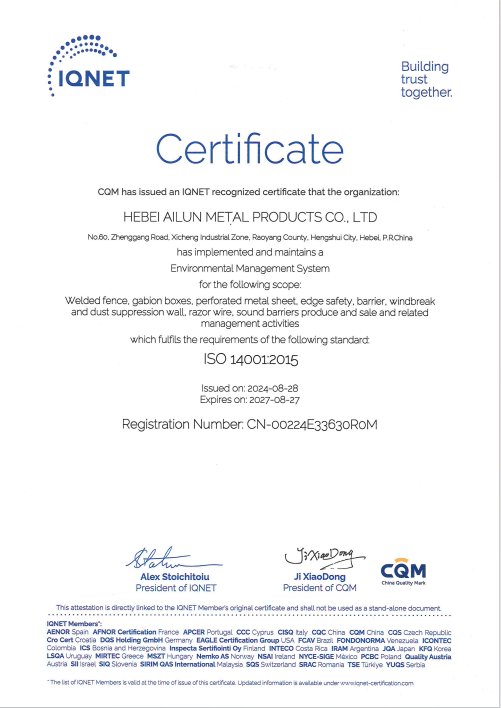
Certification and inspection documentation — request the full document pack with your specification sheet.
Request the Welded Mesh Fence Compliance Pack
Send us your specification sheet, destination market and panel drawing. We will return a quotation, the applicable certificate and inspection documents, and a sample plan for your evaluation.
Download the product brochure: Welded Wire Mesh & GI Wire Catalogue (PDF)
Anping Dengfeng Wire Mesh Products Co., Ltd. — dengfengwiremesh.com | Email: sales@alunfence.com | WhatsApp: +86 158-3395-6854
Have Questions or Need More Details?
Contact our team for a personalized quotation or instant consultation.
Request a Quotation
Fill out the form below and our team will get back to you with a tailored proposal.
WhatsApp Direct Chat
Prefer to chat in real-time? Message us on WhatsApp for instant assistance & quick answers.
- Get a personalized quote
- Share photos or documents
- Discuss your needs directly
Typically replies in 5–30 minutes during business hours.