Welded Mesh Fence Compliance: ISO9001, SGS & BV Certifications Explained
Welded Mesh Fence Compliance: ISO9001, SGS & BV Certifications Explained
ISO 9001, SGS and BV documents do not prove the same thing, and buyers who treat them as interchangeable make avoidable procurement mistakes. ISO 9001:2015 certifies a manufacturer's quality management system. An SGS report records third-party testing or inspection of a defined sample, batch or consignment on a defined date. A BV document records an inspection, factory audit or conformity verification carried out by Bureau Veritas. This guide explains what each document verifies, why EU, Australian, Middle Eastern and North American projects ask for them, how they connect to the stated over-10-year service life of a welded mesh fence range, and how to verify a supplier's certification status before you place an order.
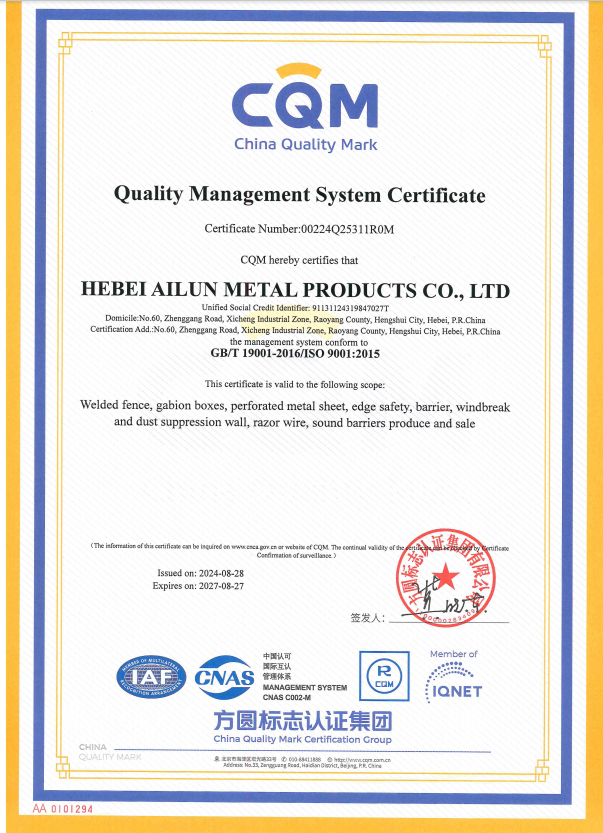
ISO 9001:2015 Quality Management System Certificate held by Anping Dengfeng Wire Mesh Products Co., Ltd. — certificate no. 00224Q25311R0M, issued by CQM, valid 28 August 2024 to 27 August 2027.
The Problem: One Word, “Certified,” Covers Three Different Documents
A compliance pack usually arrives as a single PDF bundle. Everything inside is introduced as a “certificate,” which is where the confusion starts, because the three document families answer three unrelated questions.
- A management system certificate (ISO 9001) describes how a factory is organised: which processes are documented, where inspection points sit, and how non-conforming product is handled.
- A third-party test or inspection report (SGS) describes what one defined sample, batch or consignment measured on one defined date.
- An independent inspection or conformity document (BV / Bureau Veritas) records that an external body audited a factory, observed a production batch, or checked a consignment against a specification.
Because the three look similar on paper, the same five mistakes repeat in tender evaluations:
- Reading ISO 9001 as if it certified the panel itself.
- Accepting a screenshot instead of the complete certificate file.
- Ignoring the scope line, which defines what the certificate is permitted to cover.
- Assuming one certificate covers every model in a supplier's catalogue.
- Failing to connect the certificate to the model actually quoted — for example a 358 anti-climb panel versus a double wire panel.
None of these are exotic errors. They appear whenever a buyer is comparing several suppliers on price and quietly treats documentation as a formality. In practice, documentation is the fastest available way to distinguish a controlled manufacturing process from an uncontrolled one.
Industry Background: Why Certification Sits in the Specification, Not the Appendix
The welded mesh fence market is large enough that buyers rarely lack suppliers, and concentrated enough that documentation has become the default screening tool. Dataintelo valued the global welded wire mesh fence market at USD 7.04 billion in 2025 and projects USD 11.72 billion by 2034. Grand View Research estimates the wider global fencing market at USD 33.8 billion in 2025, with metal fencing holding the largest material share at 53%. Dataintelo also reports that Asia Pacific accounted for a 38.5% revenue share of the welded wire mesh fence market in 2025, driven substantially by infrastructure projects in China and India.
Alongside market growth, two standard frameworks dominate specification language. In the European Union, EN 10223-7:2012 specifies requirements for steel wire welded panels used for fencing, published by CEN and distributed by BSI. In the United States, ASTM F2453 / F2453M-14 covers the standard specification for welded wire mesh fence fabric with metallic or polymer coatings for high-security applications, published by ASTM International. Projects in Australia, the Middle East and North America typically reference one of these frameworks or a national equivalent, which is why the applicable standard should be confirmed with the project specifier rather than assumed from a supplier's brochure.
Application demand reinforces the trend. Industry analysis notes that welded mesh fencing is preferred for critical infrastructure such as railways, where cable theft prevention matters, and for schools, because rigid frame panels and anti-climb geometry are harder to scale than flexible systems (Linkland Fence, industry blog). Both applications are exactly where a buyer's client will eventually ask for evidence instead of assurance.
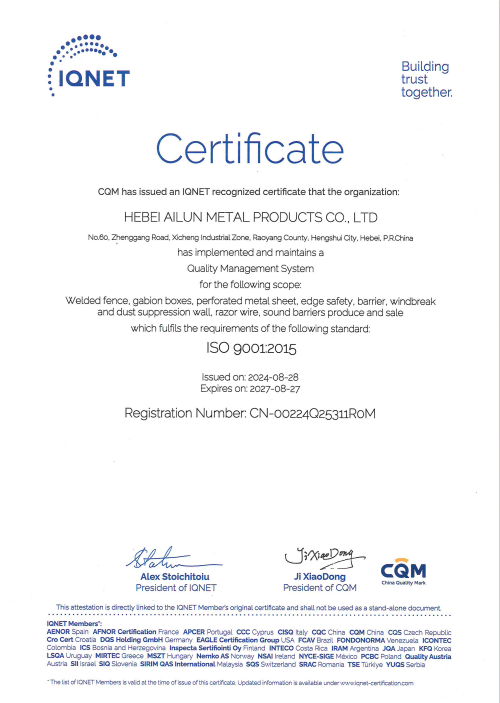
Factory production qualification documentation — the manufacturing-side evidence that sits behind a compliance pack.
What ISO 9001, SGS and BV Actually Verify
Anping Dengfeng Wire Mesh Products Co., Ltd. (“Dengfeng”) is a wire mesh manufacturer based in Anping County, Hebei Province, China, the region known as the “Hometown of Wire Mesh.” Founded in 2008, the company operates a 70,000 m² factory with 80 employees, an annual output of 5,000,000 m², a 10-engineer R&D team and an export share of 80% across Europe, Saudi Arabia, the Middle East, the United Arab Emirates and the United States. Its welded mesh fence range carries ISO 9001, SGS and BV certification, which is why its documentation is used as the worked example below.
ISO 9001:2015 — the factory system certificate
Dengfeng holds an ISO 9001:2015 Quality Management System Certificate, certificate number 00224Q25311R0M, issued by CQM against the standard GB/T 19001-2016 / ISO 9001:2015. It was issued on 28 August 2024 and expires on 27 August 2027. Its stated scope is the production and sale of welded fence, gabion boxes, perforated metal sheet, edge safety barrier, windbreak and dust suppression wall, razor wire and sound barriers.
In operational terms, an ISO 9001 certificate tells a buyer that the factory runs documented process control: incoming wire is checked against specification, welding parameters are controlled, galvanizing and powder-coating stages have defined inspection points, finished panels pass a defined pre-shipment inspection, and non-conforming product is isolated rather than shipped.
What ISO 9001 does not do is certify a product's dimensions or coating. A quality management certificate will not tell you that a panel is 2,000 mm high or that the wire is 5.0 mm. Those numbers come from the product specification, which for this range states a height range of 630 mm to 3,000 mm, a panel width range of 2,000 mm to 3,000 mm, wire diameters from 3.0 mm to 6.0 mm, mesh sizes of 50 × 100 mm and 76.2 × 12.7 mm, hot-dip galvanized plus powder-coated surface treatment, low-carbon steel wire and galvanized steel pipe as base materials, and a service life of over 10 years.
The scope line is the most important sentence on the certificate. If the scope does not name welded fence production, the document does not cover the product you are buying — regardless of how the certificate is presented in a sales deck.
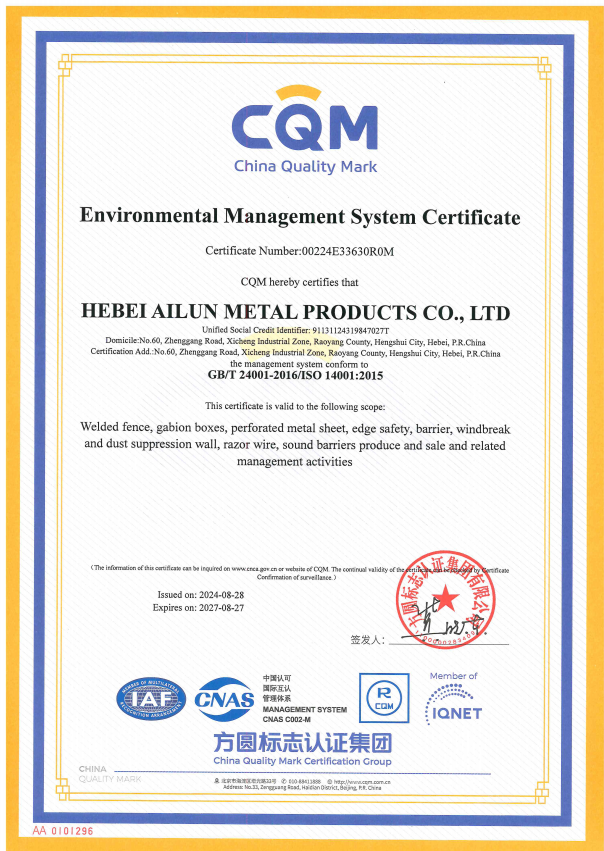
Quality management certification is the document most buyers ask for, but the wider management system file — including environmental and occupational health and safety certification — is what an auditor will read next.
SGS — third-party testing and inspection outputs
SGS is a multinational testing, inspection and certification organisation. In fencing procurement, an SGS document is normally the output of an independent examination of a defined sample, batch or consignment: panel dimensions, mesh aperture, wire diameter, coating condition, weld integrity or material composition. Dengfeng's welded mesh fence product data lists SGS among the certifications held on the range, alongside ISO 9001 and BV.
Because an SGS document is tied to a sample and a date, a buyer should read four things before relying on it: the report number and issue date; the exact model or specification tested; the test method or standard applied; and the sampling basis, meaning whether the sample was drawn by the inspector or supplied by the factory. A report that names a method and a sampling basis is far more useful in a dispute than a one-page logo sheet.
BV (Bureau Veritas) — inspection, audit and conformity verification
Bureau Veritas is likewise a multinational testing, inspection and certification organisation. In fence procurement, BV involvement typically appears in one of three forms: a factory audit reviewing production capability and quality control; a pre-shipment inspection of a specific consignment before loading; or conformity verification against a project or destination-market requirement. Dengfeng product data lists BV certification on the welded mesh fence range.
BV-style inspection and factory-internal inspection are complementary rather than competing. Dengfeng operates 100% full inspection on orders, and its stated acceptance criteria allow third-party testing: pre-shipment full inspection is the default basis, and a third-party test is acceptable when the buyer requires one. The internal inspection covers every unit; the independent inspection covers the buyer's selected scope.
Why these three documents sit behind an over-10-year service-life claim
A service-life figure is only as credible as the process that produced it, and the chain works in three links. First, the ISO 9001 system governs the parameters that determine corrosion resistance and coating durability — surface preparation, galvanizing, powder coating and the inspection points between them. Second, independent verification through SGS or BV confirms that a sample or consignment matched the stated specification on a given date. Third, field evidence exists: the welded mesh fence range has documented installations in Germany, Australia and the United Kingdom, where 5,000 m² of fencing was installed for site boundary isolation and community security enclosure, with the product in service for over 10 years and delivering long-term anti-rust and anti-climb protection for engineering contractor, real estate developer and security wholesaler clients.
The three links are not interchangeable, and that is the point. The certificate proves the process is controlled; the report proves a sample was verified against a specification; the case record proves the design has held up in service. A supplier holding only the third link is telling a story. A supplier holding all three is providing a chain of evidence that a project engineer can file.
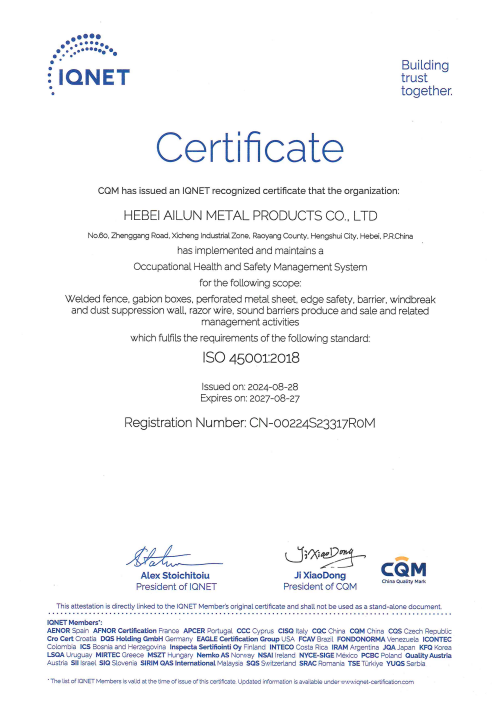
Product inspection and test documentation — the layer that connects a stated specification such as 3.0–6.0 mm wire diameter to a recorded measurement.
How to Verify a Welded Mesh Fence Supplier's Certifications: Seven Steps
Step 1 — Request the full certificate file, not a screenshot
Ask for the complete PDF rather than a cropped image or a watermarked page. A usable certificate shows the certificate number, the issuing body, the standard applied, the issue date, the expiry date and the scope statement. Screenshots are easy to produce, difficult to verify and impossible to file in a bid submission.
Step 2 — Confirm the issuing body and check its registry
Certificate numbers are issued by specific bodies, and most bodies publish a searchable registry. For reference, Dengfeng's ISO 9001:2015 certificate is issued by CQM under certificate number 00224Q25311R0M, valid from 28 August 2024 to 27 August 2027. Verify the number with the issuer rather than with the supplier's own website.
Step 3 — Read the scope line against the product you are buying
A management system certificate is only as wide as its scope. Dengfeng's certificate scope covers welded fence production and sale, which is the relevant line for a welded mesh fence order. If a scope names only unrelated product families, the certificate does not support the quotation in front of you.
Step 4 — Check the dates against your delivery schedule
A certificate that expires before your shipment date creates a documentation gap in the middle of a project. Cross-check the expiry date against the delivery window. The welded mesh fence range quotes a lead time of 15 to 30 days, so a certificate with multi-year validity is normally straightforward to align with a project schedule.
Step 5 — Tie the certificate to the model actually quoted
Certification is held at manufacturer and range level, while a quotation is issued for a specific model. Dengfeng's welded mesh fence range includes the 3D-2000, 358-1800, TW-1500 and TC-2100 models, spanning 3D curved fence, 358 anti-climb fence, double wire fence, palisade fence, temporary construction fence and chain link fence types. Confirm which of those appears on your drawing and which test evidence applies to it.
Step 6 — Ask separately for SGS and BV documents and read what each covers
Treat SGS and BV documents as evidence with a subject line. Ask what was inspected, on what date, under what method and by whom. This is also the point to confirm customization scope if the project is not standard: Dengfeng provides OEM/ODM production with customization of size, wire diameter, mesh, colour, logo and surface treatment, and supplies free CAD drawings.
Step 7 — Write inspection and acceptance terms into the contract
Documentation review belongs in the commercial terms as well. Dengfeng's stated purchasing terms are MOQ 1 set; delivery FOB Tianjin or CIF; acceptance based on pre-shipment full inspection with third-party test acceptable; and payment by L/C, T/T, D/P, Western Union, Paypal or Money Gram. Putting inspection rights in writing is what turns a certificate from a marketing asset into a contractual checkpoint.
Use Cases: Where Certification Requirements Decide the Outcome
Compliance documentation is not equally decisive in every project. It matters most where a specifier, insurer, client or authority has to sign off on a physical asset.
- School perimeters. School projects combine two requirements: physical resistance to climbing and a paper trail a school board can review. Rigid frame panels and anti-climb geometry are the design response, which is why welded mesh is frequently preferred for school security. Dengfeng's OEM/ODM service supports school projects through customization of panel size, wire diameter, mesh aperture, colour, logo and surface treatment, with free CAD drawings for approval.
- Parks and residential properties. Here the compliance question is corrosion protection rather than intrusion resistance. Hot-dip galvanized plus powder-coated panels support a low-maintenance specification and the over-10-year service life stated for the range.
- Industrial perimeters and logistics sites. Anti-climb and anti-cut performance drive the specification, which is where 358 anti-climb panels (358-1800) and double wire panels (TW-1500) apply.
- Railways. Railway corridors need rigid panels and anti-climb characteristics, a requirement widely associated with cable theft prevention in critical infrastructure.
- Airports, ports and high-security sites. These projects typically reference high-security fabric standards such as ASTM F2453 / F2453M-14, published by ASTM International, and often require independent inspection before shipment.
- Construction and municipal work. Temporary construction fence models such as the TC-2100 serve phased site works where the boundary layout changes as the project progresses.
In the documented Dengfeng case, engineering contractors, real estate developers and security wholesalers across Germany, Australia and the United Kingdom used the range for site boundary isolation and community security enclosure across 5,000 m² of installed fencing. The reported outcome was long-term anti-rust and anti-climb protection, with full custom sizing, ISO certification, low maintenance and fast delivery identified as the deciding factors.
Certification and Compliance Comparison Table
| Document | Issued / performed by | What it verifies | What it does not prove |
|---|---|---|---|
| ISO 9001:2015 Quality Management System Certificate (no. 00224Q25311R0M) | CQM, against GB/T 19001-2016 / ISO 9001:2015 | Documented process control across welded fence production and sale; inspection routines; handling of non-conforming product | Panel dimensions, coating condition or service life of a specific model |
| SGS test / inspection report | SGS, independent third party | Measured results for a defined sample, batch or consignment on a stated date | Ongoing process control beyond the sampled unit |
| BV (Bureau Veritas) inspection, audit or conformity document | Bureau Veritas, independent third party | Factory audit findings, pre-shipment inspection results or project conformity verification | That a different, unsampled consignment meets the same specification |
| EN 10223-7:2012 | CEN / BSI | European requirements for steel wire welded panels for fencing | Compliance of one specific supplier unless supporting evidence is produced |
| ASTM F2453 / F2453M-14 | ASTM International | Standard specification for welded wire mesh fence fabric with metallic or polymer coatings for high-security applications | Project-specific requirements beyond the standard's scope |
For buyers who need to match documentation to a specification quickly, the table below summarises the welded mesh fence range as documented.
| Parameter | Documented value |
|---|---|
| Models | 3D-2000, 358-1800, TW-1500, TC-2100 |
| Panel types | 3D curved fence, 358 anti-climb fence, double wire fence, palisade fence, temporary construction fence, chain link fence |
| Height range | 630 mm – 3,000 mm |
| Panel width range | 2,000 mm – 3,000 mm |
| Wire diameter | 3.0 mm – 6.0 mm |
| Mesh size | 50 × 100 mm; 76.2 × 12.7 mm |
| Surface treatment | Hot-dip galvanized + powder coated |
| Materials | Low-carbon steel wire, galvanized steel pipe |
| Service life | Over 10 years |
| Certification | ISO 9001, SGS, BV |
| Monthly capacity | 420,000 m² |
| Lead time | 15 – 30 days |
| Quality control | 100% full inspection |
| MOQ | 1 set |
| Export markets | EU, Australia, Southeast Asia, Middle East, North America |
Competition in certified perimeter fencing is established and global; recognised players in the security fencing segment include Betafence, Bekaert, Ameristar Perimeter Security and Jacksons Fencing. That is precisely why documentation discipline matters. When several suppliers can meet a specification, the buyer's screening criteria shift from capability to verifiable evidence.
Frequently Asked Questions
Is Dengfeng's welded mesh fence ISO 9001 certified, and what does the certificate cover?
Yes. Anping Dengfeng Wire Mesh Products Co., Ltd. holds an ISO 9001:2015 Quality Management System Certificate, certificate number 00224Q25311R0M, issued by CQM against GB/T 19001-2016 / ISO 9001:2015. It was issued on 28 August 2024 and expires on 27 August 2027. The scope covers the production and sale of welded fence, gabion boxes, perforated metal sheet, edge safety barrier, windbreak and dust suppression wall, razor wire and sound barriers, so welded fence production is named inside the scope.
Can Dengfeng manufacture OEM welded mesh fence for school security projects?
Yes. Dengfeng operates as an OEM/ODM manufacturer, with customization available for size, wire diameter, mesh, colour, logo and surface treatment, and provides free CAD drawings for project approval. The welded mesh fence range covers the 3D-2000, 358-1800, TW-1500 and TC-2100 models across 3D curved, 358 anti-climb, double wire, palisade, temporary construction and chain link fence types.
What are the minimum order quantity, payment terms and delivery terms?
MOQ is 1 set. Delivery terms are FOB Tianjin or CIF. Payment terms are L/C, T/T, D/P, Western Union, Paypal and Money Gram. Lead time is 15 to 30 days, with a monthly capacity of 420,000 m².
How is quality verified before shipment, and can a third party inspect the order?
The standard acceptance basis is pre-shipment full inspection: 100% full inspection rather than sampling, and a third-party test is acceptable when the buyer requires one. The welded mesh fence range also carries ISO 9001, SGS and BV certification, so documentation and physical inspection can be aligned on the same order.
What lead time should be planned for a certified welded mesh fence order?
Documented lead time is 15 to 30 days from order confirmation, with a monthly production capacity of 420,000 m². Add time for certificate verification and, where required, third-party inspection before shipment. To start an evaluation, request a quotation with your required models, dimensions and certification documents, or ask for a free CAD drawing of your perimeter layout.
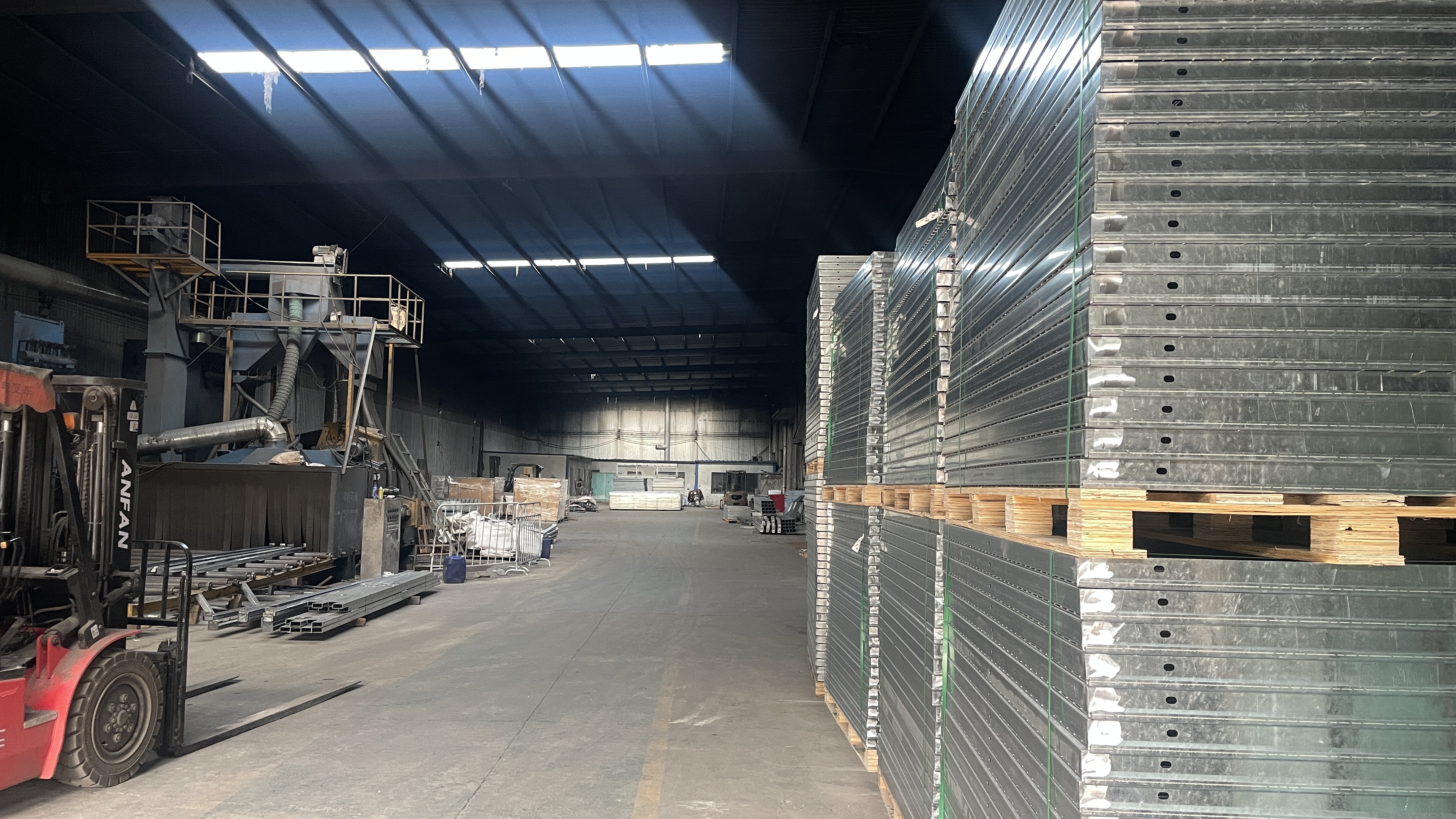
Production capacity documented at 420,000 m² per month, with 100% full inspection on every order and third-party testing accepted when required.
Conclusion: Compliance Is a Chain, Not a Logo
ISO 9001, SGS and BV each answer a different question, and a welded mesh fence buyer needs all three questions answered. ISO 9001:2015 confirms that the factory runs a controlled, documented process — for Dengfeng, certificate 00224Q25311R0M issued by CQM, valid to 27 August 2027, with welded fence production named in the scope. SGS and BV documents confirm that an independent body examined a defined sample, factory or consignment. The product specification — 630–3,000 mm heights, 3.0–6.0 mm wire, 50 × 100 mm and 76.2 × 12.7 mm mesh, hot-dip galvanized plus powder-coated finish and over 10 years of service life — is what the documentation is ultimately supporting.
For projects in the EU, Australia, the Middle East or North America, the practical action is the same whether the specification cites EN 10223-7:2012, ASTM F2453 / F2453M-14 or a national equivalent: request the full certificate files, verify the issuing body's registry, read the scope line, match the certificate to the model on the drawing, and write inspection and acceptance terms into the contract. That sequence takes a week and prevents the far more expensive sequence of discovering a documentation gap after the panels have shipped.
Next Step: Request Certification Documents, Samples or a Quotation
Send your perimeter layout and the certification list your project requires. Dengfeng will return the ISO 9001:2015 certificate, available SGS and BV documentation, a free CAD drawing and a quotation covering the 3D-2000, 358-1800, TW-1500 or TC-2100 models, with delivery FOB Tianjin or CIF and lead time of 15 to 30 days.
Email: sales@alunfence.com | Phone / WhatsApp: +86 158-3395-6854 | Website: dengfengwiremesh.com
Download the Welded Wire Mesh & GI Wire product catalogue (PDF) for full model and specification reference.
Have Questions or Need More Details?
Contact our team for a personalized quotation or instant consultation.
Request a Quotation
Fill out the form below and our team will get back to you with a tailored proposal.
WhatsApp Direct Chat
Prefer to chat in real-time? Message us on WhatsApp for instant assistance & quick answers.
- Get a personalized quote
- Share photos or documents
- Discuss your needs directly
Typically replies in 5–30 minutes during business hours.