
Welded Mesh Fence Technical Guide: Wire Diameter, Mesh Size, Material & Surface Treatment
Welded Mesh Fence Technical Guide: Wire Diameter, Mesh Size, Material & Surface Treatment
A welded mesh fence is a rigid panel system in which every wire intersection is machine-welded rather than woven or knotted. That manufacturing difference is why the product behaves as a structural panel instead of a flexible screen: it holds a flat plane, resists deformation, and can be specified precisely by five parameters — wire diameter, mesh aperture, panel height and width, base material, and surface treatment. For buyers who are past the research stage and about to place a repeat order, those five parameters, not the general appearance of the panel, decide whether the installation is still serviceable in year ten.
This guide explains what each parameter controls, how the available ranges interact, where the trade-offs sit, and how to lock a specification that a supplier can reproduce consistently across multiple sites and multiple years. It also sets out what buyers should verify before committing to a long-term supply relationship.
Problem Definition: Why Welded Mesh Fence Specifications Fail After Handover
Most perimeter failures are not the result of a bad product category. They are the result of a specification that was never resolved at parameter level. A panel with 3.0 mm wire and a wide aperture can look identical to a panel with 5.0 mm wire and a tight aperture in a photograph or a showroom sample, yet the two behave very differently against climbing, cutting, wind load and corrosion.
Three specification gaps account for most of the problem:
- Threat and geometry are mismatched. A panel chosen for visual screening is asked to perform an anti-cut role it was never dimensioned for.
- Coating is treated as cosmetic. Surface treatment drives corrosion life far more than base-material choice in most inland and coastal environments.
- Repeat orders drift. When a multi-site rollout spans several years, an unspecified parameter set allows wire diameter or coating mass to move between batches without anyone noticing until panels no longer match.
The practical fix is to write the specification as a parameter table rather than a product name, and to require the supplier to confirm each value on the datasheet before production. That is the approach this guide follows.
Industry Background: A Category Under Sustained Specification Pressure
Welded wire mesh fencing is a large and still-expanding segment of the global perimeter market. According to Dataintelo, the global welded wire mesh fence market was valued at USD 7.04 billion in 2025 and is projected to reach USD 11.72 billion by 2034. The same source reports that Asia Pacific dominated the welded wire mesh fence market in 2025 with a 38.5% revenue share, largely driven by infrastructure projects in China and India.
Fencing as a whole follows the same direction. Grand View Research estimates the overall global fencing market at USD 33.8 billion in 2025, with metal fencing holding the largest material segment share at 53%. Market sizing varies by source depending on whether installation services are included, so these figures should be read as scale indicators rather than a single reconciled number.
Two structural factors push buyers toward tighter technical specifications:
- Published standards exist and are being referenced in tenders. EN 10223-7:2012 is the active European standard specifying requirements for steel wire welded panels for fencing, published by CEN/BSI. In the United States, ASTM F2453 / F2453M-14 from ASTM International covers the standard specification for welded wire mesh fence fabric with metallic or polymer coatings for high-security applications.
- Mainstream suppliers keep raising the technical floor. Betafence Group expanded its perimeter security portfolio in February 2024 by launching new-generation welded mesh systems with intrusion detection and solar surveillance. Other established names in the security fencing market include Betafence, Bekaert, Ameristar Perimeter Security and Jacksons Fencing, according to Fortune Business Insights and Mordor Intelligence.
For a project buyer, the consequence is straightforward: the parameter set is now the differentiator, and the supplier's ability to reproduce that parameter set consistently over years matters as much as the first delivery.
Detailed Solution: The Five Parameters That Control Performance
1. Wire Diameter (3.0–6.0 mm)
Wire diameter is the primary driver of panel rigidity and cutting resistance. Within a supported range of 3.0 mm to 6.0 mm, the lower end produces a lighter panel that is easier to handle and suitable where the perimeter requirement is demarcation and deterrence. The upper end produces a stiffer panel with greater resistance to levering, spreading and repeated impact.
Two practical rules apply. First, wire diameter should rise with the level of physical threat, not with the visual importance of the site. Second, wire diameter and aperture must be selected together — a heavy wire in a wide aperture is stiff but open to reach-through and toe-hold, while a light wire in a tight aperture resists climbing but can deform under sustained force.
2. Mesh Size (50 × 100 mm and 76.2 × 12.7 mm)
Aperture geometry decides what the fence can physically prevent. Two configurations cover most requirements:
- 50 × 100 mm — the anti-climb configuration. The opening is too small for a toe-hold or a handhold while remaining open enough to preserve visibility and light. This is the standard choice where supervision and sightlines matter, such as schools, parks and sports fields.
- 76.2 × 12.7 mm — the anti-cut configuration, widely known as 358 mesh. The narrow 12.7 mm slot prevents hand tools such as bolt cutters from gaining purchase on the wire, which is why this geometry is used for high-security perimeters and where cable theft is a concern.
Welded mesh fencing is preferred for critical infrastructure such as railways, where cable theft prevention matters, and for schools, because rigid frame panels combine anti-climb geometry with controlled visibility. That application pattern is consistent with industry reporting on high-security and anti-climb use.
3. Panel Height and Width (630–3000 mm / 2000–3000 mm)
Panel height sets the deterrence threshold. A supported range of 630 mm to 3000 mm covers everything from low demarcation and garden boundaries through to full high-security perimeter panels. Height should be decided before aperture, because an anti-climb panel at insufficient height still permits an unaided climb over the top.
Panel width, available in a 2000 mm to 3000 mm range, is an execution parameter rather than a security parameter. Wider panels reduce the number of posts and fixings per linear metre and speed up installation, but they also increase individual panel weight and handling requirements. On sites with restricted access or uneven ground, the narrower end of the range is usually the more practical choice.
4. Material Options and Where Each Belongs
Material selection is an environment question, not a quality ranking:
| Material | Where it is typically used | Buyer consideration |
|---|---|---|
| Low carbon steel wire | General perimeter, schools, parks, industrial fencing | Cost-efficient base; corrosion life depends almost entirely on the coating system |
| Galvanized steel pipe | Posts, rails and frame members that carry the panels | Frame stiffness determines whether panels stay in plane under load |
| Aluminum alloy | Lightweight and non-sparking installations | Inherent corrosion resistance; different fixing and grounding practice |
| Stainless steel 304 / 316 | Coastal, chemical and wash-down environments | Grade 316 is specified where chloride exposure is continuous; higher material cost |
| Carbon steel | Structural framing and heavy-duty supports | Strength-driven choice; coating discipline is critical |
5. Surface Treatment: Hot Dip Galvanized Plus Powder Coating
Surface treatment is the parameter that most often determines whether a welded mesh fence reaches a service life beyond ten years or fails early. A dual system — hot dipped galvanizing as the corrosion barrier, followed by powder coating as the outer finish — addresses both corrosion and appearance in one specification.
The galvanized layer provides sacrificial protection at cut edges, weld points and minor abrasion sites. The powder coating adds a sealed, colour-stable outer surface that resists UV degradation and gives the panel a uniform finish. For powder coated welded mesh fence panels, both layers should be stated separately on the datasheet: coating thickness or mass for the zinc layer, and coating type and film thickness for the powder layer. A single vague statement such as "galvanized and coated" is not a specification.
6. Welding and Inspection: What "Machine Welded" Should Mean
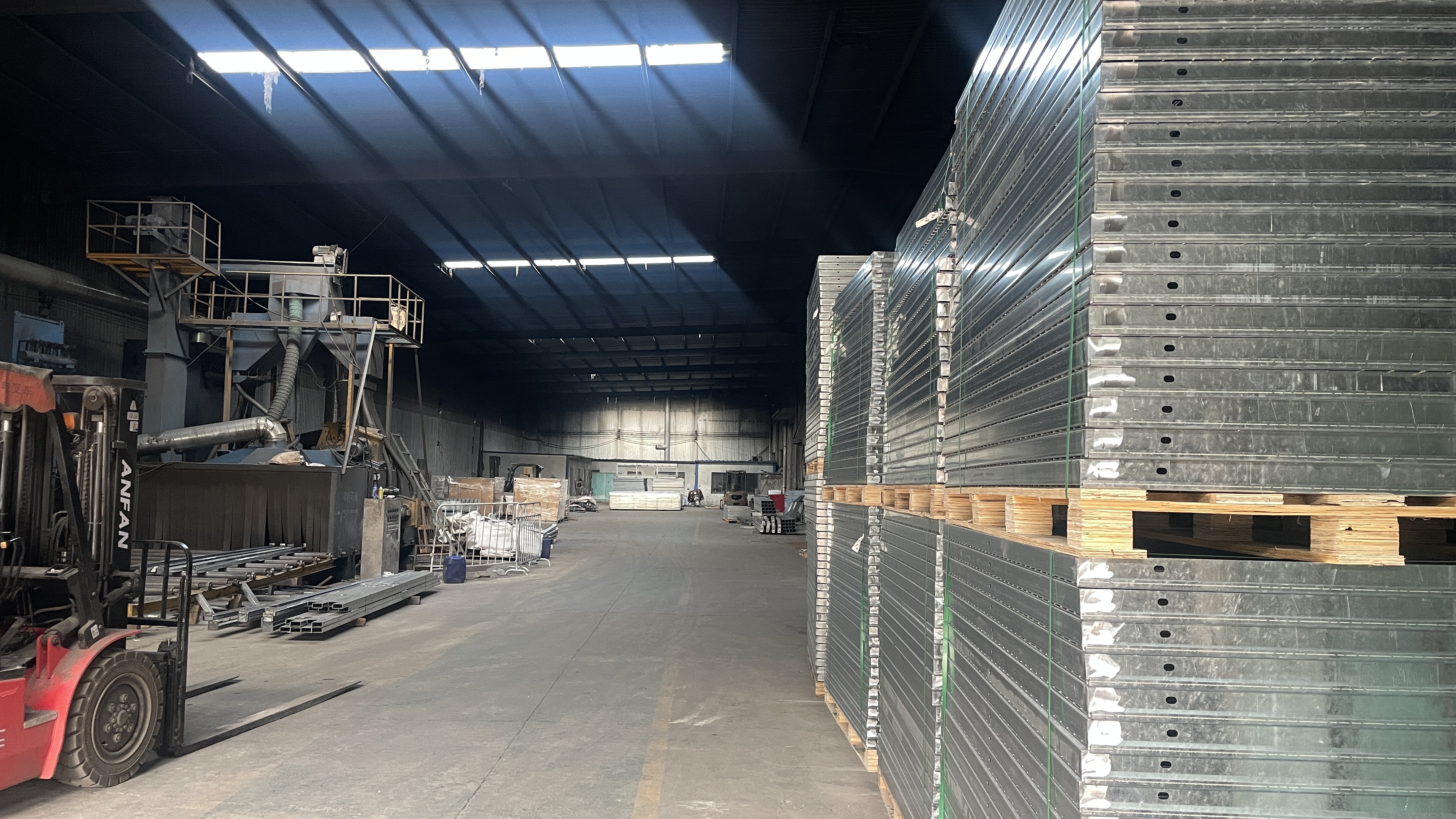
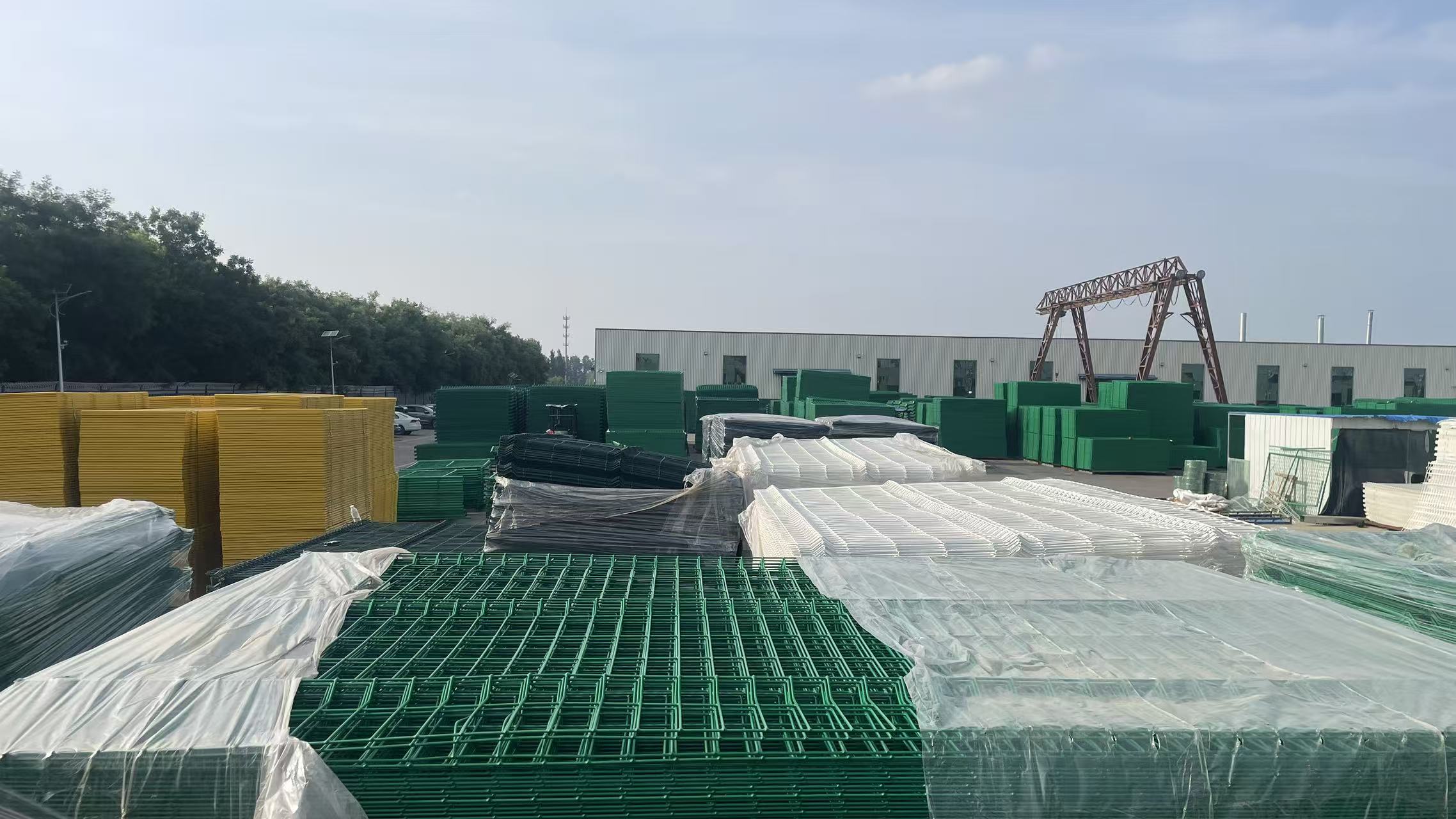
Weld quality determines whether the panel behaves as one rigid sheet or as a collection of loose wires. In Dengfeng's production process, the welding is completed by robotic welding, and manual inspection is conducted throughout polishing, pickling and powder coating procedures. This combination matters: automation delivers consistent weld shear strength across the full panel, while manual inspection catches the exceptions that a machine will not flag.
At the order level, quality control covers 100% raw material inspection, finished product load testing and full delivery inspection, with the specific objective of controlling corrosion damage and structural deformation. Buyers qualifying a supplier should ask for these three checkpoints in writing rather than accepting a general quality statement.
Step-by-Step Breakdown: How to Lock a Welded Mesh Fence Specification
The following sequence prevents the most common specification errors, because each step constrains the next.
Step 1 — Define the threat and the site function
Decide whether the perimeter must deter, delay or detect. A park boundary and a rail corridor with cable theft exposure require different answers even if both are "welded mesh fence".
Step 2 — Set panel height first
Choose within the 630–3000 mm range. Height is the parameter that cannot be corrected later without replacing panels.
Step 3 — Choose aperture geometry by threat type
Select 50 × 100 mm where anti-climb and visibility dominate; select 76.2 × 12.7 mm where anti-cut resistance is the governing requirement.
Step 4 — Match wire diameter to required rigidity
Work within the 3.0–6.0 mm range. Heavier wire increases stiffness and cutting resistance but also panel weight and handling cost.
Step 5 — Select material by environment, not by preference
Low carbon steel wire for typical inland sites, aluminum alloy or stainless steel 304/316 where corrosion exposure is severe, galvanized steel pipe and carbon steel for the structural frame.
Step 6 — Specify the coating system in two layers
State hot dipped galvanizing and powder coating separately, each with its own thickness or mass value. This is the step that converts a ten-year expectation into a ten-year commitment.
Step 7 — Confirm welding, inspection and delivery terms
Require robotic welding with documented manual inspection stages, confirm the inspection protocol, and agree commercial terms. For reference, Dengfeng's standard terms are a minimum order quantity of 1 set, a typical production lead time of 15–30 days, and a monthly production capacity of 420,000 square meters. Delivery terms are FOB Tianjin or CIF, with pre-shipment full inspection and third-party testing acceptable as acceptance criteria; payment terms include L/C, T/T, D/P, Western Union, Paypal and Money Gram.
Use Cases: Matching the Parameter Set to the Site
Schools
Welded mesh fence for schools is specified around two requirements at once: it must resist climbing by unaided hands and feet, and it must preserve adult sightlines into the grounds. A 50 × 100 mm anti-climb aperture with a mid-range wire diameter satisfies both better than a solid or heavily obscured barrier. Because school projects are usually governed by local building code compliance and safety standards, the specification should also reference the applicable standard on the datasheet.
Parks and sports fields
Welded mesh fence for parks and welded mesh fence for sports fields share a preference for openness combined with damage resistance. Panels must absorb ball impact and casual contact without permanent deformation, which points toward adequate wire diameter and a rigid frame rather than tightly packed geometry.
Industrial perimeters
Welded mesh fence for industrial perimeter applications usually has to combine access control with long service intervals. Low-maintenance panels with a two-layer coating reduce repainting and replacement cycles across large, hard-to-reach boundaries.
Railways and critical infrastructure
Welded mesh fence for railways is frequently specified in the anti-cut configuration because the 76.2 × 12.7 mm aperture denies purchase to hand tools used in cable theft attempts. Rigid frame panels are preferred for this duty because they maintain a consistent plane that is harder to defeat without leaving visible evidence.
Residential properties
Welded mesh fence for residential properties is a specification based on boundary definition and appearance rather than heavy threat, which makes the lower end of the height and wire range appropriate — provided the coating is still specified properly, since a fading or chalking finish is the most visible long-term failure on residential sites.
Comparison Table: Parameter Ranges and What They Control
| Parameter | Supported range / options | Primary performance effect | Where the choice is decisive |
|---|---|---|---|
| Wire diameter | 3.0–6.0 mm | Panel rigidity, cutting resistance, deformation recovery | High-security panels, industrial perimeter |
| Mesh aperture | 50 × 100 mm (anti-climb); 76.2 × 12.7 mm (358 anti-cut) | Climb resistance, tool-purchase resistance, visibility | Schools, sports fields; railways, substations |
| Panel height | 630–3000 mm | Deterrence threshold, containment | Every project — set before aperture |
| Panel width | 2000–3000 mm | Posts and fixings per metre, handling weight | Restricted-access and uneven sites |
| Material | Low carbon steel wire, galvanized steel pipe, aluminum alloy, stainless steel 304/316, carbon steel | Corrosion resistance, weight, structural capacity | Coastal, chemical and wash-down environments |
| Surface treatment | Hot dipped galvanizing + powder coating | Corrosion life, finish stability, maintenance interval | Any specification targeting >10-year service life |
| Welding & inspection | Robotic welding; manual inspection through polishing, pickling and powder coating | Weld consistency, defect detection before shipment | Multi-batch and multi-site programmes |
Long-Term Cost Profile: What a Heavier Specification Actually Returns
Buyers comparing a properly specified welded mesh fence against ordinary cheap wire mesh fence are usually comparing two different products. The stronger specification delivers better anti-corrosion and anti-climb performance, and in practice it has been documented as providing 6+ years longer service life. The commercial trade-off is measurable: roughly 5% higher initial cost, against approximately 40% lower replacement cost over the life of the installation, with zero maintenance required within 10 years.
This cost profile is what makes welded mesh fence suitable for construction, community and airport security projects, where the cost of access, traffic management and temporary security during a replacement cycle often exceeds the cost of the panels themselves. It is also the reason long-term supply relationships matter more in this category than in most perimeter products: the value is realised in years six to twelve, not on the delivery date.
Quality Documentation to Request Before You Commit
A parameter table is only as good as the supplier's ability to demonstrate conformance. For a long-term programme, request and verify:
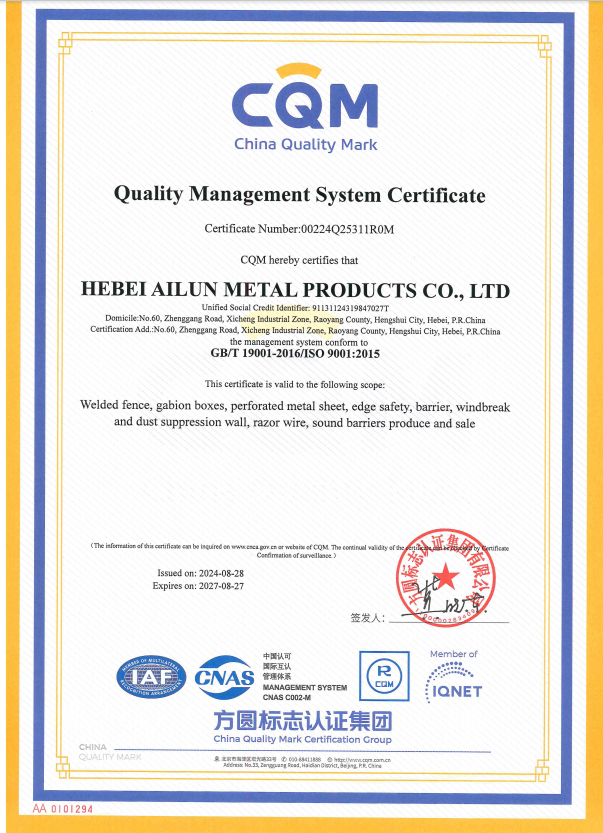
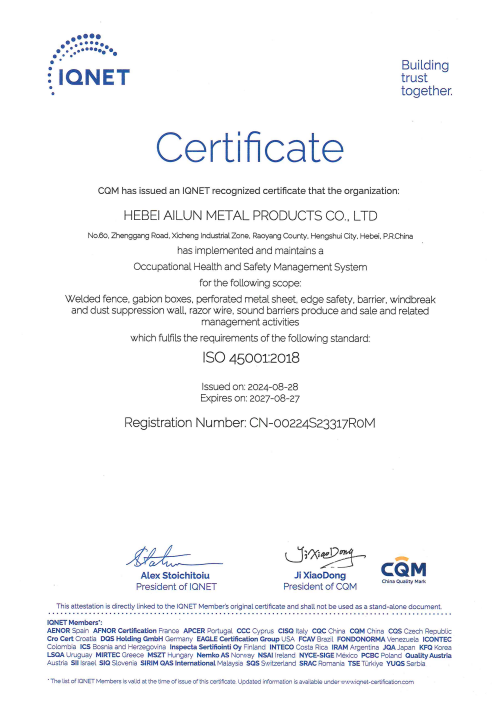
- The management system certificate behind the manufacturing process — for Anping Dengfeng Wire Mesh Products Co., Ltd., this is an ISO9001 Quality Management System certificate, alongside ISO14001 environmental and ISO45001 occupational health and safety certification.
- A product quality inspection test report covering the actual panel construction being ordered.
- The welding and inspection protocol, stated as processes rather than as claims.
- The coating values for both the galvanized layer and the powder layer.
- Pre-shipment inspection records, with third-party testing agreed in advance where the project requires it.
FAQ
Which standards and certifications should a welded mesh fence supplier document for compliance review?
Two published standards are commonly referenced in tenders. EN 10223-7:2012 is the active European standard specifying requirements for steel wire welded panels for fencing, published by CEN/BSI. ASTM F2453 / F2453M-14, published by ASTM International, covers the standard specification for welded wire mesh fence fabric with metallic or polymer coatings for high-security applications. At manufacturer level, an ISO9001 Quality Management System certificate is the baseline quality document, supported by a product quality inspection test report for the specific panel construction ordered. Buyers should map the applicable standard to the site type and confirm it on the datasheet rather than assuming a generic compliance claim.
How do wire diameter, mesh size and material change anti-climb and anti-corrosion performance?
Wire diameter, within a 3.0–6.0 mm range, controls panel rigidity and resistance to levering and cutting. Mesh aperture controls the physical barrier logic: 50 × 100 mm denies a toe-hold or handhold while preserving visibility, and 76.2 × 12.7 mm (358 mesh) prevents hand tools from gaining purchase on the wire. Corrosion performance is driven mainly by the dual surface treatment — hot dipped galvanizing followed by powder coating — with material choice (low carbon steel wire, galvanized steel pipe, aluminum alloy, stainless steel 304/316, carbon steel) selected according to the corrosivity of the site environment. The combination, not any single parameter, determines service life.
What is the real cost profile of a heavier welded mesh fence specification?
Compared with ordinary cheap wire mesh fence, a properly specified welded mesh fence carries roughly 5% higher initial cost while delivering better anti-corrosion and anti-climb performance, 6+ years longer service life, and approximately 40% lower replacement cost. Maintenance within 10 years is not required. For multi-site and long-lifecycle projects, the relevant comparison is therefore total cost across the full service period, not the unit price on the first purchase order.
Can panels be validated by sample or pre-shipment inspection before a long-term order?
Yes. The standard acceptance criteria are pre-shipment full inspection, with third-party testing acceptable where the project requires independent verification. Order-level quality control covers 100% raw material inspection, finished product load testing and full delivery inspection, targeting corrosion damage and structural deformation. The minimum order quantity is 1 set, so a sample or trial panel can be supplied and evaluated before a programme-scale commitment is placed.
How do you qualify a long-term welded mesh fence supplier for school security projects, and what lead time and capacity should you expect?
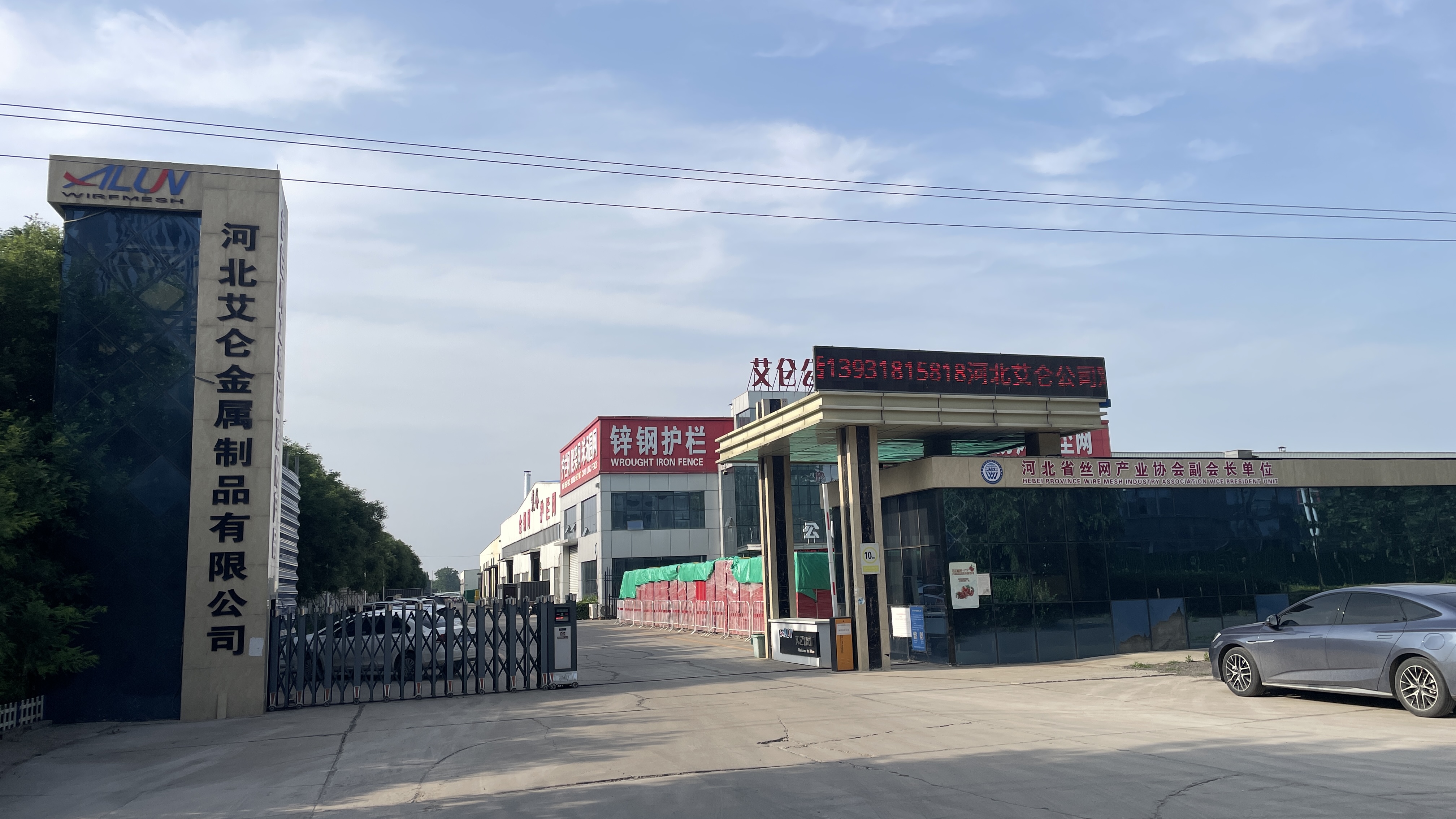
Qualification for a long-term welded mesh fence supplier for school security projects rests on four checks: a fixed parameter sheet covering wire diameter, aperture, height, material and both coating layers; documented welding and inspection processes, since the welding process is completed by robotic welding with manual inspection through polishing, pickling and powder coating; verifiable quality documentation; and demonstrated capacity to repeat the same specification across multiple sites and years. Anping Dengfeng Wire Mesh Products Co., Ltd. has operated since 2008 with a 70,000 m² facility, an annual output of 5,000,000 m² and a monthly production capacity of 420,000 square meters, typically delivering in 15–30 days with a minimum order quantity of 1 set. To start a technical review or request sample panels against a specific parameter set, contact sales@alunfence.com or the WhatsApp line at +86 158-3395-6854.
Conclusion: Specify the Parameters, Then Hold Them Constant
A welded mesh fence performs as well as its parameter set allows. Wire diameter in the 3.0–6.0 mm range sets rigidity; aperture geometry — 50 × 100 mm or 76.2 × 12.7 mm — sets whether the fence resists climbing or cutting; panel height within 630–3000 mm sets the deterrence threshold; panel width within 2000–3000 mm sets installation efficiency; material selection matches the site environment; and the combination of hot dipped galvanizing with powder coating, applied over robotic welding with manual inspection at each finishing stage, determines whether the installation is still sound beyond ten years.
The discipline that makes this work over a long programme is documentation. Fix the parameter table, confirm the values behind any model designation such as 3D-2000, 358-1800, TW-1500 or TC-2100 on the datasheet, and require the same values on every subsequent batch. That is how a welded mesh fence specification survives handover, budget cycles and staff changes intact.
Next Step: Specification Review, Sample Panels and Quotation
Send your site type, required panel height, aperture preference and environment conditions, and Anping Dengfeng Wire Mesh Products Co., Ltd. will return a parameter-matched specification, sample panel availability and a firm quotation. Minimum order quantity is 1 set with a typical lead time of 15–30 days.
Download the product catalogue: Welded Wire Mesh and GI Wire Catalogue (PDF)
Website: dengfengwiremesh.com | Email: sales@alunfence.com | WhatsApp: +86 158-3395-6854
Have Questions or Need More Details?
Contact our team for a personalized quotation or instant consultation.
Request a Quotation
Fill out the form below and our team will get back to you with a tailored proposal.
WhatsApp Direct Chat
Prefer to chat in real-time? Message us on WhatsApp for instant assistance & quick answers.
- Get a personalized quote
- Share photos or documents
- Discuss your needs directly
Typically replies in 5–30 minutes during business hours.