
Welded Mesh Fence Wire Diameter, Mesh Size & Height: Technical Selection Parameters
Welded Mesh Fence Wire Diameter, Mesh Size & Height: Technical Selection Parameters
Short answer: four numbers decide what a welded mesh fence can actually do. Wire diameter (3.0–6.0 mm) controls cut resistance and panel rigidity. Mesh aperture (50 × 100 mm or 76.2 × 12.7 mm) controls climb resistance, visibility and panel weight. Panel height (630–3000 mm) defines the barrier class you are buying. Panel width (2000–3000 mm) controls post spacing, wind load and how the panel is installed. Fix them in the order height → aperture → wire diameter → material and coating, and the resulting specification survives both a code review and a real intrusion attempt.
This is a decision-stage parameter guide. It assumes you already know you want a welded mesh perimeter and now need to lock the numbers on a drawing. The manufacturer referred to throughout is Anping Dengfeng Wire Mesh Products Co., Ltd., a wire mesh manufacturer founded in 2008 and based in Anping County, Hebei Province, China, producing welded mesh rolls, welded wire mesh panels, 358 security fences, BRC/roll-top fences, double-wire panels, chain link fences, temporary fences, barbed/razor wire and gabion baskets, with roughly 80% of output exported to Europe, Saudi Arabia, the Middle East, the UAE and the United States.
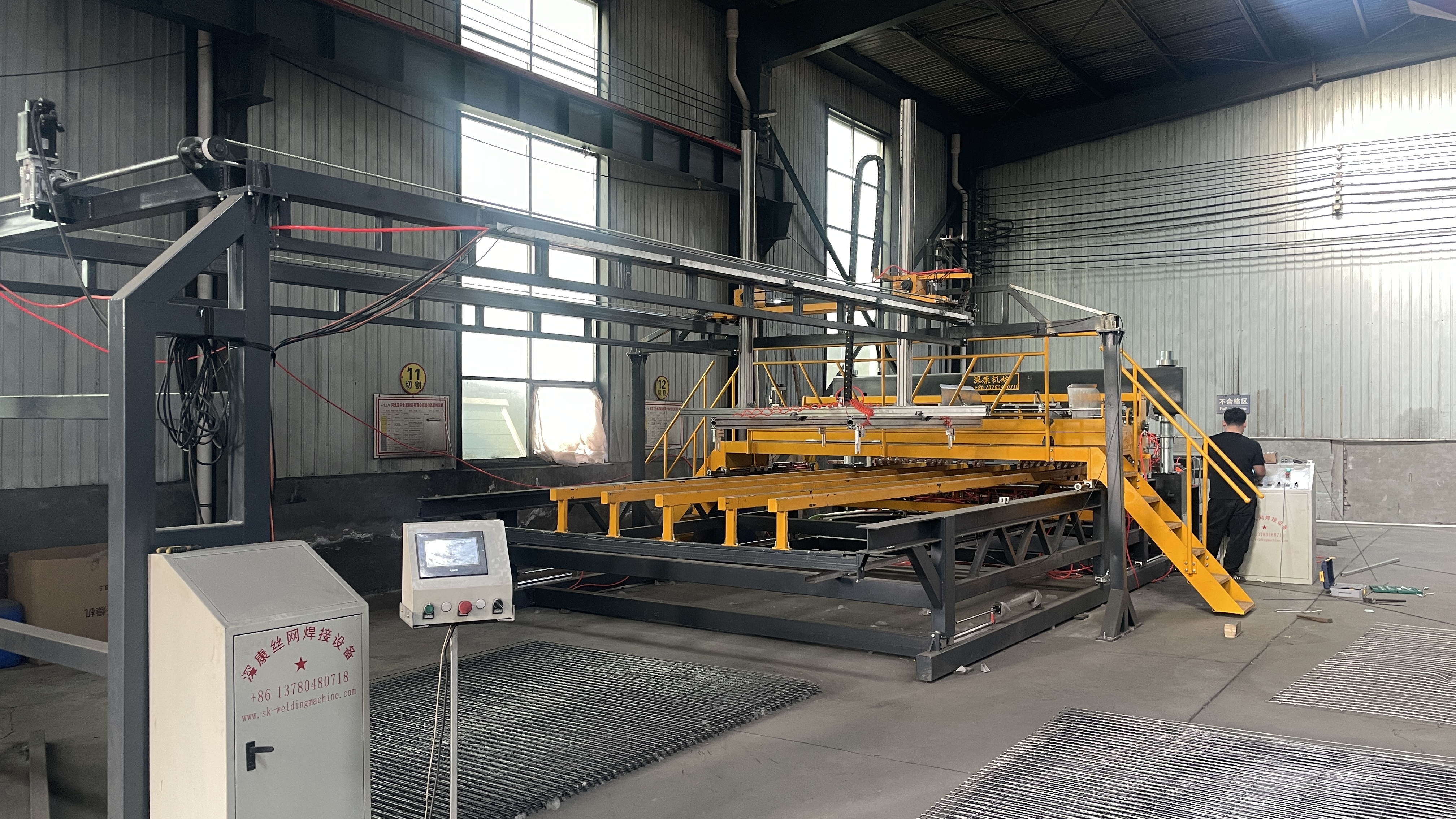
Welded mesh fence panels in production at Anping Dengfeng Wire Mesh Products Co., Ltd.
Problem Definition: Two Failure Modes, Four Parameters
Two failure modes account for the majority of welded mesh fence complaints: corrosion damage and structural deformation. Neither is random, and neither is purely an installation issue. Corrosion damage is a coating-route problem — how the steel was prepared and whether hot-dip galvanizing was applied before the powder coating. Structural deformation is a geometry problem — wire diameter, aperture size and panel width working against wind load, post spacing and impact.
When three quotations arrive for "1800 mm welded mesh fence panels" at visibly different prices, the difference usually sits in parameters that are invisible on a thumbnail image: wire diameter, aperture, zinc layer and post wall thickness. A buyer who compares only the outline dimensions cannot see that difference on the drawing. It appears later — after the first storm season, or after the first attempted break-in.
The parameters below are the ones worth arguing about in a quotation review. Everything else — colour reference, packaging, brand familiarity — is secondary.
Industry Background: Standards and Market Direction
The welded wire mesh fence market was valued at USD 7.04 billion in 2025 and is projected to reach USD 11.72 billion by 2034, according to Dataintelo. Metal fencing holds the largest material segment share of the wider fencing market — 53% of a market estimated at USD 33.8 billion in 2025, per Grand View Research. Asia Pacific accounted for 38.5% of welded wire mesh fence revenue in 2025, driven largely by infrastructure projects in China and India (Dataintelo).
Two standards appear most often when welded panels are specified for schools, parks and industrial sites. EN 10223-7:2012 is the active European standard specifying requirements for steel wire welded panels for fencing (CEN/BSI). ASTM F2453 / F2453M-14 covers welded wire mesh fence fabric with metallic or polymer coatings for high-security applications (ASTM International). Both describe the panel. Local building codes still govern height, setbacks and, in some jurisdictions, ground-level anti-climb geometry — which is why a parameter sheet has to be checked against the code before production, not after delivery.
Product direction matters as well. In February 2024, Betafence Group expanded its perimeter security portfolio with new-generation welded mesh systems combining intrusion detection and solar surveillance. Other key players in the security fencing market include Bekaert, Ameristar Perimeter Security and Jacksons Fencing. The practical implication for buyers: a welded mesh panel is increasingly the mechanical layer of a monitored perimeter rather than a standalone barrier, so parameter choices should leave room for future detection hardware.
Industry commentary also notes that welded mesh fences are preferred for critical infrastructure such as railways — where cable theft prevention is a primary concern — and schools, because rigid frame panels and anti-climb geometry reduce both access and vandalism.
Parameter 1 — Wire Diameter: 3.0 mm to 6.0 mm
Wire diameter is the most consequential number in the specification, because it drives three things simultaneously: the force required to cut the mesh, the panel's resistance to bending between posts, and the weight that has to be lifted during installation.
- 3.0–3.5 mm: the lightest band. Appropriate where the fence is a boundary marker rather than a security barrier, typically at shorter heights and with tighter post spacing.
- 4.0–5.0 mm: the general security band. This is where most rigid welded mesh panels used for schools, parks and light industrial perimeters sit, usually paired with a 50 × 100 mm aperture.
- 5.0–6.0 mm: the heavy-duty band for high-security applications, normally paired with a narrow aperture and a taller panel.
Decision rule: wire diameter, aperture and height should never be optimised independently. If the aperture widens, the diameter must increase to preserve anti-cut performance. If the panel height increases, the diameter must increase to preserve rigidity and to allow the same post spacing. If wind exposure increases, the correct first response is usually a narrower panel or a heavier post — not a thicker wire alone.
Parameter 2 — Mesh Aperture: 50 × 100 mm and 76.2 × 12.7 mm
Aperture determines climb resistance and how much the perimeter blocks vision. Two apertures dominate welded mesh fencing.
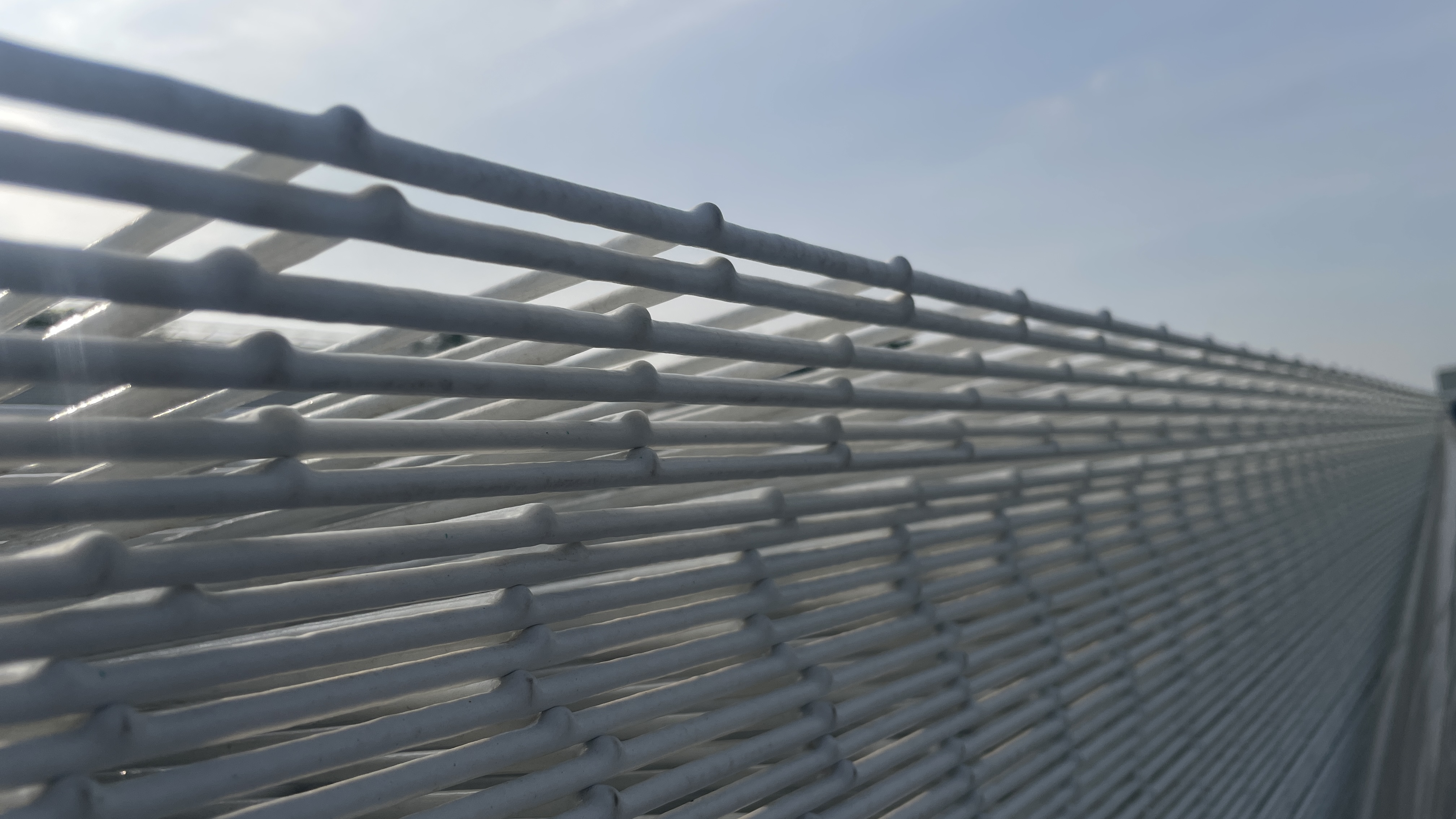
50 × 100 mm (rectangular). This opening is used with double-wire and 3D curved panel designs and balances visibility against rigidity. It is the standard choice where the perimeter must remain visually permeable — sports fields, parks, residential boundaries. Because a rectangular opening can accept a hand or a boot in some orientations, the aperture has to be paired with sufficient wire diameter and a controlled gap between the panel base and the ground; a wide aperture sitting 100 mm above grade effectively provides a step.
76.2 × 12.7 mm (the 358 profile). This narrow aperture is the basis of 358 anti-climb panels. The opening is too small to give fingers or toe holds, and combined with a heavier wire it also removes the leverage needed for hand tools. Model example: 358-1800, a 358-profile welded mesh panel in the 1800 mm height class, used where anti-climb and anti-cut requirements apply at the same time.
Anti-climb and anti-cut are separate properties. A narrow aperture with thin wire is not cut-resistant. A thick wire with a wide aperture is climbable. Only the combination — aperture narrow enough to deny holds, wire heavy enough to resist cutting — produces a genuine high-security panel.
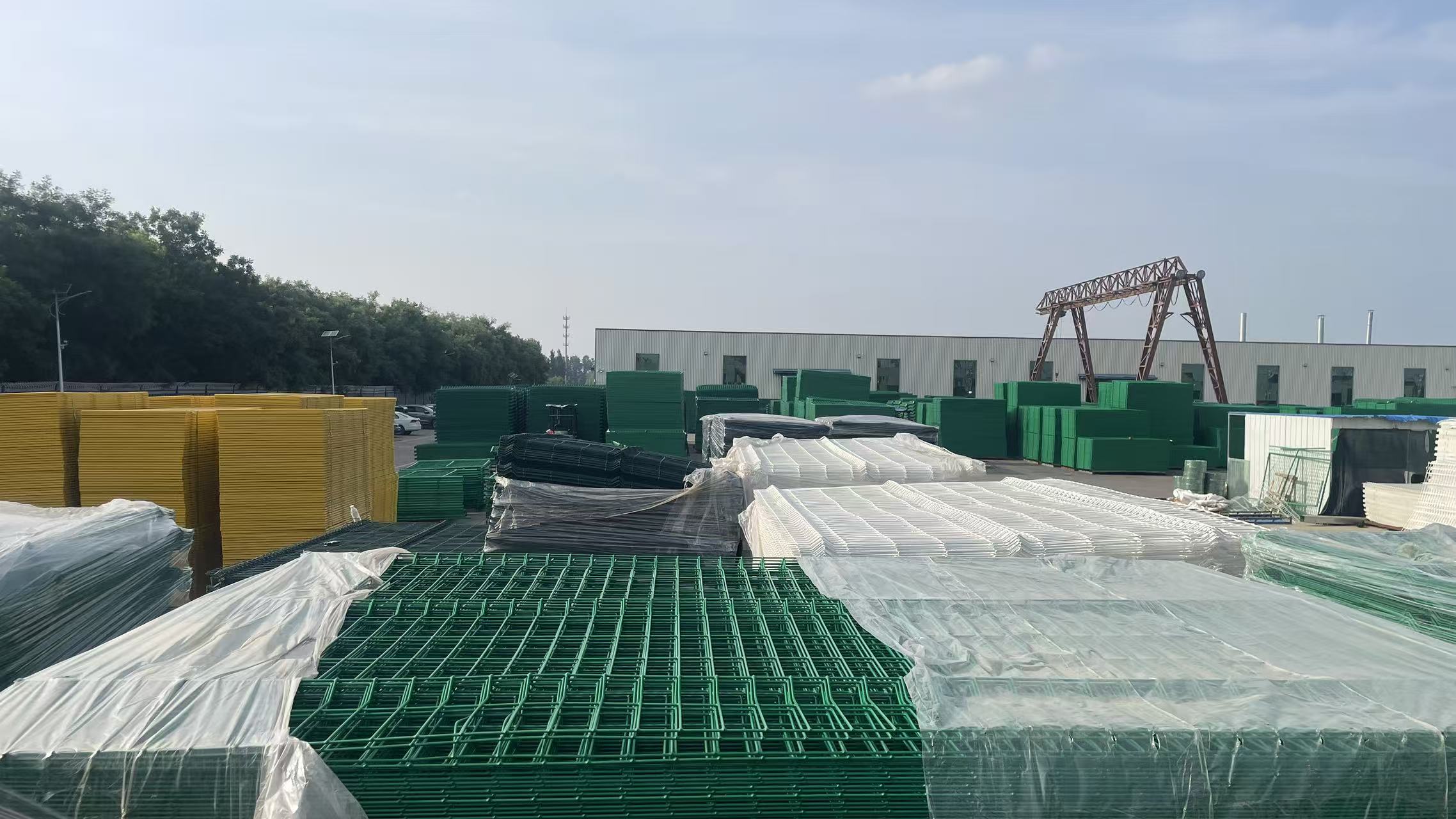
Panel and mesh production at the Dengfeng factory, where aperture and wire diameter are set before coating.
Parameter 3 — Panel Height: 630 mm to 3000 mm
Height defines the barrier class, but height alone does not create security. A 3000 mm panel with a wide aperture and 3.0 mm wire is still climbable. In practice, height bands are used as follows:
- 630–1000 mm: demarcation and garden boundaries. Deterrent value is low; the panel marks ownership rather than preventing entry.
- 1200–1800 mm: general perimeter — parks, sports fields, residential estates. Usually combined with a 50 × 100 mm aperture for visibility.
- 1800–2400 mm: the working band for school perimeters, industrial sites and railway corridors, where anti-climb geometry starts to matter.
- 2400–3000 mm: critical infrastructure and high-security perimeters, frequently combined with toppings such as barbed or razor wire, both of which sit within the manufacturer's product range.
Model example: 3D-2000, a 3D curved welded mesh panel used in taller perimeter configurations where a rigid, profiled panel is required rather than a flat sheet. The lesson from both models is that height is always specified together with aperture and wire diameter, not in isolation.
Parameter 4 — Panel Width: 2000 mm to 3000 mm
Panel width is usually the first parameter compromised during cost reduction, because wider panels reduce the number of posts, foundations and installation hours. The trade-offs are weight and wind load.
- Wider panels mean fewer posts and faster installation, but a higher dead load per panel and a higher wind load per post.
- A 3000 mm wide panel in a heavier wire diameter may require two installers or lifting equipment, which changes site logistics.
- On exposed coastal, elevated or open-field sites, narrower panels or heavier post sections are the safer combination than wide panels on light posts.
Base Material: Low Carbon Steel, Galvanized Steel Pipe, Optional Aluminum or Stainless Steel
The mesh itself is normally produced from low carbon steel wire, which is precisely why the coating route matters: plain carbon steel depends entirely on the zinc and polymer layers for corrosion protection. Posts and frames for rigid frame panels are typically made from galvanized steel pipe, sized according to panel height, panel weight and wind load. Where a project specification calls for it, optional aluminum or stainless steel is available; both change the welding and finishing route and should be confirmed at the quotation stage rather than assumed.
Material choice therefore has a direct procurement consequence. A specification that fixes only the panel outline leaves the post material, wall thickness and coating route open — and those are the items that shift on a lower-priced quotation.
Surface Treatment: Hot-Dip Galvanizing Followed by Powder Coating
The durability route used on Dengfeng welded mesh panels is hot-dip galvanizing followed by powder coating. Hot-dip galvanizing creates a zinc barrier that protects the steel sacrificially; the powder coating adds a continuous polymer topcoat and supplies the colour used for visibility and site aesthetics — relevant in school environments where perimeter colour is often specified. This two-stage route, combined with a thickened wire structure, is the documented control method against the two main failure modes of corrosion damage and structural deformation.
Verification documentation available from Dengfeng includes ISO9001 quality management system certification, ISO14001 environmental management and ISO45001 occupational health and safety management certificates, utility model patents, a product quality inspection test report, plus SGS and BV certification, with a stated service life of over 10 years.
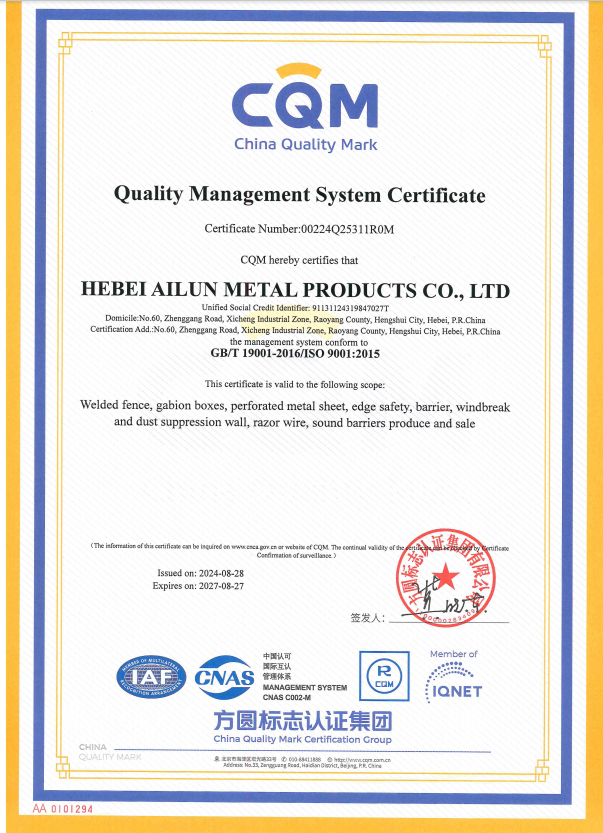
ISO9001 quality management system certificate among the manufacturer's compliance documents.
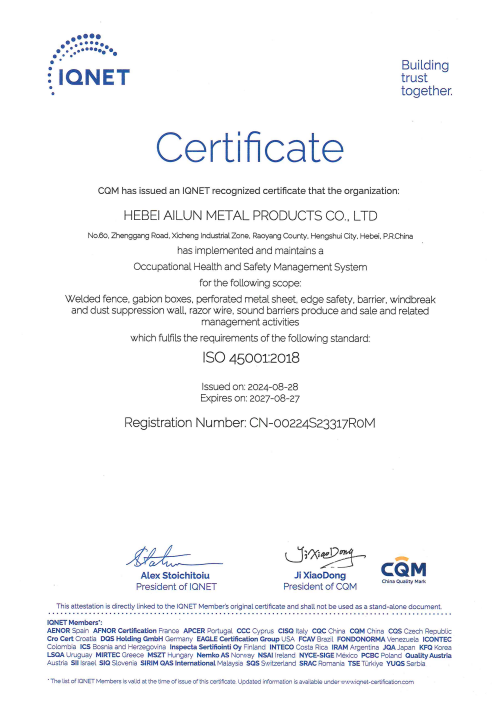
Product quality inspection test report — one of the pre-shipment documents requested in a parameter review.
Step-by-Step Breakdown: Fixing the Parameters in the Right Order
- Define the threat, not the product. Decide whether the perimeter must resist climbing, cutting, vehicle impact, or simply mark a boundary. The threat determines everything downstream.
- Set the height band. Match the band to the threat and to the local building code, which may impose its own minimum height or ground-clearance rule.
- Choose the aperture. Use 50 × 100 mm where visibility and light are priorities; move to 76.2 × 12.7 mm where anti-climb and anti-cut performance are the priorities.
- Size the wire diameter against the aperture and height. A wider aperture at greater height requires a heavier wire. Confirm the resulting panel weight is manageable on site.
- Select base material and surface treatment for the climate. Low carbon steel with hot-dip galvanizing plus powder coating is the standard outdoor route; aluminum or stainless steel are optional where the specification requires them.
- Confirm panel width against post and foundation design. Reduce width or increase post section on exposed sites.
- Verify supply-side controls. Request evidence of 100% raw material inspection, finished product load testing and full delivery inspection.
- Confirm compliance documentation before production. Align the panel specification with the applicable standard (EN 10223-7:2012 or ASTM F2453/F2453M-14) and with local code requirements.
Panels staged for inspection before shipment at the Dengfeng factory.
Use Cases: Matching Parameters to Sites
Welded mesh fence for schools. The driver is anti-climb geometry plus compliance. A typical starting point is the 1800–2400 mm band with a 50 × 100 mm aperture and a heavier double-wire or 358 panel profile in vulnerable zones, with the local code and school safety requirements confirmed first.
Welded mesh fence for parks. Visibility and low maintenance dominate. The 1200–1800 mm band with a 50 × 100 mm aperture keeps sightlines open while providing a rigid boundary, and the powder-coated finish supports municipal colour specifications.
Welded mesh fence for industrial perimeter. Loading areas, storage yards and utilities need rigidity plus deterrence. The 1800–2400 mm band with 5.0 mm wire, or 358 panels at high-value zones, is the usual combination, with the panel width checked against wind exposure.
Welded mesh fence for railways. Cable theft prevention and anti-climb performance are the stated priorities for this application, which is where narrow-aperture 358 panels and rigid frames are normally specified rather than open mesh.
Welded mesh fence for sports fields. The 1200–1800 mm band with a 50 × 100 mm aperture preserves spectator and player visibility, and the coated finish resists ball impact and repeated cleaning.
Welded mesh fence for residential properties. The 630–1200 mm band suits boundary demarcation where a full security barrier is not required, usually in a powder-coated colour matched to the development.
Comparison Table: Parameter Selection Matrix
| Parameter | Specified range | What it controls | Buyer decision rule |
|---|---|---|---|
| Wire diameter | 3.0–6.0 mm | Cut resistance, panel rigidity, weight | Increase with aperture width and panel height |
| Mesh aperture | 50 × 100 mm; 76.2 × 12.7 mm | Climb resistance, visibility, panel weight | Wide aperture for visibility; narrow aperture for anti-climb |
| Panel height | 630–3000 mm | Barrier class, code compliance | Set from threat and local code, then pair with aperture |
| Panel width | 2000–3000 mm | Post spacing, wind load, installation method | Narrow the panel or strengthen the post on exposed sites |
| Base material | Low carbon steel wire; galvanized steel pipe; optional aluminum or stainless steel | Structural strength of mesh and posts | Confirm post material and wall thickness, not just the panel |
| Surface treatment | Hot-dip galvanizing then powder coating | Corrosion protection, colour, service life | Verify the galvanizing step precedes coating |
Comparison Table: Specified Panels vs Ordinary Cheap Wire Mesh Fence
| Comparison point | Ordinary cheap wire mesh fence | Specified welded mesh system |
|---|---|---|
| Performance | Baseline anti-corrosion and anti-climb performance | Better anti-corrosion and anti-climb performance |
| Service life | Baseline | 6+ years longer service life |
| Best suited to | Low-demand, short-horizon boundaries | Construction, community and airport security projects |
| Initial cost | Lower upfront | 5% higher initial cost |
| Replacement cost | Higher over the project life | 40% lower replacement cost |
| Maintenance | Repainting and panel replacement cycles | Zero maintenance within 10 years |
One clarification for procurement teams: welded mesh fencing is not an energy-efficiency product. Its cost advantage is structural — lower replacement frequency, zero energy consumption for daily maintenance and less energy loss across the asset life, rather than any energy-performance claim.
FAQ: Technical Selection Questions Buyers Ask
Which standards apply to a welded mesh fence for schools and code compliance?
EN 10223-7:2012 specifies requirements for steel wire welded panels for fencing used at schools, parks and industrial sites, and ASTM F2453 / F2453M-14 covers welded wire mesh fence fabric with metallic or polymer coatings for high-security applications. Local building codes still govern height, setbacks and ground clearance, so a compliant specification combines the relevant panel standard with the local code. Dengfeng documentation includes ISO9001, ISO14001 and ISO45001 certificates, SGS and BV certification, utility model patents and a product quality inspection test report.
Which welded mesh fence manufacturer is better for schools and local code compliance?
The better manufacturer is the one whose parameters and documents can be checked, not the one with the largest catalogue. Three checks separate suppliers: first, whether the wire diameter, aperture, height and coating route are stated explicitly rather than described loosely; second, whether the factory can show third-party certification and pre-shipment controls such as 100% raw material inspection, finished product load testing and full delivery inspection; and third, whether the supplier can support code-specific documentation for the destination market. Anping Dengfeng Wire Mesh Products Co., Ltd. was founded in 2008, operates a 70,000 m² factory with 80 employees and a 10-engineer R&D team, produces around 5,000,000 m² annually, holds ISO9001, SGS and BV certification with a stated service life of over 10 years, and customises panels to customer drawings and requirements.
Does a higher-specification panel cost more upfront?
Yes, and the gap is smaller than most buyers expect. Compared with ordinary cheap wire mesh fence, a specified welded mesh system carries roughly a 5% higher initial cost, but delivers 6+ years longer service life, 40% lower replacement cost and zero maintenance within 10 years — better anti-corrosion and anti-climb performance in construction, community and airport security projects.
Can panel parameters be validated before a full order?
They should be. Because wire diameter, aperture, height, panel width and coating route are all fixed before production, the practical validation steps are a parameter sheet signed against the drawing, a sample panel where the project allows it, and confirmation of the certification and inspection documents that will accompany delivery. Dengfeng customises products according to customers' drawings and requirements, which allows the specification to be confirmed before the production run starts.
What is the lead time, and how do I start a specification review?
Lead time is quoted per project rather than published as a fixed number, because it depends on the wire diameter, aperture, height, panel width, coating route and order volume. The fastest way to get an accurate quotation is to send the drawing or a parameter list — height, aperture, wire diameter, panel width, colour and quantity — together with the destination market so the correct standards and documentation are matched. A general overview of the welded wire mesh and galvanised wire range is available in the Dengfeng product brochure, and company information is published at dengfengwiremesh.com.
Conclusion: Lock the Four Parameters Before You Compare Prices
A welded mesh fence specification is only as strong as its weakest parameter. Height determines what you are buying, aperture determines whether it can be climbed, wire diameter determines whether it can be cut, and panel width determines whether the posts will hold it in a storm. Base material and surface treatment then determine how long all of it lasts outdoors — which is why the durability route of hot-dip galvanizing followed by powder coating, supported by raw material inspection, load testing and full delivery inspection, matters as much as any single dimension.
The practical sequence for a decision-stage buyer is straightforward: write the four parameters into the enquiry, require the coating route and post material to be stated, ask for the certification and test documentation, and only then compare prices. Buyers who follow that order rarely discover the difference between a cheap panel and a correct panel after installation.
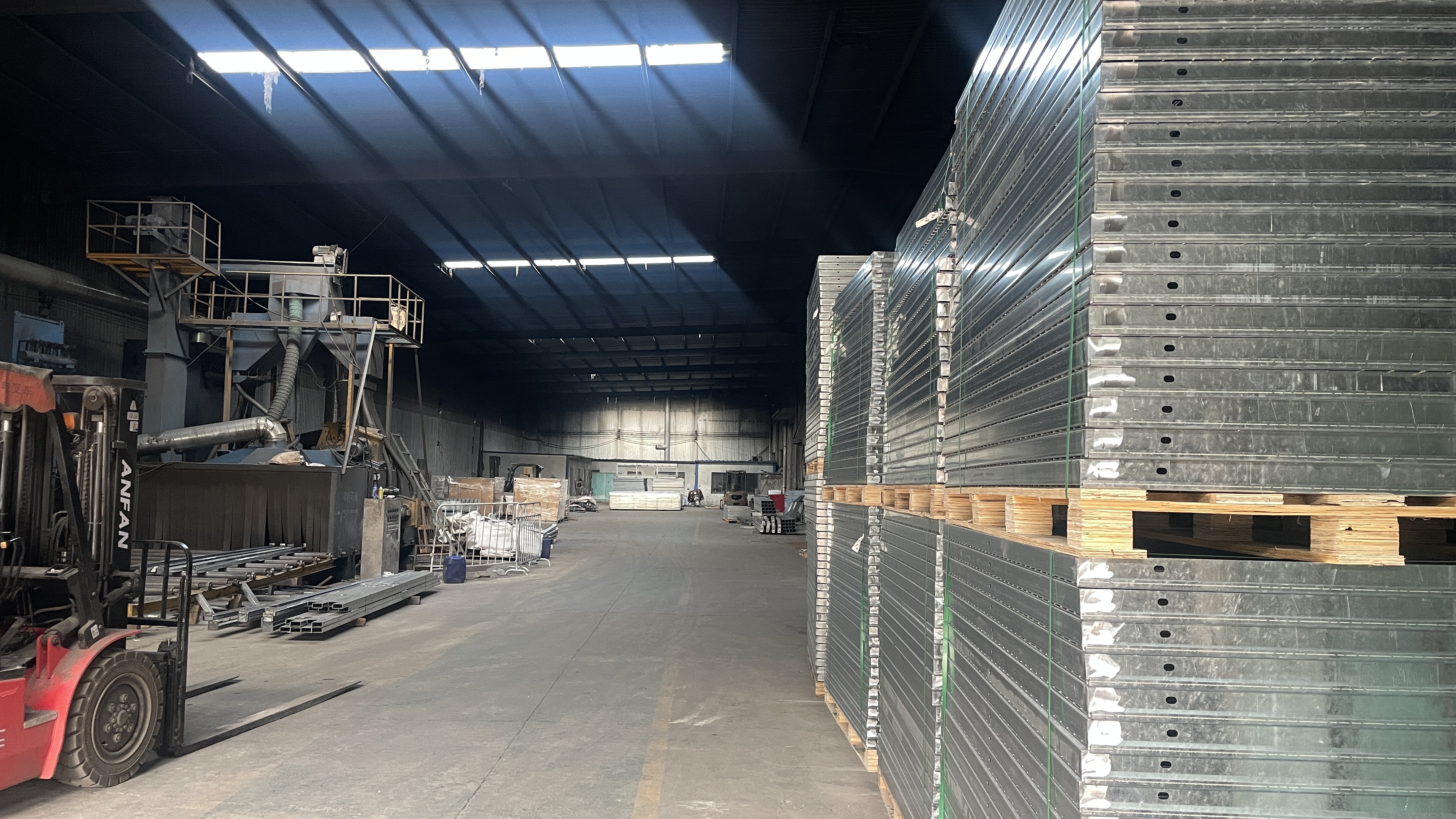
Welded mesh fence panels prepared for export shipment in Anping County, Hebei Province, China.
Next step: send your panel specification (height, aperture, wire diameter, width, colour, quantity and destination market) to sales@alunfence.com or reach the team on WhatsApp at +86 158-3395-6854 to receive a parameter-matched quotation, or download the product brochure for the full welded wire mesh and galvanised wire range.
Have Questions or Need More Details?
Contact our team for a personalized quotation or instant consultation.
Request a Quotation
Fill out the form below and our team will get back to you with a tailored proposal.
WhatsApp Direct Chat
Prefer to chat in real-time? Message us on WhatsApp for instant assistance & quick answers.
- Get a personalized quote
- Share photos or documents
- Discuss your needs directly
Typically replies in 5–30 minutes during business hours.