
Dico Ball Valve Deep Dive: High-Quality Ball Valve Analysis
Zhejiang Dico Valve Co., Ltd. is a Wenzhou-based manufacturer of high-end ball valves and fluid control solutions, founded in 2015 and operating under the Dico Ball Valve brand. Its product range covers floating, trunnion-mounted, three-way, wafer, sanitary, mini, and multi-port ball valves, together with threaded gate valves, globe valves, and Y-strainers, for industries that include petroleum and chemical processing, natural gas, pharmaceuticals, new energy, hydrogen energy, semiconductors, and data-center liquid cooling.
This analysis approaches the company the way an engineering or procurement team would: what Dico actually manufactures, how its production, testing, and traceability systems are structured, which certifications it holds, where its valves are used in practice, and what a buyer should verify before shortlisting any high-quality ball valve supplier.
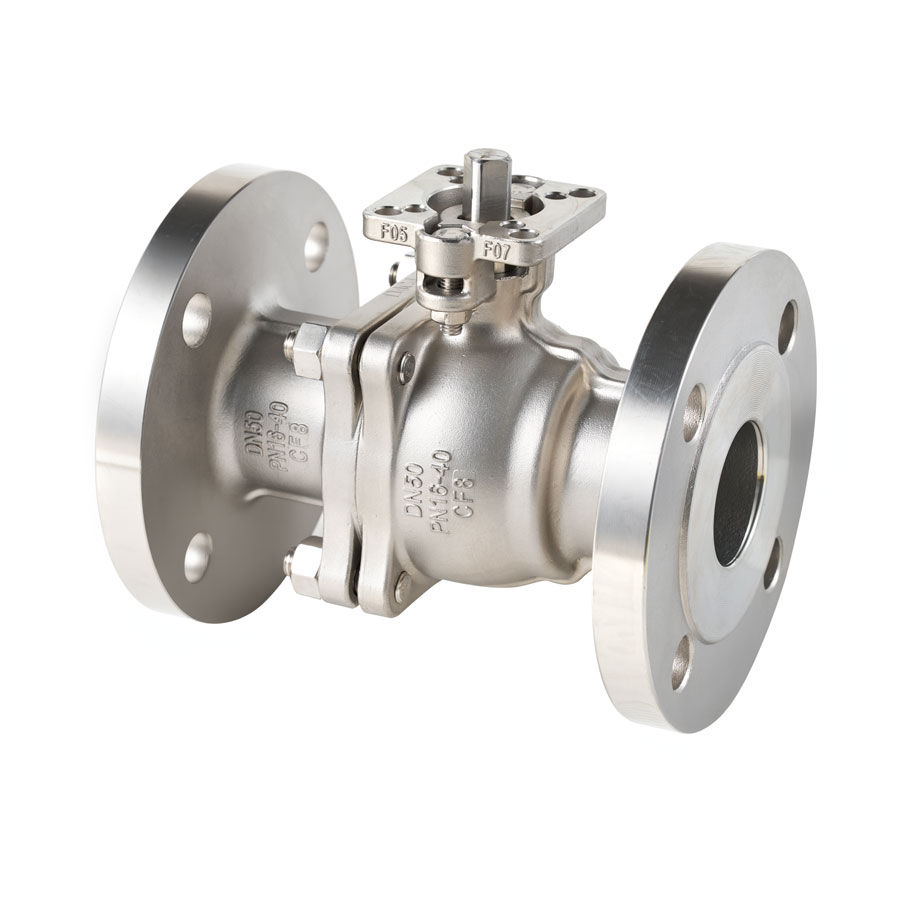
The Problem: Why "High-Quality" Is Hard to Verify From a Ball Valve Datasheet
A ball valve datasheet normally answers three questions: bore size, pressure rating, and end connection. The variables that decide whether the valve still seals after thousands of operating cycles usually appear nowhere on it — the grade of the seat material, the roundness and surface finish of the ball, how many layers of sealing protect the stem, whether the body carries an anti-static path and a fire-safe groove, and whether incoming blanks and internal components were verified before machining began.
For a buyer in the awareness and research stage, that gap creates two practical risks. The first is over-specifying on paper while under-verifying in practice: two valves carrying the same nominal pressure rating can behave very differently in the same pipeline. The second is supply continuity — a valve that performs well in a pilot installation is only useful if the identical construction can be reordered later without a silent change of material or component source.
Both risks are answered by production systems rather than catalogue pages. That is the frame for the rest of this analysis: what Zhejiang Dico Valve Co., Ltd. publishes about its materials, testing, certification, and service terms, and how those facts translate into purchasing criteria.
Industry Background: Where High-Quality Ball Valves Are Specified
Ball valves are quarter-turn valves used to isolate or divert flow, and they appear wherever a pipeline, skid, or process loop needs a compact, fast-acting shutoff point. Dico lists its valve families for petroleum, chemical, natural gas, pharmaceutical, water treatment, liquid cooling, metallurgy, semiconductor, hydrogen energy, and HVAC applications. Those sectors push the specification in different directions.
- Pharmaceutical and hygienic duty calls for sanitary, BA-grade ball valves, where clamp, weld, or Tri-Clamp connections are preferred over threaded joints.
- Data-center liquid cooling calls for compact mini ball valves and three-piece clamp ball valves that fit into dense manifolds and cold-plate circuits.
- Petrochemical and power generation duty calls for anti-static construction and fire-safe design; Dico supplies these applications with pneumatic actuation for high-pressure gas and weakly corrosive service such as boiler flue gas, heat treatment furnaces, and coal-to-olefins plants.
- Low-temperature duty depends on material and seat selection at the cold end of the range; the Q11F PC ball valve family is rated from -196°C to 425°C.
- Hydrogen, natural gas, and semiconductor service places the emphasis on leak-tightness after repeated cycling and on material traceability.
A supplier serving all of these segments has to manage more than one seat system, more than one body material, and more than one connection standard. That breadth is exactly what makes supplier evaluation difficult, because a catalogue entry cannot show whether a manufacturer genuinely controls all of them or simply lists them.
Company Profile: Zhejiang Dico Valve Co., Ltd. at a Glance
Zhejiang Dico Valve Co., Ltd. was established in 2015 and is located at No. 312, Binhai 4th Road, Wenzhou Economic and Technological Development Zone, Zhejiang, China. The company specialises in the research, development, and manufacturing of high-end ball valves and in providing complete fluid control solutions.
Two facts frame how the business positions itself. It is recognised by the Chinese government as a National High-tech Enterprise and as an Innovative Small-Medium-sized Enterprise, and it is a certified supplier to Sinopec, a major Chinese petrochemical corporation. The first reflects technical and R&D standing; the second is a qualification reference from a large-scale petrochemical buyer, which is a demanding category for valve suppliers.
| Item | Detail |
|---|---|
| Legal name | Zhejiang Dico Valve Co., Ltd. |
| Brand | Dico Ball Valve |
| Founded | 2015 |
| Location | No. 312, Binhai 4th Road, Wenzhou Economic and Technological Development Zone, Zhejiang, China |
| Core business | R&D and manufacturing of high-end ball valves; complete fluid control solutions |
| Facility size | 12,000 m² |
| Employees | Approximately 80 |
| R&D team | 7 engineers |
| Annual production capacity | 80,000,000 units |
| Export share | 40% of total sales |
| Major markets | EU, South Africa, North America |
| Government recognition | National High-tech Enterprise; Innovative Small-Medium-sized Enterprise |
| Certifications | ISO9001, ISO14001, API6D, CE, SIL, ISO15848, API607 |
| Website | www.dicovalve.com |
Three operational figures complete the picture. The facility covers 12,000 m² with approximately 80 staff; annual production capacity is stated at 80,000,000 units; and export business accounts for 40% of total sales, with the EU, South Africa, and North America named as major markets. For a company founded in 2015, that export ratio indicates an early orientation toward international buyers rather than a purely domestic sales base.
Core Products and Fluid Control Solutions
The Dico Ball Valve portfolio is organised around a limited number of body styles rather than a very wide catalogue, and each style carries a defined set of materials, connections, and pressure and temperature limits.
Floating Ball Valve (Q41F) and Trunnion-Mounted Ball Valve (Q47F)
Both families use flange connections and are available in soft-seated and metal-seated versions. The pressure range is 1.0–10.0 MPa and the temperature range is -29°C to 425°C. Body materials include carbon steel, SS304, SS316, dual phase steel, titanium, and alloy steel; seal materials include PTFE, PPL, PI, PEEK, and Stellite; and the ball can be hollow or solid. Standard design features are an ISO 5211 mounting pad, an anti-static structure, and three-layer sealing of the valve stem.
The difference between the two lies in how the ball is supported. A floating ball design is generally chosen for smaller sizes and moderate pressures, while a trunnion-mounted design is generally chosen where operating torque must stay manageable at larger sizes and higher differential pressures. Both Dico families share the same seal-material options, which means seat selection — not body style — usually decides whether a valve survives a given service.
Three-Way Ball Valve (Q44F)
The Q44F is a diverting and mixing valve available in L-type and T-type configurations. Connection options are flange or clamp, body materials are carbon steel, SS304, or SS316, and the ball may be hollow or solid. Seal materials include PTFE, PPL, PI, PEEK, and Stellite. The valve features an ISO 5211 mounting pad, an anti-static structure, and three-layer valve stem sealing, and it is listed for petroleum, pharmaceutical, water treatment, liquid cooling, metallurgy, chemical, semiconductor, hydrogen energy, and HVAC industries.
PC, Sanitary, Mini, and Multi-Port Ball Valves (Q11F)
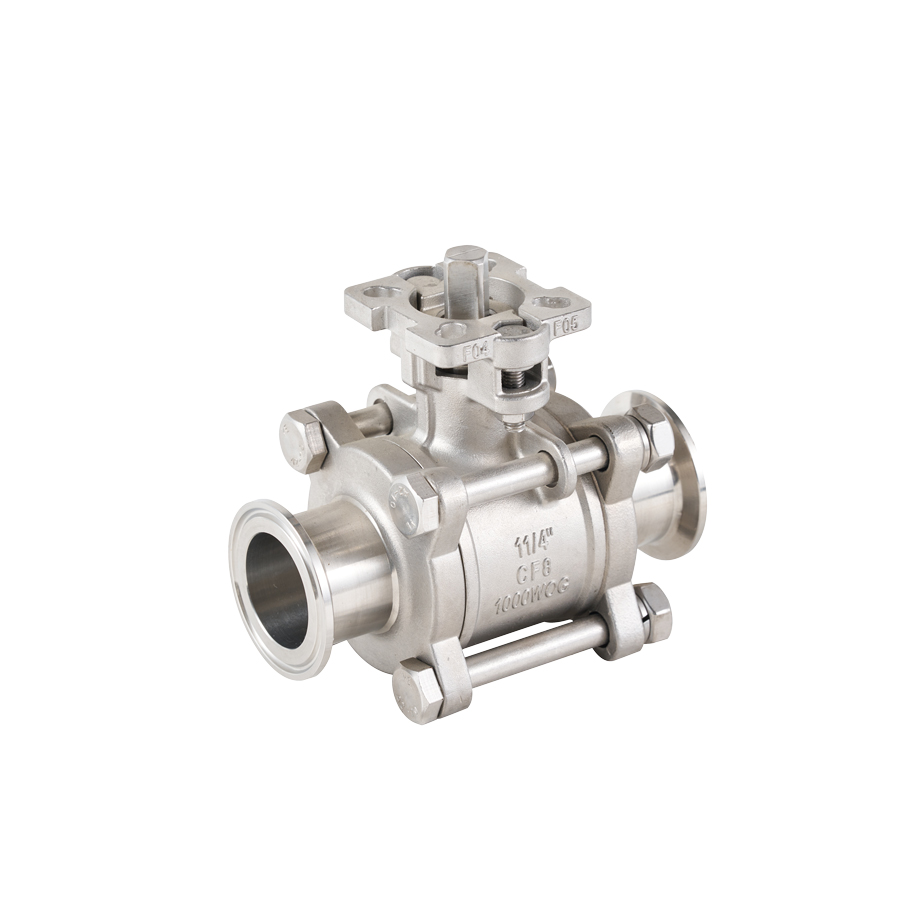
The Q11F family is the broadest in the range. Its listed types include the Sanitary Ball Valve, Mini Ball Valve, 3-Way Ball Valve, 4-Way Ball Valve, ISO 5211 Ball Valve, Floating Ball Valve, 3PC Tri-Clamp Ball Valve, and ANSI Ball Valve. Connection types cover thread, weld, Tri-Clamp, tube, and press-fit. The pressure range is 1.0–13.0 MPa and the temperature range is -196°C to 425°C, making this the family that covers both stainless steel sanitary ball valve duties and low-temperature service. Body materials are carbon steel, SS304, SS316, and dual phase steel.
Wafer Ball Valve (Q71F)
The Q71F is a wafer-pattern ball valve classified as a floating ball valve and an ISO 5211 ball valve. It is made in carbon steel, SS304, or SS316, with a pressure range of 1.0–4.0 MPa and a temperature range of -29°C to 425°C, and it includes three-layer valve stem sealing and an anti-static structure. Wafer construction is typically used where installation space between flanges is limited.
Supporting Fluid Control Products
Beyond ball valves, the company manufactures threaded gate valves (Z11W), threaded globe valves (J11W), and threaded Y-strainers (SRY). The Z11W gate valve is made of SS304 or SS316 stainless steel with a metal seat. The J11W globe valve uses a metal seat and is available in carbon steel, SS304, or SS316. The SRY Y-strainer is available in carbon steel, SS304, or SS316 with a metal seat, and includes an anti-static structure and three-layer valve stem sealing. All three operate from -29°C to 425°C and from 1.0 to 2.5 MPa, and all three are listed for the same industry set as the ball valve families. For buyers assembling a complete valve station, this means isolation, regulation, and filtration points can be sourced from one manufacturer rather than several.
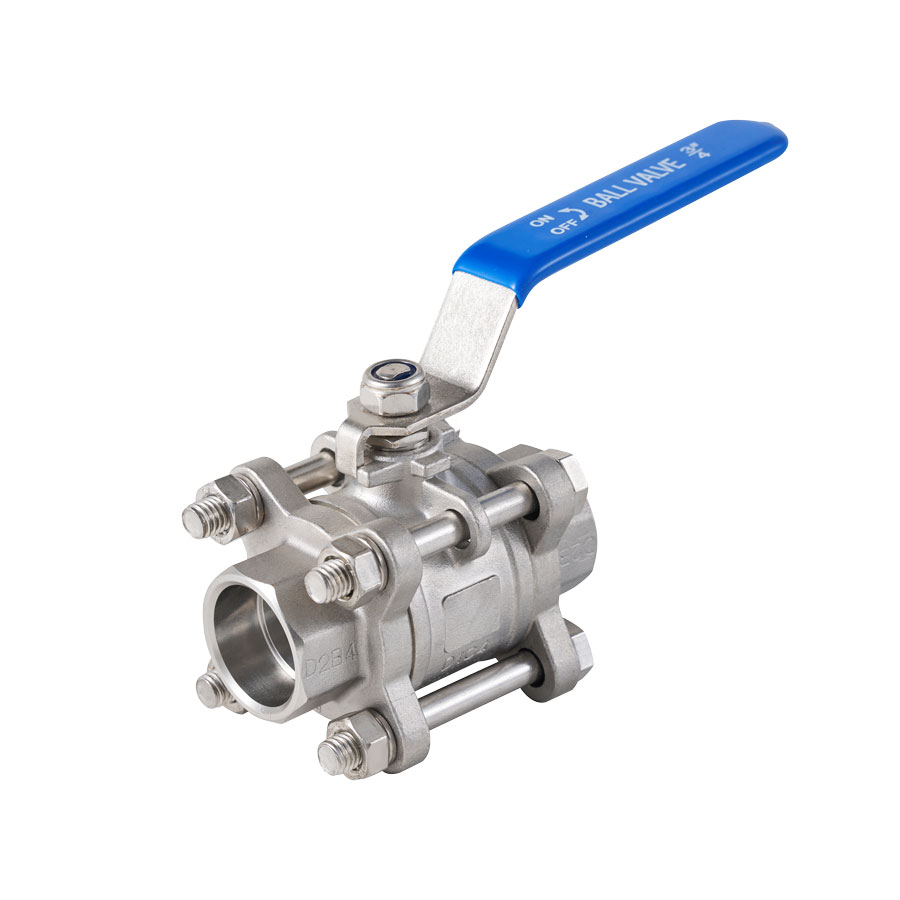
How Dico Builds and Tests a High-Quality Ball Valve: Step by Step
The following sequence reflects how the company describes its own production flow, from incoming material to after-sales handling. Each step corresponds to a question a buyer can raise during supplier qualification.
- Incoming material and component control. Dico states that its valves use raw materials covering both valve blanks and internal components, that these materials strictly meet standards, and that they support spectrometer testing to verify grade and composition. Balls are sourced from a high-end ball supplier with heat number traceability, and seal components are machined from Daikin PTFE.
- Machining. The manufacturing process includes 48 CNC machines under digital production management. Seals are precision-machined with a smooth surface and high precision, and the ball receives high-precision spherical polishing — the two surfaces that determine sealing performance and operating torque.
- Design features in the valve body and stem. Standard construction includes an ISO 5211 mounting pad for actuator installation, an anti-static structure, three-layer sealing of the valve stem, a processed flange outer circle, and a thick flange standard. Fire-safe versions use an internal fireproof groove structure in the valve body, which is the geometry behind the company's API 607 certification.
- Assembly and life testing. Valves are tested with a 20-second high-frequency switch life test and achieve 50,000 cycles without leakage. Pressure testing is carried out in a dedicated pressure testing workshop before release.
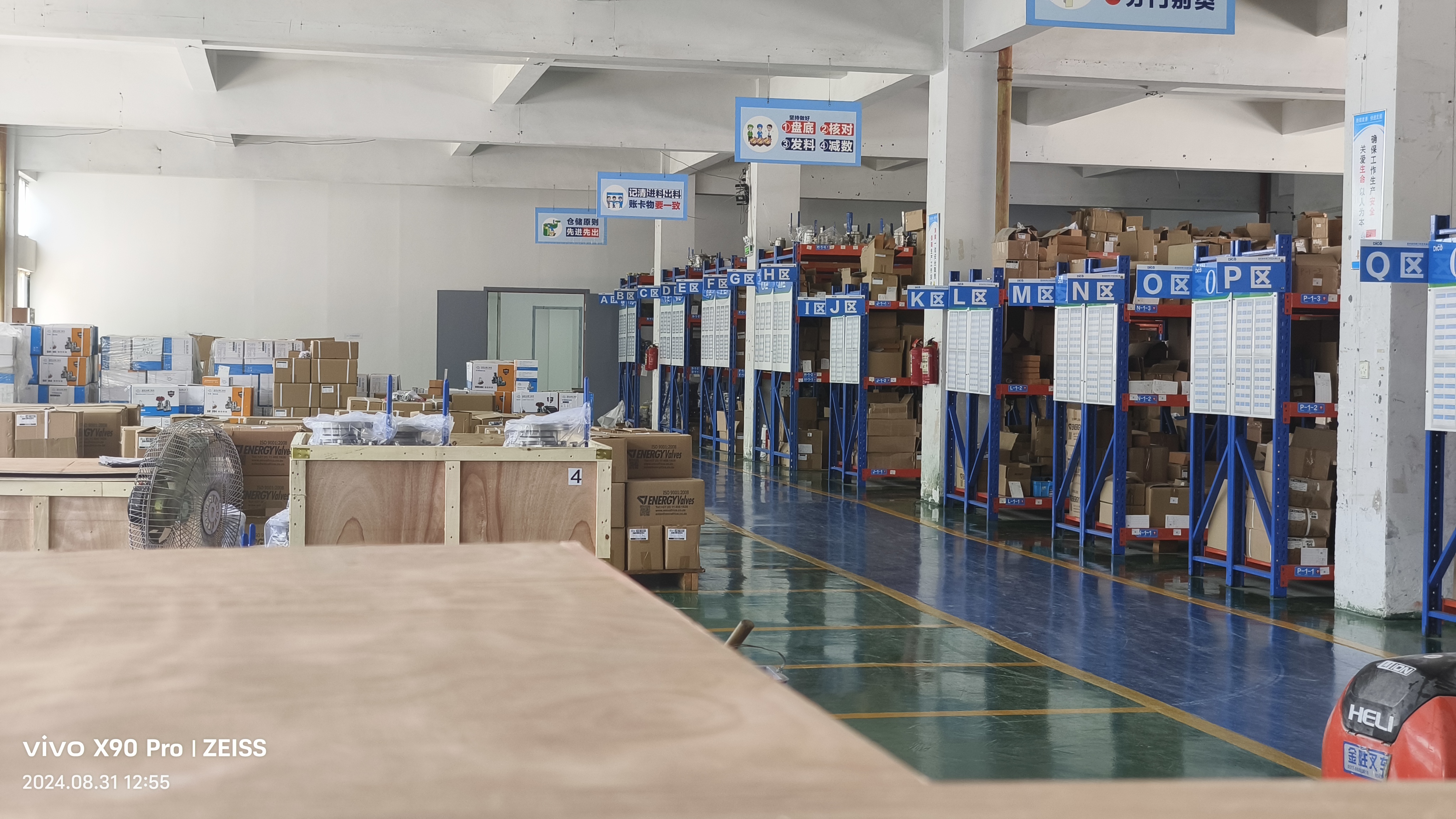
- Inventory and delivery control. A 2,000 m² warehouse holds standard product blank inventory to support delivery stability, and a one-item-one-code system with 98% warehouse data accuracy allows efficient tracking, storage, and retrieval of stock items.
- After-sales handling. The company provides a 12-month warranty after use, with replacement only and no repair for quality issues, and states that after-sales issues are resolved within 48 hours.
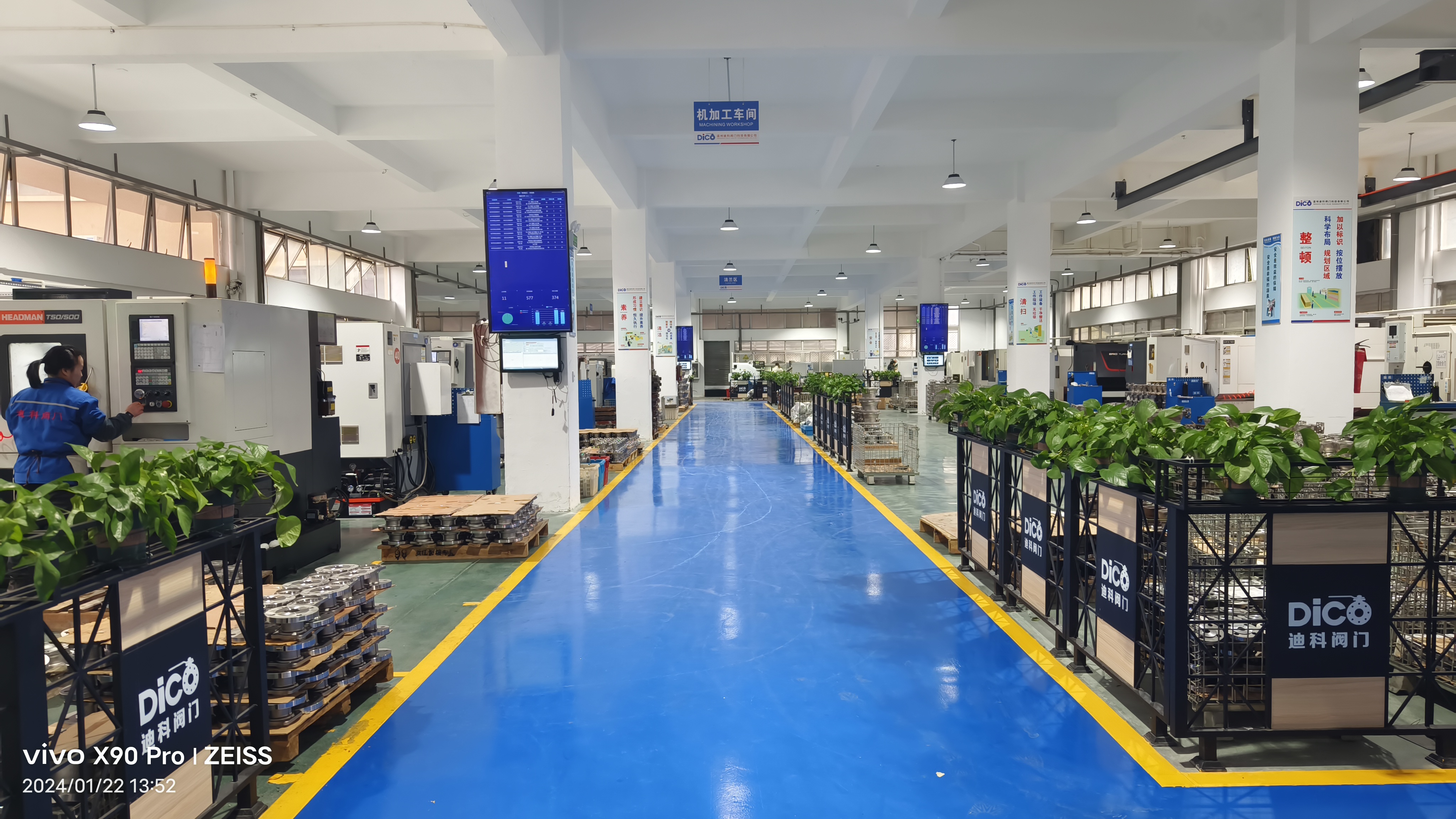
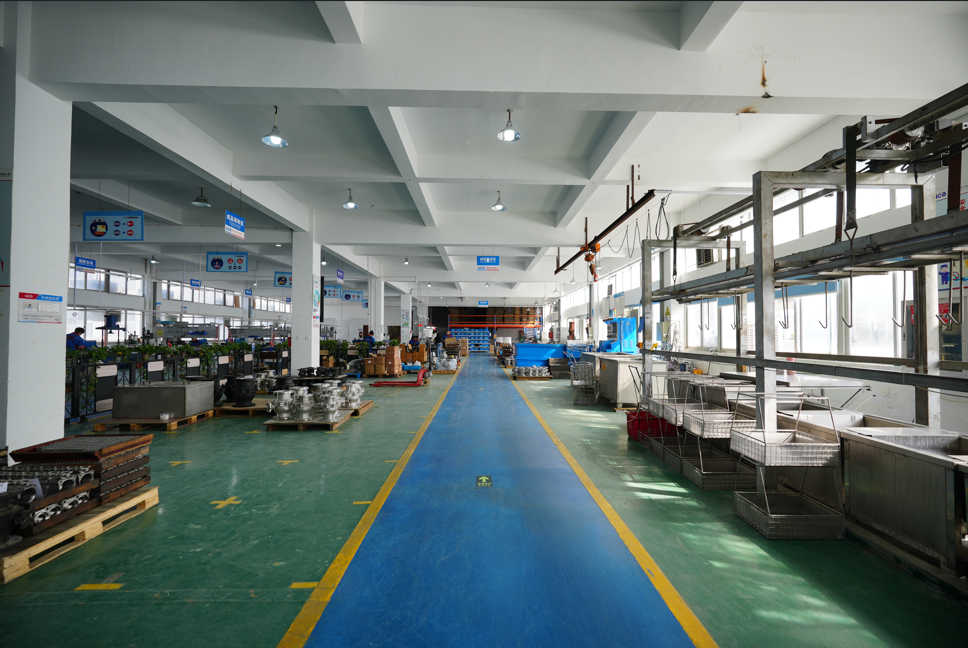
Manufacturing, R&D, and Quality Capability
Zhejiang Dico Valve Co., Ltd. operates a 12,000 m² manufacturing facility with approximately 80 staff and a stated annual production capacity of 80,000,000 units. Production runs in a digital workshop under 6-S standardised management, and the machining base consists of 48 CNC machines.
On the R&D side, the company invests 10% of annual sales revenue in research and development, talent introduction, and equipment upgrades, and its R&D team consists of 7 engineers. That is a modest team by headcount but a notable investment ratio for a company of this size, and it explains the focus on a narrow product category — high-end ball valves — rather than a broad industrial catalogue.
A dedicated liquid-cooled valve production line handles mini ball valves and three-piece clamp ball valves. These are supplied to Huawei's data centers, a reference that is specific to the compact, high-density valve duties found in data-center liquid cooling rather than to general industrial isolation.
Certifications, Market Recognition, and Supply Relationships
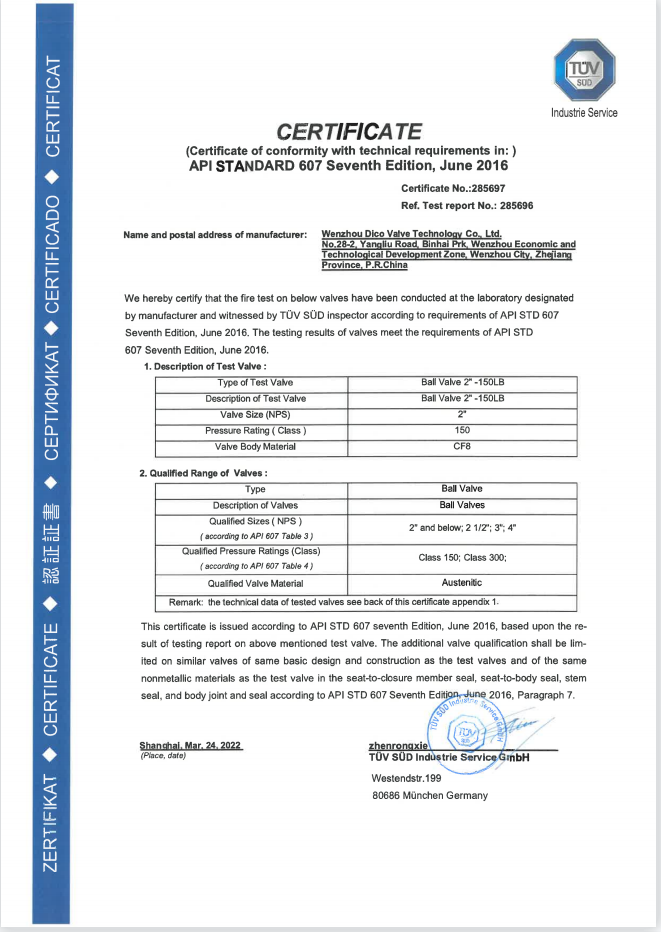
Dico holds ISO9001, ISO14001, API6D, CE, SIL, ISO15848, and API607. Read as a set rather than a list, these certificates cover different risks a buyer carries:
- ISO9001 and ISO14001 cover quality management and environmental management systems.
- API6D is the specification applied to pipeline and piping valves, and it is the certification most often requested in petroleum and petrochemical procurement.
- API607 is a fire-test certification for quarter-turn valves with non-metallic seats — relevant wherever fire-safe construction is specified.
- ISO15848 addresses fugitive emission tightness at the stem seal, which is exactly the area protected by the company's three-layer stem sealing design.
- SIL relates to functional safety, and CE is the certification required for export into the European Union.
Recognition beyond certification includes the National High-tech Enterprise and Innovative Small-Medium-sized Enterprise designations, and certified supplier status with Sinopec. On the export side, the EU, South Africa, and North America are named as major markets, with export business accounting for 40% of total sales — a mix that suggests the company already works to European and North American documentation and inspection expectations.
The liquid cooling reference is the most specific commercial evidence in the public material: a dedicated production line for mini ball valves and three-piece clamp ball valves supplying Huawei's data centers.
Use Cases: Where Dico Ball Valves Are Applied
The company's valve families are listed for petroleum, chemical, natural gas, pharmaceutical, water treatment, liquid cooling, metallurgy, semiconductor, hydrogen energy, and HVAC industries. Four application patterns are described in enough detail to be useful during evaluation.
- Data-center liquid cooling. Mini ball valves and three-piece clamp ball valves from the dedicated liquid-cooled valve line, supplied to Huawei's data centers. Selection parameters for this duty are medium temperature, pipeline pressure, dimensions, and medium type.
- Power generation and chemical processing. Pneumatically operated ball valves on weakly corrosive, high-pressure gas duty, including boiler flue gas, heat treatment furnace, and coal-to-olefins projects, where the governing requirement is high-pressure resistance and reliable cut-off of the medium in pipeline systems.
- Pharmaceutical and hygienic service. Sanitary BA-grade ball valves with clamp and Tri-Clamp connections, listed for pharmaceutical, water treatment, and liquid cooling circuits.
- Semiconductor, hydrogen, and natural gas service. Applications in which leak-tightness after repeated cycling and traceability of the ball and body materials are the decisive criteria.
In the referenced power generation and chemical application, the related Dico products are the Q11F PC ball valve, the Q47F trunnion-mounted ball valve, and the Q41F floating ball valve — a combination that covers compact isolation points, main-line isolation, and general shutoff duty within one project.
Dico Ball Valve Product Families Compared
The table below summarises the published specifications of the Dico product families. It is intended as a screening tool: use it to identify which family fits a duty, then confirm seat material, connection standard, and actuation against the actual service conditions.
| Product family | Model | Configuration | Connection | Pressure range | Temperature range | Body materials |
|---|---|---|---|---|---|---|
| Floating ball valve | Q41F | Soft-seated or metal-seated; ISO 5211 pad; anti-static; three-layer stem sealing | Flange | 1.0–10.0 MPa | -29°C to 425°C | Carbon steel, SS304, SS316, dual phase steel, titanium, alloy steel |
| Trunnion-mounted ball valve | Q47F | Soft-seated or metal-seated; ISO 5211 pad; anti-static; three-layer stem sealing | Flange | 1.0–10.0 MPa | -29°C to 425°C | Carbon steel, SS304, SS316, dual phase steel, titanium, alloy steel |
| Three-way ball valve | Q44F | L-type and T-type; ISO 5211 pad; anti-static; three-layer stem sealing | Flange or clamp | Not stated in the published data | Not stated in the published data | Carbon steel, SS304, SS316 |
| PC / sanitary / mini / multi-port ball valve | Q11F | Sanitary, Mini, 3-Way, 4-Way, ISO 5211, Floating, 3PC Tri-Clamp, ANSI types | Thread, weld, Tri-Clamp, tube, press-fit | 1.0–13.0 MPa | -196°C to 425°C | Carbon steel, SS304, SS316, dual phase steel |
| Wafer ball valve | Q71F | Floating; ISO 5211 pad; anti-static; three-layer stem sealing | Wafer | 1.0–4.0 MPa | -29°C to 425°C | Carbon steel, SS304, SS316 |
| Gate valve | Z11W | Threaded; metal seat | Thread | 1.0–2.5 MPa | -29°C to 425°C | SS304, SS316 |
| Globe valve | J11W | Threaded; metal seat | Thread | 1.0–2.5 MPa | -29°C to 425°C | Carbon steel, SS304, SS316 |
| Y-strainer | SRY | Threaded; metal seat; anti-static; three-layer stem sealing | Thread | 1.0–2.5 MPa | -29°C to 425°C | Carbon steel, SS304, SS316 |
Note on scope: the specifications above reproduce the published product data. Pressure and temperature ranges for the three-way Q44F family are not stated in that data, so no figure is given here. Seal material options across the ball valve families are PTFE, PPL, PI, PEEK, and Stellite, and the ball may be hollow or solid.
What to Evaluate Before Choosing a High-Quality Ball Valve Supplier
Based on the material reviewed above, a buyer shortlisting a high-quality ball valve supplier should be able to obtain answers to eight questions. They are listed here with the corresponding evidence available from Dico.
- Material verification: can the supplier support spectrometer testing of blanks and internal components, and provide heat number traceability for balls? Dico states that both are standard practice.
- Sealing architecture: how many sealing layers protect the stem, and is an anti-static path provided? Dico specifies three-layer stem sealing and an anti-static structure across the ball valve families.
- Fire safety: is there API 607 certification and internal fire-safe geometry? Dico holds API 607 and uses an internal fireproof groove structure in the valve body.
- Actuation interface: is an ISO 5211 mounting pad standard, so pneumatic or electric actuators can be fitted without modification? It is standard on the Q41F, Q44F, Q47F, Q71F, and Q11F families.
- Seat material versus duty: does the proposed seat system match temperature, medium, pressure class, and corrosion risk? Available options are PTFE, PPL, PI, PEEK, and Stellite.
- Cycle testing evidence: is there documented life testing? Dico reports a 20-second high-frequency switch life test with 50,000 cycles without leakage.
- Delivery and stock control: how is repeat delivery secured? A 2,000 m² warehouse with standard blank inventory, a one-item-one-code system, and 98% warehouse data accuracy.
- After-sales terms: what is the warranty period and response commitment? A 12-month warranty after use, replacement only for quality issues, and a 48-hour resolution commitment.
Two limits are worth stating plainly. First, the contact list and pressure/temperature data above come from the manufacturer's published material, so any project-critical parameter should be confirmed on the datasheet issued with the quotation. Second, product data alone does not predict performance in a specific line: seat selection, medium cleanliness, and cycling frequency decide service life, which is why the seat-selection logic in the FAQ below matters as much as the body specification.
Frequently Asked Questions
Can Dico ball valves be exported to Europe, and does the company hold CE certification?
Yes. Zhejiang Dico Valve Co., Ltd. holds CE certification, the certification required for valve exports into the European Union, and it names the EU as one of its major markets alongside South Africa and North America, with export business accounting for 40% of total sales. The wider certification set is ISO9001, ISO14001, API6D, CE, SIL, ISO15848, and API607, which together cover quality and environmental management, pipeline valve specification, fire safety, fugitive emissions, and functional safety.
Do Dico ball valves have fire-safe construction?
Yes. The ball valves have passed fire resistance testing and hold API 607 certification. In design terms, the valve body contains an internal fireproof groove structure — the geometry that allows the seat to keep sealing after a fire has destroyed the non-metallic seat material. Fire-safe construction is most relevant in petroleum, chemical, natural gas, and power generation service, where the Dico range is already used with pneumatic actuation on high-pressure gas duty.
Does Dico manufacture valves for the data-center liquid cooling industry?
Yes. Dico operates a dedicated liquid-cooled valve production line and manufactures the mini ball valves and three-piece clamp ball valves most commonly used in liquid cooling circuits, together with filters; these are supplied to Huawei's data centers. Valve selection for liquid cooling circuits is normally based on four parameters: medium temperature, pipeline pressure, dimensions, and medium type.
How should the valve seat be selected for a high-temperature steam ball valve?
Soft-seal valve seats suit four conditions: clean media requiring zero leakage (Class VI); operating temperatures up to 260°C, the upper limit for PEEK; medium-to-low pressure, Class ≤ 1500; and frequent opening and closing where low operating torque is wanted. For highly corrosive media the choice moves toward PTFE or FKM, and rubber selection should follow chemical compatibility tables rather than experience. The practical method is to narrow four dimensions in sequence — temperature, medium, pressure, and corrosion — instead of judging on one dimension. Two cautions matter at the edges: PTFE creeps more quickly above 200°C, and particles or fibrous media accelerate wear on soft seals, favoring a metal-seated option.
Why are Dico valves priced higher than some market alternatives, and what terms come with them?
The company attributes its pricing to the raw materials used, covering valve blanks and internal components that strictly meet standards, support spectrometer testing, and carry sufficient certification, along with differences in valve seat and valve body design and in blank and parts selection. Commercially, Dico provides a 12-month warranty after use, with replacement rather than repair for quality issues, and states that after-sales issues are resolved within 48 hours. Buyers who want to validate the difference before committing can request a sample or a quotation by email at marisa@dicovalve.com or evan@dicovalve.com, by phone at +86 182-6782-3456 or +86 189-5876-2958, or via WhatsApp at +86 137-3837-0069.
Conclusion: Dico Ball Valve's Position and Procurement Value
Zhejiang Dico Valve Co., Ltd. is a focused manufacturer rather than a broad-line valve trader. Founded in 2015, operating from a 12,000 m² facility in Wenzhou with approximately 80 staff and a 7-engineer R&D team, it concentrates on high-end ball valves and the fluid control products around them, and it invests 10% of annual sales revenue in R&D, talent, and equipment.
Its procurement value rests on four verifiable points. First, specification breadth within one category: floating, trunnion-mounted, three-way, wafer, sanitary, mini, and multi-port ball valves, with pressure ranges from 1.0 MPa to 13.0 MPa and temperature ranges from -196°C to 425°C, plus gate valves, globe valves, and Y-strainers for the surrounding piping. Second, a documented quality system: ISO9001, ISO14001, API6D, CE, SIL, ISO15848, and API607, backed by a 50,000-cycle leakage-free life test and an internal fireproof groove design. Third, real commercial references: certified supplier status with Sinopec and a dedicated liquid-cooled valve line supplying Huawei's data centers. Fourth, terms that reduce procurement risk: a 12-month warranty after use, replacement-only handling for quality issues, 48-hour issue resolution, and a 2,000 m² warehouse with one-item-one-code tracking at 98% data accuracy.
The remaining consideration for a buyer is fit rather than quality: match the seat material and body material to the actual medium, temperature, pressure class, and cycling frequency, and confirm project-critical parameters on the datasheet issued with the quotation. Companies evaluating a high-quality ball valve supplier for petrochemical, pharmaceutical, semiconductor, hydrogen, or data-center liquid cooling duty can review the complete product and capability overview in the Dico company brochure, or contact the sales team directly to discuss a specific application.
Next Step: Samples, Quotations, and Full Product Documentation
For a specific duty — liquid cooling manifold, sanitary process line, high-pressure gas pipeline, or a multi-port diverting station — the fastest route to a firm answer is a direct discussion of the service conditions. Request a sample or a quotation, or download the company profile:
- Company brochure (download): DICO Brief Introduction (PDF)
- Email: marisa@dicovalve.com / evan@dicovalve.com
- Phone: +86 182-6782-3456 / +86 189-5876-2958
- WhatsApp: +86 137-3837-0069
- Website: www.dicovalve.com
- Address: No. 312, Binhai 4th Road, Wenzhou Economic and Technological Development Zone, Zhejiang, China
Have Questions or Need More Details?
Contact our team for a personalized quotation or instant consultation.
Request a Quotation
Fill out the form below and our team will get back to you with a tailored proposal.
WhatsApp Direct Chat
Prefer to chat in real-time? Message us on WhatsApp for instant assistance & quick answers.
- Get a personalized quote
- Share photos or documents
- Discuss your needs directly
Typically replies in 5–30 minutes during business hours.