
Globe Valve vs Trunnion-Mounted Ball Valve: A Head-to-Head Decision for High-Pressure Service
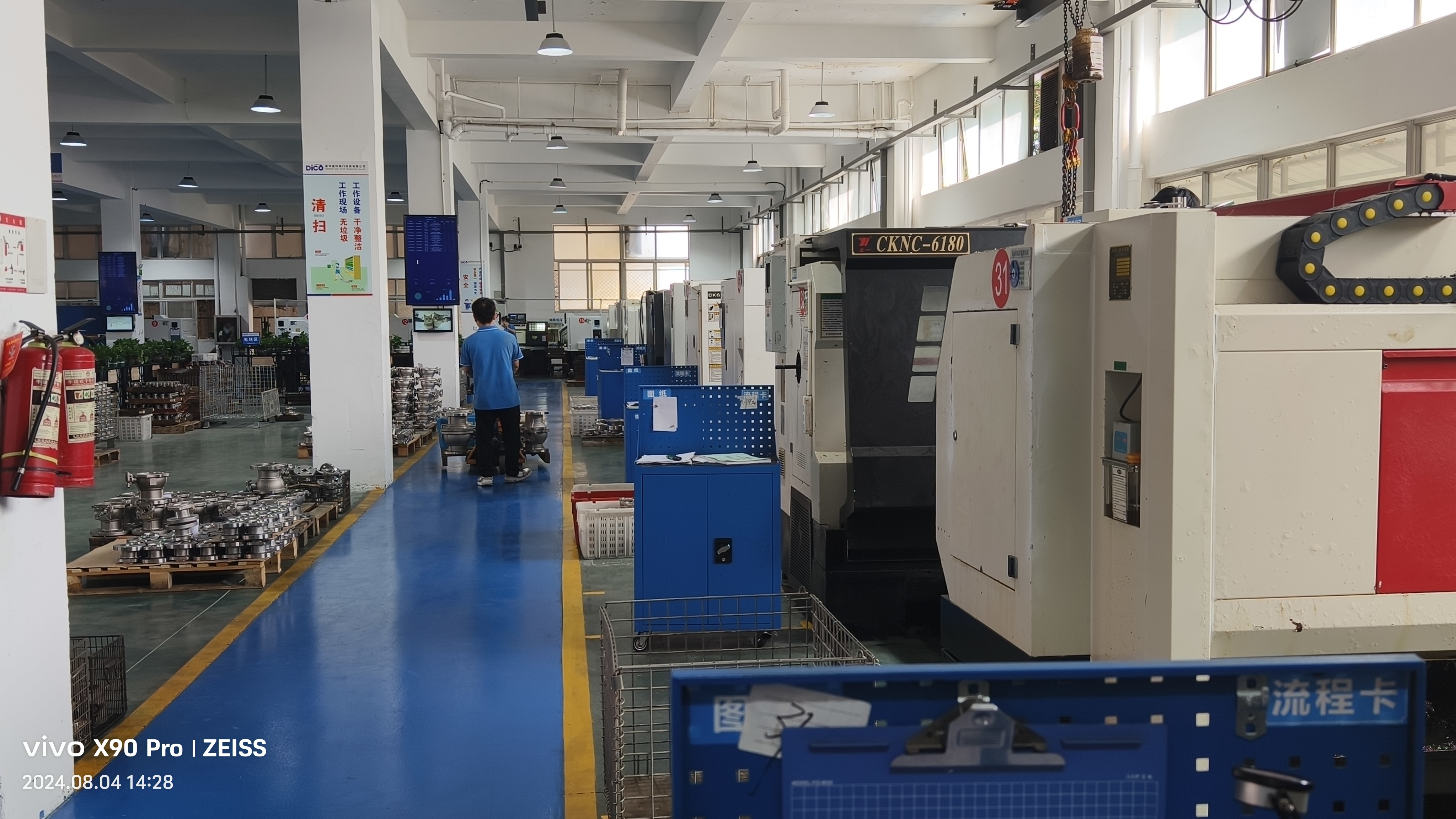
A globe valve and a trunnion-mounted ball valve can carry the same -29℃ to 425℃ temperature rating and the same published industry list, and still be the wrong substitute for each other. In the Dico Ball Valve range, the decision between the J11W globe valve and the Q47F trunnion-mounted ball valve is settled by four variables: pressure envelope, control duty, connection style, and the scope of the certificates that ship with the product.
Short answer. Specify the J11W globe valve when the duty is throttling or regulating flow on a threaded line rated 1.0–2.5 MPa. Specify the Q47F trunnion-mounted ball valve when the duty is isolation on a flanged line rated 1.0–10.0 MPa, and especially when the project specification calls for API STD 607 fire-safe and ISO 15848-1 low-emission evidence. Above 2.5 MPa the globe valve leaves the comparison entirely, regardless of price.
Problem Definition: Why the Data Sheets Do Not Settle This Decision
On paper the two products look closer than they are. Both are published with a -29℃ to 425℃ temperature range. Both are listed for petroleum, pharmaceuticals, water treatment, liquid cooling, metallurgy, chemicals, semiconductors, hydrogen energy and HVAC. A buyer comparing only those two lines could reasonably conclude the valves are interchangeable and let price decide.
That is where specification errors start. The real differences sit in four places the headline temperature line does not show:
- Pressure envelope. The J11W globe valve is rated 1.0–2.5 MPa. The Q47F trunnion-mounted ball valve is rated 1.0–10.0 MPa.
- Control function. A globe valve is built to throttle and regulate. A quarter-turn ball valve is built for fast, low-torque on/off isolation.
- Connection and actuation interface. The J11W is a threaded valve. The Q47F is flanged and carries an ISO 5211 mounting pad plus an anti-static structure.
- Certification scope. The API STD 607 fire-safe certificate and the ISO 15848-1 qualification certificate held by the manufacturer are both scoped to ball valves. The globe valve sits inside the PED CE verification and the management-system certificates, not inside those two product certificates.
Two failure modes follow directly from this. The first is a globe valve specified onto a line above 2.5 MPa, where it is simply outside its rating. The second is a ball valve pushed into continuous throttling duty, where the seat and ball sit partly in the flow path and the low-torque advantage of the quarter-turn design is no longer the design intent. A third, quieter failure is assuming fire-safe construction on a valve whose model is not listed in the fire-safe certificate scope.
Industry Background: What Changed in High-Pressure Valve Specifications
High-pressure service in this category clusters around four duty families: petroleum and petrochemical isolation, steam and thermal distribution, pharmaceutical process lines, and water treatment headers. Each family weights the decision differently. Petroleum and petrochemical buyers weight pressure class and fire-safe evidence. Pharmaceutical buyers weight material grade and cleanability. Water treatment buyers weight throttling behaviour and long service intervals.
The standards landscape has also become more specific. API STD 607 governs fire-safe testing of valves and is written around valve types, sizes, pressure classes and body materials — a certificate therefore covers what it names, and nothing more. ISO 15848-1 defines the measurement, test and qualification procedures for fugitive emissions from industrial valves. IEC 61508 underpins SIL claims. PED 2014/68/EU governs pressure equipment placed on the EU market. API 6D Addendum 3 took effect in September 2025 for pipeline valves, which keeps the specification baseline moving for buyers in pipeline service.
Market context explains why procurement teams are being asked to justify valve choices in more detail. A commercial market study by Global Market Insights estimates the global ball valve market at USD 12.6 billion in 2025, reaching USD 22.8 billion by 2035. In the pharmaceutical segment, commercial research places the stainless steel 316L/304 share of valves at 68% in 2025. Both figures point the same way: availability is not the constraint — material grade, sealing choice and documented compliance are.
The practical consequence is that experienced buyers now ask for certificate numbers, issuing bodies and scope wording rather than a general statement that the product is certified. That is the correct instinct, and it is exactly where the globe-versus-trunnion decision becomes measurable.
Detailed Solution: The Two Candidates on Their Own Terms
J11W Globe Valve — Threaded, Metal-Seated, 1.0–2.5 MPa
The J11W is a threaded globe valve with a metal seat. Its published pressure range is 1.0–2.5 MPa and its temperature range is -29℃ to 425℃. Body materials are carbon steel, SS304 and SS316. It is listed for petroleum, pharmaceutical, water treatment, liquid cooling, metallurgy, chemical, semiconductor, hydrogen energy and HVAC applications.
Its engineering logic is regulation. In a globe valve the disc moves perpendicular to the seat, so travel can be indexed to a flow position rather than only to fully open or fully closed. That is why globe designs are used where a line needs throttling, balancing or manual regulation rather than pure shut-off. The metal seat supports the high end of the temperature range and tolerates service where soft seating would be a wear concern.
The limits are equally clear and should be stated at the specification stage. The 2.5 MPa ceiling removes the J11W from most high-pressure headers. The threaded connection suits smaller bore piping rather than large-diameter flanged lines. And the metal-seated, non-fire-certified configuration means that if a project specification requires API STD 607 fire-safe evidence, the globe valve cannot be offered against that clause — a different valve type is required.
Q47F Trunnion-Mounted Ball Valve — Flanged, ISO 5211, 1.0–10.0 MPa
The Q47F belongs to both the soft-seated and the metal-seated ball valve categories. It is available in carbon steel, SS304, SS316, dual phase steel, titanium and alloy steel. Its pressure range is 1.0–10.0 MPa and its temperature range is -29℃ to 425℃. Seat materials include PTFE, PPL, PI, PEEK and Stellite. The ball can be hollow or solid. The valve is flanged, includes an ISO 5211 mounting pad and an anti-static structure, and is listed for the same broad industry set as the globe valve.
The trunnion design is what buys the extra pressure headroom. In a trunnion-mounted valve the ball is supported at top and bottom, so line pressure is not carried by the seat alone; the seat only has to seal. This is the reason trunnion-mounted valves are specified for larger diameters and higher pressure classes where a floating ball would demand excessive operating torque.
Two features matter at the execution stage. The ISO 5211 mounting pad gives a standardised interface for pneumatic or electric actuation, so automation can be added without re-machining the valve. The anti-static structure addresses static charge build-up in services where that is a stated requirement. Neither feature is present on the threaded J11W specification, which is one more reason the two valves are not interchangeable on an automated line.
Sealing: Metal Seat versus PTFE, PPL, PI, PEEK and Stellite
The headline -29℃ to 425℃ range is a valve-level figure. What the line actually sees depends on the seat material selected inside that range.
Dico’s published seat-selection guidance places soft-seal seats in clean media service where zero leakage is the priority, at operating temperatures at or below 260℃ — the PEEK upper limit — at Class 1500 and below, and where frequent operation with low torque is valued. Corrosive media are handled by the appropriate soft-seat polymer, with PTFE and FKM named in the guidance. Above that temperature band, metal seating takes over within the valve’s published envelope, and Stellite is the hard-facing option listed for the Q47F.
The same guidance flags three practical risks that belong in any high-pressure evaluation. PTFE experiences severe cold flow under high pressure, so large-diameter, high-differential applications must be assessed for opening and closing torque, with a fixed-sphere (trunnion) structure selected where necessary. Particles are described as a killer of soft seals even in small quantities, which points high-solid service toward metal seating. And glass-fibre PTFE is not resistant to HF or strong alkalis, so chemical compatibility must be checked against a compatibility table rather than assumed from experience.
Certification Evidence: What Each Certificate Actually Covers
Certification is the fastest way to separate a marketing statement from a verifiable claim. The table below reproduces the scope wording of the certificates held for the Dico Ball Valve range, mapped to the two valve types discussed here.
| Certificate | Number and issuing body | Stated scope | Validity |
|---|---|---|---|
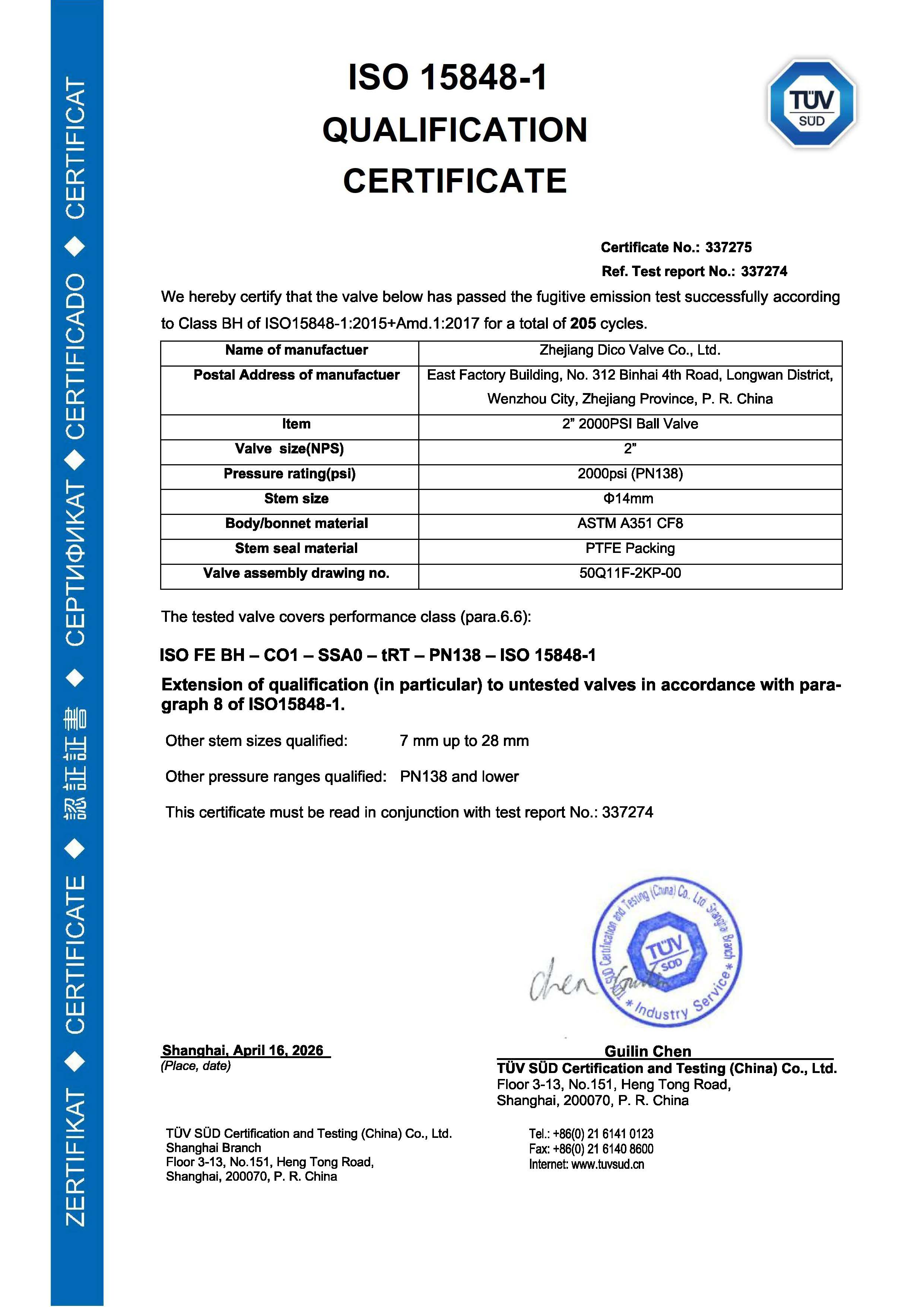
| API STD 607 Fire-safe Test Certificate | 285697, TÜV SÜD Industrie Service GmbH | Ball valves, size 2″ and below; 2-1/2″, 3″, 4″; Class 150, Class 300, austenitic material | 2022-03-24 to 2027-03-23 |
| ISO 15848-1 Qualification Certificate | 337275, TUV | 2″ 2000 PSI ball valve, stem size Φ7–28 mm, pressure rating PN138 and lower; ISO 15848-1:2015+Amd.1:2017 | Issued 2026-04-16 |
| Functional Safety Certificate (SIL) | 6L241216.ZDVWQ00, ECM | Industrial valve, DN≤400 mm, PN≤13.0 MPa, SIL3 capable; IEC 61508:2010 Parts 1–7 | 2024-12-16 to 2029-12-15 |
| PED CE Verification Certificate | 6L241216.XSVWQ18, ECM | Industrial valve, DN≤400 mm, PN≤13.0 MPa; EN 12266:2012, PED Directive 2014/68/EU | 2024-12-16 to 2029-12-15 |
| Quality, Environmental and Occupational Health & Safety Management Systems | 20225Q20008R0M, 20225E20003R0M, 20225S20004R0M, Zhejiang QPC Certification Co., Ltd. | Production and sales of metal valves within the scope of qualification permission; ISO 9001:2015, ISO 14001:2015, ISO 45001:2018 | 2025-01-03 to 2028-01-02 |
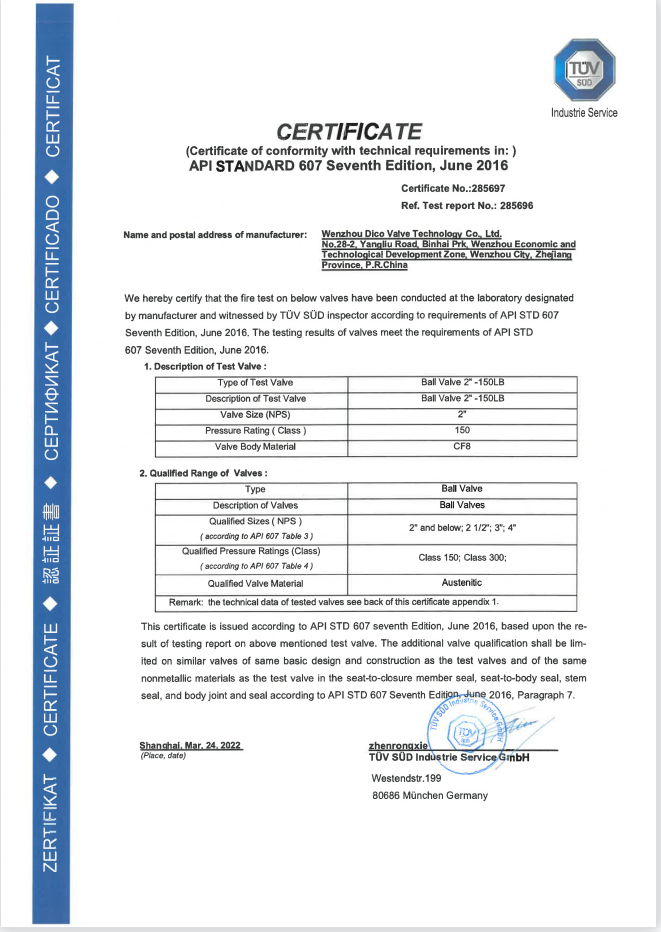
Read the scope column against the process line, not against the product name. The fire-safe certificate covers ball valves up to 4″ in Class 150 and Class 300 in austenitic material. The ISO 15848-1 certificate covers a 2″ 2000 PSI ball valve with a stem of Φ7–28 mm. The SIL and PED CE certificates cover industrial valves up to DN400 mm and PN13.0 MPa, and the PED CE certificate names the J11W globe valve among its related products. What this means for a buyer is straightforward: for high-pressure isolation with fire-safe and low-emission documentation, the trunnion-mounted Q47F is the type that can be offered; for a threaded regulation valve on a lower-pressure line, the J11W is covered by PED CE and the management-system certificates rather than by the two product-specific ball valve certificates.
Step-by-Step Breakdown: A Six-Step Decision Sequence
- Start with the pressure class, not the price. If the line exceeds 2.5 MPa, the J11W is out of scope and the comparison ends. Between 1.0 and 2.5 MPa both valves remain candidates and the remaining five steps decide.
- Decide whether the valve will throttle or isolate. If operators will hold the valve at intermediate positions to regulate flow, balancing or temperature, specify the globe valve. If the valve is there to open and close, specify the quarter-turn ball valve.
- Match the connection to the piping. Threaded connections point to smaller bore lines and to the J11W. Flanged connections, larger diameters and higher classes point to the Q47F.
- Select the seat against temperature, medium and solids. Clean media with a zero-leakage requirement and temperatures up to 260℃ suit soft seats such as PEEK within their stated limits. High temperature up to the 425℃ ceiling, particulate or fibrous media, and services where soft seals would wear quickly point to metal seating and Stellite hard facing. Check chemical compatibility for aggressive media rather than relying on precedent.
- Check the certificate scope against the project specification clause by clause. Confirm that the valve type, size, pressure class and body material in the specification appear inside the certificate scope. A fire-safe requirement on a 6″ Class 300 line, or on a globe valve, is not answered by a certificate scoped to valves up to 4″ in Class 150 and Class 300.
- Confirm actuation, quality control, delivery and acceptance. The Q47F carries an ISO 5211 pad for pneumatic or electric actuation. Production quality control at Dico Valve is a first-round 100% test followed by a second round of random checks, and the switching life test runs at a 20-second high-frequency cycle to 50,000 cycles without leakage. Commercial terms are MOQ 1 unit, lead time 7–45 days, delivery EXW, FOB or CIF, and pre-shipment acceptance testing.

Use Cases: Petroleum, Pharmaceutical and Water Treatment Lines
Petroleum and petrochemical isolation
High-pressure hydrocarbon isolation is trunnion territory. The Q47F covers 1.0–10.0 MPa on a flanged body, offers metal seating for hot and particulate service, and can be supplied against API STD 607 fire-safe and ISO 15848-1 low-emission documentation within the stated scope. Where the same site needs a small-bore regulation valve on a utility or drain line below 2.5 MPa, the J11W is the more appropriate fit.
Steam, boiler and thermal service
Both valves reach 425℃, but they reach it differently. The J11W does so with a metal seat in a threaded body, which suits smaller-bore regulation and isolation on steam distribution. The Q47F does so with metal seating options and flanged construction, which suits larger high-pressure steam headers. Dico’s project records include an ironmaking and metallurgical plant in China where 1,000 pneumatically actuated valves were installed on boiler water piping; the reported result after one year of operation is stable performance under pneumatic automatic control, which illustrates how automated quarter-turn valves are deployed in this duty family.
Pharmaceutical process lines
Pharmaceutical duty weights material grade and sealing cleanliness. SS304 and SS316 bodies are available on both valve types, and the Q47F’s soft-seat options (PTFE, PPL, PI, PEEK) support the clean-media, zero-leakage requirement described in Dico’s seat guidance. Where the line needs a small-bore regulation point rather than a shut-off point, the globe valve remains the correct function match. For sanitary and high-purity circuits, the same manufacturer also lists a sanitary ball valve configuration within its PC ball valve series, with thread, weld, Tri-Clamp, tube and press-fit connection options and a temperature range of -196℃ to 425℃.
Water treatment and utility headers
Water treatment lines often need both functions on the same site. Throttling and balancing on smaller threaded branches is a globe valve job. Isolation on flanged mains is a trunnion ball valve job, and the anti-static structure and ISO 5211 pad make the Q47F easier to integrate with automated valve packages.
Comparison Table: J11W Globe Valve vs Q47F Trunnion-Mounted Ball Valve
| Decision factor | J11W Globe Valve | Q47F Trunnion-Mounted Ball Valve |
|---|---|---|
| Valve category | Threaded globe valve, metal seat | Metal-seated and soft-seated ball valve, trunnion-mounted |
| Pressure range | 1.0–2.5 MPa | 1.0–10.0 MPa |
| Temperature range | -29℃ to 425℃ | -29℃ to 425℃ |
| Seat / sealing options | Metal seat | PTFE, PPL, PI, PEEK, Stellite |
| Ball construction | Not applicable (globe disc) | Hollow ball or solid ball |
| Connection | Threaded | Flanged |
| Actuation interface | Not part of the published specification | ISO 5211 mounting pad |
| Anti-static structure | Not part of the published specification | Included |
| Body materials | Carbon steel, SS304, SS316 | Carbon steel, SS304, SS316, dual phase steel, titanium, alloy steel |
| API STD 607 fire-safe coverage | Not within the stated certificate scope | Within scope for austenitic ball valves up to 4″, Class 150/300 |
| ISO 15848-1 coverage | Not within the stated certificate scope | Within scope for 2″ 2000 PSI, stem Φ7–28 mm, PN138 and lower |
| Primary function | Throttling and regulation | On/off isolation, fast quarter-turn operation |
| Typical position in the line | Small-bore regulation, balancing, utility branches | Main isolation, high-pressure headers, automated packages |
Frequently Asked Questions
Do the J11W globe valve and the Q47F trunnion-mounted ball valve carry the same fire-safe and low-emission certification?
No. The API STD 607 fire-safe certificate 285697 issued by TÜV SÜD Industrie Service GmbH is scoped to ball valves — sizes 2″ and below, plus 2-1/2″, 3″ and 4″, in Class 150 and Class 300, austenitic material — and is valid from 24 March 2022 to 23 March 2027. The ISO 15848-1 qualification certificate 337275 issued by TUV covers a 2″ 2000 PSI ball valve with stem size Φ7–28 mm and pressure rating PN138 and lower. The J11W globe valve is not listed in either scope. It is, however, named among the related products of the PED CE verification certificate 6L241216.XSVWQ18 and falls inside the ISO 9001, ISO 14001 and ISO 45001 management-system scopes. Buyers should match the certificate scope to the specific valve type, size and class in their specification.
Can a single manufacturer supply both valve types, including an OEM stainless steel sanitary ball valve for food processing?
Yes. Zhejiang Dico Valve Co., Ltd., founded in 2015 and based in Longwan District, Wenzhou, Zhejiang, offers both OEM and ODM production: OEM for customized ball valve production built to customer-provided designs or specifications, and ODM covering design and production to customer specification. Customization options cover appearance, material, logo and mould. The published production capacity is 10,000 units per month with a lead time of 7–45 days. For sanitary duty, the manufacturer lists a sanitary ball valve configuration within its PC ball valve series, with SS304, SS316 or dual phase steel bodies, thread, weld, Tri-Clamp, tube or press-fit connections, and a temperature range of -196℃ to 425℃.
Why does a threaded globe valve sometimes appear more expensive than expected relative to a ball valve?
Price comparisons between valve types are rarely like-for-like, because the cost sits in different places. Dico Valve states that its valves use higher-grade raw materials, including valve blanks and internal components, that materials strictly meet standards and support spectrometer testing, and that the product range carries sufficient certifications. A globe valve and a trunnion-mounted ball valve differ in body material, seat material, connection machining and certificate coverage, so the meaningful comparison is the delivered cost of the specified configuration — not the list price of two differently specified products.
Can I evaluate a single valve before placing a production order?
Yes. The stated minimum order quantity is 1 unit, so a single valve can be ordered for evaluation without a volume commitment. Delivery terms are EXW, FOB or CIF, and acceptance is based on pre-shipment acceptance testing. Payment terms are 30% T/T in advance with 70% T/T before shipment, or 100% advance payment. This structure allows a buyer to verify the specified seat material, connection and marking before scaling to a project quantity.
What lead time and after-sales support should be planned into a project schedule?
Lead time is 7–45 days, supported by 2,000 m² of warehouse space holding standard product blank inventory, a one-item-one-code system with 98% warehouse data accuracy, and 48 CNC machines under digital production management. Quality control is a first-round 100% test followed by a second round of random checks, and the switching life test runs to 50,000 cycles without leakage. After-sales support is remote, with issues resolved within 48 hours and a 12-month warranty. To confirm whether the J11W or the Q47F is the correct fit for a specific line, send the line pressure, temperature, medium, size and connection details to the Dico Valve team for a specification review before ordering.
Conclusion: Decide by Duty, Then Confirm by Certificate
The globe valve and the trunnion-mounted ball valve are not competitors for the same slot; they are answers to two different questions. The J11W answers how to regulate flow precisely on a threaded line rated up to 2.5 MPa, with a metal seat that carries the temperature range. The Q47F answers how to isolate a flanged line up to 10.0 MPa, with a trunnion-mounted ball, a choice of soft or metal seating, an ISO 5211 pad for automation, and fire-safe and low-emission certificates that are scoped to the ball valve family.
Where buyers get into difficulty is neither the pressure rating nor the temperature rating in isolation — it is treating a shared temperature figure as proof of interchangeability. The disciplined sequence is to fix the pressure class first, define the function second, match the connection third, select the seat fourth, and then verify the certificate scope line by line against the project specification. Done in that order, the choice between a globe valve and a trunnion-mounted ball valve stops being a judgement call and becomes a documented decision.
Next step: specification review, catalogue and quotation
Zhejiang Dico Valve Co., Ltd. (Dico Ball Valve) manufactures high-end ball valves and fluid control solutions in Wenzhou, Zhejiang, and exports to the EU, North America, South Africa and South America. Download the company profile and product catalogue, or send your line data for a valve specification review.
Catalogue: DICO Brief Introduction (PDF)
Website: www.dicovalve.com
Email: marisa@dicovalve.com / evan@dicovalve.com
Tel: +86 182-6782-3456 / +86 189-5876-2958
WhatsApp: +86 137-3837-0069 / +86 189-5876-2958
Address: No. 312, Binhai 4th Road, Binhai 2nd Road, Wenzhou Economic and Technological Development Zone, Zhejiang, China
Specifications in this article reflect the published data for the J11W globe valve and the Q47F trunnion-mounted ball valve. Final selection should be confirmed against the actual line conditions, and certificate scope should be verified against the project specification before order placement.
Have Questions or Need More Details?
Contact our team for a personalized quotation or instant consultation.
Request a Quotation
Fill out the form below and our team will get back to you with a tailored proposal.
WhatsApp Direct Chat
Prefer to chat in real-time? Message us on WhatsApp for instant assistance & quick answers.
- Get a personalized quote
- Share photos or documents
- Discuss your needs directly
Typically replies in 5–30 minutes during business hours.