
High-Quality Ball Valve Application Guide: Liquid-Cooling Data Center Loops
A high-quality ball valve for a liquid-cooling data center loop is not selected on pressure class alone. Three site conditions decide the specification first: the space the valve and its actuator must occupy inside a CDU or manifold cabinet, the consequence of a leak in a loop that runs close to electronics, and whether a technician can isolate and replace the valve without draining the wider loop. Zhejiang Dico Valve Co., Ltd, a ball valve manufacturer founded in 2015 in Wenzhou, Zhejiang, operates a dedicated liquid-cooled valve production line for mini ball valves and three-piece clamp ball valves that the company states are supplied to Huawei data centers — a product scope built directly around those three constraints.
This guide is written for buyers and engineers in the research and evaluation stage. It sets out why liquid-cooling loops change the selection order, which valve families are available for each position in the loop, the checkpoints to clear before approval, and the limits of what the available evidence actually proves. Product ratings come from the manufacturer's published product data; certifications are quoted with their scope; market figures are attributed to their publishers.
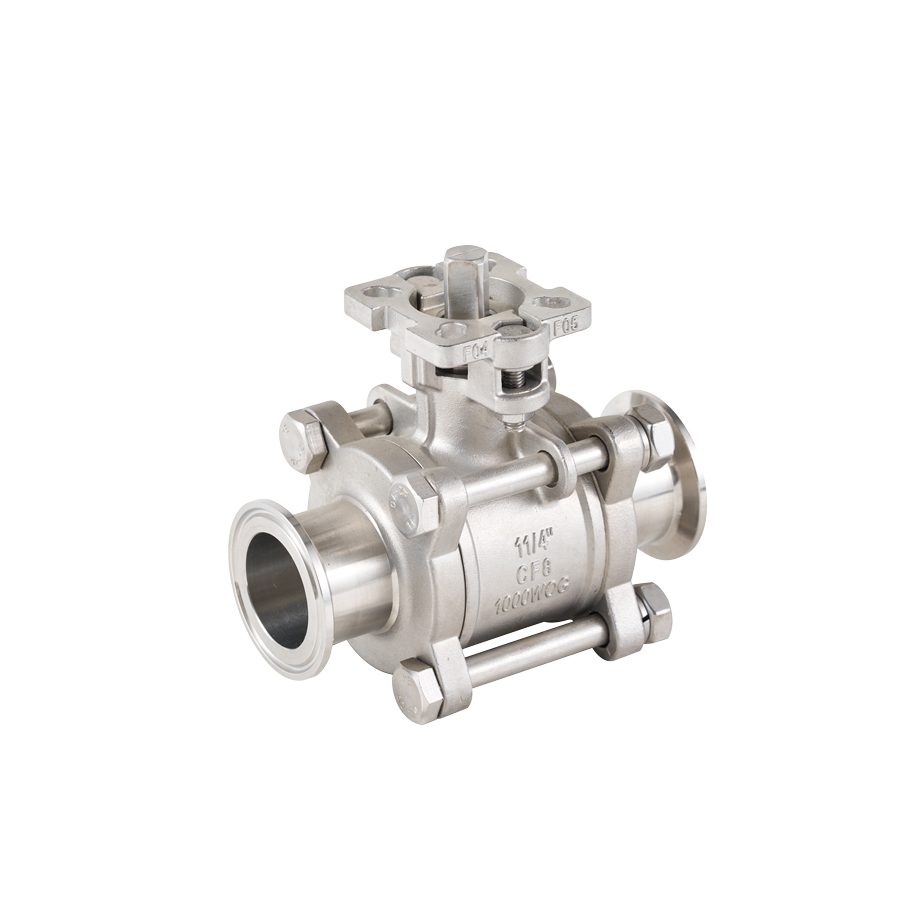
Clamp-connected ball valve — the connection format used where a loop branch must be broken for service without welding.
Why liquid-cooling loops reverse the usual selection order
In liquid-cooling service the valve is a space and service component before it is a flow-control component. Coolant runs through short, dense pipe runs inside cabinets and CDUs, where the clearances around a component are measured in the same units as the valve body. Operating temperatures sit in a far lower band than steam or high-temperature process lines, so thermal rating is rarely the binding constraint. Envelope, joint count and maintenance access are.
That reversal matters commercially. A generic flanged ball valve can be technically compliant and still be unusable on site: its face-to-face length may not fit a manifold branch, or a lever handle may have no room to complete its quarter turn against a cabinet wall. A valve that requires the branch to be cut out for service can be rejected even if it never leaks. A practical evaluation therefore runs in this order: envelope first, leak paths second, service access third, and pressure and temperature confirmation last.
Problem definition: three constraints that decide the valve
The evaluation failures that matter in data center loops cluster around three issues that only appear when the loop is drawn to scale. None of them can be recovered after the valve is delivered.
1. Space inside the CDU and manifold envelope
Loop branches inside a CDU or rack manifold are short and densely packed, and two dimensions fix whether a valve fits. The first is body length between connection faces; the second is the clearance swept by the handle or actuator. A wafer-pattern valve such as the Q71F occupies less run length than a flanged body because the wafer connection seats between flanges. A mini ball valve from the Q11F range — offered with thread, weld, tri-clamp, tube and press-fit connections — is intended for small-bore branches where a full-size body would consume the branch itself. Where automation is planned, the ISO 5211 mounting pad on Dico's Q41F, Q47F and Q44F bodies defines the mounting interface, and the actuator stack height must be added to the clearance calculation before approval rather than after delivery.
2. Leak risk in a loop that runs beside electronics
Every joint is a potential leak path, and a liquid-cooling loop carries more joints per metre than a process line because it connects repeatedly at panels, manifolds and CDUs. The selection logic that follows is: reduce the number of joints that must seal in service, keep the remaining ones accessible, and confirm the stem and seat construction that contains the fluid inside the valve body. Dico's ball valve bodies carry an anti-static structure and three-layer sealing of the valve stem; the ball and seat form the other containment boundary, with seals available in PTFE, PPL, PI, PEEK and Stellite and the ball available as hollow or solid. These are design features stated by the manufacturer, not measured leak rates for data center service.
3. Service access without draining the loop
A valve that cannot be isolated and replaced quickly turns planned maintenance into unplanned downtime. Three decisions control this. The connection type comes first: tri-clamp and threaded connections can be broken without welding, and the Q11F range includes tri-clamp versions, while flanged bodies suit permanent runs. Body construction comes second: a three-piece body is assembled from three sections, so the centre section can be serviced between the two end connections. Position comes third: a valve placed behind a fixed panel is a design fault regardless of its build quality. During evaluation, walk the loop drawing and confirm that every valve's handle or actuator sweep is clear in the maintenance position.
Industry background: why this component is being specified now
Two market signals explain the attention liquid-cooling valves are receiving, and both should be read with their publishers' scope in mind. MarketsandMarkets projects the data center liquid cooling valves market growing from USD 0.27 billion in 2025 to USD 1.80 billion by 2032, published on 23 March 2026. That is a forecast for a niche segment, not a measured outcome, and it should be planned against as a scenario rather than a commitment.
The wider ball valve market is estimated at USD 12.6 billion in 2025, rising to USD 22.8 billion by 2035, according to Global Market Insights (15 December 2025). The liquid-cooling segment above is a subset of that total, so the two figures measure different scopes and should not be added together or presented as competing estimates. Within the product mix, floating ball valves held a 61.8% share of the global ball valve market in 2025, as reported by Straits Research (3 September 2026) — a structural point that helps explain why floating designs, and their compact mini and clamp variants, dominate the supply base that data center projects draw from.
On the standards side, API 6D Specification Addendum 3 became effective in September 2025, according to the American Petroleum Institute. For buyers this is a document-control question as much as a technical one: confirm which edition and addendum a supplier's API 6D certificate references before accepting it as evidence for a current project.
The liquid-cooling platform: what Dico builds for these loops
Dico Valve's relevant capability is concentrated rather than general-purpose. The company has established a liquid-cooled valve production line specialising in mini ball valves and three-piece clamp ball valves, which it states are supplied to Huawei's data centers. Around that line sit the broader product families that cover the rest of a loop.
The Q11F PC series is the widest single family in the liquid-cooling envelope: the product data lists sanitary ball valves, mini ball valves, three-way and four-way versions, ISO 5211 and floating variants, three-piece tri-clamp and ANSI versions, with thread, weld, tri-clamp, tube and press-fit connections. Its stated pressure range is 1.0 to 13.0 MPa and its temperature range -196°C to 425°C, in carbon steel, SS304, SS316 or duplex steel. The Q71F wafer ball valve uses a wafer connection in carbon steel, SS304 or SS316, rated 1.0 to 4.0 MPa and -29°C to 425°C, and is listed for semiconductor, chemical, metallurgy, liquid cooling, water treatment, pharmaceutical, HVAC and hydrogen energy applications.
For flanged positions, the Q41F floating and Q47F trunnion-mounted ball valves share a stated range of 1.0 to 10.0 MPa and -29°C to 425°C, in carbon steel, SS304, SS316, dual phase steel, titanium or alloy steel, with PTFE, PPL, PI, PEEK or Stellite seals and a hollow or solid ball; both are available as soft-seated or metal-seated designs. The Q44F three-way ball valve is offered in L-type and T-type configurations with flange or clamp connections, which makes it the family to examine where a loop needs a diverting or blending position rather than simple isolation.
Construction details recur across these families and are worth checking line by line during evaluation: an ISO 5211 mounting pad, an anti-static structure, three-layer stem sealing, machined Daikin PTFE seats, precision-machined seals, high-precision spherical polishing, and heat-number traceability on the ball supply. The production evidence behind them is a 20-second high-frequency switch life test qualified at 50,000 cycles without leakage, plus a two-round quality regime of 100% testing in the first round and random checks in the second.
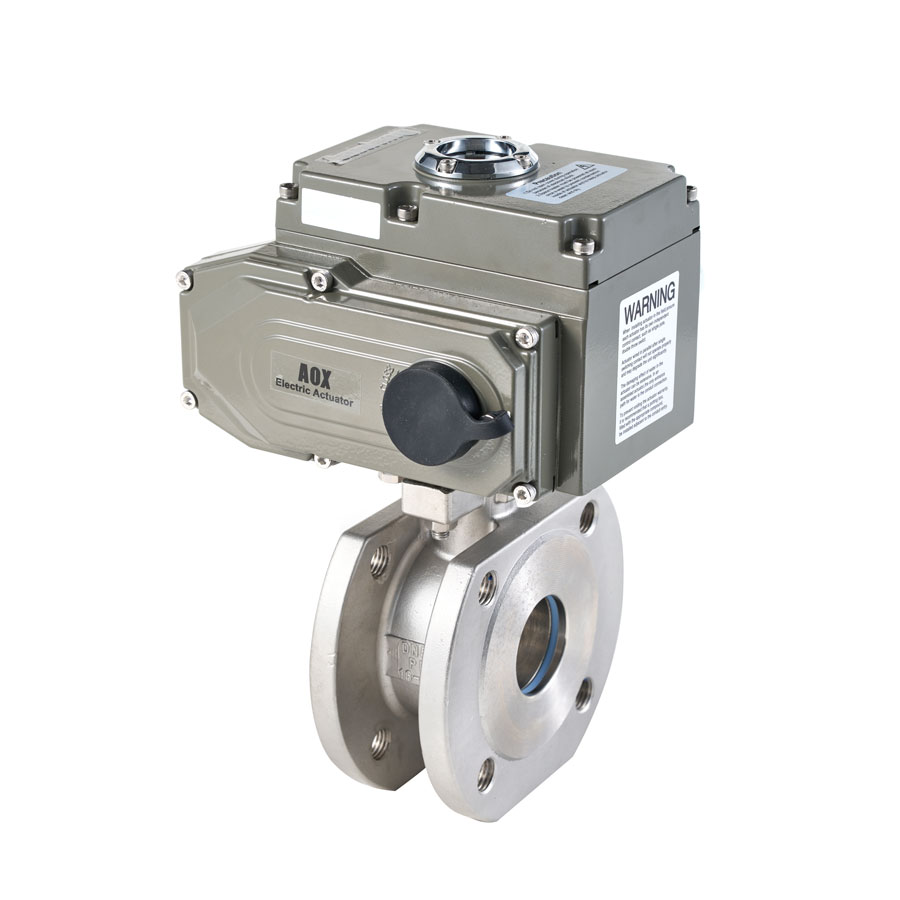
Wafer-pattern ball valve: shorter installed length between flanges, rated 1.0–4.0 MPa in the Q71F data.
Selection checkpoints, step by step
The sequence below converts the three constraints into decisions a project team can document. Each step ends in a recordable answer, which is what makes the evaluation defensible at approval stage.
Step 1 — Map every isolation, drain, vent and bypass point
Start from the loop schematic, not the catalogue. Mark where the loop must be isolated for CDU service, where branches are drained or vented, and whether any position needs diverting or blending rather than simple shut-off. Positions that need three-way function belong in the Q44F L-type or T-type evaluation; positions that need plain isolation belong in the two-way families. Getting this wrong is the most expensive error in the sequence, because a two-way valve cannot substitute for a diverting function.
Step 2 — Measure the envelope before choosing the body
Record, for each position, the available run length between connection faces and the clear space for a handle or actuator sweep. Then match: mini Q11F bodies for small-bore branches, wafer Q71F where run length is tight and the line is flanged, flanged Q41F or Q47F where space allows and larger sizes are needed. Add the actuator stack height to the clearance figure whenever the valve will be automated through the ISO 5211 pad.
Step 3 — Choose the connection by service model, not by habit
If a joint will be broken during the loop's life, specify a connection that can be broken without welding: tri-clamp, thread, tube or press-fit within the Q11F range, or clamp on the Q44F three-way. If the joint is permanent, a flanged or wafer body is the simpler specification. The decision should be written next to the valve tag, because it determines both the spare-part strategy and the maintenance procedure.
Step 4 — Decide floating, trunnion or wafer on pressure, size and actuation
This is a configuration question, not a ranking. The Q41F floating and Q47F trunnion-mounted bodies share the same stated pressure and temperature envelope (1.0–10.0 MPa, -29°C to 425°C) and the same material and seal options, so the choice turns on size, torque and actuation rather than on one family being rated higher. The Q71F wafer body is stated at 1.0 to 4.0 MPa, which is a lower ceiling and must be checked against the loop's design pressure before it is treated as interchangeable with the flanged families.
Step 5 — Match seat and seal material to the fluid and temperature
Seal options across the families are PTFE, PPL, PI, PEEK and Stellite, with soft-seated and metal-seated versions available on the flanged bodies. The temperature range a valve can claim depends on the seat actually fitted, so the practical checkpoint is to ask for the seat material in writing against the loop's design temperature, not to accept the family's headline range. Metal seating and Stellite belong in the conversation wherever soft-seat polymers are the wrong answer for the duty.
Step 6 — Confirm the actuation interface and control behaviour
The ISO 5211 mounting pad is the interface that lets a manual body become a pneumatic or electric valve without adaptor machining, and Dico's range includes pneumatic and electric ball valves as product families. Confirm the pad size against the actuator selected, confirm the anti-static structure is specified where the loop requires it, and record the fail position the loop needs. Actuation changes the envelope: an automated valve occupies more space than the manual version of the same body.
Step 7 — Verify evidence, scope and warranty before approval
Ask for the certificates, not the certificate list. Dico holds ISO 9001, ISO 14001, API 6D, CE, SIL, ISO 15848 and API 607. Its API 607 fire-safe certification covers austenitic material ball valves up to 4 inches in Class 150/300 and is valid until March 2027, so a larger body or a different material falls outside that certified scope. Pair the certificate review with the production evidence — 50,000-cycle switch testing without leakage, 100% first-round testing — and with the commercial terms: a 12-month warranty, replacement only, with no repair for quality issues.
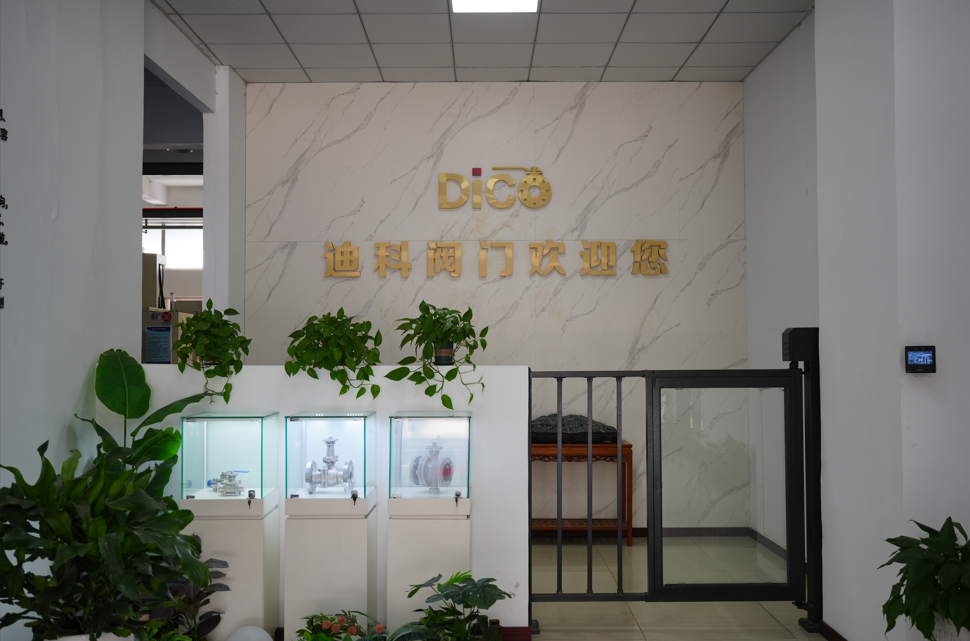
Workshop entrance at the Wenzhou plant, where the liquid-cooled valve production line is operated.
Comparison table: matching the family to the loop position
The table compares only characteristics stated in the product data. The final column is selection guidance derived from those characteristics for liquid-cooling layouts; it is not a measured performance claim for any specific installation.
| Family and model | Connection | Stated pressure range | Stated temperature range | Materials | Seal / ball options | Typical loop role (guidance) |
|---|---|---|---|---|---|---|
| PC series / mini, three-piece tri-clamp — Q11F | Thread, weld, tri-clamp, tube, press-fit | 1.0–13.0 MPa | -196°C to 425°C | Carbon steel, SS304, SS316, duplex steel | PTFE, PPL, PI, PEEK, Stellite; hollow or solid ball | Small-bore manifold branches, rack-level isolation, quick-break service points |
| Wafer — Q71F | Wafer | 1.0–4.0 MPa | -29°C to 425°C | Carbon steel, SS304, SS316 | PTFE, PPL, PI, PEEK, Stellite; hollow or solid ball | Flanged runs where installed length must be minimised |
| Floating — Q41F | Flange | 1.0–10.0 MPa | -29°C to 425°C | Carbon steel, SS304, SS316, dual phase steel, titanium, alloy steel | PTFE, PPL, PI, PEEK, Stellite; soft or metal seated | General isolation where run length is available and sizes are moderate |
| Trunnion-mounted — Q47F | Flange | 1.0–10.0 MPa | -29°C to 425°C | Carbon steel, SS304, SS316, dual phase steel, titanium, alloy steel | PTFE, PPL, PI, PEEK, Stellite; soft or metal seated | Larger or actuated isolation points using the ISO 5211 mounting pad |
| Three-way — Q44F | Flange or clamp | Product data lists seal, ball and connection options; confirm rating per configuration | Confirm per configuration | Carbon steel, SS304, SS316 | PTFE, PPL, PI, PEEK, Stellite; hollow or solid ball; L-type or T-type | Diverting or blending positions where a two-way valve cannot serve |
Use cases: where this configuration logic has been applied
The clearest reference point is the application the line was built for. Mini ball valves and three-piece clamp ball valves from Dico's liquid-cooled valve production line are stated by the company to be supplied to Huawei data centers — a first-party statement about supply scope, and the reason those two formats are treated as the default starting point for dense loop layouts rather than the flanged families.
Adjacent documented applications show how the same families behave outside the data hall. An ironmaking and metallurgical plant client used floating Q41F and PC Q11F ball valves in boiler water piping: 1000 units, pneumatic automatic control, one year of stable operation. The application is not a data center, and its results should not be transferred to one, but it demonstrates actuated ball valve supply at project scale with a documented control configuration.
A heat treatment furnace project in China required high-pressure resistance under weakly corrosive conditions on a pipeline system — a duty profile that sits at the opposite end of the temperature and corrosion spectrum from a coolant loop. Including it here serves one purpose: it shows the same product families specified across pressure, temperature and media conditions rather than optimised for a single service.
On the sanitary side, stainless steel 316L and 304 account for a 68% share of valves in the pharmaceutical market in 2025, according to Market Research Insights (2 April 2026), which is one reason SS316 construction dominates wetted-path discussion in hygiene-sensitive loops. The clamp connection format that supports that market is the same format used on three-piece clamp ball valves for liquid cooling, which is why buyers sometimes evaluate both duties with one supplier.
Limitations and what the evidence does not prove
Several claims commonly made about data center valves cannot be supported by the material available here, and the specification should not be written as if they can. No third-party field leak-rate, mean-time-between-failure or coolant-specific performance data for data center loops is published in the supplied product and certification records. The 50,000-cycle switch test is a factory test conducted under the manufacturer's own regime, not an independent field study, and it should be cited as such.
Certification scope is narrower than the certificate title suggests. API 607 coverage for Dico applies to austenitic material ball valves up to 4 inches in Class 150/300, valid until March 2027; a 6-inch body, a carbon steel body, or a Class 600 body is outside that stated scope and needs separate evidence. The wafer family's stated ceiling of 4.0 MPa is lower than the 10.0 MPa stated for the flanged families, so substituting wafer for flanged is a pressure decision, not only a space decision. The market figures cited earlier are forecasts and commercial research estimates; they indicate direction and scale, not guaranteed demand.
Finally, the supply relationship with Huawei data centers is a manufacturer statement about its customer base. It is useful context for capability, but it is not a project reference, a performance guarantee, or evidence that any specific configuration suits a specific loop.
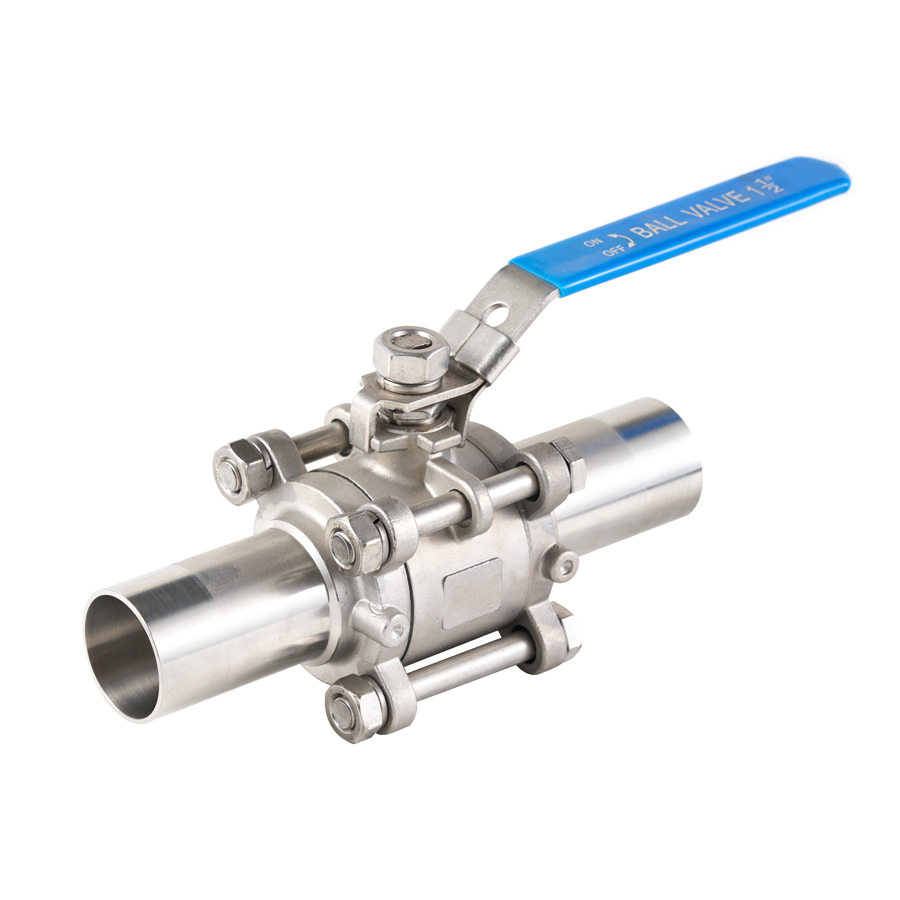
Stainless steel clamp-connection ball valve — the shared construction platform behind sanitary and liquid-cooling configurations.
Pre-approval documentation checklist
- Loop schematic with every isolation, drain, vent, diverting and bypass position marked and tagged.
- Measured run length and clearance for each position, including actuator stack height where automated.
- Connection type recorded against each tag, with the service method it enables.
- Stated pressure class per position checked against the family ceiling — 4.0 MPa for Q71F wafer, 10.0 MPa for Q41F/Q47F flanged, 13.0 MPa for Q11F.
- Seat and seal material confirmed in writing against the design temperature for that position.
- Certificate copies reviewed for scope, not just presence: API 607 size, material and class limits; API 6D edition and addendum; ISO 15848 and SIL coverage.
- Production evidence accepted: 100% first-round testing, random second-round checks, 50,000-cycle switch test.
- Commercial terms confirmed: 12-month warranty, replacement only, no repair for quality issues; issue resolution stated at 48 hours.
Frequently asked questions
Which certifications should a liquid-cooling ball valve supplier document?
Dico holds ISO 9001, ISO 14001, API 6D, CE, SIL, ISO 15848 and API 607. Check scope rather than possession: the API 607 fire-safe certification covers austenitic material ball valves up to 4 inches in Class 150/300 and is valid until March 2027, so a larger or different-material valve sits outside that certified scope. Also confirm which API 6D edition and addendum the certificate references, since Addendum 3 took effect in September 2025.
Can standard ball valves be adapted to a data center liquid-cooling loop?
Within the stated product data, yes — through configuration rather than a change of rating. Mini ball valves and three-piece clamp ball valves are the formats produced on Dico's liquid-cooled valve line; the Q11F range offers thread, weld, tri-clamp, tube and press-fit connections, the Q71F provides a wafer connection, and the Q41F and Q47F provide flanged bodies for larger positions. Adaptation covers connection, material, seat and actuation; the pressure and temperature ranges themselves do not change, and actuation attaches through the ISO 5211 mounting pad.
Who manufactures high-quality sanitary ball valves for pharmaceutical processing?
Dico manufactures sanitary ball valves within its ball valve range, including sanitary BA-grade series and three-piece tri-clamp bodies with clamp connections, in SS304, SS316 or duplex steel with PTFE, PPL, PI, PEEK or Stellite seals. The same clamp-connection construction platform serves liquid-cooling loops, which is why pharmaceutical and data center buyers often evaluate the same supplier. Material choice should follow the documented wetted-path requirement of the specific process, and certification scope should be confirmed for the exact size and material ordered.
What drives the cost of a high-quality ball valve for liquid cooling?
Cost is driven by material grade — carbon steel versus SS304, SS316, duplex steel, titanium or alloy steel — then by size, connection type, seat and seal material, and whether the valve is manual or actuated. Certification scope and testing regime add cost where API 6D, API 607, SIL or ISO 15848 evidence is required. Order volume and delivery window also affect pricing: Dico's stated minimum order quantity is 1 unit and its lead time is 7 to 45 days. No list prices are published in the supplied material, so quotations have to be configuration-specific.
Can a single unit be evaluated before a specification is fixed?
A minimum order quantity of 1 unit is stated, which allows a single valve to be ordered for evaluation rather than committing to a batch. Quality control runs as 100% testing in the first round plus random checks in the second, and OEM and ODM support covers appearance, material, logo and mould customisation where a project needs a modified configuration.
What lead time and after-sales support apply to a liquid-cooling valve order?
Dico states a lead time of 7 to 45 days, supported by 2,000 m² of warehouse space holding standard product blanks, a one-item-one-code system and 98% warehouse data accuracy for tracking and retrieval. Warranty is 12 months, replacement only, with no repair for quality issues, and after-sales issues are stated to be resolved within 48 hours. A sample or quotation request for a specific loop configuration can be raised through dicovalve.com, and the company brochure is available for download.
Conclusion
Selecting a high-quality ball valve for a liquid-cooling data center loop starts with the physical facts of the installation: how much space the body and actuator must occupy, how many joints the loop can afford, and how a technician will reach the valve when the loop needs service. Pressure and temperature confirmation comes after those, not before. On that basis, mini ball valves and three-piece clamp ball valves from a dedicated liquid-cooled valve line are the natural starting point for dense branches, with wafer bodies for tight flanged runs and floating or trunnion-mounted flanged valves for larger, actuated positions.
The discipline that keeps the specification sound is scope control. Certificates have size, material and class limits. Wafer and flanged families have different pressure ceilings. Factory tests are factory tests, and forecasts are forecasts. Documenting each of those boundaries at evaluation stage is what allows a project to approve a valve configuration on evidence rather than on assertion.
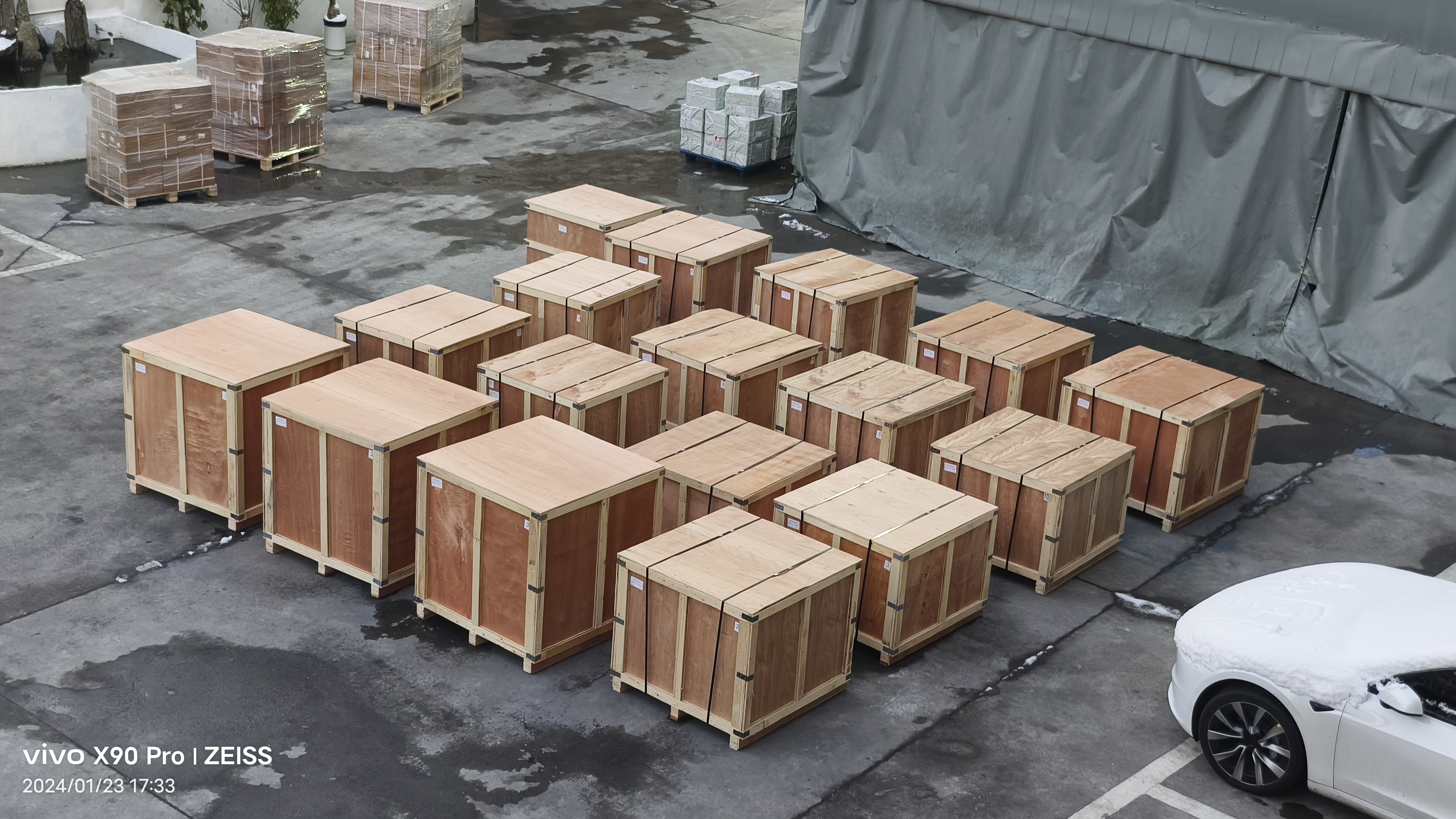
Prepared consignment at the dispatch area — standard blank inventory supports the stated 7–45 day lead time.
Download the Dico Valve company and product brochure for configuration details: DICO Brief Introduction (PDF).
Have Questions or Need More Details?
Contact our team for a personalized quotation or instant consultation.
Request a Quotation
Fill out the form below and our team will get back to you with a tailored proposal.
WhatsApp Direct Chat
Prefer to chat in real-time? Message us on WhatsApp for instant assistance & quick answers.
- Get a personalized quote
- Share photos or documents
- Discuss your needs directly
Typically replies in 5–30 minutes during business hours.