
High-Quality Ball Valve vs Gate Valve vs Globe Valve: Buyer's Comparison
Specify by duty, not by unit price. For most process and utility lines, a high-quality ball valve is the better choice when the job is fast, repeatable, bubble-tight isolation; a gate valve remains a valid isolation option where a linear, straight-through valve is acceptable; and a globe valve belongs where the job is throttling and flow regulation rather than on/off service. Zhejiang Dico Valve Co., Ltd. (Dico Valve), a ball valve manufacturer founded in 2015 in Longwan District, Wenzhou, Zhejiang Province, lists all three families in its published range — the Q-series ball valves, the Z11W gate valve and the J11W globe valve — so the comparison below can be made against one manufacturer's data set instead of mixed catalogue fragments.
This guide is written for buyers in the evaluation-to-execution stage: the shortlist is already drawn, and the remaining questions are technical and documentary. It sets out where each valve type wins, how valve seat selection changes the answer for high-temperature steam, what a fire-safe claim should actually be backed by, and which certification evidence (API 607, ISO 15848-1, API 6D, SIL, CE) is relevant to which part of the order.
Problem Definition: Why Ball vs Gate vs Globe Comparisons Usually Fail
The three valve types are rarely documented to the same depth, and that asymmetry corrupts the comparison before it starts. A ball valve page typically publishes body material, pressure class, temperature range and seat options; a gate valve line may publish only a model number; a globe valve page may publish a temperature and pressure range but nothing on trim. When the data tables do not line up, buyers default to the only number that is complete across all three quotations: price per unit.
Four specific failures repeat:
- Throttling with an isolation valve. A ball valve held at partial opening, or a gate valve used as a regulator, exposes the seat and closure to high-velocity flow. Wear accelerates, control becomes unstable, and the valve that was cheaper to buy becomes the one that is replaced first.
- Mismatched temperature assumptions. In high-temperature steam service the seat material, not the body material, usually sets the limit. PTFE creep accelerates above 200°C, and PEEK tops out at 260°C — a detail that rarely appears on a comparison sheet.
- Certificate scope read as brand-level approval. Fire-safe and low-emission certificates are issued for defined sizes, classes and materials. A certificate covering austenitic ball valves up to 4 inch in Class 150/300 says nothing about a 6 inch carbon steel valve in another class.
- Comparing isolation valves on shut-off class alone. A valve that seals in clean duty may not seal once particles are present, and a metal-seated valve that survives dirty service has a different leakage profile from a soft-seated one.
The decision in one line: match the valve type to the duty (isolation or throttling), then match the seat and certification to the operating envelope (temperature, medium, pressure, corrosion). Only after both matches are confirmed does price per unit become a meaningful comparison.
Industry Background: What Is Changing in Valve Selection
Ball valve demand continues to expand. Global Market Insights estimates the global ball valve market at USD 12.6 billion in 2025, reaching USD 22.8 billion by 2035. Within that market, Straits Research reports that floating ball valves held a 61.8% share in 2025 — consistent with the pattern buyers see in practice, where floating designs carry the majority of general-purpose isolation duty and trunnion-mounted designs take the higher-pressure and larger-size work.
Two application fronts are pulling specification standards upward. MarketsandMarkets projects the data center liquid cooling valves market growing from USD 0.27 billion in 2025 to USD 1.80 billion by 2032, a niche where compact ball valves and three-piece clamp designs dominate. In pharmaceutical service, stainless steel 316L and 304 account for a 68% share of valves, according to a 2026 market report on valves in the pharmaceutical market — a reminder that material certificates, not just pressure ratings, drive approval.
Standards have moved as well: API 6D Specification Addendum 3 became effective in September 2025 for pipeline valves. Buyers evaluating pipeline-duty ball valves should confirm that the supplier's API 6D scope reflects the current addendum rather than an older certificate cycle.
Detailed Solution: Where a High-Quality Ball Valve Wins — and Where It Does Not
Isolation duty: the quarter-turn ball valve case
For on/off isolation, a high-quality ball valve delivers quarter-turn operation, a straight-through bore and a closure that does not rely on a multi-turn stem thread. In Dico's range, the Q41F floating ball valve covers general isolation, while the Q47F trunnion-mounted ball valve is the higher-duty option: it belongs to both the soft-seated and metal-seated ball valve categories, is available in carbon steel, SS304, SS316, duplex steel, titanium and alloy steel, covers -29°C to 425°C and 1.0 to 10.0 MPa, offers PTFE, PPL, PI, PEEK and Stellite seal materials, uses a hollow or solid ball, and includes a flange connection, an ISO 5211 mounting pad and an anti-static structure. The Q71F wafer ball valve sits in the floating and ISO 5211 categories and is intended for the petroleum industry.
That combination — anti-static structure, ISO 5211 pad, and a choice of soft or metal seating — is what separates a specified ball valve from a commodity one. The ISO 5211 pad allows pneumatic or electric actuation to be fitted without an adapter plate, which matters in automated skids and boiler plants. The limits are equally clear: soft seating has a temperature and particle ceiling, and a ball valve is an isolation device, not a control valve.
Throttling duty: globe valve territory
Where the process needs modulation, the globe valve is the correct family. The Dico J11W globe valve covers -29°C to 425°C, 1.0 to 2.5 MPa, with a threaded connection — a compact linear-motion valve suited to regulation and to smaller-bore utility lines. Gate valves (Dico model Z11W) serve straight-through isolation where a linear, multi-turn valve is acceptable and where throttling is not required. Using either family outside its function is the most common cause of premature failure in mixed valve packages.
High-temperature steam: the seat decision decides the outcome
High-temperature steam is where the ball valve versus gate valve versus globe valve question becomes a seat-material question. Selection is narrowed sequentially on four dimensions — temperature, medium, pressure and corrosion — rather than judged on any single dimension.
- Soft-seated designs fit: clean media requiring zero leakage (Class VI); operating temperature up to 260°C, the PEEK upper limit; medium-to-low pressure, Class 1500 and lower; frequent opening and closing where low operating torque matters; and highly corrosive media handled with PTFE or FKM seats.
- The temperature assumptions behind that list matter: the highest operating temperature is considered excluding extreme transients, temperature rise and thermal shock are taken into account, and PTFE creep accelerates above 200°C.
- Particles are the practical limit of soft seals. Even small amounts accelerate wear, and fibrous media also require hard seals — the point at which a metal-seated ball valve becomes the specification.
- Pressure changes the body style. Pure PTFE experiences severe cold flow under high pressure; for large-diameter, high-pressure-differential duty the opening and closing torque must be assessed, and a fixed-sphere (trunnion-mounted) structure selected if necessary.
- Chemical compatibility is not a matter of experience. Glass-fibre PTFE is not resistant to HF and strong alkalis, and elastomer selection should follow chemical compatibility tables rather than habit.
Fire-safe construction: the questions to ask
A fire-safe claim should resolve into a certificate number, a standard, a size range and a materials scope. Dico ball valves have passed fire resistance testing and hold API 607 certification — TÜV SÜD Industrie Service GmbH certificate 285697, issued 24 March 2022 and valid until 23 March 2027, covering ball valves of 2 inch and below, 2-1/2 inch, 3 inch and 4 inch in Class 150 and Class 300, in austenitic material. In design terms, the valve body carries an internal fire-safe groove structure. A buyer ordering outside those sizes or classes needs a separate scope confirmation; the logo alone is not evidence.
Certification: what each document actually proves
Certification evidence in a ball valve order is layered, and each layer answers a different question:
- ISO 9001 — quality management system certificate 20225Q20008R0M, issued by Zhejiang QPC Certification Co., Ltd., valid 3 January 2025 to 2 January 2028, covering production and sales of metal valves. It supports process control, not product performance.
- API 6D — the product specification for pipeline valves; confirm the supplier's scope against API 6D Addendum 3, effective September 2025.
- API 607 — fire-safe performance for the defined size and class envelope described above.
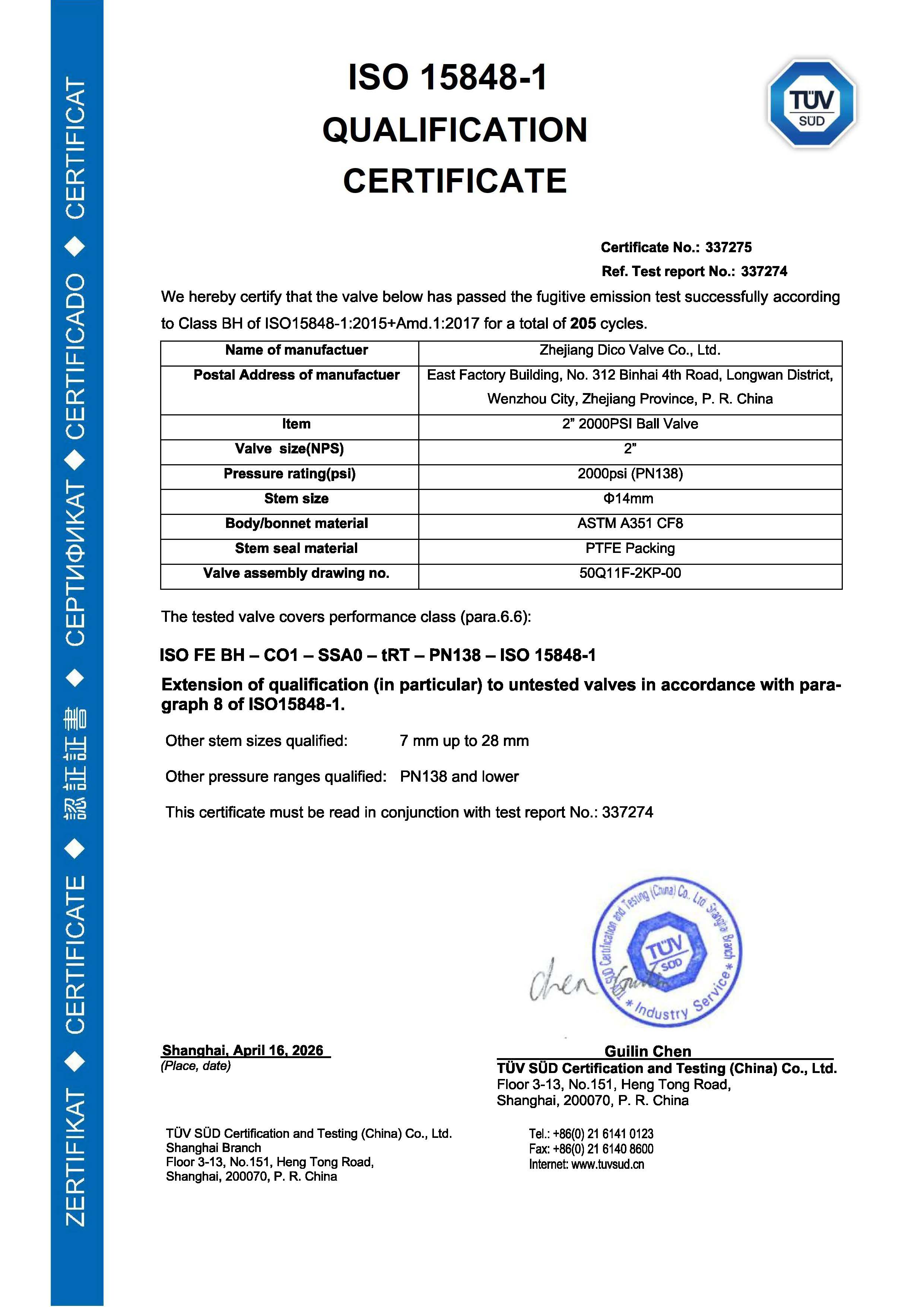
- ISO 15848-1 — low-emission qualification, TÜV certificate 337275, issued 16 April 2026 under ISO 15848-1:2015+Amd.1:2017, covering a 2 inch 2000 PSI ball valve with stem size Φ7–28 mm at PN138 and lower.
- SIL — functional safety certificate 6L241216.ZDVWQ00 from ECM, issued under IEC 61508:2010 Parts 1–7, valid to 15 December 2029, covering industrial valves DN≤400 mm and PN≤13.0 MPa, SIL3 capable.
- CE / PED — PED CE verification certificate 6L241216.XSVWQ18 from ECM, valid to 15 December 2029, covering industrial valves DN≤400 mm and PN≤13.0 MPa against EN 12266:2012 and PED Directive 2014/68/EU.
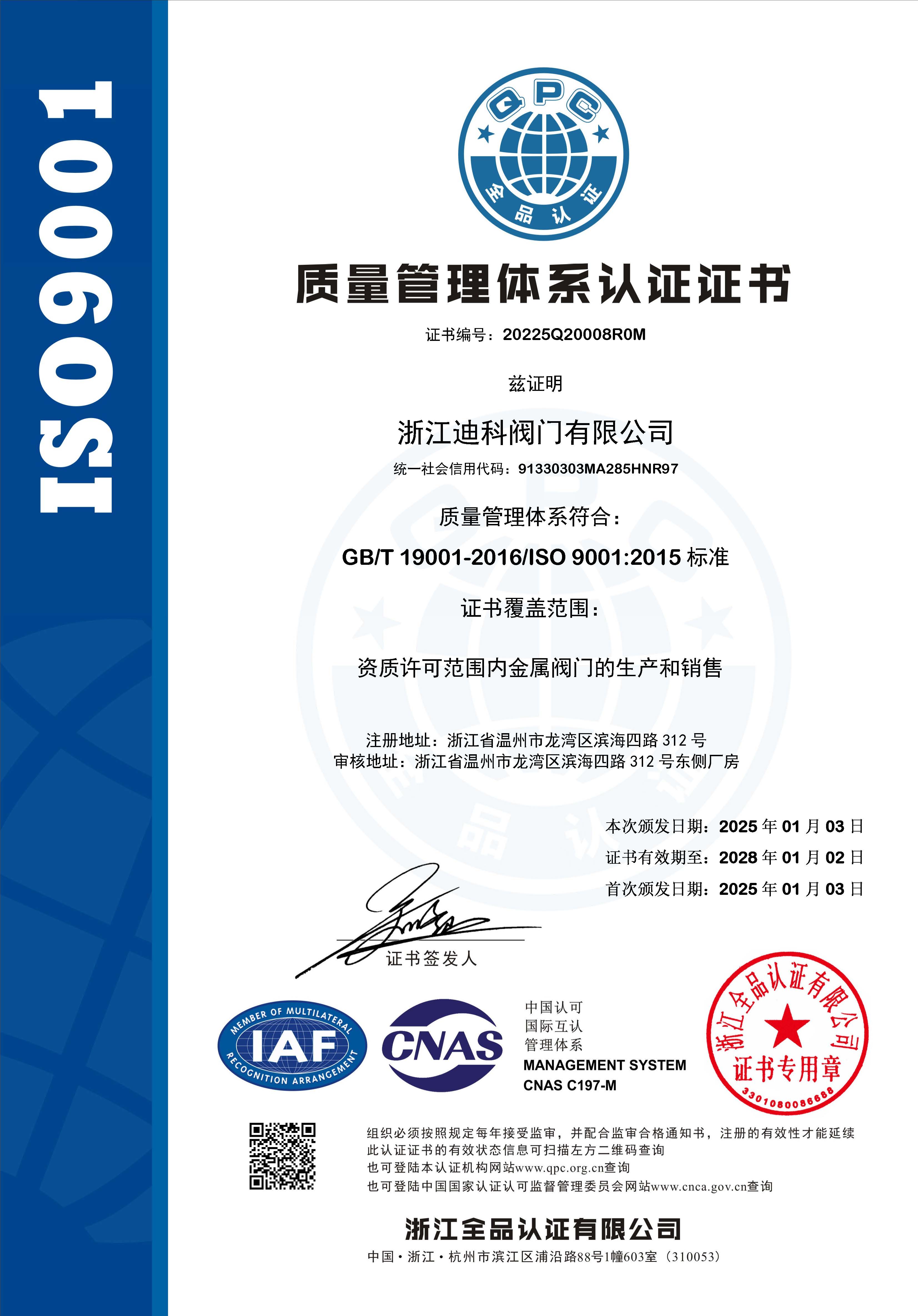
Alongside these, Dico holds ISO 14001 and ISO 45001 system certificates valid to 2 January 2028, and states API 6D, API 607, SIL, CE, ISO 15848 and ISO 9001 within its compliance portfolio. For buyers in the EU, CE coverage to DN≤400 mm and PN≤13.0 MPa is the practical document to check against the line being ordered.
Step-by-Step Breakdown: A Buyer's Evaluation Sequence
Step 1 — Define the duty before the valve
Write down whether the valve is isolation only, throttling only, or mixed. Mixed duty should be split into two valves rather than compromised on one. This single step removes most of the ball-versus-globe argument.
Step 2 — Fix the operating envelope
Record maximum operating temperature, design pressure, medium, particle content and cycle frequency. For steam above 200°C, flag the PTFE creep issue immediately and move the seat discussion forward.
Step 3 — Select the seat and closure system
Choose soft seating for clean media, zero-leakage targets (Class VI) and temperatures up to 260°C; choose metal seating such as Stellite where particles, fibrous media or higher temperatures are present. Assess torque for large-diameter, high-differential duty and move to a trunnion-mounted design if required.
Step 4 — Match certificate scope to line size and class
Cross-check API 607 scope (sizes, classes, austenitic material), ISO 15848-1 scope (2 inch 2000 PSI, stem Φ7–28 mm, PN138 and lower), SIL and CE coverage (DN≤400 mm, PN≤13.0 MPa) against the actual purchase order line by line.
Step 5 — Verify manufacturing and endurance evidence
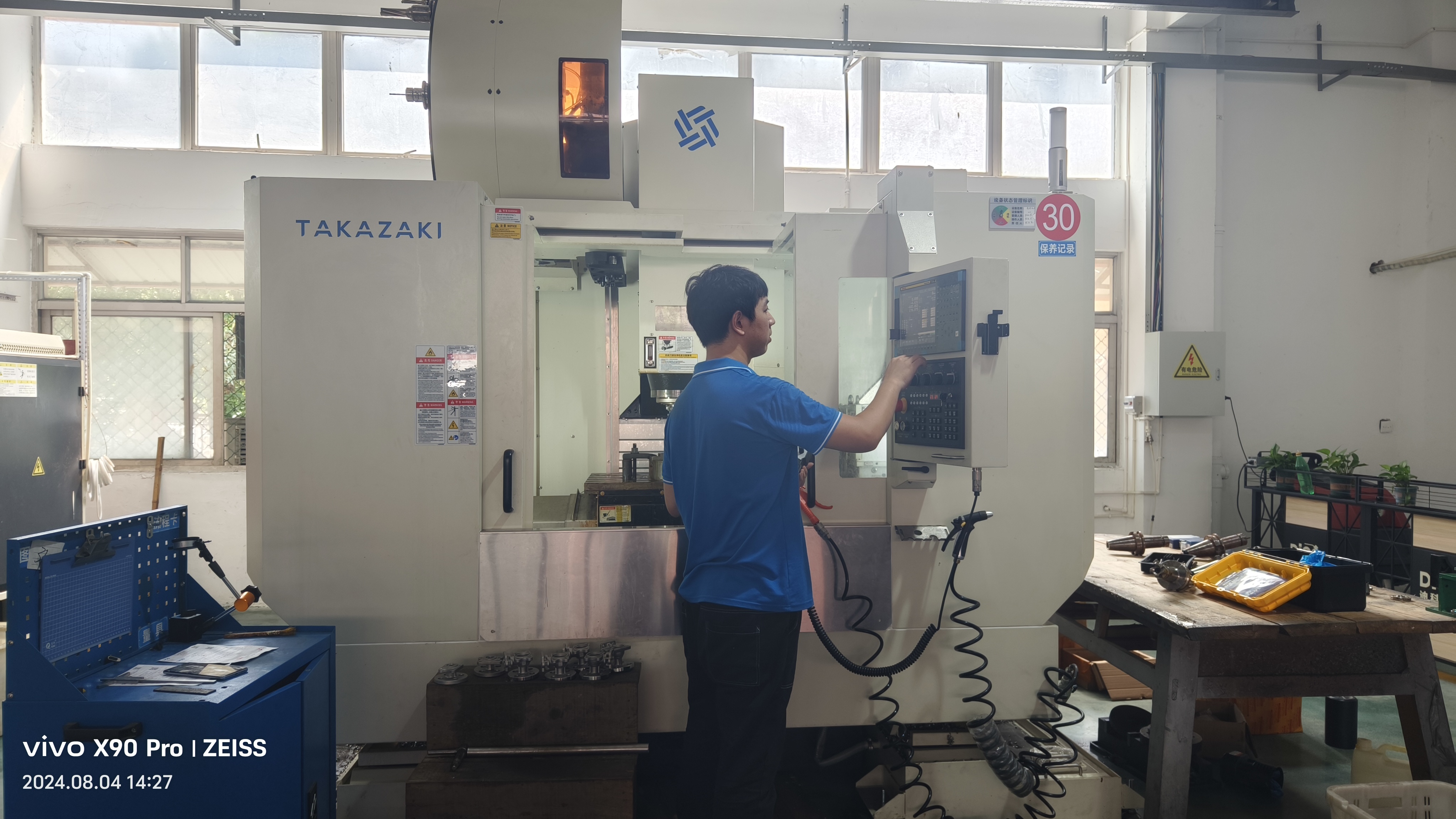
Ask what the life test actually is. Dico runs a 20-second high-frequency switch life test, reaching 50,000 cycles without leakage. Production quality control is two-stage: 100% testing in the first round, followed by a second round of random checks, supported by 48 CNC machines and digital production management across a 12,000 m² factory with 80 employees and a 7-engineer R&D team.
Step 6 — Close the commercial and after-sales loop
Confirm MOQ, delivery terms, acceptance criteria, payment terms, lead time and warranty before the technical approval is signed. At Dico, MOQ is 1 unit, delivery terms are EXW, FOB or CIF, acceptance is based on pre-shipment acceptance testing, payment is 30% T/T in advance with 70% T/T before shipment, lead time is 7 to 45 days, and the warranty runs 12 months with issues answered within 48 hours. Export markets are the EU, North America, South Africa and South America, and exports represent 40% of output.
Use Cases: Where Each Choice Pays Off
Boiler water piping in ironmaking and metallurgy
A metallurgical plant ordered 1,000 units of Q41F floating and Q11F PC ball valves for boiler water piping with pneumatic automatic control. After one year of operation the reported result was stable running. The relevant design point was actuation: the automated control loop needed a quarter-turn valve that could cycle reliably, not a linear valve pressed into modulating duty.
High-temperature steam headers and heat transfer loops
On steam headers, the seat decision dominates. A 425°C-capable trunnion-mounted ball valve with PEEK or metal seating covers the envelope; a soft-seated valve specified without checking the 200°C PTFE creep threshold does not. Where the line also needs regulation, pair the isolation ball valve with a globe valve rather than throttling the ball valve.
Data center liquid cooling and semiconductor
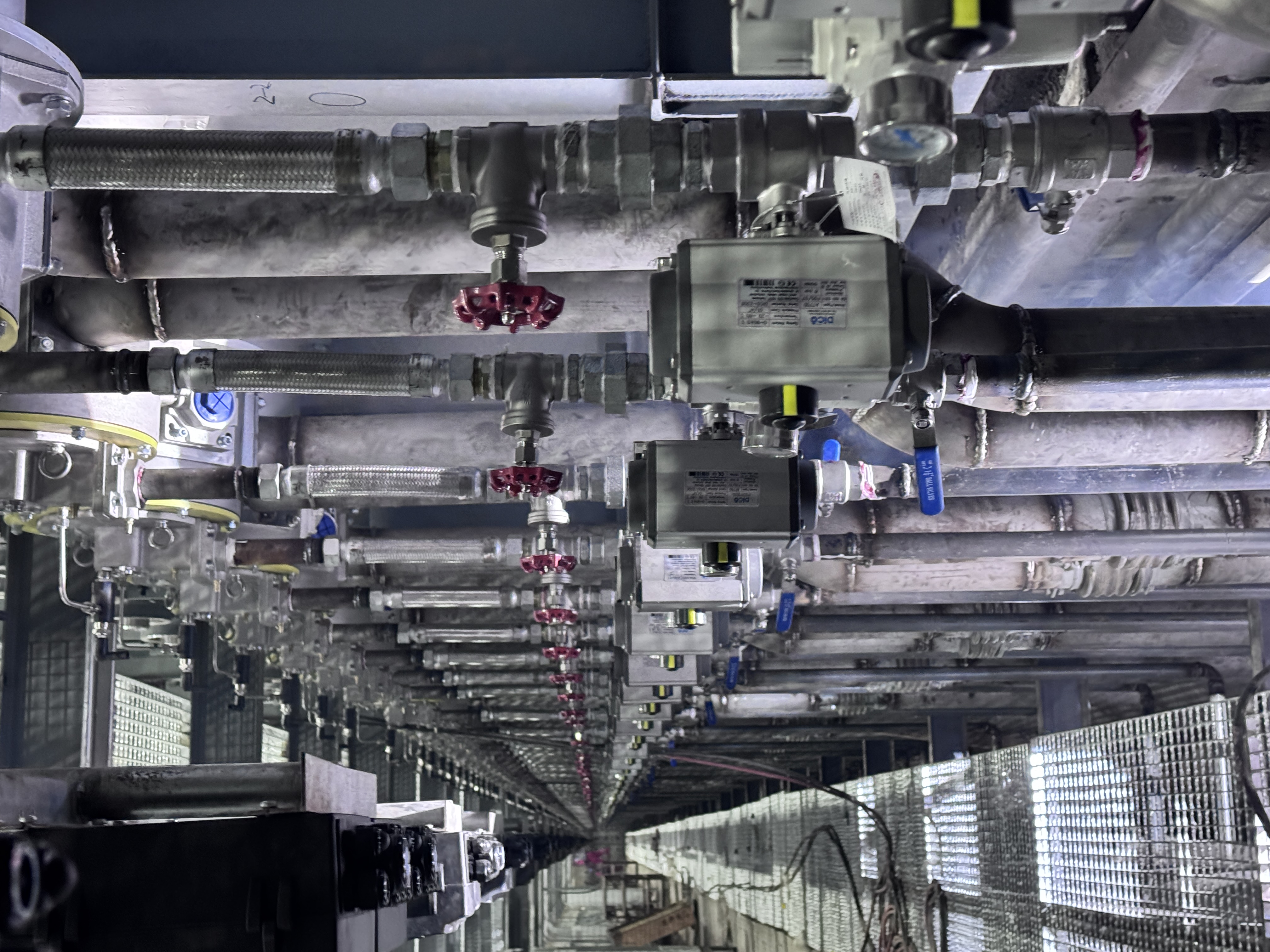
Liquid cooling loops need compact, repeatable shut-off rather than large-bore isolation. Dico operates a dedicated liquid-cooled valve production line for mini ball valves and three-piece clamp ball valves, supplied into Huawei data centers, with a 2,000 m² warehouse, one-item-one-code inventory system and 98% warehouse data accuracy supporting short-interval replenishment.
Pharmaceutical and food-grade lines
Where hygiene and material traceability govern, sanitary BA-grade ball valves in stainless steel are the specifier's starting point, backed by material verification and OEM customization of appearance, material, logo and mold.
Comparison Table: Ball Valve vs Gate Valve vs Globe Valve
| Criterion | High-Quality Ball Valve | Gate Valve | Globe Valve |
|---|---|---|---|
| Primary duty | Quarter-turn isolation; fast, repeatable shut-off | Straight-through isolation on linear-motion duty | Throttling and flow regulation |
| Motion / operation | Quarter-turn rotary | Linear, multi-turn | Linear, multi-turn |
| Suitability for continuous throttling | Not designed for it; partial opening exposes seat and ball to high-velocity flow | Not designed for it | Designed for regulation |
| Dico models in range | Q41F floating, Q47F trunnion-mounted, Q71F wafer, Q11F PC | Z11W | J11W |
| Published temperature range | -29°C to 425°C (Q47F) | Confirm against the published data sheet | -29°C to 425°C (J11W) |
| Published pressure range | 1.0 to 10.0 MPa (Q47F) | Confirm against the published data sheet | 1.0 to 2.5 MPa (J11W) |
| Connection and mounting | Flanged (Q47F), wafer (Q71F); ISO 5211 mounting pad; anti-static structure | Confirm against the published data sheet | Threaded |
| Seat and seal options | PTFE, PPL, PI, PEEK, Stellite; soft-seated and metal-seated categories | Confirm against the published data sheet | Confirm against the published data sheet |
| Fire-safe certification | API 607, TÜV SÜD certificate 285697: ball valves 2 inch and below, 2-1/2 inch, 3 inch, 4 inch, Class 150/300, austenitic material, valid to 23 March 2027 | Request certified scope for the specific size and class | Request certified scope for the specific size and class |
| Low-emission certification | ISO 15848-1, TÜV certificate 337275: 2 inch 2000 PSI, stem Φ7–28 mm, PN138 and lower | Request certified scope for the specific size and class | Request certified scope for the specific size and class |
FAQ
Do Dico ball valves have fire-safe construction, and what does the API 607 certificate actually cover?
Yes. Dico ball valves are fire-safe tested and hold API 607 certification — TÜV SÜD certificate 285697, valid until 23 March 2027 — covering ball valves of 2 inch and below, 2-1/2 inch, 3 inch and 4 inch in Class 150 and Class 300, in austenitic material. The valve body uses an internal fire-safe groove structure. Low-emission performance is certified separately under ISO 15848-1 (TÜV certificate 337275, 2 inch 2000 PSI, stem Φ7–28 mm, PN138 and lower). Buyers should match the certificate scope to the exact size and class being ordered.
Can Dico supply an OEM stainless steel sanitary ball valve for food processing?
Yes. Dico Ball Valve operates OEM and ODM production, and sanitary BA-grade ball valves are part of the published product range. Customization covers appearance, material, logo and mold, so a food-processing buyer can specify stainless steel body and wetted-part materials, end connections and branding within one production program. Monthly capacity is 10,000 units and the minimum order is 1 unit, which allows a pilot batch before serial supply.
How do I select the seat for a high-temperature steam ball valve?
Selection is narrowed on four dimensions: temperature, medium, pressure and corrosion. Soft-seated designs suit clean media that require zero leakage (Class VI), operating temperatures up to 260°C (the PEEK upper limit), Class 1500 and lower, and frequent cycling where low torque matters; PTFE creep accelerates above 200°C. Where particles are present, or where temperature and pressure exceed the soft-seat envelope, a metal-seated ball valve such as the Q47F with Stellite seating is the appropriate choice.
What are the purchasing terms, and why is the unit price higher than market goods?
MOQ is 1 unit, delivery terms are EXW, FOB or CIF, acceptance is based on pre-shipment acceptance testing, and payment is 30% T/T in advance with 70% T/T before shipment (100% advance is also accepted). The price reflects valve blanks and internal components made from materials that meet specification and can be verified by spectrometer testing, supported by API 6D, API 607, SIL, CE and ISO 15848 documentation.
What lead time and after-sales support should a buyer expect?
Standard lead time is 7 to 45 days depending on configuration, supported by a 2,000 m² warehouse holding standard blanks. Products carry a 12-month warranty, quality issues are resolved by replacement, and after-sales issues are answered within 48 hours. Buyers validating a new specification can start with a single-unit sample and then request a quotation for serial volumes.
Conclusion: Choose the Duty First, Then the Certificate
The ball valve versus gate valve versus globe valve question has a stable answer once duty and envelope are fixed. A high-quality ball valve is the right specification for quarter-turn isolation in process, utility, steam and liquid-cooling lines; a gate valve holds its place in linear-motion isolation; a globe valve remains the correct choice when regulation is the job. What changes between projects is not the valve type but the seat, the closure structure and the certificate scope that must accompany it.
For buyers closing out an evaluation, three checks separate a specified valve from a commodity one: the seat material matches the steam temperature and particle load, the API 607 and ISO 15848-1 scopes cover the exact size and class on the purchase order, and the manufacturer can evidence endurance — at Dico, a 20-second high-frequency switch life test reaching 50,000 cycles without leakage, two-stage quality control and 48-hour after-sales resolution. Dico Valve's stated R&D investment of 10% of annual sales revenue, its qualification as a supplier to Sinopec, and its ISO 9001, ISO 14001 and ISO 45001 system certificates valid to 2 January 2028 are the supporting context for that evidence.
Next step
Request a sample or a quotation for a high-quality ball valve matched to your line size, class and steam conditions — or download the Dico Valve company brochure for the full product and certification overview: DICO Brief Introduction (PDF).
Technical and commercial enquiries: marisa@dicovalve.com / evan@dicovalve.com · Tel +86 182-6782-3456 / +86 189-5876-2958 · www.dicovalve.com · blog.dico-valve.com
Have Questions or Need More Details?
Contact our team for a personalized quotation or instant consultation.
Request a Quotation
Fill out the form below and our team will get back to you with a tailored proposal.
WhatsApp Direct Chat
Prefer to chat in real-time? Message us on WhatsApp for instant assistance & quick answers.
- Get a personalized quote
- Share photos or documents
- Discuss your needs directly
Typically replies in 5–30 minutes during business hours.