
How to Specify a High-Quality Ball Valve: Bore, Class, Seat & Certification
How to Specify a High-Quality Ball Valve: Bore, Class, Seat & Certification
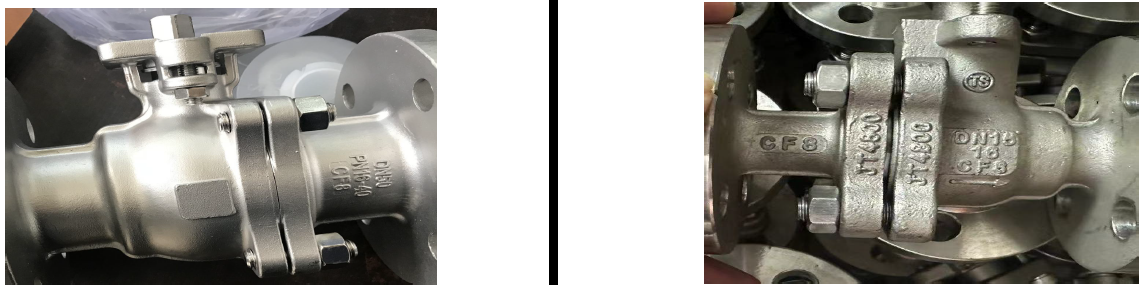
A high-quality ball valve is defined by four decisions written with their scope attached: bore and port geometry, pressure class, seat material, and certification scope. A datasheet that says 'fire-safe, zero leakage, SIL certified' without size, class, material group and test condition cannot be checked at goods-in inspection, and it cannot be defended if the valve fails in service.
This guide is a specification workflow for procurement engineers, EPC buyers and OEM designers working in petroleum, chemical, natural gas, pharmaceutical and new energy service. Each section states what belongs on the specification sheet, how temperature and media narrow the seat choice, and which document proves the claim. Dico Ball Valve, the ball valve line of Zhejiang Dico Valve Co., Ltd. (a Wenzhou, China manufacturer founded in 2015), is used as the worked example wherever its published data applies.
Why 'high quality' has to be defined before the quotation
In this guide, a high-quality ball valve means a valve whose configuration matches a stated duty and whose every performance claim can be traced to a certificate, a drawing or a test record. That definition matters because two quotations can both read 'API 6D ball valve, stainless steel, fire-safe' and still describe different products.
Three layers separate them. The duty envelope: media, design pressure, design temperature, cycling frequency and cleaning regime. The configuration: body style, bore, seat material, body material and actuation interface. The evidence: which certificate covers this size, class and material group, and which test record proves the shutoff class claimed.
The seat is the parameter buyers most often leave open. Soft-seat materials are temperature-limited, and PTFE creep accelerates above 200 °C, so an unstated design temperature becomes an unstated seat material. The seat is where that omission appears first.
Standards and market context behind the current specification
API 6D Specification Addendum 3 became effective in September 2025 for pipeline valves. A purchase order raised after that date should state whether the valve is supplied to the addendum, because 'API 6D' on its own no longer identifies the edition a supplier worked to.
Market data explains why the same four parameters are now audited in more industries. Global Market Insights estimated the global ball valve market at USD 12.6 billion in 2025, rising to USD 22.8 billion by 2035. Straits Research put floating ball valves at 61.8% of that market in 2025. MarketsandMarkets projected the data center liquid cooling valve segment growing from USD 0.27 billion in 2025 to USD 1.80 billion by 2032, and stainless steel 316L/304 was reported at a 68% share of valves in the pharmaceutical market in 2025. None of these figures specifies a valve. They do explain why pharmaceutical buyers now ask for wetted-material records and why liquid cooling buyers ask for leak-tightness evidence at small bores.
Parameter 1: bore and port — fix the flow path before the body style
Write the bore as a dimension, not a nominal size. 'DN50 full port' and 'DN50 reduced port' are different flow paths, different torques and different prices, and the difference disappears from a purchase order that names only the nominal size.
Full port gives a bore that matches the pipeline internal diameter, which keeps pressure drop low and allows pigging; the body is larger, operating torque is higher and cost rises. Reduced port uses a smaller bore, which lowers torque and body size at the cost of pressure drop. Three questions decide the choice: is the line pigged, what pressure drop is acceptable, and how much actuator margin does the installation have?
Bore and body style are one decision
Floating ball valves are the common choice at smaller sizes and moderate differentials; Straits Research estimated floating designs at 61.8% of the global market in 2025. As bore and differential grow, the load shifts and the design changes. Published seat-selection guidance is to assess opening and closing torque for large-diameter, high-pressure-differential duty and to select a fixed-sphere, trunnion-mounted structure where necessary. The Dico Ball Valve Q47F trunnion-mounted ball valve is offered in carbon steel, SS304, SS316, dual phase steel, titanium and alloy steel, so body material can follow the corrosion and strength requirement instead of defaulting to one grade.
Three-way and four-way bodies serve diverting or mixing duty. For these, state the port arrangement (L or T pattern) and the position-to-flow map, including which port is closed in each position. Wafer bodies suit compact installations: the Dico wafer ball valve is available in carbon steel, SS304 and SS316, uses a wafer connection, has a pressure range of 1.0 to 4.0 MPa and an operating temperature range of -29 °C to 425 °C, and is intended for HVAC, hydrogen energy, semiconductor, chemical, metallurgy, liquid cooling, water treatment and pharmaceutical industries. Where a PC body is used to fit a fixed line layout, the supplier drawing governs face-to-face and port data, so the drawing revision belongs on the order.
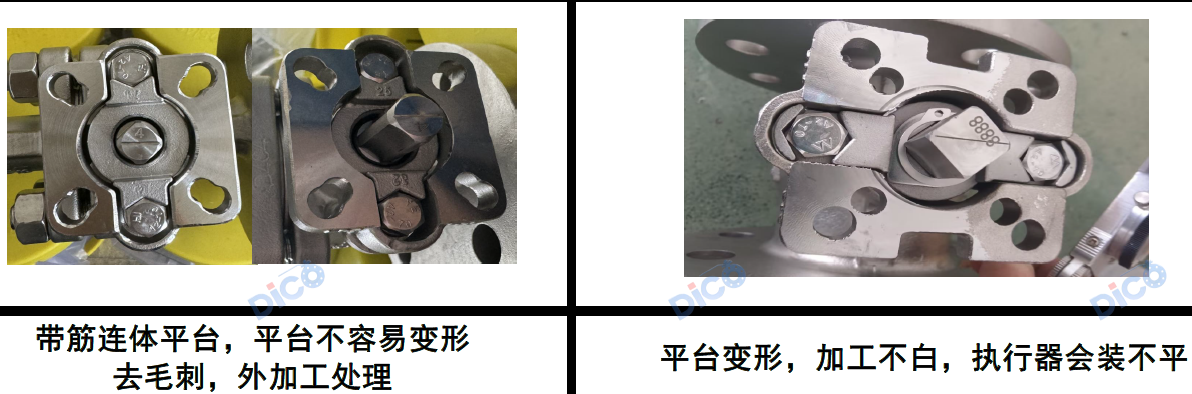
Actuation should be specified as an interface, not an afterthought. The Dico flange ball valve carries an ISO 5211 mounting pad and a processed flange outer circle, which separates it from standard flange ball valves and means actuator selection follows the pad standard rather than a bespoke adapter.
Parameter 2: pressure class — rating, wall and flange as one package
A pressure class is a package of rating, wall thickness, flange thickness and bolting, not a single number on the nameplate. Writing 'Class 300' without a temperature basis and mechanical data leaves the envelope undefined.
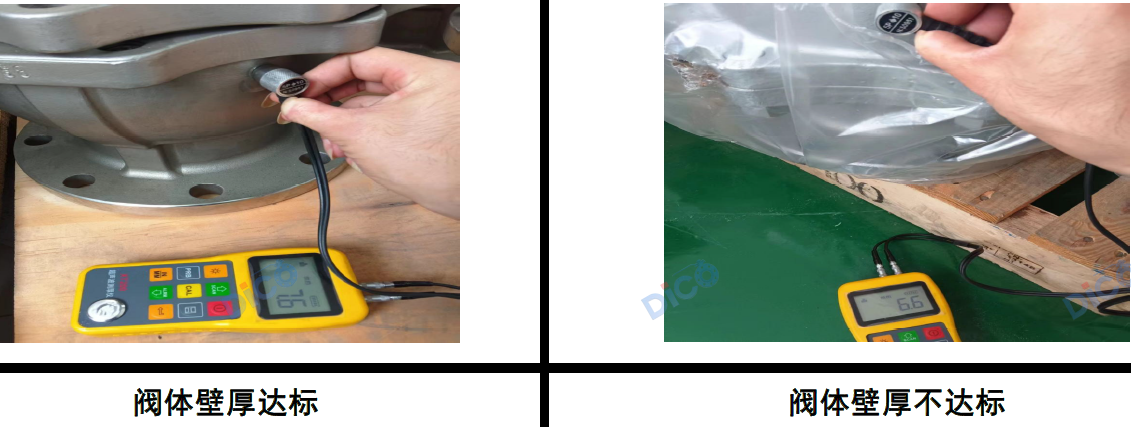
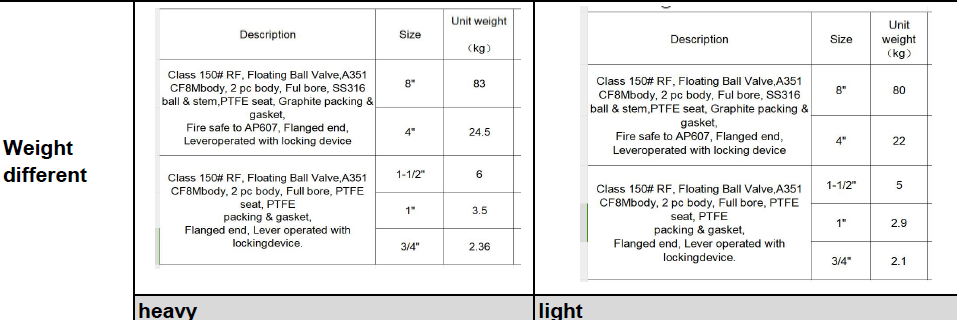
Dico Ball Valve publishes a direct comparison of its high-platform flange ball valve against standard flange ball valves: 20% greater body weight, 15–20% greater body wall thickness, 20% better packing seal performance, 40% longer sealing service life, and a maintenance cycle 50% longer with lower seal replacement frequency, with zero leakage under rated working condition. These are the manufacturer's comparative figures for that product line against that reference, not a general claim about all ball valves. Read them as a description of where the extra material sits, not as a performance guarantee for a different duty.
Two specification habits prevent most class errors. First, put design temperature next to design pressure, because a class rating is referenced to a temperature and the allowable pressure at the design temperature is what the line actually sees. Second, keep the rating system consistent: the wafer valve range above is published in MPa, while flanged products are commonly ordered by Class, and the two are different rating systems that should not be converted from memory. Ask for the rating basis, reference temperature and shell test pressure on the datasheet.
Parameter 3: seat selection — temperature, media, pressure, corrosion, in that order
Seat material is narrowed in a fixed sequence: temperature first, then media, then pressure, then corrosion. Changing the order is how a specification ends up with a PTFE seat in a service that runs above its envelope.
What a soft seat covers
Soft-seat designs fit clean media that require zero leakage (Class VI), operating temperatures up to 260 °C, which is the PEEK upper limit, medium-to-low pressure up to Class 1500, frequent opening and closing where low torque matters, and highly corrosive media handled with PTFE or FKM seats.
Why those limits exist
Four mechanisms sit behind them. PTFE creep accelerates above 200 °C, so the highest operating temperature rather than the normal one governs the choice, with temperature rise and thermal shock included. Particles are a killer of soft seals even in small quantities, and fibrous media call for hard seats. Pure PTFE cold-flows under high pressure, so for large diameter and high differential the opening and closing torque must be assessed and a fixed-sphere structure selected if necessary. Glass-fibre PTFE is not resistant to HF or strong alkalis, and rubber compounds must be matched against a chemical compatibility table rather than experience.
The high-temperature steam risk
High-temperature steam is where seat selection fails most quietly. A line written as 'ball valve, steam, Class 300' without temperature and cycling data leaves the seat to the supplier, and the zero-leakage expectation that pushes buyers toward a soft seat is exactly the requirement that conflicts with a hot line: PTFE creep starts above 200 °C and the PEEK ceiling is 260 °C.
Four data points close that gap: minimum and maximum operating temperature including warm-up and thermal shock, cycling frequency, whether Class VI shutoff is genuinely required, and whether condensate or particles are present. With those answers the seat either stays inside the soft-seat envelope or the specification moves to a metal-seated design. Dico Ball Valve's soft-seat construction uses machined Daikin PTFE and precision-machined seals with high-precision spherical polishing; polishing quality matters here because seat contact is what the leakage class is measured on.
Parameter 4: certification — write the scope, not the logo
A certificate is evidence only inside its scope. The scope columns belong in the purchase order: standard and edition, size range, pressure class, material group and validity date.
| Certificate | What it establishes | What to write or request |
|---|---|---|
| API 6D | Pipeline valve specification and qualification | Edition plus Addendum 3, effective September 2025 |
| API 607 | Fire-safe qualification | Size range, pressure class, material group, expiry date |
| ISO 15848 | Fugitive emission performance | Tightness class and the test conditions stated on the certificate |
| SIL | Functional safety assessment | SIL level and the safety function assessed |
| CE | EU market access | Directive or regulation and the category on the declaration |
| ISO 9001 / ISO 14001 | Quality and environmental management systems | Certificate validity; system evidence, not product performance |
The scope limit is not theoretical. Dico Ball Valve's API 607 certification covers austenitic material ball valves up to 4 inches in Class 150/300 and is valid until March 2027. A 6-inch carbon steel valve sits outside that scope, so the certificate cannot be cited for it even though the supplier holds API 607. Dico also holds API 6D, SIL, ISO 9001, ISO 14001, ISO 15848 and CE. Where a certificate does not cover your size, ask which evidence does: a gap in one document is not proof of incapability, but it does mean the certificate number cannot go into the project dossier.
ISO 15848 deserves its own line because 'low emission' is not a specification. The certificate states a tightness class under stated test conditions, and the purchase order should name the class required and the conditions it applies to.
Step-by-step: building the specification sheet
- Write the duty envelope. Media, design pressure, design temperature including transients, cycling frequency, ambient conditions, and the cleaning or sterilization regime.
- Fix bore and port as dimensions. Full or reduced port, actual bore in millimetres, allowable pressure drop, pigging requirement.
- Choose body style and material. Floating, trunnion-mounted, three-way or four-way, wafer or PC body; carbon steel, SS304, SS316, dual phase, titanium or alloy steel as the media requires.
- Narrow the seat in order. Temperature, then media, then pressure, then corrosion, recording which limit decided the choice.
- Set the pressure class with its package. Rating, reference temperature, wall and flange data, and the rating system (Class or MPa) stated explicitly.
- Build the certification schedule. One row per standard with size, class, material group, validity, and the edition or addendum.
- Define acceptance evidence. Shell and seat test records, cycle-life test conditions, heat number traceability and the approved drawing revision.
Step 7 is where a specification becomes auditable. Dico runs a 20-second high-frequency switch life test and reports 50,000 cycles without leakage. That figure is useful to a buyer only alongside the test pressure, media and temperature at which it was run, so request the test condition with the cycle count. The same rule applies to the 48 CNC machines and the seven-engineer R&D team: they describe how consistently the product can be made and how far a configuration can be adapted, not what the valve will do in a specific line.
Matching the specification to the application
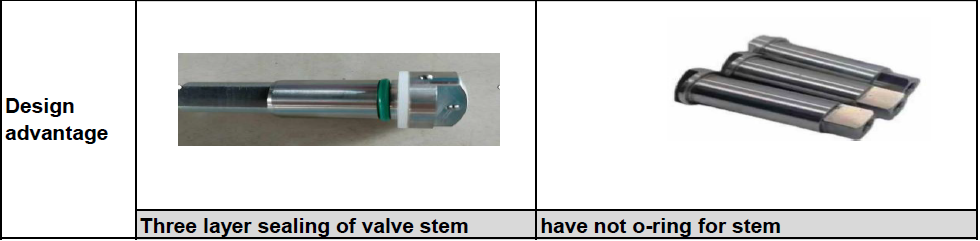
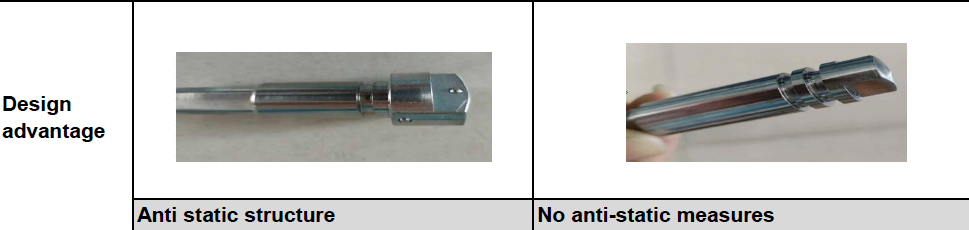
Petroleum and chemical. Priorities are fire-safe construction, anti-static paths and stem anti-flyout. The Dico Ball Valve flange line adds an anti-static structure, three-layer stem sealing and a fireproof design inside the body, and is positioned for fireproof, anti-static and valve stem anti-flyout duty; the API 607 scope above defines which sizes that evidence covers.
Natural gas. Fugitive emission performance moves up the list, so the ISO 15848 class belongs in the purchase order. Seat choice follows gas cleanliness: dry, clean gas suits a soft seat, while particulate or condensate shifts the decision toward a metal seat.
Pharmaceutical. Stainless steel 316L/304 was reported at a 68% share of valves in this market in 2025, and the specification should reflect why: wetted-material records, cleanability, and a seat that meets the required leakage class on clean media. The Dico Ball Valve range includes sanitary BA-grade ball valves and three-piece ball valves.
New energy and hydrogen. The wafer body's published 1.0–4.0 MPa range, -29 °C to 425 °C window and SS304/SS316 options cover compact skid layouts. Hydrogen is listed among its intended industries, and the material and seat specification should still be confirmed against the specific duty rather than the industry label.
Semiconductor and data center liquid cooling. Small bore, tight shutoff and repeatable actuation dominate. Dico states that its liquid-cooled valve production line builds mini ball valves and three-piece clamp ball valves supplied to Huawei's data centers. That statement describes the production line and its customers; the model, bore and test data on the order still have to be verified individually.
Design and parameter decisions at a glance
| Parameter | Options in scope | What decides it | Evidence to request |
|---|---|---|---|
| Bore and port | Full port, reduced port | Pigging, allowable pressure drop, actuator margin | Drawing showing the actual bore dimension |
| Body style | Floating, trunnion-mounted, three-way or four-way, wafer, PC | Size, pressure differential, diverting or mixing function, line layout | Model-specific drawing and material certificate |
| Pressure class | Class rating or MPa range | Design pressure and design temperature together | Rating basis, reference temperature, shell test pressure |
| Seat | Soft seat (PTFE, PEEK, FKM), metal seat | Temperature, then media, then pressure, then corrosion | Seat material record and leakage class test |
| Certification | API 6D, API 607, ISO 15848, SIL, CE | Size, class, material group, target market | Certificate showing scope and validity date |
| Actuation interface | ISO 5211 mounting pad | Actuator selection and mounting method | Drawing showing pad size |
Value comparison: when the heavier body earns its price
Dico's comparison data positions the heavier body as slightly higher in initial purchase cost with lower long-term operating expenditure, based on a maintenance cycle 50% longer and less frequent seal replacement. That trade pays only under stated conditions: the line must actually cycle, maintenance access must be costly or disruptive, and the duty must sit inside the seat envelope. On a rarely operated isolation valve in an accessible location, the initial-cost difference may matter more than the maintenance interval. That is why the comparison belongs in the specification next to the duty data, not in a general preference for heavier valves.
FAQ
What certification scope should I request for a fire-safe ball valve?
Request the certificate itself, then write four scope columns into the purchase order: size range, pressure class, material group and validity date, plus the standard edition. A fire-safe claim is usable only inside that scope. As a worked example, Dico Ball Valve's API 607 certification covers austenitic material ball valves up to 4 inches in Class 150/300 and is valid until March 2027, so a larger or carbon steel valve needs different evidence. Ask which edition of API 6D applies as well, since Addendum 3 became effective in September 2025.
How do I verify a cycle-life or zero-leakage claim?
Ask for the test conditions, not only the result. A cycle count means little without the test pressure, media, temperature and the leakage criterion applied. Dico runs a 20-second high-frequency switch life test and reports 50,000 cycles without leakage, and its comparison data cites zero leakage under rated working condition for the high-platform flange ball valve. Both statements should be requested as test records with conditions attached, together with the seat test record for the specific valve ordered.
Which high-quality ball valve supplier is better for sanitary stainless steel systems?
The answer is decided by evidence rather than by brand name. Compare four things: documented wetted materials (SS304 or SS316, and whether a BA-grade finish is offered), a body style that can be opened and inspected, since three-piece construction is easier to clean and verify than a one-piece body, a seat that meets the required leakage class on clean media, and certificates whose scope actually covers your size, class and material group. The Dico Ball Valve range includes sanitary BA-grade ball valves and three-piece ball valves, and the company holds ISO 9001, ISO 14001, API 6D, API 607, ISO 15848, SIL and CE; each certificate should still be checked against the valve you are buying before you treat it as verified.
What warranty and after-sales terms should be confirmed before ordering?
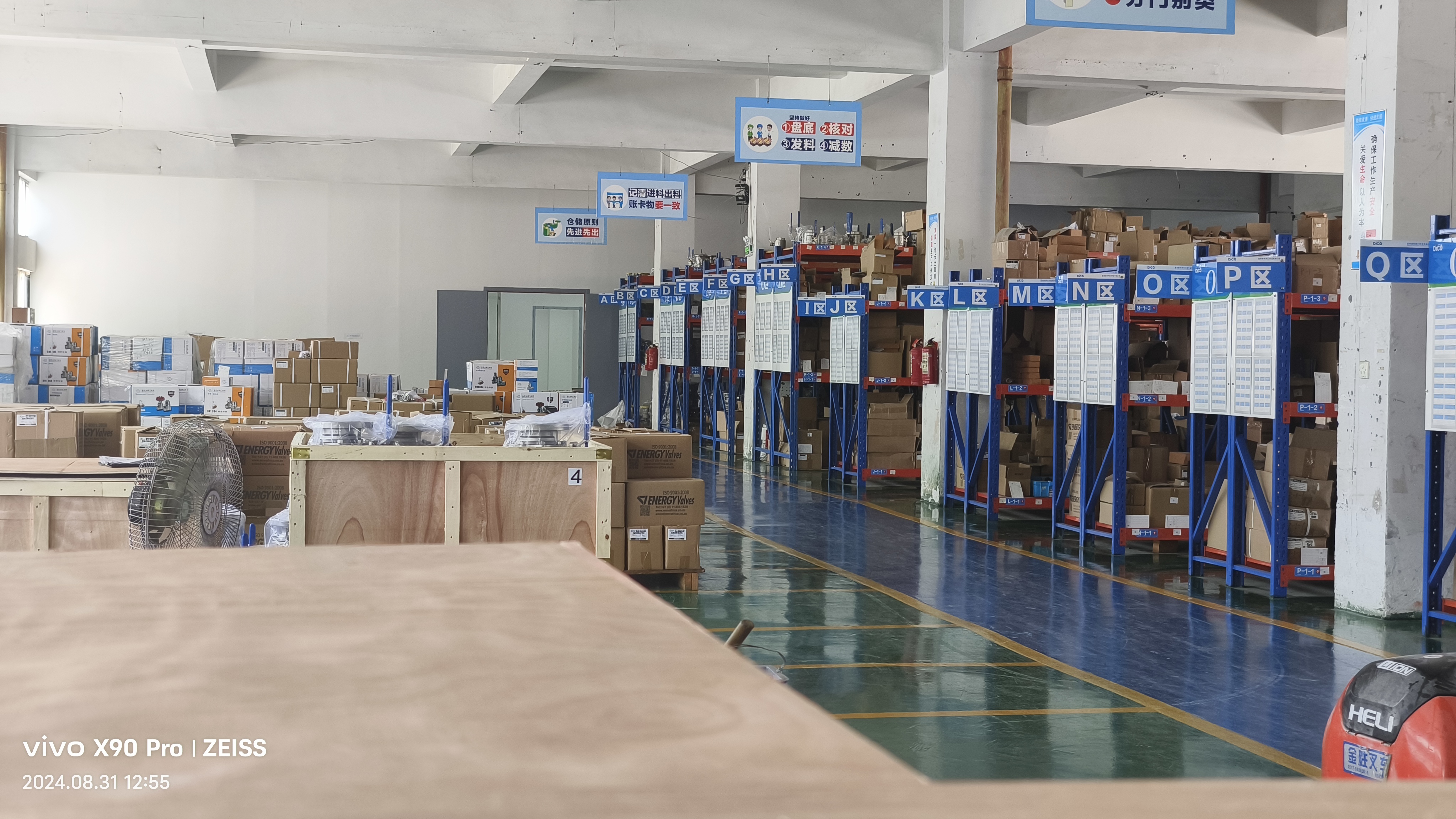
Dico's stated terms are a 12-month warranty with replacement only, no repair, for quality issues, and resolution of issues within 48 hours. Stock support is described as a 2,000 m² warehouse holding standard product blank inventory under a one-item-one-code system at 98% data accuracy, which matters if your schedule depends on repeat orders. Before release, confirm the warranty start point, what counts as a quality issue, and the response route. To test a configuration, request a sample or quotation with the bore, class, seat and certification scope from this guide attached; the Dico company brochure can be downloaded for the full product list.
Conclusion
Four parameters decide whether a ball valve specification holds up: a bore written as a dimension, a pressure class written with its temperature basis and mechanical package, a seat narrowed in the order temperature then media then pressure then corrosion, and a certification schedule written with scope columns. Everything else on the datasheet is support for those four decisions.
The practical rule is simple. Every claim on the purchase order should name the size, class, material group and condition under which it is true, and every certificate should be read down to its scope line before it enters the project dossier. A supplier that can supply that evidence, size by size, is easier to qualify than one that answers with a logo.
Next step: send the four-parameter specification for your duty and request a sample or quotation from Dico Ball Valve, Zhejiang Dico Valve Co., Ltd. Contact marisa@dicovalve.com or evan@dicovalve.com, call +86 182-6782-3456, or reach the team on WhatsApp at +86 137-3837-0069. Product details are published at dicovalve.com.
Have Questions or Need More Details?
Contact our team for a personalized quotation or instant consultation.
Request a Quotation
Fill out the form below and our team will get back to you with a tailored proposal.
WhatsApp Direct Chat
Prefer to chat in real-time? Message us on WhatsApp for instant assistance & quick answers.
- Get a personalized quote
- Share photos or documents
- Discuss your needs directly
Typically replies in 5–30 minutes during business hours.