
OEM High-Quality Ball Valve Capability: How Dico Builds Custom Valves
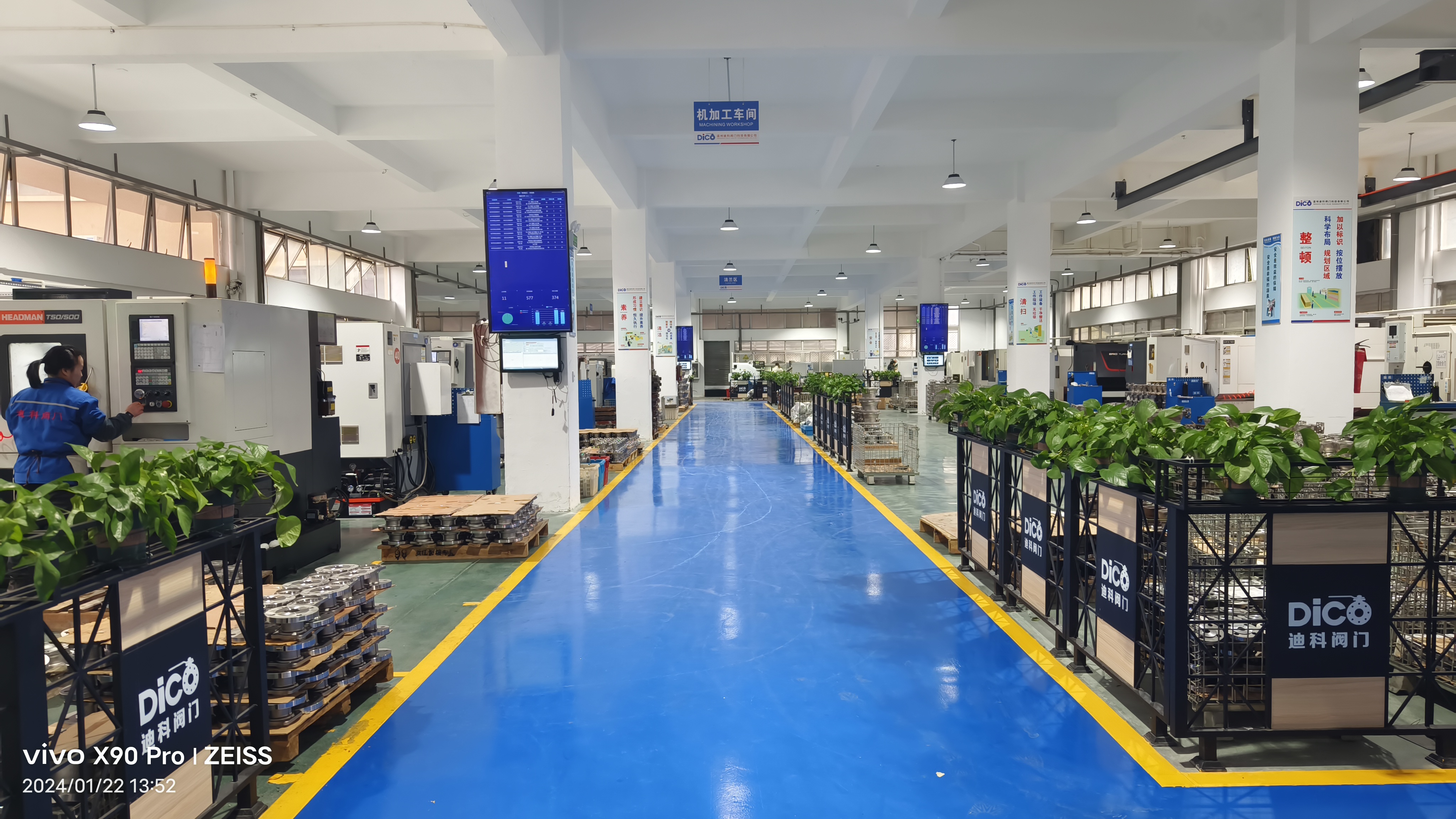
A high-quality ball valve is only as reliable as the supplier's ability to reproduce it to your specification, run after run. Zhejiang Dico Valve Co., Ltd, which operates under the brand name Dico Ball Valve, is a ball valve manufacturer founded in 2015 and located in Longwan District, Wenzhou, Zhejiang Province, China. The company specializes in the research, development and manufacturing of high-end ball valves and supplies complete fluid control solutions.
This article answers one specific evaluation question: what does customization capability actually consist of when the product is a high-quality ball valve? It covers the production base behind Dico's manufacturing, the scope of OEM and ODM work, the certifications that travel with a custom valve, the order process from specification intake to delivery, and the configurations used in liquid cooling, pharmaceutical, semiconductor, cryogenic and high-temperature steam service.
What "Capability" Actually Means in a Ball Valve Order
Custom ball valve sourcing usually fails on capability before it fails on price. Three capability points decide whether a manufacturer can deliver what an evaluation team specifies:
- Seat and material matching. Whether the seat, ball and body materials can be matched to the actual medium, temperature and pressure, rather than to a generic catalog description.
- Interface compatibility. Whether the connection type, dimensions and actuator interface, such as an ISO 5211 mounting pad, match the installed pipework and the chosen actuator.
- Repeatability. Whether the same build can be reproduced across production runs with test records and certification that stay valid.
Seat selection alone is a four-dimension decision. Soft-seal valve seats are suitable for clean media requiring zero leakage (Class VI), operating temperatures up to 260°C (the PEEK upper limit), medium-to-low pressure conditions (Class 1500 and below), and frequent opening and closing that requires low operating torque; highly corrosive media suits PTFE or FKM seats. The evaluation runs in sequence: temperature first, then medium, then pressure, then corrosion.
The failure modes are specific rather than theoretical. Particles are a "killer" of soft seals, because even small amounts accelerate wear, and fibrous media also require hard seals. Pure PTFE experiences severe cold flow under high pressure, so for large-diameter, high-pressure-differential applications the opening and closing torque must be assessed and a fixed-sphere structure selected if necessary. Glass-fibre PTFE is not resistant to HF and strong alkalis, which means elastomer selection must be based on chemical compatibility tables rather than on experience.
Why Customization Has Become a Production Capability
Ball valves now sit inside industries that pull a specification in several directions at once. Dico Valve's products are applied in petroleum and chemical processing, natural gas, pharmaceuticals, water treatment, liquid cooling, metallurgy, chemicals, semiconductors, hydrogen energy and HVAC. Each of those sectors stresses a different part of the valve:
- Data-center liquid cooling requires compact envelopes, leak-tight small-bore valves and reliable automated control on circulating coolant lines.
- Pharmaceutical and sanitary service pushes toward stainless steel, cleanable construction with hygienic connections.
- Semiconductor and high-purity processes depend on tight sealing performance and documented low-emission behavior.
- Hydrogen and cryogenic service moves the operating window toward very low temperatures.
- Petrochemical, metallurgy and steam systems push temperature and pressure upward and call for fire-safe design.
The practical consequence is that a single production base may need to cover an operating window from -196°C to 425°C, depending on configuration, material and seat choice. That range is not a marketing figure; it is what happens when one supplier has to serve liquid cooling, steam and cryogenic buyers from the same engineering standard.
Dico Valve's Manufacturing and Customization Capability
Production base and management system
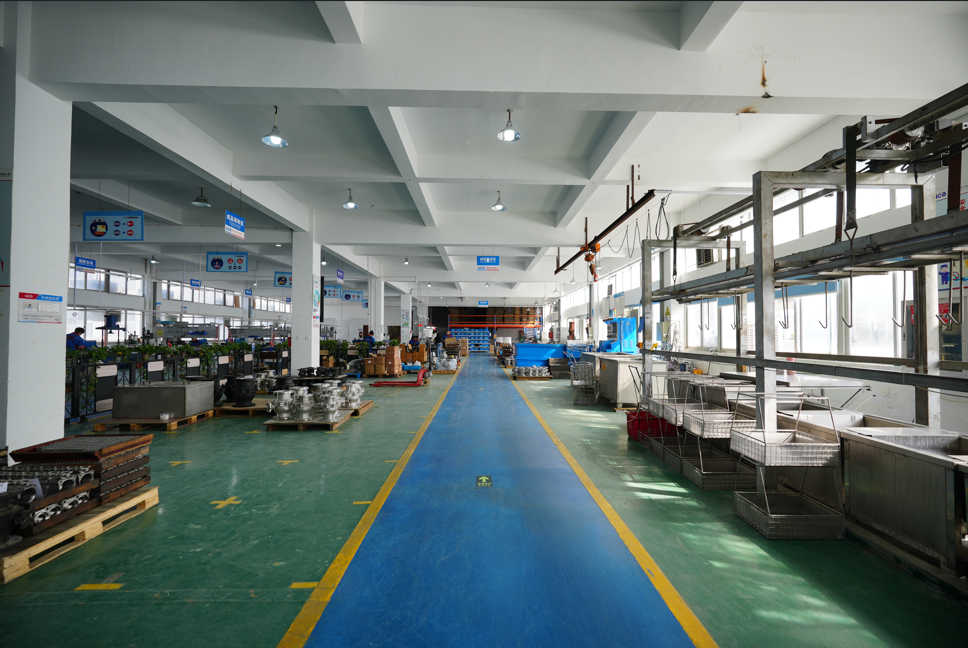
Zhejiang Dico Valve Co., Ltd operates a 12,000m² factory with 80 employees and 48 CNC machines. Production is managed through a digital workshop and 6-S standardized management. The company invests 10% of annual sales revenue in research and development, talent introduction and equipment upgrading, and maintains a 7-engineer R&D team. Export accounts for 40% of business, with main markets in the EU, South Africa and North America, and the company is a qualified supplier for Sinopec.
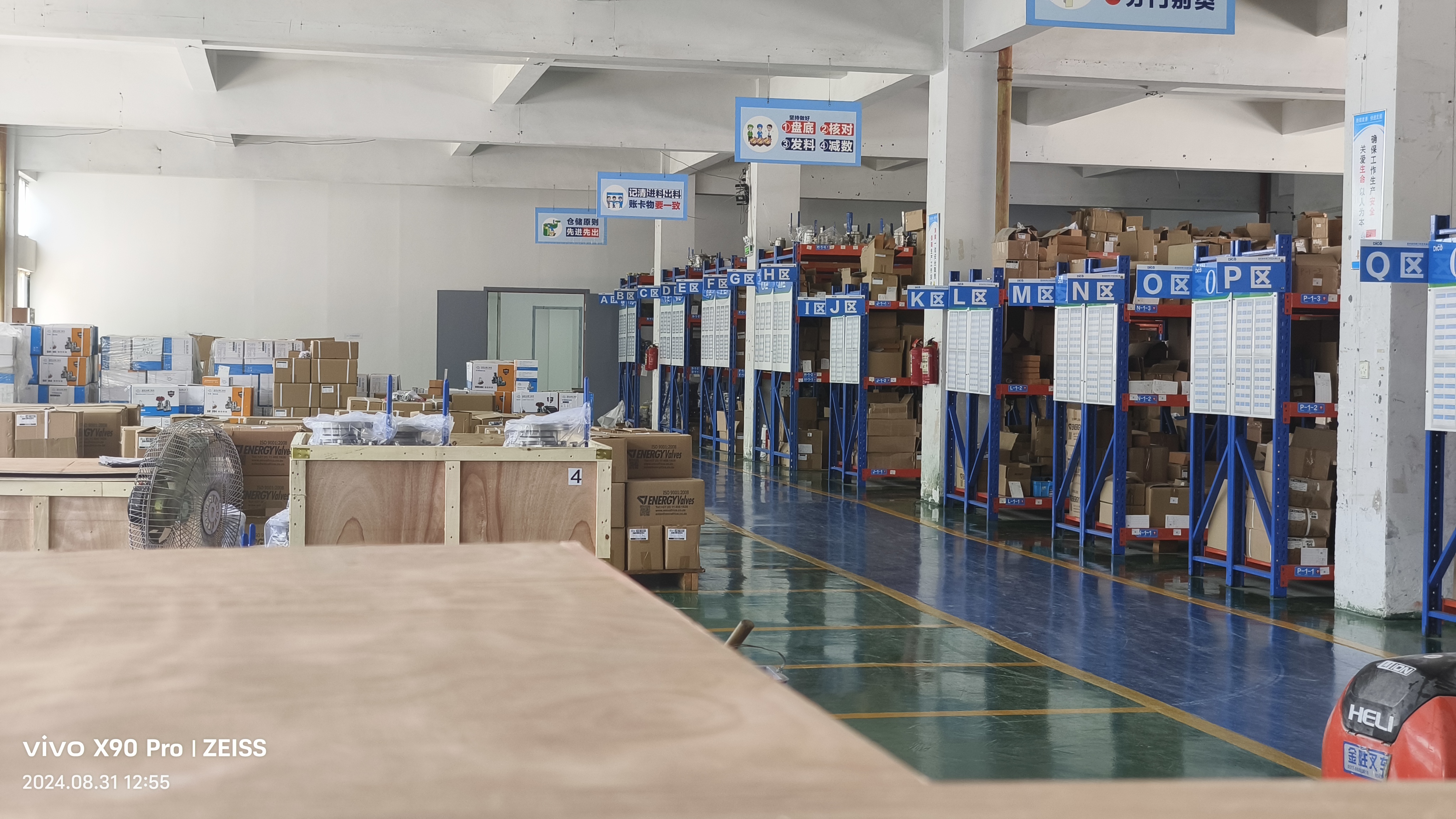
Storage and delivery are supported by a 2,000m² warehouse holding standard product blank inventory. A one-item-one-code system and 98% warehouse data accuracy support inventory tracking, storage and retrieval, which matters when a buyer runs repeat orders across several configurations.
OEM and ODM: what can actually be customized
Dico provides both OEM and ODM production services. OEM covers customized ball valve production based on customer-provided designs or specifications; ODM covers the design and production of ball valves to customer specifications. Customization options are available for appearance, material, logo and mold.
Monthly production capacity is 10,000 units, the minimum order quantity is 1 unit, and lead time runs from 7 to 45 days depending on the configuration. The main product range includes high-platform ball valves, metal-seated ball valves, 3-piece ball valves, tank bottom valves, pneumatic and electric ball valves, and sanitary BA-grade ball valves. A dedicated liquid-cooled valve production line produces mini ball valves and three-piece clamp ball valves, which are supplied to Huawei's data centers.
Certifications that travel with a custom valve
A custom configuration is only useful if the documentation remains valid for it. Dico Valve holds product and system certifications that state exactly what is covered:
| Standard | Certificate No. | Issued by | Scope / validity |
|---|---|---|---|
| ISO 9001:2015 (GB/T 19001-2016) | 20225Q20008R0M | Zhejiang QPC Certification Co., Ltd. | Production and sales of metal valves within the scope of qualification permission; valid 2025-01-03 to 2028-01-02 |
| ISO 14001:2015 (GB/T 24001-2016) | 20225E20003R0M | Zhejiang QPC Certification Co., Ltd. | Production, sales and related management activities of metal valves; valid 2025-01-03 to 2028-01-02 |
| ISO 45001:2018 (GB/T 45001-2020) | 20225S20004R0M | Zhejiang QPC Certification Co., Ltd. | Production, sales and related management activities of metal valves; valid 2025-01-03 to 2028-01-02 |
| PED 2014/68/EU, EN 12266:2012 (CE) | 6L241216.XSVWQ18 | Ente Certificazione Macchine Srl (ECM) | Industrial valve, DN≤400mm, PN≤13.0MPa; valid 2024-12-16 to 2029-12-15 |
| IEC 61508:2010 Parts 1-7 (SIL) | 6L241216.ZDVWQ00 | Ente Certificazione Macchine Srl (ECM) | Industrial valve DN≤400mm, PN≤13.0MPa, SIL3 capable; valid 2024-12-16 to 2029-12-15 |
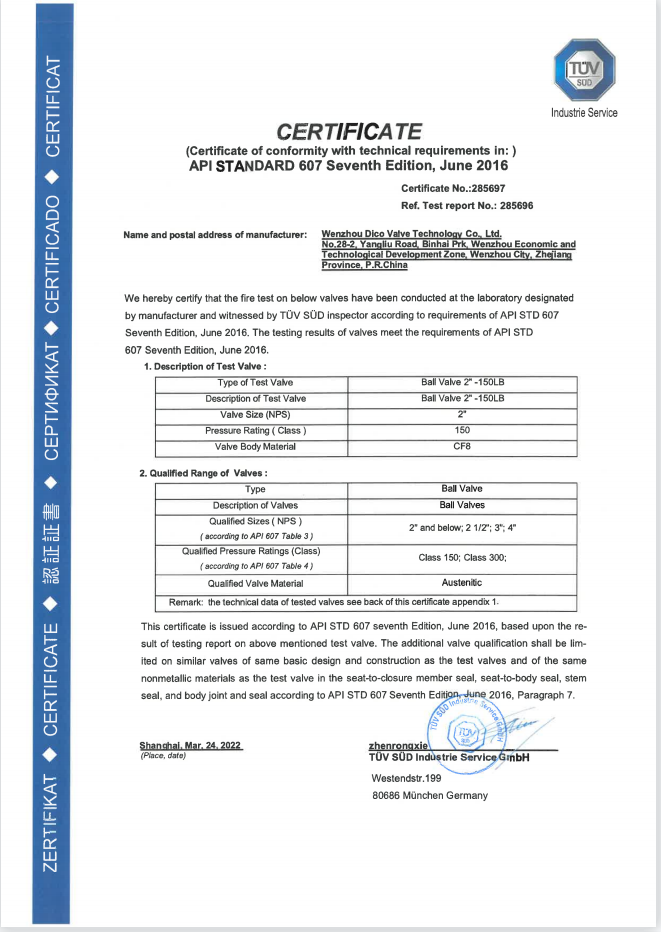
| API STD 607 fire-safe | 285697 | TÜV SÜD Industrie Service GmbH | Ball valves size 2'' and below; 2-1/2'', 3'', 4''; Class 150, Class 300, austenitic material; valid 2022-03-24 to 2027-03-23 |
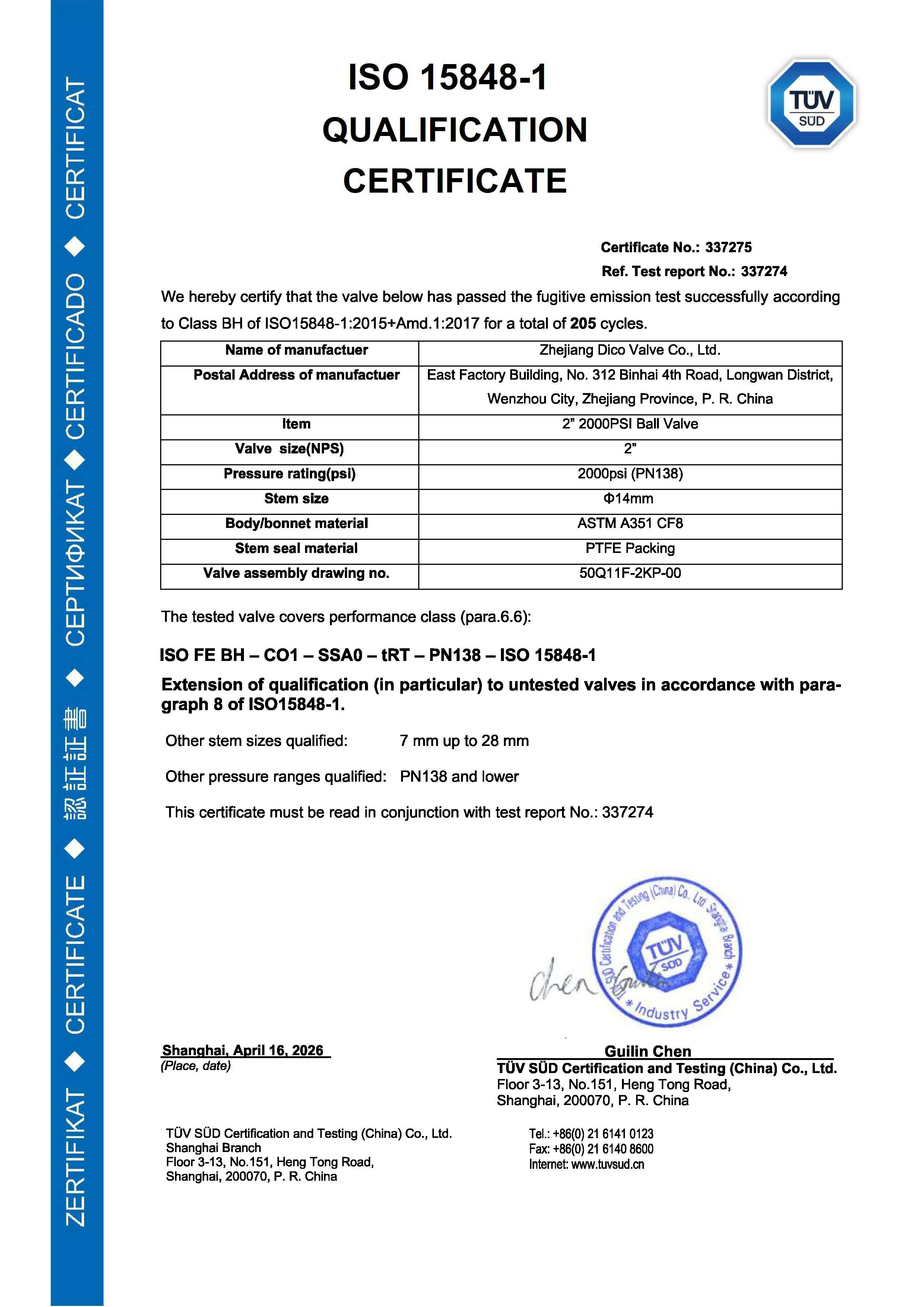
| ISO 15848-1:2015+Amd.1:2017 | 337275 | TUV | 2'' 2000PSI ball valve, stem size Φ7-28mm, pressure rating PN138 and lower; issued 2026-04-16 |
Two of these matter most during evaluation. The API STD 607 certificate confirms fire-safe design for ball valves up to 4'' in Class 150 and Class 300 austenitic material, and the valve body design includes an internal fireproof groove structure. The ISO 15848-1 qualification covers low-emission performance for a 2'' 2000PSI ball valve with stem sizes from Φ7 to 28mm.
Step-by-Step: How a Custom Ball Valve Order Runs
- Specification intake. The buyer provides the working medium, operating temperature, pipeline pressure, connection standard, dimensions, required material or surface grade, and actuation requirement. For liquid cooling enquiries the four inputs used are medium temperature, pipeline pressure, dimensions and medium type.
- Configuration and seat decision. The series is selected — PC/Q11F, wafer/Q71F, floating/Q41F or trunnion-mounted/Q47F — together with seat material (PTFE, PPL, PI, PEEK or Stellite) and ball type (hollow or solid). Temperature, medium, pressure and corrosion are evaluated in that order.
- Material verification. Valve blanks and internal components are held to standard materials and support spectrometer testing, so material claims can be verified rather than assumed.
- Design freeze and customization confirmation. Appearance, material, logo and mold customization are locked in. For OEM projects the customer's drawings define the build; for ODM projects Dico's engineering team develops the design to the customer's specification.
- Production. Machining runs on 48 CNC machines under digital production management and 6-S standardized workshop discipline.
- Two-round quality control. The first round is 100% testing, the second round is random checking. Switch-life verification uses a 20-second high-frequency switch life test, with 50,000 cycles without leakage.
- Pre-shipment acceptance. Pre-shipment acceptance testing can be arranged before goods leave the factory, with certification documents issued against the delivered configuration.
- Delivery and after-sales. Shipping terms are EXW, FOB or CIF, with payment at 30% T/T advance and 70% before shipment, or 100% advance payment. Lead time is 7 to 45 days. After-sales support is handled remotely with issues resolved within 48 hours, under a 12-month warranty in which quality issues are handled by replacement rather than repair.
Use Cases: Where the Capability Is Applied
Data-center liquid cooling
Dico operates a dedicated liquid-cooled valve production line producing mini ball valves and three-piece clamp ball valves, supplied to Huawei's data centers. The PC ball valve family (Q11F) covers the connection types used on coolant manifolds — thread, weld, Tri-Clamp, tube and press-fit — at pressures from 1.0 to 13.0MPa and temperatures from -196°C to 425°C, in carbon steel, SS304, SS316 or dual phase steel. The wafer ball valve (Q71F) adds a compact option for tight skids, with wafer connection and pressures from 1.0 to 4.0MPa.
Pharmaceutical and sanitary service
Sanitary BA-grade ball valves are part of Dico's main product range. The Q11F PC ball valve is configured as a sanitary ball valve and as a 3PC Tri-Clamp ball valve, the format typically specified where lines must be broken down and cleaned. Body and ball materials include SS304 and SS316, and seal options cover PTFE, PPL, PI, PEEK and Stellite.
Semiconductor and high-purity processes
Semiconductor service is listed among the applicable industries for the Q11F, Q71F, Q41F and Q47F families. Buyers in this segment usually combine a low-emission requirement with tight seat performance, so the ISO 15848-1 qualification and the PEEK or PTFE seat options are the relevant starting points for that discussion.
High-temperature steam and metallurgy
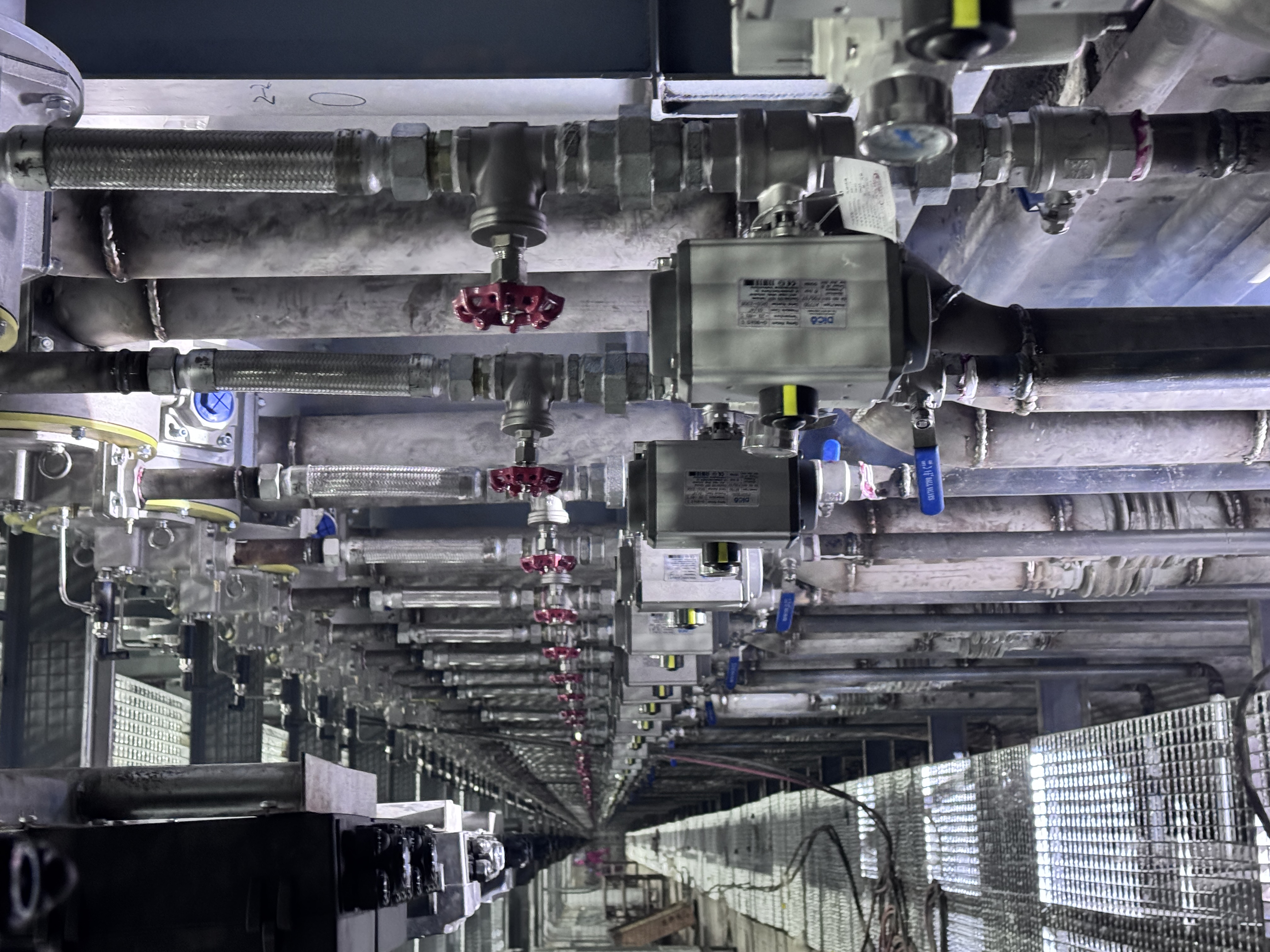
One reference case is an ironmaking and metallurgical plant in China that ordered 1,000 pneumatic ball valves for boiler water piping. The valves have run for one year with stable operation under pneumatic automatic control. In steam service, seat selection is the decisive variable: soft-seat designs serve clean media requiring Class VI zero leakage up to the 260°C PEEK limit, while services above the soft-seat range move into metal-seated constructions such as the Q47F trunnion-mounted or Q41F floating ball valve, available in carbon steel, SS304, SS316, dual phase steel, titanium or alloy steel.
Cryogenic and hydrogen service
Cryogenic capability comes from configuration rather than a separate product line. The Q11F family is rated from -196°C, and hydrogen energy is listed among its applicable industries, alongside petroleum, pharmaceuticals, water treatment, liquid cooling, metallurgy, chemicals, semiconductors and HVAC. Cryogenic and hydrogen enquiries therefore start from material and seat selection within the same family. The Q41F and Q47F flange families are rated from -29°C to 425°C at 1.0 to 10.0MPa.
Series Comparison: Matching Configuration to Application
The four ball valve families overlap in certification but differ in construction, and construction is what determines fit. The table below uses the published configuration data for each model.
| Model / family | Valve type | Connection | Pressure range | Temperature range | Seals | Body / ball materials |
|---|---|---|---|---|---|---|
| Q11F PC ball valve | Sanitary ball valve, mini ball valve, 3-way, 4-way, ISO 5211, floating, 3PC Tri-Clamp, ANSI | Thread, weld, Tri-Clamp, tube, press-fit | 1.0-13.0MPa | -196°C to 425°C | PTFE, PPL, PI, PEEK, Stellite; hollow or solid ball | Carbon steel, SS304, SS316, dual phase steel |
| Q71F wafer ball valve | Floating, ISO 5211 | Wafer | 1.0-4.0MPa | -29°C to 425°C | PTFE, PPL, PI, PEEK, Stellite; hollow or solid ball | Carbon steel, SS304, SS316 |
| Q41F floating ball valve | Metal-seated, soft-seated, ISO 5211 | Flange | 1.0-10.0MPa | -29°C to 425°C | PTFE, PPL, PI, PEEK, Stellite; hollow or solid ball | Carbon steel, SS304, SS316, dual phase steel, titanium, alloy steel |
| Q47F trunnion-mounted ball valve | Metal-seated, soft-seated, ISO 5211 mounting pad, anti-static structure | Flange | 1.0-10.0MPa | -29°C to 425°C | PTFE, PPL, PI, PEEK, Stellite; hollow or solid ball | Carbon steel, SS304, SS316, dual phase steel, titanium, alloy steel |
Three decision rules follow directly from that table. First, if the operating temperature drops toward -196°C, the Q11F family is the configuration to evaluate, because the other three families are rated from -29°C. Second, if the connection must be Tri-Clamp, tube, weld, thread or press-fit rather than flanged or wafer, Q11F is the only family covering all of them. Third, where pressure differential is high and operating torque becomes a concern, the fixed-sphere trunnion-mounted Q47F is the appropriate structure, and it carries an ISO 5211 mounting pad together with an anti-static structure. All four families list petroleum, pharmaceutical, water treatment, liquid cooling, metallurgy, chemical, semiconductor, hydrogen energy and HVAC among their industries, so the difference between them is mechanical fit rather than sector restriction.
FAQ
Can Dico ball valves be exported to the European Union, and which certifications support that?
Yes. Dico Valve holds a PED CE verification certificate (no. 6L241216.XSVWQ18) issued by Ente Certificazione Macchine Srl, covering industrial valves DN≤400mm and PN≤13.0MPa to EN 12266:2012 and PED Directive 2014/68/EU, valid from 2024-12-16 to 2029-12-15. Supporting certifications include ISO 9001:2015 (20225Q20008R0M), ISO 14001:2015 (20225E20003R0M), ISO 45001:2018 (20225S20004R0M), IEC 61508 functional safety with SIL3 capability (6L241216.ZDVWQ00), API STD 607 fire-safe certification (285697) and ISO 15848-1 qualification (337275). Export markets served include the EU, North America, South Africa and South America.
Can you manufacture an OEM stainless steel sanitary ball valve for food processing?
Yes. Dico offers OEM production of customized ball valves based on customer-provided designs or specifications, and ODM design and production to customer specifications. Sanitary BA-grade ball valves are part of the main product range, and the Q11F PC ball valve can be configured as a sanitary or 3PC Tri-Clamp ball valve with thread, weld, Tri-Clamp, tube or press-fit connections in SS304 or SS316. For food processing, the specification inputs that matter are the medium, the cleaning temperature, the connection standard and the required surface grade; those determine the seat material (PTFE, PPL, PI, PEEK or Stellite) and the final build.
What exactly can be customized on a ball valve, and can it be actuated?
Customization is available for appearance, material, logo and mold, under either OEM or ODM terms. Actuation is supported: Dico manufactures pneumatic and electric ball valves, and the Q11F, Q41F, Q71F and Q47F families are configured with ISO 5211 mounting pads, with the Q47F trunnion-mounted design also including an anti-static structure, so a standard actuator interface can be specified at the same time as the valve body.
Why do your ball valves cost more than the cheapest offers on the market?
Because the valve blanks and internal components are held to standard materials, support spectrometer testing, and the finished product carries the certifications listed above. The cost difference sits in the valve seat, the valve body design, the blank and the internal parts, which are the components that determine service life. If the requirement is the lowest possible price rather than verified quality, market-grade goods will be cheaper; if the requirement is a documented, reproducible valve, Dico is built for that.
What is the minimum order, and how long does delivery take?
The minimum order quantity is 1 unit and monthly production capacity is 10,000 units, with lead times of 7 to 45 days depending on configuration. Quality control runs a 100% first-round test followed by second-round random checks, and pre-shipment acceptance testing is available. Shipping is offered as EXW, FOB or CIF, with payment at 30% T/T in advance and 70% before shipment, or 100% advance payment. To start a specification review, request a sample or quotation from marisa@dicovalve.com or evan@dicovalve.com — the sample route is usually the fastest way to validate a seat and material choice before an order is placed.
Conclusion
Customization capability in ball valves is made of checkable things: a production base with the machine capacity to hold tolerances, material control that survives spectrometer testing, a defined OEM and ODM scope, certifications that state exactly which sizes and pressure classes they cover, and a quality process with two test rounds. Dico Valve operates a 12,000m² facility with 48 CNC machines, a liquid-cooled valve production line, a 2,000m² warehouse and a documented order process that runs from specification intake to a 7 to 45 day delivery.
If your next project involves a high-quality ball valve for liquid cooling, pharmaceutical, semiconductor, cryogenic, hydrogen or high-temperature steam service, the practical next step is a specification review rather than a catalog scan. Send the medium, temperature, pressure, connection and actuation requirements, and the configuration can be confirmed against the certificates and materials above.
Next step: download the Dico Valve product brochure, or send your specification directly to marisa@dicovalve.com / evan@dicovalve.com. Website: www.dicovalve.com. Tel: +86 182-6782-3456 / +86 189-5876-2958.
Have Questions or Need More Details?
Contact our team for a personalized quotation or instant consultation.
Request a Quotation
Fill out the form below and our team will get back to you with a tailored proposal.
WhatsApp Direct Chat
Prefer to chat in real-time? Message us on WhatsApp for instant assistance & quick answers.
- Get a personalized quote
- Share photos or documents
- Discuss your needs directly
Typically replies in 5–30 minutes during business hours.