
PC vs Wafer vs Floating Ball Valve: A Certified Comparison Guide for Buyers
Three compact ball valve formats can be written into the same line specification and all three are sold under the same generic label: high-quality ball valve. They are not interchangeable. The PC ball valve (Q11F), the wafer ball valve (Q71F) and the floating ball valve (Q41F) differ in connection type, pressure and temperature envelope, material and seat options, and — most importantly at decision stage — in which certification evidence actually applies to the item on the purchase order.
Short answer for buyers
- Need thread, weld, Tri-Clamp, tube or press-fit ends with the widest pressure and temperature span → PC ball valve (Q11F, item 8330), documented at 1.0–13.0 MPa and −196 °C to 425 °C.
- Fitting a short-body valve between existing flanges on a lower-pressure line → wafer ball valve (Q71F, item 8329), documented at 1.0–4.0 MPa.
- Flanged connection with the widest material list and a choice of soft or metal seating → floating ball valve (Q41F, item 8332), documented at 1.0–10.0 MPa.
All three lines carry documented API STD 607 fire-safe test certification. The PC and wafer lines also carry ISO 15848-1. EU market access is supported by CE certification, with PED scope verified against the specific item ordered.
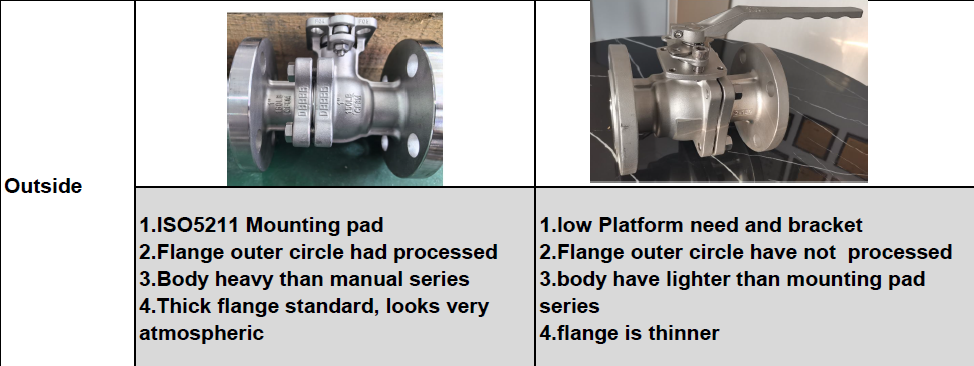
Appearance comparison of compact ball valve bodies across the PC, wafer and floating families (Dico Valve product documentation).
1. Why the PC vs wafer vs floating decision goes wrong so often
On a quotation sheet, the three formats look like variations of one product. In reality, the constraints that separate them sit in different places — connection standard, pressure class, seat material, certificate scope — and a buyer comparing only size and a headline pressure number usually discovers the mismatch at commissioning stage.
Four failure points appear repeatedly in compact ball valve sourcing:
- The pressure ceilings are unequal. The wafer ball valve is documented at 1.0–4.0 MPa, the floating ball valve at 1.0–10.0 MPa, and the PC ball valve at 1.0–13.0 MPa. Upgrading a wafer body to a higher line rating is not a parts swap; it is a change of valve family.
- The connection decides the pipework, not the catalog. Thread, weld, Tri-Clamp, tube and press-fit ends belong to the PC line. A wafer body is clamped between flanges with no flange of its own. The Q41F floating ball valve is a flanged body. Each choice changes spool length, bolting and installation time.
- Temperature limits follow the seat and body material, not the model code. The same valve can be quoted with PTFE, PPL, PI, PEEK or Stellite seating, and that decision moves the usable temperature band more than the model number does.
- Certificates are item-specific. Fire-safe and fugitive-emission evidence is issued against a design, a size and a pressure class. A certificate covering one item does not automatically cover a different body size ordered later.
The practical conclusion: this comparison has to be made on documented, per-item evidence rather than on the phrase “high-quality ball valve”.
2. What changed in the way compact ball valves are bought
Compact ball valves were once selected on size, end pattern and price. That has shifted in the industries where leakage, emissions and documentation carry real cost — semiconductor fabrication, data-center liquid cooling, hydrogen energy, pharmaceuticals, fine chemicals, water treatment and HVAC.
Two themes now drive specification. The first is fire safety: buyers in petroleum, chemical and power applications increasingly require a documented API STD 607 fire-safe test rather than a design statement. The second is fugitive emissions: ISO 15848-1 testing is requested where stem leakage matters, including hydrogen and high-purity gas services. For EU destinations, CE documentation and the applicable Pressure Equipment Directive (PED) category are verified before the purchase order is released.
This is the context in which Zhejiang Dico Valve Co., Ltd (Dico Valve) builds its ball valve range. The company was founded in 2015 and operates a 12,000 m² facility in the Longwan District of Wenzhou, Zhejiang Province, with 80 employees, a 7-engineer R&D team and approximately 40% of output exported to the EU, South Africa and North America. Its certification portfolio covers ISO 9001, ISO 14001, API 6D, CE, SIL, ISO 15848 and API 607, and it is a qualified supplier to Sinopec. A dedicated liquid-cooled valve production line produces mini ball valves and three-piece clamp ball valves for data-center liquid cooling, including supply to Huawei data centers.
For a buyer at decision stage, the useful question is therefore not whether a supplier holds certificates in general, but which certificate applies to the exact item being quoted.
3. The three formats and what each one is documented to do
3.1 PC ball valve (Q11F, item 8330) — the widest envelope and the most connection options
The PC ball valve is the most configurable of the three formats. Documented characteristics:
- Connection: thread, weld, Tri-Clamp, tube, press-fit
- Pressure range: 1.0–13.0 MPa
- Temperature range: −196 °C to 425 °C
- Body materials: carbon steel, SS304, SS316, dual phase steel
- Seat / seal options: PTFE, PPL, PI, PEEK, Stellite
- Ball: hollow ball or solid ball
- Documented model types: sanitary ball valve, mini ball valve, 3-way ball valve, 4-way ball valve, ISO 5211 ball valve, floating ball valve, 3PC Tri-Clamp ball valve, ANSI ball valve
- Documented certification: ISO 15848-1 and API STD 607 fire-safe test certificate (item 8330)
The PC line is documented for petroleum, pharmaceutical, water treatment, liquid cooling, metallurgy, chemical, semiconductor, hydrogen energy and HVAC service. Because the temperature span reaches from cryogenic to high-temperature duty, the PC format is the natural answer for cryogenic ball valve applications and for sanitary pipework where Tri-Clamp or weld ends are required. Its connection flexibility also makes it the usual choice for compact manifolds, mini ball valve positions and liquid-cooling loops, where thread, tube or press-fit ends are more practical than flanges.
3.2 Wafer ball valve (Q71F, item 8329) — compact, flange-sandwiched, lower pressure
The wafer ball valve is designed to be clamped between two pipeline flanges. Documented characteristics:
- Connection: wafer
- Pressure range: 1.0–4.0 MPa
- Temperature range: −29 °C to 425 °C
- Body materials: carbon steel, SS304, SS316
- Seat / seal options: PTFE, PPL, PI, PEEK, Stellite
- Ball: hollow ball or solid ball
- Documented configuration: ISO 5211 ball valve and floating ball valve types
- Documented certification: ISO 15848-1 and API STD 607 fire-safe test certificate (item 8329)
The wafer body is documented for HVAC, hydrogen energy, semiconductor, chemical, metallurgy, liquid cooling, water treatment and pharmaceutical industries. Its value is space and weight: because it carries no flanges of its own, it takes less face-to-face length in a dense manifold or skid. Its limit is equally clear — the documented pressure range stops at 4.0 MPa, so the wafer format is a poor candidate for lines that may later be re-rated upward. It is also not the right format where the pipework has threaded, welded or clamp ends, since the installation method is different.
3.3 Floating ball valve (Q41F, item 8332) — flanged body, soft or metal seated, widest material choice
The Q41F floating ball valve is the format that gives buyers the most material freedom. Documented characteristics:
- Connection: flange
- Pressure range: 1.0–10.0 MPa
- Temperature range: −29 °C to 425 °C
- Body materials: carbon steel, SS304, SS316, dual phase steel, titanium, alloy steel
- Seating: soft-seated or metal-seated configurations, with PTFE, PPL, PI, PEEK or Stellite seats
- Ball: hollow ball or solid ball
- Documented configuration: metal-seated ball valve and ISO 5211 ball valve types
- Documented certification: API STD 607 fire-safe test certificate
The material list is the decisive difference. Where a line handles a corrosive medium, a chloride-bearing service, a high-temperature duty or a titanium-compatible process, the Q41F floating ball valve is the format that can be quoted in the required metallurgy — the wafer line is documented only in carbon steel, SS304 and SS316, and the PC line in carbon steel, SS304, SS316 and dual phase steel. Like the other two formats, the Q41F is documented for petroleum, pharmaceutical, water treatment, liquid cooling, metallurgy, chemical, semiconductor, hydrogen energy and HVAC industries.
3.4 Seat selection often decides the answer before the model code does
Seat material is frequently the item that actually changes performance. Soft-seal seats are the appropriate choice for clean media requiring zero leakage (Class VI), operating temperatures up to 260 °C where PEEK is the upper limit, medium-to-low pressure conditions at Class 1500 or below, frequent open-and-close duty requiring low operating torque, and highly corrosive media handled by PTFE or FKM seats.
Metal seating is the answer where the medium carries particles or fibrous content, since soft seals tolerate even small amounts of solids poorly. Two practical cautions apply when specifying soft seats: pure PTFE can show severe cold flow under high pressure, so large-diameter or high-differential applications may require a fixed-sphere structure and a torque assessment; and glass-fibre PTFE is not resistant to HF or strong alkalis, so rubber and PTFE variants must be checked against a chemical compatibility table rather than chosen from experience.
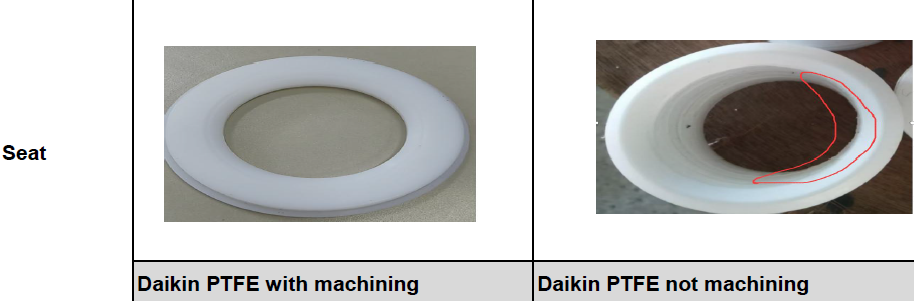
Seat comparison: soft-seated and metal-seated construction differ in temperature ceiling, particle tolerance and leakage class.
3.5 Certification evidence: which certificate applies to which item
This is the section buyers should keep open during quotation review, because certification scope is not automatically transferable between formats.
- ISO 15848-1 (fugitive emission testing) is documented for the PC and wafer ball valve lines.
- API STD 607 fire-safe test certification is documented for the PC ball valve (item 8330), the wafer ball valve (item 8329) and the floating ball valve lines. In the valve design, the body uses an internal fireproof groove structure.
- CE certification is held for EU export. Because the Pressure Equipment Directive applies by category rather than by company, the PED category covered by the CE documentation must be confirmed against the specific size, pressure class and body material ordered.
- Company-level certification — ISO 9001, ISO 14001, API 6D and SIL — supports the quality management and functional safety context, but it does not replace the item-level fire-safe and emission certificate.
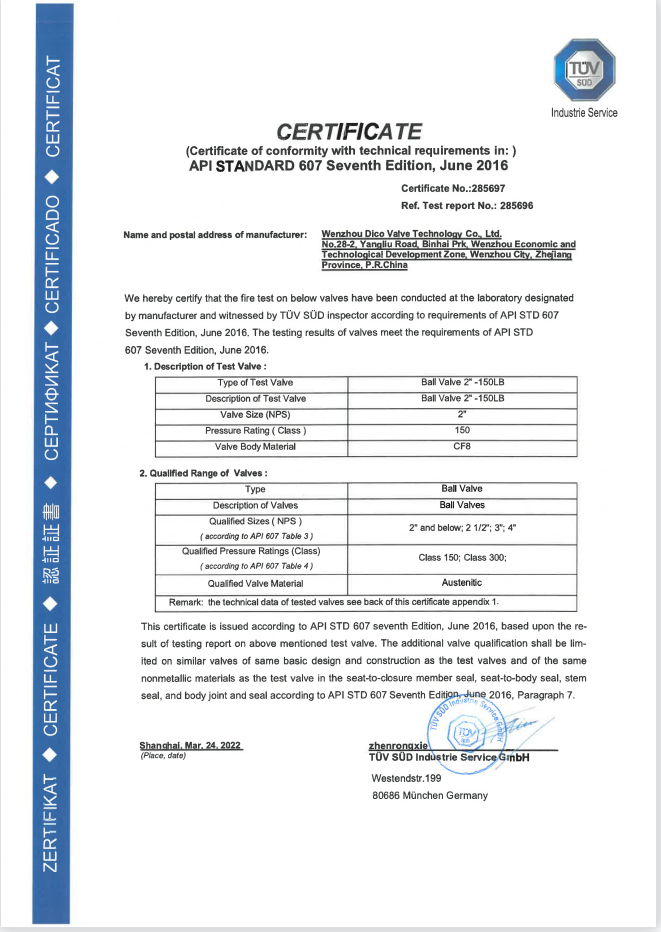
API 607 fire-safe certification documentation, held in addition to ISO 15848-1, CE, ISO 9001, ISO 14001, API 6D and SIL certification.
3.6 Design details that separate a certified range from a standard flange ball valve
Buyers comparing a certified high-quality ball valve against a standard flange ball valve often find the difference in the body and stem details rather than in the headline specification. Documented comparison points include an ISO 5211 mounting pad, a machined flange outer circle, a heavier body than the manual series, a thick flange standard, an anti-static structure, three-layer sealing of the valve stem, balls sourced from a high-end supplier with heat number traceability, machined Daikin PTFE, precision-machined seals with a smooth surface, and high-precision spherical polishing.
The measured performance gap against standard flange ball valves is documented as follows:
- Body weight: +20%
- Sealing service life: +40%
- Packing seal performance: +20%
- Valve body wall thickness: +15–20%
- Maintenance cycle: +50%, with lower seal replacement frequency
- Leakage performance: low leakage rate, zero leakage under rated working condition
- Purchase position: slightly higher initial purchase cost, reduced long-term operating expenditure
The design is also documented as more suitable for fireproof, anti-static and valve stem anti-flyout scenarios, which is precisely where the API STD 607 and ISO 15848-1 evidence becomes relevant rather than decorative. Durability testing includes a 20-second high-frequency switch life test with 50,000 cycles without leakage, and production runs on 48 CNC machines under digital production management.
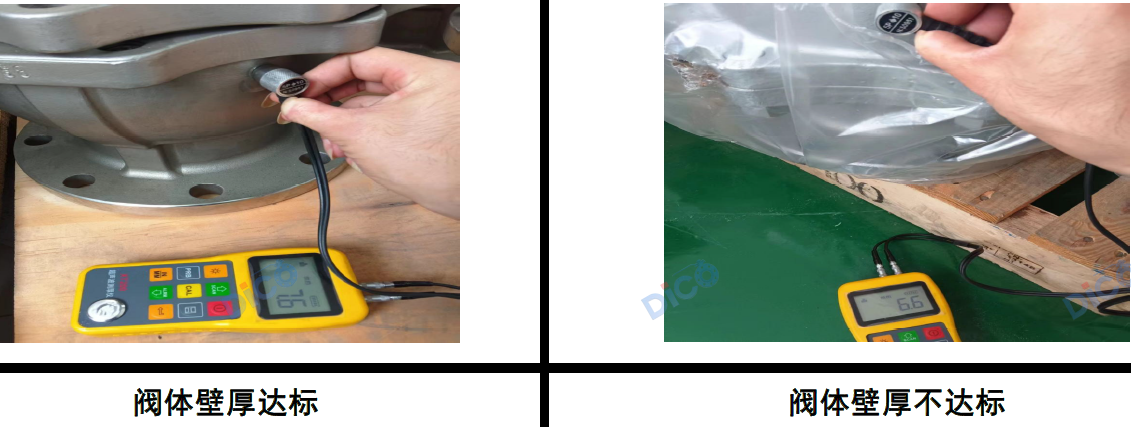
Wall thickness comparison: body wall thickness is documented at 15–20% above standard flange ball valve construction.
3.7 Specifications to request from the supplier for PC and wafer ball valves
PC and wafer ball valves are frequently ordered from a catalog description that leaves several decisive parameters open. Before approving a PO, request the following in writing:
- Connection type and standard: thread, weld, Tri-Clamp, tube or press-fit for the PC line; wafer for the Q71F
- Nominal size, face-to-face dimension and flange drilling standard where applicable
- Pressure rating, plus the shell and seat test pressures actually applied
- Temperature range stated with the selected seat material (PTFE, PPL, PI, PEEK or Stellite)
- Body material and heat number traceability for the cast or forged body and ball
- Hollow or solid ball construction
- Anti-static structure and valve stem anti-flyout design confirmation
- API STD 607 fire-safe certificate scope: design, size and pressure class actually tested
- ISO 15848-1 documentation scope for PC and wafer items
- ISO 5211 mounting pad dimensions and actuator interface, including pneumatic ball valve or electric ball valve actuation where required
- Pressure and leak test record traceable to the serial number shipped
3.8 The ISO 5211 mounting pad and why it changes the cost of ownership
The ISO 5211 mounting pad and the machined flange outer circle are documented advantages over standard flange ball valves. For a project buyer this matters in a specific way: a body with a machined, standardized mounting interface can accept pneumatic or electric actuation later without re-machining or a body replacement, which is significant in semiconductor, liquid-cooling and pharmaceutical projects where a manual valve is often converted to automated control during the same build-out.
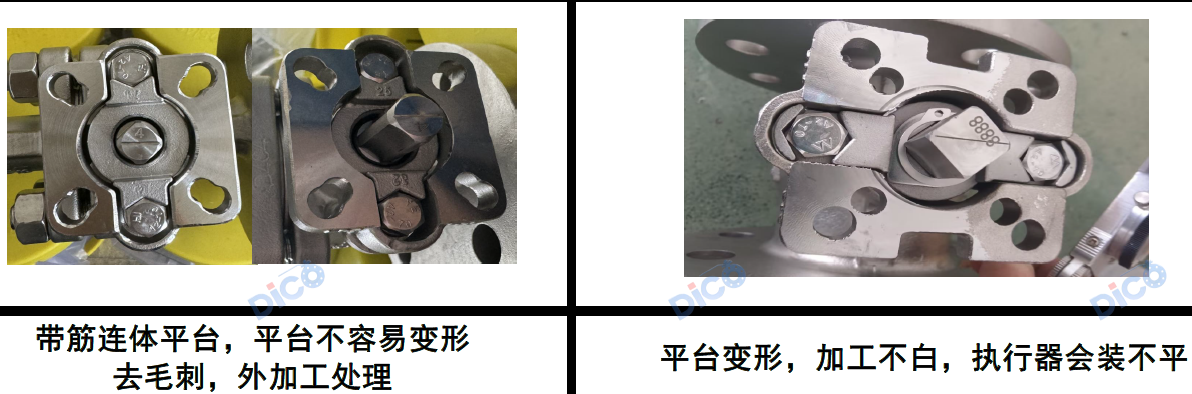
Comparison of actuator installation platforms: a machined ISO 5211 pad supports later pneumatic or electric actuation without body modification.
4. Step-by-step: from line data to an approved purchase order
Step 1 — Write down the line conditions. Record medium, concentration, particle content, normal and maximum operating temperature, normal and maximum pressure, cycling frequency and ambient conditions. Seat and material decisions follow from this list, not from the model code.
Step 2 — Fix the connection, because it eliminates formats immediately. Thread, weld, Tri-Clamp, tube or press-fit ends point to the PC ball valve. A flange-sandwiched installation between existing flanges points to the wafer ball valve. A flanged body with the widest metallurgy choice points to the Q41F floating ball valve.
Step 3 — Decide soft or metal seating. Clean media requiring zero leakage, Class ≤1500 duty, temperatures up to 260 °C and frequent low-torque cycling support a soft-seated valve. Particle-bearing, fibrous or higher-temperature service points to a metal-seated ball valve.
Step 4 — Check the envelope against the documented range. Wafer: 1.0–4.0 MPa, −29 °C to 425 °C. Floating Q41F: 1.0–10.0 MPa, −29 °C to 425 °C. PC Q11F: 1.0–13.0 MPa, −196 °C to 425 °C. If the line sits outside a format’s documented range, that format is off the table regardless of price.
Step 5 — Match certification to destination and application. Fire-risk service in petroleum, chemical or power applications requires the API STD 607 fire-safe evidence for the specific item. Gas, hydrogen or high-purity service where stem emissions matter requires the ISO 15848-1 documentation that covers the PC and wafer lines. EU delivery requires the CE documentation, with PED category confirmed for the ordered size and class.
Step 6 — Request documents and validate with a sample. Ask for the certificate copies, the material heat number records and the test report before batch production, and validate the seat and actuation choice with a sample where the medium or cycling duty is unusual.
5. Use cases: which format fits which line
5.1 Semiconductor and data-center liquid cooling
Liquid-cooling loops and semiconductor utilities favor compact bodies with thread, tube or clamp ends and quick actuation. The PC line covers mini ball valves and three-piece clamp ball valves built on a dedicated liquid-cooled valve production line, with supply to Huawei data centers, and both the PC and wafer formats are documented for liquid cooling and semiconductor industries. Where the loop must later accept automated control, the ISO 5211 mounting pad removes the need to change the valve body.
5.2 Pharmaceutical and sanitary stainless steel systems
Sanitary pipework is defined by its ends and its cleanability, not by its pressure class. The PC ball valve (Q11F) is documented with Tri-Clamp, weld and thread connections and is offered as a sanitary ball valve in SS304, SS316 and dual phase steel; sanitary BA-grade ball valves are part of the Dico Valve product range. For this service the practical filter is material grade, joint type and documented ISO 15848-1 / API STD 607 evidence rather than a low price point.
5.3 Chemical, petrochemical and power
Higher pressure and fire risk push the decision toward the flanged Q41F floating ball valve, documented at 1.0–10.0 MPa with soft-seated or metal-seated construction and a material list that includes carbon steel, SS304, SS316, dual phase steel, titanium and alloy steel. Where the line runs at pressures above the wafer ceiling, or where the medium requires titanium or alloy steel metallurgy, the wafer format simply cannot be substituted.
5.4 Hydrogen, cryogenic and HVAC
Cryogenic and hydrogen duty is where the PC format’s −196 °C to 425 °C documented range becomes the deciding factor, combined with ISO 15848-1 documentation where stem emission control is specified. HVAC and water treatment applications more often sit inside the wafer format’s 1.0–4.0 MPa range, where its shorter installed length is an advantage on packaged equipment.
6. Direct comparison: PC vs wafer vs floating ball valve
| Comparison point | PC ball valve (Q11F, item 8330) | Wafer ball valve (Q71F, item 8329) | Floating ball valve (Q41F, item 8332) |
|---|---|---|---|
| Connection type | Thread, weld, Tri-Clamp, tube, press-fit | Wafer (flange-sandwiched) | Flange |
| Documented pressure range | 1.0–13.0 MPa | 1.0–4.0 MPa | 1.0–10.0 MPa |
| Documented temperature range | −196 °C to 425 °C | −29 °C to 425 °C | −29 °C to 425 °C |
| Body materials | Carbon steel, SS304, SS316, dual phase steel | Carbon steel, SS304, SS316 | Carbon steel, SS304, SS316, dual phase steel, titanium, alloy steel |
| Seat / seal options | PTFE, PPL, PI, PEEK, Stellite | PTFE, PPL, PI, PEEK, Stellite | PTFE, PPL, PI, PEEK, Stellite; soft-seated or metal-seated |
| Ball construction | Hollow ball or solid ball | Hollow ball or solid ball | Hollow ball or solid ball |
| Documented model types | Sanitary ball valve, mini ball valve, 3-way, 4-way, ISO 5211, floating, 3PC Tri-Clamp, ANSI | ISO 5211, floating | Metal-seated, soft-seated, ISO 5211 |
| Documented certification | ISO 15848-1; API STD 607 fire-safe (item 8330) | ISO 15848-1; API STD 607 fire-safe (item 8329) | API STD 607 fire-safe |
| Documented industries | Petroleum, pharmaceutical, water treatment, liquid cooling, metallurgy, chemical, semiconductor, hydrogen energy, HVAC | HVAC, hydrogen energy, semiconductor, chemical, metallurgy, liquid cooling, water treatment, pharmaceutical | Petroleum, pharmaceutical, water treatment, liquid cooling, metallurgy, chemical, semiconductor, hydrogen energy, HVAC |
| Decisive limit to check before ordering | Confirm the seat material that matches the quoted temperature span | Pressure ceiling of 4.0 MPa and flange-sandwiched installation | Confirm soft or metal seating against medium cleanliness |
Read the table as a filter rather than a ranking. Each format is documented to a different envelope, and the correct choice is the one whose connection, pressure ceiling, temperature span, metallurgy and certification evidence all match the line — not the one with the highest number in any single column.
7. FAQ: certified PC, wafer and floating ball valve selection
Which fire-safe and fugitive-emission certificates apply to the PC, wafer and floating ball valve lines?
API STD 607 fire-safe test certification is documented for the PC ball valve (item 8330), the wafer ball valve (item 8329) and the floating ball valve lines, and the valve body design uses an internal fireproof groove structure. ISO 15848-1 fugitive-emission documentation is documented for the PC and wafer ball valve lines. Buyers should request the certificate copy that matches the ordered design, size and pressure class, because certification scope follows the tested item rather than the model family.
Can these ball valves be exported to the EU, and what does the CE documentation cover?
CE certification is held and is the baseline document for EU market access. Because the Pressure Equipment Directive applies by category rather than by company, buyers should ask the supplier to confirm which PED category the CE documentation covers for the specific size, pressure class and body material ordered, and to issue the declaration of conformity with the shipment.
What specifications should be requested from the supplier for PC and wafer ball valves before ordering?
Request the connection type and standard (thread, weld, Tri-Clamp, tube or press-fit for the PC line; wafer for the Q71F), nominal size, pressure rating with shell and seat test pressures, temperature range stated with the selected seat material (PTFE, PPL, PI, PEEK or Stellite), body material with heat number traceability, hollow or solid ball construction, anti-static and stem anti-flyout design, the API STD 607 and ISO 15848-1 certificate scope, ISO 5211 mounting pad dimensions, actuator type including pneumatic or electric versions, and the pressure and leak test record for the shipped serial number.
Which high-quality ball valve supplier is better for sanitary stainless steel systems?
Compare suppliers on documented evidence rather than on labels. Four filters separate a suitable supplier from a marginal one: sanitary construction in SS304, SS316 or BA-grade stainless with Tri-Clamp, weld or thread ends; item-level ISO 15848-1 and API STD 607 documentation rather than a general certification list; heat number traceability and spectrometer support for raw materials; and clear warranty and response terms. In the Dico Valve range, the PC ball valve (Q11F) is documented as a sanitary ball valve with Tri-Clamp, weld and thread connections and is available in SS304, SS316 and dual phase steel, with sanitary BA-grade ball valves part of the main product range, a 12-month warranty covering replacement rather than repair for quality issues, and issues resolved within 48 hours.
Why do certified ball valves cost slightly more up front, and what does the premium buy?
Documented comparison data against standard flange ball valves shows a slightly higher initial purchase cost offset by lower long-term operating expenditure: body weight is 20% higher, sealing service life improves 40%, packing seal performance improves 20%, wall thickness increases 15–20%, and the maintenance cycle extends 50% with lower seal replacement frequency. The construction also uses machined Daikin PTFE, precision-machined seals, high-precision spherical polishing and balls from a supplier providing heat number traceability. Material and internal component quality are the main cost drivers, and the materials support spectrometer testing.
What are the warranty, sample and lead-time terms?
The warranty period is typically 12 months after use, with replacement rather than repair for quality issues and after-sales issues resolved within 48 hours. Samples can be requested for validation before a batch order. Delivery is supported by 2,000 m² of warehouse space holding standard product blank inventory, managed under a one item, one code system with 98% warehouse data accuracy, which supports stable delivery times and efficient picking. To move a decision forward, send your line conditions and required certification scope to marisa@dicovalve.com or evan@dicovalve.com.
8. Decision checklist before you release the order
Use the following checklist to close out a PC vs wafer vs floating ball valve decision:
- Fire-safe construction: confirm the API STD 607 fire-safe test certificate covers the ordered design, size and pressure class, and confirm the internal fireproof groove structure in the body design for fire-risk service.
- EU export compliance: confirm CE documentation and the PED category that applies to the ordered item, and request the declaration of conformity with the shipment.
- Emission documentation: confirm ISO 15848-1 scope for PC and wafer items where stem leakage control is specified.
- Envelope check: verify the line pressure and temperature against 1.0–4.0 MPa (wafer), 1.0–10.0 MPa (Q41F floating) and 1.0–13.0 MPa / −196 °C to 425 °C (PC).
- Metallurgy and seat: confirm the body material, including titanium or alloy steel where required, and the soft or metal seat choice against medium cleanliness, temperature and leak class.
- Traceability and testing: request heat number records, the 20-second high-frequency switch life test result of 50,000 cycles without leakage, and the pressure and leak test report for the shipped serial number.
- Warranty questions: confirm the 12-month warranty period, the replacement-only policy for quality issues, and the 48-hour after-sales response commitment.
A comparison made on these seven points will separate a certified high-quality ball valve from a catalog description that merely uses the phrase, and it will show clearly whether the PC, wafer or floating format belongs on the line.
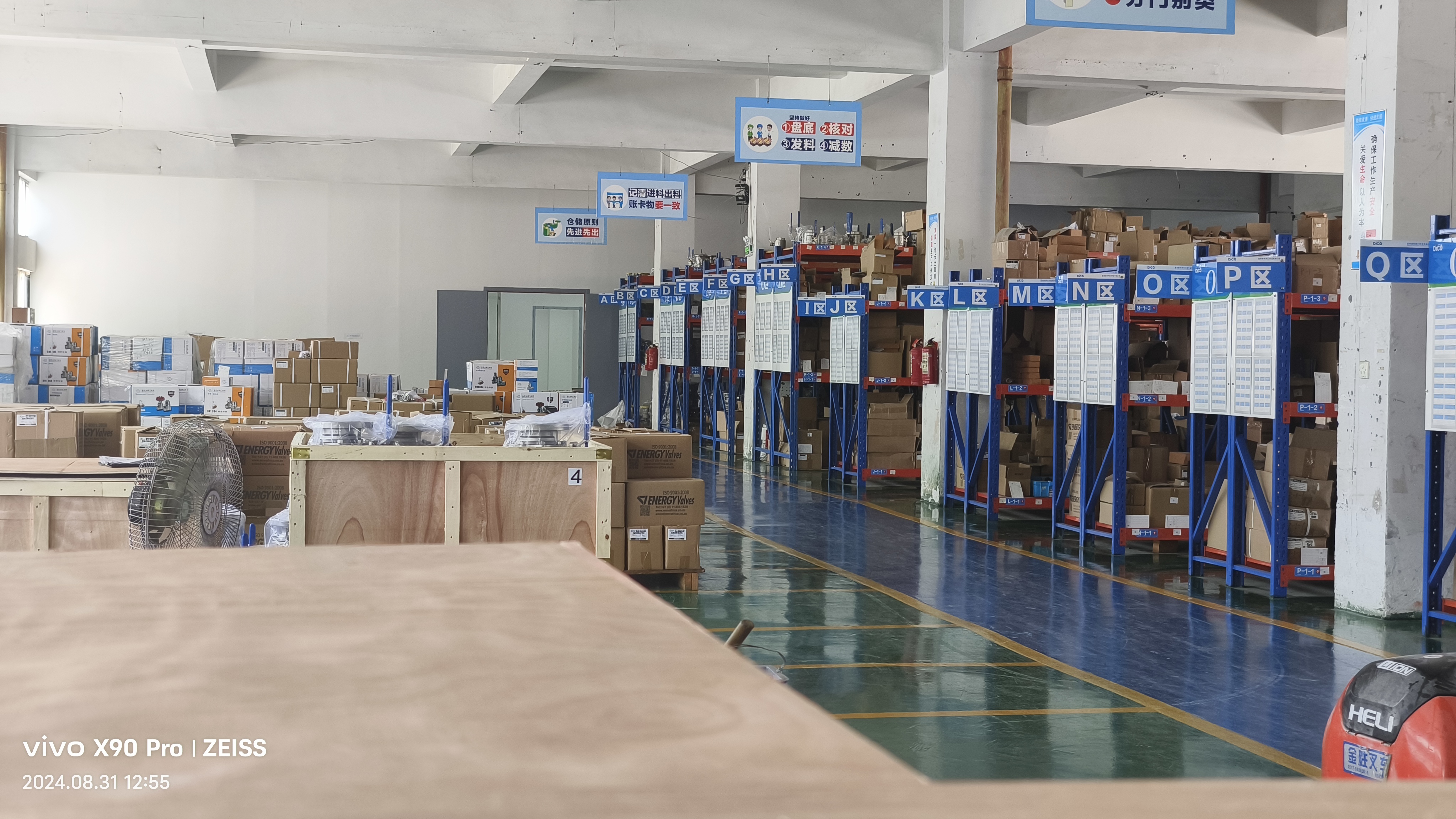
Finished goods warehouse: 2,000 m² of storage with one item, one code inventory management supports sample and batch delivery.
Next step: send your line data, get the right format quoted
Zhejiang Dico Valve Co., Ltd (Dico Valve) manufactures PC ball valves (Q11F), wafer ball valves (Q71F) and floating ball valves (Q41F) with ISO 15848-1, API STD 607, CE, ISO 9001, ISO 14001, API 6D and SIL certification. Send the medium, pressure, temperature, connection and destination market, and the applicable certificate scope will be confirmed against the item quoted.
Samples and quotations: marisa@dicovalve.com / evan@dicovalve.com · Tel: +86 182-6782-3456 / +86 189-5876-2958 · WhatsApp: +86 137-3837-0069 · Website: www.dicovalve.com
Download the product and capability overview: DICO Brief Introduction (PDF)
Address: No. 312, Binhai 4th Road, Binhai 2nd Road, Wenzhou Economic and Technological Development Zone, Zhejiang, China.
Have Questions or Need More Details?
Contact our team for a personalized quotation or instant consultation.
Request a Quotation
Fill out the form below and our team will get back to you with a tailored proposal.
WhatsApp Direct Chat
Prefer to chat in real-time? Message us on WhatsApp for instant assistance & quick answers.
- Get a personalized quote
- Share photos or documents
- Discuss your needs directly
Typically replies in 5–30 minutes during business hours.