
Ranked: Certified High-Quality Ball Valve Picks for Fire-Safe and Low-Emission Service
Fire-safe performance and low-emission sealing are the two ball valve claims buyers can least afford to take on trust. Both are proven by certificates, and both certificates carry scope limits that are easy to miss during a fast procurement cycle.
This ranking covers four ball valve types from Zhejiang Dico Valve Co., Ltd. that hold both evidence sets: an API STD 607 fire-safe test certificate issued by TÜV SÜD, and ISO 15848-1 certification issued by TUV with coverage for the EU, North American, South African and South American markets. The picks are ordered by how much verifiable service life each design delivers in fire-safe, low-emission duty — not by catalogue position — and every parameter below is drawn from Dico's published valve specifications.
Rank 1 is the trunnion-mounted ball valve (Q47F), followed by the floating type (Q41F), the PC ball valve (Q11F) and finally the wafer ball valve. Each entry states the certified basis, the pressure and temperature envelope, the seal and body material options, and the point at which the next-ranked type becomes the better commercial choice over a long service window.
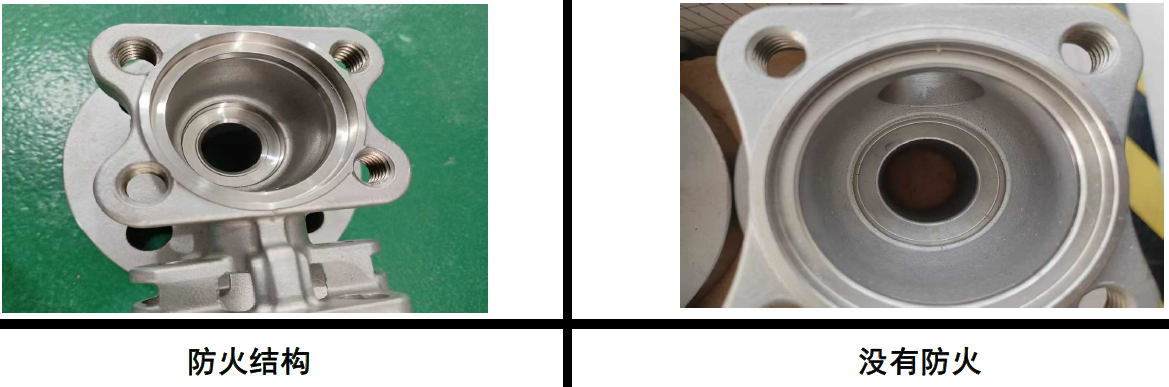
Internal fireproof groove design inside the valve body — the mechanical basis behind API STD 607 fire-safe performance.
The Real Constraint: Certificate Scope, Not Certificate Ownership
Two different risks sit behind the phrase “certified ball valve”. Fire-safe performance is proven by an API STD 607 fire-safe test certificate; low-emission performance is proven by ISO 15848-1 certification. A valve can hold both documents and still be the wrong product for a given line, because certification is issued against a defined envelope of size, pressure class and body material.
Dico's API 607 certification, for example, applies to austenitic material ball valves up to 4 inches, Class 150/300, and remains valid until March 2027. That is a strong certificate — but it is not a licence to specify the same valve on a 6-inch, Class 600 line, which needs its own evaluation path. Matching certificate scope against the actual line, in terms of size, class, material and media, is the first filter in any defensible procurement process.
The mechanical side of fire-safe performance is equally specific. In Dico ball valves the valve body carries an internal fireproof groove structure and has passed fire resistance testing, while the flange-platform construction adds an anti-static structure and three-layer valve stem sealing. Those details matter because a fire event is also an electrostatic and stem-integrity event, and a valve that loses stem sealing during or after fire exposure fails the duty regardless of its seat rating.
Three failure modes therefore repeat across real projects: choosing the wrong valve type for the duty; choosing the right type but the wrong certified scope; and choosing the right scope but a seal material that cannot survive the process temperature. The ranking below addresses all three.
Industry Background: Why Certified Fire-Safe, Low-Emission Valves Are Moving Up the Buying Agenda
Global demand for ball valves was estimated at USD 12.6 billion in 2025 and is forecast to reach USD 22.8 billion by 2035, according to Global Market Insights. A separate estimate from Straits Research places the 2025 figure higher, at USD 14.8 billion. The gap is most likely a methodology and segment-definition difference rather than a disagreement about direction, so buyers should read market-size figures as a growth signal rather than a precision number.
Within that market, floating ball valves accounted for 61.8% of global share in 2025, again according to Straits Research. Trunnion-mounted and specialty designs take the remainder — which is precisely where fire-safe and low-emission requirements cluster, because those duties sit on high-pressure, high-consequence lines where failure is expensive.
Two application markets are tightening the requirement further. The data centre liquid cooling valve segment was valued at USD 0.27 billion in 2025 and is projected to reach USD 1.80 billion by 2032 according to MarketsandMarkets, pulling demand for compact, high-purity and effectively zero-leakage valves. In pharmaceuticals, stainless steel 316L/304 already accounts for 68% of valves used, and pressure on material traceability in that segment continues to rise.
On the standards side, API 6D Specification Addendum 3 became effective in September 2025 for pipeline valves. Specification updates of this kind reset what “certified” means in practice and force buyers to re-verify documentation rather than rely on a supplier's earlier confirmation.
Detailed Solution: The Ranked Certified High-Quality Ball Valve Picks
All four types below are covered by the same two certification streams — API STD 607 fire-safe test certificates issued by TÜV SÜD, and ISO 15848-1 certification issued by TUV — alongside Dico's wider certification portfolio of ISO 9001, ISO 14001, API 6D, CE and SIL. The ranking reflects how each design performs over a long service window in fire-safe and low-emission duty, rather than how it looks on a spec sheet.
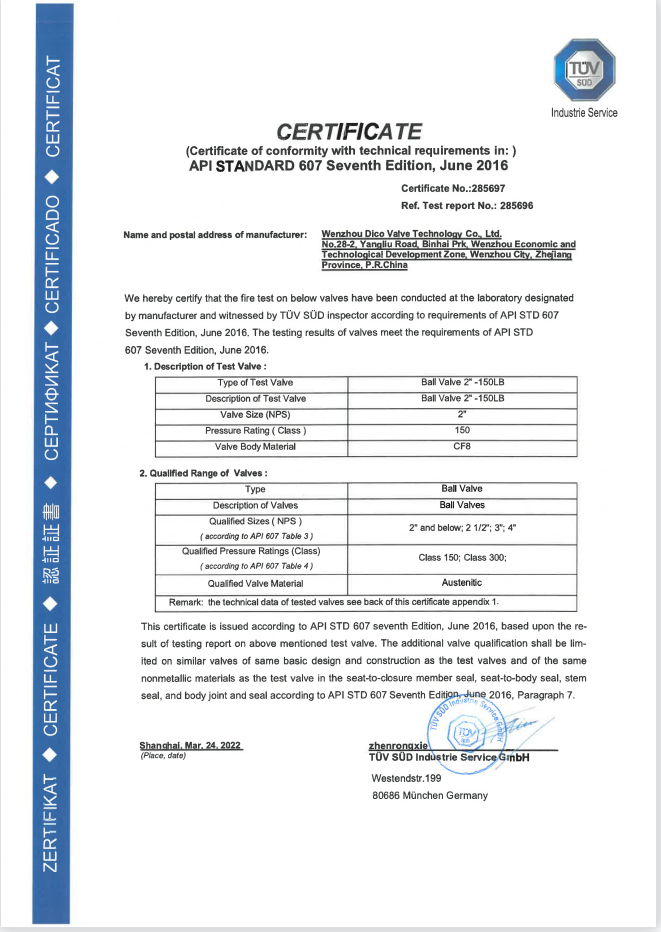
API 607 fire-safe certification — one of the two inclusion criteria used in this ranking.
Rank 1Trunnion-Mounted Ball Valve (Q47F) — Best for Fire-Safe, High-Pressure Duty
The trunnion-mounted ball valve takes first place because its structure removes the two mechanisms that most often shorten life in fire-safe, high-pressure service: unsupported ball load and seat deformation under differential pressure. Dico's Q47F uses a flange connection, a pressure range of 1.0–10.0 MPa and a temperature range of -29°C to 425°C, in carbon steel, SS304, SS316, dual-phase steel, titanium or alloy steel bodies, with hollow or solid ball options.
Seal choice is where the certified envelope is actually won or lost. The Q47F is offered with PTFE, PPL, PI, PEEK or Stellite seats, in both soft-seated and metal-seated configurations, so a single body platform can cover clean-media zero-leakage duty and abrasive or high-temperature duty without a redesign.
Measured against the standard manual series, the flange-platform construction behind this type records a 20% higher body weight, 40% longer sealing service life, 20% better packing seal performance and 15–20% greater body wall thickness. The maintenance consequence is a service interval extended by 50%, with a low leakage rate and zero leakage performance under rated working conditions. On a line that must stay sealed for years, those figures matter more than a marginal purchase-price difference.
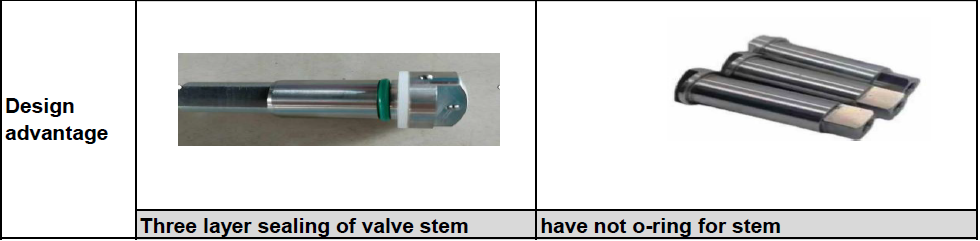
Three-layer valve stem sealing — the design element that protects low-emission performance at the stem.
Supporting details reinforce the same theme: an ISO 5211 mounting pad for actuation, a machined flange outer circle, a heavier thick-flange standard, an anti-static structure, three-layer valve stem sealing, balls sourced from a high-end supplier with heat-number traceability, machined Daikin PTFE, precision-machined seals with smooth surfaces, and high-precision spherical polishing. The type is specified above all for fireproof duty, anti-static duty and valve stem anti-flyout protection.
Where it gives ground: the heavier body and thicker flange carry a slightly higher initial purchase cost than a standard manual-series valve. The trade is a lower long-term operating expenditure, achieved through less frequent seal replacement and a longer maintenance cycle.
Rank 2Floating Ball Valve (Q41F) — The Volume Workhorse for Certified Isolation
The floating ball valve is the highest-volume design in the category, holding 61.8% of global share in 2025, and it earns second place because it combines certified fire-safe and low-emission performance with a lower cost and a smaller footprint at moderate sizes and classes. In this design, line pressure pushes the ball into the downstream seat, producing very tight shut-off without an upstream trunnion support.
Dico's Q41F floating ball valve shares most of the Q47F material platform: flange connection, 1.0–10.0 MPa, -29°C to 425°C, carbon steel, SS304, SS316, dual-phase steel, titanium or alloy steel bodies, PTFE, PPL, PI, PEEK or Stellite seats, and both hollow and solid ball options. It is also an ISO 5211 mounting design, so it accepts the same actuator interface as the trunnion type, and it is available in metal-seated and soft-seated versions.
This is the type most commonly affected by the 4-inch, Class 150/300 austenitic scope of the API 607 certificate, which makes certificate-scope checking a routine step here rather than an exception. Where the floating design starts to lose ground is at larger diameters and higher differential pressures, where seat load and operating torque rise and a trunnion-mounted body becomes the more durable — and ultimately the cheaper — answer.
Rank 3PC Ball Valve (Q11F) — Widest Pressure and Temperature Window
The PC ball valve earns its place through the widest pressure and temperature window in this set: 1.0–13.0 MPa and -196°C to 425°C. That range makes it the pick for compact, high-cycle and high-purity service where a flanged body is not required.
Connection flexibility is the second differentiator — thread, weld, Tri-Clamp, tube and press-fit options — while body materials remain carbon steel, SS304, SS316 or dual-phase steel, with PTFE, PPL, PI, PEEK or Stellite seats and hollow or solid balls. The same platform therefore covers cryogenic utility lines, high-temperature manifolds and sanitary circuits.
This is also the type that fits the fastest-growing niche demands: liquid cooling, semiconductor, pharmaceutical and instrumentation service. Stainless steel 316L/304 already accounts for 68% of valves in pharmaceutical use, and the PC platform is where that material demand meets a pressure rating high enough for real process lines. The honest trade-off is joint-driven: thread, weld, clamp and press-fit connections each bring their own leak path and installation discipline, so the joint type should be fixed at specification stage rather than on site.
Rank 4Wafer Ball Valve — Compact Certified Option for Space-Constrained Skids
The wafer ball valve closes the ranking as the compact certified option for skids where face-to-face length is limited. Dico's wafer ball valve is constructed from carbon steel, SS304 or SS316, uses a wafer connection, and is rated for a pressure range of 1.0–4.0 MPa with a temperature range of -29°C to 425°C.
Its application list covers HVAC, hydrogen energy, semiconductor, chemical, metallurgy, liquid cooling, water treatment and pharmaceutical industries. The lower pressure band is the honest limitation: this is not the type for high-differential, high-consequence lines and should not be specified there. Within its band, however, it delivers the same fire-safe and low-emission certification basis in a shorter envelope — often the only way to fit a certified valve into an existing skid or a retrofit.
Step-by-Step Breakdown: Qualifying a Fire-Safe, Low-Emission Ball Valve
The selection sequence below is the order in which constraints actually bind. Applying it in a different order is the most common cause of a valve that arrives certified but unsuitable.
Step 1 — Define the service envelope
Record medium, operating temperature, maximum differential pressure, pressure class, line size and whether the location falls inside a fire-risk zone or under a fugitive emission limit. These six inputs determine which certified types are even eligible.
Step 2 — Match certificate scope to the line
Check the API STD 607 fire-safe certificate against size, class and body material — for Dico this means austenitic material ball valves up to 4 inches, Class 150/300, valid until March 2027. Confirm ISO 15848-1 coverage for the destination market, and add the PED CE verification certificate where the valve is destined for the EU.
Step 3 — Choose body and seal materials
Seat selection is determined sequentially by four dimensions: temperature, medium, pressure and corrosion. Soft-seal seats suit clean media requiring zero leakage (Class VI), operating temperatures up to 260°C where PEEK is the upper limit, medium-to-low pressure conditions of Class ≤1500, frequent opening and closing that demands low operating torque, and highly corrosive media handled by PTFE or FKM. Hard seats become necessary once particles or fibrous media are present, because even small amounts of solids accelerate soft-seal wear. Pure PTFE can creep under high pressure, so large-diameter, high-differential applications require a torque assessment and may need a fixed-sphere structure instead.
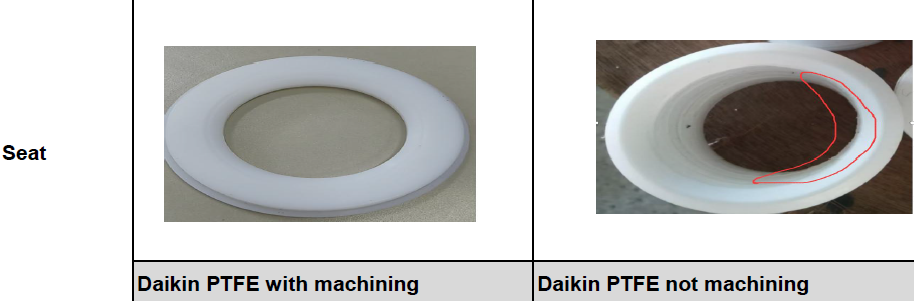
Seat comparison — soft-seat and metal-seat options determine the achievable emission and temperature class.
Step 4 — Match connection and actuation interface
Flange, wafer, thread, weld, Tri-Clamp, tube and press-fit joints each change installation, inspection and leak behaviour. On the actuation side, the ISO 5211 mounting pad on the Q47F, Q41F and Q11F platforms allows pneumatic or electric actuators to be fitted without an adaptor between the bracket and the stem. Check the anti-static structure and stem anti-flyout features at the same time, since both sit inside the fire-safe and safety scope.
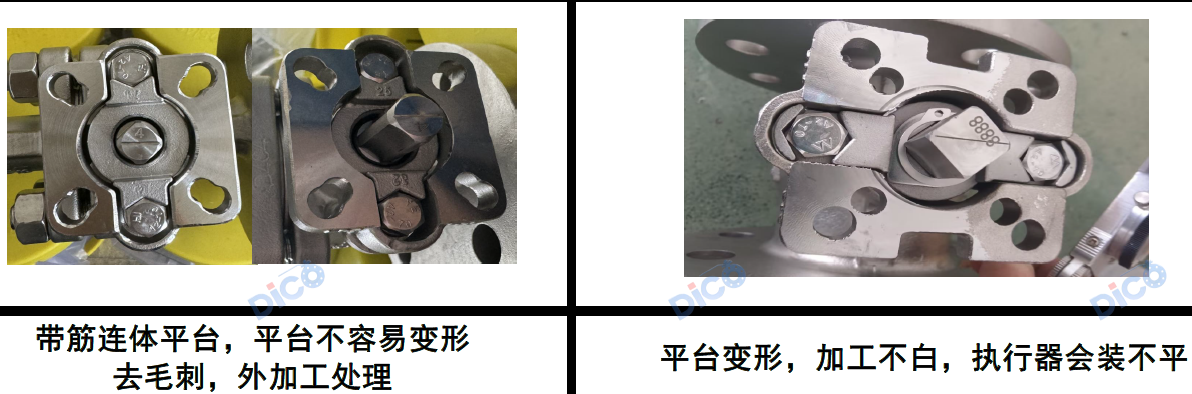
Actuator mounting platform comparison — ISO 5211 interfaces allow automation without adaptor interference.
Step 5 — Validate by testing and acceptance
Acceptance criteria for Dico orders are pre-shipment acceptance testing. Material claims can be checked by spectrometer testing, and sealing durability is verified by a 20-second high-frequency switch life test that reaches 50,000 cycles without leakage. Buyers qualifying a new type should request these records alongside the certificates.
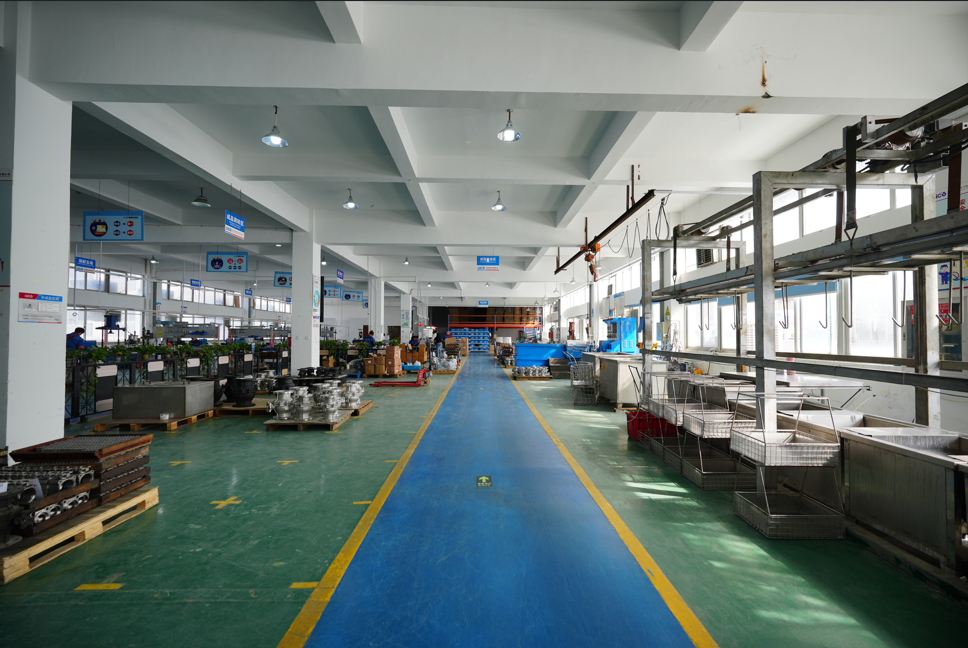
Pressure testing workshop — pre-shipment acceptance testing is the contractual verification step.
Step 6 — Lock lifecycle and supply terms
Dico valves carry a 12-month warranty with a replacement-only policy for quality issues, and after-sales issues are resolved within 48 hours. Supply continuity comes from a 2,000 m² warehouse holding standard product blank inventory, managed through a one item, one code system with 98% warehouse data accuracy. Commercial terms are MOQ 1 unit, delivery on EXW, FOB or CIF, and payment at 30% T/T advance with 70% before shipment, or 100% advance.
Use Cases: Where Each Certified Pick Pays Off
- Oil, gas and petrochemical lines: specify the trunnion-mounted Q47F where fire risk, anti-static requirements and stem anti-flyout protection apply. Heavier bodies and thicker flanges are the price of containment margin.
- Data centre liquid cooling: the exposed duty is compact, high-cycle and leak-sensitive, which fits the PC platform and the dedicated liquid-cooled valve production line covering mini ball valves and three-piece clamp ball valves.
- Pharmaceutical and sanitary service: stainless steel 316L/304 already dominates this segment, so PC and wafer types in SS304 or SS316 with clean-media soft seats are the practical certified choices.
- Semiconductor and hydrogen: the widest temperature window matters here, and the PC ball valve's -196°C to 425°C range covers both cryogenic and elevated-temperature utility lines.
- Water treatment, HVAC and metallurgy: the floating Q41F and the wafer valve cover the majority of isolation points at lower pressure, where certification still applies but duty is less severe.
Comparison Table: The Four Certified Picks Side by Side
| Rank | Type & model | Connection | Pressure range | Temperature range | Body materials | Seal options | Fire-safe / low-emission basis |
|---|---|---|---|---|---|---|---|
| 1 | Trunnion-mounted ball valve, Q47F | Flange | 1.0–10.0 MPa | -29°C to 425°C | Carbon steel, SS304, SS316, dual-phase steel, titanium, alloy steel | PTFE, PPL, PI, PEEK, Stellite | API STD 607 fire-safe test certificate (TÜV SÜD); ISO 15848-1 certification (TUV) |
| 2 | Floating ball valve, Q41F | Flange | 1.0–10.0 MPa | -29°C to 425°C | Carbon steel, SS304, SS316, dual-phase steel, titanium, alloy steel | PTFE, PPL, PI, PEEK, Stellite | API STD 607 fire-safe test certificate (TÜV SÜD); ISO 15848-1 certification (TUV) |
| 3 | PC ball valve, Q11F | Thread, weld, Tri-Clamp, tube, press-fit | 1.0–13.0 MPa | -196°C to 425°C | Carbon steel, SS304, SS316, dual-phase steel | PTFE, PPL, PI, PEEK, Stellite | API STD 607 fire-safe test certificate (TÜV SÜD); ISO 15848-1 certification (TUV) |
| 4 | Wafer ball valve | Wafer | 1.0–4.0 MPa | -29°C to 425°C | Carbon steel, SS304, SS316 | Not specified in the reference specification | API STD 607 fire-safe test certificate (TÜV SÜD); ISO 15848-1 certification (TUV) |
Scope note: Dico's API 607 certification covers austenitic material ball valves up to 4 inches, Class 150/300, valid until March 2027. EU-bound industrial ball valves additionally require the PED CE verification certificate.
Certification tells you a type is eligible. The next table shows what the certified flange-platform construction changes over the service life, measured against the standard manual series.
| Metric or design element | Change vs standard manual series | What it means in fire-safe, low-emission duty |
|---|---|---|
| Body weight | +20% | More material around the sealing and flange zone |
| Body wall thickness | +15–20% | Higher containment margin under pressure and thermal cycling |
| Sealing service life | +40% | Fewer unplanned shutdowns on critical isolation points |
| Packing seal performance | +20% | Lower fugitive emission risk at the stem |
| Maintenance cycle | Extended by 50% | Fewer seal replacements and lower lifecycle cost |
| Leakage performance | Low leakage rate; zero leakage under rated working condition | Meets low-emission expectations at rated conditions |
| Initial purchase cost | Slightly higher than the standard manual series | Offset by reduced long-term operating expenditure |
| Design features | ISO 5211 mounting pad, machined flange outer circle, anti-static structure, three-layer valve stem sealing, heat-number traceable balls, machined Daikin PTFE, precision-machined seals, high-precision spherical polishing | Directly supports fireproof, anti-static and stem anti-flyout requirements |
Comparison basis: Dico flange ball valve platform versus the standard manual series.
FAQ
Which certifications make a ball valve suitable for fire-safe and low-emission service, and where do they apply?
Two certificates form the basis. An API STD 607 fire-safe test certificate issued by TÜV SÜD covers the fire-safe requirement, and ISO 15848-1 certification issued by TUV covers low-emission performance, with coverage for the EU, North American, South African and South American markets. Dico's wider portfolio also includes ISO 9001, ISO 14001, API 6D, CE and SIL. Note the scope: the API 607 certificate applies to austenitic material ball valves up to 4 inches, Class 150/300, valid until March 2027. For industrial ball valves supplied into the European Union, the PED CE verification certificate is the relevant compliance document.
How should the valve seat material be selected for a high-temperature or high-purity line?
Selection narrows sequentially across four dimensions: temperature, medium, pressure and corrosion. Soft-seal seats are suitable for clean media requiring zero leakage (Class VI), operating temperatures up to 260°C where PEEK is the upper limit, medium-to-low pressure conditions of Class ≤1500, frequent opening and closing that requires low operating torque, and highly corrosive media handled by PTFE or FKM. Once particles or fibrous media are present, hard seats become necessary because solids accelerate soft-seal wear. Pure PTFE can creep under high pressure, so large-diameter, high-differential applications must have opening and closing torque assessed and may require a fixed-sphere structure. The trunnion-mounted Q47F, floating Q41F and PC Q11F platforms all offer PTFE, PPL, PI, PEEK or Stellite seats.
Why do certified ball valves cost more than generic market products?
Because the raw materials differ, including valve blanks and internal components. Dico materials strictly meet standards, support spectrometer testing, and are backed by sufficient certifications. The comparison data makes the commercial case explicit: the certified flange-platform construction carries a slightly higher initial purchase cost than a standard manual series, but delivers a 40% longer sealing service life, a 50% longer maintenance cycle, 20% higher body weight and 15–20% greater wall thickness. Entry is not the barrier it is often assumed to be — MOQ is 1 unit, with delivery on EXW, FOB or CIF terms.
Can a valve be tested before committing to a production order?
Yes. Minimum order quantity is 1 unit, and acceptance criteria are pre-shipment acceptance testing. Material verification can be supported by spectrometer testing, and sealing durability is demonstrated by a 20-second high-frequency switch life test that reaches 50,000 cycles without leakage. Valves carry a 12-month warranty with a replacement-only policy for quality issues. Where a failure occurs, the documented triggers are incorrect model selection or special operating conditions, and the mitigation during the warranty period is repair or replacement of parts.
What lead-time and long-term supply support should a distributor expect?
Delivery stability rests on a 2,000 m² warehouse holding standard product blank inventory, managed through a one item, one code system with 98% warehouse data accuracy, which allows efficient inventory tracking, storage and retrieval. After-sales issues are resolved within 48 hours, and the warranty term is 12 months with replacement only for quality issues. For partners building a long-term programme, the next step is straightforward: request a sample or a quotation, and review the full product range against your own line list.
Conclusion: Certification as a Service-Life Asset, Not a Badge
Ranking certified ball valves for fire-safe and low-emission service comes down to three checks that must all pass at once: the certificate scope must match the line, the seal material must survive the process temperature, and the construction must hold its sealing performance over years rather than months. On those criteria, the trunnion-mounted Q47F leads because it removes unsupported ball load and seat deformation from the equation, followed by the floating Q41F as the certified volume workhorse, the PC Q11F for its 1.0–13.0 MPa and -196°C to 425°C window, and the wafer valve as the compact option for constrained skids.
What ties the four together is not a single certificate but a system: API STD 607 fire-safe testing, ISO 15848-1 low-emission certification across the EU, North American, South African and South American markets, a PED CE verification certificate for EU industrial ball valves, and lifecycle support in the form of a 12-month replacement warranty, 48-hour issue resolution and warehouse blank inventory that keeps delivery stable after the first order.
Zhejiang Dico Valve Co., Ltd. was founded in 2015 in Longwan District, Wenzhou, Zhejiang Province, and manufactures high-end ball valves and fluid control solutions.
Next Step
Send us your line data — size, pressure class, medium, temperature and destination market — and we will confirm which certified type applies, what seal material fits the duty, and where the certificate scope covers your specification. Samples and quotations are available at MOQ 1 unit.
Email: marisa@dicovalve.com / evan@dicovalve.com · Tel: +86 182-6782-3456 / +86 189-5876-2958 · WhatsApp: +86 137-3837-0069
Website: www.dicovalve.com · Download the product brochure: DICO Brief Introduction
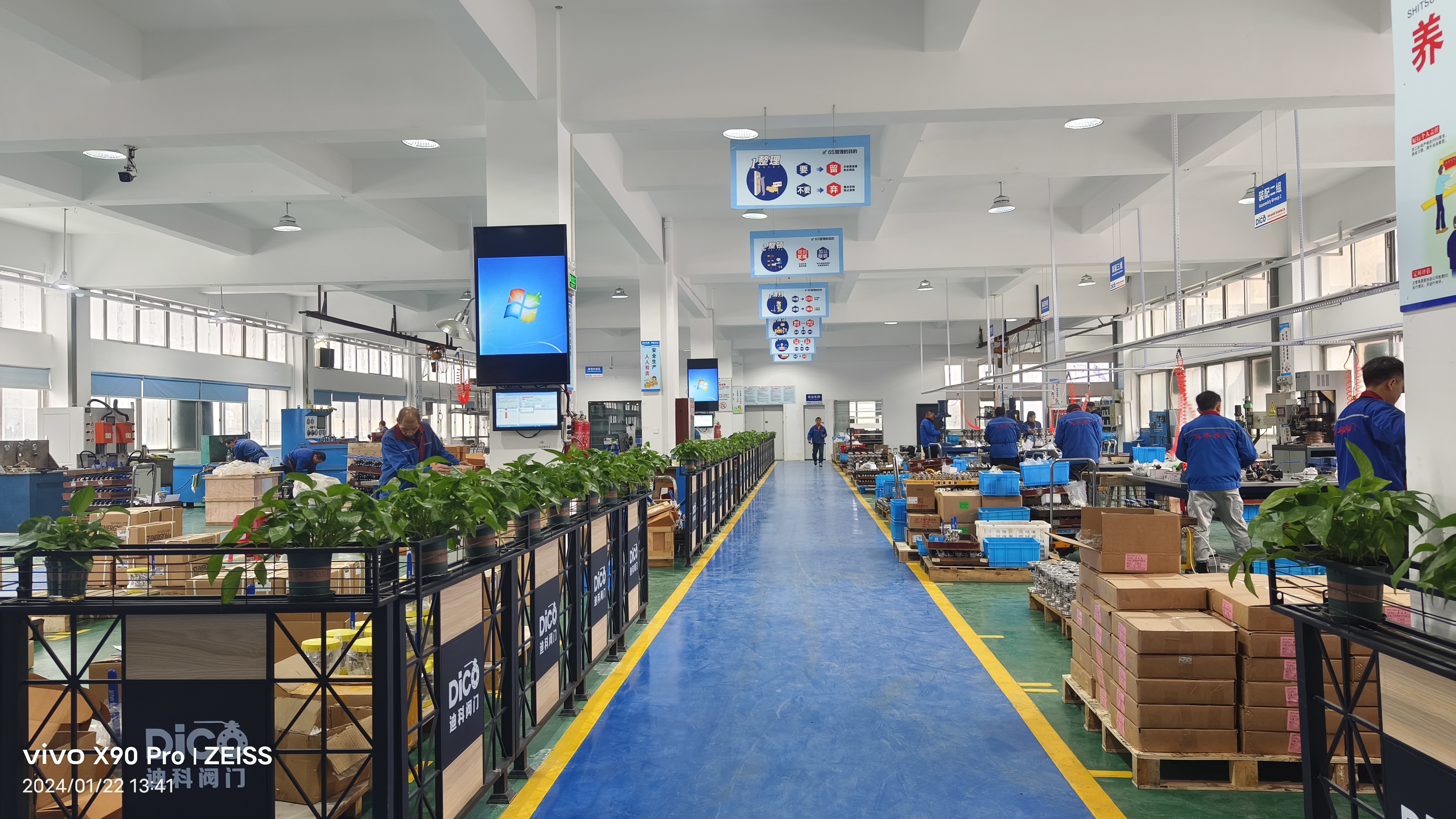
Assembly workshop — certified ball valve types prepared for sample validation and production orders.
Have Questions or Need More Details?
Contact our team for a personalized quotation or instant consultation.
Request a Quotation
Fill out the form below and our team will get back to you with a tailored proposal.
WhatsApp Direct Chat
Prefer to chat in real-time? Message us on WhatsApp for instant assistance & quick answers.
- Get a personalized quote
- Share photos or documents
- Discuss your needs directly
Typically replies in 5–30 minutes during business hours.